Effect of neutralising substances on reducing the influence of cobalt on the content
of selected elements in soil
Milena Kosiorek and Mirosław Wyszkowski *
Department of Environmental Chemistry, University of Warmia and Mazury in Olsztyn, 10-727 Olsztyn, plac Łódzki 4, Poland Received March 2, 2018; accepted October 18, 2018
*Corresponding author e-mail: [email protected] © 2019 Institute of Agrophysics, Polish Academy of Sciences A b s t r a c t. The objective of this study was to determine
the effect of cobalt on the content of total organic carbon, total nitrogen, the available forms of phosphorus, potassium and mag-nesium and the C:N ratio in soil, following the application of neutralising substances. The effect of cobalt in soil was tested on oats (Avena sativa L.). In order to limit the effect of cobalt, the soil was enriched with neutralising substances, i.e. manure, clay, char-coal, zeolite and calcium oxide. In the series with no neutralising substance, the increasing doses of cobalt only caused an increase in the amount of the available potassium, and the highest Co dose favoured an increase in the organic carbon content and a wider C:N ratio in soil. All the substances affected the content of the available potassium in soil, with charcoal, and especially manure, contributing to its elevated accumulation. Besides, manure fos-tered a growth in the soil content of the available phosphorus, charcoal - the content of organic carbon and the available potas-sium, and zeolite - the total nitrogen content, while calcium oxide promoted a higher content of total nitrogen and the available phosphorus. Clay and charcoal (unlike zeolite) caused the widen-ing of the C:N ratio in soil.
K e y w o r d s: cobalt contamination, sorbents, soil, elements, C:N ratio
INTRODUCTION
Soil environment is one of the ecosystems which are
essential to living organisms (Kabir et al., 2014). Although
the soil condition is affected by natural factors, certain
anthropogenic factors have also come to play an increas
-ing role (Brio et al., 2013; Liu et al., 2014). The major anthropogenic soil contaminants include trace elements
(Adamczyk-Szabela et al., 2017; Garba et al., 2012). The
presence of trace elements is largely affected by their min
-ing, the combustion of different fuels, and industrial and
agricultural activities (Adamczyk-Szabela et al., 2017;
Brodowska et al., 2016; Zupančič and Skobe, 2014).
Cobalt is one of the many trace metals present in soil. The natural concentration of cobalt does not usually exceed
12 mg kg-1 (Sheppard et al., 2007) but it depends, to the
greatest extent, on the bedrock in a specific type of soil (Cappuyns and Mallaerts, 2014). The greatest accumulators of cobalt include igneous rocks, which can accumulate up to
200 mg kg-1 of cobalt. Cobalt also occurs in minerals, such
as cobaltite, spherocobaltite and linneite (Luo et al., 2010), which are found in soil. Cobalt is released to the soil
solu-tion in erosion processes, during which it is fixed into the mineral and mineral-organic complex. Cobalt occurs in soil
as Co2+, Co3+, CoOH+ and Co(OH)-3 (Tappero et al., 2007). The natural concentration of cobalt in soil is exceeded
mainly because of human activities and, more specifical
-ly, as a result of the combustion of hard coal, automotive
fuels and the process of mining cobalt ore for industrial
purposes (Mahapatra et al., 2013). Both excessively high
and low concentrations of cobalt in soil can seriously
dis-rupt the growth processes in plants, animals and humans
(Ballestrazzi et al., 2009). The occurrence of cobalt in such
concentrations that are in excess of the acceptable levels
also contributes to changing soil properties (Kosiorek and
Wyszkowski, 2016a; 2016b; Zaborowska et al., 2016),
and proves to have a considerable effect on the
concentra-tion of organic carbon and macronutrients (Cappuyns and
Mallaerts, 2014; Gad, 2012). Therefore, effective meth
should be sought. Phytoremediation can be considered a method of eliminating cobalt from soils (Adamczyk-Szabela et al., 2017; Alkorta et al., 2004).
Considering all this, a study was conducted to deter
-mine the effect of cobalt on the content of organic carbon,
total nitrogen and the available forms of phosphorus, potas
-sium and magne-sium in soil, as well as the C:N ratio in soil, following the application of neutralising substances.
MATERIALS AND METHODS
An experiment was conducted in the plant growing room
of the University of Warmia and Mazury in Olsztyn
(north-east of Poland) on acidic soil with the following properties:
pH in 1 M KCl - 5.05; hydrolytic acidity (HAC) - 28.40 mmol(+) kg-1; total exchangeable cations (TEB) - 46.50
mmol(+) kg-1; cation exchange capacity (CEC) - 74.90
mmol(+) kg-1; base saturation (BS) - 68.08%, the content
of organic carbon - 12.15 g kg-1, total nitrogen - 0.73 g kg-1, the C:N ratio - 16.64, and the content of the available forms of: phosphorus, potassium and magnesium: 40.99,
46.29, and 116.21 mg kg-1 of soil, respectively. The soil
had a textural composition typical of loamy sand (sand
> 0.05 mm – 73.9%, silt 0.002-0.05 mm - 24.1% and
clay <0.002 mm - 2.0%). The effect of cobalt at 0, 20,
40, 80, 160 and 320 mg Co kg-1 of soil was tested on oats
(Avena sativa L.), Zuch cultivar (15 plants per pot). Cobalt
was applied as cobalt chloride. The cobalt doses in the
experiment were chosen in accordance with the Regulation of the Minister of the Environment of 9 September 2002 on
soil quality standards and earth quality standards. In order
to reduce the effect of cobalt, neutralising substances were
applied to soil, i.e. manure (granulated bovine manure), clay, charcoal and zeolite at 2% of the soil weight, and
calcium oxide at a dose corresponding to 1 unit of hydro
-lytic acidity (HAC). The kinds and doses of sorbents were
determined on the basis of their influence on soil physico
-chemical properties, and especially the reactive and sorption properties of soil. The chemical composition of these
addi-tives was as follows: manure: Corg - 149.0 g kg-1, total
nitrogen - 20.0 g kg-1, the C:N ratio - 7.45, P - 21.80 g kg-1, K - 16.30 g kg-1, and Mg - 6.020 g kg-1; clay: P - 1.088 g
kg-1, K - 1.290 g kg-1, and Mg - 0.525 g kg-1; charcoal:
P - 0.260 g kg-1, K - 0.766 g kg-1, and Mg - 0.477 g kg-1;
zeolite: P - 1.836 g kg-1, K - 5.435 g kg-1, and Mg - 0.553 g
kg-1; as well ascalcium oxide: P - 0.088 g kg-1, K - 0.436 g
kg-1, and Mg - 0.901 g kg-1. The effect of cobalt and these sorbents on both pH and sorption properties of soil was
published in this paper (Kosiorek and Wyszkowski, 2016a).
Moreover, the soil was mixed with equal amounts of
minerals, corresponding to nutritional demands of plants
(100 mg N - NH4NO3; 35 mg P - KH2PO4; 100 mg K
-KCl; 50 mg Mg - MgSO4 7H2O; 0.33 mg B - H3BO3; 5 mg
Mn - MnCl2 4H2O and 5 mg Mo kg-1 of soil – (NH4)6Mo7O24
4H2O. The soil (9 kg) was then transferred to polyethylene
pots and oats was sown. The moisture content at 60% of the capillary water capacity was maintained during plant growth. After 78 days from the experiment commencement
soil samples for laboratory tests were collected in the peri-od of full oats maturity.
Before the laboratory analyses, the soil was dried and
sieved through a 1 mm mesh sieve. The following param
-eters were determined in the samples: organic carbon - by
the Tiurin method and total nitrogen - by the Kjeldahl
method. The concentration of the available forms of
phos-phorus and potassium was determined by the Egner-Riehm
method, and that of the available magnesium (Mg) - by
the Schachtschabel method. The results at the end of the experiment were worked out statistically with a two-way
analysis of variance ANOVA, the principal component
analysis (PCA) and the coefficients of Pearson’s linear cor
-relation using the Statistica software package (StatSoft Inc., 2014).
RESULTS AND DISCUSSION
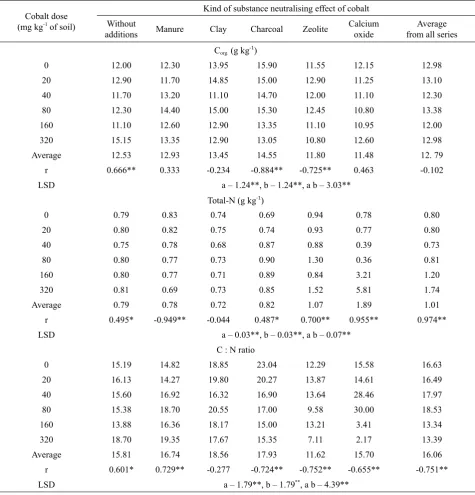
The laboratory analyses showed that the soil proper-ties under examination depended on its contamination with
cobalt and the application of neutralising substances. The
contamination of soil with 20, 40 and 80 mg Co kg-1 of soil,
in a series with no neutralising substances, only slightly
affected the content of organic carbon (Table 1). The great
-est increase in its concentration (by 26%) was observed in
the soil contaminated with 320 mg of Co kg-1. The
increas-ing doses of cobalt did not significantly affect the content of total nitrogen in soil (Table 1). The C:N ratio in the soil
contaminated with 320 mg of Co kg-1 was found to widen
from 15.19 to 18.70. The contamination of soil with cobalt
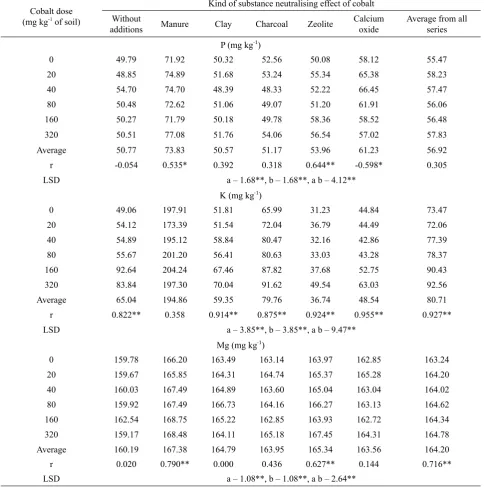
did not have any obvious effect on the concentration of the
available phosphorus or magnesium in soil (Table 2). After
cobalt was added to soil, the content of the available
potas-sium in soil with no additives increased significantly, as compared to the control (by 71%), when the largest dose of
cobalt was added.
Studies by Cappuyns and Mallaerts (2014) also revealed significant correlations between the content of cobalt and the content of organic carbon in soil. The ploughing layer of soil, which contains large amounts of organic carbon, was also found to exhibit high concentrations of cobalt. According to Gad (2012), the appropriate fertilisation of soil with cobalt could increase the content of nitrogen, phosphorus and potassium in soil. Significant relationships
between the amounts of N2 reduced by Rhizobium
gale-gae, and the amount of cobalt accumulated both in soil and
plants, were demonstrated by Symanowicz and Kalembasa
(2012). The appropriate fertilisation with cobalt was
prov-en to have a significantly positive effect on the formation
of leghemoglobin, which not only plays a major role in fix
-ing nitrogen, but also significantly improves the activity
A positive effect of cobalt on the nitrogen content in soil was also found by Boom (2002). These findings partly confirm the experiments mentioned above, because the increasing doses of cobalt in soil only brought about an increase in the content of nitrogen and available potassium.
Among the neutralising substances used in the experi
-ment, charcoal (followed by clay) increased the organic content in soil to the greatest extent (by 16 and 7%, on ave-rage), as compared to the soil with no additives (Table 1).
The soil with calcium oxide and zeolite was found to
con-tain significantly more nitrogen (139 and 35%). The greatest widening of the C:N ratio in soil was observed in the soil with an addition of clay (from 15.81 to 18.56) and charcoal (from 15.81 to 17.93) (Table 1). Introducing zeolite to soil lowered the C:N ratio to the greatest extent (from 15.81 to 11.62). Except for clay and charcoal, all of the neutralising
substances increased the content of the available
phospho-rus in soil (Table 2). As regards the other substances, their amounts in soil were increased to the greatest extent by manure (+45%) and calcium oxide (+21%). Manure and
Table 1. Effect of cobalt contamination and neutralising substances on content of organic carbon, total nitrogen, and C:N ratio in soil
Cobalt dose (mg kg-1 of soil)
Kind of substance neutralising effect of cobalt Without
additions Manure Clay Charcoal Zeolite Calcium oxide from all seriesAverage Corg. (g kg-1)
0 12.00 12.30 13.95 15.90 11.55 12.15 12.98
20 12.90 11.70 14.85 15.00 12.90 11.25 13.10
40 11.70 13.20 11.10 14.70 12.00 11.10 12.30
80 12.30 14.40 15.00 15.30 12.45 10.80 13.38
160 11.10 12.60 12.90 13.35 11.10 10.95 12.00
320 15.15 13.35 12.90 13.05 10.80 12.60 12.98
Average 12.53 12.93 13.45 14.55 11.80 11.48 12. 79
r 0.666** 0.333 -0.234 -0.884** -0.725** 0.463 -0.102
LSD a – 1.24**, b – 1.24**, a b – 3.03**
Total-N (g kg-1)
0 0.79 0.83 0.74 0.69 0.94 0.78 0.80
20 0.80 0.82 0.75 0.74 0.93 0.77 0.80
40 0.75 0.78 0.68 0.87 0.88 0.39 0.73
80 0.80 0.77 0.73 0.90 1.30 0.36 0.81
160 0.80 0.77 0.71 0.89 0.84 3.21 1.20
320 0.81 0.69 0.73 0.85 1.52 5.81 1.74
Average 0.79 0.78 0.72 0.82 1.07 1.89 1.01
r 0.495* -0.949** -0.044 0.487* 0.700** 0.955** 0.974**
LSD a – 0.03**, b – 0.03**, a b – 0.07**
C : N ratio
0 15.19 14.82 18.85 23.04 12.29 15.58 16.63
20 16.13 14.27 19.80 20.27 13.87 14.61 16.49
40 15.60 16.92 16.32 16.90 13.64 28.46 17.97
80 15.38 18.70 20.55 17.00 9.58 30.00 18.53
160 13.88 16.36 18.17 15.00 13.21 3.41 13.34
320 18.70 19.35 17.67 15.35 7.11 2.17 13.39
Average 15.81 16.74 18.56 17.93 11.62 15.70 16.06
r 0.601* 0.729** -0.277 -0.724** -0.752** -0.655** -0.751**
LSD a – 1.79**, b – 1.79**, a b – 4.39**
charcoal significantly increased the content of the available potassium in soil (by 200 and 23%, on average), whereas
the application of zeolite, calcium oxide and clay resulted
in its decrease (by 44, 25 and 9%). All of the neutralising
substances had a slightly positive effect on the concentra
-tion of the available magnesium in soil (Table 2).
The correlation coefficients calculated for this study have shown that the most significant (p ≤ 0.01) negative correlations exist between the content of organic carbon and
both pH and total nitrogen, as well as between total nitro
-gen and both hydrolytic acidity and the C:N ratio. Positive
correlations were found to exist between the content of the available phosphorus and pH, the available potassium and
magnesium, as well as between the available potassium and magnesium, and between the content of organic carbon and
the C:N ratio in soil (Table 3).
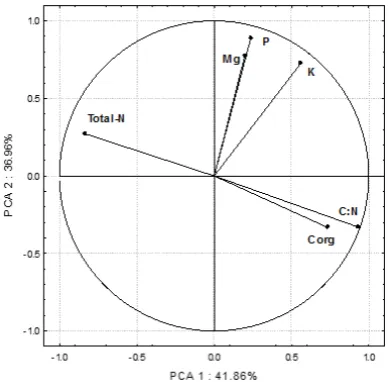
The significance of the correlations for p ≤ 0.05 has been demonstrated in several other cases. Figure 1 shows the content of organic carbon, total nitrogen, phosphorus, potassium and magnesium, and the C:N ratio in soil as
Table 2. Effect of cobalt contamination and neutralising substances on content of available phosphorus, potassium and magnesium in soil
Cobalt dose (mg kg-1 of soil)
Kind of substance neutralising effect of cobalt Without
additions Manure Clay Charcoal Zeolite Calcium oxide Average from all series P (mg kg-1)
0 49.79 71.92 50.32 52.56 50.08 58.12 55.47
20 48.85 74.89 51.68 53.24 55.34 65.38 58.23
40 54.70 74.70 48.39 48.33 52.22 66.45 57.47
80 50.48 72.62 51.06 49.07 51.20 61.91 56.06
160 50.27 71.79 50.18 49.78 58.36 58.52 56.48
320 50.51 77.08 51.76 54.06 56.54 57.02 57.83
Average 50.77 73.83 50.57 51.17 53.96 61.23 56.92
r -0.054 0.535* 0.392 0.318 0.644** -0.598* 0.305
LSD a – 1.68**, b – 1.68**, a b – 4.12**
K (mg kg-1)
0 49.06 197.91 51.81 65.99 31.23 44.84 73.47
20 54.12 173.39 51.54 72.04 36.79 44.49 72.06
40 54.89 195.12 58.84 80.47 32.16 42.86 77.39
80 55.67 201.20 56.41 80.63 33.03 43.28 78.37
160 92.64 204.24 67.46 87.82 37.68 52.75 90.43
320 83.84 197.30 70.04 91.62 49.54 63.03 92.56
Average 65.04 194.86 59.35 79.76 36.74 48.54 80.71
r 0.822** 0.358 0.914** 0.875** 0.924** 0.955** 0.927**
LSD a – 3.85**, b – 3.85**, a b – 9.47**
Mg (mg kg-1)
0 159.78 166.20 163.49 163.14 163.97 162.85 163.24
20 159.67 165.85 164.31 164.74 165.37 165.28 164.20
40 160.03 167.49 164.89 163.60 165.04 163.04 164.02
80 159.92 167.49 166.73 164.16 166.27 163.13 164.62
160 162.54 168.75 165.22 162.85 163.93 162.72 164.34
320 159.17 168.48 164.11 165.18 167.45 164.31 164.78
Average 160.19 167.38 164.79 163.95 165.34 163.56 164.20
r 0.020 0.790** 0.000 0.436 0.627** 0.144 0.716**
LSD a – 1.08**, b – 1.08**, a b – 2.64**
vector variables affected by cobalt and neutralising sub -stances (manure, clay, charcoal, zeolite and calcium oxide).
The value of vectors denoting the available phosphorus, magnesium and potassium in soil was nearly 37% of the
total correlation of the data set; furthermore, the value of
total nitrogen, organic carbon and the C:N ratio in soil was nearly 42%. The vector which illustrates the content of magnesium and organic carbon was shorter than the other
vectors, so it can be concluded that they contributed little to
the variability studied. The PCA illustrates a highly signifi
-cant correlation between the vectors denoting the available phosphorus and magnesium, as well as organic carbon and the C:N ratio in soil (Fig. 1). A significant (but much weaker) correlation was observed between the available phosphorus and magnesium, and the available potassium. However, a negative correlation was observed between total nitrogen and organic carbon, and the C:N ratio. No
significant correlations were observed between the other variables. The dispersion of the PCA results (Fig. 2) shows
that an addition of manure, followed by calcium oxide, had
the greatest effect on the soil properties under examination
(especially on the content of phosphorus, potassium and
magnesium).
A beneficial effect of adding substances with a high content of organic matter on the amount of organic carbon in soil was observed in a study by Aoyama and Kumakura (2001). The application of elements with organic substances
caused an increase in these elements in soil. The content of
organic carbon may be positively correlated with hydrolytic
acidity (Šimanský and Kováčik, 2015). Beak et al. (2011)
reported that the cobalt ions present in the soil solution
showed a high affinity to organic ligands. If their content was too low, cobalt was fixed on the mineral surface, mainly to iron and manganese oxides. It was found in an earlier study by Kosiorek and Wyszkowski (2016a) that the
Table 3. Correlation coefficients (r) between content of elements and C:N ratio and some properties of soil
Variable Corg Total-N C:N ratio P K Mg
pH -0.383** 0.563** -0.553** 0.353** -0.213 0.054
HAC 0.216 -0.408** 0.352** -0.298* 0.245* 0.072
TEB -0.164 0.244* -0.184 0.266* -0.177 -0.133
CEC -0.135 0.176 -0.120 0.234* -0.142 -0.139
BS -0.168 0.176 -0.148 0.293* -0.150 -0.102
Corg -0.371* 0.765** -0.152 0.124 0.001
Total-N -0.853** 0.012 -0.277* 0.105
C:N ratio -0.060 0.232* -0.031
P 0.760** 0.554**
K 0.509**
pHKCl – pH in 1M KCl, HAC – hydrolytic acidity, TEB – total exchangeable bases, CEC – cation exchange capacity, BS – base
satura-tion. Significant at *p ≤0.05, **p ≤0.01, r – correlation coefficient.
Fig. 1. Content of organic carbon, total nitrogen, phosphorus, potassium and magnesium and C:N ratio in the soil illustrated with the PCA method. Key: vectors represent analyzed variable (content of Corg, total-N, available P, K, Mg and C:N ratio).
soil pH increased after calcium oxide, zeolite and manure were added to it. An increase in the soil pH promotes the immobilisation of cobalt in a soil solution, thereby
reducing its toxicity to plants (Lago-Vila et al., 2015; Li et al., 2009; Wendling et al., 2009). A significant effect of pH
and CaCO3 on the content of cobalt in soil was suggested
by Kabir et al. (2014).
According to Boom (2002), maintaining the soil pH between 6 and 6.5, along with the appropriate content of cobalt in soil (among other things), has a significant effect on the activity of soil organisms and, in consequence, on the fixation of nitrogen. Since it brings about a change in
the soil pH (a decrease in its acidity), the application of cal-cium oxide to soil can increase the content of the available
potassium and magnesium (Wyszkowski and Sivitskaya,
2012). These factors also have an effect on the C:N ratio in soil. A narrower C:N ratio is correlated with a more intensive mineralisation process which, in turn, favours the
release of macronutrients essential for plant growth (Fanin
et al., 2013; Heuck et al., 2015). A decrease in the C:N ratio
has a positive effect on the nitrogen content in soil because the uptake of this and other elements by plants from the soil
solution was smaller. These relations were observed in our
study. According to a study conducted by Tsai et al. (2012),
the application of a substance containing a large percent
-age of organic matter, such as manure, increases the content
of macronutrients in soil. The application of manure to
soil caused in an increase in the content of total nitrogen
(Temmerman et al., 2003, Delgado and Follett, 2002) phos
-phorus and potassium in soil (Delgado and Follett, 2002).
According to Wright et al. (2007), compost increased
the contents of the available phosphorus, potassium and
magnesium in soil. In a study conducted by Wyszkowski and Sivitskaya (2012), zeolite increased the content of the available magnesium in soil, whereas Wyszkowski and
Modrzewska (2016) found the use of zeolite to have a posi
-tive effect on the content of organic carbon, the available phosphorus and the C:N ratio in soil. Zeolite increased the content of organic carbon and the available magnesium, in reverse to the phosphorus content in soil (Wyszkowski and Radziemska, 2012). Calcium oxide can also reduce the content of the available phosphorus and organic carbon in soil (Wyszkowski and Sivitskaya, 2012).
CONCLUSIONS
1. The experiment showed that applying both the
increasing doses of cobalt and some neutralising sub
-stances to the soil had a significant effect on the content of organic carbon, total nitrogen and the available phosphorus
and potassium in the soil.
2. In the soil with no addition of the neutralising sub
-stances, a significant increase in the content of organic carbon and a widening of the C:N ratio in soil were observed in the soil contaminated with the largest amounts
of cobalt. Doses of 160 and 320 mg Co kg-1 increased the
content of the available potassium in soil to the greatest extent. The increasing doses of cobalt did not significantly
affect the content of total nitrogen, the available phospho
-rus or magnesium in soil.
3. Among the neutralising substances used in the exper
-iment, charcoal increased the organic content in soil to the greatest extent; a similar effect was observed for calcium
oxide on total nitrogen and for clay - on widening the C:N
ratio in soil. The largest increase in the content of the avail -able phosphorus and potassium was observed in soil with
manure. A significant decrease in the content of organic
carbon and the available potassium in soil was observed in the soil with an addition of zeolite and calcium oxide.
Conflict of interest: The Authors do not declare any
conflict of interest.
REFERENCES
Adamczyk-Szabela D., Romanowska-Duda Z., Lisowska K., and Wolf W.M., 2017. Heavy metal uptake by herbs. V. Metal accumulation and physiological effects induced by thiuram in Ocimum basilicum L. Water Air Soil Pollut., 228, 334. https://doi.org/10.1007/s11270-017-3508-0
Alkorta I., Hernández-Allica J., Becerril J., Amezaga I., Albizu I., and Garbisu C., 2004. Recent findings on the phytoremediation of soils contaminated with environmen-tally toxic heavy metals and metalloids such as zinc, cadmium, lead, and arsenic. Rev. Environ. Sci. Biotechnol., 3, 71-90. https://doi.org/10.1023/B:RESB.0000040059. 70899.3d
Aoyama M., and Kumakura N., 2001. Quantitive and qualita-tive changes of organic matter in an Ando soil induced by mineral fertilizer and cattle manure applications for 20 years. J. Soil Sci. Plant Nut., 47(2), 241-252.
Awomi T. A., Singh A.K., Kumar M., and Bordoloi L.J., 2012.
Effect of phosphorus, molybdenum and cobalt nutrition on yield and quality of mungbean (Vigna radiata L.) in acidic soil of Northeast India. Indian J. Hill Farm., 25(2), 22-26.
Balestrazzi A., Bonadei M., Quattrini E., and Carbonera D., 2009.
Occurrence of multiple metal-resistance in bacterial iso-lates with transgenic white poplars (Populus alba L.). Ann. Microbiol., 59, 1-8. https://doi.org/10.1007/BF03175593
Beak D.G., Kirby J.K., Hettiarachachi G.M., Wendling L.A., McLaughlin M.J., and Khatiwada R., 2011. Cobalt dis-tribution and speciation: effect of aging, intermittent submergence, in situ rice roots. J. Environ. Qual., 40(3), 679-695. https://doi.org/10.2134/jeq2010.0139
Boom R., 2002. Healthy soil, healthy grass, healthy stock – the balanced approach. Proc. 1st Virtual Global Conf. Organic Beef Cattle Production, September 2 to October 15, Concordia, Brazil.
Brodowska M.S., Kurzyna-Szklarek M., and Haliniarz M., 2016.
Selenium in the environment. J. Elem., 21(4), 1173-1185. https://doi.org/10.5601/jelem.2016.21.2.1148
Cappuyns V., and Mallaerts T., 2014. Background values of cobalt in Flemish and European soils. Geol. Belg., 17(2), 107-114.
Delgado J.A., and Follett R.F., 2002. Carbon and nutrient cycles. J. Soil Water Conserv., 57, 6, 455-464.
Fanin N., Fromin N., Buatois B., and Hättenschwiler S., 2013.
An experimental test of the hypothesis of non-homeostatic consumer stoichiometry in a plant litter microbe system. Ecol. Lett., 16(6), 764-772. https://doi.org/10.1111/ele.12108
Gad N., 2012. Role and importance of cobalt nutrition on ground-nut (Arachis hypogaea) production. World Appl. Sci. J., 20(3), 359-367.
Garba S.T., Osemeahon A.S., Maina H.M., and Barminas J.T., 2012. Ethylenediaminetetraacetate (EDTA)-Assisted phy-toremediation of heavy metal contaminated soil by Eleusine indica L. Gearth. J. Environ. Chem. Ecotoxicol., 4(5), 103-109.
Heuck C., Weig A., and Spohn M., 2015. Soil microbial biomass C:N:P stoichiometry and microbial use of organic phospho-rus. Soil Biol. Biochem., 85, 119-129. https://doi. org/10.1016/j.soilbio.2015.02.029
Kabir D., Katkar R.N., and Lakhe S.R., 2014. Georeferenced status of cobalt in soils of yavatmal district of Maharashtra. IOSR J. Agric. Vet. Sci. (IOSR-JAVS), 7(2), 10-13.
Kosiorek M., and Wyszkowski M., 2016a. Selected properties of cobalt-contaminated soil following the application of neutralising substances. Environ. Prot. Natural Res., 27(1), 22-25. https://doi.org/10.1515/oszn-2016-0006
Kosiorek M., and Wyszkowski M., 2016b. Effect of neutralising substances on selected properties of soil contaminated with cobalt. J. Ecol. Eng., 17(3), 193-197. https://doi.org/10. 12911/22998993/63337
Lago-Vila M., Arenas-Lago D., Rodríguez-Seijo A., Andrade Couce M.L., and Vega F.A., 2015. Cobalt, chromium and nickel contents in soils and plants from a serpentinite quar-ry. Solid Earth, 6(1), 323-335. https://doi.org/10.5194/ se-6-323-2015
Li H.F., Gray C., Mico C., Zhao F.J., and McGrath S.P., 2009.
Phytotoxicity and bioavailability of cobalt to plants in a range of soils. Chemosphere, 75(7), 979-986. https://doi. org/10.1016/j.chemosphere.2008.12.068
Liu Y., Su C., Zhang H., Li X., and Pei J., 2014. Interaction of soil heavy metal pollution with industrialisation and the landscape pattern in Taiyuan city, China. PloS One, 9(9), 1-14. https://doi.org/10.1371/journal.pone.0105798
Luo D., Zheng H., Chen Y., Wang G., and Fenghua D., 2010.
Transfer characteristics of cobalt from soil to crops in the suburban areas of Fujian Province, southeast China. J. Environ. Manag., 91(11), 2248-2253. https://doi.org/10. 016/j.jenvman.2010.06.001
Mahapatra P.S., Ray S., Das N., Mohanty A., Ramulu T.S., Das T., Chaudhury G.R., and Das S.N., 2013. Urban air-quality assessment and source apportionment studies for Bhubaneshwar, Odisha. Theor. Appl. Climatol., 112(1), 243-251. https://doi.org/10.1007/s00704-012-0732-9
Sheppard P.R., Speakman R.J., Ridenour G., Glascock M.D., Farris C., and Witten M.L., 2007. Spatial patterns of
tungsten and cobalt in surface dust of Fallon, Nevada. Environ. Geochem. Hlth., 29(5), 405-412. https://doi. org/10.1007/s10653-007-9085-1
Šimanský V., and Kováčik P., 2015. Long-term effects of tillage and fertilization on pH and sorption parameters of haplic Luvisol. J. Elem., 20(4), 1033-1040. https://doi.org/10. 5601/jelem.2015.20.1.857
StatSoft, Inc., 2014. STATISTICA data analysis software system, version 12. www.statsoft.com.
Symanowicz B., and Kalembasa S., 2012. Effect of iron, molyb-denum and cobalt on the amount of nitrogen biologically reduced by Rhizobium galegae. Ecol. Chem. Eng., A, 19(11), 1311-1320.
Temmerman L., Vanongeval L., Boon W., Hoenig M., and Geypens M., 2003. Heavy metal content of arable soils in northern Belgium. Water Air Soil Poll., 148, 61–76. https:// doi.org/10.1023/A:1025498629671
Tappero R., Peltier E., Gräfe M., Heidel K., Ginder-Vogel M., Livi K.J., Rivers M.L., Marcus M.A., Chaney R.L., and Sparks D.L., 2007. Hyperaccumulator Alyssum murale relies on a different metal storage mechanism for cobalt than for nickel. New Phytol., 175(4): 641-654. https://doi. org/10.1111/j.1469-8137.2007.02134.x
Tsai W.T., Liu S.C., Chen H.R., Chang Y.M., and Tsai Y.L., 2012. Textural and chemical properties of swine-manure-derived biochar pertinent to its potential use as a soil amendment. Chemosphere, 89(2), 198-203. https://doi. org/10.1016/j.chemosphere.2012.05.085
Wendling L.A., Kirby J.K., and McLaughlin M.J., 2009.
Aging effects on cobalt availability in soils. Environ. Toxicol. Chem., 28(8), 1609-1617. https://doi.org/10.1897/ 08-544.1
Wright A.L., Provin T.L., Hons F.M., Zuberer D.A., and White R.H., 2007. Compost Skurce and rate effects on soil macro-nutrient availability under Saint Augustine Grass and Bermuda Grass Turf. Compost Sci. Utiliz., 15, 1, 22-28. https://doi.org/10.1080/1065657X.2007.10702306
Wyszkowski M., and Modrzewska B., 2016. Development of the selected properties of zinc-contaminated soil following an addition of neutralising substances. Polish J. Soil Sci., 49(2), 101-109.
Wyszkowski M., and Radziemska M., 2012. Effect of some sub-stances on the content of organic carbon and mineral components in soils contaminated with chromium. Ecol. Chem. Eng., A, 19, 4-5, 361–368.
Wyszkowski M., and Sivitskaya V., 2012. Changes in the con-tent of organic carbon and available forms of macronutrients in soil under the influence of soil contamination with fuel oil and application of different substances. J. Elem., 17(1), 139-148. https://doi.org/10.5601/jelem.2012.17.1.12
Zaborowska M., Kucharski J., and Wyszkowska J., 2016.
Biological activity of soil contaminated with cobalt, tin and molybdenum. Environ. Monit. Assess., 188(7), 398, 1-10.