Web Ecology 3: 43–47.
Nowadays, forest edges are in the focus of both ecological research and conservation. Edges are transition zones be-tween adjacent habitats (Murcia 1995) and the edge effect hypothesis states that species richness increases at the bor-der between different habitats (Odum 1971). Edges may also have a crucial role in maintaining natural biodiversity (Kotze and Samways 1999).
Studies of the edge effect on invertebrates are usually aimed only at one trophic level (Heublein 1983, Bedford and Usher 1994, Asteraki et al. 1995, Downie et al. 1996, Magura and Tóthmérész 1997, 1998). There are just a few
published studies that include more than one trophic level (e.g. Helle and Muona 1985). Species from different trophic levels may have diverse behaviours in response to environmental conditions. Therefore a comparative analy-sis of these taxa may be useful to explore general rules for edge effects.
In this paper we analysed the edge effect on two inverte-brate taxonomic groups, which operate at different trophic levels. The weevils (Coleoptera: Curculionoidea) are a phy-tophagous group, and the spiders (Araneae) are a predator group.
Edge effect on weevils and spiders
R. Horváth, T. Magura, G. Péter and B. Tóthmérész
Horváth, R., Magura, T., Péter, G.and Tóthmérész, B. 2002. Edge effect on weevils and spiders. – Web Ecol. 3: 43–47.
The edge effect on weevils and spiders was tested along oak forest – meadow transects using sweep-net samples at the Síkfőkút Project in Hungary. For spiders the species richness was significantly higher in the forest edge than either in the meadow or the forest interior. For weevils the species richness of the forest edge was higher than that of the meadow, but the difference was not statistically significant whereas the species rich-ness of the forest interior was significantly lower than that of the forest edge and the meadow. The composition of the spider assemblage of the edge was more similar to the forest, while the composition of weevils in the edge was more similar to the meadow. Our results based on two invertebrate groups operating on different trophic levels sug-gest that there is a significant edge effect for the studied taxa resulting in higher species richness in the edge.
Material and methods
The sampling area was in the Bükk-Mountain, Hungary, in the research area of the “Sikfőkút Project” (Jakucs
1985). It is covered by an oak forest (Quercetum petraeae-cerris). Samplings were carried out along three replicated transects, which started from the forest towards a neigh-bouring meadow Calamagrostietum epigeii (L.) Roth. There were three characteristic habitats along the transects: 1) Oak forest: a ca 100-yr old stand, which was not forestry managed in the past 50 yr. The shrub layer and the herba-ceous layer were dense. 2) Edge of the forest: the shrub layer was thick. In the undergrowth vegetation herb species characteristical of the meadow prevail. 3) An old field (meadow) that developed on a large deforested area after the clear-cutting of the oak forest. Earlier the clear-cut area was ploughed, but it was not cultivated during the last 15 yr. The floristic composition of the forest was analysed in detail by Papp and Jakucs (1985). The forest margin was analysed by Mészáros et al. (1982).
Vegetation of these habitats were characterised based on a field survey. In the tree layer of the forest Quercus petraea
(Mattuschka) Lieblein was dominant; the cover of Q. cerris
(L.) was ca 15%. The shrub layer was well-developed. In the high shrub layer (>1 m) Cornus mas (L.) and Acer campestre (L.) were dominant, along with other species like
Acer tataricum (L.), Cornus sanguinea (L.), Q. petraea and
Ligutrum vulgare (L.). In the low shrub layer Ligustrum vulgare, Q. petraea, Cornus sanguinea, Acer tataricum were frequent. In the low shrub layer (<1 m) Ligustrum vulgare,
Q. petraea, Cornus sanguinea, Euonymus verrucosus (Scop.),
E. europaeus (L.) were frequent. Also occurred the follow-ing species in the low shrub layer: Acer tataricum, Cretaegus monogyna (Jacq.), Cornus mas, Q. cerris, Prunus spinosa
(L.). The cover of the herbs was 15–25%. The most fre-quent species were as follows: Melica uniflora (Retz.), Dac-tylis polygama (Horvátovszky), Carex montana (L.), Poa nemoralis (L.), Galium cruciata (Opiz), Veronica chamae-drys (L.), Viola silverstris (Lam.), Galium schultesii (Vest).
In the forest edge the following species were frequent:
Acer tataricum, Cornus sanguinea, Euorrymus verrucosus,
Cornus mas. Other shrub species were relatively frequent:
Prunus spinosa, Crataegus monogyna, Viburnum lantana
(L.), Frangula alnus (Mill.), Ligustrum vulgare, Carpinus betulus (L.), Berberis vulgaris (L.), as well as the shrubs of the species of the tree layer. In the herbaceous layer the grass and herbs of the forest were present along with other species like Galium aparine (L.), Agropyron repens (L.) P.B.,
Achillea millefolium (L.), Fragaria vesca (L.), Viola sp., Pul-monaria mollissima (Wulf.), Origanum vulgare (L.), Sature-ja vulgaris (L.), Stellaria holostea (L.), Veronica chamaedrys. The frequent grass species of the meadow were the fol-lowing: Agropyron repens, Agrostis sp., Arrhenatherum ela-tius (L.) Presl, Calamagrostis epigeios (L.) Roth, Dactylis po-lygama, Poa nemoralis (L.), Poa pratensis (L.). The grassland is under regular disturbance, which resulted in a larger
pro-portion of dicotyledons than usual in a grassland. The fol-lowing herbs were frequent: Achillea millefolium, Chrysan-themum corymbosum (L.), Coronilla varia (L.), Euphorbia polychroma (Kern.), Fragaria vesca, Galium mollugo (L.),
Hypericum perforatum (L.), Knautia arvensis (L.) Coult.,
Linaria vulgaris (Mill.), Melampyrum nemorosum (L.),
Plantago media (L.), Potentilla recta (L.), Origanum vul-gare, Salvia verticillata (L.), Satureja vulgaris, Scabiosa och-roleuca (L.), Verbascum austriacum (Schott), Veronica chamaedrys, Veronica prostrata (L.), Vicia crassubica (L.).
In the herbaceous layer from May to September sweep-net samples were taken every three weeks, from the forest interior, from the forest edge, and from the meadow; 5 times altogether during the vegetation period. Each of the transects was 30 m long, and the sample consisted of 50 sweeps. Pooled samples were used for the numerical analy-sis.
The expected number of species in a sub-sample of m individuals is usually mentioned as the ES(m) diversity. It was used to compare the species richness of the studied habitats. In the case of small samples the unbiased, mini-mum variance estimation of ES(m) was provided by Smith and Grassle (1977):
where ni is the number of individuals of the i-th species and N is the total number of individuals; the binomial co-efficient was defined as
where N! = 1· 2·….·N is the factorial. It is a useful and reliable statistical method characterising species richness in the case of large differences in the number of individuals in the samples (Ludwig and Reynolds 1988). We used a sub-sample size of m=70 as standard, because the smallest sam-ple size of all studied habitats was just slightly larger than that. The significance of the differences in species richness was tested by the usual t-test (Zar 1984).
Species composition of the assemblages was compared by Bray-Curtis dissimilarity. Their dissimilarity structure was displayed by metric multidimensional scaling, calcu-lated by the NuCoSA package (Tóthmérész 1993); it is frequently mentioned as Principal Coordinates Analysis or shortly as PCoA (Legendre and Legendre 1998).
Results
We sampled 29 spider species and another 14 taxa that can be identified only to genera level. Gibbaranea bituberculata
(Walckenaer, 1802) and Heliophanus cupreus (Walckenaer, 1802) were the most abundant species in the forest edge. The G. bituberculata was also present in the forest, while
ES m 1 N n N
m m i 1 s i
( )
= ∑ − − = m N N!N m ! m!
the H. cupreus was also present in the meadow.
Enoplognatha latimana (Hippa and Oksala, 1982), Theridion nigrovariegatum (Simon, 1873), Neriene chlalrata (Sundevall, 1830), Tetragnatha sp., Cyclosa conica
(Pallas, 1772), Zilla dioida (Walckenaer, 1802) and
Philodromus longipalpis (Simon, 1870) were sampled ex-clusively in the forest edge.
During the study, 70 weevil species were collected.
Pseudoperapion brevirostre (Herbst, 1797) was the most abundant in the forest edge, and it was also present in the meadow. The following species occurred exclusively in the forest edge: Stomodes gyrosicollis (Boheman, 1843), Omi-amima mollina (Boheman, 1842), Brachysomus villosulus
(Germar, 1824), Lixus brevipes (Ch. Brisout, 1866), Rhyn-chaeus lonicerae (Herbst, 1795), Miarus distinctus (Bohe-man, 1841), Brachytarsus nebulosus (Forster, 1771), Cer-atapion gibbirostre (Gyllenhal, 1813), Protapion nigritarse
(Kirby, 1808), Protapion fulvipes (Fourcroy, 1785), Oxysto-ma craccae (Linné, 1767), Eutrichapion ervi (Kirby, 1808). The ES(70) diversity (expected number of species in a random sub-sample of 70 individuals) of the spider assem-blage of the forest edge was the highest. The assemassem-blage of forest interior and of the meadow was less diverse. The ex-pected number of species of the assemblage of forest edge was significantly higher than that of the assemblages of for-est interior and meadow (t-tfor-est, DF>120, p<0.05), where-as the other differences in the ES(70) diversity were not significant (Table 1).
The expected number of species of weevils was highest at the forest edge; it was slightly less than that in the mead-ow, and the assemblage of the forest interior was the least diverse. The ES(70) diversity of the weevils of forest edge and meadow were not significantly different, while all oth-er diffoth-erences between habitats woth-ere significant (t-test, DF>120, p<0.05).
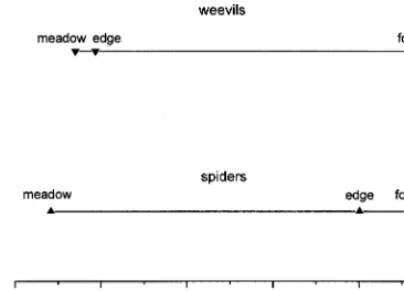
It is demonstrated by metric multidimensional scaling that the composition of the weevil assemblages of the for-est edge and the meadow were similar to each other, and the weevil assemblage of the forest interior differed consid-erably from them (Fig. 1). Composition of the spider as-semblage of forest edge was more similar to the asas-semblage of forest interior than to the assemblage of the meadow.
Discussion
Our study showed that the spider assemblage of the forest edge was the most species rich. Heublein (1983), Blick and Bliss (1991) and Downie et al. (1996), studying spider as-semblages of a forest and the adjacent grass, also reported that species richness was the highest at the forest edge. Our results also corroborated that there was a significant edge effect on the spider assemblages. That is, the species rich-ness was significantly higher in the forest edge than in the adjacent habitats.
Previous works demonstrated that structural diversity of habitats and its derived changes in the abiotic environ-mental conditions were important factors structuring spi-der assemblages (Bergthaler 1996, Hatley and MacMahon 1980). Greater structural diversity of a habitat accompa-nied by higher spider richness (Robinson 1981). In the studied forest edge the leaf litter, the herbs and the shrubs contributed to the structural diversity and heterogeneity of the habitat. Increasing the cover of leaf litter, herbs and shrubs supported the development of abundant decom-posers, phytophagous and predator invertebrates available as prey for spiders, which also increased spider species rich-ness (Wise 1993).
At the studied spatial scale, dispersal between adjacent habitats may also influence species richness. Heublein (1983) reported that by unfavourable environmental con-ditions (microclimate, food concon-ditions, etc.) spiders mi-grate into habitat with favourable conditions. Further-more, for some spider species, juveniles do not develop in the same habitat as is used by adults. Heublein (1983) pointed out that juvenile exemplars of Pisaura mirabilis
were abundant in the open habitats, while adult individu-als in the forest edge and in the forest. This fact explained the dominance of Pisaura mirabilis both in the meadow and in the forest in our research. Forest edge with specific abiotic and biotic environmental conditions may insure suitable consuming, hibernation and reproduction habi-tats for species (Murcia 1995). Vlijm and Kossler-Ge-schiese (1967) reported that males of some spider species after copulation moved to the periphery of the habitat to avoid cannibalism and intraspecific competition. This
dis-Table 1. Species richness of spiders and weevils in the studied habitats based on sub-samples of 70 individuals. Different letters indicate significant differences (p<0.05).
Meadow Forest edge Forest interior
Spiders 16.3 ± 1.610a 21.3 ± 1.434b 17.3 ± 1.162a
persal mechanism may also contribute the observed high species richness in the forest edge, and perhaps the similar-ity of the spider assemblages of the forest and the forest edge is due to these movements. Downie et al. (1996) also reported that spider composition of forest edge was more similar to the forest interior than to the grass.
Our study proved that the weevil assemblage of the for-est edge was slightly more species rich than the other hab-itats. Although, the species richness of weevil assemblage of the forest edge and the meadow was not different signifi-cantly, these assemblages were significantly richer in spe-cies than the forest interior. Previous studies pointed out that there was a positive correlation between the species richness of weevil assemblage and the cover of herbs (Brown and Hyman 1986). With the increasing of the cover of herbs, the spectrum of weevils’ feed-plants also increased, thus more weevil species can find their feed-plants (Witkowski 1975). The high coverage of the herbs in the forest edge and in the meadow explained the high species richness of these habitats. For example, Phyllobius vespertinus occurred exclusively in the meadow because its feed-plants (Achillea, Dactylis and Fragaria species) were in large number in the meadow. In the forest edge the most frequent occurrence of Otiorhynchus fullo (Schrank, 1781) was explained by the high abundance of its food-plants (e.g. Prunus spinosa, Crataegus species). As the food-plants (Achillea species) of Eusomus ovulum were frequent both in the meadow and in the forest edge, this weevil species was also captured in both habitats. With the decreasing of the canopy cover, the herbs typical of meadow can also pene-trate into the forest edge and thus the species composition of the herbaceous layer of the forest edge and the meadow become more similar. Similarity of the species composition of herbaceous plants explains the high relative similarity of weevil assemblages of the forest edge and the meadow. It also explains how the diversity of the weevil assemblage of these habitats were not significantly different.
However, many polyphagous weevils (18.6% of the sampled species and 47.2% of the species captured in the forest edge) occurred exclusively in the forest edge. This fact cannot be explained by the presence of the feed-plants but rather with the special abiotic and biotic environmen-tal factors that characterise the forest edge. Namely, prox-imity of two structurally dissimilar habitats (meadow and forest) resulted in a special abiotic environmental condi-tions in the forest edge, which can also influence both the abundance, distribution of species and the species interac-tions, such as predation, competition etc. (Murcia 1995).
Our results, similar to previous studies analysing edge effect on other taxa of invertebrates, revealed that there was a significant edge effect on the studied phytophagous and predator invertebrate groups (Heublein 1983, Helle and Muona 1985, Duelli et al. 1990, Bedford and Usher 1994, Magura and Tóthmérész 1997, 1998). There were no pub-lications demonstrating the edge effect for these two par-ticular taxa. It is important to stress that the two studied invertebrate groups operated at different trophic levels. The weevils were a phytophagous group, and the spiders were a predator group. In spite of their ecological and/or trophic differences both of them exhibit a significant edge effect. We have demonstrated that the high species richness observed in the forest edge was partly due to the presence of species characteristic of each of the adjacent habitats plus edge-associated species.
Acknowledgements – The authors are thankful to Cs. Szinetár, and L. Szabó for their valuable suggestions. The research was support-ed by the Pro Regionae and the Pro Renovanda Cultura Hungar-iae Funds, and OTKA T25888 Research Grant.
References
Asteraki, E. J., Hanks, C. B. and Clements, R. O. 1995. The influence of different types of grassland field margin on cara-bid beetle (Coleoptera, Caracara-bidae) communities. – Agricult. Ecosyst. Environ. 54: 195–202.
Bedford, S. E. and Usher, M. B. 1994. Distribution of arthropod species across the margins of farm woodlands. – Agricult. Ec-osyst. Environ. 48: 295–305.
Bergthaler, J. G. 1996. Preliminary results on the colonization of a newly planted hedgerow by epigeic spiders (Araneae) under the influence of adjacent cereal fields. – Rev. Suisse de Zool. 1: 61–70.
Blick, T. and Bliss, P. 1991. Spinnentiere und Laufkäfer am Waldrand (Arachnida: Araneae, Opiliones, Pseudoscorpi-ones; Insecta: Coleoptera: Carabidae). – Bull. Soc. Neuchä-tel. Sci. Nat. 116: 25–34.
Brown, V. K. and Hyman, P. S. 1986. Successional communities of plants and phytophagous coleoptera. – J. Ecol. 74: 963– 975.
Downie, I. S., Coulson, J. C. and Butterfield, J. E. L. 1996. Dis-tribution and dynamics of surface-dwelling spiders across a pasture-plantation ecotone. –Ecography 19: 29–40. Fig. 1. Ordination of the assemblages by PCoA, based on
Duelli, P. et al. 1990. Population movements of arthropods be-tween natural and cultivated areas. – Biol. Conserv. 54: 193– 207.
Hatley, C. L. and MacMahon, J. A. 1980. Spider community organization: seasonal variation and the role of vegetation ar-chitecture. – Environ. Entomol. 9: 632–639.
Helle, P. and Muona, J. 1985. Invertebrate numbers in edges be-tween clear-fellings and mature forests in northern Finland. – Silva Fenn. 19: 281–294.
Heublein, D. 1983. Räumliche Verteilung, Biotoppräferenzen und kleinräumige Wanderungen der epigäischen Spinnen-fauna eines Wald-Wiesen-Ökotons; ein Breitag zum Thema “Randeffekt”. – Zool. Jb. Syst. 110: 473–519.
Jakucs, P. 1985. Ecology of an oak forest in Hungary. – Akadémiai Kiadó.
Kotze, D. J. and Samways, M. J. 1999. Invertebrate conservation at the interface between the grassland matrix and natural Afromontane forest fragments. – Biodiv. Conserv. 8: 1339– 1363.
Legendre, P. and Legendre, L. 1998. Numerical ecology, 2nd ed. – Elsevier.
Ludwig, J. A. and Reynolds, J. F. 1988. Statistical ecology. – Wi-ley.
Magura, T. and Tóthmérész, B. 1997. Testing edge effect on cara-bid assemblages in an oak-hornbeam forest. – Acta Zool. Hung. 43: 303–312.
Magura, T. and Tóthmérész, B. 1998. Edge effect on carabids in an oak-hornbeam forest at the Aggtelek national Park (Hun-gary). – Acta Phytopath. Entom. Hung. 33: 363–371.
Mészáros, I., Jakucs, P. and Précsényi, I. 1982. Diversity and niche chl˛ges of shrub species within forest margin. – Acta Bot. Acad Sci. Hung. 27: 421–437.
Murcia, C. 1995. Edge effects in fragmented forests: implications for conservation. –Trends Ecol. Evol. 10: 58–62.
Odum, E. P. 1971. Fundamentals of ecology. – Saunders. Papp, M. and Jakucs, P. 1985. Pytosociology of the forest. – In:
Jakucs, P. (ed.), Ecology of an oak forest in Hungary. Akadémiai Kiadó, pp. 39–50.
Robinson, J. V. 1981. The effect of architectural variation in hab-itats on a spider community: an experimental field study. – Ecology 62: 73–80.
Smith, W. and Grassle, F. J. 1977. Sampling properties of a family of diversity measures. – Biometrics 33: 283–292.
Tóthmérész, B. 1993. NuCoSA 1.0: number cruncher for com-munity studies and other ecological applications. – Abstr. Bot. 17: 283–287.
Vlijm, L. and Kessler-Geschiere, A. M. 1967. The phenology and habitat of Pardosa monticola, P. nigriceps and P. pullata (Ara-neae, Lycosidae). – J. Anim. Ecol. 36: 31–56.
Wise, D. H. 1993. Spiders in ecological webs. – Cambridge Univ. Press.
Witkowski, Z. 1975. The ecology and succession of weevils (Co-leoptera: Curculionidae) on mowed meadows in the Zabri-erzów area (Poland). – Stud. Nat. A 12: 1–81.