Vol.9 (2019) No. 2
ISSN: 2088-5334
Backpropagation Neural Network Based on Local Search Strategy and
Enhanced Multi-objective Evolutionary Algorithm for Breast Cancer
Diagnosis
Ashraf Osman Ibrahim
1 ,2, Siti Mariyam Shamsuddin
3, Abdulrazak Yahya Saleh
4, Ali Ahmed
5,
Mohd Arfian Ismail
6, Shahreen Kasim
7*1
Faculty of computer and technology, Alzaiem Alazhari University, Khartoum, Sudan
2
Faculty of Computer Science, Future University, Khartoum, Sudan
3
UTM Big Data Centre, Universiti Teknologi Malaysia, Skudai, 81310 Johor, Malaysia
4
FSKPM Faculty, University Malaysia Sarawak (UNIMAS), Kota Samarahan, 94300 Sarawak, Malaysia
5
Faculty of Computer Science and Information Technology, Karary University, Omdurman, 12305, Sudan
6
Faculty of Computer Systems and Software Engineering, Universiti Malaysia Pahang, Pahang, Malaysia
7
Soft Computing and Data Mining Centre, Faculty of Computer Science and Information Technology, Universiti Tun Hussein Onn, Malaysia E-mail: * [email protected]
Abstract— The role of intelligence techniques is becoming more significant in detecting and diagnosis of medical data. However, the performance of such methods is based on the algorithms or technique. In this paper, we develop an intelligent technique using multiobjective evolutionary method hybrid with a local search approach to enhance the backpropagation neural network. First, we enhance the famous multiobjective evolutionary algorithms, which is a non-dominated sorting genetic algorithm (NSGA-II). Then, we hybrid the enhanced algorithm with the local search strategy to ensures the acceleration of the convergence speed to the non-dominated front. In addition, such hybridization get the solutions achieved are well spread over it. As a result of using a local search method the quality of the Pareto optimal solutions are increased and all individuals in the population are enhanced. The key notion of the proposed algorithm was to show a new technique to settle automaticly artificial neural network design problem. The empirical results generated by the proposed intelligent technique evaluated by applying to the breast cancer dataset and emphasize the capability of the proposed algorithm to improve the results. The network size and accuracy results of the proposed method are better than the previous methods. Therefore, the method is then capable of finding a proper number of hidden neurons and error rates of the BP algorithm.
Keywords— local search; breast cancer; neural network; NSGA-II; ANN.
I. INTRODUCTION
The main aim of the classification process is labeling patterns into a different set of categories of labeled data. The classification of the medical diagnosis of the disease has become a growing interest in using intelligent systems in the areas of medical computing. Since medical applications enable a powerful and accurate result and help in decision making in a short period. Diagnosis of some disease depends
The evolutionary algorithms (EAs) have provided a powerful and effective method of exploring a massive search space. We can find that EAs allow the simultaneous exploration of various parts in the Pareto optimal set. Based on fact, EAs are population-based approaches, and therefore it can evolve ANNs that involve the simultaneous optimization of several objectives [4]–[6]. In addition, multiobjective evolutionary algorithms (MOEAs) also used for the same purpose. The hybrid method combines two or more methods to take advantage of each methods [7]. Nowadays, the use of hybrid methods becomes attractive for the researchers to increase the accuracy of their proposed methods. In MOEAs, hybrid methods combine characteristics of different methods. It can increase the speed of convergence and can have better results. Recently, hybrid methods have achieved significant results in solving many complex problems in the real world, such as medical data applications [8]–[11] and especially for breast cancer classification diagnosis [12]–[16]. Still, there are work needs to design and improve ANN classifier using hybrid methods. The goals of this paper are of three folds: (i) an attempt is made to enhance a famous NSGA-II. By replacing the crossover operator with parent-centric blend (PBX) crossover. This process makes the proposed method to produce results, which is better than the original SBX crossover. (ii) Combine the local search strategy with NSGA-II algorithm; this combination benefited from the use of Pareto optimal solutions, this configuration has improved the results. (iii) Design automatically the BP structure by optimizing both the accuracy and network structure simultaneously using an enhanced Pareto optimal algorithm hybrid with local search strategy. The proposed algorithm is then capable of finding an appropriate number of hidden neuron along with the error. The proposed method was implemented for solving Breast Cancer data in this study.
The paper is organized into several sections: Section 1 discusses the literature review, introduces the fundamentals of the proposed algorithm. Section 2 presents the steps of the proposed algorithm, indications the experimental study. The result and discussion are shown in Section 3. Finally, Section 4 concludes the paper.
A. Literature Review
The process of designing a reasonable and appropriate ANNs that useful in the different field of applications. The EAs provides methods for improving and enhancing ANNs parameters and architecture. The recent adaptation of different ANNs technologies places multi-objective evolutionary algorithms as the appropriate technology by benefiting from the opportunities offered by the simultaneous optimization of the objectives (parameters).
However, there are several works in the literature have been given much more attention by researchers from the viewpoint of the optimizing the ANN structure to enhance the classification result of the network. Due to the importance of the computation algorithms in the medical fields, some researches used ANNs for medical field application, for example, a diagnosis system utilizing neural network to define patients liver disease types [17] and a model for heart disease diagnosis based on the multi-layer Perceptron (MLP) neural network architecture [18].
Likewise, a hybrid system between GA and BP algorithm to the diagnosis of Pima Indians’ diabetes has been introduced [19]. An association rule (AR) and ANN for breast cancer has been proposed [20]. The ANN used for classifying the results and AR used to reduce the dimension of data. A hybrid algorithm to EAs and SVM has also been introduced [21]. Looking for high prediction accuracy SVM is used and EA to examine how the diagnosis was done.
A training method for feedforward ANN by using a multiobjective genetic algorithm (MOGA) [22]. The study used a noisy data and then found that the MOGA can reduce the ANN size and error rates as well. In other work, a hybrid MOGA methodology has been offered [23]. The hybridization process implemented the NSGA-II and strength Pareto evolutionary algorithm-II to enhance the training process and design the recurrent neural network (RNN) simultaneously. Likewise, MOGA is used to train a feed-forward ANNs to solve the regularization in term of network complexity [24]. Furthermore, recognizing nonlinear schemes helped from multiobjective procedures to report the optimization of the ANN size [25]. In addition, a classical hybrid method based on NSGA-II process using ANN combined with local search has been offered.
However, numerous studies advised tangible solutions for feedforward ANN, strategy to automatic design of three-term BP implemented to solve classification tasks by utilizing a multiobjective evolutionary hybrid task has been presented [27], [28]. Similarly, existing an improved version of the NSGA-II joint with a local search technique for learning and train the neural network. We conclude from the literature that ANNs based evolutionary algorithms and hybrid methods can be very efficient for classification tasks, in particular for medical data classification. However, the designing of the ANN using trial and error methods have limitations in terms of selecting the proper parameters and structure of the network. Therefore, the decision to choose the best network architecture depends on the automatic design of the system.
B. Preliminaries
In this section, we provide a concise explanation for critical basic concepts of the backpropagation algorithm, NSGA-II, and local search algorithm along.
C. Backpropagation neural network
The architecture for the BP is intentionally constructed like the structure of a neuron. Each layer connects to the upper and lower layer by connection weight. The connection weight exactly connects the neuron within the layers with the neuron in the neighboring layer. The architecture of an ANN shown in Figure 2.1 [29].
D. NSGA-II
The NSGA-II is one of the modern MOEAs that integrates a non-dominating sorting approach [30], which provides accelerated speed compared to any other multi-objective evolutionary algorithm, and identifies the crowded comparison operator for the maintenance of diversity as Pareto-optimal. In this method, the initialization of the population depends on the problem range and constraints if any within the specified variable ranges. In the population basis, help is provided for maintaining diversity. Crossover and mutation processes are executed and change the offspring attributes. This procedure is repeated until the maximum number of repetitions is terminated. NSGA-II utilized fast elitism non-dominated sorting for speeding up convergence and achieving the best solution. Generally, elitism is implemented by hybridizing the non-dominated parents with the offspring while the non-elitism only uses the offspring as the next generation and deletes all the parents from the current generation [31].
E. Local search (LS)
Is a metaheuristic methodology use to solve hard optimization problems. This meta-heuristic technique, the processes are moving to look for a solution that available between many solutions, until a result is considered optimal. LS techniques are commonly used for numerous problems in various fields but have to get special attention in engineering and computer science, mainly AI applications. The LS approach is capable to find the local optimal. Thus, the integration of EA with a local search algorithm benefited from the global search; EA locates ANNs near the global optimum and the LS technique trying to achieve speed and competent best solution [32].
II. MATERIAL AND METHOD
The proposed methodology combines by LS method for classification of breast cancer data. The LS process used to enhance the final solutions. The improved NSGA-II used to enhance and optimize the structure of ANN appropriately and accurately. Therefore, the proposed algorithm is capable of finding fit and proper number of the nodes in the middle layer and small error rates. Thus, its benefits are derived from the optimal Pareto solutions.
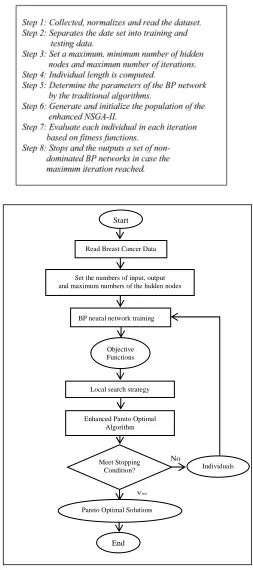
In the basic NSGA-II, the BP algorithm improved by using enhanced version [30]. The main search operator in nature-inspired evolutionary [33], [34]. The proposed technique has settled the accuracy and network design simultaneously with each being fully specified BP neural network. The proposed algorithm employed to define the best performance and the corresponding architecture of the BP network. The following steps showed the proposed algorithm:
Fig. 2 Flowchart for the proposed method
The proposed method emphases two fitness functions to assess BP algorithm performance. The first objective is the accuracy, and it is based on the MSE. While the second objective is the network complexity, it represents the number of neuron in the mid layer of the network.
Yes No Start
Read Breast Cancer Data
Set the numbers of input, output and maximum numbers of the hidden nodes
Objective Functions BP neural network training
End Pareto Optimal Solutions
Individuals Meet Stopping
Condition? Enhanced Pareto Optimal
A. Experimental study
The medical informational dataset contains breast cancer diagnosis in patients by ordering a tumor as benign or malignant. “Breast Cancer Wisconsin” was gathered and prepared at the Wisconsin Hospitals University [35]. It has 699 examples. We can find 458 with the percentage of (65.5%) of the examples in the dataset are benign, but 241 with the percentage of (34.5%) of the examples are malignant. There are nine characteristics or sources of information (clump thickness, uniformity of cell size and shape, marginal adhesion, single epithelial cell size, bare nuclei, bland chromatin, normal nucleoli, and mitoses) and only two conceivable outcome classes (either benign or malignant). Table 1 demonstrates a list of nine characteristics of breast cancer information.
TABLEI
THE BREAST CANCER ATTRIBUTES
Label Features
f1 Clump thickness
f2 Uniformity of cell size
f3 Uniformity of cell shape
f4 Marginal adhesion
f5 Single epithelial cell size
f6 Bare nuclei
f7 Bland chromatin
f8 Normal nucleoli
f9 Mitoses
B. Experimental results
This section offering the numerical results of the suggested method containing the improved NSGA-II with the LS strategy for Breast Cancer classification task. In this context 10-fold cross-validation process utilized to assess the proposed technique. Other measurements are used in this paper such as; sensitivity, specificity, and accuracy as displayed in equations 1-3. The sensitivity utilized to categorize the precise positive samples based on the number of true positives and false negatives. The Specificity is used to assist and predicts the explicit negative examples based on the number of true negatives and false positives. The accuracy is a measure to yield the level of accurate results.
C. Experimental settings
The proposed algorithm used and set some parameters; it used the population size as 100. In addition, 0.90 used as crossover rate while the mutation rate is set to 1/N, N here is represent the dimension length of the individual. The maximum number of hidden neurons set to 10 and training iterations of the network is set to be 1,000 [36], [37]. In addition, the local search technique used BP algorithm and the learning rate used the value 0.01.
PN
FP
TN
TP
TN
TP
Accuracy
+
+
+
+
=
(1)
FP
TP
TP
y
Sensitivit
+
=
(2)FP
TN
TN
Specivity
+
=
(3)Where TP is true positive, FP is false positive, TN is truly negative, and FN is a false negative.
III.RESULTS AND DISCUSSION
This section provides execution approaches plus empirical outcomes of the proposed technique. Breast cancer data was used and implemented to investigate the effectiveness of the proposed technique. The dataset is separated from training and testing data. The results used the 10-fold cross-validation and found the average and standard deviation values.
TABLEII
TRAINING AND TESTING ERROR
# Fold Train error Test error
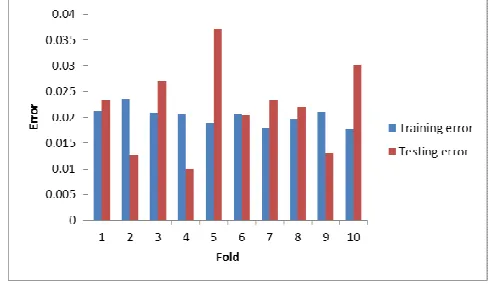
Fold-no 1 0.0211 0.0233
Fold-no 2 0.0236 0.0125
Fold-no 3 0.0209 0.0271
Fold-no 4 0.0207 0.0100
Fold-no 5 0.0188 0.0371
Fold-no 6 0.0206 0.0204
Fold-no 7 0.0180 0.0234
Fold-no 8 0.01986 0.0220
Fold-no 9 0.0210 0.0130
Fold-no 10 0.0177 0.0301
Average 0.0202 0.0218
Standard
Devation 0.0017 0.0084
From Table 2, we can see the error rates of the training and testing. In addition, the results summarize the generalization error of the proposed algorithm. It is observed from Table 2 that the proposed algorithm yields more promising outcomes in performance for Breast Cancer data. Nevertheless, the results in Table 2, is the average of the error rates that gained in a single run of the multiobjective evolutionary enhanced NSGA-II hybrid with LS and BP algorithm.
TABLEIII
TRAINING AND TESTING SENSITIVITY AND SPECIFICITY RESULTS
# Fold Train Sensitivity
Test Sensitivity
Train Specificity
Test Specificity
Fold-no 1 97.26 97.81 95.89 97.78
Fold-no 2 97.28 97.64 96.02 100
Fold-no 3 96.78 97.59 100 93.27
Fold-no 4 97.74 97.31 95.93 100
Fold-no 5 97.28 97.67 95.91 95.67
Fold-no 6 96.79 97.38 100 93.27
Fold-no 7 97.76 97.79 91.77 97.85
Fold-no 8 97.71 97.61 95.91 97.83
Fold-no 9 96.41 97.37 100 100
Fold-no 10 97.78 97.83 100 95.67
Average 97.28 97.60 97.14 97.13
Standard
Deviation 0.48 0.19 2.77 2.59
The results appeared in Table 3 illustrate the sensitivity and specificity results for the train data and sensitivity and specificity results for the test data as well which are produced by the proposed method. Moreover, we can see from the same table the sensitivity and specificity for ten folds results. In addition, average and STD also highlighted. We can note from table 3; the specificity results achieved an acceptable outcome of the proposed algorithm.
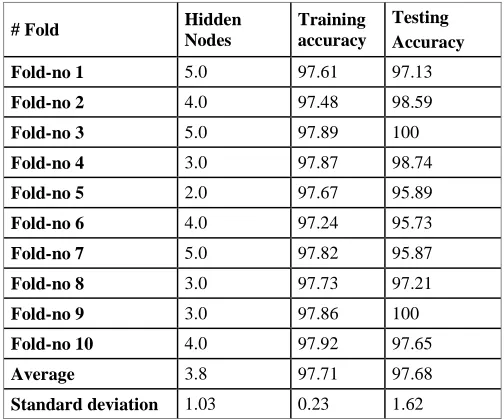
From the numerical outcomes listed in Table 4, the proposed algorithm can produce good quality outcomes in train and test accuracy. In addition, the average of the 10-fold results was calculated and STD calculated as well. Generally, the classification results obtained by the proposed algorithm on Breast Cancer disease diagnosis are good. It does yield several results for all folds which some of them are best. Indeed, the final results of the classification based on how the training data is implemented effectively and accurately. Therefore, the use of enhanced NSGA-II hybrid with LS technique helps to improve the exploration capability of the proposed algorithm for all fitness functions simultaneously.
Fig. 4 the results of the training and testing sensitivity
The statistics that appeared in Table 4 are the results of 10-fold outputs achieved by the proposed algorithm for the used Breast Cancer dataset. In addition, the results show the average and STD results of 10-fold.
Fig. 5 Training and testing specificity results
TABLEIV
RESULTS OFHIDDEN NEURONS AND ACCURACY
# Fold Hidden Nodes
Training accuracy
Testing Accuracy
Fold-no 1 5.0 97.61 97.13
Fold-no 2 4.0 97.48 98.59
Fold-no 3 5.0 97.89 100
Fold-no 4 3.0 97.87 98.74
Fold-no 5 2.0 97.67 95.89
Fold-no 6 4.0 97.24 95.73
Fold-no 7 5.0 97.82 95.87
Fold-no 8 3.0 97.73 97.21
Fold-no 9 3.0 97.86 100
Fold-no 10 4.0 97.92 97.65
Average 3.8 97.71 97.68
Standard deviation 1.03 0.23 1.62
The numerical results in Table 4 show the complexity calculated by the average of the hidden neurons in the BP network structure; it is clear that the proposed algorithm produced good outcomes and succeeded to get a network architecture with low complexity based on the low average value of the hidden neurons. Therefore, the results of these factors emphasize the robustness of the proposed algorithm.
TABLEV
COMPARISON OF THE NETWORK COMPLEXITY AND ACCURACY RESULTS
Method Hidden Nodes Sensitivity Specificity Accuracy
METBP [27] 4.10 96.67 97.30 97.07
MLP-ENSGA-II 4.6 98.77 97.80 97.01
MOGATTBP [39] 4.70 96.01 97.08 96.97
Fig.6 The network complexity (Hidden nodes)
The comparison of the results is also done, and the results can be seen in Tables 5. The results compared with MOGATTBP [38]. The ANN complexity in term of the number of the hidden neurons, sensitivity, specificity, and accuracy of the tested problem. From the results shown by the proposed algorithm, we noted that BP neural network size considers as optimal network size and this network size is generated automatically with the run of the algorithm. We can say such a scenario is the benefit of the proposed algorithm. Furthermore, the use of the local search technique with the EA is lead to an increase in the quality of the Pareto optimal solutions and improves all individuals in the population. Accordingly, the network size and accuracy results are becoming better than MOGATTBP [38].
Fig.7 Proposed method Compared to other methods
IV. CONCLUSION
In this study, the combination of a local search scheme and enhanced NSGA-II based on BP algorithm for the classification of the Breast Cancer diagnosis implemented and done successfully. The fundamental notion of the proposed algorithm was to show a new technique to settle ANN design problem automatically. We benefited from the multi-objective thoughts and applied two objectives simultaneously: the error rates and network structure of the BP algorithm. The PBX replaced the SBX crossover in NSGA-II algorithm. The use of the PBX crossover helps the proposed algorithm to yield a better solution than the regular crossover. Combination of the local search strategy with NSGA-II algorithm helps to increase the quality in terms of Pareto optimal results. Thus, the results generated by the proposed algorithm show compact network and good accuracy. Therefore, the method is then capable of finding a
proper number of hidden neurons and error rates of the BP algorithm.
ACKNOWLEDGMENT
We would like to thank the Universiti Tun Hussein Onn for supporting this research under the Contract Grant Vot number W004.
REFERENCES
[1] Khosrowshahi, F., Innovation in artificial neural network learning: Learn-On-Demand methodology. Automation in Construction, 2011. 20(8): p. 1204-1210.
[2] Kuo, R. and L. Lin, Application of a hybrid of genetic algorithm and particle swarm optimization algorithm for order clustering. Decision Support Systems, 2010. 49(4): p. 451-462.
[3] Cheok, C.Y., et al., Optimization of total phenolic content extracted from Garcinia mangostana Linn. hull using response surface methodology versus artificial neural network. Industrial Crops and Products, 2012. 40: p. 247-253.
[4] Ding, S., et al., Evolutionary artificial neural networks: a review. Artificial Intelligence Review, 2013: p. 1-10.
[5] Caballero, J.C.F., et al., Sensitivity versus accuracy in multiclass problems using memetic Pareto evolutionary neural networks. IEEE Transactions on Neural Networks, 2010. 21(5): p. 750-770. [6] S. Dehuri, S. Patnaik, A. Ghosh, R. Mall, Application of elitist
multi-objective genetic algorithm for classification rule generation. Applied Soft Computing Journal. 8, 477–487 (2008).
[7] P. P. Bonissone, Y. U. T. O. Chen, K. Goebel, P. S. Khedkar, Hybrid soft computing systems: Industrial and commercial applications. Proceedings of the IEEE. 87, 1641–1667 (1999).
[8] Seera, M. and C.P. Lim, A hybrid intelligent system for medical data classification. Expert Systems with Applications, 2014. 41(5): p. 2239-2249.
[9] R. Deja, W. Froelich, G. Deja, A. Wakulicz-Deja, Hybrid approach to the generation of medical guidelines for insulin therapy for children. Information Sciences. 384, 157–173 (2017).
[10] C. Y. Fan, P. C. Chang, J. J. Lin, J. C. Hsieh, A hybrid model combining case-based reasoning and fuzzy decision tree for medical data classification. Applied Soft Computing Journal. 11, 632–644 (2011).
[11] Gorzałczany, M.B. and F. Rudziński, Interpretable and accurate
medical data classification–a multi-objective genetic-fuzzy optimization approach. Expert Systems with Applications, 2017. 71: p. 26-39.
[12] Zheng, B., S.W. Yoon, and S.S. Lam, Breast cancer diagnosis based on feature extraction using a hybrid of K-means and support vector machine algorithms. Expert Systems with Applications, 2014. 41(4): p. 1476-1482.
[13] Turabieh, H., GA-based feature selection with ANFIS approach to breast cancer recurrence. International Journal of Computer Science Issues (IJCSI), 2016. 13(1): p. 36.
[14] F. Ahmad, N. A. Mat Isa, Z. Hussain, M. K. Osman, S. N. Sulaiman, A GA-based feature selection and parameter optimization of an ANN in diagnosing breast cancer. Pattern Analysis and Applications. 18, 861–870 (2015).
[15] A. O. Ibrahim, S. M. Shamsuddin, A. Y. Saleh, A. Abdelmaboud, A. Ali, in Proceedings - 2015 International Conference on Computing, Control, Networking, Electronics and Embedded Systems Engineering, ICCNEEE 2015 (Institute of Electrical and Electronics Engineers Inc., 2016), pp. 422–427.
[16] L. Peng et al., An immune-inspired semi-supervised algorithm for breast cancer diagnosis. Computer methods and programs in biomedicine. 134, 259–65 (2016).
[17] Lin, R.-H. and C.-L. Chuang, A hybrid diagnosis model for determining the types of the liver disease. Computers in Biology and Medicine, 2010. 40(7): p. 665-670.
[18] H. Yan, Y. Jiang, J. Zheng, C. Peng, Q. Li, A multilayer perceptron-based medical decision support system for heart disease diagnosis. Expert Systems with Applications. 30, 272–281 (2006).
[20] Karabatak, M. and M.C. Ince, An expert system for detection of breast cancer based on association rules and neural network. Expert systems with Applications, 2009. 36(2): p. 3465-3469.
[21] Stoean, R. and C. Stoean, Modeling medical decision making by support vector machines, explaining by rules of evolutionary algorithms with feature selection. Expert Systems with Applications, 2013. 40(7): p. 2677-2686.
[22] Pettersson, F., N. Chakraborti, and H. Saxén, A genetic algorithms based multi-objective neural net applied to noisy blast furnace data. Applied Soft Computing, 2007. 7(1): p. 387-397.
[23] Delgado, M., M.P. Cuellar, and M.C. Pegalajar, Multiobjective hybrid optimization and training of recurrent neural networks. IEEE Transactions on Systems, Man, and Cybernetics, Part B (Cybernetics), 2008. 38(2): p. 381-403.
[24] Jin, Y., B. Sendhoff, and E. Körner. Evolutionary multi-objective optimization for simultaneous generation of signal-type and symbol-type representations. in International Conference on Evolutionary Multi-Criterion Optimization. 2005. Springer.
[25] Liu, G. and V. Kadirkamanathan, Multiobjective criteria for neural network structure selection and identification of nonlinear systems using genetic algorithms. IEE Proceedings-Control Theory and Applications, 1999. 146(5): p. 373-382.
[26] Mane, S., S. Sonawani, and S. Sakhare, Hybrid Multi-objective Optimization Approach for Neural Network Classification Using Local Search, in Innovations in Computer Science and Engineering. 2016, Springer. p. 171-179.
[27] Ibrahim, A.O., S. Hasan, and S. Noman, Memetic Elitist Pareto evolutionary algorithm of three-term backpropagation network for classification problems. Int. J. Advance Soft Compu. Appl, 2014. 6(3).
[28] A. O. Ibrahim, S. M. Shamsuddin, N. B. Ahmad, M. N. M. Salleh, in 2014 International Conference on Computer and Information Sciences, ICCOINS 2014 - A Conference of World Engineering, Science and Technology Congress, ESTCON 2014 - Proceedings (Institute of Electrical and Electronics Engineers Inc., 2014). [29] Xiaoyuan, L., Q. Bin, and W. Lu. A New Improved BP Neural
Network Algorithm. in Intelligent Computation Technology and
Automation, 2009. ICICTA'09. Second International Conference on. 2009. IEEE.
[30] K. Deb, A. Pratap, S. Agarwal, T. Meyarivan, A fast and elitist multiobjective genetic algorithm: NSGA-II. IEEE Transactions on Evolutionary Computation. 6, 182–197 (2002).
[31] Coello, C.A., An updated survey of GA-based multiobjective optimization techniques. ACM Computing Surveys (CSUR), 2000. 32(2): p. 109-143.
[32] A. Lara, G. Sanchez, C. A. C. Coello, O. Schütze, HCS: A new local search strategy for memetic multiobjective evolutionary algorithms. IEEE Transactions on Evolutionary Computation. 14, 112–132 (2010).
[33] De Jong, K.A. and W.M. Spears, A formal analysis of the role of multi-point crossover in genetic algorithms. Annals of mathematics and Artificial intelligence, 1992. 5(1): p. 1-26.
[34] Črepinšek, M., S.-H. Liu, and M. Mernik, Exploration and
exploitation in evolutionary algorithms: A survey. ACM Computing Surveys (CSUR), 2013. 45(3): p. 35.
[35] Wolberg, W.H. and O.L. Mangasarian, Multisurface method of pattern separation for medical diagnosis applied to breast cytology. Proceedings of the national academy of sciences, 1990. 87(23): p. 9193-9196.
[36] Qasem, S.N., et al., Memetic multiobjective particle swarm optimization-based radial basis function network for classification problems. Information Sciences, 2013. 239: p. 165-190.
[37] Abbass, H.A., An evolutionary artificial neural networks approach for breast cancer diagnosis. Artificial intelligence in Medicine, 2002. 25(3): p. 265-281.
![Fig. 1 ANN architecture [29]](https://thumb-us.123doks.com/thumbv2/123dok_us/9980997.1986423/2.595.360.507.653.752/fig-ann-architecture.webp)