Benchmarking as a Quality Management Tool in Public Administration
Dusan Milosevic, Mladen Djuric, Jovan Filipovic, Slobodan Ristic
University of Belgrade
Jove Ilica 154, 11040 Belgrade, Serbia
e-mail: [email protected], [email protected], [email protected], [email protected]
http://dx.doi.org/10.5755/j01.ee.24.4.2785
This article discusses benchmarking theory, its private sector roots and its implementation in the public sector thus far. The overall purpose of this article is the proper porting of the benchmarking process into the public administration sector. Essentially, what all differences between private and public sector imply is that the public sector does not seek value-for-money. Also, literature on benchmarking in the public sector appears to be less organized and orderly than literature on benchmarking in the private sector. This article bridges this gap in order to answer the question can benchmarking function as efficiently and effectively in the public administration sector as in any private sector organization by showing how governments have been able to utilize benchmarking in order to improve their performances. The use of series of benchmarks can help in making a solid base for factual approach to decision making with regard to setting specific targets for performances of the public administration system, its reform and modernization, and monitoring progress over time. The Public Sector Benchmark of the Republic of Ireland and the Public Sector Comparator of South Africa will be used to show how experimental implementation of benchmarking has been able to produce effective results.
Keywords: benchmarking, quality management, public administration, public procurements, private sector, performances.
Introduction
Quality management in the field of public administration has been a growing and evolving concept in the past two decades. Practitioners have come to realize that efficiency and effectiveness are two ideas that will, and must, rule everything, even the most backwards, encumbered bureaucracy. However, as private sector concepts get ported to the public sector, a very peculiar occurrence has been taking place. In many cases, the results of attempting to apply private sector’s know-how to the public sector have resulted in Frankenstein like abominations. This has begged many to ask the question: Can the public sector, and more specifically public administration, perform in a manner suitable to accept certain private sector management tools? The answer is simple: It must if it wishes to survive. Now, without going off on a tangent as to what will happen if it does not, namely that the private sector will absorb all public sector operations and that it will perform public sector functions as if the public sector never existed, it must be noted that the purpose of this article is not to argue whether or not the public sector can be skillful enough to utilize certain private sector tools, but rather to show actually what effect a proper utilization of private sector know-how can have on public administration. The objective of this article is to port the idea of benchmarking to a degree where the result would be satisfactory had it have been performed for a private sector corporation. We begin from the hypothesis that the only thing missing from proper implementation of quality management practices in public administration are the experts who will know what to do and how to do it. The idea of higher education schools that are working on producing these experts is paramount to the success of this notion, and it is happening right now.
The research problems of this article are related to benchmarking theory, its private sector roots and its implementation in the public sector thus far. The overall purpose of this article is the proper porting of the benchmarking process into the public administration sector. Our main hypothesis is that quality management principles, and benchmarking particularly, can function as efficiently and effectively in the public administration sector as in any private sector organization.
As research methods we used theoretical research and review of literature regarding our topic. We have also included case studies analysis in order to confirm our findings on the use of benchmarking as a quality management tool in public administration through practical examples.
Brief overview of benchmarking theory and
history
In the early 1990s, a single word captured the imagination and attracted the attention of the entire business world. Now, two decades later, benchmarking has gone through its trials and tribulations and proven that it is here to stay. But what exactly is benchmarking? The first section of this article will attempt to answer this question, but not by trying to define what benchmarking is, but rather by identifying what benchmarking does and how it does it. This might seem like an oxymoron, since it would make sense to define something in order to identify what it does and how it does it, but that will not be the case in this instance.
ever-evolving concept. Back in the mid-1990s Watson wrote that, “Benchmarking is a business practice which stimulates process improvement by determining best practices across organizations through performance measurement and understanding those factors which enabled the higher performance of the leading organizations” (Watson, 1994). Not long after, two more sets of authors produced a single definition that might be easiest to understand. Both Elmuti and Kathawala (1997) and Bhutta and Huq (1999) wrote, “The essence of benchmarking is the process of identifying the highest standards of excellence for products, services, or processes, and then making the improvements necessary to reach those standards – commonly called best practices” (Elmuti & Kathawala, 1997, 229; Bhutta & Huq, 1999, 254).
However, any benchmarking paper introduction would not be indicative of a paper truly devoted to benchmarking if it did not give immediate praise to the Xerox Corporation for starting the entire trend. So, without further wait, it must be said that the origins of benchmarking can be tied back to the late 1970s when Xerox decided to compare its operations to those of its competitors. Xerox was losing market share and under a lot of pressure due to the increased efficiency and effectiveness with which its competitors were operating. After finding an appropriate target against whom to compare itself, Xerox began one of the greatest trends in the business world at that time (McNair & Leibfried, 1992). Xerox's success is the first in the history of benchmarking and the corporation has since achieved what is today called a top-benchmarking partner status. In 1979 Xerox started benchmarking and by 1989 had won the Malcolm Baldrige National Quality Award (Boxwell, 1994). In retrospect, what Xerox had done during its initial benchmarking study was a performance-competitive benchmark using a ten-step approach (Camp, 1989). In the end, Xerox’s results speak for themselves. It is the only company in the world to have won all three major benchmarking awards: Japan's Deming Prize, USA's Malcolm Baldrige National Quality Award and the European Quality Award (Finnigan, 1996). However, the keys to Xerox’s success were quite simple really, even textbook – one might say. Xerox identified the performance-competitive benchmarking combination as the one that would best suit its needs and further implemented the results of their study into practice.
Kodak is another company considered by many as one of the forefathers of benchmarking. Kodak followed in the footsteps of Xerox starting in the early 1990s, but did it in their own way. As concluded by Geber (1994), with regards to the situation that Kodak was faced; one must never underestimate the importance of the maintenance department in a manufacturing company. While other departments may seem of more importance, it is the maintenance departments that keep production running efficiently. As a large company with worldwide locations, Kodak had the luxury of measuring all of its maintenance divisions against each other internally as it tried to find the exemplars. It then compared the various measured results against those of other companies with seemingly superior maintenance departments. As a result, Kodak was able to
increase its planned maintenance work, reduce its inventory of parts for maintenance and reduce the amount of time it spent on emergency repairs. Each one of those outcomes had an effect on the company's earnings. In the end, Kodak’s benchmarking study was broken down into two parts: Initially, they performed a process-internal type benchmark, then a process-external type, in all using a six-step approach.
Since then, benchmarking has been gaining popularity at an astounding rate. The process of benchmarking is more than just a means of gathering data on how well a company performs. Benchmarking can be used in a variety of industries, both services and manufacturing – and this is one of its greatest strengths. It is also a method of identifying new ideas and new ways of improving processes and, therefore, being ever more efficient in the ability to meet the needs of consumers.
According to Watson (1994), there are three significant advantages for conducting benchmarking studies. Firstly, benchmarking provides an independent assessment of how well a process is operating by evaluating performance of similar processes across different organizations, or units within a single organization. By measuring the performance of other organizations or other organizational units, an objective baseline for realistic, quantitative performance goals can be established. Secondly, benchmarking provides a stimulus for making breakthrough change initiatives a reality by enhancing the creativity and innovation of teams who are working on process improvement. Thirdly, benchmarking broadens the experience base of an organization or units. By looking at the experience of other organizations externally, or other units internally, benchmarking gives examples of behaviors, systems and methods which enable better performance – as well as insights into those things that do not work so well.
This article will examine benchmarking in public administration and show how governments have been able to utilize benchmarking in order to increase their effectiveness and efficiency. The Public Sector Benchmark of the Republic of Ireland and the Public Sector Comparator of South Africa will be used to show how experimental implementation of benchmarking has been able to produce effective results. In conclusion it will be said that benchmarking in the public sector and public administration has had varied effectiveness in its implementation. This is largely due to the lack of know-how and proper porting of the benchmarking idea. However, benchmarking remains to have an enormous amount of untapped potential that could be utilized in making it an essential tool in the public sector and public administration.
Benchmarking process variations
Bhutta and Huq (1999) have slightly modified the list made by Matters and Evans (1997) and have added one more step, while fusing data collection and analysis. The added step follows planning and team formation and deals with identifying the appropriate benchmarking partners. Once assembled, the benchmarking team should then identify potential benchmarking partners – organizations that are considered by the business community to be world class at a given process. Though these organizations can be competitors, it is more common that they will be non-competitors within the same industry. Many organizations choose Baldrige Award winners as benchmarks (Bhutta & Huq, 1999). Candidate companies are invited to participate in the study, and an agreement is reached about the information that will be shared and how it will be used. Not all organizations contacted will want to participate, so it is imperative that mutual benefits are highlighted. Generally, sharing the benchmarking report with partners serves as a strong incentive for participation. Having delved into the five steps of the benchmarking process, Bhutta and Huq (1994) have developed a cyclical model known as the Benchmarking Wheel, that depicts how the five steps, or rather their adaptation of the five steps, should look like (Figure 1).
Figure 1. The Benchmarking Wheel
Source: Bhuta & Huq (1999) [Adapted from Camp (1989)]
As one may have come to understand, benchmarking can be carried out in many steps. Some organizations have used up to 33 steps while others have used only 4 (Bhutta & Huq, 1999). In the end, different organizations may develop and use their own adapted steps in the benchmarking process, but no matter what the variance is, there will always be three major benchmarking phases, as explained by Omachonu and Ross (1994). The first phase consists of measuring the performance of the best-in-class, relative to critical performance variables such as cost, productivity, and quality. The second phase is to determine how the measured levels of performance are achieved. And the third phase is to use the learned information in order to develop and implement a plan for. Elmuti and Kathawala (1997) have adopted Bateman’s (1989) flow chart that identifies all of the necessary components of each benchmarking study, regardless of how one may define the steps (see Figure 2).
Ultimately however, the benchmarking process has to be considered a cyclical one (Bogan & English, 1994). The
benchmarking organization must continuously observe the results of the improvement step under way, as well as the evolution of the organizations with which it is compared. It is a never-ending discovery and learning process that identifies and evaluates the best practices and performance so that they can be integrated into an organization’s present activities to increase effectiveness, efficiency and adaptability (Buyukozkan & Maire, 1998). And since benchmarking is a continuous process, it can be said that it follows the PDCA (Plan-Do-Check-Act) cycle (Pulat, 1994; Longbottom, 2000). The plan phase focuses on the various upfront decisions, such as the selection of functions and processes to benchmark, and the type of benchmarking study to embark on. In the do phase, one delves into a self-study to characterize the selected processes using metrics and documenting business practices. Furthermore, data (metrics and business practices) are collected on the company that is the benchmarking partner. Check refers to the comparison of findings via a gap analysis to observe whether negative or positive gaps exist between the benchmarking company and the benchmarking partner. Act refers to the launching of projects either to close negative gaps or maintain positive ones.
Figure 2. The Benchmarking Process
Source: Elmuti & Kathawala (1997) [Adapted from Bateman (1989)]
Perceived limitations of benchmarking
While benchmarking may appear to be an omnipotent tool for use in any business or organization, it does have certain requirements that must be respected in order for it to perform in a useful manner.
different steps, it will always follow the Plan-Do-Check-Act cyclical model. Among the problems and constraints of benchmarking, this author reported strong pressures to undertake benchmarking projects in the public sector followed by the concerns with regard to understanding and motivations (Longbottom, 2000, 106). This is why we find appropriate to discuss more on additionally perceived limitations of benchmarking and their influences on its application in public sector.
In his study of how intermediate benchmarks for development studies can influence transparency about what development studies is and what it can offer, Copestake (2002) explained some dangers which benchmarking can cause. He identified “specification problem” as a situation in which there is a wrong perception of what makes universal best practice in a specific field, hence making this diversity favors the needs and interests of users at expense of innovations; “identification problem” as a potential danger of a biased benchmarking which can serve as an instrument for promoting interests of dominant stakeholder, rather than being based on pluralistic approach which takes care on making consensus among all interested parties; and “application problem” as an issue of how benchmarking is used (Copestake, 2002, 303-304.). Having these problems and definition and benefits of benchmarking in mind, the author suggests that from a public policy perspective it is very important to recognize and compare costs and benefits of benchmarking distributed to different stakeholders. Fernandez et al. (2001) have identified five limitations of benchmarking that may be important to distinguish and understand in context of comparing its private sector and public sector use:
Static Perception. Benchmarking is often a static comparison or snapshot of the company and its environment. Although such snapshots are useful, they can lead to misfits between the reality of the company and the capability of the benchmarking technique. This is considered to be a drawback, as the resulting analysis does not represent the dynamic issues of organizational development.
Transferability. One of the key issues in benchmarking, even after the completion of the data collection and analysis, is the transferability of the gained experience. Aside from the inability to implement a given action plan into effect, there could be problems in terms of conflicting organizational cultures, management styles or management structures.
Diversity. Using a large number of benchmarking partners can help to ensure that relevant information is collected and that good practice is identified. However, since the number of partners in a given benchmarking study can vary greatly, it must be noted that the fewer the number of partners the greater the possible drawbacks of the study. This is because smaller benchmarking groups cannot necessarily ensure an eventual process improvement due to small research samples. This is not to say that one-to-one comparisons cannot be successful and that multi-partner benchmarking studies do not have their drawbacks. Lack of Direction. Whilst benchmarking informs managers and directors about the competitive gap that their
organizations may face, it does not necessarily inform them of the improvement program needed to bridge the gap. In other words, benchmarking provides a situational analysis. This means that while benchmarking may give a clear picture of where one stands, it will not explain how to reach a desired level thereafter.
Reductionism Approach. It is generally accepted that a reductionist approach in benchmarking can mislead and that it should be avoided. Instead, a systemic approach should be adopted. The systemic view states that the whole is made up of parts that are self-organizing and have rules that are independent of the rules passed down from the whole system. Meaning that while the whole cannot be assumed uniform; neither can the individual units be assumed a perfect representative of the whole.
Benchmarking in public administration
Public sector usage of benchmarking has grown exponentially over the past two decades. This growth has been especially apparent in the health and infrastructure industries and projects that have involved contracting out of public services (Dorsch & Yasin, 1998). Literature on this subject has been found dating back to the early 1990s and much of it has focused on directly porting the private sector benchmarking experience to the public sector, but with mixed results. However, some authors argue that there are differences between benchmarking in the private and public sectors and that these differences must be properly addressed. Bowerman et al. (2002) have identified three of such differences:
Benchmarking in private sector always seeks the best practice in a given field, while public sector benchmarking usually produces results that are satisfactory, but not necessarily the best;
Benchmarking in the private sector is seen as an internal management tool and its application is voluntary. Benchmarking in the public sector can be voluntary, but its application is often compulsory;
Knowledge gained through private sector benchmarking can be considered private property and thus does not have to be shared. Knowledge gained through public sector benchmarking can be considered public property and thus should be shared.
paramount in all day-to-day operations. Counting pennies has become a practice not uncommon to anyone.
Another author with an interesting approach to benchmarking in the public sector is Triantafillou. Triantafillou (2007) underlines that benchmarking in the public sector might be perceived as a governing technology seeking to enable self governance of individuals or organizations through the creation of knowledge on the activity targeted by governing. This is an interesting take since it introduces a clear contrast as to the purpose of benchmarking in either of the two sectors. In the private sector, benchmarking has traditionally been seen as a tool of improvement; by contrast, Triantafillou argues that in the public sector it is a tool of governance. Now, while this argument may hold some weight, it pauses the question: Could benchmarking in the public sector not be seen with a dual purpose, both as a tool of improvement and a tool of governance? It would seem implausible that any governance goals would have negative connotations, therefore they would inherently introduce improvement as a by-product.
Gallagher (2005) used benchmarking to compare tax system performances and capabilities, thus putting these assessments into an international perspective. Although this context is rather financial than quality management, the use of series of benchmarks can help in making solid base for factual approach to decision making with regard to setting specific targets for performances of this part of public administration system, its reform and modernization, and monitoring progress over time. This author is of the opinion that regional comparisons are preferred by tax administrators, because they want to compare their own systems with neighboring or regional competitors, but comprehensive benchmarking in specific regions and around the world may be more effective in system improvements and overall public administration efforts (Gallagher, 2005).
Lastly, a very popular form of benchmarking in the public sector is public procurement benchmarking. However, here is where another set of differences between the private and public sectors becomes apparent. Public sector procurement is more regulated than private sector procurement, and there are more rules to comply with – more policy considerations to take into account (Chamberland, 2005). Palaneeswaran and Kumaraswamy (2000) say that even those public bodies that genuinely wish to change are restricted by standing orders, public accountability and probity constraints. It has been a common assumption that government agencies are very bureaucratic in nature and are extremely reluctant to change their habits and practices. Same authors argue that public sector agencies need to incorporate most of the modern management tools and technologies to cope with the procurement industry, to remain competitive and make maximum use of scarce resources. All of this ties in to the idea that the public sector does not effectively seek value-for-money, however, this question will be addressed in further detail later on. In all, literature on benchmarking in the public sector appears to be less organized and orderly than literature on benchmarking in the private sector. There seems to be a wider variance of use and a looser usage of the definition of benchmarking – therefore allowing a wider range of application. Here is a compiled list of some of the
functions and types of benchmarking applied in the public sector.
Voluntary Benchmarking. Voluntary, improvement-oriented benchmarking, emulating private sector benchmarking usage by conducting benchmarking studies to identify areas in need of improvement, locate good practices and copy these from benchmarking partners (Gunasekaran, 2005).
Compulsory Benchmarking. Improving the value for money delivered by public sector organizations to its constituents through compulsory benchmarking. Compulsory benchmarking attempts to expose performance gaps and helps close them by providing examples of good practice, either universal practices distributed widely or specific practices observed in a smaller community.
Performance Measuring Benchmarking. Closely related to compulsory benchmarking, performance measuring benchmarking serves to provide comparative analyses of a given organization's performance and reports it to the public or authority that it answers to (Holloway et al., 1999). Conversely, the said authority can set performance standards, or rather a benchmark, against which a given organization is to compare (Bowerman & Ball, 2000; Wynn-Williams, 2005).
Public Procurement Benchmarking. Public procurement benchmarking is a public benchmarking type that has, arguably, been the most innovative and different as compared to other types of benchmarking utilized in the public sector. In essence, public procurement benchmarking seeks to identify the best value or best value for money proposal in a given procurement process. This model will be discussed in more detail later on.
Strategic Benchmarking. Strategic benchmarking focuses on long-term benefits; here benchmarking is used as a tool not to improve the immediate practices for delivery of certain goods or services, but rather to chart a more long-term course for the development of a given organization.
Best Value. One of the most commonly asked questions when dealing with benchmarking in the public sector and public administration is: Can best value (BV) be achieved in the public sector through benchmarking? The BV framework encourages public sector organizations to achieve effective partnerships and innovative approaches in the delivery of local services (Magd & Curry, 2003). It is because benchmarking has become synonymous to BV when discussing BV in the public sector and public administration. In today’s highly competitive market and rapidly changing global economy, organizations have been encouraged to consider, and in many situations adopt or implement, a wide variety of innovative management philosophies, approaches and techniques (Dorsch & Yasin, 1998). It has been no different in the public administration sector, where public sector organizations have had to adapt increasingly starting with the introduction of New Public Management. And just as with private sector benchmarking, local government can derive public value from benchmarking in a number of ways. Cost benchmarking, for instance, has had a significant impact on the public procurement process (Barker & Rubycz, 1996), as will be seen later.
services was essential for public stakeholders, but also signalized a danger that high-level performance benchmarks might oversimplify view of some complex changes. These authors challenged local government management experience and capabilities to use BV for improvement of their services while keeping balance between national standards and local priorities. They underlined a need to go beyond common performance benchmarks and to try to understand the complexity of localized conditions; therefore, national standards must be in line with this local diversity.
Benchmarking: public vs. private sector
implementation
Generally speaking, the process of benchmarking, as noted by many authors (Davis, 1998; Ball et al., 2000; Magd & Curry, 2003), contrary to the before mentioned three differences, should be applicable to the public sector on a basis of implementation similar to that of the private sector. The Plan-Do-Check-Act cycle is not a cycle designed with only the private sector in mind. In fact, benchmarking in the public sector, in theory, should be more accessible than benchmarking in the private sector due to the lack of information obstruction (Bowerman et al., 2002). This is because unlike in the private sector, the public sector has no trade secrets, per se – especially not on a sub-state level where information sharing is often considered compulsory. In essence, the public sector, per state, can be considered all as one organization. Therefore, all benchmarking on the sub-state level could be likened to internal benchmarking, while benchmarking on the state level could be likened to external benchmarking.
Of course, this does not necessarily have to be the case since different organizations within the public sector can still act as separate entities within the larger unit. In all however, the idea of benchmarking in the public sector has two sides to the argument of its effectiveness. Essentially, one side seeks to argue that while public sector may seek BV in theory, it does not, for a multitude of reasons, achieve it in practice. The other side argues that given the proper circumstances, benchmarking should be able to flourish perfectly well in the public sector, especially considering that the public sector has been moving towards seeking BV more since the introduction of New Public Management. These authors are of the latter opinion.
Ball et al. (2000) have analyzed the impact of benchmarking on the public sector of the United Kingdom and concluded that benchmarking has clearly been transferred and enthusiastically adopted in the public administration. However, they have also noted that a lack of a real understanding of private sector benchmarking amongst most of those who are responsible for its implementation has led, at least initially, to some interesting experimentation. The initial public experience of benchmarking does not wholly mirror that of the private sector and this is due to a wide range of issues. One issue, as identified by Ball et al. (2000), is that the degree of improvement sought was set internally, rather than with reference to the achievements of the competition. As has already been discussed, one of the primary purposes of benchmarking is to compare and emulate with effect.
Simply comparing and gathering data cannot be qualified as a properly executed benchmarking study.
However, some types of benchmarking are more difficult than others to implement in the public sector. For instance, process benchmarking demands the systematic comparison of complex and more or less unique systems. Most of the key local government services are human services and these types of services are generally characterized by ambiguity and complexity in both their production and consumption (Walsh, 1991). If comparisons are attempted on the basis of uncertain or dissimilar understandings, causal ambiguity may ensue. Misreading cause-and-effect can then inflict actual damage on an agency as opposed to helping improve it (Davis, 1998). However, once again, the issue is simple: The porting of the private sector benchmarking practice has not been done properly. This porting process is paramount to the success of benchmarking in the public sector and more importantly in public administration. Experimentation, such as that which will be discussed next, can be satisfactory to a certain degree, however in order to experiment, one must first have an understanding of the initial concept.
Benchmarking in Public Procurement: the
cases of the Republic of Ireland and South
Africa
As has already been mentioned, one of the most successful implementations of benchmarking in the public sector has been cost benchmarking or public procurement benchmarking (Barker & Rubycz, 1996). Raymond (2008) argues that benchmarking in the public sector should be used in order to promote value for money, ethics, competition, transparency and accountability. Two states that have put considerable effort into implementing cost benchmarking into their public sectors and public administrations are the Republic of Ireland and South Africa. These two states have both utilized cost benchmarking by employing it into their public-private partnership (PPP) procurement process, thus creating a public procurement benchmarking model. The Republic of Ireland has created the Public Sector Benchmark (PSB) (Central PPP Policy Unit, 2007), while South Africa has created the Public-Private Partnership Manual, within which it utilizes the Public Sector Comparator (PSC) (National Treasury PPP Unit, 2004). Both the PSB and PSC are public procurement tools which function by establishing a benchmark that includes the costs of executing a given project using traditional public procurement means, and then comparing all other offers against this established benchmark. This public sector procurement benchmark is a realistic public sector alternative to procuring a project using a PPP arrangement and employing the traditional procurement method used in the relevant sector (Central PPP Policy Unit, 2007). In essence, this process calculates whether the PPP bid offers value for money. Both the PSB and PSC are underlined by a complicated financial model. This model uses various financial principles such as discount rates, discounted cash-flows, present and future value of money and so on.
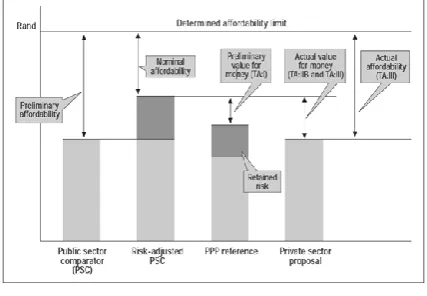
stated that the public sector has been plagued with a lack of benchmarking know-how, which has led to some experimentation. The PSB and the PSC serve as perfect examples of this since they use the benchmarking process in an unorthodox manner. Whereas in a traditional benchmarking process, the party initiating the study would seek the best in class in order to compare against, in the public procurement benchmarking model, the party initiating the benchmark actually compares against its own already established benchmark. However, as experimental as it may seem, and as outside of the traditional benchmarking model as it is, this model does perform a very useful function. It produces a best value and value for money assessment and involves the benchmarking process. In a sense, public procurement benchmarking is a sort of reverse traditional benchmarking tool. Figure 3 graphically shows how the value for money assessment is made.
Figure 3. Affordability and value for money
Source: National Treasury PPP Unit (2004)
Essentially, the public administration team calculates what the cost of the project would be should it be completed completely via public sector means. Secondly, bidders are invited to submit their offers which are then compared to the already established benchmark. The major flaw in this approach is the fact that the invited bidders may not necessarily represent the best offer. As has already been said, one of the keys of benchmarking is to compare against the best in class; this is not the case here, in fact, the best offer may not even be near the best in class.
Conclusions
This article has identified benchmarking processes variations and concluded that although each benchmarking study may utilize different steps, it will always follow the Plan-Do-Check-Act cyclical model.
Additionally, this article has examined some of the perceived limitations of benchmarking: static perception, transferability, diversity, lack of direction and reductionism approach; and showed how easily they can be avoided. While private sector benchmarking always functions in a manner seeking best practice in a given field,
public sector benchmarking seems content with satisfactory, not necessarily the best results.
Knowledge management through private sector benchmarking leads to the creation of private intellectual property which does not have to be shared, while knowledge gained through public sector benchmarking can be considered public property and thus should be shared. While, private sector benchmarking necessarily functions in a manner seeking best practice in a given field, public sector benchmarking seems content with results that are simply satisfactory, but not necessarily the best (Bowerman et al., 2002).
Essentially, what all three of these differences assume is that the public sector does not seek value-for-money. All of these differences assume that the public sector does not seek value-for-money. The functions and types of benchmarking applied in the public sector to overcome this problem include voluntary, compulsory, strategic, performance measuring, public procurement and best value benchmarking.
Triantafillou (2007) has identified benchmarking in the public sector as a governing technology that seeks to facilitate the self governing capacities of individuals or organizations through the production of knowledge on the activity targeted by governing.
As Gallagher (2005) had shown, the use of series of benchmarks can help in making solid base for factual approach to decision making with regard to setting specific targets for performances of the public administration system, its reform and modernization, and monitoring progress over time.
We have identified the most of benchmarking functions and types applied in the public sector, compiled a list which includes voluntary, compulsory, performance measuring, public procurement and best value benchmarking, and explained there constraints and benefits.
This article has also examined the ways some governments have utilized benchmarking - the Public Sector Benchmark of the Republic of Ireland and the Public Sector Comparator of South Africa enabled experimental implementation of benchmarking in order to increase effectiveness and efficiency of their governments. Both the PSB and PSC were used for public procurement to establish a benchmark that includes the costs of executing a given project using traditional public procurement means, and then to compare all other offers against this established benchmark.
It should also be said that benchmarking in the public sector and public administration has had varied effectiveness in its implementation. This is largely due to the lack of know-how and proper porting of the benchmarking idea. However, benchmarking remains to have an enormous amount of untapped potential that could be utilized in making it an essential tool in the public sector and public administration.
References
Auluck, R. (2002). Benchmarking: A Tool for Facilitating Organizational Learning? Public Administration and Development 22, 109-122. http://dx.doi.org/10.1002/pad.219
Ball, A., Bowerman, M., & Hawksworth, S. (2000). Benchmarking in Local Government Under a Central Government Agenda. Benchmarking: An International Journal 7(1), 20-34. http://dx.doi.org/10.1108/14635770010314927
Barker, L., & Rubycz, R. (1996). Performance Improvement in Public Service Delivery: A Tool-kit for Managers. Pitman: London, UK.
Bateman, G., R. (1989). Benchmarking management education: Teaching and Curriculum. In Camp, R., (Ed.). Benchmarking, Quality Resources. White Plains, USA.
Bhutta, K., & Huq, F. (1999). Benchmarking – Best Practices: an Integrated Approach. Benchmarking for Quality Management & Technology 6(3), 254-268. http://dx.doi.org/10.1108/14635779910289261
Bogan, C., E., & English, M., J. (1994). Benchmarking for Best Practices: Winning Through Innovative Adaptation. McGraw-Hill: New York, USA.
Bowerman, M., & Ball, A. (2000). Great Expectations: Benchmarking for Best Value. Public Money & Management 20(2), 21-26. http://dx.doi.org/10.1111/1467-9302.00207
Bowerman, M., Francis, G., Ball, A., & Fry, J. (2002). The Evolution of Benchmarking in the UK Local Authorities. Benchmarking: An International Journal 9(5), 429-449. http://dx.doi.org/10.1108/14635770210451455
Boxwell, R., J., Jr. (1994). Benchmarking for Competitive Advantage. McGraw-Hill: New York City, USA.
Büyüközkan, G., & Maire, J., L. (1998). Benchmarking Process Formalization and a Case Study. Benchmarking for Quality Management & Technology 5(2), 101-125. http://dx.doi.org/10.1108/14635779810212356
Camp, R., C. (1989). Benchmarking the Search for Industry Bbest Ppractices that Lead to Superior Performance. Quality Resources. White Plains, USA.
Central PPP Policy Unit – Government of the Republic of Ireland: Technical Note on the compilation of a Public Sector Benchmark for a Public Private Partnership Project – January 2007. Available from internet: http://www.ppp.gov.ie, Accessed: February 17th, 2010.
Chamberland, D. (2005). Boosting your Best Practices. Purchasing B2B 47(6), 16-17.
Copestake, J. (2002). Learning to Suck Eggs, or is There a Case for a Postgraduate Development Studies Benchmark? Public Administration and Development 22, 303-308. http://dx.doi.org/10.1002/pad.237
Davis, P. (1998). The Burgeoning of Benchmarking in British local Government. Benchmarking for Quality Management & Technology 5(4), 260-270. http://dx.doi.org/10.1108/14635779810245099
Dorsch, J., J., & Yasin, M., M. (1998). A Framework for Benchmarking in the Public Sector: Literature Review and Directions for Future Research. International Journal of Public Sector Management 11(2/3), 91-115. http://dx.doi.org/10.1108/09513559810216410
Elmuti, D., & Kathawala, Y. (1997). An Overview of Benchmarking Process: a Tool for Continuous Improvement and Competitive Aadvantage. Benchmarking for Quality Management & Technology 4(4), 229-243. http://dx.doi.org/10.1108/14635779710195087
Fernandez, P., McCarthy, I., P., & Rakotobe-Joel, T. (2001). An evolutionary approach to benchmarking. Benchmarking: An International Journal 8(4), 281-305. http://dx.doi.org/10.1108/14635770110403783
Finnigan, J., P. (1996). The Managers Guide to Benchmarking. Jossey-Bass: San Francisco, USA.
Gallagher, M. (2005). Benchmarking Tax Systems. Public Administration and Development 25, 125-144. http://dx.doi.org/10.1002/pad.353
Geber, B. (1994). Benchmarking at Kodak: How to Measure a Maintenance Unit. Lakewood Publications, USA
Gunasekaran, A. (2005). Editorial: Benchmarking in Public Sector Organizations. Benchmarking: An International Journal, 12(4).
Holloway, J., Hinton, M., Francis, G., & Mayle, D. (1999). Identifying Best Practice in Benchmarking. CIMA Research Series. London, U.K.: CIMA Publishing.
Longbottom, D. (2000). Benchmarking in the UK: An Empirical Study of Practitioners and Academics. Benchmarking 7, 98-117. http://dx.doi.org/10.1108/14635770010322324
Magd, H., & Curry, A. (2003). Benchmarking: Achieving Best Value in Public Sector Organizations. Benchmarking: An International Journal 10(3), 261-286. http://dx.doi.org/10.1108/14635770310477780
Matters, M., & Evans, A. (1997). The Nuts and Bolts of Benchmarking. Alpha Publications Pty. Ltd: Melbourne, Australia McAdam, R., & Walker, T. (2004). Evaluating the Best Value Framework in UK Local Government Services. Public
Administration and Development 24, 183-196. http://dx.doi.org/10.1002/pad.275
McNair, C., J., & Leibfried, K., H., J. (1992). Benchmarking: A Tool for Continuous Improvement. Oliver Wright. Essex Junction, UK.
Omachonu, V., K, & Ross, J. R. (1994). Principles of Total Quality. St. Lucie Press: Delray Beach, USA.
Palaneeswaran, E., & Kumaraswamy, M., M. (2000). Benchmarking Contractor Selection Practices in Public-Sector Construction – a Proposed Model. Engineering Construction & Architectural Management 7(3), 285-299.
Pulat, M., B. (1994). Benchmarking is More than Organized Tourism. Industrial Engineering 26(3), 22-24.
Raymond, J. (2008). Benchmarking in Public Procurement. Benchmarking: An International Journal 15(6), 782-793. http://dx.doi.org/10.1108/14635770810915940
Triantafillou, P. (2007). Benchmarking in the Public Sector: A Critical Conceptual Framework. Public Administration 85(3), 829-846. http://dx.doi.org/10.1111/j.1467-9299.2007.00669.x
Walsh, K. (1991). Quality and Public Services. Public Administration 69(4), 503-514. http://dx.doi.org/10.1111/j.1467-9299.1991.tb00917.x
Watson, G. (1994). A Perspective on Benchmarking, Benchmarking for Quality Management & Technology 1(1), 5-10. http://dx.doi.org/10.1108/14635779410056840
Wynn-Williams, K., L., H. (2005). Performance Assessment and Benchmarking in the Public Sector: An Example from New Zealand. Benchmarking: An International Journal 12(5), 482-492. http://dx.doi.org/10.1108/146357 70510619393
Dusan Milosevic, Mladen Djuric, Jovan Filipovic, Slobodan Ristic
Lyginamoji analizė kaip kokybės valdymo priemonė viešajame administravime
Santrauka
Per pastaruosius du dešimtmečius, kokybės valdymas viešojo administravimo srityje tapo augančia ir tobulėjančia koncepcija. Praktikai suprato, kad našumas ir efektyvumas yra dvi idėjos, kurios valdys ir privalo valdyti viską, net labiausiai atsilikusią, varžančią biurokratiją. Tačiau, kai privataus sektoriaus koncepcijos nukreipiamos į viešąjį sektorių, atsiranda tam tikrų nenuoseklumų. Dažniausiai bandymas taikyti privataus sektoriaus technines žinias viešajame sektoriuje baigdavosi kaip „Frankenšteino pabaisai“. Ne vienas tuo metu kėlė klausimą: Ar gali viešasis sektorius, o dar tiksliau viešojo sektoriaus administravimas, veikti taip, kad galėtų tinkamai priimti tam tikras, privataus sektoriaus valdymo priemones? Atsakymas paprastas: jis privalo tai padaryti, jei nori išlikti. Šiame straipsnyje nagrinėjama lyginamosios analizės teorija, jos atsiradimas privačiajame sektoriuje ir tolesnis jos diegimas viešajame sektoriuje. Šio straipsnio tikslas – tinkamas lyginamosios analizės proceso nukreipimas į viešojo administravimo sektorių. Analize siekiama įrodyti, kad kokybės valdymo principai ir ypač lyginamoji analizė viešojo administravimo sektoriuje gali veikti taip pat našiai ir efektyviai, kaip ir bet kurioje privataus sektoriaus organizacijoje. Tyrimo metodai – su šia tema susijusios literatūros apžvalga ir analizė. Siekiant praktiniais pavyzdžiais patvirtinti mūsų rezultatus dėl lyginamosios analizės, kaip kokybės valdymo priemonės naudojimo viešajame administravime, įtraukta nagrinėtų pavyzdžių analizė. Pasak Watson (1994), egzistuoja trys svarbūs privalumai atlikti lyginamosios analizės tyrimą. Pirma – lyginamoji analizė pateikia nepriklausomą įvertinimą to, kaip gerai veikia procesas, kartu įvertinant panašių procesų veikimą skirtingose organizacijose arba atskiros organizacijos junginiuose. Antra – lyginamoji analizė suteikia paskatą/perversmą sukeliančių pokyčių iniciatyvoms tapti realybe, kartu sustiprinant kūrybiškumą ir inovacijas komandų, kurios dirba tobulindamos procesą. Trečia – lyginamoji analizė išplečia organizacijos ar junginių patirtį.
Išanalizavęs skirtingus lyginamosios analizės tipus (veiklos, proceso, strategijos, vidinė, konkurencinė, funkcinė ir bendra), Auluck (2002) pabrėžė, kad nors kiekvienas lyginamosios analizės tyrimas gali naudoti skirtingus žingsnius, jis visada bus atliktas pagal P-D-C-A (plg. angl. Plan „planuok“ –
Do „daryk“ – Check „tikrink“ – Act „veik“) ciklinį modelį. Išsiaiškinęs lyginamosios analizės problemas ir suvaržymus, autorius išskyrė būtinybę imtis
lyginamosios analizės projektų viešajame sektoriuje, po kurių seka susirūpinimas dėl supratimo ir motyvacijos (Longbottom, 2000). Dėl šios priežasties
buvo nuspręsta išsamiau ir plačiau panagrinėti papildomai pastebėtus lyginamosios analizės apribojimus ir jų įtaką taikant viešajame sektoriuje. Lyginamosios analizės taikymas viešajame sektoriuje per pastaruosius du dešimtmečius eksponentiškai išaugo. Šis augimas buvo ypač ryškus sveikatos ir draudimo įstaigose bei projektuose, kurie apėmė sutarčių sudarymą su neviešųjų paslaugų šalimis (Dorsch ir Yasin, 1998). Literatūros, analizuojančios šią temą randama jau dešimtajame dešimtmetyje, tačiau pagrindinis aspektas joje buvo sutelktas į tiesioginį privataus sektoriaus lyginamosios analizės patirties nukreipimą į viešąjį sektorių. Kai kurie autoriai teigia, kad egzistuoja skirtumai tarp lyginamosios analizės privačiame ir viešajame sektoriuose, ir, kad tie skirtumai turi būti tinkamai nukreipti. Iš esmės, visi skirtumai tarp privataus ir viešojo sektorių reiškia, kad viešasis sektorius nesiekia piniginės vertės. Taip pat literatūroje, vertinant lyginamąją analizę privačiame sektoriuje, yra teigiama, kad ji ne tokia organizuota ir tvarkinga. Šis straipsnis leidžia atsakyti į klausimą: ar lyginamoji analizė gali taip pat našiai ir efektyviai funkcionuoti viešojo administravimo sektoriuje, kaip ir bet kurioje privataus sektoriaus organizacijoje, parodant kaip vyriausybės sugebėjo panaudoti lyginamąją analizę, norėdamos pagerinti savo
veiklą. Žinių valdymas per privataus sektoriaus lyginamąją analizę veda prie privačios intelektualinės nuosavybės sukūrimo, kuria neturi būti
pasidalinama, o žinios, gautos per viešojo sektoriaus lyginamąją analizę gali būti laikomos vieša nuosavybe ir todėl jomis reikia dalintis. Kol privataus sektoriaus lyginamoji analizė būtinai ieško geriausios praktikos duotoje srityje, viešojo sektoriaus lyginamoji analizė, atrodo, tenkinasi rezultatais, kurie yra tiesiog patenkinami, bet nebūtinai geriausi (Bowerman ir kt., 2002). Triantafillou (2007) nustatė lyginamąją analizę viešajame sektoriuje kaip pagrindinę technologiją, kuri siekia palengvinti individų ar organizacijų savivaldos gebėjimus kuriant žinias apie valdymu nustatytą veiklą.
Kaip parodė Gallagher (2005), daugelio lyginamųjų analizių panaudojimas gali padėti sukuriant tvirtą pagrindą faktiškam metodui, skirtam sprendimams priimti, kartu atsižvelgiant į tam tikrų tikslų nustatymą viešojo administravimo sistemos veiklai, jos pertvarkymui ir modernizacijai, bei kontroliavimui laikui bėgant. Mes nustatėme daug lyginamosios analizės funkcijų ir tipų, taikomų viešajame sektoriuje. Buvo sudarytas sąrašas, kuris apima savanorišką, privalomąją, veiklos įvertinimo, viešųjų pirkimų ir geriausios vertės lyginamąją analizę ir paaiškinti suvaržymai ir nauda.
Šiame straipsnyje taip pat išnagrinėti būdai, kuriais kai kurios vyriausybės panaudojo lyginamąją analizę. Airijos respublikos Viešojo sektoriaus
lyginamoji analizė (PSN) ir Pietų Afrikos Viešojo sektoriaus komparatorius (PSC) leido įdiegti eksperimentinę lyginamąją analizę siekiant padidinti jų
vyriausybių efektyvumą ir našumą. Ir PSB, ir PSC buvo panaudoti viešiesiems pirkimams, norint nustatyti tokią lyginamąją analizę, kuri apimą duoto projekto vykdymo kaštus, naudojant tradicines viešojo pirkimo priemones, o tada palyginti visus kitus pasiūlymus su tais, kuriuos nustatė lyginamoji
analizė. Kadangi lyginamoji analizė išlaiko didžiulius kiekius nepanaudotų galimybių, kurias galima būtų panaudoti kuriant pagrindines priemones
viešajame sektoriuje ir viešajame administravime, šis straipsnis nukreipia lyginamosios analizės idėją ten, kur rezultatai tenkintų, jei tai būtų atlikta privataus sektoriaus koorporacijai. Šie autoriai tiki, kad vienintelis dalykas kurio trūksta tinkamam kokybės valdymo praktikos įdiegimui viešajame administravime yra ekspertai, kurie žino ką ir kaip daryti.
Raktiniai žodžiai: lyginamoji analizė, kokybės valdymas, viešasis administravimas, viešieji pirkimai, privatus sektorius, veikla
The article has been reviewed.
![Figure 1. The Benchmarking Wheel Source: Bhuta & Huq (1999) [Adapted from Camp (1989)]](https://thumb-us.123doks.com/thumbv2/123dok_us/9999579.1987553/3.595.320.531.338.546/figure-benchmarking-wheel-source-bhuta-huq-adapted-camp.webp)