107
Presenting three design methods for axial compressor blade via
optimization
Omid Fathia, Hadi Kargarsharifabada,b,*
aDepartment of Mechanical Engineering, Najafabad Branch, Islamic Azad University, Najafabad, Iran. bEnergy and Sustainable Development Research Center, Semnan Branch, Islamic Azad University, Semnan, Iran
Article info: Abstract
Improving the efficiency of compressors has been one of the most important goals of researchers over the years. In this paper, three different methods are presented for parameterization and blade optimization of axial flow compressor. All methods consist of flow analysis tool, optimization algorithms, and parametric geometry generation tool that are different in each approach. An objective function is defined based on the aerodynamic performance of blade in the acceptable incidence angles range. A double circular arc blade is used as the initial guess for all methods. The performance of optimized blades and the initial blade are compared to evaluate the capability of various methods, and a good agreement is achieved. The results show that the level of performance improvement in each method depends on the number and type of the chosen parameters. All three methods have improved blade performance at the design incidence angle. However, only the first method shows significant performance improvement in off-design conditions.
Received: 30/09/2016 Accepted: 10/01/2018 Online: 10/04/2018
Keywords:
Parametric geometry, Loss coefficient, Optimization algorithm, Multi-point objective function.
Nomenclature
𝜇
Angle of the suction surface
𝑐
Blade chord
χ
Edge angles of leading and trailing
L
Length
ω Loss coefficient
𝑛
Height control points
Subtitles
𝑡
Distance control points of the leading edge
1,2,3,4
Different length indicator
Wi
The weight of the objective function
Ave
The average value
x
Coordinates x
coef Coefficient
y
Coordinates y
e Exit
Greek signs
l Leading edge Parameters
∝
The angle of attack
γ
Installation angle i
Input
𝑚𝑖𝑛
Minimize loss
∆𝛼
Interval changes the angle of attack
ref Reference values
1. Introduction
The axial compressor is one of the largest power consumers in industries. For example, the
JCARME Omid Fathi, et al Vol. 8, No. 1
108
the years. Aerodynamic optimization is an important factor in compressor efficiency enhancement. Nowadays, different methods of optimal design, including aerodynamic design, have brought about many improvements in the operation of axial compressors. In general, the aerodynamic design of axial compressors aims at increasing efficiency, raising pressure ratio, widen operational range, and increasing surge margins. Each goal has different effects on the configuration of the compressor. In this regard, a great deal of research has been conducted to develop optimized methods for blade design using numerical algorithms. Adopting a geometrical production tool along with an optimization method and a tool for fluid dynamic analysis of the flow are typical options in the optimal design of compressor blades. Park et al. [1] presented three-dimensional measures of a one-row blade. Bonaiuti and Zangeneh [2] presented a strategy for multiple-point and multiple-purpose three-dimensional optimization of turbo-machinery blades. This strategy was developed based on the reverse design of the blade; they integrated response surface optimization, multi-objective evolutionary algorithm, and computational fluid dynamics analysis. Korakanites [3] presented a method for the direct design of the blade aiming at enhancing the capability of two-dimensional geometry production of the blade. This method is used to produce input blade in direct or reverse design in subsonic and supersonic circumstances for turbine and compressor. This procedure improves aerodynamic and heat transfer operation of the blade. Many researchers such as Sonoda and et al. [4], Shahpar and Rodford [5], Kammerer and et al. [6], Buche and et al. [7], Benini and Tourlidakis [8], Bonaiuti and Pediroda [9] conducted many activities to reduce the computational costs of the numerical design of the blade. Siddappaji et al. [10] presented a new multi-dimensional method that consists of low- level optimizations of the thorough flow and used empirical relations to estimate performance. Their method is only valid for preliminary design and the design using conventional blades. Jaron et al. [11] presented a new method for optimizing blade of the
compressor for reducing noise on trailing edge. Vitale et al. [12] developed a new adjoint solver for non-ideal compressible flow method for designing compressor blade.
Turbo-machinery designs are usually multi-dimensional problems in which different parameters should be considered in the design process. Multi-objective optimizations require a lot of simulations. Therefore, the use of automatic methods for blade design is limited due to high computational costs. This problem becomes acuter when operational parameters are calculated at multiple operational points. Hence, several simulations are carried out to estimate the performance of a blade.
In this study, three different methods are presented for parameterization and multiple-point optimization of compressor blades, as well as the ability and computational costs of these methods in achieving the designer's desired objectives, are compared.
2. Problem description
109 from stall to choke are shown. In general,
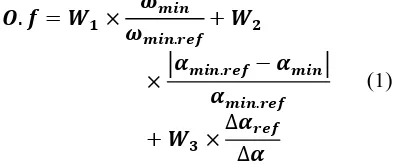
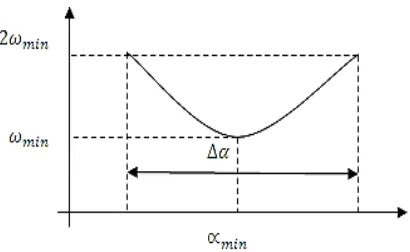
optimization is carried out to increase ∆α and reduce 𝜔𝑚𝑖𝑛 in a certain 𝛼𝑚𝑖𝑛. By increasing
the loading of the blades, the minimum value of loss increases, and the value of ∆α decreases. In cases where there are not many changes in off-designs, the design can be done aiming at reducing the minimum loss, and in cases where the changes of the angle of attack in off-design circumstances are huge, design can be done aiming at increasing ∆α. Eq. (1) shows the proposed objective function to design the blade in this study.
𝑶. 𝒇 = 𝑾𝟏×
𝝎𝒎𝒊𝒏
𝝎𝒎𝒊𝒏.𝒓𝒆𝒇
+ 𝑾𝟐
×|𝜶𝒎𝒊𝒏.𝒓𝒆𝒇− 𝜶𝒎𝒊𝒏| 𝜶𝒎𝒊𝒏.𝒓𝒆𝒇
+ 𝑾𝟑×
∆𝜶𝒓𝒆𝒇
∆𝜶
(1)
where the values with the ref subscripts are the values obtained from the middle pass flow of the compressor. Wi is the weight of each term of the objective function. The designer applies the philosophy of the blade design to the design tool using these weights.
The computational cost of the above objective is high because the calculation of equation parameters need cascade fluid analysis of the blade in a few different points.
3. Optimization process
In this research, the direct method is used to design the blade. In this procedure, the designer gives the geometry as input to flow analysis code and receives the operation of the blade as output. The blade performance can play a guiding role for decreasing and increasing the loads applied and to decide how to improve blade surface. In reverse or quasi-reverse methods, pressure distribution or Mach number should be determined on the blade surface. Given that appropriate Mach number and pressure distribution corresponding to
the design, the objective is unclear, and using these methods in the mentioned design system requires an extra design loop to determine the appropriate distribution of pressure or Mach number on the blades.
JCARME Omid Fathi, et al. Vol. 8, No. 1
110
Fig. 1. (a) 16-stage axial compressor, (b) incidence angle and (c) profile loss at mean line [13].
Fig. 2. Loss variation versus incidence angle [13]. Fig. 3. Blade optimization process.
(a)
(b)
111
3.1. Geometry parameterization methods
An appropriate design system requires a tool which can produce a suitable geometric model of a blade in addition to high flexibility with the least number of parameters. Thru increasing the loading of the compressor blade, due to a rise in the negative pressure gradient, the value of minimum drop increases and the gradient of drop variations decreases in proportion to the angle of attack. Therefore, the designer must strike a balance between the load of the blade, the minimum value of decline and the variation range of the angle of attack. The more flexible the parametric geometry of the production method, the higher the possibility of designing a blade with better flow control. On the other hand, the increase in the number of parameters means a rise in time and calculation costs of the blade design. In each method, two-dimensional geometries of a blade are defined by four curves: leading and trailing edges and pressure and suction surfaces. Leading edges in each of the three methods are defined by the arc of a circle. A shape function, Eq. (2), is also added which causes the value of the curvature of leading edge to change so by an increase in the value of α, the value of the angle of attack decreases (the leading edge become more beveled). Fig. 4 shows a leading edge and the parameters used to define it. In all three methods, trailing edge is defined by a semi-circle. The semi-circle diameter is one of the constructional limitations which should not become less than the allowable minimum value in the entire optimization process.
Fig. 4. Geometric parameterization of leading edge.
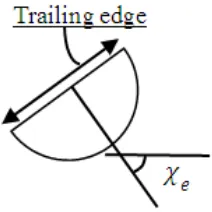
Therefore, the only parameters that enter the optimization process are the angle of trailing edge and its thickness (Eq. (2)).
𝒇(𝒙) = (𝒙 × (𝟏 − 𝒙))∝
0 < 𝛼 < 1 (2)
Fig. 5 shows the geometry of the trailing edge and the parameters used to define it. There are three different methods to define suction and pressure surfaces in different blade optimization methods. In the first method, the suction surface is defined by an 8-point Bezier curve. The 1st and 8th points are achieved through the geometry of the leading and trailing edges.
Fig. 5. Geometric parameterization of trailing edge.
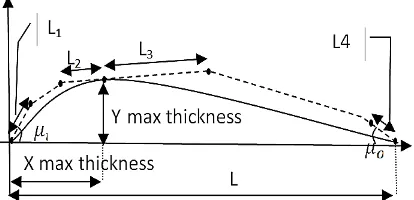
The coordinates of the 5th and 6th points are among design parameters. The coordinates of the 2nd, 3rd, 6th, and 7th points, assuming that the curve and rigidity of the curve (Eqs. (3 and 4)) are known, are calculated at the beginning and the end of the intake surface. Fig. 6 shows the geometry and the parameters used to define the suction surface in the first method.
Fig. 6. Geometry and parameters used of suction surface in the first method.
Leading edge
α
JCARME Omid Fathi, et al Vol. 8, No. 1
112
The number of parameters in this method is large; however, due to the close relationship of the curvature (k) and rigidity of surfaces with cascade flow pattern, this method brings about an improvement in the optimization speed.
𝜿 = (𝒙̇𝒚̈ − 𝒚̇𝒙̈)
(𝒙̇𝟐+ 𝒚̇𝟐)𝟑⁄𝟐 (3)
𝑠𝑡𝑖𝑓𝑓𝑛𝑒𝑠𝑠 =(𝑥̇𝑥̈ + 𝑦̇𝑦̈)
(𝑥̇2+ 𝑦̇2) (4)
In the second method, suction surface is defined by couple of two-point Bezier curves, one from the attack edge up to the maximum thickness place and the other, from leading edge to the maximum thickness place. The coordinates of the initial and final points of the suction surface are obtained through leading edge and trailing edge surfaces curves, and the coordinates of other points are defined as parameters; they are considered to be the same at the junction of the slope and the curvature of two curves. Fig. 7 shows the geometry and the parameters used to define the suction surface using the second method.
Fig. 7. Geometry and parameters of suction surface in the second method.
The great number of parameters in the two mentioned methods increases the computational costs of blade design. Fig. 8 shows the geometry and the parameters used to define the blade in the third method. The suction surface in the third method is defined by a four-point Bezier curve. In this method, the coordinates of the 1st and the 4th points of the Bezier curve are obtained from the geometry of the leading and trailing edge surfaces. Therefore, only the coordinates of the 2nd and 3rd points have a role in defining suction surface as a design parameter. Given the low number of parameters
in this method, optimization costs are lower, but the flexibility of this method is also lower than the former. The pressure surface in the first method is defined by a 5-point Bezier curve. However, in the second and third methods, pressure surface is defined similarly to suction surface.
Fig. 8. Geometry and parameters of suction surface in the third method.
3. 2. Flow analysis
Accurate calculations of the cascade loss in different conditions are necessary to determine an objective function. Thus, a flow analysis tool including mesh generation tool as well as computational fluid dynamics solver is used to calculate cascade losses. The flow field is automatically divided into several zones in a way that one structured mesh is used for each zone which is able to make a fine mesh near the walls. A two-dimensional compressible viscous flow code is used to simulate the cascade fluid flow. This code is developed based on Roe scheme, so that it could be used to design transonic blades, too. The method presented by Kermani and Plett [14] is used to solve the fluid equations by the Roe scheme in the computational domain and to give a formula for the Roe’s numerical fluxes in generalized coordinates. The fluid governing equations for the viscous, unsteady and compressible flow in generalized coordinates with no body force could be shown as follows:
𝜕𝑄1
𝜕𝑡 + 𝜕𝐹1
𝜕𝜉 + 𝜕𝐺1
𝜕𝜂 = 𝜕𝐺1𝑉𝑇
𝜕𝜂 (5)
113 approximation). Therefore the governing
equation can be discretized as follows:
𝜕𝑄1
𝜕𝑡 +
𝐹1𝐸− 𝐹1𝑤
𝛥𝜉 +
𝐺1𝑁− 𝐺1𝑆
𝛥𝜂
=𝐺1𝑉𝑇𝑁− 𝐺1𝑉𝑇𝑆 𝛥𝜂
(6)
For the time discretization, the two-step explicit scheme, from the Lax-Wendorff family of predictor-correctors, is used. The inviscid numerical flux F1E based on the Roe scheme is written in generalized coordinates, according to Ref. [14]. The other flux term can be written the same as F1E (Eq. 7).
𝐹𝐼𝐸
=1 2[𝐹1𝐸
𝐿 + 𝐹 1𝐸
𝑅]
−1
2∑ |𝜆̂𝐸
(𝑘)
|
4
𝑘=1
𝛿𝜔𝐸(𝐾)𝑇̂𝐸(𝑘)
[
√𝜉𝑥2+ 𝜉𝑦2
𝐽 ]𝐸
(7)
In order to obtain the left (L) and right (R) flow conditions, a third order upwind-based algorithm with MUSCL extrapolation strategy [15] is applied to the primitive variables (pressure, velocity components and temperature). For example, at the east cell face of the control volume, E, L and R flow conditions are determined as (k=1/3 in this study):
𝑞𝐸𝐿 = 𝑞𝑗,𝑘+
1
4[(1 − 𝑘)𝛥𝑤𝑞 + (1 + 𝑘)𝛥𝐸𝑞]
𝑞𝐸𝑅 = 𝑞 𝑗+1,𝑘−
1
4[(1 − 𝑘)Δ𝐸𝐸𝑞 + (1 + 𝑘)Δ𝐸𝑞]
(8)
For successful modeling of the turbulent effects on the flow, the 𝐾−ω (𝑆𝑆𝑇) method is utilized to incorporate modifications for low-Reynolds number effect, compressibility and shear flow spreading. k-ω (SST) model consists of a transformation of the k-e model in the outer region to a k-ω formulation near the surface by a blending function F1. Eqs. (9 and 10) are k and ω of the model, respectively.
𝜕(𝜌𝑘) 𝜕𝑡 +
𝜕 𝜕𝑥𝑗
(𝜌𝑈𝑗𝑘)
= 𝜕 𝜕𝑥𝑗
[(+ 𝜇𝑡 𝜎𝑘3
)𝜕𝑘 𝜕𝑥𝑗
]
+ 𝑃𝑘+ 𝛽́𝜌𝑘𝜔
(9)
𝜕(𝜌𝜔) 𝜕𝑡 +
𝜕 𝜕𝑥𝑗
(𝜌𝑈𝑗𝜔)
= 𝜕 𝜕𝑥𝑗
[(𝜇 + 𝜇𝑡 𝜎𝜔2
)𝜕𝜔 𝜕𝑥𝑗
]
+ (1 − 𝐹1)2𝜌
1 𝜎𝜔2𝜔
𝜕𝑘 𝜕𝑥𝑗
𝜕𝜔 𝜕𝑥𝑗
+ 𝑎3
𝑤
𝑘𝑃𝑘+ 𝛽3𝜌𝜔
2
(10)
In this model, the eddy-viscosity formulation is used by a limiter to consider the transport of the turbulent shear stress (Eq. (11)).
𝑞𝐸𝐿= 𝑞𝑗,𝑘+
1
4[(1 − 𝑘)𝛥𝑤𝑞 + (1 + 𝑘)𝛥𝐸𝑞]
𝑞𝐸𝑅= 𝑞𝑗+1,𝑘−
1
4[(1 − 𝑘)Δ𝐸𝐸𝑞 + (1 + 𝑘)Δ𝐸𝑞]
μt= ρ
a1k
max (a1ω, SF2)
(11)
F2 is a blending function which restricts the limiter to the wall boundary layer. S is an invariant measure of the strain rate. The blending functions are defined based on the distance to the nearest wall and the flow variables by Eqs. (12 and 13).
𝐹1= 𝑡𝑎𝑛ℎ
((𝑚𝑖𝑛 (𝑚𝑎𝑥 (√𝑘 𝛽́𝜔𝑦,
500𝜈 𝑦2𝜔) ,
4𝜌𝑘 𝐶𝐷𝑘𝑤𝜎𝜔2𝑦2
))
4
)
(12) where:
𝐶𝐷𝑘𝜔= 𝑚𝑎𝑥 (2𝜌
1 𝜎𝜔2𝜔
𝜕𝑘 𝜕𝑥𝑗
𝜕𝜔 𝜕𝑥𝑗
, 1.0
× 10−10)
F2= tanh ((max (
2√k β́ωy,
500ν y2ω))
2
)
JCARME Omid Fathi, et al Vol. 8, No. 1
114
All coefficients of the model are listed in Table 1. In order to achieve accurate and reliable results, the tools could make the mesh coarser or finer considering the input condition and the turbulence model. Details of domain mesh are presented in Table 1. Boundary layer mesh is used to satisfy 𝑦+ criteria. Domain mesh is shown in Fig. 9.
Table 1. Blade-to-blade domain mesh.
Boundary Grid number
Grid property Inlet periodic 101 Grid ratio is 1.02 Inlet 51 Grid ratio is 1
Blade walls 101 Grid ratio is 1.02 double side
Outlet periodic 91 Grid ratio is 1.02 Leading and
trailing edges 5 Grid ratio is 1
Boundary layer 10
First row height is 0.01(mm) and growth factor is 1.25
Fig. 9. Cascade domain mesh.
The surface pressure coefficient (Eq. (14)) distributions at design point conditions resulting from the experimental cascade tests [16] and Naiver-Stokes solver calculations for a controlled diffusion blade are shown in Fig. 10.
𝐶𝑝=
𝑝 − 𝑝1
0.5𝜌𝑉2 (14)
A good agreement between the experimental data and those simulated by the presented flow
solver is observed. This agreement is pronounced along the whole blade surfaces. Therefore, the comparison indicated that the present flow solver has enough accuracy to be used in this work.
Fig. 10. Pressure coefficient over blade surfaces comparing the experimental [13] and numerical results.
4. Results and discussion
115 In this paper, three different methods are
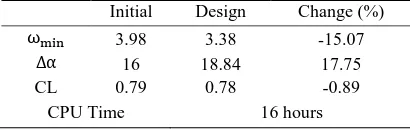
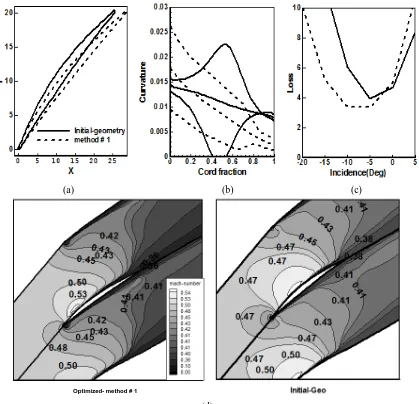
presented to optimize the blades of an axial flow compressor. The optimization of these blades aims to reduce the loss in the design angle of attack and increase the permitted range of angle of attack. Therefore, weight coefficients of the objective function are considered to be ω1=0.4, ω2=0.2, and ω3=0.4. In all three methods, input and output angles, installation angle, and the proportion of the chord length to the distance among blades are considered to be equal to the primary blade. A double circular arc (DCA) blade is used as the primary guess in each of the three methods. The quality of the optimized blade is achieved by each method through comparing the performance of the blade with the initial blade. The results provided in Tables 2, 3, and 4 show that the greatest reduction in the design point loss coefficient and the greatest increase in the allowable range of the angles of attack are associated with the optimized blade using the first method. Reduction in the loss in the second method is more than the third method; however, increase in the range of allowable angles of attack is inconsiderable in these two methods.
Table 2. Performance comparison between DCA and optimized blade in first method
Initial Design Change (%)
ωmin 3.98 3.38 -15.07 Δα 16 18.84 17.75 CL 0.79 0.78 -0.89
CPU Time 16 hours
Table 3. Performance comparison between DCA and optimized blade in second method.
Initial Design Change (%)
ωmin 3.98 3.49 -12.31
Δα 16 16.24 1.5
CL 0.79 0.79 0
CPU Time 17 hours & 30 minutes
Table 4. Performance comparison between DCA and optimized blade in third method.
Initial Design Change (%)
ωmin 3.98 3.65 -8.29
Δα 16 16.4 2.5
CL 0.79 0.79 0 CPU Time 17 hours & 30 minutes
JCARME Omid Fathi, et al. Vol. 8, No. 1
116
(a) (b) (c)
(d)
Fig. 11. Comparison between DCA (solid line) and optimized blade in first method (dashed line), a: Blade geometry, b: Curvature variation along the chord, c: Loss variation versus incidence angle, d: Mach distribution.
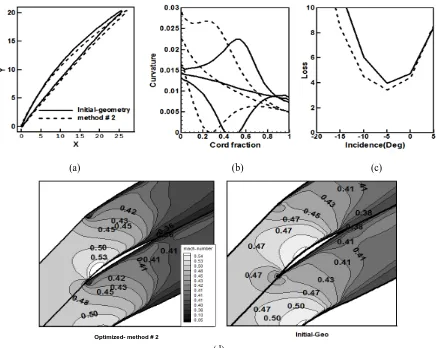
Fig. 12 compares the geometry and the operation of the optimized blade using the second method with the primary blade. Fig. 12(a) shows the comparison between the geometry of the optimized blade and DCA blade. As shown in Fig. 12(b), the maximum curvature place in the optimized blade is a bit closer to leading edge rather primary blade. Therefore, the place of the maximum Mach number in this blade is closer to leading edge rather that of the primary blade. Fig. 12(d) shows that the flow accelerates at the beginning of this blade. The acceleration in the design angle of the attack causes the transition of flow from laminar to turbulent. Steady reduction
in curvature in the rest of the suction surface causes a small growth in the boundary layer in the suction surface. Therefore, the boundary layer's thickness at trailing edge in this blade is less than that of the primary blade (Fig. 12(d)). In off-design conditions, the leading edge causes flow transition from laminar to turbulent. The acceleration on the suction surface causes rapid growth of the boundary layer or flow separation at this point. In view of Fig. 12(c), blade operation in off-design conditions does not have a significant improvement compared with DCA blade.
117
(a) (b) (c)
(d)
Fig. 12. Comparison between DCA (solid line) and optimized blade in second method (dashed line), a: Blade geometry, b: Curvature variation along the chord, c: Loss variation versus incidence angle, d: Mach distribution.
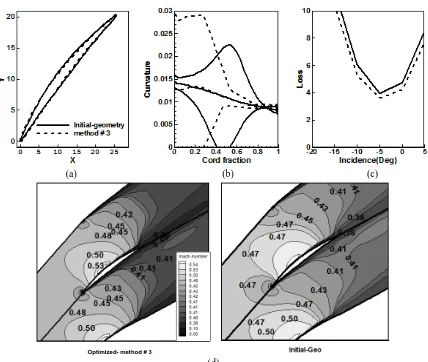
Fig. 13 compares the geometry and performance of the blade optimized using the third method with the primary blade. Fig. 13(a) shows the curvature of the optimized blade which has no considerable changes compared with the primary blade. In the blade optimized using this method, the maximum curvature value is transferred to the beginning of the blade.
Table 2 provides that the number of parameters of the third method is much smaller than that of the other two methods; the optimization time in this method is almost 2.5 times less. However, the maximum curvature of this blade is great compared with that of the primary blade. As shown in Fig. 13(d), the place of the maximum Mach is transferred to the beginning of the blade. Therefore, in design angle, the loss
coefficient has 8% reduction compared with that of the primary blade. In off-design circumstances, the blade operation has no significant improvement because the high curvature of the beginning of the suction surface and the primary acceleration of the flow in attack edge cause rapid growth or separation of the boundary layer in this area. Fig. 13(c) compares the loss curve of the optimized blade and that of the primary blade. However, the reduction in the number of parameters causes the flexibility of blade geometry to decrease in the optimization process; consequently, the improvement in the blade performance is less than that of the other two methods. The number of parameters in the first method is more than that of the second method, but its optimization time is less.
JCARME Omid Fathi, et al. Vol. 8, No. 1
118
(a) (b) (c)
(d)
Fig. 13. Comparison between DCA (solid line) and optimized blade in third method (dashed line), a: Blade geometry, b: Curvature variation along the chord, c: Loss variation versus incidence angle, d: Mach distribution.
Using geometrical parameters, which have a close relationship with the flow pattern on the blade (such as surface curvature which is associated with the distribution of Mach number and the boundary layer growth [9]) causes the optimization time in the first method to decrease. Therefore, the numbers and types of design parameters have a great impact on the time and quality of blade optimization.
5. Conclusions
The present study presents three different methods for multiple-point optimization of the axial flow compressor blades. DCA blade is used in all three methods as the primary guess. The first method has the highest number of
parameters and, after that, the second and third methods have the highest number of parameters, respectively. The most performance improvement is related to the first method with 15% reduction in the loss coefficient of the design angle of attack and 17% increase in the allowed range of performance. The optimization of all three blades caused a transfer of the maximum curvature of surfaces from the middle to the front of the blade. In the first method, in which the tool of blade generation is more flexible, the maximum curvature is less, and it is at the beginning of the suction surface. In this method, despite more design parameters compared with the second method, the optimization time is less. The results show that
119 the use of geometrical parameters, which
directly affect the flow pattern, has a great impact on the quality and time of optimization.
References
[1] K. Park, M. G. Turner, K. Siddappaji, S. Dey, and A. Merchant, “Optimization of a 3-stage booster: part 1-the axisymmetric multi-disciplinary optimization approach to compressor design”, in ASME 2011 Turbo Expo: “Turbine Technical Conference and Exposition”, pp. 1413-1422, (2011). [2] D. Bonaiuti and M. Zangeneh, “On the
coupling of inverse design and optimization techniques for the multiobjective, multipoint design of turbomachinery blades”, Journal of Turbomachinery, Vol. 131, No. 2, p. 021014, (2009).
[3] T. Korakianitis, “Hierarchical development of three direct-design methods for two-dimensional axial-turbomachinery cascades”, Journal of turbomachinery, Vol. 115, No. 2, pp. 314-324, (1993).
[4] T. Sonoda, Y. Yamaguchi, T. Arima, M. Olhofer, B. Sendhoff, and H.-A. Schreiber, “Advanced High Turning Compressor Airfoils for Low Reynolds Number Condition: Part 1-Design and Optimization”, in ASME Turbo Expo 2003, “collocated with the 2003 International Joint Power Generation Conference”, pp. 437-450, (2003). [5] S. Shahpar and D. Radford, “Application
of the FAITH linear design system to a compressor blade”, International Society for Air Breathing Engines- ISOABE, “ISABE- International Symposium on Air Breathing Engines”, 14 th, Florence, Italy, (1999).
[6] S. Kammerer, J. Mayer, M. Paffrath, U. Wever, and A. Jung, “Three-dimensional optimization of turbomachinery bladings using sensitivity analysis”, in ASME Turbo Expo 2003, “collocated with the
2003 International Joint Power
Generation Conference”, pp. 1093-1101, (2003).
[7] D. Buche, G. Guidati, and P. Stoll, “Automated design optimization of compressor blades for stationary, large-scale turbomachinery”, in ASME Turbo Expo 2003, “collocated with the 2003 International Joint Power Generation Conference”, pp. 1249-1257, (2003) [8] E. Benini and A. Tourlidakis, “Design
optimization of vaned diffusers of centrifugal compressors using genetic algorithms”, 15th AIAA Computational Fluid Dynamics Conference, Vol. 2583, pp. 2001, (2001).
[9] D. Bonaiuti and V. Pediroda, “Aerodynamic optimization of an industrial centrifugal compressor impeller using genetic algorithms”, in
Proceedings of Eurogen, pp. 467-472, (2001).
[10] K. Siddappaji, M. G. Turner, S. Dey, K. Park, and A. Merchant, “Optimization of a 3-Stage Booster: Part 2-The Parametric 3D Blade Geometry Modeling Tool”, in
ASME 2011 Turbo Expo: “Turbine Technical Conference and Exposition”, pp. 1431-1443, (2011).
[11] R. Jaron, A. Moreau, S. Guérin, and R. Schnell, “Optimization of Trailing-Edge Serrations to Reduce Open-Rotor Tonal Interaction Noise”, Journal of Fluids
Engineering, Vol. 140, No. 2, pp.
021201-021201-8, (2017).
[12] S. Vitale, T. A. Albring, M. Pini, N. R. Gauger, and P. Colonna, “Fully turbulent discrete adjoint solver for non-ideal compressible flow applications”, Journal of the Global Power and Propulsion Society, Vol. 1, pp. 252-270, (2017). [13] H. Schreiber and H. Starken,
“Experimental cascade analysis of atransonic compressor rotor blade section”, Journal of Engineering for
Gas Turbines and Power, Vol. 106,
No. 2, pp. 288-294, (1984).
JCARME Omid Fathi, et al Vol. 8, No. 1
120
[15] B. Van Leer, “Towards the ultimate conservative difference scheme. V. A second-order sequel to Godunov's method”, Journal of computational Physics, Vol. 32, No. 1, pp. 101-136, (1979).
[16] W. Steinert, B. Eisenberg, and H.
Starken, “Design and testing of a controlled diffusion airfoil cascade for industrial axial flow compressor
application”, Journal of
Turbomachinery, Vol. 113, No. 4, pp. 583-590, (1991).
How to cite this paper:
Omid Fathi and Hadi Kargarsharifabad, “ Presenting three design methods for axial compressor blade via optimization” Journal of Computational and Applied Research in Mechanical Engineering, Vol. 8, No. 1, pp.
![Fig. 10. Pressure coefficient over blade surfaces comparing the experimental [13] and numerical results](https://thumb-us.123doks.com/thumbv2/123dok_us/9965865.1984872/8.595.306.500.157.335/pressure-coefficient-blade-surfaces-comparing-experimental-numerical-results.webp)