Journal of Surgery and Trauma 2014; 2(2): 52-58. www.jsurgery.bums.ac.ir
Educational Needs of Patients with Heart Valve Replacement
Surgery in Birjand, 2012
Tayebeh Amirabadi
1, Ahmad Nasiri
2, Toba Kazemi
3, Mojgan Kardan
4 1Atherosclerosis and Coronary Artery Research Centre, M.A. in Nursing and CCU ward head nurse in Vali-e-Asr Hospital, Birjand University of Medical Sciences, Birjand, Iran;
2
Assistant Professor, Department of Nursing, Faculty of Nursing and Midwifery, Birjand University of Medical Sciences, Birjand, Iran;
3
Atherosclerosis and Coronary Artery Research Centre, Professor of Cardiology, Birjand University of Medical Science, Birjand, Iran;
4
B.Sc. in Nursing and CCU ward nurse in Vali-e-Asr Hospital, Birjand University of Medical Sciences, Birjand, Iran.
Received: July 3, 2014 Revised: February 12, 2015 Accepted:February 14, 2015
Abstract
Introduction: Despite advances in cardiac surgery, many patients might still encounter some post-surgical complications and difficulties. To overcome such difficulties, they should receive the required education. In view of the fact that determining the educational needs is the first step in educational planning, the present study aims to determine the educational needs of patients undergoing heart valve replacement.
Methods: This descriptive-analytic study was conducted cross-sectionally during the summer of 2012. The questionnaire was designed by the researchers and covered demographics and knowledge assessment sections (in four categories including the nature of diseases, different types of artificial heart valves, drugs and nutritional diets, and the activity level). The validity of the questionnaire was checked based on content validity and its reliability was calculated 0.89 by Chronbach's alpha. Participants were between 15-80 years of age. Their surgery was performed in the last 3 years. The data was analyzed in SPSS (version 16.0) using descriptive statistical tests (mean and standard deviation), t-test, and ANOVA. The significance level was set at P<0.05.
Results: The finding showed that the highest mean score belonged to the knowledge of the nature of the disease whereas the lowest one, to the knowledge of drugs. As regards to the nature of the disease, there was a significant relationship between educational needs of the patients and their gender (P=0.01), age (P=0.02), education (P=0.005), and marital status (P=0.01). As for the knowledge of drugs, there was a significant relationship between gender and education. On the contrary, there was no significant relationship between the patients’ educational needs and previously-received trainings.
Conclusions: Based on the results of the current study and the changing needs of the patients, nurses should perform needs analysis before starting any educational program. Moreover, by designing a well-organized program and investigating the patients before they leave the hospital, nurses should ensure that such a basic need is met. The findings of this study can help nurses to identify the educational priorities of patients undergoing heart valve replacement.
Key Words: Heart valve replacement; Educational needs; Birjand
Correspondence to:
Mojgan Kardan; B.Sc. in Nursing and CCU ward nurse in Vali-e-Asr Hospital, Iran;
Telephone Number: +985632443041 Email Address: [email protected]
@
2014 Journal of Surgery and Trauma; Birjand University of Medical Sciences Journal Office, Ghaffari Ave., Birjand, I.R. Iran
Tel: +985632443041 (5533) Fax: +985632440488 Po Bax 97175-379 Email: [email protected]
Introduction
Cardiovascular diseases are considered the most epidemic disease in the world and especially in the United States that causes over 12 million losses each year [1]. According to the statistics, 2 million out of 4 million annual deaths in Europe are caused by cardiovascular diseases [2]. Deaths caused by this type of diseases are also increasing in Iran, with the estimated percentage of 46% [3]. If the present condition continues without taking any preventive measures to improve people’s cardiovascular health, it is estimated that 25% of the healthy years of every individual would be lost throughout the world by 2020 [4].
Heart valve disorders pertain to a major category of cardiovascular diseases [5]. Heart valve replacement surgery is regarded as one of the effective and final treatments for this category of diseases. About 250,000 heart operations are done annually, a major part of which includes valve replacement surgery [6]. As regards to the spread of different types of surgical operations, heart valve operation is the second wide-spread surgical operation the heart might experience [7]. To put it statistically, more than 6,000 people in England and 60,000 people in the US undergo heart valve replacement operation each year [8]. In Iran, out of the total 9,601 cardiac surgeries in 1998, nearly 23.8% instances were related to heart valve replacement [6]. Despite the success and scientific advances in heart operations, there remain many clients who suffer from the complications and problems of such surgical operations [9].
Nowadays, patient hospitalization time is reduced after heart surgery, and patient convalesce and recovery period is mostly spent at home without continuous medical and nursing care [10]. In order to increase the patients’ life quality and prevent surgical complications, necessary trainings are required to ensure the patients’ post-surgical life, their regular obedience of the medical advice as well as a change in their life style. Therefore, to guarantee a high quality life for the patient and avoid further complications, it seems necessary to provide patients with guidelines on how to behave and what measures to take in order to take care of themselves [9].
Generally, in the recent decades, the basic approach to providing necessary information and satisfying the educational needs of patients has changed. Healthcare providers are expected to give perfect information to the patients and their families concerning the disease, its complications, treatments and self-care methods to an extent that the patients become aware of all the aspects of the
disease in addition to being enabled to play an active and independent role in self-related decisions. But fulfilling this is only possible by interaction between the two parties and application of logic [11]. Goodman (1997) proposes that training of the patients should be done based on determining their educational needs which in turn requires the identification of the educational needs of each patient during hospitalization [12]. Brunner and Suddarth (2010) believe that a basic need of the human is the need for training, learning and acquiring information [13].
An educational need is the gap between the present condition and the ideal one which has to be identified by health-care providers [1]. In the same way, educational needs differ depending on when the patients require them, e.g. the time they are discharged or shortly after the operation. Thus, these needs should be investigated correctly to facilitate the measures that are to be taken to satisfy them [14]. To do this, we need both to evaluate all the effective factors along with considering the client’s ability and inclination to learn, and to design the educational program based on the identified educational needs [15]. Studies reveal that strategies focusing on the educational needs determined by the patients are more successful than strategies focusing on the educational needs specified by other people [16]. Drawing on what was said, the present study aims to determine the educational needs of patients undergoing heart valve replacement surgery. The results of this study might be helpful in designing a solid educational program for this group of patients.
Methods
In this descriptive-analytic study, which was conducted during the summer of 2012 based on a cross-sectional design, 55 patients with artificial heart valves were recruited. They were selected from among the clients attending the cardiologists’ offices using convenience sampling method in Birjand, Iran. To determine the sample size the estimation formula (1) i.e., was used in which Z=1.96, SD=1.03, d=0.28 were set according to Ghazanfari [13].
formula (1)
Furthermore, the determined sample size was 52. As for 10% of sample attrition, 55 participants completed the questionnaire. Data collection instrument was a questionnaire designed by the
researchers which comprised of two parts. The first part included questions on personal information, operation and drugs etc., and the second part entailed 44 multiple-choice questions on 4 areas, knowledge of the nature of the disease and types of artificial valves (11 questions), drugs and their complications (18 questions), nutritional diet (7 questions), and activity and physical exercise threshold (8 questions). They were completed through interviews. Questions included one or more correct responses and one “I don’t know” response which was considered as the wrong response. In case the participant chose all the correct responses, s.he would get the complete score of 10. If only some of the correct responses were chosen, his. her score would have consisted of the sum of answered responses of that item multiplied by the score for each response (Each response’s score equated 10 divided by the number of responses in each item.). Finally, the score for an item would be zero if no response or the “I don’t know” response was selected. The sum of scores in each area was divided by the number of questions and its percentage was calculated. Content and face validity were used to affirm the validity of the questionnaire, and its reliability was calculated and confirmed by Chronbach's alpha.
For this objective, first 10 patients with inclusion criteria went through the pilot study, whereupon the internal correlation in each questionnaire was determined by alpha coefficient as 0.89.
Content and face validity were used to ensure instrument validity, and the contents of the questionnaire were based on books and scientific resources. Then, the questionnaire was given to 8 faculty members of the Birjand University of Medical Sciences who were experienced enough concerning the subject of the present study. Based on their suggestions, the necessary modifications were made on the questionnaire. To determine the reliability of the questionnaire, we used Cronbach’s alpha method. To do this, first a pilot study was conducted on 10 patients who had the same characteristics as the main participants, and then the internal coherence of the questionnaire was determined using alpha coefficient which equaled 0.89. The present study included patients between 15 to 80 years of age, time lapse of less than 3 years after operation, and the ability to communicate. Exclusion criteria consisted of inability to communicate, and decision to withdraw from the study. The purpose of the study was explained to all the participants, and they provided informed consent
In the end, the data was analyzed in SPSS (version 16.0) using descriptive statistical tests
(mean and standard deviation), t-test, and ANOVA. Here, p≤0.05 was considered significant.
Results
From among the 55 patients under study, 60% were male and 40% were female with the mean age of 49.67±16.02 years (Table 1).
Table 1: Demographic characteristics of patients undergoing Heart Valve Replacement
Variables N Percent
Gender
Male 33 60
Female 22 40
Age
>20 2 3.6
21-40 16 29.1
41-60 22 40
<60 15 27.3
Heart valve replaced
Aortic 26 47.3
Mitral 23 41.8
Tricuspid 1 1.8
Aortic and mitral 4 7.3 Aortic, and tricuspid 1 1.8
Drugs
Warfarin 39 70.9
Digoxin 1 1.8
Warfarin and
Digoxin 15 27.2
Training
Yes 40 72.7
No 15 27.3
Education
Illiterate 24 43.6 >diploma 18 32.7 <diploma 13 23.6
Etiology
Congenital 10 18.2 Degenerative 24 43.6 Heart rheumatism 17 30.9 Endocarditis 4 7.3
Marital status
Single 8 14.5
Married 47 85.5
The results showed that patients’ knowledge in all of the investigated domains was limited such that the received scores for all the domains were lower than 50. The lowest mark was that of knowledge of nature of disease and the types of artificial valves with the mean score (20.92±19.48) and the highest score was obtained by knowledge of drugs with the mean 47.00±22.65. As the results showed, the educational needs of the patients in an order of importance were knowledge of the nature
of the disease as the fundamental need and knowledge of drugs as the least important one (table 2).
Table 2: Priorities of the educational needs of patients based on the mean and standard Deviation of knowledge score
Knowledge score
Knowledge domain Educational
need priority (Mean and
standard deviation)
1 20.9±19.48
Knowledge of the nature of disease and types of
artificial valves
2 31.5±20.87
Knowledge of activity level
3 37.5±19.58
Knowledge of nutritional diet
4 47.0±22.65
Knowledge of drugs
This study also investigated the relation between the educational needs of the subjects and
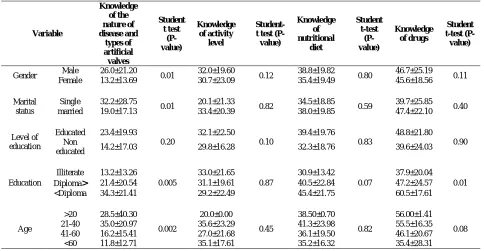
such variables as age, sex, marital status, level of education and previous training. There was a significant relation between the educational needs of the patients and their sex in the domain of knowledge of the nature of the disease (P=0.01) such that the mean of men’s knowledge score was higher. In the same way, the results showed a significant relation between educational needs and age in the domains of knowledge of the nature of the disease (P=0.002). Younger patients had fewer educational needs than older ones. In a comparison between educational needs and marital status, single patients had more knowledge than the married ones (P=0.01) in the domain of the nature of the disease. The level of education of the patients also affected their knowledge of the disease nature (P=0.005) and drugs (P=0.01) in a way that the comparison between educational needs and patient’s level of education showed that educated people had more knowledge. On the contrary, no significant relation could be found between patients’ educational needs and previously-received trainings (Table 3).
Table 3: the relation between the educational needs and Demographic characteristics of patients undergoing Heart Valve Replacement
Variable
Knowledge of the nature of disease and
types of artificial
valves
Student t test
(P-value)
Knowledge of activity
level
Student-t Student-tesStudent-t (P-value)
Knowledge of nutritional
diet
Student t-test
(P-value)
Knowledge of drugs
Student t-test (P-value)
Gender Male 26.0±21.20 0.01 32.0±19.60 0.12 38.8±19.82 0.80 46.7±25.19 0.11
Female 13.2±13.69 30.7±23.09 35.4±19.49 45.6±18.56
Marital status
Single
32.2±28.75
0.01 20.1±21.33 0.82 34.5±18.85 0.59 39.7±25.85 0.40
married
19.0±17.13 33.4±20.39 38.0±19.85 47.4±22.10
Level of education
Educated 23.4±19.93
0.20
32.1±22.50
0.10
39.4±19.76
0.83
48.8±21.80
0.90 Non
educated 14.2±17.03 29.8±16.28 32.3±18.76 39.6±24.03
Education
Illiterate 13.2±13.26
0.005
33.0±21.65
0.87
30.9±13.42
0.07
37.9±20.04
0.01
>
Diploma 21.4±20.54 31.1±19.61 40.5±22.84 47.2±24.57
<Diploma 34.3±21.41 29.2±22.49 45.4±21.75 60.5±17.61
Age
>20 28.5±40.30
0.002
20.0±0.00
0.45
38.50±0.70
0.82
56.00±1.41
0.08
21-40 35.0±20.97 35.6±23.29 41.3±23.98 55.5±16.35
41-60 16.2±15.41 27.0±21.68 36.1±19.50 46.1±20.67
<60 11.8±12.71 35.1±17.61 35.2±16.32 35.4±28.31
Discussion
It is obvious that identifying the risk factors is the first step in promoting health, health-related activities, and disease prevention. One of the elements of adjusting and controlling risk factors is changing the type of health-oriented behaviors [3] which can only be realized when the educational needs of individuals are identified and the hazardous factors are controlled by careful planning of and effective satisfaction of educational needs [17]. In the present study, the findings suffered from some limitations such as participants’ personal and cultural differences, which can lead to unequal awareness despite similar educational content. Another issue that can be taken as a limitation was the time elapsed since the operation. As much of the education was given before or shortly after the operation, the long time from the operation had affected the knowledge attained by patients because the content was not reiterated and forgot.
In the present study, the most urgent educational need was that of the knowledge of the nature of the disease and the least important one related to knowledge of drugs. In Rostami’s study (2011) and Nazari’s investigation (2009) who respectively investigated the educational needs of patients with heart failure and osteoporosis, the most serious educational need was also that of the nature of the disease [1, 16]. Contrary to the results of the present study, in a research by Wehby and Brenner’s (1999), they concluded that the foremost educational priority of the patients was knowledge of drugs [18]. In an investigation of educational needs of patients undergoing coronary bypass surgery, Shafeipour (2006) also proclaimed that the most essential educational need was that of drugs [9]. In the same way, in a progressive world, Goodman (1977) considers the most important educational need, the need for knowledge of drugs [12].
The major reason for the obvious incompatibility of the results of the present research with those of the above-mentioned studies lies in the differences between the demographical features of samples of the present study and other investigations, since the difference between these features influences individuals’ knowledge. On the other hand, such an incompatibility can be attributed to the time of the need analysis as in each stage of the disease, people have different educational needs. Moreover, the above-mentioned researches investigated the patients’ educational needs shortly after the discharge time whereas some of the samples of the
present study had undergone the surgery three years before the investigation. More importantly, the results of different studies show that these needs are changing constantly; therefore, implementing any educational program requires investigating and evaluating educational needs. Moreover, a basic principle of needs analysis is that the analysis must be generalizable to the whole population of the research [1].
Investigations on the relation between educational needs and sex showed that men had more knowledge in the domain of the nature of the disease. According to Shafeipour (2006), women had less knowledge in this regard [9]. Apparently, in the present study, the high number of men and their higher educational level were among the main reasons for the difference between the levels of knowledge of the two sexes. The findings from previous studies also indicate the reversing effects of age on knowledge; namely, such an increase had a negative effect on the patient’s knowledge [9]. The results of the recent study showed that younger patients had more knowledge of the nature of disease and drugs. In a study by Van Damme et al (2009) on the patients’ knowledge of anticoagulants after heart valve replacement surgery, no relation was identified between knowledge and age [19] which is not compatible with the results of our study. In addition to patients’ knowledge, increasing age and changes originating from it e.g., hearing and sight loss, can influence patients' power of learning such that younger people are more successful in learning and consequently have a higher level of information.
The demographic characteristics of the patients showed that 71% of the participants of the study had previously received a kind of training. The training was done immediately before surgery or after discharge (in a written form e.g. instructive pamphlet and leaflet), but could not have increased the patients’ level of knowledge; hence, no significant relation was identified between the previously-received trainings and their informational level. The results of the studies have shown that during hospitalization, training is not highly effective due to emotional stress, negative effects of hospital atmosphere, presence in operation room, and deep concern about the result of the surgery, and similarly an indefinite future. The results of a study by Cupples (1991) about the effects and consistency of pre-surgery trainings on the knowledge of patients who undergo coronary by-pass operation also revealed that the trainings given during hospitalization or before surgery bring about learning or memorizing errors due to stress or similar problems [20]. In his article
“Assessment of implementing educational programs on patients and their families”, Scalzi (1980) also showed that learning is inconsistent and very limited in the acute phase of the disease [21].
In some domains, patient’s educational level had a significant relation with their knowledge score. Patients with a high school diploma or a higher degree had a deeper knowledge of the nature of the disease and drugs than the other patients. The results of a research on the effects of training on physical disability and (wo)man mortality by Amaducci (1998) showed that there was a strong relationship between educational level and patients’ health information level [22]. Hu et al (2006) in an investigation of factors influencing patients' knowledge about taking Warfarin after valve replacement surgery showed a significant relation between patients’ knowledge and their education [23]. Shafeipour also identified the same relationship between educational level and the need for training [9]. For its relation with a better occupation and more income, high level of education affects one’s knowledge. People with a high level of education have also more faculties for learning and are stronger in comprehension compared with uneducated individuals.
The results of the present study showed that single people have more information about their disease. In Taheramuz’s study (2003) about the influence of implementing a comprehensive educational program on the level of the managerial information of nursing managers with an emphasis on the principle of delegation of authority, single people were recognized as being more knowledgeable than the married ones [24]. The reason for it might be the increased mental occupation of the married individuals compared with the single ones, which results in reduced concentration of the former group in learning. Moreover, the single subjects of the study were younger and much more educated than the married ones – a fact that resulted in their increased learning.
Conclusions
Based on the findings of the present study, training will be effective when it is based on needs analysis, and such needs are constantly increasing and changing. Hence, implementing any educational program requires evaluating and investigating the educational needs. An important principle of educational needs analysis is its generalizability to all the population of the research. Nurses have to assess the educational
needs of the clients constantly and progressively in terms of their condition and position [11]. Finally, scholars and authorities are highly recommended to identify and find the main origins and major causes of inadequacy in patient training. The authorities are also suggested to develop in-service educational courses for the employees and provide the facilities and bases for running training programs at the bedside prior to discharge for patients. By designing a systematic program and investigating the clients before leaving the hospitals or any other treatment center, the authorities can ensure that such a basic need is fulfilled and patients have received the needed self-care programs.
Acknowledgements
This article has been prepared from MSC thesis of Tayebeh Amirabad. We deem it necessary to thank all the respectable employees and nurses of Vali-e-Asr Hospital, Birjand as well as all professors and patients who helpfully responded to the questionnaires. The assistance of all the people who warmly cooperated with the researchers to fulfill this study is also appreciated.
References
1.Rostami H, Ghahramanian A, Golchin M. Educational needs of myocardial infarction patients. Journal of Urmia Nursing And Midwifery Faculty. 2011;9(3):157-64. [Persian]
2.Chan MF, Kwong WS, Yang YL, Wan PY. Evaluation of an osteoporosis prevention education program for young adults. J Adv Nurs. 2007;57(3):270-85.
3.Taherian A, Mohammadi F, Hosseini MA, Rahgozar M, Falahi M. The effectiveness of patient education and home-based follow up on knowledge and health behavior in patients with myocardial infarction. Iranian Journal of Nursing Research. 2007;2(4-5):7-13. [Persian].
4.Rezaeian M, Dehdarinejad A, Esmaili Nadimi A, Tabatabaie SZ. Geographical epidemiology of deaths due to cardiovascular diseases in kerman province. Iranian Journal of Epidemiology. 2008;4(1):35-41. [Persian]
5.Akhlaghi M, Erisian M, Panahian Pour MH, Gharedaghi J, Mohammadi N, Ghorbani M. Frequency of vascular heart diseases in adult cadavers referred to Autopsy Hall of LMO in 2003. Iranian Journal of Forensic Medicine. 2005;11(2):63-7. [Persian]
6.Taqaddosi M, Abdar Esfahani M, Musavi S. Difficulties of patients with replaced heart valve in Kashan, 2001. Feyz, Journal of Kashan University of Medical Sciences. 2005;9(2):62-9. [Persian]
7.Lee VH, Wijdicks EFM. Neurologic complications of cardiac surgery. Continuum (Minneap Minn). 2008:14(1):145–64.
8.Tabatabaei MB, Kashfi F, Khamoshi AJ, Hosseini S, Maleki M, Noohi F. Frequency of abortion and fetal-maternal complications in pregnant women with prosthetic heart valves on Warfarin therapy. J Reprod Infertil. 2003;4(4):322-7. [Persian]
9.Shafiepour V, Najaf Yarandi A. The educational needs at time of hospital discharge of patients who have undergone coronary artery bypass graft (CABG). The Journal of Mazandaran University of Medical Sciences. 2006;16(55):145-51. [Persian]
10.Basampour Sh, Monjamed Z, Nikbakhtnasrabadi A, Babaie Gh, Moshtaghian M. Assessment of educational needs of patients and their families after coronary artery bypass graft (CABG) surgery at discharge and one month later. Hayat, Journal of Faculty of Nursing & Midwifery. 2004;10(1):15-24. [Persian]
11.Mohammad Pour A, Dehgan Naieri N. The survey of patient educational need on discharge phase in Gonabad health and treatment centers. Quarterly Horizon of Medical Sciences. 2007;12(4):34-9. [Persian]
12.Goodman H. Patients’ perceptions of their Education needs in the first six weeks following discharge after cardiac surgery. J Adv Nurs. 1997;25(6):1241-51.
13.Ghazanfari Z, Arab M, Forouzi M, Pouraboli B. Knowledge level and education needs of thalassemic childern's parents of Kerman city. Iranian Journal of Critical Care Nursing. 2010;3(3):3-4. [Persian]
14.Brunner LS, Smeltzer SCOTT. Brunner & Suddarth's textbook of medical-surgical nursing. 12th ed.
Philadelphia: Lippincott Williams & Wilkins;2010.
15.Nasiri M, Rahimian B, Larihani M, Norozi SH. Survey the educational needs and quality of life of the patients with chronic myocardial infarction in Emam Sajjad hospital in Ramsar. Journal of Urmia Nursingand Midwifery Faculty. 2008;6(3):145-50. [Persian]
16.Rafii F, Shahpoorian F, Naasher Z, Azarbaad M, Hosseini F. The importance of learning needs of CHF patients from patients' and nurses' perspective. Iran Journal of Nursing. 2009;22(57):19-30. [Persian]
17.Imani A, Imani E. Needs assessment of self-care training in patients with coronary artery disease in Bandar Abbas, 2011. Preventive Care in Nursing & Midwifery Journal. 2013:3(1):30-7. [Persian]
18.Wehby D, Brenner PS. Perceived learning needs of patients with heart failure. Heart Lung. 1999:28(1):31-40.
19.Van Damme S, Van Deyk K, Budts W, Verhamme P, Moonsph P. Patient knowledge of and adherence to oral anticoagulation therapy after mechanical heart-valve replacement for congenital or acquired valve defects. Heart Lung. 2011;40(2):139-46.
20.Cupples S. Effects of timing and reinforcement of preoperative education on knowledge and recovery of patients having coronary artery bypass graft surgery. Heart lung. 1991;20(6):654-60.
21.Scalzi CC, Burke LE, Greenland S. Evaluation of an inpatient educational program for coronary patients and families. Heart lung. 1980;9(5):846-53.
22.Amaducci L, Maggi S, Langlois J, Minicuci N, Baldereschi M, Di Carlo A, Grigoletto F. Education and the risk of physical disability and mortality among men and women aged 65 to 84: the Italian Longitudinal Study on Aging. J Gerontol A Biol Sci Med Sci. 1998;53(6):M484-90.
23.Hu A, Chow CM, Dao D, Errett L, Keith M. Factors influencing patient knowledge of warfarin therapy after mechanical heart valve replacement. J Cardiovasc Nurs. 2006;21(3):169-75.
24.Taheramooz M, Baghaei J, Saleh Moghadam A, Nasiri M. Survey on the effect of a training program on the management information rate of nursing leaders. Journal of School of Nursing and Midwifery, Mashhad University of Medical Sciences. 2003;5(15-16):87-93. [Persian]