112 Iranian Journal of Electrical & Electronic Engineering, Vol. 13, No. 2, June 2017
Optimal Thermal Unit Commitment Solution integrating
Renewable Energy with Generator Outage
S. Siva Sakthi*(C.A.), R. K. Santhi**, N. Murali Krishnan***, S. Ganesan**** and S. Subramanian**
Abstract: The increasing concern of global climate changes, the promotion of renewable energy sources, primarily wind generation, is a welcome move to reduce the pollutant emissions from conventional power plants. Integration of wind power generation with the existing power network is an emerging research field. This paper presents a meta-heuristic algorithm based approach to determine the feasible dispatch solution for wind integrated thermal power system. The Unit Commitment (UC) process aims to identify the best feasible generation scheme of the committed units such that the overall generation cost is reduced, when subjected to a variety of constraints at each time interval. As the UC formulation involves many variables and system and operational constraints, identifying the best solution is still a research task. Nowadays, it is inevitable to include power system reliability issues in operation strategy. The generator failure and malfunction are the prime influencing factor for reliability issues hence they have considered in UC formulation of wind integrated thermal power system. The modern evolutionary algorithm known as Grey Wolf Optimization (GWO) algorithm is applied to solve the intended UC problem. The potential of the GWO algorithm is validated by the standard test systems. Besides, the ramp rate limits are also incorporated in the UC formulation. The simulation results reveal that the GWO algorithm has the capability of obtaining economical resolutions with good solution quality.
Keywords: Grey Wolf Optimization, Ramp Rate Limit, Reliability Analysis, Unit Commitment, Wind Power Generation.
Nomenclatue 1
Indices:
i Index of thermal generating unit.
t Index of hour (sub interval).
Parameters:
ai , bi , ci Cost coefficients of generating unit i.
N Number of generators.
T Total scheduling period.
Pimax Maximum real power generation limit of unit i (MW).
Iranian Journal of Electrical & Electronic Engineering, 2017. Paper first received 20 March 2017 and in revised form 06 July 2017. * The author is with the Department of Electrical and Electronics Engineering, Krishnasamy College of Engineering and Technology, Cuddalore - 607 109, Tamil Nadu, India.
E-mail: [email protected].
** The authors are with the Department of Electrical Engineering, Annamalai University, Annamalai Nagar - 608 002, Tamil Nadu, India.
E-mails: [email protected], [email protected].
*** The author is with the Department of Electrical and Electronics Engineering, Mailam Engineering College, Mailam - 604 304, Tamil Nadu, India.
E-mail: [email protected].
**** The author is with the Department of Electrical and Electronics Engineering, Government College of Engineering, Dharmapuri - 636 704, Tamil Nadu, India.
E-mail: [email protected]. Corresponding Author: S. Siva Sakthi.
Pimin Minimum real power generation limit of unit i (MW).
Tion Minimum up time of unit i.
Tioff Minimum down time of unit i.
SCi (t) Start up cost of unit i at hour t ($).
SDi (t) Shut down cost of unit i at hour t ($).
hcosti Hot start cost of unit i ($).
ccosti Cold start cost of unit i ($).
cshouri Cold start time of unit i.
Pd(t) Load demand at hour t.
Pwmax Maximum real power generation limit of wind farm (MW).
Pwmin Minimum real power generation limit of
wind farm (MW).
TiMon Maximum up time limit of unit i.
TiMoff Maximum down time limit of unit i.
Tio Duration of the last cycle of the previous
scheduling day.
BTic-1 Scheduling time remaining after the
allocation of the first c-1 cycles.
𝛾 Forced outage rate.
Rt Spinning reserve requirement in the hour t
(MW).
DRi Down ramp limit of unit i.
URi Up ramp limit of unit i.
Variables:
Pi(t) Real power generation of unit i at hour t
Iranian Journal of Electrical & Electronic Engineering, Vol. 13, No. 2, June 2017 113
(MW).
Xion Duration during which unit i is
continuously on.
Xioff Duration during which unit i is
continuously off.
Fi (Pi(t)) Fuel cost of unit i at hour t ($/h).
Ft Total cost ($).
Pw(t) Real power generation of wind farm at
hour t (MW).
Tic Duration of operating cycle c for unit i.
NC Number of operating cycle for each unit.
Rand Random number generator with uniform distribution between 0 and 1.
1 Introduction
HE Unit Commitment (UC) is one of the vital divisions of the thermal power generation scheduling. This is significant because of today's energy paucity and economical impact of power utilities. UC problem minimizes the total production cost while satisfying the forecasted load demand, physical and operational constraints of thermal generating units. The constraints include real power generation limits, minimum up/down time, up/down ramp limits and unit initial status. Here, the schedule of thermal generating units combined with wind farm to meet the power requirement of each hour in the scheduling horizon by considering the generator outages.
Profuse literatures have been reported for determining thermal UC. Since the Wind Integrated UC (WIUC) is the emerging research field, very few research works have been reported. Hence, the solution quality of WIUC problem can be improvised by exploring the search space. This inspires, to develop a prominent method to determine the most feasible UC schedule for WIUC.
The UC problem is formulated as a large-scale, non-convex, mixed integer and non liner programming problem. Finding optimum schedule of generating units is very difficult within acceptable processing time and memory requirement. The complete enumeration method can yield exact solution of the UC problem. However, the excessive computational time requirement makes is not suitable for realistic power systems. Numerous solution techniques have been developed for solving UC problem and are classified as traditional, artificial intelligence and hybrid methods.
1.1 Review of Existing Methods
The traditional methods such as Priority List (PL) [1], Branch-and-Bound (BB) [2], Dynamic Programming (DP) [3], Integer Programming (IP) [4], Mixed Integer Programming (MIP) [5] and Lagrangian Relaxation (LR) [6] have been employed to solve thermal UC problems. These techniques are simple and fast, nevertheless most of them suffer to handle large and non-convex search space.
The enhanced versions of PL, MIP and LR have been developed to address their limitations. Extended PL (ExPL) [7], Enhanced PL (EPL) [8], Improved PL (IPL) [9], Improved MIP (IMIP) [10], Improved LR (ILR) [11] and Parallel Augment LR (PALR) [12] have been applied for the UC solution.
A straightforward (SF) [13] method has also been proposed in which the UC problem is decomposed into three sub problems that are solved in sequence. Most of the above approaches suffers with the curse of dimensionality and are commonly struck at a premature optimal solution point. These limitations can be overcome by using artificial intelligence techniques. Soft computing techniques such as Simulated Annealing (SA) [14], Genetic Algorithm (GA) [15], Differential Evolution (DE) [16, 17], Expert System (ES) [18], Neural Network (NN) [19], Ant Colony
System (ACS) algorithm [20], Evolutionary
Programming (EP) [21], Bacterial Foraging Algorithm (BFA) [22], Shuffled Frog Leaping Algorithm (SFLA) [23], Gravitational Search Algorithm (GSA) [24],
Quasi-Oppositional Teaching Learning Based
Optimization (QOTLBO) algorithm [25] and Invasive Weed Optimization (IWO) [26] have been reported in the field of thermal UC.
The modified versions of these techniques have been developed in order to improve the solution quality. The altered versions of SA, Absolutely Stochastic SA (ASSA) [27] and Adaptive SA (ASA) [28] have been evolved to solve the UC problem. The improved versions of GA namely Integer Coded GA (ICGA) [29] and Binary-real Coded GA (BCGA) [30] have been applied to determine optimal solution for UC problem. The modified versions of Particle Swarm Optimization (PSO) namely fuzzy controlled binary PSO [31] and pseudo-inspired weight-improved crazy PSO [32] have also been applied to solve thermal UC problem. Fireworks Algorithm [33] is one of the recently developed swarm optimization algorithm which is also applied to solve for UC problem.
Various hybrid methods combining meta-heuristic with mathematical techniques or other meta-heuristic are developed to explore the search space in practical UC problems. Hybrid methods include Hybrid Taguchi (HT) - ACS [34], LR and PSO [35], GA-DE [36], hybrid harmony search/random search algorithm [37] and LR-DE [38] have been reported to solve thermal UC problems.
Quantum-inspired Evolutionary Algorithm (QEA) [39] yields feasible solutions even with small population compared with the EA. Advanced Quantum-inspired Evolutionary Algorithm (AQEA) [40] and Quantum-inspired Binary GSA (QBGSA) [41] have also been evolved for UC problem.
1.2 Present Work
The meta-heuristic approaches find difficult to
T
114 Iranian Journal of Electrical & Electronic Engineering, Vol. 13, No. 2, June 2017
determine the proximity of the estimated solution to the optimal solution. Parameter selection plays a vital role in success of these techniques but it is a time consuming process, as it requires complete knowledge about the algorithm.
A novel Swarm Intelligence (SI) technique, Grey Wolf Optimization (GWO) [42] has been developed to solve optimization problems. This technique has unique behaviour which other SI techniques not exhibit is mimicking the leadership hierarchy of grey wolves, well known for their pack hunting. This motivates the researchers to apply GWO for solving UC problems. The merits of the GWO are easy to handle, simple and require tuning of few parameters.
1.3 Research Gap and Contribution
The determination of thermal UC scheduling has been reported in several existing literature. In UC integrated wind power generation considering reliability analysis [43, 44], only few research works has been carried. The incorporation of wind power and forced outage rate make further the solution space as non-linear that leads to identification of optimum solution is a challenging work. Profuse artificial intelligence techniques exist for the UC solution, still improving their solution quality is interesting research task. The advantages of GWO against other population based algorithms motivate us to use it as the main optimization tool to solve the WIUC problem.
1.4 Paper Organization
The rest of the paper is organized as follows: In Section 2, the mathematical formulation of WIUC problem is presented. Section 3 describes the implementation of GWO. The numerical results and discussions are presented in Section 4. In section 5, the performance analysis of the GWO algorithm is included. Finally, the conclusion is presented in section 6.
2 Problem Formulation 2.1 Objective Function
The total cost, over the entire scheduling period is the sum of the running cost, start up cost and shut down cost of all the units [7]. Accordingly, the overall objective function of the UC problem is stated as:
(1)
1 1
min
T N
t i i i i
t i
F F P t SC t SD t
Generally, the fuel cost, Fi (Pi (t)) of unit i in any given time interval t is a function of the generator power
output. The production cost of unit i can be
approximated as a quadratic function of the real power outputs from the generating units and can be expressed as:
(2)
2
i i i i i i i
F P t a b P t c P t
The generator start up cost depends on the time, the unit has been off prior to start up. In this work, time-dependent start up cost is used and is defined as follows:
(3) ;
;
off off off
i i i i i
i off off
i i i i
hcost T X T cshour
SC
ccost X T cshour
The SD cost is usually given a constant value for each unit. In this paper, the SD cost has been taken equal to zero for each unit.
The objective function, i.e., minimization of total cost
Ft is subject to the system and generating unit constraints which are as follows.
2.2 System Constraint
2.2.1 Power balance constraint
The total power generated by the combination of thermal and wind generating units must meet the load demand Pd (t) on hourly basis:
(4)
1 ( )
N
d i w
i
P t P t P t
2.3 Unit Constraints
The generating unit operational constraints are as follows [7, 16]:
2.3.1 Generation limits
The real power generation of each generator has a lower and upper limits, so that generation should lie within this boundary. This inequality is stated as follows:
(5)
imin i imax
P P t P
(6)
wmin w wmax
P P t P
2.3.2 Unit minimum up/down time constraints
The inequality constraints of minimum up/down time limits of generating units is given by
(7)
on on i i
T X
(8)
off off i i
T X
2.3.3 Generator forced outage rate
The equipment malfunction is considered as certain percentage of the load in each interval, by considering the generator forced outage rate, the UC solution should satisfy the condition as follows:
(9)
1
. .
N
t i i imax d
i
U t P P P t R
Iranian Journal of Electrical & Electronic Engineering, Vol. 13, No. 2, June 2017 115
(10) 1
i
P
2.3.4 Up/down ramp limits
The up and down ramp limits of the thermal units are given by
(11)
1
i i i i
DR P t P t UR
3 Unit Commitment based on GWO
The GWO algorithm has essential steps such as social hierarchy, encircling, hunting, attacking and search for prey. The implementation of GWO algorithm for solving UC problem is detailed in this section.
3.1 Definition of Wolf and Initial Population
In the integer coded GWO, operating mode (ON/OFF) of thermal unit over the scheduling duration is indicated by a sequence of integer numbers which represents the Wolf Position (WP). The duration of continuous ON and OFF state is indicated by positive and negative integers in WP. Based on number of load peaks during the UC horizon and the sum of the minimum up and down times of the unit, the number of a unit’s ON/OFF cycles are decided. For base, medium, and peak load units, the numbers of ON/OFF cycles are 2, 3, and 5 respectively. To overcome the restriction of search space for base and medium units due to reduction of cycles, the number of cycles of all units same as number of cycles peak load units are selected. For day scheduling (D), NC is equal to D × 5. Each solution contains N × D × 5 variables for D-day scheduling. The initial population of the GWO is generated as follows:
The running duration of the first cycle of unit i, 1
i
T is initialized by considering unit i operating state of the last cycle of the previous scheduling day to avoid violation of minimum up/down time constraints.
(12)
0 0 1 0 0Rand max 0, , , if 0
Rand max 0, , , if 0
Mon
i i i
i
Moff
i i i
T T T T
T
T T T T
For c < NC, the operating period of the cth cycle of unit i, Tic is determined by taking into account of the minimum up and down time constraints of the generating units, the UC scheduling period and the operating period of the c -1 prior cycles of operation of the unit.
For Tic-1 < 0, cycle c is in ON mode with duration
(13)
1
11
Rand , , if
, otherwise
Mon c c Mon
i i i i
c i
c i
T B T BT T
T BT
For Tic-1 > 0, cycle c is in OFF mode with duration
(14)
1
11
Rand , ,if
, otherwise
Moff c c Moff
i i i i
c i
c i
T B T BT T
T BT (15) 1 1 1 c c j i i j
BT T T
By taking into account the randomly generated cycle durations, the entire scheduling period is covered with the first c < NC operating cycles. The remaining cycles are filled with zero. Once initial population is determined, the unit minimum up and down-time constraints are satisfied automatically.
3.2 GWO Execution for WIUC
In this section, the algorithmic steps of GWO for WIUC are presented. The constraint handling schemes are also briefed:
1) Read the system data and initialize GWO parameters such as population size (PS), maximum number of iterations (iter-max) and the vector value (a,
A and C).
2) Initialization
The initial population (Xt) is generated as follows: a) The entire scheduling period is divided into number of cycles and is denoted by NC.
b) All the units are committed based on their initial state conditions.
c) The operating duration is determined by considering the minimum up and down time constraints. d) This process is repeated for all NC-1 cycles and the remaining time is computed which is the operating duration of the last segment.
e) Apply the constraint handling scheme to satisfy the operational constraints.
f) The online generating units along with dependent units are identified within their operational limits.
3) Compute the fitness of each individual, an individual having the minimum fitness is mimicked as the alpha, second minimum is beta and third minimum is delta.
(16)
Fitness Ft OCV
where, OCV is the Operational Constraint Violation and
Xα ,Xβ and Xγ are the best, second and third search
agents respectively.
4) iter-max = iter-max +1. 5) Search agent, SAg= SAg+1.
6) Modify the generation of N-1 online units based on the hunting mechanism.
(17)
1
α 1 α β 2 β
γ 3 γ
1
. .( )
3
.( )
t
X X A D X A D
X A D
where, Dα = |C1.Xα - X|; Dβ = |C2.Xβ - X|; Dγ = |C3.Xγ -X|;
116 Iranian Journal of Electrical & Electronic Engineering, Vol. 13, No. 2, June 2017 A= 2a.rand – a.
7) Apply constraint handling strategy.
8) Repeat step 5 for all search agents. Otherwise go to next step.
9) Update the vector values of (a, A and C). 10) Compute the fitness for all search agents. 11) Update the values of Xα, Xβ and Xγ.
12) Termination criterion.
Repeat the procedure from steps 4 to 6, until the maximum number of iteration is reached.
4 Simulation Results and Discussions
In this section, the effectiveness of the GWO method is tested on the standard test system having ten thermal generating units with one wind farm for a scheduling horizon of 24 hours. The algorithm is developed in Matlab platform and is executed on a personal computer configured with Intel core i3 processor 2.20 GHz and 4 GB RAM. The thermal unit data and load demands of ten thermal units are exerted from the literature [15]. The wind farm consists of similar type of 20 number of wind turbine generators which are operating in parallel. The wind power generation data [45] is presented in Table 1 which are calculated using forecasted wind power beforehand and converted into electrical power. The minimum and maximum output power delivered by the wind farm is 15 MW and 100 MW respectively. The wind farm generates 15.01 MW at 10th hour as minimum output and 98.559 MW at 16th hour as maximum output.
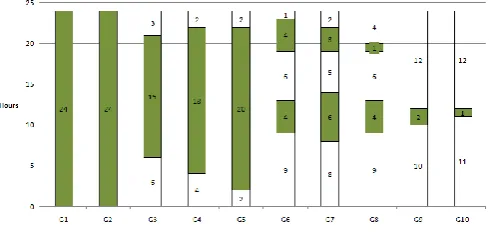
The GWO algorithm has been tested on the standard 10 unit system with the scheduling horizon of 24 hours. For each unit, the maximum number of cycles is 5. For each problem set, 50 test trials are made. The random initial population is generated for each run. Multiple runs have been carried out, to ascertain the robustness of the GWO in determining optimum UC scheduling. Two case studies have been conducted in order to show the effectiveness of GWO in solving UC problem. The configuration for final population to UC problem using GWO is illustrated in the Fig. 1.
4.1 Reliability Constrained UC
Recently, the reliability becomes vital criteria in the
Table 1 Output of wind farm. Period (h) Wind Power
(MW) Period (h)
Wind Power (MW)
1 42.602 13 41.233
2 35.409 14 50.478
3 60 15 80
4 17.193 16 98.559
5 20 17 72.194
6 31.309 18 49.655
7 40 19 36.44
8 32.802 20 57.185
9 21.784 21 64.243
10 15.01 22 85.541
11 24.383 23 70.677
12 27.058 24 61.298
Fig. 1 Configuration for final population to WIUC problem considering FOR using GWO.
power system operations. To enhance the better operations and scheduling in the power system, many optimization tools have been developed. By integrating the above, reliability constrained optimization is developed to improve the performance of power system. The uncertainties in power system scheduling is taken into account. By considering, the various combination of all component states, system state is prepared. The probability of component is appears in the component state. The evaluation of power generation systems is carried out by ascertaining the generation capability to meet the requirement of the system load. Here, we assume that the transmission and distribution facilities are completely reliable. That means the generated energy are transmitted and distributed to the load centres without failure. The generating system reliability indices are treated as the expected value of a test function applied to a system state. The state of each component presented in vector to determine whether the specific generation combination yields to a feasible or infeasible solution. The mathematical expectation of a given reliability index is considered as fundamental parameter in reliability evaluation.
4.2 Reliability Constrained WIUC
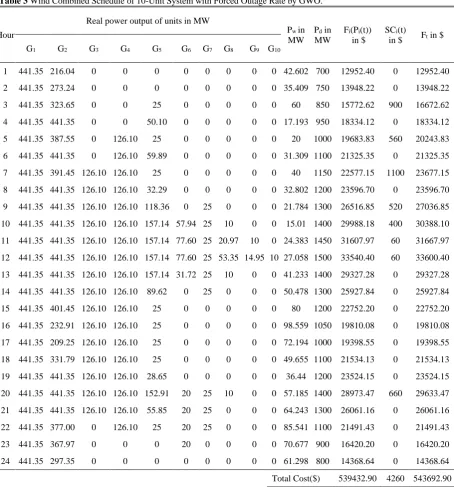
In recent past, a number of initiatives have been taken to enhance the utilization of wind power in the electric power generation sector. Limited predictability and variability of wind power makes the operation of power system is problematic. The Wind Integrated Thermal Scheduling (WITS) problem plays a vital role in generating green power. The optimal selection and optimal dispatch of thermal units require to be modified based on wind farm output. This makes WITS is a complex optimization problem, that has to identify the optimal schedule of generating units while satisfying all prevailing constraints. GWO algorithm is used to determine the generating schedule of thermal units. By observing Table 3, it can be understood that the minimum up/down time constraints and initial status of units are satisfied for all thermal generating units. First two thermal units are committed for whole scheduling horizon, because these units have high commitment priorities than other thermal units. They function as
Iranian Journal of Electrical & Electronic Engineering, Vol. 13, No. 2, June 2017 117 Table 2 Maximum possible output of thermal units Forced Outage Rate by GWO.
Unit 1 2 3 4 5
Maximum output considering FOR (MW) 441.35 441.35 126.1 126.1 157.14
Unit 6 7 8 9 10
Maximum output considering FOR (MW) 77.6 82.45 53.35 53.35 53.35
Table 3 Wind Combined Schedule of 10-Unit System with Forced Outage Rate by GWO.
Hour
Real power output of units in MW
Pw in
MW Pd in
MW
Fi(Pi(t))
in $
SCi(t)
in $ Ft in $
G1 G2 G3 G4 G5 G6 G7 G8 G9 G10
1 441.35 216.04 0 0 0 0 0 0 0 0 42.602 700 12952.40 0 12952.40 2 441.35 273.24 0 0 0 0 0 0 0 0 35.409 750 13948.22 0 13948.22 3 441.35 323.65 0 0 25 0 0 0 0 0 60 850 15772.62 900 16672.62 4 441.35 441.35 0 0 50.10 0 0 0 0 0 17.193 950 18334.12 0 18334.12 5 441.35 387.55 0 126.10 25 0 0 0 0 0 20 1000 19683.83 560 20243.83 6 441.35 441.35 0 126.10 59.89 0 0 0 0 0 31.309 1100 21325.35 0 21325.35 7 441.35 391.45 126.10 126.10 25 0 0 0 0 0 40 1150 22577.15 1100 23677.15 8 441.35 441.35 126.10 126.10 32.29 0 0 0 0 0 32.802 1200 23596.70 0 23596.70 9 441.35 441.35 126.10 126.10 118.36 0 25 0 0 0 21.784 1300 26516.85 520 27036.85 10 441.35 441.35 126.10 126.10 157.14 57.94 25 10 0 0 15.01 1400 29988.18 400 30388.10 11 441.35 441.35 126.10 126.10 157.14 77.60 25 20.97 10 0 24.383 1450 31607.97 60 31667.97 12 441.35 441.35 126.10 126.10 157.14 77.60 25 53.35 14.95 10 27.058 1500 33540.40 60 33600.40 13 441.35 441.35 126.10 126.10 157.14 31.72 25 10 0 0 41.233 1400 29327.28 0 29327.28 14 441.35 441.35 126.10 126.10 89.62 0 25 0 0 0 50.478 1300 25927.84 0 25927.84 15 441.35 401.45 126.10 126.10 25 0 0 0 0 0 80 1200 22752.20 0 22752.20 16 441.35 232.91 126.10 126.10 25 0 0 0 0 0 98.559 1050 19810.08 0 19810.08 17 441.35 209.25 126.10 126.10 25 0 0 0 0 0 72.194 1000 19398.55 0 19398.55 18 441.35 331.79 126.10 126.10 25 0 0 0 0 0 49.655 1100 21534.13 0 21534.13 19 441.35 441.35 126.10 126.10 28.65 0 0 0 0 0 36.44 1200 23524.15 0 23524.15 20 441.35 441.35 126.10 126.10 152.91 20 25 10 0 0 57.185 1400 28973.47 660 29633.47 21 441.35 441.35 126.10 126.10 55.85 20 25 0 0 0 64.243 1300 26061.16 0 26061.16 22 441.35 377.00 0 126.10 25 20 25 0 0 0 85.541 1100 21491.43 0 21491.43 23 441.35 367.97 0 0 0 20 0 0 0 0 70.677 900 16420.20 0 16420.20 24 441.35 297.35 0 0 0 0 0 0 0 0 61.298 800 14368.64 0 14368.64 Total Cost($) 539432.90 4260 543692.90
"Must-Run" units. The optimum UC schedule considering Forced Outage Rate (FOR) limits obtained by GWO is presented in Table 3. Assume that FOR of all thermal unit is 0.03. Table 2 shows the maximum possible output of all thermal units considering FOR. Table 3 also shows the optimum thermal UC schedule considering thermal generator outage and real power sharing of committed generating units. It is observed
that the real power generation by thermal units (G1-G10)
and wind power plants is equivalent to the power demand Pd (t) for each hour. The operational constraints such as generation limits, minimum up/down time and initial status of units are also satisfied in this case study. The fuel, start up and total costs obtained in this case are $539432.90, $4260 and $543692.90 respectively.
118 Iranian Journal of Electrical & Electronic Engineering, Vol. 13, No. 2, June 2017 4.3 Reliability Constrained WIUC considering
Ramp Rates
In this case, the ramp rate constraints are introduced in the same test system over 24 hour of schedule and the effectiveness of the GWO algorithm is verified [46]. It has been assumed that the value of down and up ramp rate of each unit are equal [47]. The ramp rate limits of thermal unit are as follows: First two units have ramp rate of 160 MW/h, unit 3, 4 and 5 have 100 MW/h as ramp rate. The value for unit 6 and 7 are 60 MW/h. Last three units have 40 MW/h as ramp rate.
Referring Tables 3 and 4, the following changes in the scheduling of thermal generating units are observed. At 13th interval, the increase and decrease in real power generation in G8 and G6 respectively to fulfil the down
ramp constraint of G8. Similarly, to satisfy the down
ramp rate of G2 at 16th hour, increased dispatch is made
in that unit and reduced dispatch in G3. Finally, to meet
the up ramp constraint of G5 at 20th period, decreased
generation is allotted in that unit and increased dispatch in G6. The sharing of real power generation among the
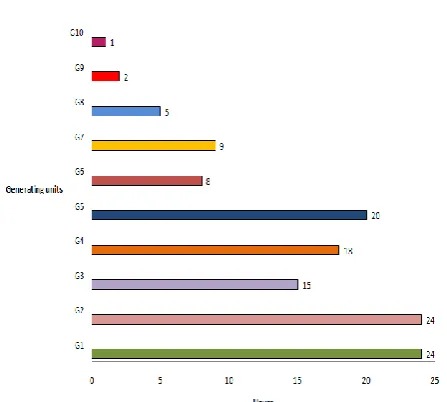
committed units increases the fuel and total costs. The scheduling schemes of case 2 and 3 are same. The introduction of ramp rate constraints made changes only in the dispatches of the committed generating units. The wind generating units along with thermal units meet the power demand in each interval. The obtained fuel, start up and total costs are $539494.80, $4260 and $543754.80 respectively. The total operating hours of all thermal units for both cases are illustrated in Fig. 2.
Table 4 Wind Combined Schedule of 10-Unit System with Forced Outage Rate and Ramp Rate by GWO.
Hour Real power output of units in MW Pw in
MW Pd in
MW
Fi(Pi(t))
in $
SCi(t)
in $ Ft in $
G1 G2 G3 G4 G5 G6 G7 G8 G9 G10
1 441.35 216.04 0 0 0 0 0 0 0 0 42.602 700 12952.33 0 12952.33 2 441.35 273.23 0 0 0 0 0 0 0 0 35.409 750 13948.16 0 13948.16 3 441.35 323.65 0 0 25 0 0 0 0 0 60 850 15772.76 900 16672.76 4 441.35 441.35 0 0 50.09 0 0 0 0 0 17.193 950 18333.94 0 18333.94 5 441.35 387.55 0 126.10 25 0 0 0 0 0 20 1000 19683.97 560 20243.97 6 441.35 441.35 0 126.10 59.88 0 0 0 0 0 31.309 1100 21325.17 0 21325.17 7 441.35 391.45 126.10 126.10 25 0 0 0 0 0 40 1150 22577.25 1100 23677.25 8 441.35 441.35 126.10 126.10 32.28 0 0 0 0 0 32.802 1200 23596.53 0 23596.53 9 441.35 441.35 126.10 126.10 118.32 0 25 0 0 0 21.784 1300 26517.04 520 27037.04 10 441.35 441.35 126.10 126.10 157.14 57.94 25 10 0 0 15.01 1400 29988.39 400 30388.39 11 441.35 441.35 126.10 126.10 157.14 77.60 25 20.98 10 0 24.383 1450 31608.20 60 31668.20 12 441.35 441.35 126.10 126.10 157.14 77.60 25 53.35 14.96 10 27.058 1500 33540.65 60 33600.65 13 441.35 441.35 126.10 126.10 157.14 28.38 25 13.35 0 0 41.233 1400 29338.63 0 29338.63 14 441.35 441.35 126.10 126.10 89.63 0 25 0 0 0 50.478 1300 25928.02 0 25928.02 15 441.35 401.45 126.10 126.10 25 0 0 0 0 0 80 1200 22752.33 0 22752.33 16 441.35 241.45 117.56 126.10 25 0 0 0 0 0 98.559 1050 19812.95 0 19812.95 17 441.35 209.26 126.10 126.10 25 0 0 0 0 0 72.194 1000 19398.69 0 19398.69 18 441.35 331.80 126.10 126.10 25 0 0 0 0 0 49.655 1100 21534.28 0 21534.28 19 441.35 441.35 126.10 126.10 28.65 0 0 0 0 0 36.44 1200 23523.98 0 23523.98 20 441.35 441.35 126.10 126.10 128.65 44.27 25 10 0 0 57.185 1400 29019.70 660 29679.70 21 441.35 441.35 126.10 126.10 55.86 20 25 0 0 0 64.243 1300 26061.34 0 26061.34 22 441.35 377.01 0 126.10 25 20 25 0 0 0 85.541 1100 21491.52 0 21491.52 23 441.35 367.97 0 0 0 20 0 0 0 0 70.677 900 16420.30 0 16420.30 24 441.35 297.34 0 0 0 0 0 0 0 0 61.298 800 14368.53 0 14368.53 Total Cost($) 539494.80 4260 543754.80
Iranian Journal of Electrical & Electronic Engineering, Vol. 13, No. 2, June 2017 119 Fig. 2 Operating period of thermal generating units.
5 Performance Analysis 5.1 Robustness
Since the GWO algorithm is a stochastic soft computing technique, the initial population is made using random numbers. Hence, number of trails should be made to ensure the performance of GWO. Hence the optimal solution is determined by carrying out several trails. For real time problems like UC, it is desired that each trail of the execution should approach near to global optimum solution. To ascertain the robustness of GWO, 50 number of trails are made to determine the optimal scheduling. For particular load demand, the frequency of convergence to best cost is presented in Figs. 3 and 4. Both figures illustrate that when compared with existing algorithms, GWO algorithm has significant robustness.
5.2 Success Rate
It indicates that in how many trails the determined total cost is less than the mean cost. The success rate of GWO is greater than 85% in both cases. It can be concluded that GWO algorithm has good success rate
and robustness compared with other reported
algorithms.
6 Conclusions
Application of GWO is a novel swarm intelligence approach in solving the UC problem with significant amount of wind power considering reliability analysis. The total objective function is the sum of the objectives and constraints, which are fuel cost, start-up cost and power demand. The up and down ramp constraints are also satisfied for each unit. The GWO algorithm is used to validate the numerical results for standard ten unit system. The inclusion of ramp rate constraints with above system also presented. It can be concluded that
Fig. 3 Robustness characteristics of wind power combined 10-unit test system with FOR.
Fig. 4 Robustness characteristics of wind power combined 10-unit test system with FOR and Ramp Rate.
the intended scheme saves the operating cost in addition to less fuel consumption and emission of thermal units. The implementation of GWO is simple and it successfully handled the operational constraints. The optimum solution for WIUC problem can be consistently obtained by GWO. Results illustrate that intended algorithm is a powerful tool for solving WIUC problem.
References
[1]A.J. Wood and B.F. Wollenberg, Power generation,
operation and control, New York: Wiley, 2002.
[2]A.I. Cohen and M. Yoshimura, “A
branch-and-bound algorithm for unit commitment”, IEEE Transactions on Power Apparatus and Systems, Vol. PAS-102, No. 2, pp. 444–451, Feb. 1983.
[3]Walter L. Snyder Jr., H. David Powell Jr. and John
C. Rayburn, “Dynamic programming approach to unit commitment”, IEEE Transactions on Power Systems, Vol. PWRS-2, No. 2, pp. 339–348, May 1987.
120 Iranian Journal of Electrical & Electronic Engineering, Vol. 13, No. 2, June 2017
[4]T.S. Dillon, K.W. Edwin, H.D. Kochs and R.J.
Taud, “Integer programming approach to the problem of optimal unit commitment with
probabilistic reserve determination”, IEEE
Transactions on Power Apparatus and Systems, Vol. PAS-97, No. 6, pp. 2154–2166, Nov/Dec. 1978.
[5]H. Monsef and N.T. Mohamadi, “Generation
scheduling in a competitive environment”, Iranian Journal of Electrical & Electronic Engineering, Vol. 1, No. 2, pp. 68–73, Apr. 2005.
[6]S. Virmani, E.C. Adrian, K. Imhof and S.
Mukherjee, “Implementation of a Lagrangian relaxation based unit commitment problem”, IEEE Transactions on Power Systems, Vol. 4, No. 4, pp. 1373–1380, Oct. 1989
[7]Tomonobu Senjyu, Kai Shimabukuro, Katsumi
Uezato and Toshihisa Funabashi, “A fast technique for unit commitment problem by extended priority list”, IEEE Transactions on Power Systems, Vol. 18, No. 2, pp. 882–888, May 2003.
[8]E. Delaruea, D. Cattrysse and W. D’haeseleer,
“Enhanced priority list unit commitment method for power systems with a high share of renewables”, Electric Power Systems Research, Vol. 105, pp. 115–123, Dec. 2013.
[9]Ran Quan, Jinbao Jian and Linfeng Yang, “An
improved priority list and neighborhood search method for unit commitment”, Electrical Power and Energy Systems, Vol. 67, pp. 278–285, May 2015.
[10] Yonghong Chen and Fengyu Wang, “MIP
formulation improvement for large scale security constrained unit commitment with configuration based combined cycle modeling”, Electric Power Systems Research, Vol. 148, pp.147–154, Jul. 2017.
[11] T. Seki, N. Yamashita and K. Kawamoto, “New
local search methods for improving the Lagrangian-relaxation-based unit commitment solution”, IEEE Transactions on Power Systems, Vol. 25, No. 1, pp. 272–283, Feb. 2010.
[12] Q. Jiang, B. Zhou and M. Zhang, “Parallel
Augment Lagrangian Relaxation Method for
Transient Stability Constrained Unit Commitment”, IEEE Transactions on Power Systems, Vol. 28, No. 2, pp. 1140–1148, May 2013.
[13] Seyed Hamid Hosseini, Amin Khodaei and
Farrokh Aminifar, “Novel straightforward unit commitment method for large scale power systems”, IEEE Transactions on Power Systems, Vol. 22, No. 4, pp. 2134–2143, Nov. 2007.
[14] A.H. Mantawy, Youssef L. Abdel-Magid and
Shokri Z. Seliin, “A simulated annealing algorithm for unit commitment”, IEEE Transactions on Power Systems, Vol. 13, No. 1, pp. 197–204, Feb. 1998. [15] S.A. Kazarlis, A.G. Bakirtzis and V. Petridis, “A
genetic algorithm solution to the unit commitment
problem”, IEEE Transactions on Power Systems, Vol. 11, No. 1, pp. 83–92, Feb. 1996.
[16] S. Patra, S.K. Goswami and B. Goswami,
“Differential evolution algorithm for solving unit commitment with ramp constraints”, Electric Power Components and Systems, Vol. 36, No. 8, pp. 771– 787, Jun. 2008.
[17] Dilip Datta and Saptarshi Dutta, “A binary-real-coded differential evolution for unit commitment problem”, Electrical Power and Energy Systems, Vol. 42, No. 1, pp. 517–524, Nov. 2012.
[18] Z. Ouyang and S.M. Shahidehpour, “Short-term
unit commitment expert system”, Electric Power Systems Research, Vol. 20, No. 1, pp. 1–13, Feb. 1990.
[19] M.R. Aghamohammadi, “Static security
constrained generation scheduling using sensitivity characteristics of neural network”, Iranian Journal of Electrical & Electronic Engineering, Vol. 4, No. 3, pp. 104–114, Jul. 2008.
[20] S.P. Simon, N.P. Padhy and R.S. Anand, “An ant colony system approach for unit commitment problem”, Electrical Power and Energy Systems, Vol. 28, No. 5, pp. 315–323, Jun. 2006.
[21] K.A. Juste, H. Kita, E. Tanaka, and J. Hasegawa, “An evolutionary programming solution to the unit commitment problem”, IEEE Transactions on Power Systems, Vol. 14, No. 4, pp. 1452–1459, Nov. 1999.
[22] M. Eslamian, S.H. Hosseinian and B. Vahidi,
“Bacterial foraging-based solution to the unit-commitment problem”, IEEE Transactions on Power Systems, Vol. 24, No. 3, pp. 1478–1488, Aug. 2009.
[23] Javad Ebrahimi, Seyed Hossein Hosseinian and
Gevorg B. Gharehpetian, “Unit commitment problem solution using shuffled frog leaping algorithm”, IEEE Transactions on Power Systems, Vol. 26, No. 2, pp. 573–581, May 2011.
[24] Bin Ji, Xiaohui Yuan, Zhihuan Chen and Hao
Tian, “Improved gravitational search algorithm for unit commitment considering uncertainty of wind power”, Energy, Vol. 67, pp. 52–62, Apr. 2014.
[25] Provas Kumar Roy and Ranadhir Sarkar, “Solution
of unit commitment problem using quasi-oppositional teaching learning based algorithm”, Electrical Power and Energy Systems, Vol. 60, pp. 96–106, Sep. 2014.
[26] B. Saravanan, E. R. Vasudevan and D. P. Kothari,
“Unit Commitment Problem Solution Using Invasive Weed Optimization Algorithm”, Electrical Power and Energy Systems, Vol. 55, pp. 21–28, Feb. 2014.
[27] A.Y. Saber, T. Senjyu, T. Miyagi, N. Urasaki and
T. Funabashi, “Fuzzy Unit Commitment
Scheduling Using Absolutely Stochastic Simulated Annealing”, IEEE Transactions on Power Systems, Vol. 21, No. 2, pp. 955–964, May 2006.
Iranian Journal of Electrical & Electronic Engineering, Vol. 13, No. 2, June 2017 121
[28] Grzegorz Dudek, “Adaptive simulated annealing
schedule to the unit commitment problem”, Electric Power Systems Research, Vol. 80, No. 4, pp. 465– 472, Apr. 2010.
[29] Ioannis G. Damousis, Anastasios G. Bakirtzis and
Petros S. Dokopoulos, “A solution to the unit-commitment problem using integer-coded genetic algorithm”, IEEE Transactions on Power Systems, Vol. 19, No. 2, pp. 1165–1172, May 2004.
[30] Dilip Datta, “Unit commitment problem with ramp
rate constraint using a binary-real-coded genetic algorithm”, Applied Soft Computing, Vol. 13, No. 9, pp. 3873–3883, Sep. 2013.
[31] S.Chakraborty, T. Ito, T. Senjyu and A.Y. Saber, “Unit commitment strategy of thermal generators by using advanced fuzzy controlled binary particle swarm optimization algorithm”, Electrical Power and Energy Systems, Vol. 43, No. 1, pp. 1072– 1080, Dec. 2012.
[32] Anup Shukla and S.N. Singh, “Advanced
three-stage pseudo-inspired weight-improved crazy particle swarm optimization for unit commitment problem”, Energy, Vol. 96, pp. 23–36, Feb. 2016.
[33] B. Saravanan, C. Kumar and D.P. Kothari, “A
solution to unit commitment problem using fire works algorithm”, Electrical Power and Energy Systems, Vol. 77, pp. 221–227, May 2016.
[34] Wu Yuan-Kang, Huang Chih-Cheng and Lin
Chun-Liang, “Resolution of the unit commitment problems by using the hybrid Taguchi-ant colony system algorithm”, Electrical Power and Energy Systems, Vol. 49, pp. 188–198, Jul. 2013.
[35] Xiang Yu and Xueqing Zhang, “Unit commitment
using Lagrangian relaxation and particle swarm optimization”, Electrical Power and Energy Systems, Vol. 61, pp. 510–522, Oct. 2014.
[36] Anupam Trivedi, Dipti Srinivasan, Subhodip
Biswas and Thomas Reindl, “A genetic algorithm - differential evoluation based hybrid framework: Case study on unit commitment scheduling problem”, Information Sciences, Vol. 354, pp. 275– 300, Aug. 2016.
[37] Vikram Kumar Kamboj, S.K. Bath and J.S.
Dhillon, “Implementation of hybrid harmony search/random search algorithm for single area unit commitment problem”, Electrical Power and Energy Systems, Vol. 77, pp. 228–249, May 2016.
[38] A.V.V. Sudhakar, Chandram Karri and A. Jaya
Laxmi, “Profit based unit commitment for GENCOs using Lagrange relaxation-differential evolution”, Engineering Science and Technology, an International Journal, Vol. 20, No. 2, pp. 738– 747, Apr. 2017.
[39] T.W. Lau, C.Y. Chung, K.P. Wong, T.S. Chung
and S.L. Ho, “Quantum-inspired evolutionary algorithm approach for unit commitment”, IEEE Transactions on Power Systems, Vol. 24, No. 3, pp. 1503–1512, Aug. 2009.
[40] C.Y. Chung, H. Yu and K.P. Wong, “An advanced
quantum-inspired evolutionary algorithm for unit commitment”, IEEE Transactions on Power Systems, Vol. 26, No. 2, pp. 847–854, May 2011.
[41] Bin Ji, Xiaohui Yuan, Xianshan Li, Yuehua Huang
and Wenwu Li, “Application of quantum-inspired binary gravitational search algorithm for thermal unit commitment with wind power integration”, Energy Conversion and Management, Vol. 87, pp. 589–598, Nov. 2014.
[42] Seyedali Mirjalili, Seyed Mohammad Mirjalili and
Andrew Lewis, “Grey wolf optimizer”, Advances in Engineering Software, Vol. 69, pp. 46–61, Mar. 2014.
[43] Lingfeng Wang and Chanan Singh, “Unit
commitment considering generator outages through a mixed-integer particle swarm optimization algorithm”, Applied Soft Computing, Vol. 9, No. 3, pp. 947–953, Jun. 2009.
[44] Chariklia A. Georgopoulou and Kyriakos C.
Giannakoglou, “Metamodel-assisted evolutionary algorithms for the unit commitment problem with probabilistic outages”, Applied Energy, Vol. 87, No. 5, pp. 1782–1792, May 2010.
[45] Jia-Chu Lee, Whei-Min Lin, Gwo-Ching Liao and
Ta-Peng Tsao, “Quantum genetic algorithm for dynamic economic dispatch with valve-point effects and including wind power system”, Electrical Power and Energy Systems, Vol. 33, pp. 189–197, Feb. 2011.
[46] Carlos M. Correa-Posada, German
Morales-Espana, Pablo Duenas and Pedro Sanchez-Martin, “Dynamic ramping model including intraperiod ramp-rate changes in unit commitment”, IEEE Transactions on Sustainable Energy, Vol. 8, No. 1, pp. 43–50, Jan. 2017.
[47] S.N. Mhanna and R.A. Jabr, “Application of semi
definite programming relaxation and selective pruning to the unit commitment problem”, Electric Power Systems Research, Vol. 90, pp. 85–92, Sep. 2012.
S. Siva Sakthi received the B.E. degree in electrical and electronics engineering from the University of Madras, Madras, 1999; the M.E.
degree in power systems
engineering from the Annamalai University, Chidambaram, India, 2008; He is perusing the Ph.D. degree in electrical engineering from the Annamalai University, Chidambaram, India. He is an Associate Professor in electrical and electronics engineering at the Krishnasamy College of Engineering & Technology, Cuddalore, India.
122 Iranian Journal of Electrical & Electronic Engineering, Vol. 13, No. 2, June 2017 R. K. Santhi received the B.E.
degree in electrical and electronics engineering from the Government College of Technology, Coimbatore, India, 1984; the M.E. degree in power systems engineering from the
Annamalai University,
Chidambaram, India, 1986; the Ph.D. degree in electrical engineering from the Annamalai University, Chidambaram, India. She is a Professor in electrical and electronics engineering at the Annamalai University, Chidambaram, India. Her field of interest are economic dispatch, relaying, reliability etc. She has more than 30 years of teaching experience.
N. Murali Krishnan received the
B.E. degree in electrical and
electronics engineering and M.E. degree in power systems engineering from the Annamalai University, Chidambaram, India, 1997 and 2005 respectively; the Ph.D. degree in electrical engineering from the Anna University, Chennai, India,2012. He is a Professor and Head in electrical and electronics engineering at the Mailam Engineering College, Mailam, India. His field of interest
are unit commitment, regulated and deregulated power systems, state estimation, etc. He has more than 17 years of teaching experience.
S. Ganesan (Senior Member IEEE) is
currently working as Assistant
Professor in the Department of
Electrical and Electronics
Engineering, Government College of
Engineering, Dharmapuri, Tamil
Nadu and previously worked in the Department of Electrical Engineering, Annamalai University, Annamalai Nagar, Tamil Nadu, India. He has authored 10 SCI research articles. His research interests include power system operation and control.
S. Subramanian (Senior Member IEEE) is working as Professor in the
Department of Electrical
Engineering, Annamalai University, Annamalai Nagar, Tamil Nadu, India. He has authored 32 SCI research articles. His research interests include power system operation and control.