Original Article
Knowledge and Attitudes of Elementary Schoolteachers on Dental Trauma and
its Management in Yazd, Iran
Hajar Attarzadeh 1, Fatemeh Kebriaei 1, Leyli Sadri 2, Elnaz Foroughi 3, Mehdi Taghian 4
1
Dept. of Pediatric Dentistry, School of Dentistry, Shahid Sadoughi University of Medical Sciences, Yazd, Iran.
2 Postgraduate Student, Dept. of Pediatric Dentistry, School of Dentistry, Isfahan University of Medical Sciences, Isfahan, Iran. 3
Dept. of Pediatric Dentistry, School of Dentistry, Arak University of Medical Sciences, Arak, Iran.
4
Dept. of Oral and Maxillofacial Surgery, School of Dentistry, Mazandaran University of Medical Sciences, Sari, Mazandaran, Iran.
KEY WORDS
Dental Trauma; Avulsion; Child;
School teachers; Attitude; Knowledge;
Received July 2016;
Received in revised form November 2016; Accepted January 2017;
ABSTRACT
Statement of the Problem: School is one of the places with the greatest prevalence of occurrence of traumatic dental injuries.
Purpose: The aim of this study was to assess the knowledge levels and attitudes of elementary school teachers towards dental trauma and its management.
Materials and Method: In this cross-sectional study, 281 elementary school teach-ers were selected through cluster sampling to answer the prepared questionnaire. The data obtained from the questionnaires were analyzed in SPSS software by using ANOVA test and t-test. p Value<0.05 was considered to be significant.
Results: The total knowledge and attitude were low and normal, respectively. No previous exposure to or close observation of a dental trauma was reported by 61.2% of teachers; while, 12.5% were trained on dental traumas first aid management. There was statistically significant relationship between the teacher’s knowledge and previous first aids training.
Conclusion: The knowledge of schoolteachers on emergency management of dental trauma is poor. Therefore, it seems to be helpful to consider the management of den-tal injuries especially avulsed teeth as a part of teachers' education.
Corresponding Author: Sadri L., Dept. of Pediatric Dentistry, School of Dentistry, Isfahan University of
Medical Sciences, Isfahan, Iran. Email: [email protected] Tel: +98-31-37925539
Cite this article as: Attarzadeh H., Kebriaei F., Sadri L., Foroughi E., Taghian M. Knowledge and Attitudes of Elementary Schoolteachers on Dental Trauma and its Management in Yazd, Iran. J Dent Shiraz Univ Med Sci., 2017 September; 18(3): 212-218.
Introduction
Dental trauma is very common in childhood. Based on epidemiologic studies, 50% of children experience den-tal trauma [1-4] and about 35% of children and adults experience trauma to permanent teeth. [5-7] According-ly, the prevalence of dental trauma ranges from 4.9% to 37% in different countries. [8-9] Progressive increase of prevalence of dental trauma necessitates comprehensive education about such injuries. [5, 10-11] Dental trauma usually accompanies injuries of lips, gingiva, tongue, and jaws which may lead to serious physiological, psy-chological, and financial adverse outcomes that nega-tively influence the quality of life. It is also estimated that 16% of dental traumas negatively alter the facial development and appearance of children. [12]
media, tetanus vaccine, and other first aid measures can be of vital significance for both saving the teeth and maintaining the child’s general health.
Many studies assessed the teachers’ knowledge of first aid measures. However, it has not been well inves-tigated in developing countries including Iran. Judy et al. [17] found that awareness of teachers was 1%. Moreover, Chan et al., [18] Sae-Lim and Lim [19] re-ported the awareness of 17.5% and 71%, respectively. Many similar studies showed the lack of sufficient awareness and the need for further education in teach-ers. [21-25] Two comparable studies were conducted in Iran, reporting the awareness of Iranian teachers in an Iranian urban area, [20] and lack of enough awareness of teachers in Tehran. [26] However, no Iranian study demonstrated whether teachers in Yazd are knowledge-able enough to manage an emergency case of dental trauma. Therefore, the aim of this study was to assess the knowledge level and attitudes of elementary school-teachers towards dental trauma and its management in Yazd, Iran.
Materials and Method
In this descriptive cross-sectional study, cluster sam-pling was used to recruit 281 elementary school teachers from 22 schools (11 girls’ school and 11 boys’ school) in Yazd, Iran. The informed consent was obtained at enrollment. The ethical approval was obtained from the Ethics Committee of the Dental Research Center at Shahid Sadoughi University of Medical Sciences (Yazd, Iran).
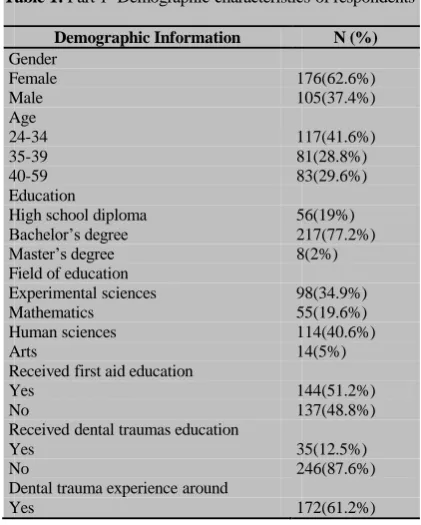
Validity of the questionnaire was approved by the Institutional Review Board (IRB). In order to confirm the reliability of the questionnaire, a pilot study was carried out on 20 subjects who were not included in the study. The data collected from the pilot study was ana-lyzed by using SPSS software. The reliability coeffi-cient (Cronbach alpha) was 0.83, indicating an accepta-ble reliability. The standardized questionnaire was com-pleted by teachers in schools. All the present teachers at the time of the study were included. Those reluctant to participate, and incomplete questionnaires were exclud-ed from the study. Part 1 includexclud-ed demographic ques-tions. (Table 1)
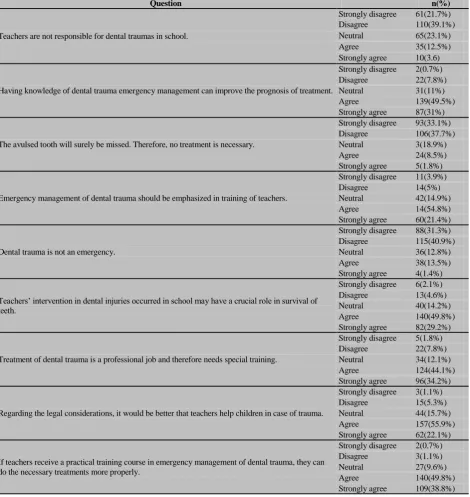
Part 2 contained nine questions on teachers’ atti-tude. (Table 2) In part three, trauma cases were
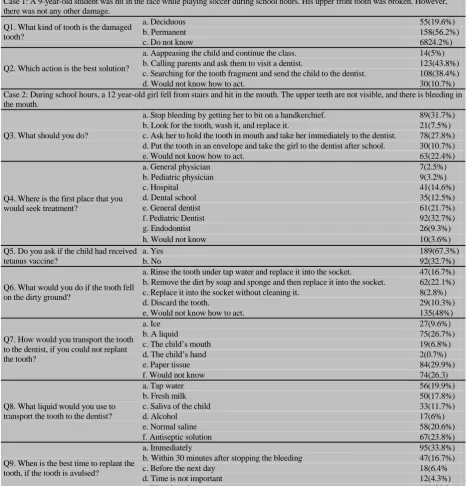
present-ed with nine relatpresent-ed questions. (Table 3) Part 4 con-tained three questions on self-assessment of teachers about their ability of emergency management of dental trauma. (Table 4) The questions were partially obtained from Caglar et al.’s study. [24]
Table 1: Part 1- Demographic characteristics of respondents
Demographic Information N (%)
Gender
Female 176(62.6%)
Male 105(37.4%)
Age
24-34 117(41.6%)
35-39 81(28.8%)
40-59 83(29.6%)
Education
High school diploma 56(19%)
Bachelor’s degree 217(77.2%)
Master’s degree 8(2%)
Field of education
Experimental sciences 98(34.9%)
Mathematics 55(19.6%)
Human sciences 114(40.6%)
Arts 14(5%)
Received first aid education
Yes 144(51.2%)
No 137(48.8%)
Received dental traumas education
Yes 35(12.5%)
No 246(87.6%)
Dental trauma experience around
Yes 172(61.2%)
In order to calculate the knowledge score, the cor-rect answers and incorcor-rect answers counted 1 and 0 point, respectively. Therefore, the score range was be-tween 0 and 15. The knowledge scores more than10.5 was considered as good, between 7.5 and 10.5 as medi-um, and less than seven as low. The same was applied to calculate the attitude score; and the range was be-tween 9 and 45. The scores >36 was considered as good, 27-36 as normal, and lower than 28 as low level of attitude.
The data were analyzed by using SPSS software, version 17 (SPSS® Inc.) T-test and ANOVA were em-ployed as appropriated. p< 0.05 was considered to be statistically significant.
Results
Table 2: Part 2- teachers’ attitude
Question n(%)
Teachers are not responsible for dental traumas in school.
Strongly disagree 61(21.7%)
Disagree 110(39.1%)
Neutral 65(23.1%)
Agree 35(12.5%)
Strongly agree 10(3.6)
Having knowledge of dental trauma emergency management can improve the prognosis of treatment.
Strongly disagree 2(0.7%)
Disagree 22(7.8%)
Neutral 31(11%)
Agree 139(49.5%)
Strongly agree 87(31%)
The avulsed tooth will surely be missed. Therefore, no treatment is necessary.
Strongly disagree 93(33.1%)
Disagree 106(37.7%)
Neutral 3(18.9%)
Agree 24(8.5%)
Strongly agree 5(1.8%)
Emergency management of dental trauma should be emphasized in training of teachers.
Strongly disagree 11(3.9%)
Disagree 14(5%)
Neutral 42(14.9%)
Agree 14(54.8%)
Strongly agree 60(21.4%)
Dental trauma is not an emergency.
Strongly disagree 88(31.3%)
Disagree 115(40.9%)
Neutral 36(12.8%)
Agree 38(13.5%)
Strongly agree 4(1.4%)
Teachers’ intervention in dental injuries occurred in school may have a crucial role in survival of teeth.
Strongly disagree 6(2.1%)
Disagree 13(4.6%)
Neutral 40(14.2%)
Agree 140(49.8%)
Strongly agree 82(29.2%)
Treatment of dental trauma is a professional job and therefore needs special training.
Strongly disagree 5(1.8%)
Disagree 22(7.8%)
Neutral 34(12.1%)
Agree 124(44.1%)
Strongly agree 96(34.2%)
Regarding the legal considerations, it would be better that teachers help children in case of trauma.
Strongly disagree 3(1.1%)
Disagree 15(5.3%)
Neutral 44(15.7%)
Agree 157(55.9%)
Strongly agree 62(22.1%)
If teachers receive a practical training course in emergency management of dental trauma, they can do the necessary treatments more properly.
Strongly disagree 2(0.7%)
Disagree 3(1.1%)
Neutral 27(9.6%)
Agree 140(49.8%)
Strongly agree 109(38.8%)
ously. Table 2 shows the results obtained from the se-cond part of the questionnaire (teachers’ attitude). More than 60% of teachers believed themselves to be respon-sible for dental injuries in school. About 70% stated that being knowledgeable in emergency management of dental trauma could improve the prognosis of trauma-tized teeth.
According to the results of T-test and ANOVA statistical tests, there was no significant relationship between knowledge as well as attitude and demographic data, education, and the field of study (p< 0.05). (Tables
5-8) However, the relationship between teachers’ Knowledge and first aid/dental emergencies education was observed to be statistically significant. (Tables 9 and 10) Furthermore, the mean knowledge score of teachers in boys’ school was significantly more than girls’ school. (Table 11)
No significant relationship existed between the attitude scores and teachers’ education, gender, first aid training, and being in a boys or girls school (p< 0.05).
Table 3: Part 3- teachers’ knowledge (correct answers are italicized).
Questions n(%)
Case 1: A 9-year-old student was hit in the face while playing soccer during school hours. His upper front tooth was broken. However, there was not any other damage.
Q1. What kind of tooth is the damaged tooth?
a. Deciduous 55(19.6%)
b. Permanent 158(56.2%)
c. Do not know 6824.2%)
Q2. Which action is the best solution?
a. Aappeasing the child and continue the class. 14(5%)
b. Calling parents and ask them to visit a dentist. 123(43.8%)
c. Searching for the tooth fragment and send the child to the dentist. 108(38.4%)
d. Would not know how to act. 30(10.7%)
Case 2: During school hours, a 12 year-old girl fell from stairs and hit in the mouth. The upper teeth are not visible, and there is bleeding in the mouth.
Q3. What should you do?
a. Stop bleeding by getting her to bit on a handkerchief. 89(31.7%)
b. Look for the tooth, wash it, and replace it. 21(7.5%)
c. Ask her to hold the tooth in mouth and take her immediately to the dentist. 78(27.8%) d. Put the tooth in an envelope and take the girl to the dentist after school. 30(10.7%)
e. Would not know how to act. 63(22.4%)
Q4. Where is the first place that you would seek treatment?
a. General physician 7(2.5%)
b. Pediatric physician 9(3.2%)
c. Hospital 41(14.6%)
d. Dental school 35(12.5%)
e. General dentist 61(21.7%)
f. Pediatric Dentist 92(32.7%)
g. Endodontist 26(9.3%)
h. Would not know 10(3.6%)
Q5. Do you ask if the child had received tetanus vaccine?
a. Yes 189(67.3%)
b. No 92(32.7%)
Q6. What would you do if the tooth fell on the dirty ground?
a. Rinse the tooth under tap water and replace it into the socket. 47(16.7%) b. Remove the dirt by soap and sponge and then replace it into the socket. 62(22.1%)
c. Replace it into the socket without cleaning it. 8(2.8%)
d. Discard the tooth. 29(10.3%)
e. Would not know how to act. 135(48%)
Q7. How would you transport the tooth to the dentist, if you could not replant the tooth?
a. Ice 27(9.6%)
b. A liquid 75(26.7%)
c. The child’s mouth 19(6.8%)
d. The child’s hand 2(0.7%)
e. Paper tissue 84(29.9%)
f. Would not know 74(26.3)
Q8. What liquid would you use to transport the tooth to the dentist?
a. Tap water 56(19.9%)
b. Fresh milk 50(17.8%)
c. Saliva of the child 33(11.7%)
d. Alcohol 17(6%)
e. Normal saline 58(20.6%)
f. Antiseptic solution 67(23.8%)
Q9. When is the best time to replant the tooth, if the tooth is avulsed?
a. Immediately 95(33.8%)
b. Within 30 minutes after stopping the bleeding 47(16.7%)
c. Before the next day 18(6.4%
d. Time is not important 12(4.3%)
e. Would not know 109(38.8%)
Table 4: Part 4- The teachers’ self-assessment
Question Answer n(%)
Q1. Do you think your knowledge on dental emergencies and its treatments is enough?
Yes 15
(5.3%)
No 266
(94.7%)
Q2. Do you need more education on dental emergencies and its
treatments?
Yes 266
(94.7%)
No 15
(5.3%)
Q3. Can you react properly in the limited time if you encounter dental injuries in a student?
Yes 97
(34.5%)
No 184
(65.5%)
Table 5: Comparison of knowledge and attitude score of
different age groups (p= 0.453 and 0.631, respectively).
Age
(years) Number
Mean knowledge score (SD)
Mean Attitude Score
(SD)
24-34 117 4.67 (1.82) 30.58
(2.91)
25-39 81 4.40 (1.78) 30.86
(2.68)
40-59 83 4.38 (1.9) 30.44
(2.89)
Total 281 4.51 (1.83) 30.62
Table 6: Comparison of different educational levels regarding their knowledge and attitude scores (p= 0.243 and 0.457, respectively).
Educational level Number
Mean knowledge score (SD)
Mean attitude score (SD)
High school diploma 56 4.075(2.04) 30.75(2.91) Bachelor’s degree 217 4.64(1.8) 30.76(2.99) Master’s degree and
higher 8 4.25(2.12) 30.12(2.23)
Total 281 4.1(1.83) 30.62(2.83)
Table 7: Comparison of the knowledge score among different
fields of education (p= 0.546).
Field of education Number Mean knowledge score
(SD)
Experimental sciences 98 4.68 (1.75)
Mathematics 55 4.23 (2.02)
Human sciences 114 4.50 (1.85)
Arts 14 4.42 (1.45)
Total 281 4.51 (1.83)
Table 8: Comparison of knowledge scores between males
and females (p= 0.082).
Gender Number Mean knowledge score (SD)
Female 176 4.65 (1.51)
Male 105 4.26 (1.67)
Total 281 4.51 (1.83)
Table 9: Comparison of knowledge scores between teachers
with and without previous first aid education (p= 0.032).
Previous first aid education Number Mean knowledge
score (SD)
Yes 137 4.75 (1.87)
No 144 4.28 (1.76)
Total 281 4.51 (1.83)
Table 10: The relationship between the teachers’ knowledge
scores and previous dental emergencies management educa-tion (p= 0.005).
Previous dental emergencies
management education Number
Mean knowledge score (SD)
Yes 35 5.31 (1.84)
No 246 4.39 (1.80)
Total 281 4.51 (1.83)
Table 11: Comparison of teachers’ knowledge score and
attitude in boys’ and girls’ school (p= 0.008 and p= 0.161, respectively).
Previous dental emergencies management education
Number
Mean knowledge score (SD)
Mean attitude score (SD)
Yes 35 4.22(1.67) 30.86(2.62)
No 246 4.80(1.95) 30.39(3.03)
Total 281 4.51(1.83) 30.62(2.83)
Discussion
Dental trauma requires immediate appropriate actions in order to minimize further complications. According to the International Association of Traumatology, in cases of permanent tooth avulsion which is one of the most
serious dental injuries, the best treatment in the field of accident is to replant the tooth immediately; if not possible, it should be saved in a suitable liquid medium as milk. However, deciduous teeth should not be replanted. [2]
The results of the current study revealed that nearly half of participants felt responsible for dental trauma occurring in their schools, and they thought the prognosis of the injured tooth would be better if they properly intervene. Furthermore, more than 70% of participants agreed that they should get dental emergencies training.
In this study, the total knowledge score of teachers on management of dental trauma was relatively low, which was consistent with those of the previously published studies by Mohandas and Chandan, [16] Blakytny et al., [22] and Al-jundi et al., [27] who re-ported the knowledge level of teachers to be 30%. Comparable findings were announced by Iranian stud-ies, as well. [26, 28]
Based on the present findings, 61% of teachers had experienced dental trauma in their students, show-ing the high prevalence of such accidents. It was noted that the teachers’ knowledge level was significantly related to their previous training of dental emergency management. Although this was supported by Sae-Lim
et al., [19] some studies found no statistically significant relationship between the previous training and the present knowledge. [16, 18, 22, 26] This is suggestive of the necessity of continuous education of teachers on dental emergency management.
The current investigation detected no significant relationship between the demographic characteristics and teachers’ knowledge, which was in line with the findings of previous studies. [18, 27]
In the case of a fractured tooth, only 38% of par-ticipants stated that they would look for the tooth frag-ment and would send the child to the dentist; this indi-cates the need for more teachers’ training. Moreover, only 7.5% of teacher claimed that they would replant the avulsed tooth by themselves. Similarly, Raoof et al. [28] reported that about 23% of teachers in their study thought that they could do the replantation.
to loss of normal morphology and metabolism of these cells. [29-32] Despite the fact that the best option as the transportation media is simply milk, [1] only 18% of teachers were aware of that; showing the necessity of further education. The insufficiency of Iranian teachers’ knowledge about the proper storage media was also reported by Raoof et al. [28] It is noteworthy that only 33.8% of teachers stated the correct timing for replantation.
The best way to clean the avulsed tooth is washing it by tap water; yet, this question received relatively low rate of correct answer (17%). While this was consistent with the results of Mohandas et al., [16] it contrasted other previous reports which mentioned that almost half of teachers knew about the necessity of washing the teeth. [20, 22, 33]
More than 94% of participants thought that their knowledge was insufficient, and they were interested in learning more. Current results also revealed the teachers’ knowledge in boys’ school to be significantly higher than that in girls’ school, which might be indicative of higher prevalence of accidents and trauma in boys’ school.
Conclusion
This study showed that the total present knowledge of Yazd school teachers on dental emergency management is low, and their attitude to these situations is relatively normal. Since, a noticeable count of dental trauma occurs in the school environment, the reaction of teachers would be of considerable importance in children health. Therefore, there is an urgent need to improve the dental awareness of school teachers.
Acknowledgements
This research received no specific grant from any fund-ing agency in the public, commercial, or not-for-profit sectors. There was no particular conflict of interest with any organization.
Conflict of Interest
Authors have no conflicts of interest to declare.
References
[1] Andreasen JO, Andreasen FM. Textbook and Color Atlas of Traumatic Injuries to the Teeth. 4th ed. Oxford:
Blackwell Publishing; 2007. p. 444-480.
[2] Ingle NA, Baratam N, Charania Z. Prevalence and factors associated with traumatic dental injuries (TDI) to anterior teeth of 11–13 year old school going children of Maduravoyal, Chennai. J Oral Health Comm Dent. 2010; 4: 55–60.
[3] Pine CM, Harris R. Community oral health. 2nd ed. Quintessence Book Publishing Co.: UK; 1997. p. 203-211.
[4] McDonald RE, Avery DR. Dentistry for the child and adolescent. 8th ed. Mosby Co.: St Louis; 2009: p. 370-470.
[5] Traebert J, Peres MA, Blank V, Böell Rda S, Pietruza JA. Prevalence of traumatic dental injury and associated factors among 12-year-old school children in Florianópolis, Brazil. Dent Traumatol. 2003; 19: 15-18. [6] Rajab LD. Traumatic dental injuries in children presenting for treatment at the Department of Pediatric Dentistry, Faculty of Dentistry, University of Jordan, 1997-2000. Dent Traumatol. 2003; 19: 6-11.
[7] Eyuboglu O, Yilmaz Y, Zehir C, Sahin H. A 6-year investigation into types of dental trauma treated in a paediatric dentistry clinic in Eastern Anatolia region, Turkey. Dent Traumatol. 2009; 25: 110-114.
[8] Traebert J, Peres MA, Blank V, Böell Rda S, Pietruza JA. Prevalence of traumatic dental injury and associated factors among 12-year-old school children in Florianópolis, Brazil. Dent Traumatol. 2003; 19: 15-8. [9] Marcenes W, al Beiruti N, Tayfour D, Issa S.
Epidemiology of traumatic injuries to the permanent incisors of 9-12-year-old schoolchildren in Damascus, Syria. Endod Dent Traumatol. 1999; 15: 117-123. [10]Marcenes W, Murray S. Changes in prevalence and
treatment need for traumatic dental injuries among 14-year-old children in Newham, London: a deprived area. Community Dent Health. 2002; 19: 104-108.
[11]Gift HC, Bhat M. Dental Visits for Orofacial Injury: Defining the Dentist’s Role. The Journal of the
American Dental Association. 1993; 124: 92-96. [12]Wilson S, Smith GA, Preisch J, Casamassimo PS.
Epidemiology of dental trauma treated in an urban pediatric emergency department. Pediatr Emerg Care. 1997; 13: 12-15.
203-208.
[14]Werder P, von Arx T, Chappuis V. Treatment outcome of 42 replanted permanent incisors with a median follow-up of 2.8 years. Schweiz Monatsschr Zahnmed. 2011; 121: 312-320.
[15]Ozen B, Cakmak T, Altun C, Bagis B, Senel FC, Balta- cioglu E, Koskan O. Prevalence of dental trauma among children age 2-15 years in the Eastern Black Sea Region of Turkey. J Int Dent Med Res. 2010; 3: 126-132 . [16]Mohandas U, Chandan GD. Knowledge, attitude and
practice in emergency management of dental injury among physical education teachers: a survey in Bangalore urban schools. J Indian Soc Pedod Prev Dent. 2009; 27: 242-248 .
[17]McIntyre JD, Lee JY, Trope M, Vann WF Jr. Permanent tooth replantation following avulsion: using a decisiontree to achieve the best outcome. Pediatr Dent. 2009; 31: 137-144.
[18]Chan AW, Wong TK, Cheung GS. Lay knowledge of physical education teachers about the emergency management of dental trauma in Hong Kong. Dent Traumatol. 2001; 17: 77-85.
[19]Sae-Lim V, Lim LP. Dental trauma management awareness of Singapore pre-schoolteachers. Dent Traumatol. 2001; 17: 71-76.
[20]Mesgarzadeh AH, Shahamfar M, Hefzollesan A. Evaluating knowledge and attitudes of elementary school teachers on emergency management of traumatic dental injuries: a study in an Iranian urban area. Oral Health Prev Dent. 2009; 7: 297-308.
[21]Newman LJ, Crawford PJ. Dental injuries: "first aid" knowledge of Southampton teachers of physical education. Endod Dent Traumatol. 1991; 7: 255-258 . [22]Blakytny C, Surbuts C, Thomas A, Hunter ML.
Avulsed permanent incisors: knowledge and attitudes of primary school teachers with regard to emergency management. Int J Paediatr Dent. 2001; 11: 327-332. [23]Pacheco LF, Filho PF, Letra A, Menezes R, Villoria
GE, Ferreira SM. Evaluation of the knowledge of the treatment of avulsions in elementary school teachers in Rio de Janeiro, Brazil. Dent Traumatol. 2003; 19: 76-78.
[24]Caglar E, Ferreira LP, Kargul B. Dental trauma management knowledge among a group of teachers in two south European cities. Dent Traumatol. 2005; 21: 258-262.
[25]Zakirulla M, Togoo RA, Yaseen SM, Al-Shehri DA, Al-Ghamdi AS, Al-Hafed MS, et al. Knowledge and attitude of Saudi Arabian school teachers with regards to emergency management of dental trauma. Int J Clin Dent Sci. 2011; 2: 25-29.
[26]Fallahinejad M, Haghighatdoost E. Evaluation of primary school teachers’ knowledge of dental traumas
in students, Tehran-2003. J Dent Sch. 2005; 22: 21-25. [27]Al-Jundi SH, Al-Waeili H, Khairalah K. Knowledge
and attitude of Jordanian school health teachers with regards to emergency management of dental trauma. Dent Traumatol. 2005; 21: 183-187.
[28]Raoof M, Zaherara F, Shokouhinejad N, Mohammadalizadeh S. Elementary school staff knowledge and attitude with regard to first-aid management of dental trauma in Iran: a basic premise for developing future intervention. Dent Traumatol. 2012; 28: 441-447.
[29]Andreasen JO, Borum MK, Jacobsen HL, Andreasen FM. Replantation of 400 avulsed permanent incisors. 4. Factors related to periodontal ligament healing. Endod Dent Traumatol. 1995; 11: 76-89.
[30]American Association of Endodontists. Treatment of the avulsed permanent tooth. Recommended guidelines of the American Association of Endodontists. Dent Clin North Am. 1995; 39: 221–225 .
[31]Barrett EJ, Kenny DJ. Avulsed permanent teeth: a review of the literature and treatment guidelines. Endod Dent Traumatol. 1997; 13: 153-163.
[32]Andreasen JO, Andreasen FM, Skeie A, Hjørting-Hansen E, Schwartz O. Effect of treatment delay upon pulp and periodontal healing of traumatic dental injuries -- a review article. Dent Traumatol. 2002; 18: 116-128. [33]Abidi SYA, Khan AM, Khan MA, Fazal-Ur-Rehman Q,