Iranian Journal of Economic Studies
Journal homepage: ijes.shirazu.ac.ir
The Success Factors in Developing Countries’ Transition to a Learning Economy: Evidence from Iran by a Grounded Theory Approach
Behnam Abdia, Seyyed Hamid Khodadad Hosseinib a.Faculty of Management, Imam Ali Officer University, Tehran, Iran.
b.Faculty of Management and Economics, Tarbiat Modares University, Tehran, Iran.
Article History Abstract
Received date: 26 November 2018 Revised date:26 July 2019 Accepted date: 25 August 2019 Available online: 16 September 2019
An outstanding feature of the contemporary world is the rapid economic, technological, social, and political changes marked by a high level of uncertainty. For surviving in this complex and constantly changing economy, successful transition to a learning economy is a necessity for developing countries. This research was aimed to investigate the factors which played a role in the developing countries’ successful transition to a learning economy. Furthermore, according to evolutionary economics, countries are path-dependent, i.e. the differences in structures and institutions of an economy give each economic system its specific nature that is illustrated in the particular challenges each country face in its transformation to a learning economy. Hence, based on the pieces of evidence from Iran, this inductive, exploratory, and qualitative research, using a grounded theory approach and a follow-up quantitative analysis based on survey data, led to the development of a model that can be used to analyze the success factors which contribute to this transition. The findings showed that in terms of the ‘paradigm model’, transitional thinking as casual condition, ICT, social capital and macro-economic conditions as intervening conditions, policy institution as central category, government, university and industry interactions, learning firms, collaborative learning, improved research and education system, and regional development as strategies were factors that could lead to a learning economy.
JEL Classification: O21
O31 O32 O33 O43
Keywords: Learning Economy Knowledge-Based Economy Transition
Policy Institution Grounded Theory Iran
1. Introduction
In recent decades, knowledge has been considered as a strategic variable in economic competitiveness and development (OECD, 2000; Mu et al., 2010;
Cavusoglu, 2016); as a result, the knowledge-based economy has been the dominant paradigm (Asongu & Andres, 2019; Zandiatashbar & Hamidi, 2018;
Ogundeinde & Ejohwomu, 2016; Amavilaha et al., 2017). At the same time, only having knowledge does not imply the necessary paradigm shift to a knowledge-based economy (Chen & Zhang, 2010). In fact, among the different engines of economic development, innovation is the most important factor for making
progress and creating wealth (Hudson & Minea, 2013; Pieroni et al., 2019). Thus, when reference is made to a knowledge-based economy, the innovation system is a crucial means of competition in such an economy (Andria & Savin, 2018). In spite of this fact, the innovation system in developing countries differs with that of the developed countries (Xao & Guan, 2009). As a result, competitive intelligence comes from a body of knowledge that is based upon learning structures. Accordingly, it is the learning capability of the society which matters in developing countries (Lundvall et al., 2006), hence the emergence of the concept of learning economy.
However, there are certain prerequisites that need to be met for each single national economic system if it is to make a transition to a learning economy (Soskice, 1999). In other words, and according to the evolutionary economics, countries are path-dependent, i.e. different national economies have their own specific profiles of science and technology (Lemola, 2002; Choung et al., 2014;
Fu et al., 2011). What is not yet clear is how this process of transition takes place and what variables initiates this transition in developing countries’. Addressing such questions can help us figure out how such a transition to a learning economy can take place in a specific country, such as Iran. Another follow-up question would be this: What are the success factors expediting this transition to a learning economy in Iran?
In what follows, a brief summary of literature on learning economy and an overview of Iran’s science and technology policy challenges and issues are provided in section 2. Then, the study methodology is discussed in section 3, followed by a discussion of the processes involved a grounded theory, (including various coding, processes and the emergence of a theory) six theoretical propositions are spelled out in section 4, and, finally, some conclusions and implications for policy and management are presented in section 5.
2. The Learning Economy and Iran's Science and Technology Policy Issues
The role of knowledge in economic development has strongly been recognized (Carayannis et al., 2018; Lundvall, 1992; French, 2004; Amavilaha et al., 2017). In various contexts, an interpretation of what has actually taken place in the economy over the last few decades under the heading ‘learning economy’ has gained currency (Lundvall & Johnson, 1994). Having access and using the international tacit knowledge and diffusing interdisciplinary problem-driven research and education system that lead to learning are needed for developing countries transition to a learning economy. That said, the important effects of learning at the firm level are crucial for economic growth (Okada, 2004). In spite of the fact that a learning economy has benefited developing countries; for instance, it has facilitated their integration into a global value chains, there are no studies about the role of a learning economy in Iran. To the best of our knowledge, there are only some limited studies about knowledge-based economies and the evident relations in this area. For example, a research which was based on the
knowledge-based economy_ showed that all of those components had a decisive impact on Iran’s economic development. Therefore, exploring and investigating key factors which influence Iran’s transition to a learning economy is imperative.
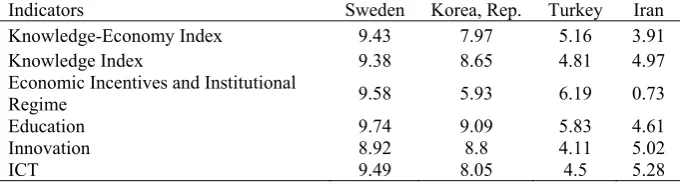
Iran’s 1404 development vision predicts that in the course of the next two decades (up to 2025), Iran will change into a developed country and will be ranked first economically, scientifically and technologically in the region. According to this vision, several five-years plans have been formulated and will be implemented to attain the final goal, which is being ranked first in the Middle East. Although there has been some primary success in attaining the objectives delineated in the development plans, such as the increase in the number of students and teachers in higher education, and government expenditures in education, and some other science and technology indicators, there has not been sufficient and real progress toward the vision. The most important change taking place thus far is in the number of published academic articles, promoting Iran’s ranking in this area in the world (27 in 2008, 22 in 2009, and 16 in 2012) (Regional Information Center for Science and Technology, 2012). Nevertheless, some other indicators, such as Iran's place among the knowledge-based economies (98 in 2009 and 96 in 2012) (World Bank, 2012) (Table 1) and its economic competitiveness (64 between 144 countries in the world), represent a great contradiction.
Table 1. Knowledge-based economy in Iran and some selected countries
Indicators Sweden Korea, Rep. Turkey Iran
Knowledge-Economy Index
9.43 7.97 5.16 3.91
Knowledge Index 9.38 8.65 4.81 4.97
Economic Incentives and Institutional
Regime 9.58 5.93 6.19 0.73
Education 9.74 9.09 5.83 4.61
Innovation 8.92 8.8 4.11 5.02
ICT 9.49 8.05 4.5 5.28
Source: World Bank (2012)
a crucial consideration for economic progress is how techno-economic and socio-institutional changes will create a national learning system.
3. Methodology and Data Collection
The learning economy paradigm needs to develop customized research methodology and models (Lundvall, 2008). Hence, the common research methodology in quantitative and deductive approaches, such as survey-based researches, is not satisfactory (Lundvall et al., 2008; Fitjar & Rodríguez-Pose, 2013; Jensen et al., 2007). That explains why the present study took an inductive and qualitative method, using grounded theory approach and a follow-up survey-based quantitative analysis to develop a model that can be used to analyze the themes and related components of this transition. In fact, this study included two phases. First, it was the qualitative phase in which grounded theory was used; second, it was the survey-based quantitative phase in which a questionnaire was utilized.
3.1 Grounded Theory: Qualitative Phase
Because of using grounded theory and comprehensive data gathering in the first phase, findings are based on real problems in society and specific history, path dependency, the size and the level of economic development. The authors contend that qualitative methods based upon grounded theory approach can play a major role in investigating some issues such as learning economy. Grounded theory is represented in the form of a theory building based on data analysis (Glaser & Strauss, 1967). In grounded theory, first, the required data is gathered and the key concepts are highlighted with specified codes. In the next step, categories will be recognized based on the codes, and the related theory will appear in the final step (Strauss & Corbin, 1990).
data were collected simultaneously through deep and comprehensive data gathering from different data sources as follows:
‐ Iran’s 1404 development vision;
‐ Iran’s Holistic Scientific Map;
‐ Iran’s 5th and 6th Development Plan;
‐ Iran’s Comprehensive IT Strategic plan;
‐ Reports and publications from international organizations, such as World Bank, IMF, OECD, United Nations about Iran;
‐ Academic resources, published books, and articles in Persian and other
languages about development issues in Iran;
‐ Opinions of policy-makers, managers, and other important decision-makers published through different mediums.
3.2 Questionnaire: Quantitative Phase
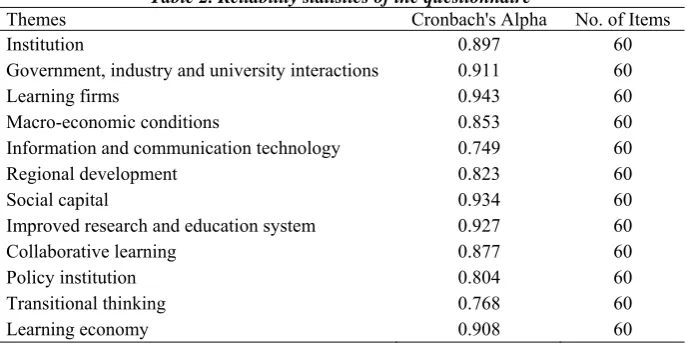
deliver similar results on repeated trials. In other words, it is the consistency or stability of scores across raters or over time. The questionnaire reliability was confirmed by Cronbach's Alpha, measured using SPSS as follows:
Table 2. Reliability statistics of the questionnaire
Themes Cronbach's Alpha No. of Items
Institution 0.897 60
Government, industry and university interactions 0.911 60
Learning firms 0.943 60
Macro-economic conditions 0.853 60
Information and communication technology 0.749 60
Regional development 0.823 60
Social capital 0.934 60
Improved research and education system 0.927 60
Collaborative learning 0.877 60
Policy institution 0.804 60
Transitional thinking 0.768 60
Learning economy 0.908 60
3.3 Presenting the Research Model and Theoretical Propositions
In the grounded theory, after three steps of coding (open, axial, and selective), the results are tested and confirmed by various methods, a questionnaire-based survey in the present research. In what follows, the research model, which is based on the paradigm model in the systemic approach, and a discursive set of theoretical propositions derived from that model are presented.
4. Results
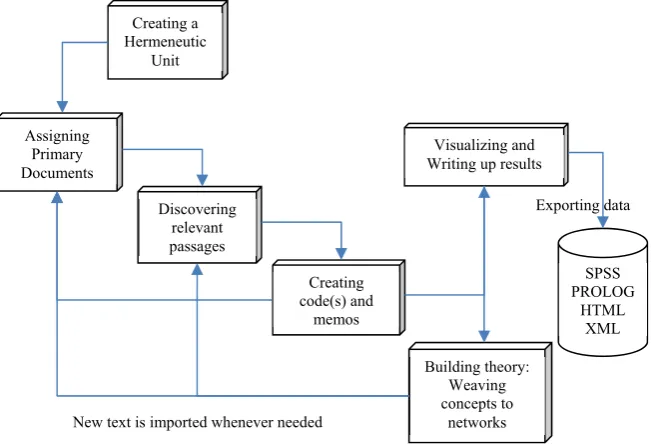
Figure 1. The ATLAS.ti workflow
For example, a part of the software output was as follows:
Figure 2. ATLAS.ti output
In this stage, 4051 codes and 600 memos were generated which resulted in 12 categories (themes), and 139 concepts (components). In the second phase, we used SPSS and one-sample T-Test for data analysis.
4.1 First Stage: Open Coding
The open coding in the grounded theory was done via some analytic processes that led to concepts (codes). This was done by repeating questions such as ‘what is this about?’ and ‘What is being referred to here?’
Creating a Hermeneutic
Unit
Assigning Primary Documents
Discovering relevant passages
Creating code(s) and
memos
Building theory: Weaving concepts to
networks Visualizing and Writing up results
SPSS PROLOG
HTML XML Exporting data
Figure 3. The process of open coding.
As can be seen in Figure 3, the analysis and coding, the discovery of categories, and categories explanation according to their characteristics are part of the open coding stage. The results are presented in the form of a table (Appendix A).
4.2 Second Stage: Axial Coding
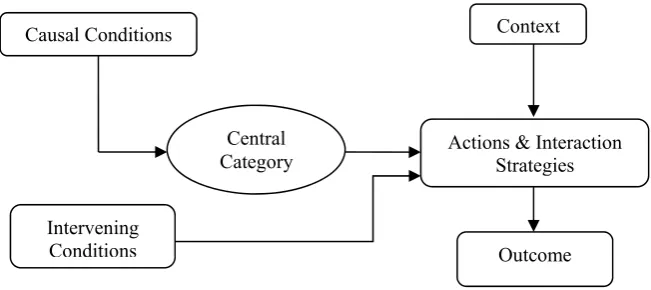
After doing the first phase and identifying 12 themes (categories) and 139 components (concepts) germane to Iran’s transition to a learning economy through three coding processes (the success factors), the 60 pivotal components selected by the ATLAS.ti, based on the density and groundedness of the components, were used in the axial coding and a set of relations established between the generated categories at the open coding stage (Figure 4).
Figure 4. The paradigm model (Strauss & Corbin, 1998).
Axial coding based upon the paradigm model is shown in the form of a table (Appendix B).
Code 1
Code 2 Theme 2
Concept 1
Code n Concept n
Concept 2
Theme 1
Theme n .
. .
. . .
. . .
Causal Conditions
Actions & Interaction Strategies
Outcome Context
Intervening Conditions
4.3 Third Stage: Selective Coding
The essential step in the grounded theory is selective coding in which central category is chosen. In fact, the researcher is expected to create an image by aligning some categories together based on their relations (Creswell, 2004).
4.3.1 Shaping the Theory of Transition to a Learning Economy for Iran: A Narrative Description
The learning economy paradigm posits that knowledge creation and destruction has accelerated over the last years, and firms and nations need to update their capabilities and competencies to keep pace with this it. Consequently, today, success is a result of proactive learning and forgetting, and not having access to a stock of knowledge (Freeman & Perez, 1988).
However, changing the attitude and mindsets of some agents is difficult but necessary for the transition to a learning economy. Therefore, we need a transitional thinking (causal conditions) in all sectors of society so that everyone will be informed of the advantages and difficulties of the process of transition. When the mindsets change and the public and policy-makers’ understanding of the transition is enhanced, it is important to take into account the policy institution (central category). Policy institution is a coherent set of individuals (policy-makers in different levels, science and technology strategists, and the general public), soft institutions (such as existing customs, norms, and collaboration), hard institutions (such as universities and research centers), and the interactions between the sections. This whole will finally lead to some desired policy inputs, outputs, and especially, outcomes. This needs an institutional set-up (context) that facilitates the interactions and increases the institutional convergence and learning, which together can contribute to cohesion and integration in the institutional structure of the society. On the other hand, ICT, social capital, and macroeconomic conditions (intervening conditions) are all at play. The considerable impact of ICT on the learning economy is indisputable; it facilitates the interactions within it and reduces its costs. Macroeconomic conditions such as opening the economy to improve competition and boost the legal security for investments may result in improvement of international competitiveness at an international level.
address the society problems and utilized in relevant contexts. Moreover, and as regards the universities, they will be deemed as economic-scientific institutions and university groups as knowledge firms. Furthermore, the interaction between universities and private corporation, as well as interdisciplinary learning, will be emphasized, activities will arise from real operational problems, and special institutions will be stablished to solve the contradictions that result from structural changes, development and growth processes, and sequential capability building. Finally, technological capabilities for key industries and policies regarding science and technology will be integrated with the development strategies and macroeconomic policies.
4.4 Quantitative Data Analysis
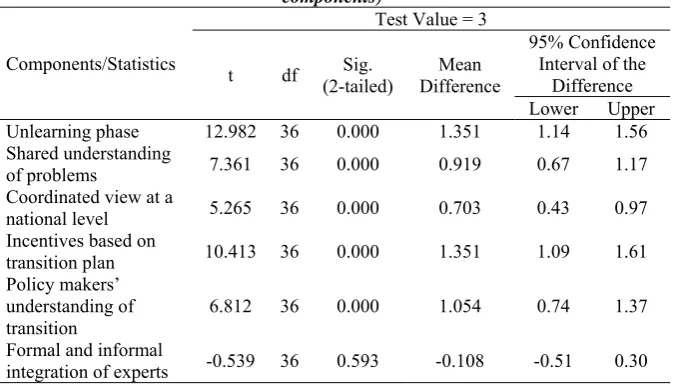
In the second phase, SPSS and one-sample T-test were used for data analysis. As mentioned in the methodology, each component had two columns. The first column was aimed to evaluate the importance of each of the 60 components, and the results are presented in Table 3.
Table 3. One-Sample T-Test Statistics (Determining the importance of each of 60 components)
Test Value = 3
Components/Statistics 95% Confidence Interval of the
Difference Mean Difference Sig. (2-tailed) df t Upper Lower 1.56 1.14 1.351 0.000 36 12.982 Unlearning phase 1.17 0.67 0.919 0.000 36 7.361 Shared understanding of problems 0.97 0.43 0.703 0.000 36 5.265 Coordinated view at a
national level 1.61 1.09 1.351 0.000 36 10.413 Incentives based on
transition plan 1.37 0.74 1.054 0.000 36 6.812 Policy makers’ understanding of transition 0.30 -0.51 -0.108 0.593 36 -0.539 Formal and informal
integration of experts
the final model. The second column was supposed to evaluate the relations between different parts of the paradigm model. A brief account of the results can be observed in the Table 4.
Table 4. One-Sample T-Test Statistics (the relations between different parts of the paradigm model)
Test Value = 3
Components/Statistics
95% Confidence Interval of the
Difference Mean Difference Sig. (2-tailed) df t Upper Lower 4.83 4.20 4.514 0.000 36 29.047 Unlearning phase 4.27 3.62 3.946 0.000 36 24.737 Shared understanding of problems 4.21 3.52 3.865 0.000 36 22.785 Coordinated view at a
national level 4.59 3.95 4.270 0.000 36 27.009 Incentives based on
transition plan 4.49 3.89 4.189 0.000 36 28.066 Policymakers’ understanding of transition
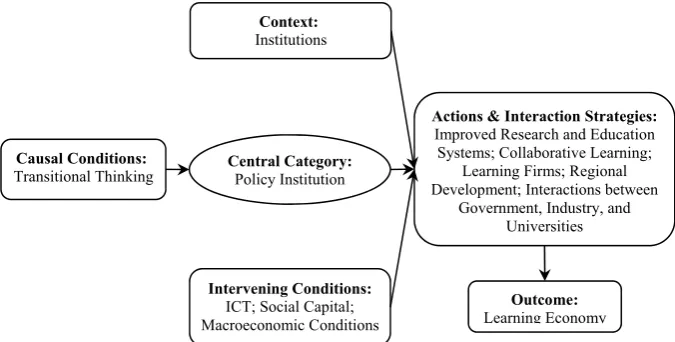
The Sig. (2-tailed) for each of the 59 components and their relations based on the paradigm model was less than 0.05. This means that these components met the criterion in this step. As a result, the final model of transition to a learning economy for Iran could be presented as what is shown in Figure 5:
Figure 5. A model for Iran’s transition to a learning economy Causal Conditions: Transitional Thinking Context: Institutions Central Category: Policy Institution Intervening Conditions:
ICT; Social Capital; Macroeconomic Conditions
Actions & Interaction Strategies:
Improved Research and Education Systems; Collaborative Learning;
Learning Firms; Regional Development; Interactions between
Government, Industry, and Universities
Outcome:
As mentioned earlier in section 3.2, a discursive set of theoretical propositions were produced at the final step. These propositions are briefly stated below.
4.5 Theoretical propositions
Theoretical propositions explain the generalized relations between the central category and other selected categories. Propositions entail conceptual relations formed (shaped) from structures. In this study, the theoretical propositions were tested by the quantitative survey, and six final propositions presented below are based on the research and the model of Iran’s transition to a learning economy.
Proposition 1: Transitional thinking includes unlearning phase, shared understanding of problems, coordinated view at a national level, formulating and implementing incentives based on a transition plan, improving both the policy makers’ and public’s understanding of transition. These elements, described as the causal conditions will affect the central category.
Proposition 2: Creating and diffusing policy learning, improving policy transfer as a whole, developing of horizontal interactions and learning networks between different policy areas, improving learning-by-comparing through international comparison and improving absorptive capacity of policy institution are the main elements of policy institution. These elements, referred to as the central category, will affect actions and interactions.
Proposition 3: ICT (ICT’s infrastructure development, E-Government development), social capital (the improvement of social trust, social cohesion improvement, social participation, public awareness, civil society, and networks as the core of social capital to improve social communications), and macroeconomic conditions (open economy, improved competition, formulation and implementation of integrated and comprehensive strategy, improved private sector participation, improved domestic economic management, creation and improvement of legal security for investments, improved international competitiveness at an international level), as intervening conditions, will affect actions and interactions.
Proposition 4: Institutional convergence, facilitation of foreign direct investment, enhancement of intellectual property rights (IPRs) & its enforcements, institutional learning diffusion and cohesion, and integration of the institutional structure of the society are the main constituents of the institution. These institutional constituents, subsumed under the context, will affect actions and interactions.
education systems (developing vocational learning, improving the quality of educational content by focusing on the relation between theory and action based on real problems in the society and integrating external action courses and training plans, developing the interactions between university, industry, and government, building and diffusing interdisciplinary research and education, enhancing international communications, building on reforms in higher education, building creative education programs and developing social skills in students via training systems), GIU interactions (designing a framework for improving the policymaking and monitoring role of government), and collaborative learning (building intentional learning processes at the national level and improving social learning, and collaboration).
Proposition 6: A Learning economy is characterized especially by systemic and aggressive learning, where science and technology policies are considered as national assets and developed and well-educated humans as capital. In such an economy, system capability is evaluated in terms of interactive links, and knowledge is produced to address the problems which the society is facing and is employed in relevant contexts. Furthermore, and with regard to universities, they are considered as economic and scientific institutions and university groups as knowledge firms. In addition, the interaction between the universities and private corporations is emphasized, as is the interdisciplinary learning. It is vital that activities are based on real operational problems, and special institutions are established to solve the contradictions that result from structural changes, development and growth processes, and sequential capability building. Finally, technological capabilities for main industries, science and technology, and policy are improved and integrated with the development strategies and macroeconomic policies. To sum up, the findings of this research showed that for a successful transition to a learning economy in Iran, deep changes had to take place in the socio-institutional and techno-economic components. For such transition, those components have to be taken into account simultaneously, as suggested in the long wave theory approach.
5. Conclusion Remarks
References
Abbasi, F., Hajihoseini, H., Mohammadi, M., & Elyasi, M. (2011). Analysis of Iranian innovation system's governance based on innovation policy making cycle. Journal of Science and Technology Policy, 4 (1) 33-49.
Amavilaha, V., Simplice, A.A., & Andrésd, A.R. (2017). Effects of globalization on peace and stability: Implications for governance and the knowledge
economy of African countries. Technological Forecasting and Social
Change, 122, 91-103.
Andria, D., & Savin, I. (2018). A Win-Win-Win? Motivating innovation in a
knowledge economy with tax incentives. Technological Forecasting and
Social Change, 127, 38-56.
Asongu, S.A. & Andres, A.R. (2019). Trajectories of knowledge economy in
SSA and MENA countries. Technology in Society, DOI:
10.1016/j.techsoc.2019.03.002 (March, 2019).
Carayannis, E.G., Ferreira, J.J.M., Jalali, M.S., & Ferreira, F.A.F. (2018). MCDA in knowledge-based economies: Methodological developments and
real world applications. Technological Forecasting and Social Change,
131, 1-3.
Cavusoglu, B. (2016). Knowledge economy and north cyprus, Procedia
Economics and Finance, 39, 720-724.
Charmaz, K. (2000). Grounded theory methodology: Objectivist and
constructivist qualitative methods. 509-535 in Handbook of Qualitative
Research, 2nd Edition, edited by N. K. Denzin and Y.S. Lincoln. Thousand
Oaks, CA: Sage.
Chen, m.h., & Zhang, G.P. (2010). Tacit knowledge acquisition and sharing in
intra-organization. Third International Symposium on Knowledge
Acquisition and Modeling.
Choung, J., Hwang, H., & Song, W. (2014). Transitions of innovation activities in latecomer countries: An exploratory case study of South Korea. World
Development, 54, 156–167.
Creswell, J.W. (2004). Research design: qualitative & quantitative approaches. California: SAGE publications.
Fitjar, R.D., & Rodríguez-Pose, A. (2013). Firm collaboration and modes of
innovation in Norway. Research Policy, 42, 128– 138.
Freeman, C., & Perez, C. (1988). Structural crises of adjustment, Business cycles
and investment behavior, 38-66.
French, S. (2004). Innovation and Social Learning: Institutional Adaptation in an
Era of Technological Change. Journal of Economic Geography,
4(2):219-220.
Fu, X., Pietrobelli, C., & Soete, L. (2011). The role of foreign technology and indigenous innovation in the emerging economies: Technological Change
Glaser, B. (1992). Basics of grounded theory analysis. Mill Valley, CA: The Sociology Press.
Glaser, B., & Strauss, A. (1967). The discovery of grounded theory: Strategies for
qualitative research. Chicago: Aldine.
Hudson, J., & Minea, A. (2013). Innovation, intellectual property rights, and
economic development: A unified empirical investigation. World
Development, 46, 66–78.
Jensen, M.B., Johnson, B., Lorenz, E., & Lundvall, B.A. (2007). Forms of
knowledge and modes of innovation. Research Policy, 36(5) 680-693.
Lemola, T. (2002). Convergence of national science and technology policies: the
case of Finland. Research Policy, 31, 1481–1490.
Lundvall, B.A. (1992). National systems of innovation: Towards a theory of
innovation and interactive learning. London: Pinter Publishers.
Lundvall, B.A. (2008). The Danish model and the globalizing learning economy
– Lessons for developing countries. Department of Business Studies, Aalborg
University.
Lundvall, B.A., Intarakumnerd, P., & Vang, J. (2006). Asia’s innovation systems
in transition. Edward Elgar Publishing, Inc.
Lundvall, B.A., & Johnson, B. (1994). The learning economy. Journal of Industry
Studies, 1(2), 23-42.
Lundvall, B.A., Rasmussen, P., & Lorenz, E. (2008). Education in the learning
economy: A European perspective. Policy Futures in Education, 6 (6).
Mejri, K., MacVaugh, J.A., & Tsagdis, D. (2018). Knowledge configurations of small and medium-sized knowledge-intensive firms in a developing
economy: A knowledge-based view of business-to-business
internationalization, Industrial Marketing Management, 71, 160-170.
Mu, J., Tang, F., & Mac Lachlan, D.L. (2010). Absorptive and disseminative
capacity: Knowledge transfer in intra-organization networks. Expert Systems
with Applications, 37, 31–38.
OECD (2000). Knowledge Management in the Learning Society. Paris: OECD.
Ogundeinde, A., & Ejohwomu, O. (2016). Knowledge economy: A panacea for
sustainable development in Nigeria. Procedia Engineering, 145, 790-795.
Okada, A. (2004). Skills development and inter-firm learning linkages under
globalization: Lessons from the Indian automobile industry. World
Development, 32 (7), 1265–1288.
Pieroni, M.P.P., McAloone, T.C. & Pigosso, D.C.A. (2019). Business model innovation for circular economy and sustainability: A review of approaches.
Journal of Cleaner Production, 215, 198-216.
Regional Information Center for Science and Technology, (2012). Available online at http://www.srlst.com,
Soskice, D. (1999). Divergent production regimes: Coordinated and
uncoordinated market economies in the 1980s and 1990s in H. Kitschelt et
Stankovic, N. & Micic, Z. (2018). Innovating and management of the knowledge base on the example of IT applications. Telematics and Informatics, 35(5). Strauss, A., & Corbin, J. (1990). Basics of qualitative research: Grounded theory
procedures and techniques. London: Sage.
Strauss, A., & Corbin, J. (1998). Basics of qualitative research: Techniques and
procedures for developing grounded theory. London: Sage, 2nd edition.
Supreme Cultural Revolution Council (2003). The council for scientific and
cultural monitoring and evaluation, Science and technology evaluation in
Islamic Republic of Iran (1st macro evaluation). Tehran: Supreme Cultural
Revolution Council publications.
World Bank (1998). World development report 1998/1999: Knowledge for
development. World Bank publications: Washington, DC.
World Bank (2012). Knowledge appraisal measurement. World Bank
publications: Washington D.C.
Xao, X., & Guan, J. (2009). A scale-independent analysis of the performance of
the Chinese innovation system. Journal of Informatics, 3(4):321-331.
Zandiatashbar, A., & Hamidi, S. (2018). Impacts of transit and walking amenities
Appendices
AppendixA: Open Coding at a Glance
Number of generated codes
Concepts (components)
Themes
(Categories)
20 Institutional capacity
Institutions
21 Foreign direct investment (FDI)
22 Intellectual property rights (IPRs) & its enforcement
41 Institutional convergence
26 Institutional learning diffusion
31 Cohesion and integration in the institutional structure of society 21 Institutional fitting and refitting in response to new rules 42 Designing a framework for improving policymaking and monitoring the role of government
Government, Industry and University Interactions 21 Financial and regulatory support of venture capital
24 Building joint work teams
21 Formulating and implementing regulations and laws to enhance interactions 32 Planning and organizing capable human resources 33 Government/University/Industry exchange of ideas 38 Improving university-industry collaboration thorough special institutions
Number of generated codes
Concepts (components)
Themes
(Categories)
34 Integrated competence building strategy at the firm level
Learning firms
25 Improving and diffusing the technological capability at the firm level 30 Improved organizational structure and systems
21 Developing and diffusing technological learning 27 Developing and diffusing organizational learning 32 Developing and diffusing organizational adaptation 43 Developing and diffusing organizational trust 31 Developing the intra-firm horizontal cooperation
22 Finding a balanced development between the firms’ internal and external R&D capacity to capture the benefits from external technology sources
24 Increasing functional flexibility
20 Focusing on core capabilities and outsourcing secondary tasks and functions
23 Developing a learning culture among employees in the public sector 41 Accelerating the development and application of ICTs 39 Improving firms’ absorptive capacity
26 Making formal interactions with key stakeholders (suppliers and customers) increasingly to gain competitive advantage
24 Making informal interactions with competitors as to improve knowledge spillover 44 Open economy and improvement of competition
Macro-Econom
ic
Conditions
26 Improving the efficiency of financial markets 24 Improving the flexibility in the labor force market
42 Planning and implementing an integrated and comprehensive strategy 54 Improving private sector participation
37 Developing applicable competition regime and policies 38 Improving market flexibility and security
44 Improving economic management by taking an indigenous approach 64 Creating and improving the legal security for investments 45 Improving international competitiveness at an international level
37 Eliminating the digital gap between the regions at a national level
Information and communication technolog
y
50 Developing ICT’s infrastructure
Number of generated codes
Concepts (components)
Themes
(Categories)
58 Developing industrial clusters
Region
al devel
opment
42 Developing learning networks thorough horizontal interactions in the regions 40 Building horizontal interactions between different regions
32 Developing business incubators
43 Improving the production structure
31 Improving trust
22 Finding a balance between centralization and decentralization in the regions
34 Developing technology clusters
39 Developing knowledge spillover in the region
31 Making broader socio-economic progress in the area of learning
46 Social trust improvement
Social Capit
al
34 Social cohesion improvement
33 Social participation improvement
49 Improving public awareness and creating a powerful civil society 48 Networks development as the core of social capital to improve social communications 25 Educational modification in research and education system
Improved Rese
arch and Educat
ion system
29 Deregulation and decentralization to enhance institutional autonomy
23 System diversification
49
Improving the quality of educational content by focusing on the relation between theory and action based on the real problems the society face and integrating external action courses and training plans
58 Vocational learning development
42 International communications enhancement 21 Brain gain thorough international communities 22 Building creative education programs
44 Building and diffusing interdisciplinary research and education 49 Developing the interactions between GUI
32 Developing students’ social skills in training systems 34 Preparing students for interdisciplinary cooperation 21 Improving the interactions between socio-economic system of a country and its research and education system
22 Flexible education system
Number of generated codes
Concepts (components)
Themes
(Categories)
41 Improvement of collaboration
Collaborativ
e
learning
31 Interactive learning improvement
32 Informal learning diffusion
40 Building intentional learning processes at a national level and improving social learning
51 Creation and diffusion of the policy of learning
Policy institution
22 Policy capacity improvement
31 Policy transfer improvement as a whole
33 Development of horizontal interactions and learning networks between different policy areas
29 Transfer of successful institutional set-up among different sectors like nuclear and medical sector to other sectors
42 Improvement of the absorptive capacity of the policy institution 34 learning-by-comparing improvement through international comparison 24 Domestic transfer of institutional forms from one sector to another 25 Policymaking (for science and technology)
23 Policymaking (through science and technology) 31 Unlearning phase (creative destruction of knowledge, diffusion of rapid forgetting and learning)
Transitional thinking
45 Shared understanding of problems
41 Coordinated view at a national level
32 Formulation and implementation of incentives based on the transition plan
24 Improvement of Policymakers’ understanding of transition 21 Improvement of public understanding of transition
24 Systemic and aggressive learning
Learning econo
my
11 Lifelong learning
13 Technology capacity (acquisition and development)
22 Cultural capital
31 Science and technology policies as national assets 41 Developed and well-educated humans as capital
12 Social capital in terms of trust as an important asset for social learning 11 Using know what and know why as a source of support for know how 23 System capability in terms of interactive links
29 Knowledge production based on society problems and its utilization in relevant contexts 32 University groups as knowledge firms
24 University as an economic and scientific institution
Number of generated codes
Concepts (components)
Themes
(Categories)
15 Technological capability
Learning econo
my
13 Learning to learn
11 Social learning with an emphasis on institutions capacity for creating sustainable growth and facilitating the learning processes
15 Interaction between ideas (software) and skills (hardware) for a learning model
21 Networking between university institutions and private corporation 12 Combining science-based learning with experience-based learning
14 Rapid adaptation to change
11 Using crises as the main tools for developing opportunistic learning
14 Mobility of professional manpower
17 Adaptive learning
14 A combination of autonomy and social integration among government officials
18 Existence of a common future and accepted vision for the STP and different sectors
15 Transfer capacity
31 Interdisciplinary learning and activity based on real operational problems
23 Integration of science and technology policy with development strategies and macroeconomic policies 19 Dual technological development (civil and military) 12 Problem-driven research and education in the economic firms 33 Improvement of technological capability for the main industries 21 Formal and informal integration of experts
12 social absorption capability
33 Existence of institutions for solving the contradictions that result from the structural changes in the process of development
23 Creating sequential capability
12 Convergent learning and divergent learning, simultaneously 14 Direct and indirect learning, simultaneously
11 Collaboration between competition policy and policies that aim to develop learning organizations and networks for producing competency
AppendixB: Axial Coding Based on the Paradigm Model
Elements of the paradigm
model
Themes
(categories) Components (concepts)
Causal
conditions Transitional thinking
1. Unlearning phase 2. Shared understanding of problems 3. Coordinated view at the national level 4. Formulation and implementation of incentives based
on a transition plan
5. Improvement of policymakers’ understanding of transition
6. Improvement of public understanding of transition
Central category
Policy institution
1. Creation and diffusion of policy learning 2. Improvement of policy transfer as a whole 3. Development of horizontal interactions and learning
networks between different policy areas 4. Improvement of learning-by-comparing through
international comparison
5. Improvement of the policy of absorptive capacity
Context Institutions
1. Institutional convergence 2. Facilitation of foreign direct investment 3. Integration in the institutional structure of the society
4. Institutional learning diffusion and cohesion 5. Enhancement of intellectual property rights (IPRs) &
its enforcement
Intervening conditions
Information and Communication Technology
1. ICT’s infrastructure development 2. E-Government development
social capital
1. Social trust improvement 2. Social cohesion improvement 3. Social participation improvement
4. Public awareness improvement 5. Creation of a powerful civil society 6. Networks development as the core of social capital to
improve social communications
Macro-economic conditions
1. Open economy and improvement of competition 2. Formulation and implementation of an integrated and
comprehensive strategy
3. Improvement of private sector participation 4. Improvement of economic management by taking an
indigenous approach
5. Creation and improvement of legal security for investments
Elements of the paradigm
model
Themes
(categories) Components (concepts)
Action and interaction strategies
Regional development
1. Industrial clusters development
2. Learning networks development thorough horizontal interactions in the region
3. Production structure improvement
Learning firms
1. Building and diffusing organizational trust 2. Accelerating the development and application
of ICTs
3. Improving firms’ absorptive capacity
Improved research and
education systems
1. Developing vocational learning 2. Improving the quality of educational content by focusing on the relation between theory and action based on real problems which the society face and integrating external action courses and training plans
3. Enhancing the interactions between government, university, and industry
4. Building and diffusing interdisciplinary research and education
5. Enhancing international communications 6. Making reforms in higher education system and
building creative education programs 7. Developing students’ social skills in training systems
GIU interactions
1. Designing a framework for improving policymaking and monitoring the role of government 2. Improving university-industry collaboration thorough
special institutions
Collaborative learning
1. Building intentional learning processes at the national level and improving social learning
Elements of the paradigm
model
Themes
(categories) Components (concepts)
Consequences Learning economy
1. Systemic and aggressive learning form the basis of the economy;
2. Science and technology policies are considered national assets;
3. Developed and well-educated humans as capital exist;
4. System capability exists in terms of interactive links; 5. Knowledge will be produced to address the society
problems and utilized in relevant contexts; 6. University is considered as an economic and scientific institution and university groups as knowledge
firms;
7. Networking between university institutions and private corporation exist;
8. Interdisciplinary learning is vital and activities should be based on real operational problems; 9. Special institutions exist for solving the contradictions that result from the structural changes
and development and growth processes; 10. There are some attempts to integrate experts
formally and informally;
11. Attempts are also made to build sequential capability;
12. Technological capability will be improved for main industries;