The relationship between working memory and L2 reading comprehension
Rebecca Adams*
(Research Fellow, University of Auckland, New Zealand & Associate Director, Northcentral University, USA) *Corresponding author email: [email protected]
Mohammadtaghi Shahnazari-Dorcheh (Assistant Professor, University of Isfahan, Iran)
(Received: 2013/12/03, Accepted: 2014/03/12)
Abstract
Since an important role for working memory has been found in the first language acquisition (e.g., Daneman, 1991; Daneman & Green, 1986; Waters & Caplan, 1996), research on the role of working memory is emerging as an area of concern for second language acquisition (e.g., Atkins & Baddeley, 1998; Miyake & Freidman, 1998; Robinson, 1995, 2002, 2005). The present study focused on the role of working memory capacity in the development of second language reading ability. 55 L1 Persian EFL learners at three proficiency levels from a private language school participated in this study. They completed a battery of reading and working memory measures. Memory measures included phonological short-term memory, and reading span test (RST). Reading measures included two expository reading comprehension tests. Multiple regression analysis was applied to determine whether there are any significant relationships between working memory capacity and reading measures. Results of this study indicated a significant relationship between working memory capacity (as measured by RST) and reading ability at lower levels of proficiency.
Keywords: Working memory capacity; second language learning; phonological short-term memory; L2 reading comprehension
Introduction
Language learning aptitude is one of the sources of individual differences in second language learning (Carroll, 1965; Skehan, 1991). Based on this view, individuals may not have an undifferentiated talent for learning languages, but rather a multi-component talent from which each component may vary relatively independently from the others (Skehan, 1991). Recent research has suggested that working memory (based on Baddeley and Hitch’s 1974 model) may form a central component of second language learning aptitude (Miyake & Freidman, 1998; Sawyer & Ranta, 2001; Skehan, 2002).
C. (2001), “It regulates information flow within working memory, activates or inhibits the whole sequences of activities, and resolves potential conflicts between ongoing schema-controlled activities” (p., 33). The phonological loop is in charge of temporary storage and processing of verbal information, (Baddeley, 2007, 2000a; N. Ellis, 2001) while the visuospatial sketchpad provides an interface between visual and spatial information received either through the senses or from long-term memory (Baddeley & Hitch, 1974, p., 854). Finally, the episodic buffer acts as a temporary storage space where information from the other components are integrated (Baddeley, 2000a).
A strong body of research implicates working memory capacity and first language abilities such as fluency of speech (Daneman, 1991), ability to learn new words (Daneman & Green, 1986) and reading comprehension (e.g., Daneman & Carpenter, 1980; Waters & Caplan, 1996). Emerging research in second language acquisition has linked working memory to second language learning in areas including word naming and vocabulary learning (Atkins & Baddeley, 1998), online parsing performance (Juffs, 2004), interactional feedback (e.g., Ando, Fukunaga, Kurahachi, Stuto, Nakano, & Kage, 1992; Mackey, Philp, Egi, Fujii, & Tatsumi, 2002, Mackey, Adams, Stafford, & Winke, 2010) and reading comprehension (e.g., Chun & Payne, 2004; Harrington & Sawyer, 1992; Lesser, 2007; Walter, 2004).
Reading comprehension
Reading is “a multifaceted, complex construct in that it consists of a number of component operations, each dependent on a wide range of competencies” (Koda, 2005, p., XV), the goal of which is to construct text meaning based on visually encoded information (Koda, 2005, p., 1). Successful comprehension occurs when
extracted text information interacts with a reader’s prior knowledge in three critical operations: decoding the linguistic information from the text, integrating the extracted information into phrases, sentences and paragraphs, and synthesizing text information with prior knowledge (Koda, 2007, p., 4). Because reading is a complex cognitive function, it is likely that individual learner capacities, like working memory, may influence reading comprehension.
Role of working memory in L2 reading comprehension
The research on the development of reading comprehension skills and sources of individual differences in comprehension indicates a strong relationship between L1 reading skills and cognitive variables such as working memory (Just & Carpenter, 2002) and inhibitory control (Gernsbacher, Varner & Faust, 1990). Since working memory is considered a mental workspace where the processes of retrieving, integrating, updating and revising of information is performed, it plays an important role in understanding a text. First, to identify the words, the reader needs to recode written symbols into phonological codes to allow for computations to recognize linguistic structure. Then, they develop a coherent and integrated representation of the concepts through making links between successive sentences. This requires the reader to maintain the recently read material in working memory to make inferences (Schmalhofer, McDaniel, & Keefe 2002), while simultaneously processing the same or other information either recoded from the text or retrieved from the long-term memory. Finally, working memory plays a role as a buffer of the just read propositions in a text, and the information retrieved from the long-term memory to both establish a local coherence between sentences and facilitate its integration with the activated background knowledge (e.g., Beech, 1997; Graesser, Singer, & Trabasso, 1994).
L1 research suggests an important role for working memory in first language reading (e.g., Daneman & Green, 1986; Waters & Caplan, 1996). In the same line, research on the role of working memory is emerging as an area of concern for second language acquisition (e.g., Miyake & Freidman, 1998; Robinson, 1995, 2002, 2005). However, little is known about the role of working memory in the processing of second language learning in general,
and in reading comprehension in particular. Prior L2 studies on reading present evidence of a relationship between working memory and reading comprehension (Alptekin & Erçetin, 2009; Chun & Payne, 2004; Harrington & Sawyer, 1992; Lesser, 2007; Walter, 2004). For example, Harrington and Sawyer (1992) investigated the relationship between L2 working memory capacity and L2 reading among Japanese learners of English. The subjects were required to complete three memory tests in L1 and L2 as well as L2 English reading comprehension. The memory assessment consisted of digit span, word span, and reading span tests. L2 English reading comprehension consisted of the grammar and reading sections of the TOEFL and a cloze passage. Results indicated a significant, strong correlation between working memory capacity (L2 reading span), and both TOEFL reading (r=.54) and TOEFL grammar (r=.57). Furthermore, there was a weak correlation between L2 reading span and cloze passage, (r=.33). However, no significant correlations were found between digit span and word span measures on the one hand and L2 English reading comprehension on the other.
they had just read, 2) a pro-form resolution test where the participants were told to read a story and stop when they encountered an expression printed in red, then read the word aloud, tell the meaning of the word, and identify its first mention, 3) a verbal working memory measure where the participants were asked to read an increasingly longer sets of sentences and judge if they were logical or illogical and then recall the sentence-final words across the sets.
The results indicated a significant correlation between working memory scores and L2 summary completion scores. However, the correlation was higher for lower-intermediate group (.79***, P < .0001) than for upper-intermediate group (.46**, P < .01). This implies that the lower-intermediate group’s success in summary completion tasks relied significantly on their working memory capacity. This supports the idea that there is a link between the development of verbal working memory in L2 and success in L2 reading comprehension. This study also revealed that success of upper-intermediate group in L2 reading comprehension relied more on reading skills (the ability to build well-structured mental representations of texts) than on working memory. These findings suggest that the role of working memory in L2 reading development may be mediated by L2 proficiency.
Recent research by Alptekin and Erçetin (2009) provides additional evidence of a mediating role of proficiency in the relationship between working memory capacity and L2 reading ability. In their study, 30 L1 Turkish undergraduate students with advanced L2 English proficiency (enrolled in English language teaching courses) were required to complete two working memory measures and a reading comprehension test. Results of their study indicated a moderately significant correlation (r= .40*, P <.05)
between scores on one working memory measure and learner ability to make inferences in the texts. However, no further relationships were found among working memory and reading measures. These findings raise questions about the importance of working memory in L2 reading at higher levels of proficiency.
As well as proficiency, Lesser’s (2007) research suggests that the role of working memory in L2 reading may also be moderated by prior content knowledge. In his study, 94 high beginner L2 Spanish learners completed a computerized version of an L1 RST as a measure of working memory capacity, a recall protocol task to measure passage comprehension, and form recognition and tense identification tests to determine processing of future tense morphology. The results of the study suggested that topic familiarity was an important factor in L2 reading comprehension as it played a significant role in beginning L2 readers’ recognition of target forms and their ability to make form-meaning connections. Working memory also played a significant role in learners’ comprehension and processing of grammatical form, depending on the extent to which it interacted with learners’ prior knowledge. A more significant role of working memory in reading comprehension was observed as the participants’ prior knowledge about text topic increased.
short story, including four sets of comprehension exercises followed by a recall protocol, was used as a measure of reading comprehension. The results indicated a strong relationship between phonological working memory capacity as measured by word recognition based on non-word repetition and look-up behavior, measured as the number of annotations which had been looked up and recorded while reading an L2 text. Learners with low phonological short-term memory capacity looked for an average of three times more words than participants with high phonological short-term memory capacity. However, they did not report any significant findings for working memory on any of the comprehension or vocabulary acquisition measures
Role of phonological short-term memory in L2 reading comprehension
A considerable body of evidence suggests that PSTM, as a component of WM, may be an essential cognitive mechanism underlying successful L2 reading (e.g., Masoura & Gathercole, 1999, 2005; Papagno, Valentine & Baddeley, 1991; Service 1992, Service & Craik, 1993; Service & Kohonen, 1995). For example, in a longitudinal study that lasted for four years, Service (1992) examined the role of PSTM in English as a foreign language learning of 44 L1 Finnish primary school students. PSTM was measured through a pseudoword repetition task conducted each year of the study. In each task, the participants were required to listen to two lists of pseudowords, an English-sounding list and a Finnish-sounding one, and repeat aloud the pseudowords they heard as quickly as possible. Service (1992) found a strong relationship between PSTM, as measured by the English-sounding pseudoword lists, at the start of the English instruction and the performance on tests of listening, reading comprehension and writing 2.5 years later. She also suggested that PSTM underlies the acquisition of
new vocabulary items in a foreign language.
In a follow-up longitudinal study, Service and Kohonen (1995) investigated whether the relationship between PSTM and foreign language learning is accounted for by vocabulary acquisition. They recorded 42 (9-10 year-old) Finnish participants' performance on pseudoword repetition, as a measure of PSTM, over four consecutive years. They also recorded the participants' performance on different individual L2 English tasks during the fourth year of the longitudinal study. These tasks measured the participants' L2 reading, listening, writing, vocabulary and knowledge of grammatical structures. Their regression analyses on pseudoword repetition and L2 tasks revealed significant correlations between pseudoword repetition and foreign language learning, even after a measure of general academic achievement had been partialed out. By varying second-step factors in their regression analysis, they were able to show that L2 vocabulary performance and pseudoword repetition accounted for the same variance in performance for foreign language measures. Service and Kohonen (1995) interpret these findings as an indication that PSTM influences vocabulary learning, which in turn influences success in other areas of L2 performance. This data provides evidence of a specific relationship between PSTM (as measured by pseudoword repetition) and vocabulary learning.
a nonverbal ability task. Masoura and Gathercole (2005) found that PSTM made a large contribution to L2 vocabulary learning at earlier stages of L2 learning, but as the familiarity with L2 knowledge increased, the existing L2 knowledge played a mediating role in L2 vocabulary learning.
However, Kormos & Sáfár (2008) found no significant correlation between PSTM and L2 proficiency. They investigated whether there is a relationship between PSTM and WMC and performance in L2 language skills, as measured by an L2 proficiency test. They asked 121 secondary school students to complete a non-word repetition test, a Cambridge First Certificate Exam, and a backward digit span test after an intensive language training program. Their results indicated that there was no significant correlation between PSTM and L2 language skills, but there was a significant correlation between WMC, as measured by a backward digit span test and L2 language skills (reading, listening, and speaking), with the exception of writing. Kormos & Sáfár (2008) suggested that PSTM and WM are distinct constructs, and play a different role in instructed second language acquisition.
Purpose of the study
Although the studies reviewed above, except for Chun and Payne (2004), provide evidence for a relationship between working memory and L2 reading comprehension, there has been little attention paid to the role of working memory in reading comprehension across language proficiency levels. The proficiency of the participants in these studies varies from the advanced level (Alptekin & Erçetin, 2009; Harrington and Sawyer, 1992) to the intermediate (Chun & Payne, 2004), upper and lower intermediate (Walter, 2004) and high beginning levels (Lesser, 2007).
Similarly, there are limitations with the prior studies on the role of PSTM in L2 reading. These studies differed in terms of the findings and the proficiency level of the participants used. While some research has linked PSTM to L2 reading ability (e.g., Masuora & Gathercole, 2005; Service, 1992), some others found no relationship between PSTM and L2 reading ability (e.g., Harrington & Sawyer, 1992; Kormos & Sáfár, 2008). Furthermore, none of the prior studies has examined the role of PSTM in L2 reading comprehension across language proficiency levels.
These limitations and differences in research findings point to the need to examine the relationship between WM and PSTM and L2 reading ability across proficiency levels. Thus, the current study was designed and proposed the following research questions to investigate whether WM and PSTM influence L2 reading ability at different levels of proficiency.
Research questions
This study has been designed to address the following questions:
1- What is the relationship between learners’ working memory and L2 reading comprehension across proficiency levels?
2- What is the relationship between phonological short-term memory and L2 reading comprehension across proficiency levels?
memory capacity outperform those with lower working memory capacity on given reading tasks. This may be that these learners rely more on memory resources in processing and arriving at the text meaning. However, as their L2 proficiency develops, their automaticity in processing the text meaning will increase, as well, and consequently their reliance on memory resources will decrease. The more the participants develop L2 proficiency, the more they draw on automaticity, and the less they rely on memory resources. Then this research was designed to examine this hypothesis and determine how the role of working memory in L2 reading ability is mediated by L2 proficiency level at different stages of development.
Methodology Subjects
Fifty five L1 Persian EFL learners at beginning, intermediate, and advanced level participated in the study. As indicated in Table 1, they included both males and females, with the mean age of 19, studying English as a foreign language in a private language school. Identification of the proficiency level of the participants was based on the Kanoon language institute (KLI) Placement test, a test used in the language school where the participants were selected. This test was originally developed to identify the optimal level for students entering programs where KLI books and materials are taught. This test includes 120 multiple-choice questions measuring the participants’ L2 proficiency in listening and reading skills as well as vocabulary and grammar and is completed within two hours. One point is allocated to each correct answer with the total of 120 for this test. The range of cut off scores for placing the participants into three levels of proficiency is 0-40, 41-80, and 80-120 for beginning, intermediate and advanced levels respectively. The participants had taken the test two weeks before this study was conducted. As indicated in Table 1
fewer students were enrolled in the advanced level course at this school, so this group was the smallest.
Table 1: Descriptive information about the participants
Female Male Mean age
Proficiency mean score
Beginning 14 6 18.5 26.5
Intermediate 15 9 18.83 61
Advanced 4 7 19.54 98
Materials
The participants each completed a battery of reading and memory measures over a total of an hour and a half. Some of the measures were administered in a group setting, others one-on-one with one of the researchers. The reading measure consisted of two reading passages at each level of proficiency. The memory measures consisted of a RST and non-word recognition task. All participants followed the same order in completing the tests.
Memory measures
Reading Span Test. A RST was first introduced by Daneman & Carpenter (1980). It was used to measure working memory capacity and give an index of processing and storage, the components of working memory. In this test, the participants are asked to read sets of sentences and report on semantic acceptability of each sentence (processing assessment) and then recall the final word of each sentence when prompted (storage assessment). As a measure of working memory capacity, this test has been used in several studies (e.g., Chun & Payne, 2004; Daneman & Carpenter, 1980; Harrington & Sawyer, 1992; Lesser, 2007; Light & Anderson, 1985; Osaka & Osaka, 1992; Osaka, Osaka, & Groner, 1993; Swanson, 1994).
independent (Osaka & Osaka, 1992; Osaka, Osaka & Groner, 1993). Furthermore, measuring working memory in L1 could help to avoid conflating working memory and L2 proficiency. This test was developed by one of the researchers, and its problems were identified and removed over three pilot studies. The test was designed with 64 items. For each item, the participants were required to judge whether the sentence made sense or was not and also to remember the final word. After sets of 3, 4, 5, or 6 sentences, the participants were asked to recall the final words and write them down in correct order in their answer sheets. The test was administered using a projector in for full-classes.
Non-word recognition test. A non-word recognition task was used to measure phonological short term memory Phonological-short term memory is in charge of temporary storage and processing of verbal information (e.g., Baddeley, 2000a, 2007; Baddeley & Hitch, 1974; N. Ellis, 2001). It is a separate construct from working memory (Juffs & Harrington, 2001). Research suggests that learning the sound structures of new words in L2 is mediated by phonological short-term memory (e.g., Gathercole & Baddeley, 1990a; Miyake & Freidman, 1998; Valler & Papango, 2002; Skehan, 1989). Measures of phonological short-term memory are commonly included in studies of working memory and second language learning (e.g., Chun & Payne, 2004; Harrington & Sawyer, 1992; Mackey, Philp, Egi, Fujii, & Tatsumi, 2002; Trofimovich, Ammar, & Gatbonton, 2007).
This test was based on recommendations by Gathercole and her colleagues (e.g., Gathercole & Baddeley, 1989; Gathercole, Frankish, Pickering, Peaker, 1999; Gathercole, Pickering, Hall & Peaker, 2001; Gathercole, Willis, Emslie & Baddeley, 1991) for the most valid
measure of phonological short-term memory. This test consisted of sequences of English non-words. Non-words were used to minimize the influence of vocabulary knowledge on phonological short-term memory and yield a relatively accurate estimate of it (Gathercole & Pickering, 2001). Following the procedure used by Trofimovich et al., (2007) the participants heard two consecutive sequences of non-words and judged whether they were in the same or different order. The length of each sequence was gradually increased across the pairs within the range of 4 to 7 non-words.
As a result, the test was administered to 55 participants at three proficiency levels in this study. This test was conducted in full class, and the participants were required to listen to each pair of sequences to determine if the order of non-words in both sequences was the same or different by checking the boxes next to each choice in their answer sheets.
Reading measure
participants’ lower and higher level processing of information respectively.
Scoring
The participants’ raw scores on each memory and reading measure were calculated. To score RST, one mark was allocated to correct judgement and one mark to their correct recall with the total of 54 each. To control the recency effect, no marks were given to the last target of each set if it was recalled first (Turner & Engle, 1989; Waters & Caplan, 1996). This has proved to be a reliable method of scoring (Convey, Kane, Bunting, Hambrick, Wilhelm, Engle, 2005). (Recency effect influence recall of information. Essentially, the most recently presented items will most likely be recalled best. Thus, controlling this effect may give us a more accurate estimate of working memory capacity.) Furthermore, to control any trade-off between the working memory components, a composite working memory z-scores was computed as an indicator of working memory capacity (e.g., Alptekin & Erçetin, 2009; Lesser, 2007; Turner & Engle, 1989; Waters & Caplan, 1996).
To score non-word recognition test, one mark was allocated to each correct answer with the total of 22 for this measure. The scores in this measure were placed at a wide range within each group. They were situated in the ranges of 7-21, 10-21, and 9-21 for the beginning, intermediate and advanced groups respectively. To score reading measures, one mark was allocated to each correct answer. Since the number of passages and questions were consistent across proficiency levels, each participant was expected to obtain a reading score within a range of 0-10. Results indicated relatively wide ranges in the reading scores within the groups, particularly at the beginning and intermediate levels. The scores at these two levels ranged from 3-10 and 4-3-10 respectively. To be consistent throughout the study, the scores of non-word recognition test and reading
measures were converted into z-scores before the inferential analysis is obtained.
Results
Descriptive statistics across proficiency levels
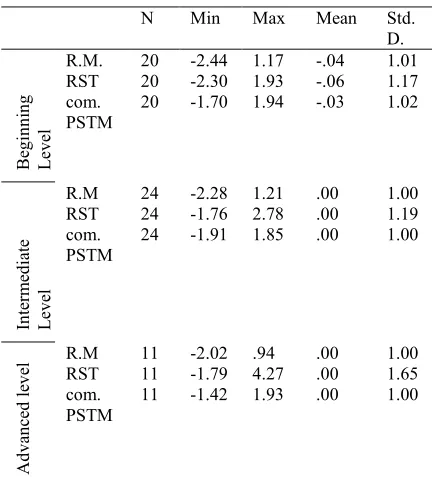
Descriptive statistics for memory and reading z-scores at each level of proficiency are indicated in Table 2 which report mean, standard deviation, range, minimum, maximum and number of participants for each proficiency level.
Table 2: Descriptive statistics of reading and memory Z-scores across proficiency levels
N Min Max Mean Std.
D. Be gin ni ng Lev el R.M. RST com. PSTM 20 20 20 -2.44 -2.30 -1.70 1.17 1.93 1.94 -.04 -.06 -.03 1.01 1.17 1.02 In term ed iate Lev el R.M RST com. PSTM 24 24 24 -2.28 -1.76 -1.91 1.21 2.78 1.85 .00 .00 .00 1.00 1.19 1.00 Ad va nc ed le ve
l R.M RST com. PSTM 11 11 11 -2.02 -1.79 -1.42 .94 4.27 1.93 .00 .00 .00 1.00 1.65 1.00
Note. R.M.= Reading Measure; RST com.= Reading
Span Test; PSTM= Phonological Short-Term Memory
Working memory and reading
In order to weight tests equally, z-scores were calculated for all measures. Then correlations between and within explanatory and responsive variables were obtained. To control any trade-off between the components of working memory and provide a more stable measure of the working memory capacity, composites were created from unit-weighted z-scores of storage and processing measures through averaging the sum of storage and processing z-scores (e.g., Lesser, 2007; Turner & Engle, 1989; Waters & Caplan, 1996). Table 3 displays the results of the correlation analysis. Only one significant correlation was found in these data, between the RST scores and reading comprehension at the beginning level. This was a moderate, positive correlation.
Table 3: Correlations between responsive and explanatory variables across proficiency levels
Reading RST composite PSTM
Beginning Level .505* -.076
Intermediate Level .280 -.068
Advanced Level -.068 -.182
Note. PSTM= Phonological Short Term Memory, RST =
Reading Span Test; * p < 0.05 (2-tailed)
Regressions were run where there was a statistically significant correlation between explanatory and responsive variable. This was to see how much the explanatory variable makes contribution to the prediction of the responsive variable. Overall, one regression was run at the beginning level. Summary results are presented in Table 4.
Table 4: Regression Results for the Reading Span Test Composite and L2 Reading measure
R R² Β F t p
RST com.
.505 .255 .505 6.17 2.48 .023
Note. n= 20; RST com. = Reading Span Test Composite
To determine how much effect can be attributed to the influence of working memory on the reading measure, the effect size for the model was obtained from the
R² value in the regression model. As displayed in Table 4, R² value indicated that RST composite accounted for 25% of the variance for the reading measure. This model had a β of .50, indicating that each increase of 1 point in the RST composite scores predicted a half point increase in the reading measure scores.
General discussion Research question 1
The first research question addressed the relationship between working memory and L2 reading comprehension and also if the relationship differed at different proficiency levels. The results provide limited evidence of a relationship between working memory capacity and L2 reading comprehension. There was a significant correlation between the reading measure and working memory composite (r=.501*, P<.05) at beginning level. Regression results also indicated that RST could be a good predictor of L2 learners’ reading performance at beginning level. The large effect size found here suggests that working memory (as measured by RST) is a good predictor of individual’s performance in the reading comprehension tests. These results suggest that working memory capacity, as measured by RST, is a potential source of individual differences in explaining L2 reading ability at the beginning level. Indeed, the analysis suggested that a quarter of the variance among learners at this level may be explained by differences in working memory capacity. This signals in an important role for working memory in beginning level L2 reading. This suggests that, at lower proficiency levels where much of the language processing may still be controlled and effortful, learners with higher cognitive resources may have an advantage.
Waters & Caplan, 1996; Just & Carpenter, 1992) and L2 (e.g., Harrington & Sawyer, 1992; Lesser, 2007; Walter, 2004). The results also provide evidence for claims that the relationship between working memory capacity and reading ability might be most important at the beginning levels of language ability (e.g., Ellis & Sinclair, 1996; Temple, 1997, Williams & Lovett, 2003).
However, as the proficiency increases, the relationship between working memory and L2 reading disappears. This suggests that low proficiency L2 learners rely on working memory more than high proficiency L2 learners during reading tasks. This supports Temple’s (1997) proposal that working memory plays an especially important role in early L2 learning. It is also consistent with findings of previous study conducted by Lesser (2007) that working memory plays an important role in beginning Spanish learners’ comprehension as well as Walter’s (2004) findings that for lower-proficiency L1 French ESL learners the transfer of reading comprehension skill from L1 to L2 relies on verbal working memory. She suggested that success of higher-proficiency learners relied more on reading skills than on working memory. It seems that for higher level learners, with greater language knowledge and greater automaticity in the reading process, the reading tasks presented less of a burden on working memory than for lower level learners who relied more on memory capacity. At this point then, differences in working memory capacity no longer lead to differences in reading comprehension. Rather, as proficiency develops, language knowledge takes the major role in extracting the text information (Alderson, 2000; Cain & Oakhill, 2006; Grabe & Stoller, 2002; Koda, 2005; Leslie & Caldwell, 2009), perhaps because of greater automaticity in language processing at higher levels of proficiency. This suggests a dual view of individual
reading comprehension in a second language; at the beginning levels of proficiency, learners with greater cognitive capacity may be better readers while at higher levels, learners with greater language knowledge may be better readers. The more fluent the learners are, the more automatic their processes, and the less memory demanding L2 reading will be.
In summary, RST, as a working memory measure, was found to be a good predictor of reading comprehension, but only for low proficiency learners. In other words, individual differences in beginners’ working memory capacity may play an important role in their reading ability. As the results of this study and prior studies (e.g., Harrington & Sawyer, 1992; Lesser, 2007; Walter, 2004) suggest beginning level learners with high working memory capacity outperformed the learners with low working memory capacity in their reading ability.
Research question 2
research in which PSTM did not explain individual differences in L1 (e.g., Daneman & Carpenter, 1980) and L2 reading comprehension (Harrington & Sawyer, 1992; Kormos & Sáfár, 2008).
Limitations of the study and suggestions for further research
There was a relatively small sample size, particularly at advanced level. Further research among a large group of participants could provide a more reliable view of the role of proficiency in the relationship between working memory and L2 reading. Second, in this study, memory measures included a PSTM test and a working memory capacity measure, RST. Both of these tests were based on verbal processing. Further research may include non-verbal measures of working memory, for example, a math span test, to more accurately measure working memory capacity. Finally, a broader testing battery of reading measures, beyond multiple-choice testing, may better illuminate the relationship between working memory and L2 reading comprehension.
Conclusion
This study examined whether the relationship between WM and L2 reading ability differs across proficiency levels. Similar to prior studies (e.g., Harrington & Sawyer, 1992; Lesser, 2007; Walter, 2004), the present study indicated that there is a relationship between WM and L2 reading ability. However, this study is distinguished from the prior studies in that it adds a unique theoretical implication to the research area of WM and L2 reading ability.
The implication of this study is that the relationship between WM and L2 reading ability differs according to proficiency level. The findings here suggest that working memory capacity can well predict participants’ reading ability at the beginning level. At higher proficiency levels, other factors such as language
knowledge may play an important role in predicting reading ability.
The present study also investigated whether the relationship between PSTM, as a component of WM, and L2 reading ability is mediated by L2 proficiency. This study provides further support for Harrington & Sawyer’s (1992) and Kormos & Sáfár’s (2008) studies, which suggest that PSTM does not play a direct role in L2 reading ability. This is likely to be because simple processing in PSTM (articulatory rehearsal) may not be a good predictor for multi-level processing in L2 reading ability.
The findings of this study should be considered as preliminary steps in exploring the relationship between working memory capacity and L2 reading comprehension, providing new directions for further studies in this area. These studies could examine the relationship between working memory capacity and the lower and higher level reading processes. Further studies could also investigate whether there is a relationship between PSTM and L2 reading comprehension by the mediating role of L2 vocabulary development.
References
Alderson, J.C. (2000). Assessing reading. Cambridge: Cambridge University Press.
Alptekin C., & Erçetin G. (2009). Assessing the relationship of working memory to L2 reading: Does the nature of comprehension process and reading span task make a difference? System, 37, 627-639.
Journal of Educational Psychology, 40, 247-256.
Atkins, W.B. & Baddeley, A.D. (1998). Working memory and distributed vocabulary learning. Applied Psycholinguistics, 19, 537-552. Baddeley, A.D. (2007). Working Memory,
Thought and Action. Oxford
University Press.
Baddeley, A.D. (2000a). The episodic buffer. A new component of working memory? Trends in Cognitive Sciences, 4, 417-423. Baddeley, A.D., & Hitch, G. (1974).
Working memory revised.
American Psychologist, 851-864. Baddeley, A. D., Papagno, C., & Valler,
G. (1998). When Long-term learning depends on short-term storage. Journal of Memory and Language,27, 586-595.
Beech, J.R. (1997). Assessment of memory and reading. In Beech, J.R. and C. Singleton, (Eds.), The
Psychological Assessment of
Reading (pp. 143-159). London: Routledge.
Cain, K. & Oakhill, J. (2006). Assessment matters: Issues in the measurement of reading comprehension. British
Journal of Educational
Psychology, 76, 697-708.
Carroll, J.B. (1965). The prediction of success in foreign language teaching. In R. Glaser (Ed.),
Training, research, and education
(pp. 87-136). New York: Wiley. Cheung, H. (1996). Non word span as a
unique predictor of second language vocabulary learning.
Developmental Psychology, 32, 867-873.
Conway, A., R. A., Kane, M. J., Bunting, M. F., Hambrick, D. Z., Wilhelm, O., Engle, R. W. (2005). Working memory span tasks: A methodological review and user’s guide. Psychonomic Bulletin & Review, 12 (5), 769-786.
Chun, D.M., & Payne, J.S. (2004). What makes students click: Working memory and look-up behavior.
System, 32, 481-503.
Daneman, M., (1991). Working memory as a predictor of verbal fluency.
Journal of Psycholinguistic
Research, 20, 445-464.
Daneman, M. & Carpenter, P.A. (1980). Individual Differences in Working Memory and Reading. Journal of Verbal Learning and Verbal Behavior, 19, 450-466.
Daneman, M., & Green, I. (1986). Individual differences in comprehending and producing words in context. Journal of Memory and Language, 25, 1-18. Ellis, N.C. (2001). Memory for language.
In P. Robinson (Ed.), Cognition and second language instruction. Cambridge: Cambridge University Press, 33-68.
Ellis, N. & Sinclair, S.G. (1996). Working memory in the acquisition of vocabulary and syntax: Putting language in good order. The Quarterly Journal of Experimental Psychology, 49A, 234-250.
Gathercole, S.E. & Baddeley, A.H. (1989). Evaluation of the role of phonological short-term memory in the development of vocabulary: A longitudinal study. Journal of Memory and Language, 28, 200-213.
Gathercole, S. E., & Baddeley, A. D. (1990a). Phonological memory deficits in language disordered children: Is there a causal connection? Journal of Memory and Language, 29, (3), 336-360. Gathercole, S.E., Frankish, C.R.,
Pickering, S.J., & Peaker, S.M. (1999). Phonetic influences on short-term memory. Journal of
Experimental Psychology:
Learning, Memory & Cognition,
Gathercole, S.E., Pickering, S.J. (2001). Working memory deficits in children with special educational needs. British Journal of special education, 28, 89-97.
Gathercole, S.E., Pickering, S.J., Hall, M., & Peaker, S.M. (2001). Dissociable lexical and phonological influences on serial recognition and serial recall. The Quarterly Journal of Experimental Psychology, 54A, 1, 1-30.
Gathercole, S. E., Willis, C. S., Emslie, H. & Baddeley, A.D. (1991). The influence of syllables and Wordlikness on children’s repetition of nonwords. Applied Psycholinguistics,12, 349-367. Gernsbacher, M.M., Varner, K.R. , &
Faust, M.E. (1990). Investigating individual differences in general comprehension skill. Journal of
Experimental Psychology:
Learning Memory and Cognition, 16, 430-445.
Grabe, W. & Stoller, F. L. (2002).
Teaching and Researching
Reading. London: Longman. Graesser, A.C., Singer, M., & Trabasso, T.
(1994). Constructing inferences during narrative text comprehension. Psychological Review, 101, 371-395.
Harrington, M., & Sawyer, M. (1992). L2 working memory capacity and L2 reading skill. Studies in Second Language Acquisition, 14, 25-38. Juffs, A. (2004). Representation,
processing and working memory in a second language. Transactions of the Philological Society, 102, 199-225.
Juffs, A. & Harrington, M.W. (2011). Aspects of working memory in L2 learning. Language Teaching:
Reviews and Studies, 42 (2), 137-166.
Just, M.A, & Carpenter, P.A. (2002). A capacity theory of comprehension: Individual differences in working
memory. In T.A. Polk & C. M. Seifert (Eds.), Cognitive modelling
(pp., 131-177). Cambridge, MA: MIT Press.
Koda, K. (2005). Insights into Second Language Reading: A cross-linguistic Approach. Cambridge University Press.
Koda, K. (2007). Reading and language learning. Blackwell Publishing: U.S.A
Kroll, J., Michael, E., Tokowicz, N., & Dufour, R. (2002). The development of lexical fluency in a second language. Second Language Research, 18, 137-171.
Kormos, J. & Sáfár, A. (2008). Phonological short-term memory, working memory and foreign language performance in intensive language learning. Language Cognition,11 (2), 261-271.
Lesser, J.M. (2007). Learner-Based Factors in L2 Reading Comprehension and Processing Grammatical Form: Topic Familiarity and Working Memory.
Language Learning, 57, 2, 229-270.
Leslie, L., & Caldwell, J. (2009). Formal and Informal Measures of Reading Comprehension. In Israel, S.E., & Duffy G.G. (Eds.), Handbook of
Research on Reading
Comprehension (pp., 403-427).
New York: Routledge.
Light, L.L., & Anderson, P.A. (1985). Working memory capacity, age and memory for discourse. Journal of Gerontology, 40, 737-747. Mackey, A., Adams, R., Stafford, C. &
Winke, P. (2010). Exploring the relationship between modified output and working memory capacity. Language Learning, 1-33.
L2 development. In P. Robinson (Eds.), Individual differences and
instructed language learning
(pp.181-209). Philadelphia: Benjamins.
Masoura, E., & Gathercole, S.E. (1999). Phonological short-term memory and foreign vocabulary learning.
International Journal of
Psychology,34, 383-388.
Masoura, E. V., & Gathercole, S. E., (2005). Contrasting contributions of phonological short-term memory and long-term knowledge to vocabulary learning in a foreign language. Memory, 13, 422-429. Mitchell, D.C., (1982). The process of
Reading: A cognitive analysis of Fluent Reading and Learning to Read. John Wiley & Sons Ltd. Miyake, A. & Friedman, N.P. (1998).
Individual differences in second language proficiency: Working memory as language aptitude. In A.F. Healy, & L.E. Bourne (Eds.),
Foreign Language Learning:
Psycholinguistics Studies on
Training and Retention (pp. 339-361).
Nation, I.S.P. (2009). Teaching ESL/EFL Reading and Writing. Routledge, Taylor & Francis.
Osaka, M., Osaka, N. (1992). Language-independent working memory as measured by Japanese and English reading span tests. Bulletin of Psychonomic Society, 30, 287- 289.
Osaka, M., Osaka, N. & Groner, R. (1993). Language-independent working memory: Evidence from German and French reading Span tests. Bulletin of the Psychometric Society, 31, 117-118.
Papagno, C., Valentine, T., & Baddeley, A. (1991). Phonological short-term memory and foreign-language vocabulary learning. Journal of
Memory and Language, 30,
331-347.
Robinson, P. (1995). Attention, memory and the "noticing" hypothesis.
LanguageLearning, 45, 283-331. Robinson, P. (2002). Effects of individual
differences in intelligence, aptitude and working memory on adult incidental SLA. In P. Robinson (Ed.), Individual differences and instructed language learning (pp. 211-266). Philadelphia: Benjamins. Robinson, R. D. (2005). Readings in reading instruction: Its history, theory, and development. Pearson: Pearson Education, Inc.
Sawyer, M., & Ranta, L. (2001). Aptitude, individual differences, and instructional design. In P. Robinson (Ed.), Cognition and second language instruction (pp. 319-353). Cambridge: Cambridge University Press.
Schmalhofer, F., McDaniel, M.A., & Keefe, D. (2002). A unified model for predictive and bridging inferences. Discourse Processes,
33, 105-132.
Service, E. (1992). Phonology, Working memory, and foreign language learning. Quarterly Journal of
Experimental Psychology, 45A,
21-50.
Service, E., & Craik, F. (1993). Differences between young and older adults in learning a foreign vocabulary. Journal of Memory and Language, 32, 608-623.
Service, E., & Kohonen, V. (1995). Is the relationship between phonological memory and foreign language learning accounted for by vocabulary acquisition? Applied Psycholinguistics, 16, 155-172. Skehan, P. (1989). Individual differences
in second language learning.
London: Edward Arnold.
Skehan, P. (1991). Individual differences in second language learning. SSLA, 13, 275-298.
P., (Eds.), Individual differences and instructed language learning. John Benjamins Publishing Company: Amsterdam/ Philadelphia.
Swanson, H.L. (1994). Short-term memory and working memory: do both contribute to our understanding of academic achievement in children and adults with learning disabilities? Journal of Learning disabilities, 27, 34-50.
Temple, L. (1997). Memory and processing modes in language learner speech production. Journal of Communication & Cognition, 30, 1/2, 75-90.
Trofimovich, P. Ammar, A., & Gatbonton, E. (2007). How effective are recasts? The role of attention, memory, and analytical ability. In A. Mackey (Ed.), Conversational interaction in second language acquisition: A series of Empirical studies (pp. 171-195). Oxford: Oxford University Press.
Turner, M., & Engle, R.W. (1989). Is working memory task dependent?
Journal of Memory and Language,
28, 127-154.
Valler, G., & Papango, C. (2002). Neuropsychological impairments of verbal short-term memory. In A. D. Baddeley, M. D. Kopelman, B. A. Wilson (Eds.). Handbook of memory disorders, 2nd ed., (pp. 249-270). Chichester: Wiley. Walter, C. (2004). Transfer of reading
comprehension skills to L2 is linked to mental representations of text and to L2 working memory.
Applied Linguistics, 25, 315-339. Waters, G.S., & Caplan, D. (1996). The
measurement of verbal working memory capacity and its relation to reading comprehension. The Quarterly Journal of Experimental Psychology, 49A, 51-79.
Williams, J.N., & Lovett, P. (2003). Phonological memory and rule learning. Language Learning, 53