Journal of Mathematical Nanoscience
Available Online at: http://jmathnano.sru.ac.irComputing the Clar number of nanotubes and other fullerenes
Juan. Andres Montoya
∗, Laura Viviana Cadavid
Universidad Nacional de Colombia, Bogota, Colombia.
Academic Editor: Alireza Ashrafi
Abstract. We exhibit a polynomial time algorithm that computes the Clar number of any nan-otube. This algorithm can be easily extended to one that computes the Clar number of fullerenes whose pentagon-clusters are all of even size. Computing the Clar number of planar graphs is NP-hard. However, it is not known if computing the Clar number of fullerenes is a tractable problem. We show that the latter problem can be suitably approximated in polynomial time. We also discuss the existence offpt-algorithmsfor this important problem of cheminformatics.
Keywords. Clar number, fullerene, nanotube.
1 Introduction
Fullerene graphsare the graphical representation of fullerene molecules, an important class of carbon molecules that has became very important in material science and technology. Therefore, fullerene graphs have attracted the attention of many researchers in the last decade and, as a consequence, nowadays we know many things about fullerenes. However, there are also many questions that remain unanswered. We study one of those questions, the question about the existence of efficient algorithms computing theClar numberof fullerenes. The Clar number is a topological index of planar graphs, an index that seems to be related to molec-ular stability [10]. It is known that computing the Clar number of general planar graphs is NP-hard (see [3]), and it is also known that the same problem can be solved in polynomial time for bipartite planar graphs (see [1]). Fullerene graphs arealmost bipartite, any fullerene has exactly 12 odd faces, and it means that fullerene are only 12 faces apart from
bipartite-∗Corresponding author (Email address: [email protected]).
ness and proved tractability, however it is not known if the Clar number of fullerene can be computed in polynomial time.
Organization of the work and contributions. This work is organized into five sections including the introduction. In section 2 we introduce the Clar number of fullerene. In section 3 we extend the latter notion to general planar graphs, and we discuss some results that are related to the computation of the Clar number for several different classes of planar graphs. In section 4 we exhibit a polynomial time algorithm that can be used to compute the Clar number of nanotubes and fullerenes of even signatures. In section 5 we discuss the case of odd signatures. We study the existence of approximation algorithms, as well as the existence offpt-algorithms,for this demanding problem (see [7]).
2 The Clar number of fullerenes
Fullerene graphs are 3-connected planar cubicgraphs, whose faces are either hexagons or pentagons. Fullerene graphs are of special interest in chemical graph theory. It happens that those graphs are themolecular graphsof the carbon molecules called fullerene. In this work we study an algorithmic problem related to fullerene graphs. First, we declare some definitions.
Definition 1. Given a graphG, aperfect matchingofGis a set of pairwise node-disjoint edges which covers the whole graph.
Thus, given graphGand given a perfect matching M, it must happen that:
1. Givene̸=stwo edges in M, those two edges do not have a common node.
2. Givenv, a node ofG, there existse∈Msuch thatecoversv(vis incident withe).
Recall that G is a cubic graph, if and only if, all the nodes of G have degree three. No-tice that if G is a cubic graph representing a carbon molecule, then the perfect matchings of G correspond to the Kekule structures of the molecule. The number of different Kekule structures (the number of perfect matchings) is a structural index that encodes important in-formation about the physico-chemical properties of the molecule. Sometimes it is necessary to compute the exact number of Kekule structures (a task that can be efficiently solved for planar molecules using Kasteleyn’s algorithm [13]), other times it is sufficient to ensure that the number of Kekule structures is large.
conjectures about cubic (planar) graphs. Important evidence concerning the later claim is provided by the recent attack to Barnette Conjecture[12]. In the aforementioned reference F. Kardoˇs proved the conjecture for fullerene, and then he extended his proof to planar graphs with faces of size at most six.
Kardoˇs, Kral et al proved that there exists C>0, such that any fullerene graph with n nodes has at least 2Cn perfect matchings. To this end, they proved that any fullerene graph admits a matching with a large number ofresonant hexagons. Given a fullerene graph Gand given a perfect matching M, a resonant hexagon for Mis a hexagonal faceCsuch thatC∩M is constituted by exactly three edges. Notice that given a perfect matchingMand a resonant hexagon for M, sayC, one can define a new matchingM{C} by excluding the three edges in M∩C, and replacing them by the three edges in Mc∩C (here Mc denotes the complement of M). Now suppose that there are K resonant hexagons for M, say C1, ...,CK, which are
node-disjoint (pairwise node-disjoint). Given J⊂ {1, ...,K}, one can construct a new perfect matching M{Ci:i∈J} by simply switching the edges for each one of the hexagons in the set
{Ci:i∈ J}, that is: For alli∈J, one excludes the three edges inM∩Ci, and he replaces them by the three edges inMc∩Ci. It is clear that givenJ̸=I, the matchingsM{Ci:i∈J}andM{Ci:i∈I} are different. Thus, if there existKnode-disjoint resonant hexagons for the perfect matching M, then there exist at least 2Kdifferent perfect matchings ofG, which can be constructed from Musing theKresonant hexagons. We say that such a set of node-disjoint resonant hexagons is aClar setforM. TheClar numberofM, denoted by C(M,G), is equal to
max{|A|: Ais a Clar set for M}.
TheClar numberofG, denoted byClar(G), is equal to
max{C(M,G): Mis a perfect matching ofG}.
Notice that ifClar(G) =K, the graphG has at least 2K perfect matchings. Then, if Ghas a large Clar number, it must have a large number of perfect matchings (Kekule structures). Kardoˇs, Kral et al proved that the Clar number of fullerene G is bounded below by n−61380, provided that G is a non-nanotube with n nodes [11]. This implies that the latter type of fullerene have exponential many matchings. It is easy to prove that nanotubes also have exponential many matchings. Thus, we have that The Lovasz-Plummer Conjecture holds true for the class of fullerene graphs.
3 On computing the Clar number of fullerene graphs and general planar graphs
We can straightforwardly extend the notion of Clar number to planar graphs. LetGbe a planar graph, and letcbe a planar representation ofG. Suppose thatMis a perfect matching of G. The quantity Clar(G,c,M) takes into account all the even faces that are resonant for Mand not only the number of resonant hexagons. Let us introduce an algorithmic problem related to those notions.
Open Problem 3.1. #Clar:Computing the Clar Number of Planar Graphs
• Input: (G,c), where G is a planar graph and c is a planar representation of c.
• Problem: Compute Clar(G,c).
We have the following important result [3].
Theorem 3.2. The problem#Clar is NP-hard.
The above result seems to be discouraging. However, we are not interested in solving the problem #Clarin its full generality, we are interested in its restriction to the class of fullerene graphs.
Notation 3.3. LetC be a class of planar graphs, we use the symbol#Clar[C]to denote the restriction of the problem #Clar to the set of instances constituted by the elements ofC. We use the symbol F to denote the class of fullerene graphs, and the symbol 2B to denote the class of 2-connected planar bipartite graphs.
It is natural to ask: What is known about restrictions of #Clar? We have an important result that was proved by Abeledo and Atkinson [1]
Theorem 3.4. The problem#Clar[2B]can be solved in polynomial time.
3.1 Signatures of fullerene graphs
LetGbe a fullerene. Apentagonal-clusteris a group of pentagonal faces whose union gives place to a connected subgraph ofGand such that any other pentagonal face is node-disjoint from the faces in the cluster. The size of a cluster is the number of its faces.
Definition 2. A fullerene signature is a tuple of positive integers (n1, ...,nk), such that n1≥
··· ≥nk≥1 and such that the equalityni=12 holds.
If(n1, ...,nk) is the signature of G, we have that the pentagonal faces of G are organized
intokpentagonal-clusters, which are pairwise node-disjoint, and such that the size of the ith cluster is equal to ni. Observe that the notion of signature corresponds to a classification of fullerenes. Given a signatureη it defines the class
Fη ={F∈ F : the signature of Fis equal toη}.
We have for instance that the signature of theBuckminsterfullereneC60(see [14]) is equal to
(1, 1, 1, 1, 1, 1, 1, 1, 1, 1, 1, 1).
We can use signatures to define important subclasses ofF.
Definition 3. A fullerene N is a nanotube, if and only if, its signature is equal to(6, 6). We use the symbol N to denote the class of all nanotubes. We say that a fullerene F is even, if and only if, all the entries of its signature are even integers. We use the symbolE to denote the class of even fullerenes.
It is important to remark that the classN is constituted by molecular graphs ofcarbon nan-otubes. Carbon nanotubes are cylindrical carbon molecules with unusual properties which are valuable for nanotechnology, electronics, optics and other fields of materials science and technology [5]. The stability properties of carbon nanotubes are important in the technologi-cal applications of those molecules. Thus, it seems that the restriction #Clar[N]is an impor-tant algorithmic problem related to mathematical nanosciences. We prove that the problems #Clar[N] and #Clar[E] can be solved in polynomial time (see below). We also show that #Clar[F]is fpt-tractable (see [7]).
3.2 Computing the Clar number of bipartite graphs
Suppose that we are given a planar graphG together with a planar representation (em-bedding) of it. We use the symbol c to denote the planar embedding. Let E be the set of edges of G, let V be the set of nodes and let F be the set of even faces determined byc. The problem of computing the Clar number of G can be formulated as a node set partitioning problem, where each node of G must be covered exactly once by either an edge or by the cycle boundary of one of the faces inF. The key observation is that each proper partition of
V, say the partition P= (V(E),V(F)), gives place to a family of perfect matchings that we denote with the symbolMP. The familyMP can be obtained in the following way:
1. Identify the faces of(G,c)used to cover the nodes inV(F)with a Clar set for the perfect matchings in MP. The later set of faces, that we denote with the symbol FP, is fully
described by the following condition: f ∈ FP, if and only if, exactly a half of the nodes of f belong toV(F).
2. Identify the edges that are used to cover the nodes inV(E) with the remaining edges included in those perfect matchings. We use the symbol EP to denote the later set, the set EP is fully described by the condition: e ∈ EP, if and only if, the end-nodes of e
belong toV(E).
The objective is to maximize the number of faces in the partition. This approach is repre-sented by the following integer program
IP-Clar(G,c) =max
{⟨ 1|F|,y
⟩
:y∈Z|F|+ , x∈Z|E|+ and (KG)x+ (RG,c)y=1|V|
}
,
where the symbolKG denotes the node-edge incidence matrix of G, the symbol RG,c
de-notes the node-face incidence matrix determined by the pair (G,c) and the symbol 1|F| de-notes the all ones vector of dimension|F|(the vector1|V| is defined accordingly).
The above representation of #Claras an integer programming problem has been used be-fore to study this hard optimization problem [1], other integer programming representations have been studied as well (see [2]). However, those representations does not yield an efficient solution of #Clar, recall that integer programming is NP-hard.
It is important to recall, at this point, that some integer programs are equivalent to their linear relaxations. We use the term easy programs to designate the latter type of integer programs. Notice that easy programs can be efficiently solved using linear programming. It means that we can use linear programming to compute the Clar number of any planar graph whose corresponding integer program IP-Clar(G,c) is an easy program. We have to ask: Which are the linear programs that are easy? It is known that an integer program
for the concatenation of the matrices KG and RG,c. It follows from the later result that given
a planar bipartite and 2-connected graphG, the integer programIP-Clar(G,c)is easy. It fol-lows that problem #Clar[2B] can be solved in polynomial time. We will try to extend the Theorem 3.4 (and the underlying approach) as much as possible.
Let(G,c)be a pair constituted by a planar graph and a planar representation of it, letV0 be a set of nodes, letE0be a set of edges, and letF0be a set of faces. A matching ofGsatisfies the triple[V0,E0,F0], if and only if, the following three conditions are satisfied:
1. All the nodes inV(G)\V0are covered by M, and the nodes inV0are not incident with
M.
2. For alle∈E0, the edgeedoes not belong to M.
3. For all f ∈F0, the face f is not a resonant face forM.
Given a matchingMsatisfying the triple [V0,E0,F0], we define
Clar∗((G,c),[V0,E0,F0],M) =max{|A|: Ais a set of resonant faces for M}.
The[V0,E0,F0]-Clar number of(G,c)is equal to
max{Clar∗((G,c),[V0,E0,F0],M):Msatisfies the triple [V0,E0,F0]}.
We consider a variation of the problem #Clar, that we call Clar number with prescribed triples. We use the symbol #ClarPTto denote the latter problem, which is the problem defined by:
• Input: ((G,c),[V0,E0,F0]), where G is a planar 2-connected and bipartite graph, c is a planar
representation of G and[V0,E0,F0]is a triple.
• Problem: Compute the[V0,E0,F0]-Clar number of (G,c).
First at all we prove that #ClarPT can be solved in polynomial time, then we use this result to design a polynomial time algorithm computing the Clar number of any fullerene whose signature is an even signature.
Proposition 3.5. The problem#ClarPT[2B]can be solved in polynomial time.
Proof. Let ((G,c),[E0,F0]) be an input of #ClarPT[2B], and let[KR]be the concatenation of the node-edge incidence matrix of G (the matrix K) and the node-face incidence matrix of
(G,c)(the matrixR). The key observation is that the[V0,E0,F0]-Clar number of(G,c)is equal to
max
{⟨
1|F|−|F0|,y ⟩
:y∈Z|F|−|F0|
+ , x∈Z|E|−|
E0|
+ andK[E0]x+R[F0]y=ØV0 }
where K[E0] is the matrix that is obtained from K by deleting all the columns
correspond-ing to edges in E0, R[F0] is the matrix that is obtained from R by deleting all the columns
corresponding to faces in F0andØV0 is the characteristic vector of the setV(G)\V0, that is:
ØV0[v] = {
1, ifv∈/V0 0, otherwise .
We observe that the constraint matrix
[
K[E0]R[F0] ]
is obtained from the unimodular matrix
[KR]by deleting some columns. It follows that
[
K[E0]R[F0] ]
is unimodular, and it implies that the problem #ClarFPcan be solved in polynomial time using linear programming methods. Then, there exists some positive integerd such that the[V0,E0,F0]-Clar number of (G,c) can be computed in timeO(|G|d).
4 Computing the Clar number of nanotubes and fullerenes of even signatures
We want to use Proposition 3.5 to compute the Clar number of some planar graphs that are not bipartite. We begin considering the classN constituted by all the nanotubes.
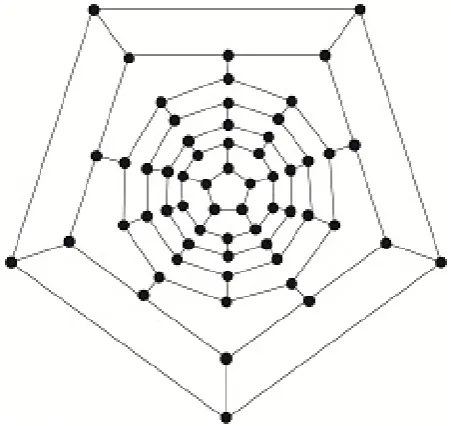
Recall thatN is the class of fullerene graphs whose signature is equal to(6, 6). This means that the twelve pentagonal faces of a nanotube are grouped together into two pentagon-clusters of size 6 that are calledpentacaps. The graphic below corresponds to a planar repre-sentation of a nanotube that we denote with the symbol N4.
Figure 1. The nanotubeN4.
graph constituted by a finite number ofbracelets, each one constituted by five hexagons (see the Figure above). We have that the class of all nanotubes is equal to the set {Ni:i≥0}, where for alli≥0 the symbolNi denotes the nanotube that contains exactlyibracelets.
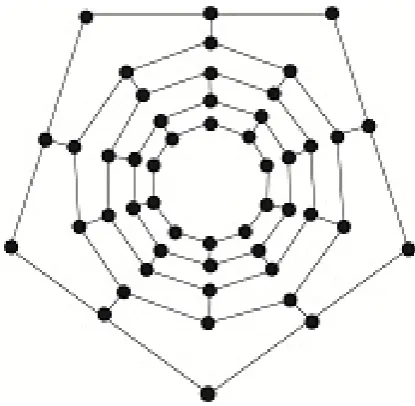
Let i≥0, notice that the boundaries of the two pentacaps of Ni are cycles of length 10. Suppose that we delete the edges and the nodes that are enclosed by any one of those two cycles. Notice that we get a 2-coonected planar graphcNisuch that all its faces are even faces. Thus, we have that cNi is a 2-connected planar and bipartite graph. The graphic below is a
planar representation of Nc4.
Figure 2. The graphNc4obtained fromN4.
We can compute the Clar number ofcNi in polynomial time in i. Can we use this fact to efficiently compute the Clar number ofNi?
Notation 4.1. Let us use the symbol ECG(i) to denote the set of edges of Ni that were deleted in the construction of cNi, that is: The symbol ECG(i) denote the set constituted by the twenty edges of Ni that are enclosed by the boundary of one of the two pentacaps. Let us use the symbol VCG(i)to denote
the set of nodes the were deleted in the construction ofcNi.
Suppose that we are given a set A⊂ECG(i), and suppose that we want to compute the
quantity
Clar(Ni,A) =max{Clar(Ni,M): Mis a perfect matching andA⊂M}.
Lete∈ A, and suppose thateis incident with a nodevthat belongs tocNi. The two edges ofcNithat are incident withvbecome forbidden edges for all the matchings extending the set
A. Observe that the face ofcNi that contains the nodevbecomes a forbidden face as well. Set
V(A) =
{
v∈ V
(
Figure 3. Green nodes are the nodes deleted fromN4to buildcN4. Red edges are the edges deleted
fromN4to builtNc4. Red bold edges are the edges chosen to cover the green nodes. Blue edges are
the forbidden edges determined by the bold edges, while bold faces are the forbidden faces determined by the bold edges.
the setV(A)determines a forbidden pair[EA,FA](see the Figure 3 below).
We observe thatClar(Ni,A)is equal to
max
{⟨
1|F|−|FA|,y
⟩
:y∈Z|F|−|FA|
+ ,x∈Z|E|−|
EA|
+ andK[E0]x+R[F0]y=ØV(A) }
,
whereØV(A)is the characteristic vector of the setV (
cNi)\V(A). Thus, we get thatClar(Ni,A)
is equal to the [V(A),EA,FA]-Clar number of the bipartite graph cNi. Recall that we can
ef-ficiently compute the later quantity. We use this fact to design a polynomial time algorithm computing the Clar number of nanotubes. We use the symbolA1to denote this algorithm.
Remark 3. Recall that all the fullerene graphs are 3-connected, and recall that all the planar representations of a 3-connected planar graph are equivalent. Thus, the input of algorithm
A1can be a positive integeriencoding the nanotubeNi. Observe thatNihas exactly 10i+20
nodes.
Definition 4. We have that a matchingMbelongs toM(Ni), if and only if, the following two conditions are satisfied:
1. M⊂ECG(i).
2. The matching Mcovers the setVCG(i).
algorithm 4.2. Procedure A1works, on input i, as follows:
1. List the subsets ofM(Ni).
2. Let A1, ...,AKi be the list computed in step 1. For all j≤Ki≤220 do:
(a) Compute the triple[V(Aj),EAj,FAj].
(b) Run, on input
(( c
Ni
)
,
[
V(Aj),EAj,FAj
])
, the algorithm in the proof of proposition 3.5. Use the variable Xjto store this value.
3. Compute X=max{Xj: j≤Ki
}
. Print X.
The execution of steps 1 and 3 require timeO(1). Then, the running time of A1 is es-sentially equal to the running time employed in the second step. The later running time is O((10i+20)20
)
. Therefore, we can conclude that A1 is a polynomial time algorithm com-puting the Clar number of nanotubes.
To finish with this section we only have to observe that the boundary of any even cluster is a cycle of even length. We get that the above algorithm can be straightforwardly extended to deal with fullerenes of even signatures. Thus, we have two polynomial time algorithms denoted A1 and A2, the first one solves the problem #Clar[N] while the second one solves the problem #Clar[E].
5 The Clar number for odd signatures
We begin this section by observing that there exists a naive polynomial time algorithm that approximates the Clar number of any fullerene within the ratio 11.
Lemma 5.1. There exists a polynomial time algorithm that approximates the Clar number of any fullerene graph within the ratio11.
Proof. The approximation algorithm, denoted by approx-CF, is the following one:
Algorithm approx-CF works, on input F,as follows:
1. Check if the signature of F is odd, in given case print⌈n−61380⌉, (here n stands for the size of F). Otherwise go to step 3.
We observe that if the signature ofFis even the algorithm approx-CF computes the exact value of Clar(F). Now suppose that the signature of F is odd, in this case the algorithm prints the value ⌈n−61380⌉. We claim that⌈n−61380⌉ approximates the quantityClar(F) within the ratio 11. First we observe that F cannot be a nanotube. Then, we have that Clar(F)
is lowerbounded by n−61380 (see [11]). If we suppose that n is large, we get that Clar(F)≥
n−380
61 ≥ 62n. On the other hand we have thatClar(F)≤ n−612 (see [16]). Notice that
11
⌈
n−380 61 ⌉ ≥11 ( n 62 ) ≥ n
6 ≥Clar(F)≥
⌈
n−380 61
⌉
.
Thus, we have that⌈n−61380⌉approximates the quantityClar(F)within the ratio 11.
We get from the above result the following conclusion: The real challenge, when coping with fullerenes of odd signatures, is to compute the Clar number exactly.
We wont exhibit a polynomial time algorithm computing the Clar number of general fullerene graphs. Actually, we do not know is such an algorithm exists. We will only ob-serve that algorithmA2can be turned into afixed parameter tractable algorithmA3solving the problem #Clar[F] (see [7] for a pedagogical introduction to the basics of fixed parameter algorithms). AlgorithmA3is based on an easy observation and a naive idea:
• The observation is that given a fullerene G, the number of its odd clusters is an even integer.
• The naive idea is the following one: Given G, the odd clusters ofG can be grouped in pairs. Then, given one of those pairs, one can merge the corresponding two clusters and some of the faces in between to define a large face whose boundary is an even cycle. If one does the same for all the pairs of clusters, he gets a bipartite graph Gbthat can be used to compute the Clar number of G. Graph Gbplays the role of the graph Nb that is used to compute the Clar number of a nanotube N.
Let F be a fullerene with n nodes. There exist positive constants C and d such that the running time ofA3, on inputF, is bounded above by the function 2C·k(F)nd. Here, the symbol
k(F) denotes a parameter related to F and which measures the distance between its odd clusters (see [3]). If Fis an even fullerene the parameter k(F) takes the value 0, and we get that the running time of A3, on input F, is bounded above by nc. If the odd clusters of F are close to each other the parameterk(F)gets a small value and the computation ofA3, on input F, is still a feasible computation. However, the same cannot be said if the odd clusters of F are far away from each other (see [3] for more details related to this issue). Algorithm
A3does not work well for fullerene graphs containing an odd cluster that is far away from the remaining odd clusters. We have to conclude that there are some remaining problems related to the computation of Clar numbers of fullerenes.
Acknowledgements
References
[1] H. Abeledo and G. Atkinson, Unimodularity of the Clar Number Problem, Linear Algebra and its Applications 420 (2007) 441-448.
[2] M. Ahmadi, E. Farhadi and V. Khorasani, On computing the Clar number of a fullerene using optimization techniques, MATCH Commun. Math. Comput. Chem. 75 (2016) 695-701.
[3] E. Berczi-Kovacs and A. Bernath, The complexity of the Clar number problem and an FPT algo-rithm, TR-2016-20. Egervary Research Group, www.cs.elte.hu/egres, 2016.
[4] E. Clar, The Aromatic Sextet, Wiley, New York, 1972.
[5] C. Dekker, Carbon nanotubes as molecular quantum wires, Physics Today 52 (5) (1999) 22-28. [6] L. Esperet, F. Kardoˇs, A. King, D. Kr´al, Daniel and S. Norine, Exponentially many perfect
match-ings in cubic graphs, Advances in Mathematics 227 (4) (2012) 1646-1664.
[7] J. Flum and M. Grohe, Parameterized Complexity Theory, Springer Verlag, Heidelberg, 2006. [8] P. Fowler and D. Manolopoulos, An Atlas of Fullerenes, Dover, NewYork, 2007.
[9] M. Ghorbani and E. Naserpour, The Clar Number of Fullerene C24n and Carbon Nanocone CNC44[n], Iranian Journal of Mathematical Chemistry 2 (1) (2011) 53-59.
[10] M. Jalali-Rad, Which fullerenes are stable?, Journal of Mathematical Nanoscience 5 (2015) 23-29. [11] F. Kardoˇs, D. Kral, J. Miskuf and J. Sereni, Fullerene graphs have exponentially many perfect
matchings, Journal of Mathematical Chemistry 46 (2) (2009) 443–447.
[12] F. Kardoˇs, A computer-assisted proof of Barnette-Goodey conjecture: Not only fullerene graphs are Hamiltonian, arXiv:1409. 2440.
[13] P. Kasteleyn, The statistics of dimers on a lattice I: The number of dimer arrangements on a quadratic lattice, Physica 27 (12) (1961) 1209–1225.
[14] H. Kroto, J. Heath, S. O’Brien, R. Curl and R. Smalley, C60Buckminsterfullerene, Nature 318 (6042)
(1985) 162-163.
[15] H. Zhang, D. Ye and Y. Liu, A combination of Clar number and Kekul´e count as an indicator of relative stability of fullerene isomers ofC60, Journal of Mathematical Chemistry 48 (2010) 733–740.