Available Online at:
www.environmentaljournals.org
Volume 8, Issue 1: 54-60
ISSN 2277- 8047
Wheat Straw Biochar Application to Loam-Sand Soil: Impact on Yield Components of
Summer Maize and Some Soil Properties
Iman Nikravesh*, Saeed Boroomandnasab, Abd Ali Naseri, Amir Soltani Mohammadi
Department of Irrigation and Drainage Engineering, Faculty of Water Sciences Engineering, Shahid
Chamran University of Ahvaz, Khuzestan, Iran.
ABSTRACT
Applying biochar to soils is a method to improve crop yield and soil fertility. The aim of this study was to investigate the effect of biochar on crop yield and some soil properties. Biochar was derived from wheat straw at different temperatures (200-600̊C), and according to the amount of the stable organic matter yield index (10.06 %), the temperature of 3̊C was chosen as the optimum temperature. Moreover, 12 lysimeters (0.8 m×1.2 m) were set up, and filled with loam-sand soil. Then, biochar treatments were added into lysimeters with different dosages (0, 10, 25, 50 tha-1 (B0, B1, B2 and B3)) in August, 2017. The crop yield of maize were collected in November, 2017. Soil properties were analyzed after the harvesting.The results indicated that the application of biochar decreased the soil bulk density, and increased the soil organic carbon (SOC), total N, total porosity and the cation exchange capacity (CEC). The diverse dosages of biochar of B1, B2 and B3
could enhance the grain yield by 12.86%, 35.83% and 54.29%; respectively. Furthermore, biochar with dosage of 50 tha-1 showed the most effect on CEC, pH, EC, N and OC of soil.Overall, the current study’s results confirmed that the added biochar could augment the maize production, and improve the soil characteristics.
Keywords: Biochar, Maize Yield, Soil Properties, Lysimeter.
Corresponding author: Iman Nikravesh
e-mail [email protected]
Received: 23 October 2018
Accepted: 27 March 2019
1. INTRODUCTION
Biomass has plenty of roles to determine the strategies for sustainable agriculture that is essential to apply an incredibly practical management in this part. Currently, researchers have been examining to discover the environmental conversion processes and applications for biomass. This has arisen in a variety of issues to describe the solid product from dry or wet pyrolysis. Biochar is a pyrolysis product that can be used for environmental applications. Biochar technology is identified as a production to improve soil fertility and cause carbon sequestration, as well as an alternative adsorbent to remove different kinds of contaminants. Recent researches have shown that biochar amendment could enhance water retention capacity of soil as well as nutrient-holding ability due to its considerably porous structure, high specific surface area, and CEC. Moreover, the effectiveness of biochar on the properties of soil and crop productivity is the subject to feedstock types, pyrolysis conditions, and dosage of biochar application. Biochar has been characterized as a stable structure, resistant to decomposition which can remain in the soil in the range of
hundreds to thousands years (Lehmann et al., 2015).
Considering the point that most of the oxygen and hydrogen existed in organic matters were lost when converted to biochar, consequently, biochar had dramatically more stable carbon contents than the original organic matter (Keiluweit et al., 2010). These have been some proofs that why scholars
have gained different results in some field experiments. For instance, positive results suggested that biochar amendment improved crop yield by improving the soil fertility, and decreasing the N fertilizer which induced N2O emissions from
agricultural lands (Jeffery et al., 2011; Liu et al., 2014; Cayuela
et al., 2013). Ullah et al (2018), proved that biochar of both types i.e. wheat straw biochar and sugarcane bagasse biochar when applied to soils in rain fed areas of Potohar region increased the maize grain yield and biomass. Additionally, comparing different rates of biochar showed that grain yield and maize crop would be greater by applying greater rates of biochar. Yang et al (2015) found that the yields of corn, peanut, and sweet potato during one crop season were increased by using both rice straw and corn stalk-derived biochar. Their experiments showed that biochar addition could increase soil water content, especially at a high rate (10%) of application. Therefore, it was considered that biochar application might increase crop yield by holding much water in the soil. The affirmative effects of biochar on crop production have been mostly proved in experiments in tropical areas and on soils with low nutrients and acidic soils (Liu et al., 2013) that such effects have been basically attributed to the liming effect of the alkaline biochar and the increase of soil water holding capacity (Jeffery et al., 2011). In contrast, biochar application has often shown a temporary influence on the crop productivity in moderate climate and on alkaline soils (Borchard et al., 2014;
Tammeorg et al., 2014; Jones et al., 2012). Moreover, the benefits of biochar on crop productions seemed to be restricted by high fertility of soil condition (Lusiba et al., 2017;
of soil pore size and density under the biochar application that affects water holding capacity, aeration, nutrient retention, permeability of soil alongside plant uptake of nutrients. It has also been confirmed that soil improvement is induced due to increase in the soil surface area after the application of biochar (Chan et al., 2008; Novak et al., 2009; Lehmann and Joseph, 2015). With regard to the eventual effects of biochar, the aims of this study were determining the optimum temperature for wheat straw biochar that is obtained by slow pyrolysis and its characteristics, and investigating the possibility of biochar application on maize yield, yield components, and some properties of a loam-sand soil.
2. MATERIAL AND METHODS
2.1. Experiment site and lysimeter set up
Twelve undisturbed soil lysimeters with Loam Sand texture were collected, in the Shahid Chamran University (31̊ 30'N, 48̊
65'E) of Ahvaz City, Khouzestan Province, Iran. Each lysimeter was 0.8 m in diameter and 1.2 m deep. The lysimeters were made by polyethylene with free drainage that was installed at the Research Farm, Shahid Chamran University.
2.2. Preparation of optimum biochar for soil
amendment
Wheat straw was air dried and converted to the small size with electric mills. The air dried material was heated in a carbonization kiln at five different pyrolysis temperatures
(200–600 ̊C), with a fixed residence time of 4 hours. The
biochar yield was calculated as the proportion of the weight of pyrolysis product to the dry wheat straw. The oxidisable organic carbon content (OC) was determined by the method of potassium dichromate oxidation. Loss on ignition (LOI) of the resultant biochar was obtained by heating the produced biochar in a kiln at 750 ̊C for 6 hours (ASTM method,
D-1762-84) (Masto et al., 2013). Stable organic matter (SOM) was
determined as follows (Masto et al., 2013):
𝑆𝑆𝑆𝑆𝑆𝑆=𝐿𝐿𝑆𝑆𝐿𝐿 −(𝑆𝑆𝑂𝑂× 1.724) (1)
Where, 1.724 is the factor to convert organic carbon to organic
matter.The stable organic matter yield index (SOMYI) was
determined as per thefollowing equation:
𝑆𝑆𝑆𝑆𝑆𝑆𝑆𝑆= (𝐵𝐵𝐵𝐵𝐵𝐵𝑐𝑐ℎ𝑎𝑎𝑎𝑎 𝑦𝑦𝐵𝐵𝑦𝑦𝑦𝑦𝑦𝑦⁄100) ×𝑆𝑆𝑆𝑆𝑆𝑆 (2)
The process parameter for biochar preparation was optimized to get maximum SOMYI used as biochar amendment.
2.3. Properties of biochar
The concentration of different elements (C, H, N, S, and O) in optimum biochar was measured by the CHNSO analyzer (vario ELIII-elementar- made in Germany). The morphology of optimum biochar was investigated using a scanning electron microscopy (SEM, Leo 1455 VP model, made in Germany). Surface area was obtained using methylene blue method (Chintala et al., 2013). The method mentioned by (Chintala et al., 2013) was used to measure cation exchange capacity (CEC). And a Fourier Transform Infrared Spectroscopy (FTIR, Spectrum GX, and Perkin-Elmer) was used to analyze the functional groups in optimum .
2.4. Field experiment design
The field trial was established in June, 2017. The soil was first treated with biochar (B) amended at four application rates of 0, 10, 25, 50 tha-1 (B0, B1, B2 and B3); respectively. All
treatments were arranged in a complete random block design with three replications. Before maize sowing in august 2017, biochar was spread on the soil surface, and was incorporated into the soil by plowing with a spade, and then thoroughly mixing the soil with a rake by hand to a depth about 0.15 m. For doing fertilization, N fertilizer (urea) was applied at 100 kg N ha-1 that must be added in three stages of plant growth.
Additionally, P (triple phosphate) at 80 kg P2O5 ha-1 and K
(potassium sulfate) at 60 kg K2O ha-1 were just added before
sowing. Maize was sown on the 6th of August, and harvested on
the 20th of November, in 2017.
2.5. Climate conditions and irrigation
The amount of irrigation was calculated by using evaporation transpiration’s data of grass and maize’s crop coefficient in each growth stage. The maize’s crop coefficient was determined by utilizing FAO 56. The sum of evaporation transpiration of grass during the trial period was equivalent to
920 mm over four months.Overall, the water use in the
summer cultivation was estimated to be 853 mm.
2.6. Yield measurement, soil sampling and analysis
Grain yield was estimated by manually harvesting all the plants in each lysimeter. Firstly, the total yield of maize ears for each treatment was weighed. Secondly, each sample was dried in oven at 75 ̊C for 48 h. Then, all of the samples were weighed again, and the grain yield along with the other parameters was calculated. Biological yield was determined by weighing all the plant organs except the plant root. Topsoil (0–0.15 m) samples were collected after the maize harvest. Randomly, three samples of chosen soil cores were taken with a sampler in each lysimeter. A re-sealed plastic bag was used to ship the samples to the laboratory in order to do more analysis. After the samples were air-dried, and the plant residues and gravels were removed, they were passed through a 2 mm sieve. From each soil sample, a part was ground more to pass through a 0.15 mm sieve for the analysis of soil organic C and total N. Soil pH was measured in soil to water ratio of 1:1. The Walkley and Black procedure was used to determine soil organic carbon (Walkley and Black, 1934). Total nitrogen (N) was determined using the Kjedahl digestion and distillation procedure (Kjeldahl, 1883). The cation exchange capacity (CEC) at pH 7 was determined by the NH4OAc method (Chintala et al., 2013). Available phosphorus was determined using Bray No. I extraction solution (Olsen and Sommers, 1982). Some physical and chemical characteristics of basic soil were mentioned in Tab. 2.
2.7. Assessment of Water Use Efficiency (WUE)
The WUE was calculated as described in Uzoma et al. (2011);
𝑊𝑊𝑊𝑊𝑊𝑊
=
𝑀𝑀𝑀𝑀𝑀𝑀𝑀𝑀𝑀𝑀𝐸𝐸𝐸𝐸𝑌𝑌𝑀𝑀𝑀𝑀𝑌𝑌𝑌𝑌𝑎𝑎 (3)
Where, ETa is the actual evaporation transpiration of plant.
Statistically, purposed items were analyzed with a one-way ANOVA followed by Duncan’s multiple range test (at p ≤ 0.05)
tocompare the differences amongst the treatments on SPSS
3. RESULTS
3.1. Characterization of wheat straw biochar
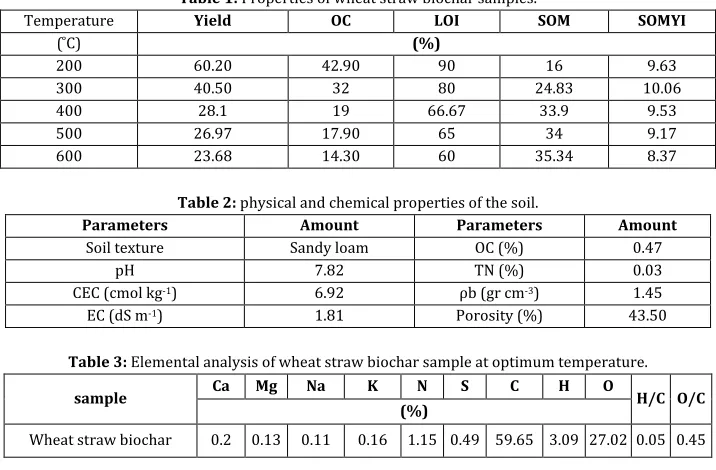
Properties of biochars produced under different temperatures in this study have been shown in Tab. 1. It can be identified that biochar yields decreased with increasing the temperature. Some other authors have found the same results where the increased pyrolysis temperature decreased the biochar yield (Kumar et al., 2013; Zhao et al., 2017). It can be explained due to the fact that below 250 ⁰C, the samples lost weight mainly
due to moisture and hydration water loss; while above 250 ⁰C,
the feedstock began to decompose and transform into vapor containing complex organic compounds mixed with gases
(including water vapor, CO2, CO, H2, CH4, and heavier
hydrocarbons). Hence, when the temperature increased, more organic matter decomposed which led to the decrease in
biochar yields at higher temperature (Sun et al., 2014).
According to the results of other studies, biochar was exposed to biological, chemical, and physical processes which were used in soil. Therefore, biochar carbon sustainability was more considerable than carbon content (Masek et al., 2013; Kumar et al., 2013). In accordance to the calculated value of stable organic matter yield index at various temperatures in this study, the most thermal constancy was obtained by 10.06 for wheat straw biochar at the temperature of 300 ̊C. As it was shown in Tab. 1, although the amount of stable organic matters (SOM) at diverse temperatures enhanced with the increase in pyrolysis temperature up to 300 ̊C, thereafter, it decreased which might be due to the increase in the ash content (Divband Hafshejani et al., 2016). Consequently, the temperature of 300 was determined as the optimum temperature of sustainable carbon biochar production, and was used to continue the experiments of this study (Elemental analysis of the biochar at optimum temperature showed that this material was carbon rich with carbon contents around 59.65% (Tab. 3). Moreover, the oxygen and hydrogen contents were obtained by 27.02% and 3.09%; respectively (Tab. 3). N, P, K, Ca, Mg, Na and S showed low levels (Tab. 3). These results were consistent with the findings reported in the literature (sun et al., 2014; kloss et al., 2012).
3.2. Soil properties
Based on table 2 and soil texture triangle, the soil had a sandy loam texture. Statistical analysis showed the noticeable effect
of biochar treatments (p ≤ 0.05) on soil’s physical and chemical
properties (Tab. 4). The results of soil’s physical and chemical properties after maize harvest under the diverse biochar treatments have been presented in Tab. 5. Biochar amendments reduced soil bulk density, and increased total porosity, soil organic carbon, total N, cation exchange capacity, and pH of soil. According to the Tab. 5, bulk density of the B1,
B2 and B3 showed respectively 7.59%, 10.34% and 13.10%
decrease compared to B0 treatment. Consequently, all
treatments caused a significant increase in total porosity compared with B0 treatment. Physical soil parameters such as
bulk density, pore volume and pore distribution have been the key factors to soil fertility and plant growth, and can be altered significantly by biochar amendment (Mukherjee and Lal, 2014). Biochar is highly porous and is characterized by a low bulk density. Depending on the feedstock of biochar and production conditions, bulk density ranged from 0.08 g cm−3 (Gundale and
Deluca, 2006) to 1.7 g cm−3 (Oberlin, 2002). Regarding the fact
that common bulk densities of mineral soil ranged from 1.16 to 2.00 g cm−3, a decrease was anticipated by adding biochar
(Atkinson et al., 2010; Major et al., 2009; Zwieten et al., 2010). Additionally, adding biochar had no effect on pH of soil. Whereas, SOC was increased by 12.77%, 31.91% and 55.32% under B1, B2 and B3 amendments; respectively. Total soil N
content of the B1, B2 and B3 was enhanced by 8.57%, 20% and
31.42% in comparison to B0 treatment. Biochar increased the
concentration of SOC and TN by 25–54% and 4–12%; respectively, whereas it had no effect on soil pH (Zhang et al., 2015). As shown in Tab. 5. CEC was found to increase by 13.41%, 30.61% and 46.50% under B1, B2 and B3 amendments;
respectively. The amendment of the soil with biochar and compost significantly improved the CEC of the soil, indicating that the retention of non-acidic cations by the soils increased. CEC has been realized as a considerable factor in maintaining inorganic nutrients such as K+ and NH4+ in soil (Lei et al., 2013),
and biochar has been brought about the intensification in CEC
of some biochar-amended soils (Glaser et al., 2015; Van
Zwieten et al., 2010), thereby increasing the availability and retention of plant nutrients in soil, and potentially increasing nutrient use efficiency. Biochar usually features a high CEC, thus when applied to soil it will add negative charges. Once biochar is incorporated into soil, CEC varies depending on soil pH, age and weathering conditions of biochar (Major et al., 2010). Lee et al. (2010) confirmed that CEC is dependent on pH by observing that, at pH values below 7, acidification leads to the release of bound cations. Biochar’s CEC plays an important
role in regard of nutrient retention and plantavailability
especially for infertile sandy soils common in smallholder farming systems in sub-Saharan Africa (Gwenzi et al., 2015). As it was shown, there has been a trend of improvement in investigated properties with increasing biochar rate. In their study, Chan et al. (2008) recognized a statistical difference only for extremely high biochar rates, namely rates as high as 50 and 100 t ha-1, but not for a rate of 10 t ha-1.
3.3. Crop yield and yield components
The analyses of variance for maize plant indicated significant
effects (P ≤ 0.05) of biochar doses on the grain yield, biological yield, harvest index, 1000 grain weight, ear length and water use efficiency (WUE); respectively (Tab. 6). Crop yields in the field experiment were collected, and have been presented in Tab. 7. The data showed that biochar addition could enhance the crop yields in all the treatments. Maize grain yield was significantly increased under different adding of biochar (B1, B2
and B3) by 12.86%, 35.83 and 54.29% as compared to the
under control treatment (B0). The biological yield of maize
ranged from 8.876 to 10.023 t –ha-1; the distinguished low
value belonged to the control treatment, and the high value referred to B3 treatment. Likewise, the plants grown under
biochar amendments have improved physical and chemical properties of the cultivated soil. Thereby, the main reason of maize yield and WUE enhancement could be ascribed to the increased nutrient availability by adding biochar (Zhang et al, 2015). Soil moisture amelioration might be another factor to increase maize yield on water stressed conditions. It has been indicated that biochar amendment can improve soil water holding capacity (Akhtar et al., 2014; Rogovska etal., 2014). Cation exchange capacity (CEC), as an essential index to improve soil fertility, was significantly increased. Therefore, it could promote nutrient retention or higher nutrient use efficiency and result in an increased maize yield and WUE. Furthermore, the high levels of soil organic carbon accumulation due to biochar amendments could enhance N efficiency and crop production with respect to biochar’s
surface area and porosity,bulk density, nutrient content,
stability, cation exchange capacity (CEC) and carbon content, and it has been expected to improve water retention, nutrient
retentionand plant uptake of nutrients. Biochar amendment
on different soils has led to the increased availability and uptake of nutrients by plants (Hass et al., 2012; Uzoma et al., 2011). In their study, Alburquerqueet al. (2014) observed that
biochar with higher ash content induced relativelyhigher
increase in sunflower growth due to the increased plant
availability of nutrients. Moreover, when the addition of
biochar directly reduced a certain soil constraint, crop productivity would likely be increased. For instance, the use of biochar with high mineral content has been advisable to apply for soils that are dependent on high nutrient inputs or with low physical fertility (Slavich et al., 2013). The positive effects of biochar application on plant growth - for example due to the retention of nutrients – were the strongest when combined with organic or inorganic fertilizers, especially on tropical soils (Alburquerque et al., 2014; Glaser et al., 2015; Schulz and
Glaser, 2012; Van Zwieten et al., 2010). Peng et al. (2011) found an increase in maize biomass by 64% (without NPK fertilizer) and an increase of maize biomass by 146% (with NPK fertilizer) for an Ultisol following biochar application (2.4 t ha -1). In Tab. 7, it is visible that the higher dosage of biochar had a
more positive effect on the crop yield and yield components. Whereas, the minimum grain yield, biological yield, harvest index, 1000 grain weight, ear length and WUE were observed in the control treatment.
4. CONCLUSIONS
Based on the results of this study, the application of biochar exhibited some promising positive impacts on soil properties, crop yield and yield components of maize. The application of biochar decreased soil bulk density along with pH, and enhanced SOM, total N, cation exchange capacity (CEC), and total porosity of soil. In addition, the application of all doses of biochar at 10, 25 and 50 t ha-1 significantly increased the grain
yield, biological yield, harvest index, ear length and weight of 1000 grains. A lower dosage of biochar (10 t ha-1 or 25 t ha-1)
could enhance the grain yield by 18%–25% , and biochar of 50 ton.ha-1 could increase the yield about 31%. Regarding the
obtained results of the present investigation, further investigation will concentrate on the biochar effects on the
physical and chemical characteristics of the soil and the mechanism of crop yield variation.
5. ACKNOWLEDGMENT
This project was supported by Water Science Engineering
Faculty of Shahid Chamran University of Ahvaz, Iran. The researchers would like to gratefully acknowledge the financial and other supports.
REFERENCES
1. Alburquerque, J. A., Calero, J. M., Barrón, V., Torrent, J., delCampillo, M. C., Gallardo, A., Villar, R. (2014): Effects of biochars produced from different feedstocks on soil properties and sunflower growth. J. Plant Nutr. Soil Sci. 177(1), 16-25.
2. Akhtar, S.S., Li, G., Neumann Andersen, M. and Liu, F.
(2014): Biochar enhances yield and quality of tomato under reduced irrigation. Agric Water Manage. 138, 37–44.
3. Atkinson, C. J., Fitzgerald, J. D., Hipps, N. A. (2010): Potential mechanisms for achieving agricultural benefits from biochar application to temperate soils: A review. Plant Soil. 337, 1-18.
4. Borchard, N., Siemens, J., Ladd, B., Moeller, A., Amelung, W. (2014): Application of biochars to sandy and silty soil failed to increase maize yield under common agricultural practice. Soil. Tillage Res. 144, 184–194.
5. Cayuela, M. L., Snehez-Monedero, M. A., Roig, A.,
Hanley, K., Enders, A., Lehmann, J. (2013): Biochar and denitrification in soils: when, how much and why does biochar reduce N2O emissions? Scientific Reports. 3, 1732.
6. Chan, K. Y., Van Zwieten, L., Meszaros, I., Downie, A., Joseph, S. (2008): Using poultry litter biochars as soil amendments. Soil Res. 46(5), 437-444.
7. Chintala, R., Mollinedo, J., Schumacher, T. E., Papiernik, S. K., Malo, D. D., Clay, D. E., Kumar, S., Gulbrandson, D. W. (2013): Nitrate sorption and desorption in bio-chars from fast pyrolysis. Microporous. Mesoporous. Mater. 179, 250–257.
8. Divband Hafshejania, L., Hooshmanda, A., Naseria, A.,
Soltani Mohammadia, A., Abbasib, F. Bhatnagarc, A. (2016): Removal of nitrate from aqueous solution by modified sugarcane bagasse biochar. Ecol Eng. 95, 101–111.
9. Glaser, B., Wiedner, K., Seelig, S., Schmidt, H. P., Gerber, H. (2015): Biochar organic fertilizers from natural resources as substitute for mineral fertilizers. Agron Sustain Dev. 35, 667–678.
10. Gundale, M., DeLuca, T. (2006): Temperature and
source material influence ecological attributes of ponderosa pine and Douglas-fir charcoal. Forest Eco Manage. 231, 86–93.
11. Gwenzi, W., Chaukura, N., Mukome, F. N., Machado, S.,
12. Hass, A., Gonzalez, J. M., Lima, I. M., Godwin, H. W., Halvorson, J. J., Boyer, D. G. (2012): Chicken manure biochar as liming and nutrient source for acid Appalachian soil. J. Environ Qual. 41(4), 1096-1106. 13. Jeffery, S., Verheijen, F. G. A., Van Der Velde, M., Bastos,
A. C. (2011): A quantitative review of the effects of biochar application to soils on crop productivity using meta-analysis. Agric. Ecosys. Environ. 144(1), 175-187.
14. Jones, D. L., Rousk, J., Edwards-Jones, G., DeLuca, T. H., Murphy, D. V. (2012): Biochar-mediated changes in soil quality and plant growth in a three year field trial. Soil Biol. Biochem. 45, 113–124.
15. Kjeldahl, J. (1883): New method for the determination
of nitrogen in organic substances. Journal of Analytical Chemistry. 22 (1), 366-383.
16. Keiluweit, M., Nico, P. S., Johnson, M. G., Kleber, M.
(2010): Dynamic molecular structure of plant biomass-derived black carbon. Environ. Sci. Technol. 44, 1247-1253.
17. Kumar, S., Masto, R. E., Ram, L. C., Sarkar, P., George, J., Selvi, V. A. (2013): Biochar preparation from Parthenium hysterophorus and its potential use in soil application. Ecol Eng. 55, 67–72.
18. Kloss, S., Zehetner, F., Dellantonio, A., Hamid, R.,
Ottner, F., Liedtke, V., Schwanninger, M., Gerzabek, M. H., Soja, G. (2012): Characterization of slow pyrolysis biochars: effects of feedstocks and pyrolysis temperature on biochar properties. J. Environ. Qual. 41, 990–1000.
19. Lehmann, J., Abiven, S., Kleber, M., Pan, G., Singh, B. P., Sohi, S., Zimmerman, A. (2015): Persistence of biochar in soil. In: LEHMANN J. AND JOSEPH S. (eds.) Biochar: Sci. Technol. Implement, 233-280. London, UK: Earthscan.
20. Lehmann, J., Joseph, S. (2015): Biochar for
environmental management: an introduction. In: Lehmann J and Joseph S (eds.): Biochar for Environmental Management: Sci. TechnoL. Earthscan, London. 1-12.
21. Lee, J. W., Kidder, M., Evans, B. R., Paik, S., Buchanan Iii, A. C., Garten, C. T., Brown, R. C. (2010): Characterization of biochars produced from cornstovers for soil amendment. Environ. Sci. Technol. 44(20), 7970-7974.
22. Lei, O., Zhang, R. (2013): Effects of biochars derived from different feedstocks and pyrolysis temperatures on soil physical and hydraulic properties. J. Soils. Sediments. 13(9), 1561-1572.
23. Liu, Z. X., Chen, X. M., Jing, Y., Li, Q. X., Zhang, J. B., Huang, Q. R. (2014): Effects of biochar amendment on rapeseed and sweet potato yields and water stable aggregate in upland red soil. Catena. 123, 45–51. 24. Liu, X. Y., Zhang, A. F., Ji, C. Y., Joseph, S., Bian, R., Li, L.,
Pan, G., Paz-Ferreiro, J. (2013): Biochar’s effect on crop productivity and the dependence on experimental conditions – a meta-analysis of literature data. Plant Soil. 373, 583–594.
25. Lusiba, S., Odhiambo, J., Ogola, J. (2017): Effect of
biochar and phosphorus fertilizer application on soil
fertility: soil physical and chemical properties. Archi. Agron. Soil. Sci. 63: 477-490.
26. Major, J., Rondon, M., Molina, D., Riha, S. J., Lehmann, J. (2010): Maize yield and nutrition during 4 years after biochar application to a Colombian savanna oxisol. Plant Soil. 333, 117–128.
27. Major, J., Steiner, C., Downie, A., Lehmann, J. 2009.
Chapter 15. Biochar effects on nutrient leaching. In ‘Biochar for Environmental Management: Sci. Technol.’ (Eds J Lehmann and S Joseph), 271-287. (Earthscan Publications).
28. Masek, O., Brownsort, P., Cross, A., Sohi, S. (2013):
Influence of production conditions on the yield and environmental stability of biochar. Fuel. 103, 151–155. 29. Masto, R. E., Kumar, S., Rout, T., Sarkar, P., George, J.,
Ram, L. (2013): Biochar from water hyacinth (Eichornia crassipes) and its impact on soil biological activity. Catena. 111, 64–71.
30. Mukherjee, A., Lal, R. (2014): The biochar dilemma.
Soil Res. 52(3), 217-230.
31. Novak, J. M., Lima, I., Xing, B., Gaskin, J. W., Steiner, C., Das, K. C., Schomberg, H. H. (2009): Characterization of designer biochar produced at different temperatures and their effects on a loamy sand. Annals. Environ Sci. 3, 195-206.
32. Oberlin, A. 2002. Pyrocarbons. Carbon. 40 (1), 7–24.
33. Olsen, S.R. and Sommers, L.E. (1982) Phosphorus. In:
Page, A.L., Ed., Methods of Soil Analysis Part 2 Chemical and Microbiological Properties, American Society of Agronomy, Soil Science Society of America, Madison, 403-430.
34. Peng, X., Ye, L. L., Wang, C. H., Zhou, H., Sun, B. (2011): Temperature- and duration dependent rice straw-derived biochar: Characteristics and its effects on soil properties of an Ultisol in southern China. Soil. Tillage Res. 112(2), 159-166.
35. Rogovska, N., Laird, D. A., Rathke, S. J., Karlen, D. L. (2014): Biochar impact on Midwestern Mollisols and maize nutrient availability. Geoderma. 230–231, 340– 347.
36. Schulz, H., Glaser, B. (2012): Effects of biochar
compared to organic and inorganic fertilizers on soil quality and plant growth in a greenhouse experiment. J. Plant Nutr. Soil Sci. 175(3), 410-422.
37. Slavich, P. G., Sinclair, K., Morris, S. G., Kimber, S. W. L., Downie, A., Van Zwieten, L. (2013): Contrasting effects of manure and green waste biochars on the properties of an acidic ferralsol and productivity of a subtropical pasture. Plant Soil. 366(1-2), 213-227.
38. Sun, Y., Gao, B., Yao, Y., Fang, J., Zhang, M., Zhou, Y., Chen, H., Yang, L. (2014): Effects of feedstock type, production method, and pyrolysis temperature on biochar and hydrochar properties. Chem Eng. J. 240, 574–578.
40. Ullah, Z., Akmal, M., Ahmed, M., Ali, M., Zaib, A., Ziad, T. (2018): Effect of biochar on maize yield and yield components in rainfed conditions. Int. J. Agron. Agrci. Res. 12(3), 46-51, 2018.
41. Uzoma, K. C., Inoue, M., Andry, H., Fujimaki, H., Zahoor, A., Nishihara, E. (2011): Effect of cow manure biochar on maize productivity under sandy soil condition. Soil use. Manage. 27(2), 205-212.
42. Van Zwieten, L., Kimber, S., Morris, S., Chan, K. Y.,
Downie, A., Rust, J., Joseph, S., Cowie, A. (2010): Effects of biochar from slow pyrolysis of paper mill waste on agronomic performance and soil fertility. Plant Soil. 327, 235–246.
43. Walkley, A., and Black, I. A. (1934): An Examination of Degtjareff Method for Determining Soil Organic Matter and a Proposed Modification of the Chromic Acid Titration Method. Soil Science. 37, 29-37.
44. Yang, Y., Ma, S., Zhao, Y., Jing, M., Xu, Y., Chen, J. (2015): A Field Experiment on Enhancement of Crop Yield by Rice Straw and Corn Stalk-Derived Biochar in Northern China. Sustainability. 7, 13713-13725.
45. Zhang, D., Pan, G., Wu, G., Wanjiru Kibue, G., Li, L.,
Zhang, X., Zheng, J., Zheng, J., Cheng, K., Joseph, S., Liu, X. (2015): Biochar helps enhance maize productivity and reduce greenhouse gas emissions under balanced fertilization in a rainfed low fertility inceptisol. Chemosphere. 142, 106–113.
46. Zhao, S. X., Ta, N., Wang, X. D. (2017): Effect of
Table 1: Properties of wheat straw biochar samples.
Temperature Yield OC LOI SOM SOMYI
( ̊C) (%)
200 60.20 42.90 90 16 9.63
300 40.50 32 80 24.83 10.06
400 28.1 19 66.67 33.9 9.53
500 26.97 17.90 65 34 9.17
600 23.68 14.30 60 35.34 8.37
Table 2: physical and chemical properties of the soil.
Parameters Amount Parameters Amount
Soil texture Sandy loam OC (%) 0.47
pH 7.82 TN (%) 0.03
CEC (cmol kg-1) 6.92 ρb (gr cm-3) 1.45
EC (dS m-1) 1.81 Porosity (%) 43.50
Table 3: Elemental analysis of wheat straw biochar sample at optimum temperature.
sample Ca Mg Na K N S C H O H/C O/C
(%)
Wheat straw biochar 0.2 0.13 0.11 0.16 1.15 0.49 59.65 3.09 27.02 0.05 0.45
Table 4: A one-way ANOVA for the effects of biochar on soil organic carbon (SOC), total N, pH, cation exchange capacity (CEC), bulk
density and total porosity of topsoil (0-15 cm)
factor
Sum of square
DF (g kgSOC -1) Total N (g kg-1) pH (Cmol kgCEC -1) Bulk density (g cm-3) Total porosity (%)
Biochar 3 0.082* 0.000052* 0.0052* 6.75* 0.021* 17.963*
Replication 2 0.001ns 0.0000025ns 0.00ns 0.072ns 0.00ns 0.00ns
Error 6 0.002 0.00000165 0.00 0.092 0.00 0.00
Table 5: The determination of soil organic carbon (SOC), total N, pH, cation exchange capacity (CEC), bulk density and total porosity of
topsoil (0-15 cm)
Biochar dosage (g kgSOC -1) Total N (g kg-1) pH (Cmol kgCEC -1) Bulk density (g cm-3) Total porosity (%)
B0 0.47 d 0.035 c 7.74 a 6.86 d 1.45 d 43.50 d
B1 0.53 c 0.038 c 7.71 a 7.78 c 1.34 c 46.32 c
B2 0.62 b 0.042 b 7.66 b 8.96 b 1.30 b 47.74 b
B3 0.73 a 0.046 a 7.63 b 10.05 a 1.26 a 49.25 a
Columns with the non-same letters have significance difference at the five percent probability level.
Table 6: A one-way ANOVA for the effect of biochar on maize yield and yield components.
factor DF Grain yield (t ha-1) Biological yield (t ha-1) Harvest index (%) Weight (gr) 1000 grain Ear length (cm) (kg mWUE -3)
Biochar 3 0.365* 1.410* 10.610* 670.256* 5.662* 0.076*
Replication 2 0.003ns 0.012ns 0.782ns 30.725ns 0.003ns 0.00011ns
Error 6 0.0012 0.0012 2.523 126.863 0.0012 0.00025
Table 7: The determination of crop yield and yield components of maize under biochar amended soil.
Biochar
dosage Grain yield (t ha-1)
Biological yield (t ha-1)
Harvest index
(%) Weight (gr) 1000 grain Ear length (cm) (kg mWUE -3)
B0 d4.66 d8.88 c52.48 c132.8 c16.3 d0.51
B1 c5.26 c9.35 b56.26 b152.3 b17 c0.59
B2 b6.33 b9.63 a65.73 a170.2 a18.2 b0.68
B3 a7.19 a10.02 a71.76 a178.5 a18.5 a0.76