Development of Robotic End-Effector Using
Sensors for Part Recognition and Grasping
Om Prakash Sahu, Bibhuti Bhusan Biswal, Saptarshi Mukharjee, and Panchanand Jha
Department of Industrial Design, National Institute of Technology, Rourkela, India Email: {omprakashsahu, bibhuti.biswal, saptarshim11}@gmail.com, [email protected]Abstract—With the advent of new technologies manufacturing houses are willing to adopt new technologies and strategies to make their products more reliable and competitive. The present work deals with the development of a multiple sensor integrated robot end-effector which can be able to recognize unshaped parts and unknown environment in the field of industrial robot is presented. In order to percept sufficient information of the internal state, workspace objects and geometric properties, the different types of sensors are configured, including a ultrasonic sensors, vision sensor, proximity sensors and F/T sensors, described the shape of the surfaces by curves and patches, performing part recognition and find lines in to the edges of each part respectively. In this paper, we analyze the task requirements in terms of what information needs to be represented, how to represent it, what kind of methodology can be used to process it, and how to implement in the system, which is more open, flexible, universal and lighter end-effector.
Index Terms—end-effector, industrial robot, multi-sensory: part identification
I. INTRODUCTION
End-effectors are important components for industrial robot, which mount in the wrists of manipulators and trace workspace parts and objects directly. As their treating objects and amorphous environs are more irregular, complicated and changeful than those of industrial robotic end-effectors, more special and intelligent design is necessary. Since 1980s, many types of end-effectors for industrial robot have been developed; meanwhile their intelligence level has been upgraded continually. But as a whole, they have not been intelligent enough to be well adapted to their treating parts and environment till now, so their industrial effectiveness and success rate have not been satisfactory.
To dissimilar kinds of parts, there are obvious differences in shape, size and other physical properties, so the above end-effectors were all designed for specific purpose, whose mechanical structure and control systems are special and closed that are difficult to be universal and expanded. Utilization coefficient of all special end-effectors is very low in consideration of variety diversity workspace and industrial environment. Corresponding end-effectors have to been replaced for different shape of
Manuscript received Mar. 15, 2014; revised June 12, 2014.
parts and object, which means heavy burden for factories and industries producers. The all mentioned sensors are placed judiciously around the wrist and end-effector of the SCARA robot, interface with the robot control system and sensory data are picked up to corporate in the robot motion control program for the desired inspection and assembly operations. D. Masumoto [1] proposed a sensory information processing system that can solve the ill-posed problem of sensory information processing. P. Markus [2] presented a novel grasp planning algorithm based on the medial axis of 3D objects. And proposed an algorithm to be met by a robotic hand is the capability to oppose the thumb to the other fingers which is fulfilled by all hand models. Laser range data and range from a neural stereoscopic vision system is presented by P. Stefano [3], and explained the estimate robot position is used to safely navigate through the environment. L. Ying [4] described an approach that handles the specific challenges of applying shape matching to grasp synthesis. A. Nicholas [5] designed to identify and locate objects lying on a flat surface and described a new method for the recognition and positioning of 2-D objects. Important progress has been made toward applying learning techniques to the grasping problem explained by A. Sahbani [6]. O. D. Faugeras [7], presented a number of ideas and results related to the problem of recognizing and locating 3-D and discussed the need for representing surface information, specifically curves and surface patches. O.P. Sahu [8] previously focused on force/torque sensing aspects applied to industrial robotic assembly operations with SCARA robot to perform assembly operation, The present work uses all mentioned sensors in the robot end-effector to facilitate inspection of parts and correct assembly operation. The novelty of this paper is that the object recognition is performed by integrating the vision sensor as well as the ultrasonic sensor matrix. The exact shape regarding surface of the target object is obtained by vision sensor. Other geometric information regarding dimension and location of the target object is obtained by ultrasonic sensor matrix.
II. METHODOLOGY
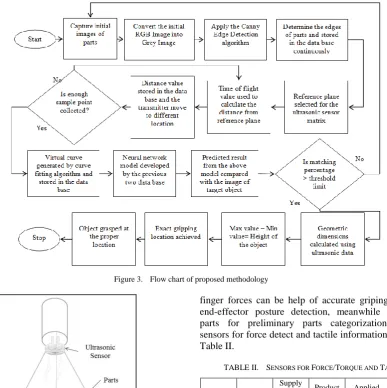
moved to grasp and manipulate the parts to perform the required task. Here force / Torque sensor, proximity sensor, vision sensors, ultrasonic sensors and tactile (LTS) sensors were mounted on the wrist of the robot to facilitate the identification of correct part to perform the desired mechanical assembly industrial operation using a SCARA robot. The flow chart of proposed methodology shown in Fig. 3.
A. System Components & Models/Scheme
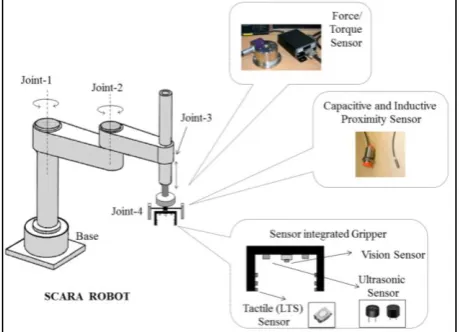
The primary objective of the robot is to recognition, pick and manipulate the correct part for assembly and to carry out the operation for mating the parts to build the final products with the help of applied integrated sensor show in Fig. 1. The specification of the F/T sensor used for the purpose is as follows. The Six axes force/torque sensor (Model No.: 9105-NET- GAMA - IP65), mounted on the wrist of a SCARA robot fitted with suitable gripper, is used to sense the force and/or torque coming on the manipulator during an ‘Obstacle encounter'. Two proximity sensors both capacitive (Model: CR30-15DP) and inductive (Model: E2A-S08KS02-WP-B1-2M) are mounted in the robot gripper to detect the presence or absence of any object; the specification of the proximity sensor used for the purpose is as follows. These sensors give ON-OFF type signals, which are being interfaced with Programmable logic controller (PLC). Ultrasonic Sensor (Model: MA40S4R/S) and Tactile Sensor (Light Touch Sensor Model: EVPAA ) is also mounted on the end-effector of a SCARA robot to sense the distance of the target object from the end-effector, and to indicate the applied pressure of the gripper to the targeted object respectively.
Figure 1. Integrated sensors with SCARA robot
B. Interfacing and Data Collection Technique
The scheme of interfacing of all mentioned sensors with SCARA robot, F/T sensor and vision sensor is connected to PC through DAQ system as represented in Fig. 3. The data acquisition system converts the transducer signals from analog voltages into digital. This data is processed by MATLAB 2012a. Proximity sensors are interfaced and experimentally controlled by PLC and programming in the ladder diagram using the PLC software Machine-addition.
Similarly Ultrasonic and tactile (LTS) sensors are interfaced by using the microcontrollers are shown in Fig. 2.
Figure 2. Scheme of interfacing of sensors with SCARA robot
It is an important feature to be able to percept interactive information in unconstructive environment to an intelligent robotic hand, especially external information such as distance, proximity and force. At present, few robotic end-effectors for industrial application have the ability to percept internal information and most of them rely on visual system to percept external information completely. In order to percept sufficient information needed in intelligent control, a multi-sensor method is applied. Many types of sensors are used to information acquisition of the object, industries and environment.
C. Sensors for Distance and Position Detect
Sensors for distance and position detect are applied for sufficient information acquisition working together with vision sensor and ultrasonic sensor, to judge 2D surface, position, distance and shape of the parts in workspace, and guide the autonomous manipulator as well as the end-effector to recognize the object and parts.
So an ultrasonic distance sensor is mounted in the middle part between the two fingers will transmit a 40 KHz square pulse signal when applied with a 5V P-P square wave.
TABLE I. SENSORS FOR DISTANCE AND POSITION
Type Model Supply Volt.
Product Mass
Detecting Distance Ultrasonic
Distance sensor
MA40S4R/S 5V 0.7 g 0.2-4 m
Omron proximity
sensor
E2A-M08-S02- 24V 65 g 2 mm ± 10%
Type Model Resolution Frame Rate
Vision sensor
NI CVS-1454
Up to 2000 x
Initially a reference point will be considered into the top of targeted object to calculate the distance using time of flight method shown in Fig. 4. Selected sensors for distance position and vision are listed in Table I.
A proximity sensor is mounted on the front of each finger, and these two proximity sensors are used to feel the proximity of the finger to the object in 2mm distance and compensate the positioning error of the visual system,
which would help the end-effector to adjust its position and posture to avoid collision with the object parts. Selection and match of these sensors is based on the follow principles: (1) Match of detecting distance and range; (2) higher detecting accuracy; (3) lighter and smaller; (4) detecting accuracy would not be influenced by shape and material of the parts; (5) better ability to adapt to the environment.
Figure 3. Flow chart of proposed methodology
Figure 4. Identifying the parts properties using ultrasonic sensors
D. Sensors for Force Detect
Accurate force control is most important for successful damage-free parts pick and place operation. As a result of cambered finger surface and upper-lower grip, slip between surface of the parts and each finger can be avoided to a great extent, so an LTS tactile sensor is mounted in each inner finger surface and a 6-axis finger sensor is amounted in the wrist which can detect all force and Torque information in three-dimensional space (Fx, Fy, Fz, Tx, Ty, Tz). Information fusion of these two
finger forces can be help of accurate griping force and end-effector posture detection, meanwhile can weigh parts for preliminary parts categorization. Selected sensors for force detect and tactile information is listed in Table II.
TABLE II. SENSORS FOR FORCE/TORQUE AND TACTILE
Type Model
Supply Voltage (v)
Product Mass
Applied force
Operating Temp
Tactile
sensor B3FS
5-24
VDC 0.2 g
0.98±0.29
N -25-70 °C
Type Model
Supply voltage (v)
Product Mass
Force sensing
range (F)
Torque sensing range
(T)
ATI F/T sensor
9105- NET-GAMMA
IP65
5V 0.255 kg
±1200
N ±79 Nm
III. RESULTS &DISCUSSION
A. Vision Sensor Calibration Using MATLAB
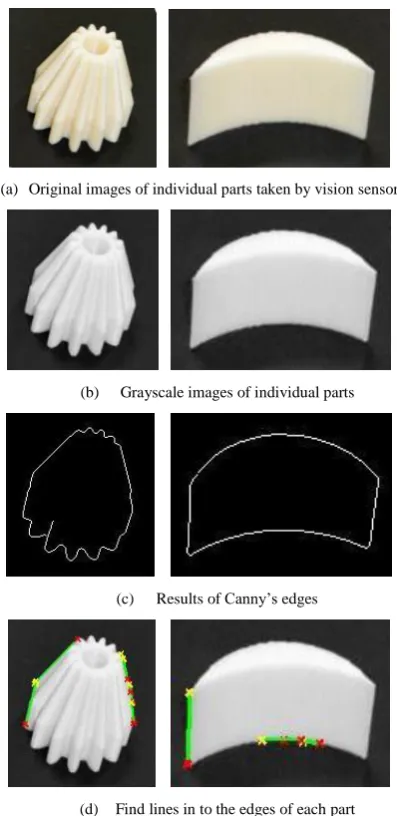
grayscale images and then the edge detection operator is applied with constant threshold value. From the edges in the image found, a specific portion (considerably a line from the edge detected) is considered and the information obtained by the help of the vision sensor will be stored in a database for further use.
(a) Original images of individual parts taken by vision sensor
(b) Grayscale images of individual parts
(c) Results of Canny’s edges
(d) Find lines in to the edges of each part
Figure 5. Experimental process of parts recognition by vision sensor
B. Ultrasonic Sensor Matrix
The ultrasonic sensor matrix will find out the distance of corner point and boundary point in 3 axes according to the reference point. Considering to the distance data the reference point of the curve can be plotted. Using curve fitting technique the virtual model of the surface can be generated shown in Fig. 6. Generated model will also be stored in other data base for further use.
By the image data the surface plane can be generated and by the help of ultrasonic data other information like dimensions, height from the base plane etc can be calculated. For height calculation we have to subtract the nearest point and the farthest point. By considering dimension, weight distribution of the target object can be calculated (provided the material is of one material). This information is used for generating the exact gripper and
target object contact point location. Tendency of toppling of the target object after lifting will be reduced.
(a) Generated point data plot using ultrasonic sensor
(b) Virtually generated surface using curve fitting algorithm Figure 6. Experimental process of parts recognition by ultrasonic
sensor
IV. CONCLUSION
In this paper the present state of the sensor technology in automated assembly system has been analyzed. The object identification is performed by integrating the vision sensor as well as the ultrasonic sensor matrix. The exact shape regarding surface of the target object is obtained by vision sensor. Proper weight distribution and other geometric information regarding dimension and location of the target object are obtained by ultrasonic sensor matrix. By using the ultrasonic database exact gripper and target object contact point is generated. Thereby tendency of toppling of the target object after lifting is reduced. It can be proposed for future scope to apply neural network prediction technique in conventional curve fitting algorithm to modify the learning method. The development of such an end-effector is definitely a step forward in automation assembly process.
REFERENCES
[1] D. Masumoto, T. Kimoto, and S. Nagata, “A sensory information processing system using neural networks,” in Proc. IEEE International Conf. on Neural Networks, 1993, pp. 655-660. [2] M. Przybylski, T. Asfour, and R. Dillmann, “Unions of balls for
shape approximation in robot grasping,” in Proc. IEEE/RSJ International Conf. on Intelligent Robots and Systems, 2010, pp. 1592-1599.
[3] S. Pagnottelli, S. Taraglioy, P. Valigi, and A. Zanelay, “Visual and laser sensory data fusion for outdoor robot localization and navigation,” in Proc. IEEE International Conf., 2005, pp. 171 -177.
[4] Li Ying and N. S. Pollard, “A Shape matching algorithm for synthesizing humanlike enveloping grasps,” in Proc. of Carnegie Mellon University Research Showcase, 2005, pp. 442-449. [5] N. Ayache and A. D. Faugeras, “HYPER: A new approach for the
Trans. on Pattern Analysis and Machine Intelligence,vol. 8, pp. 44-54, 1986.
[6] A. Sahbani, S. El-Khoury, and P. Bidaud, “An overview of 3D object grasp synthesis algorithms,” Robotics and Autonomous Systems, vol. 60, pp. 326-336, 2012.
[7] O. D. Faugeras and M. Hebert, “The representation, recognition, and locating of 3-D objects,” The International Journal of Robotic Research, vol. 3, no. 3, pp. 27-52, 2011.
[8] O. P. Sahu and B. B. Biswal, “Force / torque sensor integrated robotic manipulation for assembly operations,” in Proc. IEEE Conference, India, ICRESE, 2013, pp. 955-959.
Om Prakash Sahu received the B.E. degree
in Electronics and Telecommunication in 2005 and M-Tech. in Instrumentation and control system in 2008 from the University of CSVT, Bhilai, India and joined as a faculty in the same institute in 2006. Currently he is pursuing PhD at National insti tute of technology Rourkela, India. He has been published more than 13 technical research papers at National and International levels. His areas of research interest include industrial robotics, control system and Instrumentation, Computer integrated manufacturing and automation.
Dr. Bibhuti Bhushan Biswal graduated in
Mechanical Enginnering from UCE, Burla, India in 1985. Subsequently he completed his M.Tech, and Ph.D. from Jadavpur University, Kolkata. He joined the faculty of Mechanical Engineering at UCE Burla from 1986 and continued till 2004 and then joined National Institute of Technology, Rourkela as Professor and currently he is the Professor
and Head of Department of Industrial Design. He has been actively involved in various research projects and published more than 100 papers at National and International levels. His areas of research interest include industrial robotics, FMS, Computer integrated manufacturing, automation, and maintenance engineering. He was a visiting Professor at MSTU, Moscow and a visiting scientist at GIST, South Korea.
Saptarshi Mukherjee received the B.E.
degree in Electronics and Instrumentation from University of Kalyani, West-Bengal India in 2013, and pursuing M-tech in Industrial Design from National institute of technology Rourkela, India. Heis currently interests include robotics, Computer integrated manufacturing and automation. He has 2 international publications to his credit.
Panchanand Jha graduated in Production