A STUDY OF EFFECTIVENESS OF INQUIRY TRAINING MODEL FOR
TEACHING SCIENCE TO STANDARD VIII STUDENTS OF VADODARA
CITY
Priti Chaudhari*
Assistant professor, Department of Education [CASE], Faculty of Education and Psychology, The Maharaja Sayajirao University of Baroda, Vadodara
Email: [email protected]
ABSTRACT
Science forms an integral part of learning. Essentially it has to be learnt mainly through con-crete situations related to immediate environment. The main focus of imparting science educa-tion is on sharpening the senses of the learners and encouraging them to discover and explore their environment and surroundings. Instead of loading the students with scientific informa-tion, efforts should be made to help them learn key concepts which cut across all the disciplines of science. This would generate curiosity and would enhance awareness and understanding. Whenever we come across anything which is unfamiliar, may it be an object, event or situation, our mind is stirred by questions which may help us in knowing more about the object of our curiosity. Nature has gifted us with the tool of curiosity for learning more and more about environment. It is common to observe children asking lot of questions about anything which
arouses curiosity. According to Singh (1995), “Whenever we are in a process of finding out or
investigating through questions, we are in the process of inquiry. From a simple array of ques-tions, if the inquiry takes the form of disciplined and systematic approach, it becomes the spirit
of scientific method”. The present study was an attempt to implement the Inquiry Training Model on standard VIII students of Vadodara city to teach science. The programme was found to be effective in terms of the achievement of the students. Also the opinion of the students proved the programme to be effective. It was also a good learning experience for the students. Inquiry Training Model is effective in terms of arising curiosity in students, better retention of the concepts, generating interest in students and provoking them to ask questions and interact in class. The results of the study shows that if regular classroom science teaching is made activity based and interactive then it will definitely positively affect the learning and achieve-ment of the students.
Keywords:
* Author for correspondence
Received : 12-09-2015 Accepted : 18-09-2015
INTRODUCTION
Science forms an integral part of learning.
Essentially it has to be learnt mainly through concrete
situations related to immediate environment. The
main focus of imparting science education is on
sharpening the senses of the learners and
encouraging them to discover, observe and explore
their environment and surroundings. Instead of
loading the students with scientific information,
efforts should be made to help them learn key
concepts which cut across all the disciplines of
science. This would generate curiosity and would
enhance awareness and understanding.
Whenever we come across anything which is
unfamiliar, may it be an object, event or situation,
our mind is stirred by questions which may help us
in knowing more about the object of our curiosity.
learning more and more about environment. It is
common to observe children asking lot of questions
about anything which arouses curiosity. According
to Singh (1995), “Whenever we are in a process of
finding out or investigating through questions, we
are in the process of inquiry. From a simple array of
questions, if the inquiry takes the form of disciplined
and systematic approach, it becomes the spirit of
scientific method”. Therefore training the learners
for investigating and explaining ant type of puzzling
problem, phenomena or event can be a way of
orienting their minds towards scientific inquiry. The
nature of science is such that it demands the spirit of
inquiry and science as a school subject has a wide
scope of scientific inquiry. There are various methods
and models of teaching through which learners can
be taught science through the process of inquiry.
Nature of Science
From these definitions three basic principles of
nature of science can be defined.
1) An accumulated and systematized body of
knowledge.
2) The scientific method of inquiry and
3) The scientific attitudes.
The first point indicates the product of science,
while second and third points indicate the process
of science. Science is not just a static body of already
established knowledge, but a living tradition of never
finished exploration into the integrated and
unexpected vistas of nature. Science as a body of
knowledge characterized by a highly dynamic
structure of knowledge, which is founded on
numerous bits of information linked with one another
into many generalization forming the substantive
corpus of science constituting its product dimension.
This structure of knowledge interacts actively with
the reality. The mode of this active interaction is
governed by the logic of the processes of scientific
inquiry or the scientific method. This constitutes the
process dimension of science. The method of
construction of knowledge follows certain systematic
logical steps for collecting and processing
information, tracing out general trends and
constructing theoretical models. This chain of
activities mediates between the reality and the
structure of knowledge, and constitutes the
processes of scientific inquiry or scientific method
which as stated earlier forms the process dimension
of science. the process of scientific inquiry represents
the spirit of science as an activity and is its essence
that distinguishes science from other disciplines.
Need Of Teaching Science Through Inquiry
In order to achieve the objectives of teaching
science, it is imperative that teaching methods should
be modified. According to NCERT (2006), “for any
qualitative change from the present situation,
sci-ence education in India must undergo a paradigm
shift. Rote learning should be discouraged and
in-quiry skills should be strengthened and supported”.
According to Menon (1986), science teaching
should depend on following premises:
l The essence of science is its process of inquiry
and not the diverse information that form part
of its substantive of product dimension.
l Teaching of science should not be taken to
information, which have already been
established as integral part of knowledge
structure.
l Learning of a concept from learner’s point of
view and not memorizing the verbal statements
of the concept. Hence science is best learnt
and taught through an inquiry approach.
l Learning is acting upon the environment and
solving his or her problems and making his or
her own discoveries.
Superficial view of present teaching of science
consists of a body of facts, principles and descriptions
of our surroundings, demonstrations and laboratory
operations. According to Mohapatra and Mahapatra
(1999), “In present education system science is
taught only as a product. The process part of science
is being neglected. As a result pupils may not be
able to apply science as a process operating in daily
life situations”. This view may incorporate limited
understandings of the relationships among various
aspects of our surroundings of the relationships
among various aspects of our surroundings including
man’s dependence upon and use of his surroundings.
The content of science is primarily a record of man’s
accomplishment. It is a kind of history of what man
has achieved. It’s major value lies in the use that we
can make out of it to improve man’s thought and
action in future.
Richardson et.al. (1968) “ Science as a school
subject should be far more than a description and
history. Science will not produce its full impact on
human life until it permeates thought and action. To
produce this impact, science should provide
experience far beyond the recapitulation of facts and
principles”. As the researcher discussed earlier the
scientific method and scientific attitude are also the
components of nature of science, it is necessary to
develop this scientific behavior in students. This
behavior is characterized by exploration resulting
from lively curiosity and by the careful and critical
investigation of problems.
Importance Of Questioning
Questions are the primary tools and basic
fundamental necessity of scientific inquiry. Whenever
an individual is puzzled about phenomena, the
curiosity propels him to ask questions and thus leads
to inquiry. According to Menon (1986), “questions
recognize the wide possibility of thought and are
built around varying forms of thinking”. Since each
question is directed towards learning and evaluative
thinking but unfortunately questions of children are
often neglected or marginalized by teachers.
According to Anderson (1970), “the activities the
students engage in when controlled with instructional
tasks are of crucial importance in determining what
he will learn”. Thus what is learnt largely depends
on the activities and questions of the students. The
questions are perhaps the primary tools by which
the individual processes information regardless of
the diversity of his procedure. Questions serve to
focus students functioning and to provide a means
for determining relevant from irrelevant information
and for pointing major relationships among variables,
as well as creating new insights and assessing the
Concept Of Inqiry Training Model (I.T.M.)
The emphasis of I.T.M. is upon making the
learners aware of the inquiry process through
structuring and re-structuring of questions and
sequencing them appropriately. The learners are
actively involved in data gathering and hypotheses
verification but all this happens through questioning
related to the problem presented by the teacher in
the beginning. The teacher guide the students to frame
such questions which can be answered in ‘Yes’ or
‘No’.
Objectives of I.T.M.
Singh (1995) and Joycee et.al. (2008) gave
objectives of I.T.M. in their respective books. Author
has presented relevant objectives from both the
books. These objectives are as follows.
a) To develop scientific process skills: observing,
collecting and organizing data, identifying and
controlling variables, formulating and testing
hypothesis, explanations and inference.
b) To develop autonomous learning.
c) To develop ability to tolerate ambiguity.
d) To develop logical thinking.
e) To make students understand that all
knowledge is tentative.
I.T.M. Chart
Joycee et.al. (2008) summarizes I.T.M. in the
following way:
A) Syntax
Phase 1: Presentation of Puzzling event and
explanation of inquiry procedure.
In this phase the teacher demonstrates
through an experiment or narrates a
phenomena which seems puzzling for students
and triggers their thinking process.
Phase 2: Data gathering and verification
In this phase the students try to find out the
variables associated with the given
phenomenon and their interrelationship.
Phase 3: Hypotheses and testing
In this phase the students try to find out the
probable causes of the phenomenon. They
formulate various hypotheses which are
subjected to testing in the form of questions.
If the answer of the particular question is ‘no’,
then that particular hypotheses is rejected.
Thus out of many hypotheses only few are
not rejected which stand as the causes of
phenomenon.
Phase 4: Formulating an explanation
After testing all hypotheses, students try to
form an explanation considering the
hypotheses which are not rejected. Thus they
try to reason out the occurrence of that
particular phenomenon.
Phase 5: Analysis of inquiry process
Finally the teacher concludes by summarizing
the concept to be taught. Also teacher analyze
the entire process and point out the mistakes
made by the students and also discuss the
ways to rectify the mistakes.
B) Social System
Co-operation, intellectual freedom and
equality is must among students- students and
teacher – students. Interaction among
students should be encouraged.
C) Principles of Reaction
a) Ensure that questions are phrased so they
can be answered in ‘yes’ or ‘no’ and that
substance does not require the teacher to do
b) Ask the students to rephrase invalid
questions.
c) Point out unvalidated points.
d) If necessary, new information can be
provided to keep the inquiry moving.
e) Try to provide a free intellectual
environment by not evaluating student
theories.
f) Encourage interaction among students.
D) Support System
The optimum support is a set of confronting
materials, a teacher who has content mastery
and understands the strategy of inquiry and
resource materials bearing on the problem.
Limitation of I.T.M.
Singh (1995) gave some limitations of I.T.M.
which are as follows:
l Helps in developing explanations on the basic
previous knowledge. So it is very necessary
that students have some basic information
which will guide them in the inquiry process.
l New concepts and formulae cannot be taught.
As students need some knowledge to start
the inquiry process so if the concept is entirely
alien to the students then it cannot be taught
through I.T.M.
l If the puzzling situation is not presented in the
form of a problem requiring explanation, the
students cannot effectively arrive at
generalization through inquiry.
Role of Teacher
l Should guide the students during the inquiry
process, prevent them from going on wrong
track and creating chaos in the class and have
content mastery.
l Be flexible and provide free environment to
the students and manage the time.
l Continuously motivate the students so they
are inquisitive to know more.
l Help in inquiry but should not do inquiry for
students.
l Before planning and implementation of
I.T.M., the teacher should check the previous
related knowledge of the students.
l After students arrive at generalization, teacher
should summarize in such a way that concept
clarity is attained by students.
l Teacher should have clear knowledge of all
the related content matter.
l The hypotheses/questions having ‘yes’
answers should be written on board so that it
becomes easy for students to generalize.
l If questions are not framed properly, teacher
should not ignore that question but ask the
students to reframe them properly.
Rationale Of The Study
The present world is a world of science and
technology. Everything or every event happening
around us demands some knowledge of simple
scientific facts and principles. Looking into the nature
of science, it is both process and product and also
the objectives of teaching science emphasize on
development of scientific attitude. Moreover almost
all commissions and committees appointed by govt.
of India recommended the development of scientific
attitude. According to NCF (2000), “Science
education should be such that it helps to generate
characterized by the spirit of inquiry, problem
solving, courage to question and objectivity leading
to elimination of superstition and fatalism”. Thus
science education if properly conceived should
primarily be concerned with the education of mind
rather than the acquisition of violated pieces of
scientific knowledge.
An important purpose of science teaching in
general education up to secondary stage is to
familiarize the learners with various dimensions of
scientific literacy. Scientific attitude, a very important
attitude should be developed in the children who
are the future citizens, if the objectives of teaching
science are to be achieved. Science teaching
through the use of models of information processing
family is to help the students become more powerful
learners.
Amin (2011) implemented I.T.M. as one of the
activity of science teaching on pre-service student
teachers. The findings reflects its effectiveness in
terms of understanding, content clarity, attitude
development, decision making, achievement and
science process skills. Also the main focus of the
present study is to make students pass through an
inquiry process, which probably will help in
development of scientific attitude and better learning.
Thus, according to the researcher I.T.M. was apt
for the present study. The effectiveness of this model
was founded in terms of the achievement of the
students as well as the opinion of students regarding
the developed programme on I.T.M. One of the
reasons to select school students for the present
study was that the researcher could not find any
study related to implementation of I.T.M. on school
students. Also the study of Menon (1986) shows
that there is increase in the process skills of students
from std. VIII till std. XII. So std. VIII can be
considered as a base for development of process
skills. Thus those students must be taught using
various methods and models which can initiate the
development of scientific attitude and science
process skills. Thus the researcher selected std. VIII
students for the present study. Science concepts such
as combustion, transfer of heat, properties of air,
depletion of ozone and static electricity were
selected as they are very general concepts and they
form a part of science curriculum of std. VIII and
the students do have a prior basic knowledge about
these concepts which is a very important
precondition for implementation of I.T.M.
Statement Of The Study
“A study of Effectiveness of Inquiry Training
Model for teaching Science to standard VIII students
of Vadodara city”
Objectives Of The Study
1) To develop a programme on inquiry training
model to teach concepts of science.
2) To implement the developed programme on
std. VIII students.
3) To study the effectiveness of the programme
in terms of
a) achievement of students
b) opinion of the students regarding the
programme
Hypothesis
There will be no significant difference between
the mean achievement scores of the experimental
Operationalisation Of The Term
Effectiveness: The difference between the
mean achievement scores of the experimental
group and that of controlled group as well as
opinion of students represented effectiveness of
the programme.
Opinion: For the present study the views of the
students regarding the programme constituted
their opinion. A five point scale opinionnaire was
used.
Delimitation Of The Study
The present study is delimited to the students of
English medium Schools following Gujarat
Secondary and Higher Secondary Education Board
(GSHSEB) of Vadodara city during the academic
year 2011-12.
Science concepts were delimited to concepts of
combustion, properties of air, transfer of heat,
depletion of ozone layer and static electricity.
Method Of The Study
The present study was quantitative in nature.
Design Of The Study
Design of the present study was
quasi-experimental. Pre-test and post-test was
implemented on experimental and controlled groups.
Implementation of I.T.M. was independent variable
and achievement of the students was dependent
variable. Age was the controlled variable.
Environmental factors like their motivational level,
exposure to other agencies of knowledge gaining
etc. were intervening variables which were thought
to be equally affecting both groups.
Population
Approximately 3500 students of VIII Std. of 62
English medium schools of Vadodara city following
GSHSEB syllabus was the population of the present
study.
Sample
Purposive sampling technique was used. Bright
Day school (Vasna) was selected as experimental
group and Sabari Vidyalaya was selected as
controlled group. All std. VIII students of Bright
Day school (55) and Sabari Vidyalaya (65)
constituted the sample for the present study. Thus
the sample size was 120 students.
Phases Of The Programme
Phase 1 – Development Of The Programme:
Content analysis was done of science textbook
of standard VIII and six concepts were
identified which could be taught through Inquiry
Training Model. These six concepts were:
(i) oxygen is necessary for combustion
(ii) ignition temperature is necessary for
combustion (iii) transfer of heat (iv) properties
of air (v) depletion of ozone layer and (vi) static
electricity. The students do have a basic
knowledge about these concepts and there is a
scope of inquiry for teaching these concepts.
Separate experiments were designed for each
concept except in depletion of ozone layer were
a puzzling phenomena was presented before the
students. The programme was validated by the
experts of science field. The following table
Table:1 Development of the Programme
Sr. No. Concept Experiment
1 Oxygen is necessary for combustion Light a candle and invert a glass on it. Observe.
2 Ignition temperature is necessary for combustion Take two balloons. Blow one balloon with air and another
balloon with water. Bring both the balloons near a candle
flame. Observe.
3 Transfer of heat Fill one bottle with hot water and put some ink drops in it.
Fill another bottle with ice cold water and invert it upon
hot water bottle. Observe.
4 Properties of air Place a funnel on a bottle. Cover the neck of the bottle
along with the funnel with clay. Pour some water in the
funnel. Observe. Now remove the clay and again pour
some water in the funnel. Observe again.
5 Static electricity Rub a plastic or comb against dry hair and bring it near
the copper coil of an electroscope. Observe what happens
to the two silver foils inside air tight bottle.
6 Ozone depletion Puzzling event: Example of Australia recorded highest
number of cases suffering from skin cancer was presented
to the students in puzzle form.
Phase–2 Administration Of Pre-Test :
An achievement test was administered on both
experimental group and control group before
implementation of developed programme.
Proper sitting arrangement of the students was
ensured before administering the test. Two
children on one bench were allowed to sit. Stu
dents were given 30 minutes for the completion
of the test. They had to write the answer in
question paper itself.
Phase–3 Implementation Of The
Programme :
The developed programme was implemented
only on experimental group. The students were
asked to observe experiment and then were given
time for inquiry and think of the probable causes
of the phenomena. Then they had to present the
probable causes in the question form which can
be answered only in ‘yes’ and ‘No’. Then at the
end, suitable explanation was given by the
students based on the positive hunches. Finally
the researcher summarized the whole process
and concept. The same method was used to
teach all the concepts.
Phase–4 Administration Of Post – Test :
After intervention program on experimental
group, again the same achievement test was
administered on both experimental group and
controlled group. An opinionnaire was
implemented only on experimental group for
knowing the reactions of the students regarding
the programme.
Tools
Achievement Test: An achievement test was
constructed by the researcher. This test contained
objective type of questions, covering the concepts
of combustion, properties of air, transfer of heat,
was of one mark. The test contained total 30
questions. It was validated by the experts of science
education.
Opinionnaire: The opinionnaire was prepared by
the researcher and validated by the experts. Only
close ended statements and 5 point rating scale was
prepared on the effectiveness of the programme after
intervention of experiment.
Data Collection
For the purpose of data collection, researcher
personally visited both the schools and took
permission from the respective principals and
explained them the purpose of the research. First
pre-test was administered on both the groups. Then
I.T.M. was implemented on only experimental group
by the researcher. Controlled group followed their
regular teaching by lecture method. Investigator
ensured that their regular teacher taught them all
these concepts through lecture method. Lastly
post-test was administered on both the groups. Thus the
achievement scores in pre and post tests of the
sample is the data for the present study.
Data Analysis
The data obtained was analyzed by using
following statistical techniques such as frequency,
percentage and t – test.
Major Findings
The major findings of the study were as follow:
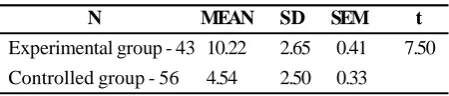
l t – value calculated > t – value in table at
0.01 level of confidence was 7.50. So the
null hypothesis – “there will be no significant
difference in the mean achievement scores of
experimental group and that of controlled
group” is rejected at both the levels of
confidence. Thus there is significant difference
in the mean achievement scores of the
experimental group and controlled group.
Table : t value calculated from the gained scores.
N MEAN SD SEM t
Experimental group - 43 10.22 2.65 0.41 7.50
Controlled group - 56 4.54 2.50 0.33
l The mean achievement score of experimental
group which is 10.22 is significantly high than
the mean achievement score of the controlled
group which is 4.54. Thus the implementation
of Inquiry Training Model (I.T.M.) to teach
science to standard VIII students is effective
in terms of the achievement of the students.
l Out of the total 45 students, 88.89 % students
liked the new method of teaching and out of
that 55.56 % of students were strongly agree
to this statement.
l 91.11 % students had reported that the
experiments performed were interesting and
95.55 % students had told that the method
used for teaching was the new method having
learning with fun.
l 77.77 % of students had revealed that they
had openly asked the questions in the class
and also enjoyed asking questions. They also
felt that the questions asked by other students
were interesting.
l 93.33 % of students were agreed that this
method aroused curiosity in them to know
more and they also easily understood the
concepts. 86.66 % of the students had agreed
that this new method provoked them to think
l 91.11 % students had reported that they are
satisfied with this new method and think that
they remember more when taught through this
new method.
l 88. 89 % students had told that this new
method of teaching is better than the regular
lecture method.
Thus as per the analyzed data and the results
obtained through opinionnaire, it can be concluded
that implementation of Inquiry Training Model is
effective in terms of arising curiosity in students,
better retention of the concepts, generating interest
in students and provoking them to ask questions
and interact in class. The principal of the
experimental group had observed many class and
based on that reported that she was very pleased
with the way the whole programme was
implemented. Also she was surprised to see that
the most notorious class was so much involved in
the programme and the most introvert students asked
questions and participated in the interaction. Also
during the whole span of the programme, researcher
observed that almost 85 % of the class participated
in questioning.
Conclusion
The present study was an attempt to implement
the Inquiry Training Model on standard VIII students
of Vadodara city to teach science. The programme
was found to be effective in terms of the achievement
of the students. Also the opinion of the students
proved the programme to be effective. It was also
a good learning experience for the students. Inquiry
Training Model is effective in terms of arising
curiosity in students, better retention of the concepts,
generating interest in students and provoking them
to ask questions and interact in class. The results of
the study shows that if regular classroom science
teaching is made activity based and interactive then
it will definitely positively affect the learning and
achievement of the students.
References
Allport., G. W. (1973). Educational Psychology.
New Delhi: Nilkamal Publication Pvt. Ltd.
Amin, J. A. (2011). Development and
implementation of and activity based science
teaching programme for pre-service students
and teachers. Unpublished Ph.D. thesis, CASE,
Vadodara.
Anderson, F. M. (1970). The act of questioning
in the classroom. London: University of London
Press ltd.
Education and National Development. (1964-66).
Report of Education Commission. New Delhi.
NCERT.
Gautam., (2002). A study of scientific attitude in
relation to interest in science of IX class
students of Allahabad city. Meeruet University,
In Indian Education Abstracts. Vol (4),
January-June.
Joshi., M. M. (2006). Modern methods of
teaching science. New Delhi: Cyber tech
Publications.
Joycee, B., Weil, M. & Calhoun, E. (2008). Models
of teaching, New Delhi: Prentice hall of India
pvt.ltd.
Kozlow., J. M. 7 Nay, M. A. (1976). An approach
education, April-June.
Menon., S. B. (1986). The study of a system of
science education in the perspective of the
processes of scientific inquiry. An unpublished
Ph. D. thesis. The M. S. University of Baroda,
Vadodara: CASE.
Mohapatra, J. K. & Mahapatra, M. (1999). New
dimensions in science curriculum : An
operational approach. New Delhi. Common
wealth publisher.
Ministry of Human Resource Development., (1986).
National Policy on Education. New Delhi:
Government of India.
Patel., R. C. (1997). A study of scientific attitude
and its correlates among secondary school
students of Vadodara city. An unpublished
Ph.D. thesis. The M. S. University of Baroda,
Vadodara: CASE.
Richardson, J.S., Williamson, S. E. & Stotler,
D. W. (1968). The education of science
teachers. Ohio, Columbus: Charles E. Merril
Company.
Sanadhya., R. P. (1996). Personality
characteristics and scientific attitude. Udaipur:
Shiva Publishers Distributors. In Patel.,
R. C. (1997). A study of scientific attitude and
its correlates among secondary school
students of Vadodara city. An unpublished
Ph. D. thesis. The M. S. University of Baroda,
Vadodara: CASE.
Singh, L. C. (1995). Inquiry training model:
Teaching problem solving through discovery
and questioning. In L.C. Singh (Ed). Multiple
models of teaching for educators. New Delhi:
Vikas publishing house pvt.ltd.
Taradevi Report., (1956). In Sharma., R. C. (2003).
Morden Science Teching, New Delhi: Dhanpat