AUT J. Civil Eng., 1(2) (2017) 111-120 DOI: 10.22060/ceej.2017.13322.5375
A Framework for Project Safety Management by Applying Social Network Analysis
H. Abbasianjahromi1*, M. Sepehri2, A. Etemadi31 Civil Engineering Department, K. N. Toosi University of Technology, Tehran, Iran
2 Graduate School of Management, Sharif University of Technology, Tehran, Iran
3 Department of Civil Engineering, Kish International Branch, Islamic Azad University, Kish Island, Iran
ABSTRACT: Projects need a network of various resources such as human, equipment and material which should be used together to achieve some goals. Today, in order to better manage this network, the idea of applying social network analysis (SNA) has been introduced in the project management. Since safety issues cause important challenges in projects, in this paper, the SNA is applied to promote the project’s safety level. The main idea of this research is to find the most influential person who has the high potential for creating accidents. Specifically, to solve this problem, the authors address three main subjects: firstly, to identify the existing links in the social network of projects according to different causes of accidents, secondly to analyze the network by applying the SNA and the third, to present some strategies to manage the most influential persons based on the results of the SNA. By applying the proposed framework with six steps, firstly the accidents can be prioritized based on their density and secondly, the most influential person can be identified based on centrality. To implement the proposed framework, a case study has been reviewed and the results showed that the falling from height and HSE man are the most important accident and the most influential person, respectively.
Review History:
Received: 22 August 2017 Revised: 2 December 2017 Accepted: 12 December 2017 Available Online: 19 December 2017
Keywords:
Safety Management Social Network Analysis Construction industry HSE
Centrality
1- Introduction
Occupational accidents are the third cause of death in the world (Yang et al., 2015). Different types of statistics show that the rate of injuries and fatalities in the construction industry is higher than other industries (Zou and Sunindijo, 2015) so safety has been one of the most popular issues among construction industry’s researchers from faraway. Due to the occupational accidents, one out of five workers has died in 2014 (labor, 2014). Social Security Organization of Iran recorded 21740 occupational accidents from 2013 to 2014 and it has claimed that 30% of the mentioned records were directly related to the construction industry (Organization, 2014-2015). The question is that why the rate of accidents is high in the construction industry.
To answer this question, different reasons for accidents should be investigated. Although the risky and harsh nature of construction industry could be considered as one of the most important reasons of the high rate of injuries in this industry (Hallowell, 2011), there are various causes which are effective on the rate of accidents. For the first time, Heinrich (1931) mentioned two main accident causes, including human errors and technical or organizational problems. Other investigators developed Heinrich’s idea and they opined that all of the accidents have four causes, including human errors, machine errors, poor-quality materials and bad construction methods (Lewandowski, 2000, Spath, 2011, Runkiewicz, 2006). Different observations showed that the human error is one of the most challenging issues because
of its high statistics on occupational accidents (Ung et al., 2006, Chen et al., 2012). Making a suitable policy to work on the human errors promotes the level of safety in construction projects. Reason (2000) believed that the human errors can be surveyed based on two approaches, including human and system. Some errors are related to humans such as blaming him/her for forgetfulness, inattention, or moral weakness. The system approach concentrates on the human works and tries to avert errors or mitigates the effects of unsafe behaviors. In this paper, the system approach is developed to mitigate the human errors in construction projects.
Social network analysis (SNA) is one of the most common techniques for understanding and analyzing the systems adhered to the concept of network. The network means a set of actors who have relationships with each other in the projects. The SNA is a new contribution to the construction project management in comparison with other popular subjects. The benefits of the SNA are rapidly growing in the practical studies of construction project management issues (Zheng et al., 2016). Wasserman and Faust (1994) defined the social network as a finite set or sets of actors and the relations among them. De Nooy et al. (2005) introduced the social network as a pattern for tying different humans in a project. Since each project consists of various subgroups, humans, equipment, etc., the concept of the social network can be adopted properly (Wambeke et al., 2011). The SNA applies the concept of social network and provides a tool for identifying the characteristics of the network (in this paper, network defines a project) (Turner and Müller, 2003). Despite the fact that this is a new contribution in the construction
industry, some investigations have been developed in different areas. Zheng et al. (2016) developed their investigation in the construction industry for different applications of the SNA. Most of the previous studies have applied the SNA in inter-organizational problems (Stinchcombe, 1959, Scott, 1981) but some new contributions are developed by applying the SNA in the construction industry. For instance, Chinowsky et al. (2010) applied the SNA in the knowledge exchange among stakeholders. Pryke (2012) published a book to describe the concept of the SNA by focusing on its applications in the procurement management of construction projects. Lin (2014) studied how the SNA can identify the main characteristics of projects and explore their threats and opportunities. Park et al. (2010) used the SNA for the evaluation of companies when they want to decide to enter into the international projects. Abbasian-Hosseini et al. (2014) presented a new approach for combining the SNA with one of the most frequently used techniques named data envelope analysis (DEA) to find the benchmarks for inefficient projects.
As discussed above, the subject of safety is very crucial in the construction industry and recently different investigations have been developed around this subject. According to the previous research, one of the most effective approaches to improve the safety level in projects is to manage human resources or reduce human errors. Moreover, it was described that human errors would be handled by focusing on one of the two different viewpoints, including human or system. This paper intends to apply the concept of SNA to handle the problem of human’s safety based on system approach. In other words, since the status of safety in the construction industry is not good, this paper aims at enhancing the level of safety by presenting a new methodology which deals with human errors in the construction projects. Moreover, the main innovation of this paper is to apply the SNA for safety issues. For more clarity, the authors see the problem of human error in construction projects as a system where humans work together in a network, thus SNA would be used for two reasons: 1) to identify the characteristics of the studied network (means for each project) 2) to explore how the project manager or everyone responsible can pursue his/her ideas to promote safety level in an effective way by focusing on some persons. To know who is the most influential person for improving the project’s safety and how the effectiveness of safety program can be increased, determining the characteristics and some parameters of network such as actors, relations, centrality, density, etc. could be considered as a solution. The paper presents a step by step framework for increasing the safety level among project’s human resources by applying the concept of the SNA. The remainder of this paper is organized into the following sections: firstly, a brief safety literature review is offered. The concept of the SNA is described in the next section. Methodology and the proposed step by step framework are explained. Next, a hypothetical example is presented in the fourth section for a better understanding of the methodology. The final section presents some discussions about the results and gives conclusions.
2- Safety literature review
Safety has been the subject of several investigations in the construction industry. The researchers developed their works with respect to the different aspects of safety in the construction industry. This section intends to review some of them. Shin
et al. (Shin et al., 2015) developed a model to predict and quantify the causal relations among safety variables and workers’ safe behaviors. They used questionnaire method to collect the needed data in South Korea. They used path diagram and analysis to develop their model. Zaira and Hadikusumo (Zaira and Hadikusumo, 2017) investigated three safety interventions existed in the construction industry, including management, human and technical issues. They applied a structural equation modeling to find which one is the most important. The results showed that technical issues are more important than the other two interventions. Wu et al. (Wu et al., 2017) developed a model of how the leader’s behaviors improve the construction safety. They found that Safety culture and safety management are the two major paths by which leadership impacts safety performance. Saunders et al. (Saunders et al., 2017) developed an instrument to track the safety attitude in the organizations. They believed that safety issues should be considered at the project start by cooperating other parties such as designer, owner, etc. Choudhry (Choudhry, 2017) surveyed the challenges between productivity and safety. There is a belief that improving the safety leads to decreasing the productivity. He distributed a questionnaire among different projects and concluded that improving safety and productivity simultaneously is possible. According to the literature review, the previous investigators applied different approaches to solving their problems based on the nature of problems in the safety issues.
3- What is the SNA?
Although there are some definitions of the social network, it can be defined simply as a set of actors who are connected to each other because of some logical reasons (Pryke, 2012). The origins of the social network are referred to the Émile Durkheim and Ferdinand Tönnies’s works at the end of 19th century. Otte and Rousseau (2002) opined that the SNA is the process of studying the social structures through the use of network and graph theory. The first endeavor in this area was taken by Moreno (1934) and Lewin (1937). The provenance of this technique is from psychology and then applied widely to other knowledge areas. Due to the SNA capability within large groups of people and their related problems, its application has increased over the last two decades (Pryke, 2012). In the construction industry, people or actors can be considered as humans or firms (Pryke, 2012). Kilduff and Tsai (2003) brought another categorization named heterophily and structural role theory. According to the heterophily theory, the interactions among individuals in the network would be considered, but the structural role theory studies different roles instead of humans. As a consequence, by considering the Pryke’ idea or Kilduff and Tsai’s opinion, the analyzer should make a decision about his strategy for developing SNA in the first step.
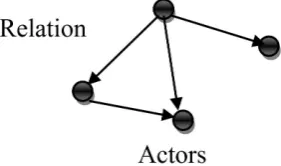
Notwithstanding the fact that what the useful strategy in developing SNA is, the analyzer should be familiar with a number of social network terms. Some of the main SNA terms are discussed as follows and demonstrated in Figure 1 (Pryke, 2012).
• Actors: Each network comprises some nodes that represent the people, groups, roles, etc.
used instead of it.
• Density: It indicates the total number of current links divided by the total number of possible links. This is expected that the networks with the low density (all factors being equal) are the less complex than others. It is obvious that more points show the density will be less with a higher probability.
• Out-degree: Links that distribute the information from each node named out-degree. In other words, it measures that how many times the node interacts with others. • In-degree: Links that gather information from a large
number of other nodes.
• Centrality: It shows the proportion of the total links of each node to the total current links. This parameter measures the importance of each node in the network with respect to its connections.
4- Methodology
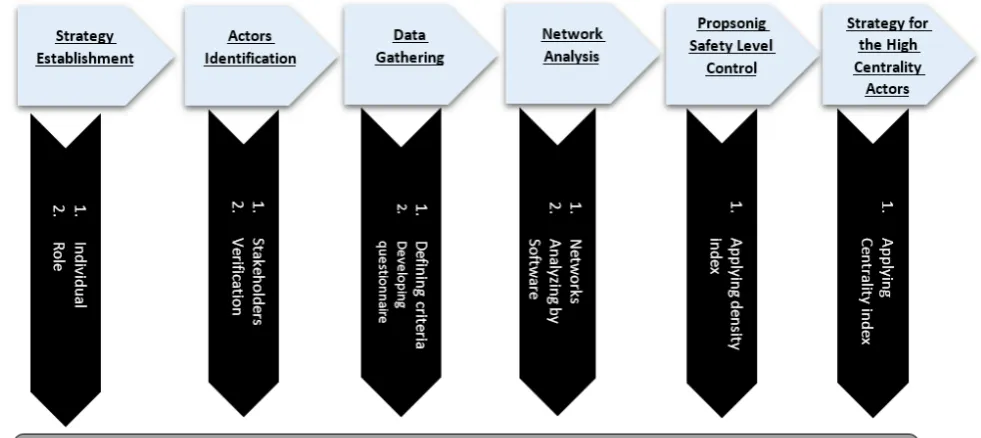
This section presents a step by step framework to find that how the SNA could be applied to improve a project’s safety level with respect to the human considerations. The present study is a descriptive survey because it tries to apply the SNA in the concept of safety management, thus it is non-experimental. Regarding two different approaches to using the SNA, the selected strategy is based on individuals in this paper. As discussed in the previous section, the analyzer should decide on selecting his contribution by studying the SNA, including the role of human or individuals. This paper intends to select the role of human strategy and to work on the communication of roles in the projects instead of studying the humans. The main contribution of this study is to use some parameters derived from the SNA to apply in the process of safety management. Two main parameters named density and centrality would be considered, as well. According to the definition of the density, whenever the value of density is close to 1, the interactions among humans are higher, and consequently, the control on a safety level should be increased. Another practical parameter is centrality. By calculating the centrality index for each node (means persons who are active in a project) and comparing them with each other, the most effective roles/humans would be recognized. It means that the most attention should be paid to nodes with high centrality values. The six steps below describe the proposed framework, and Figure 2 demonstrates pictorially these steps.
Step1: Strategy Establishment: There are two main approaches to developing the strategy of the SNA, including a human base and role base. Since the safety issues deal with different humans, the individual base strategy is recommended because of its usefulness but it is not a mandatory decision.
Step2: Actor Identification: This step is vital because if one
individual is not identified, the structure of network would be incomplete. A lack of knowledge about one node causes the calculations of the network to be incomplete due to the dependency among nodes and the whole network. Another problem is to engage some irrelevant actors in the process of developing the network that leads to enhancing the complexity of analyzing the network. It is recommended that the boundaries of a project are defined clearly. If one actor does not meet the boundaries’ conditions, it should not be considered in the network. The boundaries’ conditions should be determined by getting the stakeholders’ ideas.
This step firstly should be done by analyzers (it means the person who analyzes the social network of the project) after a good recognition of a project. They should have prepared a detailed list of actors. Secondly, the list should be verified by project’s stakeholders.
Step3: Data gathering: When the list of actors is prepared and verified by stakeholders, the required network data should be collected. The main question is that which data should be gathered and how?
Since the concept of this paper is to apply the SNA in safety issues, the considered data is on safety. The analyzer should find the most frequent accidents in each case. As an example, if falling from height is the most popular accidents, the gathered data should be related to this topic. Developing a questionnaire is a typical way of gathering information. The questionnaire should be distributed among actors. As an instance, in the case of falling from a height, the following questions could be asked (Pryke, 2012):
• Do you work at the height?
• With whom do you work in the height?
• From whom do you receive information about working in the height?
By asking these questions from actors, analyzers would be able to find the relations among people. When talking about the questionnaire, it is necessary to determine the statistical society. Pryke (2012) expressed that sampling is not a good approach in this case and the questionnaire should be distributed among all actors to get the required information for developing the network.
Step4: Network Analysis: After identifying the actors and gathering the required SNA data, the pictorial network could be prepared. Preparing or drawing the network means that all of the nodes (actors) and their relations (links) are connected to each other to create a network. After preparing the network, the network should be analyzed. In this case, analyzing network means to identify different characteristics of a network for instance, density, centrality, in-degree or out-degree of each node, etc. These parameters will be used in the next steps for some strategy developments. For a small network, the network can be analyzed without the aid of computer but for a complex network, (which is typical in the construction industry) the use of the computer software is unavoidable. There are different software packages, which are capable enough to handle this problem. The most popular software in this field is named UCINET (Pryke, 2012).
Step5: Proposing Safety Level Control: One of the most challenging decisions in implementing the safety plan is to answer this question: what is the appropriate safety level control?
The safety level control is defined by considering two main factors. The first one is the project risk level. Obviously,
after analyzing the project risks regarding safety, by applying various methodologies, the level of risk can be determined. The high-risk safety issues need more stringent control. It should be noticed that this is not the subject of this paper, and there are many studies in the literature. The second approach is the complexity of a project. This is the case that has not been studied enough in the past. By increasing the project’s complexity, more and precise control is needed (Dao et al., 2016). The paper considered this issue by applying one of the parameters obtained from the SNA, named density. For a project with the density close to 1, designing the safety plan should be done very carefully. High-density value means that a lot of persons are directly or indirectly connected to each other, and usually, their connections are based on contract terms. As a consequence, one of the most effective strategies for developing and implementing the safety plan is applying the contract’s terms between individuals, as a general approach. In other words, whenever the density value is close to 0, it means that the contractual connections are not strong enough to force individuals in obeying the safety plan by terms of a contract. This needs to use other strategies for instance, working on the safety culture, education, technical issue, etc. Moreover, a high-density project indicates the complexity of connections among humans. This complexity can increase the probability of accident due to the rising likelihood of missing one connection and its effects on the whole network. Thus, the safety planer should take into account in more detail when they want to develop and implement a safety plan for a high-density project.
Step 6: Strategy for High Centrality Actors: Due to the fact that there is a resource constraint for the safety management, the decision maker should allocate the limited resources efficiently. The centrality index is a good parameter to understand which person is more influential. As discussed early, centrality index is defined for each node (actor) and it measures the proportion of the total number of node’s links to all of the network’s links. The authors’ studies showed that
the actor with the high centrality has considerable effects on the whole network since his/her relationships with other actors are more than other ones. Whenever the network is developed with respect to the safety issues, the actor with a high centrality should be considered carefully. As a suggestion, the actions below can be applied to the actors with the high centrality index:
• Hiring persons with the good safety background • Hiring persons having an official training in the field of
safety
• Involving these persons in different safety courses • Designing a safety reward system for these people and
giving them some responsibilities
5- Case study
The proposed framework is implemented in a sample building project in Iran. The building has five stories located in the capital of Iran, Tehran. There are three main parties, including client, consultant and contractor, which create the main actors of the SNA. To implement the proposed framework, this case study was selected and the following steps were done in accordance with the proposed framework.
Step1: Strategy Establishment: The analyzer decided to establish the strategy of SNA based on roles. It means that the analyzer has considered different roles in the project instead of individuals existed in the project. In other words, the analyzer worked with the job instead of working with humans. For example, the position of the project manager was considered instead of studying the person who has the project manager position.
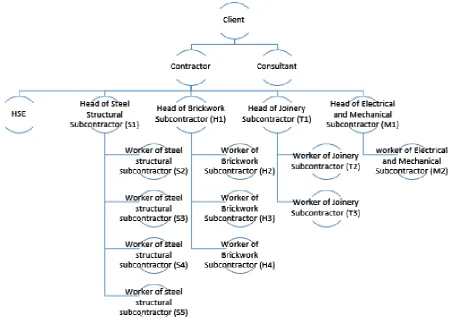
Step2: Actors Identification: By studying the organization breakdown structure of the company, different roles can be identified. Figure 3 demonstrates the organizational breakdown structure of the project. As shown in Figure 3, the project breakdown structure of the contractor has comprised several roles such as HSE, steel structural subcontractor, brickwork subcontractor, joinery subcontractor and electrical
and mechanical subcontractor. Therefore, the nodes of the network were adapted to the contractor’s parties.
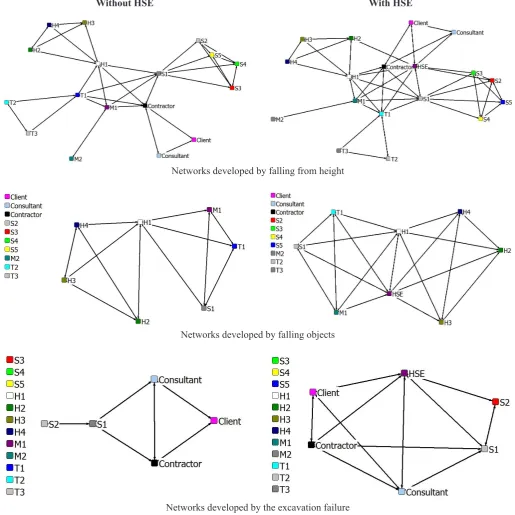
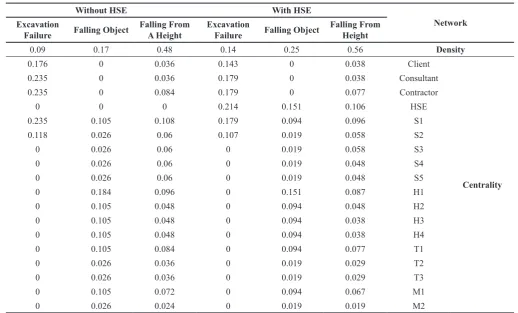
Three most common accidents in Iranian construction industry, falling from a height, falling objects and excavation failure (Organization, 2014-2015), were selected to develop three networks. The authors studied the case with and without considering HSE in the project. A questionnaire is distributed among the statistical society and the network is built accordingly. As described in step 3, the statistical society includes all of the actors. In the case of this paper, actors are the jobs demonstrated in Figure 3. It should be noted again that the sampling is not a good idea and the questionnaire should be distributed among all actors. The density and centrality of each network would be measured. The following figure depicts the results.
Step3: Data gathering: Since three accidents, including falling from a height, falling objects and excavation failure
were considered in the case study, one network should be developed for every accident. For each accident, three questions were put to the actors identified in step 2. Table 1 depicts these questions:
Step4: Network analysis: Since the effects of presence or absence of one actor on the network analysis were investigated, the number of networks is increased to two for each accident. As a consequence, Figure 4 demonstrates six networks, including two networks for every accident with or without HSE. The alphabets used in Figure 4 is based on those in Figure 3. Nodes are the representative of project’s actors and the links depict the relationships between actors. For example, the network developed for falling from height has been constituted from several nodes which are the jobs worked on the height and some arrows between nodes. The arrows depict the relations between jobs worked on the height and their relations were discovered by analyzing the
Fig. 3. The organization breakdown structure of project
Accident Questions
Falling from height • • Do you work at the height?With whom do you work in the height?
• From whom do you receive information about working in the height?
Falling objects • • Do you work in the place that objects can be fallen?With whom do you work in a place that objects can be fallen?
• From whom do you receive information about working in the place that objects can be fallen?
Excavation Failure • • Do you work in the excavated area?With whom do you work in the excavated area?
distributed questionnaire.
After developing the networks, they were analyzed based on the concept of the SNA. The networks depicted in Figure 4 were modeled in a software named UCINET (Pryke, 2012) to calculate the parameters of the SNA. The results of the SNA have been tabulated in Table 2.
Step 5: Proposing safety level control: As shown in Table 2, the density of networks in three accidents is not higher than 0.5, thus it can be concluded that the safety level control can be set in a medium range. Education strategies or implementing some engineering controls will be enough as a safety control in the project. In the case of this paper, the density of the network in falling from height is higher
than others. It means that applying the contract terms as a general strategy is a useful approach while in the network developed based on excavation failures which have the lowest density tells analyzers that the roles related to the excavation activities for example client, contractor, consultant, HSE, S1 and S2 should be paid more attention and specifically more technical training should be given.
Step 6: Strategy for High Centrality Actors: Regarding the centrality index, it can be specified who is the most effective actor to be engaged in the HSE plan. It is obvious that the higher the centrality index, the more effective the actors. As an instance, in the falling from the height network when the HSE is available, HSE, S1 and H1 have the highest
Fig. 4. Figure 4. a) Networks developed by falling from height, b) Networks developed by falling objects, c) Networks developed by the excavation failure
Networks developed by falling from height
Networks developed by falling objects
Networks developed by the excavation failure
centrality, respectively. It means that the concentration of safety team should be given to them. Some strategies such as setting high qualification criteria in the recruitment process, precise monitoring during the execution phase, etc. should be considered. When the HSE is unavailable, S1, H1, contractor and T1 have the highest centrality index. These are the roles that analyzer should manage carefully. As a suggestion, the actions below can be applied to them:
• Hiring persons with the good safety background • Hiring persons having an official training in the field of
safety
• Involving these persons in different safety courses • Designing a safety reward system for these individuals
and giving them some responsibilities
According to this analysis, other networks can be interpreted.
6- Discussion and Validation
This paper has applied two parameters of the SNA, including density, to discover which accident is more crucial than others in each studied project and centrality, to find the most influential persons in each accident.
The results of framework implementation in a case study revealed that determining the most effective persons with respect to the safety is highly dependent on the types of actors, their relationships and the type of accident. The proposed framework applied the density of the network to show what the most important accident is in each case study. This finding is dependent on the relationships among actors in the network of the project. For example, falling from the height is the accident with the highest density between three accidents mentioned in the case study thus it can be concluded that the importance of falling from height is more than others
and project’s officials should pay more attention to manage activities carried out in the height. It seems that the output of proposed framework adopts the reality and the previous statistics since several activities will be done in the height. It is obvious when the concept of the project is changed, the priority of accidents will be altered. Suppose that the studied project is excavating the tunnel. In this situation, the probability of increasing the density of network developed based on falling from a height in comparison with excavation failure is considerably low. The most important point that should be noticed is that the projects’ networks are developed based on the relationships and communications among actors and the effects of other parameters were not considered. The other issue that this paper has taken into account is the role of actors in the SNA. The centrality index is a parameter used to identify the role of each actor in the project by considering the studied accident. Regarding the actors, by adding or removing one individual in the project’s network, the shape of the network will be changed and as a consequence, the SNA outputs will be changed, as well. For instance, in the case of this paper, with or without the HSE, the shape of the network is different (see Figure 4). A change in the shape of network causes an alteration in the centrality of each actor and as a consequence, the most effective persons will be changed. Moreover, the concept of SNA emphasizes not only the number of actors is important in network analysis but also the relationships between the actors in projects is effective on the results, as well. The relationships among actors are different because the project organization breakdown structure can be different for each project. Preparing the networks of the paper’s case is based on the investigation in the organization breakdown structure of the studied project.
Without HSE With HSE
Network Excavation
Failure Falling Object Falling From A Height Excavation Failure Falling Object Falling From Height
0.09 0.17 0.48 0.14 0.25 0.56 Density
0.176 0 0.036 0.143 0 0.038 Client
Centrality
0.235 0 0.036 0.179 0 0.038 Consultant
0.235 0 0.084 0.179 0 0.077 Contractor
0 0 0 0.214 0.151 0.106 HSE
0.235 0.105 0.108 0.179 0.094 0.096 S1
0.118 0.026 0.06 0.107 0.019 0.058 S2
0 0.026 0.06 0 0.019 0.058 S3
0 0.026 0.06 0 0.019 0.048 S4
0 0.026 0.06 0 0.019 0.048 S5
0 0.184 0.096 0 0.151 0.087 H1
0 0.105 0.048 0 0.094 0.048 H2
0 0.105 0.048 0 0.094 0.038 H3
0 0.105 0.048 0 0.094 0.038 H4
0 0.105 0.084 0 0.094 0.077 T1
0 0.026 0.036 0 0.019 0.029 T2
0 0.026 0.036 0 0.019 0.029 T3
0 0.105 0.072 0 0.094 0.067 M1
0 0.026 0.024 0 0.019 0.019 M2
If the analyzer intends to bring the precise conclusions, he/ she should discover the project communication plan in an appropriate way. In other words, it can be concluded that the results of implementing the proposed framework in projects will not be the same as each other since the types and the relationships of actors are different. In the case of this paper, by adding or removing HSE actor to the network, the most influential persons changed.
Validation process checks whether the model represents the real situation correctly (Sargent, 2005). There are three approaches for validating the model, including expert intuition, real system measurements and theoretical results/ analysis. The expert intuition is used when there is no similar example for the model. Since the idea of this paper is new, the authors applied expert judgments to validate the proposed model. To do this, nine experts were selected. They are members and responsible for some parts of a company in which the case of paper was developed. Their average experience is about 12 years. Five questions were put to the experts as follows:
• Is the general concept of the model logical?
• Does the model cover the required safety considerations? • Is the model applicable to different construction
companies?
• How much do you trust the output of the model?
• Do you support the implementation of the paper’s framework in your company?
After holding some meetings with experts and describing the proposed framework, their answers were collected. The experts presented their ideas about the questions based on an ordinal scale from 1 (the lowest score) to 5 (the highest score). Table 3 presents the final results.
Results show that the validation of the proposed model is acceptable by the expert intuition.
7- Conclusions
There is no doubt that the safety issue is one of the most challengeable subjects in the construction industry. Annually the considerable amount of money is, directly and indirectly, spent for the cost of accidents in construction projects. A large number of investigators have oriented their studies to the safety issues in the construction industry. This paper investigates safety issue as well but uses a new approach. The main focus of this paper was on human errors, which is one of the most important reasons for accidents in the construction projects. Regarding the nature of human behavior, the social network, which is an innovative tool was applied to analyze the behaviors in the network of a project. The project safety level would be improved by managing the human resource in an appropriate way hence the SNA as a practical tool for recognizing the individuals’ behavior can be considered to develop an efficient plan for the safety improvement. The framework proposed by the authors has been comprised of six
steps, including, strategy establishment, actors’ identification, data gathering, network analysis, proposing safety level control and the strategy for high centrality actors. Different networks based on the various reasons for the accidents can be designed. This paper used three criteria, including falling from a height, falling objects and excavation failure, which are the common accidents in construction projects in Iran. After designing the networks based on the data gathered from the site, the analyzing was done and subsequently, the density and the centrality of networks were calculated. According to the results, falling from height criterion can be improved by preparing the safety plan according to the contract terms. Other criteria such as excavation failure need specific considerations such as education or engineering control for the improvement. Also, the centrality index showed that which of the roles should be paid more attention. The main benefit of this paper in comparison with other research is to increase the project’s safety level by improving the roles’ behavior in the project. Applying the concept of SNA as a new tool in the step by step framework for analyzing the roles’ behavior is another benefit of this paper. Regarding the familiarity of authors with the different aspects of this subject, it is recommended that other investigations can be developed in proposing a model for combining the results of all of the networks as a single solution.
References
[1] M. Yang, F. Khan, L. Lye, P. Amyotte, Risk assessment of rare events, Process Safety and Environmental Protection, 98 (2015) 102-108.
[2] P.X. Zou, R.Y. Sunindijo, Strategic safety management in construction and engineering, John Wiley & Sons, 2015. [3] U.S.D.o. labor, Census of Fatal Occupational Injuries
Summary, 2014.
[4] S.S. Organization, Reports of Occupational Accident, Iran, 2014-2015.
[5] M.R. Hallowell, Safety-knowledge management in American construction organizations, Journal of Management in Engineering, 28(2) (2011).
[6] H. Heinrich, Industrial Accident prevention McGraw Hilt Book Company, New York, (1931).
[7] J. Lewandowski, Work safety management in company, Lodz: Lodz Polytechnic Publishers, (2000).
[8] P.L. Spath, Error reduction in health care: A systems approach to improving patient safety, John Wiley & Sons, 2011.
[9] L. Runkiewicz, On construction failures and disasters in Poland in years 1962–2004, Engineering and Building
(Inżynieria i Budownictwo), 4 (2006) 193-195.
[10] S. Ung, V. Williams, H. Chen, S. Bonsall, J. Wang,
No Question Average Standard-Deviation
1 Is the general concept of the model logical? 4.4 1.2
2 Does the model cover the required safety considerations? 4.2 0.86
3 Is the model applicable to different construction companies? 3.8 0.61
4 How much do you trust the output of the model? 4.1 1.5
Human error assessment and management in port operations using fuzzy AHP, Marine Technology Society Journal, 40(1) (2006) 73-86.
[11] H. Chen, H. Qi, R. Long, M. Zhang, Research on 10-year tendency of China coal mine accidents and the characteristics of human factors, Safety science, 50(4) (2012) 745-750.
[12] J. Reason, Human error: models and management, BMJ: British Medical Journal, 320(7237) (2000) 768.
[13] X. Zheng, Y. Le, A.P. Chan, Y. Hu, Y. Li, Review of the application of social network analysis (SNA) in construction project management research, International Journal of Project Management, 34(7) (2016) 1214-1225.
[14] S. Wasserman, K. Faust, Social network analysis: Methods and applications, Cambridge university press, 1994.
[15] W. De Nooy, A. Mrvar, V. Batagelj, M. Granovetter,
Exploratory Social Network Analysis with Pajek
Cambridge University Press, Cambridge (p 334), (2005). [16] B.W. Wambeke, M. Liu, S.M. Hsiang, Using Pajek
and centrality analysis to identify a social network of construction trades, Journal of construction engineering and management, 138(10) (2011) 1192-1201.
[17] J.R. Turner, R. Müller, On the nature of the project as a temporary organization, International journal of project management, 21(1) (2003) 1-8.
[18] A.L. Stinchcombe, Bureaucratic and craft administration of production: A comparative study, Administrative science quarterly, (1959) 168-187.
[19] W.R. Scott, Rational, natural, and open systems, in, NJ: Prentice Hall, Englewood Cliff, 1981.
[20] P. Chinowsky, J.E. Taylor, M. Di Marco, Project network interdependency alignment: New approach to assessing project effectiveness, Journal of Management in Engineering, 27(3) (2010) 170-178.
[21] S. Pryke, Social network analysis in construction, John Wiley & Sons, 2012.
[22] S.-C. Lin, An analysis for construction engineering networks, Journal of Construction Engineering and Management, 141(5) (2014) 04014096.
[23] H. Park, S.H. Han, E.M. Rojas, J. Son, W. Jung, Social network analysis of collaborative ventures for overseas construction projects, Journal of construction
engineering and management, 137(5) (2010) 344-355. [24] S.A. Abbasian-Hosseini, S.M. Hsiang, M.L. Leming, M.
Liu, From social network to data envelopment analysis: Identifying benchmarks at the site management level, Journal of Construction Engineering and Management, 140(8) (2014) 04014028.
[25] D.-P. Shin, H.-S. Gwak, D.-E. Lee, Modeling the predictors of safety behavior in construction workers,
International journal of occupational safety and ergonomics, 21(3) (2015) 298-311.
[26] M.M. Zaira, B.H. Hadikusumo, Structural equation model of integrated safety intervention practices affecting the safety behaviour of workers in the construction industry, Safety science, 98 (2017) 124-135.
[27] C. Wu, N. Li, D. Fang, Leadership improvement and its impact on workplace safety in construction projects: A conceptual model and action research, International Journal of Project Management, 35(8) (2017) 1495-1511.
[28] L.W. Saunders, B.M. Kleiner, A.P. McCoy, K.P. Ellis, T. Smith-Jackson, C. Wernz, Developing an inter-organizational safety climate instrument for the construction industry, Safety Science, 98 (2017) 17-24. [29] R.M. Choudhry, Achieving safety and productivity in
construction projects, Journal of Civil Engineering and Management, 23(2) (2017) 311-318.
[30] E. Otte, R. Rousseau, Social network analysis: a powerful strategy, also for the information sciences,
Journal of information Science, 28(6) (2002) 441-453. [31] J. Moreno, L., 1934, Who Shall Survive, Foundations
of Sociometry, Group Psychotherapy and Sociodrama. Nervous and Mental Disease Publishing Company, Washington, DC, (1934).
[32] K. Lewin, Psychoanalysis and topological psychology,
Bulletin of the Menninger Clinic, 1(6) (1937) 202. [33] M. Kilduff, W. Tsai, Social networks and organizations,
Sage, 2003.
[34] B. Dao, S. Kermanshachi, J. Shane, S. Anderson, E. Hare, Identifying and measuring project complexity,
Procedia Engineering, 145 (2016) 476-482.
[35] R.G. Sargent, Verification and validation of simulation models, in: Proceedings of the 37th conference on Winter simulation, winter simulation conference, 2005, pp. 130-143.
Pleasecitethisarticleusing:
H. Abbasianjahromi, M. Sepehri, A. Etemadi, A Framework for Project Safety Management by Applying Social Network Analysis, AUT J. Civil Eng., 1(2) (2017) 111-120.