Online Publication Date: 1st July 2013 Online Issue: Volume 2, Number 3, July 2013
http://www.centreofexcellence.net/J/JSS/JSS Mainpage.htm
L
2Learners’ Performance in Three Language Skills:
Focus on Sex-Related Differences
Hosni Mostafa El-dali, Ph.D.
Abstract
It is a generally accepted fact in L1 acquisition that females enjoy a rate advantage, initially at least. However, I know of no study that has systematically investigated the rate of second language acquisition (SLA) in females versus males. It might be safe to cite few SLA studies: Farhady, 1982; Eisenstein, 1982; Lakoff, 1973; Zimmerman and West, 1975; and Gass and Varonis, 1986. Although these studies reported sex-related differences, they were incidental to their main focus.
The subjects for the present study are 180 students in the Department of English, Faculty of Arts, Minufiya University, Egypt. They are divided into three groups according to their academic status in their university: Beginners (60); Intermediate (60); and advanced (60). Each group is equally divided into males (30), and females (30). Accordingly, the total number of males is 90, and that of females is 90, as well. All subjects performed three tasks: 1) listening; 2) reading, and 3) structure and written expressions, similar, to those used in the TOEFL test. The overall umbrella, under which all these tasks are designed, is ‘systematicity’; and/or ‘variability’; and whether learners' sex is responsible for it. Results are obtained and conclusions are made.
Keywords: Variability; L2 learners’ proficiency, sex.
115 1. Introduction
Although I know of no study that has systematically investigated the rate of second language acquisition (SLA) in females versus males, it is a generally accepted fact in first language (L1) acquisition that females enjoy a rate advantage, initially at least. It is possible, however, to cite a few SLA studies that have reported sex-related differences incidental to their main focus. For example, Farhady (1982) found that female subjects significantly outperformed male subjects on a listening comprehension test in his study of 800 university students who were obliged to take a placement test. Eisenstein (1982) also showed that females performed significantly better than males on a dialect discrimination task and in the extent to which they could recognize dialects of greater or lesser prestige. (See Anne Brooks, 2009; Basturkment et al., 2004; Beare & Bourdages, 2007).
In addition to differences in proficiency or dialect discrimination, other sex-linked differences which might affect SLA have been noted. Lakoff (1973) suggests the existence of a ‘woman's language’, which is replete with hedging devices such as question tags. It has also been noted that males tend to interrupt more than females (Zimmerman and West 1975, cited in Gass and Varcinis 1986).
In one SLA study which did not investigate rate of acquisition differences between the sexes but did study the conversational behaviour of male and female second language learners, Gass and Varonis (1986) found that men dominated the conversations. The researchers concluded, therefore, that men received more speaking practice in such interactions; however, since women initiated more meaning negotiations than men, women may have benefited from receiving more comprehensible input (Freeman and Long, 1991; Brantmeier, 2004, 2003; Trenkic; Kissau, 2007).
The present study is a modest attempt to examine the variations in the proficiency of adult learners (male and females) of English. The overall umbrella, under which this study is designed, is "systematicity or variability" in adult L2 learners' performance, and to what extent their sex is responsible for it (See Brown, 2009; Cohen, 2008; Conley, 2008; De Bot et al., 2007).
2. Rationale
First, it is well known that some people learn a second language more easily than others. Relatedly, L2 acquisition is not a simple process; rather, it is quite complex and many factors are involved. Therefore, it is not easy to decide which factor is actually superior to another (See De Keyser, 2003; Echevarria et al., 2004; Ellis, N., 2002, 2005).
might include (1) the linguistic environment; (2) sociolinguistic factors; (3) the type of speech event; (4) the developmental stage of the learner; and (5) factors associated with the data collection procedures. In this regard, Freeman and Long (1991: 152) also maintain that “there is, however, a host of other factors which have been proffered to explain differential success among SL learners, to explain why some acquire a SL with facility while others struggle and only meet with limited success. These factors are native language variable; input variable, and the individual differences that exist among second language learners” (See Ellis, R., 2006; Eskildsen, 2008; Eslamim & Fatahi, 2008; Hoey, 2007; Jiang, 2007; Kimberley, 2009).
Ellis (1990: 387) writes of the variability among second language learners as follows: The essence of a variabilist account of SLA is that the competence of the learner is much more variable than that of the native speaker, for the simple reason that inter-language systems are more permeable to new forms than fully formed natural languages. Often a learner's knowledge is anomalous in the sense that she may not be sure whether form X or Y is required in a given linguistic context. As a result she will sometimes use one and sometimes the other.... (a learner's competence) is inevitably variable because acquisition involves change, and change can only occur when new forms are added to the existing system, resulting in a stage where two (or more) forms are used for the same function”. Relatedly, the problem is how to describe the speaker's knowledge, particularly if the speaker is a SL learner. The variationists may simply be ‘collecting facts’, without a theory to explain them (Brown, 1996). It is widely agreed that second language learners manifest variable control in performance. That is, whereas, on one occasion, they may produce a correct structure, on another occasion, where the same structure, would be appropriate, they produce a deviant structure. In this regard, Tarone (1985) maintains that 'the systematic variability which is exhibited in the learner's performance on a variety of elicitation tasks actually reflects his/her growing capability in IL, and is not just a performance phenomenon'. (p. 35) Tarone, then, is claiming that variability is an inherent feature of the representation of language knowledge among second language learners (Knutson, 2006; Larsen Freeman & Cameron, 2007; Lightbown & Spada, 2006; Mangubhai, 2006).
3. Review of Literature
Cameron (1995) made a distinction between three models of language and gender: (1) the deficit model, (2) the dominance model, and (3) the cultural difference model. In the deficit model, females are seen as disadvantaged speakers and communicators. Accordingly, the speech of men is considered as the accepted norm, while the women's speech is to be perceived as deficient (Aslan, 2009, p. 9). Along the same line, Swan (1989) found that "in contrast to the stereotype of the over-talkative women... it is men who dominate the talk...men have been found to use more interruptions...and simply to talk more than women" (cited in Gascoigne, 2002, p. 83). Along the same line, as reported by Holmes (1995), men use interaction as a means of gaining and exchanging information, whereas women use it as a way to connect to others (cited in Gascoigne, 2002, p. 83). Furthermore, studies of Ll classroom interaction have long shown that boys tend to dominate classroom interaction and that educators, at times, reinforce this type of behavior by giving additional time and attention to males (Gascoingne, 2002, p. 83). According to Holms (1995, cited in Gascoigne, 2002), it is "females who lost out. Their polite ways of participating in classroom talk means they are disadvantaged in mixed-sex classrooms" (p. 203).
The dominance model is, as Aslan (2009) asserts, rather radical in comparison with the deficit model which is more conservative. Along the same line, Block (2002) argues, "In this model women are perceived to perform their 'woman-ness' in an ethnomethodological frame as they continually negotiate their position of relative powerlessness vis a vis men" (p.53).
117
cultures which predate the development of individuals who are socialized into them (Block, 2002). Unlike deficit model, it does not take the differences negatively (Aslan, 2009). As Block (2002) reports cultural difference model adopts a socially liberal position that men and women are different but equal: women's speech and communication styles are not inferior to men's; rather the relationship between the two are problematic at least in part because of culture clash (Block, 2002). Overall, if communication breaks down between men and women, it's caused by misinterpreting the other party's form of interaction (Tannen, 1993, cited in Aslan, 2009, p. 12).
In second language acquisition, the concept of gender is variously interpreted. To Ellis (1994), there was nothing conclusive in studies of gender differences in SLA in achievement, attitudes and strategy use at that time. Accordingly, Ellis (1994) holds: “Sex is, of course, likely to interact with other variables in determining L2 proficiency. It will not always be the case, therefore, that females outperform males. Asian men in Britain generally attain higher levels of proficiency in L2 English than do Asian women for the simple reason that their jobs bring them into contact with the majority English speaking group, while women are often "enclosed" in the home. Sex interacts with such factors as age, ethnicity, and, in particular social class (p. 204).
However, in a study reported by Aslan (2009), it was reported gender influences strategy choice. Along the same vein, females and males are observed to employ various strategies in language acquisition. In a similar study, Ehrman and Oxford (1990) who looked at the strategies used by 1200 university students came to this conclusion that gender differences made a profound influence. Also, Gascoigne (2002), in a study on "the Role of Gender in L2 Interaction: Socialization via L2 Materials" brings that males tend to use linguistic devices such as interruptions, directives, and sentence-initial conjunctions. Females, in contrast, tend to rely more heavily upon questions, justifiers, intensive adverbs, personal pronouns and word-initial adverbs (Gascoigne, 2002, p. 83). Kimura (2006, cited in Piasecka, 2010, pp. 146-149) thoroughly discusses the differences between females and males in terms of various abilities: With respect to motor abilities, Kimura (2006), concluded men do better at such tasks as throwing things at a target (e.g. a game of darts) or catching objects (e.g. ball games), whereas women have an advantage at the so-called subtle motor activities (e.g. performing movement sequences using fingers, like in weaving, knitting or sewing). In much the same way, females are better at calculations and tests which refer to the material that was learned at school. In terms of verbal abilities, girls usually start speaking earlier than boys; they use longer sentences. Their articulation and grammar are more correct. Consequently, they have a richer vocabulary. Moreover, they are better at spelling, reading and tests in which they have to generate words according to a certain rule (e.g. words that start with a certain letter).
While the research shows that the topic of the text was an important factor in the reading performance; for example, female students did better on female topics, gender differences have also been identified in attitudes to reading. Furthermore, girls have more positive attitudes to reading and higher reading achievement than boys. It appeared that students who had more positive reading attitudes and whose self-concepts were higher were more successful on reading tasks.
Kaushaskaya et al. (2011), also, continue the mechanism responsible for the female advantage when learning phonologically-familiar novel words therefore appears to be greatly flexible and dynamic in nature, and is likely based on the active recruitment of descriptive structures (long-term memory) during the encoding of verbal information (See Shakouri and Saligheh, 2012; Ehrlich, 1997).
4. The Present Study 4.1. The Purpose
This research reports on the results of an experiment, carried out by the author, on speakers of English as a foreign language. The purpose of this experiment is to examine the performance of 90 male-university students and 90 female-university students in three language skills: listening comprehension skill; structure and written expressions, and reading comprehension skills. The overall umbrella, under which the experiment is designed, is 'systematicity', and/or 'variability', and whether learners' gender is responsible for it. In other words, the present study is mainly concerned with clarifying and providing an evidence for the variation in L2 learners' performance; that is, it shows how their performance is not unitary or systematic. This objective can be expressed in the following questions:
1. To what extent is L2 learners' performance varied from one language skill to another? In other words, do students who perform in a certain way in one skill perform the same way in another? Relatedly, how does their varied or systematic performance in various language skills relate to the underlying representation of their knowledge?, and what does it tell about the nature of each of these skills?
2. To what extent is this variation or systematicity in L2 learners' performance in various language skills related to their progress in language learning or academic status? In other words, is the variation in performance associated with beginning students only?; whereas advanced students' performance is totally systematic, and what is the direction of this variation or systematicity?
3. To what extent does male-students' performance in various language skills vary from that of female-students, within and among groups?
Finding answers to these questions may help us understand the phenomenon of variation or systematicity of L2 learners’ performance, and the factors that determine their performance in various language skills.
4.2. Methodology
The subjects of this study are 180 undergraduate university students. They are students of English as a foreign language in the faculty of Arts, Department of English, Minufiya University, Egypt. They were equally divided into three levels: 1) Beginners; 2) Intermediate, and 3) Advanced. Each level (N=60 students) was, in turn, equally divided into two sub-groups; males (N=30), and females (N=30). This means that the present study is conducted on 90 male students, and 90 female students, distributed on three different levels.
The subjects were assigned to their level according to their academic status in their university. That is, first-and second-year students were considered `beginners'; third-year students ‘intermediate’, and fourth-year students 'advanced'. The subjects were chosen randomly; and their participation in the present study was mainly due to their belief that this was a glearning experience for them.
119 1. TOEFL Listening Comprehension (LC)
TOEFL is a four-choice norm-referenced test of English proficiency consisting of three subjects: 1) listening comprehension; 2) structure and written expression, and 3) reading comprehension.
The (LC) subtest consists of audiotaped texts followed by questions. Specifically, it is made of 58 items; distributed in three parts: part one contains 20 short statements; part two contains 30 short conversations, and part three contains longer conversations followed by 8 questions.
2. TOEFL Structure and Written Expressions (SWE)
This subtest consists of 40 individual items; distributed on o sections; the first section is made of 15 incomplete sentences, and the second one is made of 25 sentences in which each sentence has four underlined words or phrases. Subjects had to identify the one underlined word or phrase that must be changed in order for the sentence to be correct.
3. TOEFL Reading Comprehension (RC)
The reading comprehension subtest consists of several reading texts, each followed by several items. Specifically, it is made of five reading passages (varied in length and difficulty), followed by 50 items.
4.3. Procedures / Analysis
The subjects in each group were met three times. This means that I had nine meetings with all the subjects, since I have three groups of students participated in the study. These meetings were distributed as follows:
Meeting 1: Beginners (males and females) were met in the language laboratory to perform on the listening comprehension subtest.
Meeting 2: Intermediate (males and females) were met to do the same as above. Meeting 3: Advanced (males and females) were met to do the same as above.
It must be mentioned that the above three meetings were conducted one after the other and on the same day.
Meeting 4: (two days later) Beginners (males and females) were met to perform or the 'structure and written expression' subtest.
Meeting 5: (the same day immediately after meeting 4) intermediate (male and female) did the same as above.
Meeting 6. (the same day immediately after meeting 5) Advanced (male and female) did the same as above.
5. Results / Discussion
Next, the results of the statistical analyses of students' performance in the three language skills will be provided.
1. Subjects’ Performance in the Listening Comprehension (LC) Subtest
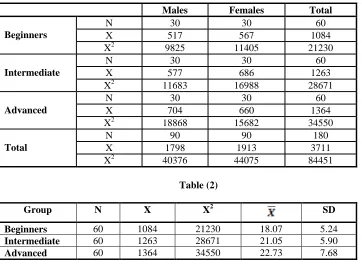
Table (1)
Descriptive statics of all subjects’ performance in the listening comprehension subtest.
Males Females Total
N 30 30 60
X 517 567 1084
Beginners
X2 9825 11405 21230
N 30 30 60
X 577 686 1263
Intermediate
X2 11683 16988 28671
N 30 30 60
X 704 660 1364
Advanced
X2 18868 15682 34550
N 90 90 180
X 1798 1913 3711
Total
X2 40376 44075 84451
Table (2)
Group N X X2 SD
Beginners 60 1084 21230 18.07 5.24
Intermediate 60 1263 28671 21.05 5.90
Advanced 60 1364 34550 22.73 7.68
The above tables show that "Beginners" scored a total of 1084 marks in the listening comprehension skill, with a mean of 18.07 and standard deviation of 5.24; whereas the Intermediate subjects scored a total of 1263, with a mean of 21.05 and standard deviation of 5.90. The Advanced subjects scored a total of 1364 with a mean of 22.73 and standard deviation of 7.68.
121 Table (3)
N X X2 SD
Males 30 517 9825 17.23 5.52
Beginners
Females 30 567 11405 18.90 4.79
Males 30 577 11683 19.23 4.42
Intermediate
Females 30 686 16988 22.87 6.59
Males 30 704 18868 23.47 8.85
Advanced
Females 30 660 15682 22.00 6.22
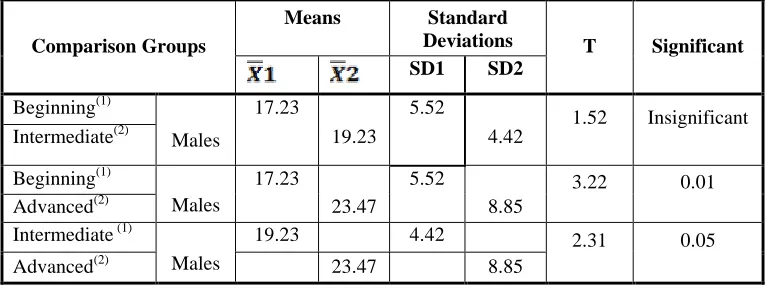
The above table shows that there is a clear variation in the performance of the subjects in the (LC) subtest within and among groups. The females in the Beginning and Intermediate groups scored better than the males in both groups. However, the males in the Advanced group scored better than the females. Moreover, comparing the performance of all males in the three groups shows that there is a systematic progress in learners, performance; that is, Advanced males performed better than the Intermediate males in the three groups shows that there is a systematic progress in learners’ performance; that is, Advanced males performed better than the Intermediate males who, in turn, performed better than the Beginning males. This is not the case, however, if we compare the performance of all females in the three groups. The females in the Advanced group didn't achieve the highest score, as the males did. The females in the Intermediate group did better than those in the Beginning and Advanced groups. The following Tables will clearly illustrate this observation.
Table (4)
Means Standard Deviations Comparison Groups
SD1 SD2
T Significant
Beginning(1) 17.23 5.52
Intermediate(2) Males 19.23 4.42
1.52 Insignificant
Beginning(1) 17.23 5.52
Advanced(2) Males 23.47 8.85
3.22 0.01
Intermediate (1) 19.23 4.42
Advanced(2) Males 23.47 8.85
2.31 0.05
N1 = N2 = 30
T = 2.00 Significant at the level of 0.05 T = 2.66 Significant at the level of 0.01
Table (5)
Means Standard Deviations Comparison Groups
SD1 SD2
T Significant
Beginning(1) 18.90 4.79
Intermediate(2) Females 22.87 6.59
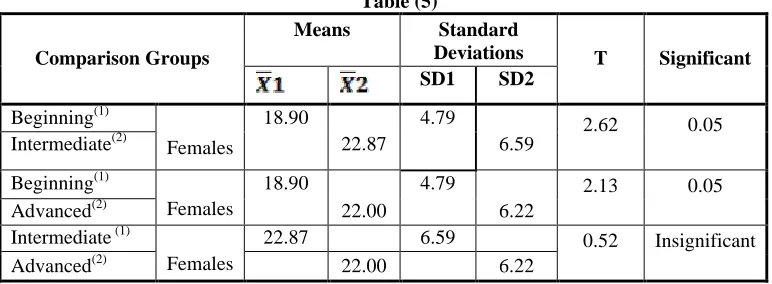
2.62 0.05
Beginning(1) 18.90 4.79
Advanced(2) Females 22.00 6.22
2.13 0.05
Intermediate (1) 22.87 6.59
Advanced(2) Females 22.00 6.22
0.52 Insignificant
The above table shows that there are significant statistical differences between the scores of the females in the Beginning and Intermediate groups at 0.05 in favor of the Intermediate group. The T value that signifies these differences is 2.62, which is statistically significant at the level 0.05. Similarly, there are, naturally, significant statistical differences between the scores of the females in the Beginning and Advanced groups at 0.05 in favor of the Advanced group. Moreover, there are not significant statistical differences between the scores of the females in both the Intermediate and Advanced groups. The T value is 0.52, which is not statistically significant.
Table (6)
Means and standard deviation of the subjects’ scores (Males and Females) in the (LC) subtest
Means Standard Deviations Comparison
Groups
SD1 SD2
T Significant
Beginning(1) 18.07 5.24
Intermediate(2) 21.05 5.90
** 2.90
0.01
Beginning(1) 18.07 5.24
Advanced(2) 22.00 6.22
** 3.85
0.01
Intermediate (1) 21.05 5.90
Advanced(2) 22.73 7.68
1.33 Insignificant
N1 = N2 = 60
2.62 Significant at 0.01 1.98 Significant at 0.05
123 Table (7)
Analysis of variance (2x3) in the subjects’ scores in Listening Comprehension: Gender x Language Level
Source of Variance Squares Degrees of Freedom
Variance F Sign.
Total 7942.55 119
Between Groups 942.18 5
Within Groups 7000.37 174 40.23
Gender 73.47 1 73.47 1.83 Insign.
Language Level 670.23 2 335.12 8.33 0.01
Interaction 198.48 2 99.24 2.47 Insign.
(1.174) 6.81 Significant at 0.01 3.91 Significant at 0.05 (2.174) 4.75 Significant at 0.01 3.06 Significant at 0.05
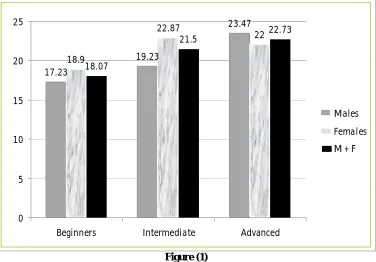
The above table shows that the subjects' gender (being male or female) had no significant effect on their performance in the Listening Comprehension subtest. On the contrary, being Beginner, Intermediate or Advanced learners had significant effect on their performance; an observation which sheds light on the nature of L y learners' interlangua. The F value that signifies this effect is 8.33, which is statistically significant at the level 0.01. The above table also shows that there is no significant statistical interaction between the subjects' gender and language education level (Beginner, Intermediate, and Advanced). The F value for the interaction between them is 2.47, which is not statistically significant. The following figure may illustrate this case.
17.23
19.23
23.47
18.9
22.87
22
18.07
21.5 22.73
0 5 10 15 20 25
Beginners Intermediate Advanced
Males Females M + F
2. Subjects’ Performance in the Structure and Written Expressions (SWE)
The following table presents a descriptive statistical analysis of all subjects (males and females) in the structure and written expressions subtest.
Table (8)
Descriptive statics of all subjects’ performance in the Structure and Written Expressions (SWE)
Males Females Total
N 30 30 60
X 620 679 1299
Beginners
X2 13458 15927 29385
N 30 30 60
X 791 793 1584
Intermediate
X2 22019 21791 43810
N 30 30 60
X 934 906 1840
Advanced
X2 29974 27840 57814
N 90 90 180
X 2345 2378 4723
Total
X2 65451 65558 131009
Table (9)
Group N X X2 SD
Beginners 60 1299 29385 21.65 4.59
Intermediate 60 1584 43810 26.40 5.76
Advanced 60 1840 57814 30.67 4.81
The above tables show that the beginning subjects scored a total of 1299 in the (SWE) subtest, with a mean of 21.65 and standard deviation of 4.59; whereas the Intermediate subjects scored a total of 1584, with a mean of 26.40 and standard deviation of 5.76. The Advanced subjects scored a total of 1840, with a mean of 30.67 and standard deviation of 4.81.
To get a more accurate and explanatory picture of all subjects' performance in the (SWE) subtest, we need to check the performance of both males and females in the three groups with a view to determining where there is a variation within and among groups in the (SWE) subtest, or not.
Table (10)
N X X2 SD
Males 30 620 13458 20.67 4.64
Beginners
Females 30 679 15927 22.63 4.32
Males 30 791 22019 26.37 6.23
Intermediate
Females 30 793 21791 26.43 5.26
Males 30 934 29974 31.13 5.46
Advanced
Females 30 906 27840 30.20 4.00
125
Advanced group; that is, the males scored better than the females. This was the situation in the listening comprehension subtest.
Moreover, comparing the performance of all males in the three groups shows that there is a systematic progress in learners' performance; that is, Advanced males performed better than the Intermediate males who, in turn, performed better than the Beginning males. The same can be applied to the females in the three groups. It should be kept in mind that this was not the case in the (LC) subtest. The following table will illustrate this observation more clearly.
Table (11)
Means Standard Deviations Comparison Groups
SD1 SD2
T Significant
Beginning 20.67 4.64
Intermediate Males 26.37 6.23
3.95 0.01
Beginning 20.67 4.64
Advanced Males 31.13 5.46
7.86 0.01
Intermediate 26.37 6.23
Advanced Males 31.13 5.46
3.09 0.01
N = N2 = 30
2.66 Significant at 0.01 2.00 Significant at 0.05
The above table shows that there are significant statistical differences between the scores of the males in the Beginning and Intermediate groups at 0.01 in favor of the latter group. The T value that signifies these differences is 3.95. Similarly, there are significant statistical differences between the scores of the males in the Beginning and Advanced group in favor of the latter group, at 0.01. The T value that signifies these differences is 7.86. Moreover, there are significant statistical differences between the scores of the males in the Intermediate and Advanced groups at 0.01 in favor of the latter group, as well. The T value that signifies these differences is 3.09.
Table (12) Means Standard
Deviations Comparison Groups
SD1 SD2
T Significant
Beginning 22.63 4.32
Intermediate Females 26.43 5.26
3.01 Insignificant
Beginning 22.63 4.32
Advanced Females 30.20 3.99
6.93 0.01
Intermediate 26.43 5.26
Advanced Females 30.20 3.99
The above table shows that there are not significant statistical differences between the scores of the females in the Beginning and Intermediate groups. The T value is 3.01 which is not statistically significant. It also shows, however, that there are significant statistical differences between the scores of the females in the Beginning and Advanced group. The T value that signifies these differences is 6.93. Similarly, there are significant statistical differences between the scores of the females in the Intermediate and Advanced groups at 0.01 in favor of the Advanced group. The T value that signifies these differences is 3.08.
Table (13)
Means and standard deviation of the subjects’ scores (Males and Females) in the (SWE) subtest
Means Standard Deviations Comparison
Groups
SD1 SD2
T Significant
Beginning(1) 21.65 4.59
Intermediate(2) 26.49 5.76 4.95
0.01
Beginning(1) 21.65 4.59
Advanced(2) 30.67 4.81 10.42
0.01
Intermediate (1) 26.40 5.76
Advanced(2) 30.67 4.81
4.37 0.01
N1 = N2 = 60
2.62 Significant at 0.01 1.98 Significant at 0.05
The above table provides us with a conclusive summary of the performance of the subjects (Males and Females) in the three groups in the (SWE) subtest. There are significant statistical differences between the scores of the subjects in the Beginning and Intermediate groups in favor of the latter group, at the level of 0.01. The T value that signifies these differences is 4.95. Relatedly, there are significant statistical differences between the scores of the Beginning and Advanced groups in favor of the latter group, at the level of 0.01. The T value that signifies these differences is 10.42. Moreover, there are significant statistical differences between the scores of the subjects in the Intermediate and Advanced groups in favor of the latter group at the level of 0.01. The T value that signifies these differences is 4.37.
Table (14)
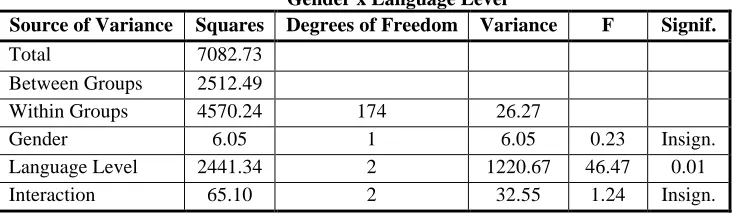
Analysis of variance (2x3) in the subjects’ scores in the (SWE) subtest: Gender x Language Level
Source of Variance Squares Degrees of Freedom Variance F Signif.
Total 7082.73
Between Groups 2512.49
Within Groups 4570.24 174 26.27
Gender 6.05 1 6.05 0.23 Insign.
Language Level 2441.34 2 1220.67 46.47 0.01
Interaction 65.10 2 32.55 1.24 Insign.
127
performance; an observation which sheds light on the nature of L2 learners' interlangua. The F value that signifies this effect is 46.47, which is statistically significant at the level 0.01.
The above table also shows that there is no significant statistical interaction between the subjects' gender and language education level. The F value for the interaction between them is 1.24, which is not statistically significant. The following figure may illustrate this case.
20.67
26.37
31.13
22.63
26.43
30.2
21.65
26.4
30.67
0 5 10 15 20 25 30 35
Beginners Intermediate Advanced
Males Females M + F
Figure (2)
3. Subjects’ Performance in the Reading Comprehension (RC) subtest
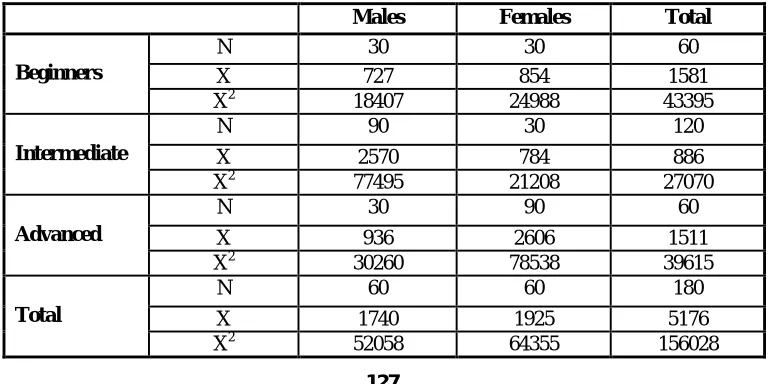
The following table presents a descriptive statistical analysis of all subjects (males and females) in the reading comprehension subtest.
Table (15)
Descriptive statics of all subjects’ performance in the Reading Comprehension (RC) subset
Males Females Total
N 30 30 60
X 727 854 1581
Beginners
X2 18407 24988 43395
N 90 30 120
X 2570 784 886
Intermediate
X2 77495 21208 27070
N 30 90 60
X 936 2606 1511
Advanced
X2 30260 78538 39615
N 60 60 180
X 1740 1925 5176
Total
Table (16)
Group N X X2 SD
Beginners 60 1511 39615 25.18 5.10
Intermediate 60 1740 52058 29.20 5.16
Advanced 60 1925 64355 32.8 6.56
The above tables show that the Beginning subjects scored a total of 1511 in the (RC) subtest, with a mean of 25.18 and standard deviation of 5.10; whereas the Intermediate subjects scored a total of 1740, with a mean of 29.00, and standard deviation of 5.16. The Advanced subjects scored a total of 1925, with a mean of 32.8 and standard deviation of 6.58.
To get a more accurate and explanatory picture of all subjects' performance in the (RC) subtest, we need to check the performance of both males and females in the three groups with a view to determining whether there is a variation within and among groups in the (RC) subset, or not.
Table (17)
N X X2 SD
Males 30 727 18407 24.23 5.13
Beginners
Females 30 784 21208 26.13 4.90
Males 30 854 24988 27.47 4.75
Intermediate
Females 30 886 27070 29.53 5.49
Males 30 989 34095 32.97 7.05
Advanced
Females 30 936 30260 31.20 5.94
The above table shows that there is a clear variation in the performance of the subjects in the (RC) subtest within and among groups. The females in both the beginning and Intermediate groups scored better than the males in both groups. This is not the case, however, in the Advanced group; that is, the males scored better than the females. This was the situation in the (LC) and (SWE). Moreover, comparing the performance of all males in the three groups shows that there is a systematic progress in learners' performance; that is, Advanced males performed better than the Intermediate males, who, in turn, performed better than the Beginning males. The same can be applied to the females in the three groups. It should be kept in mind that this was the case in the (SWE), but not in the (LC) subtest.
Table (18) Means Standard
Deviations Comparison Groups
SD1 SD2
T Significant
Beginning 24.23 5.13
Intermediate Males 28.47 4.75
3.27 0.01
Beginning 24.23 5.13
Advanced Males 32.97 7.05
5.40 0.01
Intermediate 28.47 4.75
Advanced Males 32.97 7.05
2.85 0.01
N1 = N2 = 30
129
The above table shows that there are significant statistical differences between the scores of the males in the Beginning and Intermediate groups at 0.01 in favor of the latter group. The T value that signifies these differences is 3.27. Similarly, there are significant statistical differences between the scores of the males in the Beginning and Advanced groups in favor of the latter group at the level of 0.01. The T value that signifies these differences is 5.40. Moreover, there are significant statistical differences between the scores of the males in the Intermediate and Advanced groups at 0.01 in favor of the latter group. The T value that signifies these differences is 2.85, which is statistically significant.
Table (19)
Means Standard Deviations Comparison Groups
SD1 SD2
T Significant
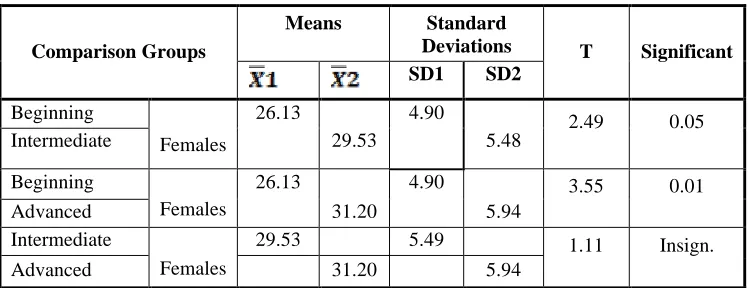
Beginning 26.13 4.90
Intermediate Females 29.53 5.48
2.49 0.05
Beginning 26.13 4.90
Advanced Females 31.20 5.94
3.55 0.01
Intermediate 29.53 5.49
Advanced Females 31.20 5.94
1.11 Insign.
The above table shows that there are significant statistical differences between the scores of the females in the Beginning and Intermediate groups at 0.05 in favor of the latter group. The T value that signifies these differences is 2.49. Similarly, there are significant statistical differences between the scores of the females in the Bea-inning and Advanced groups at 0.01 in favor of the latter group. The T value that signifies these differences is 3.55. However, there are not significant statistical differences between the scores of the females in the Intermediate and Advanced groups. The T value is 1.11 which is not statistically significant.
Table (20)
Means Standard Deviations Comparison Groups
SD1 SD2
T Signifi.
Beginning (males + females)(1) 25.18 5.10
Intermediate (males + females)(2) 29.00 5.16 4.04 0.01 Beginning (males + females)(1) 25.18 5.10
Advanced (males + females)(2) 32.08 6.58 6.37 0.01 Intermediate (males + females)(1) 29.00 5.16
Advanced (males + females)(2) 32.08 6.58 2.83 0.01
N1 = N2 = 30
2.62 Significant at 0.01 1.98 Significant at 0.05
group, at the level of 0.01. The T value that signifies these differences is 4.04. Relatedly, there are significant statistical differences between the scores of the Beginning and Advanced groups in favor of the latter group, at the level of 0.01. The T value that signifies these differences is 6.37. Moreover, there are significant statistical differences between the scores of the Intermediate and Advanced groups in favor of the latter group at the level of 0.01. The T value that signifies these differences is 2.83.
Table (21)
Analysis of variance (2x3) in the subjects’ scores in the (RC) subtest: Gender x Language Level
Source of Variance
Squares Degrees of Freedom
Variance F Signif.
Total 7189.24 179
Between Groups 1551.71 5
Within Groups 5637.53 174 32.40
Gender 7.20 1 7.20 0.22 Insign.
Language Level 1433.68 2 716.84 22.13 0.01
Interaction 110.83 2 55.42 1.71 Insign.
The above table shows that the subjects' gender (being male or female) had no significant statistical effect on their, performance hi the (RC) subtest. On the contrary, being Beginners, Intermediate, or Advanced learners (language level) had significant effect on their performance; an observation which sheds light on the nature of L2 learners' interlangua. The F value that signifies this effect is 22.13, which is statistically significant at the level 0.01.
The above table also shows that there is no significant statistical interaction between the subjects' gender and language education level. The F value for the interaction between them is 1.71, which is not statistically significant. The following figure may illustrate this case.
24.23
28.47
32.8
26.13
29.53 31.2
25.18
28.15
32.97
0 5 10 15 20 25 30 35
Beginners Intermediate Advanced
Males Females M + F
131
Having presented a statistical analysis of the performance of the subjects in the three subtests separately, I would like, next, to present a statistical analysis of the subjects' performance in the three subtests combined.
Table (22)
Descriptive statics of all subjects’ performance in the Reading Comprehension (RC) subset
Males Females Total
N 30 30 60
X 1864 2030 3894
Beginners
X2 119192 140360 259552
N 30 30 60
X 2222 2365 4587
Intermediate
X2 167972 191815 359787
N 30 30 60
X 2627 2502 5129
Advanced
X2 240979 213972 454901
N 90 90 180
X 6713 6897 136100
Total
X2 528143 546147 1074290
Table (23)
Group N X X2
_
SDBeginners 60 3894 259552 64.90 10.67
Intermediate 60 4587 359787 76.45 12.32
Advanced 60 5129 454951 85.48 16.09
The above tables show that the Beginning subjects scored a total of 3894 in the three subtests used in the study, with a mean of 64.90 and standard deviation of 10.67, whereas the, Intermediate subjects scored a total of 4587, with a mean of 76.45 and standard deviation of 12.32. The Advanced subjects scored a total of 5129 with a mean of 85.48 and standard deviation of 16.09.
To get a more accurate and explanatory picture of all subjects performance in the three subtests, we need to check the performance of both males and females in the three groups with a view to determining whether there is a variation within and among groups in the three subjects, or not.
Table (24)
N X X2
_
SDMales 30 1864 119192 62.13 10.61
Beginners
Females 30 2030 140360 67.67 9.99
Males 30 2222 167972 74.07 10.64
Intermediate
Females 30 2365 191815 78.83 13.38
Males 30 2627 240979 78.54 19.10
Advanced
Females 30 2502 213972 23.40 13.30
Advanced males performed better than the Intermediate males. The same can be said in reference to the females in the three groups.
Table (25) Means Standard
Deviations Comparison Groups
_
_
SD1 SD2T Significant
Beginning(1) 62.13 10.61
Intermediate(2) Males 74.07 10.64
4.28 0.01
Beginning(1) 62.13 10.61
Advanced(2) Males 87.57 19.10
6.27 0.01
Intermediate(1) 74.07 10.64
Advanced(2) Males 87.57 19.10
3.33 0.01
N1 = N2 = 30
2.66 Significant at 0.01 2.00 Significant at 0.05
The above table shows that there are significant statistical differences between the scores of the males in the beginning and Intermediate groups at 0.01 in favor of the Intermediate males. The T value that signifies this difference is 4.28. Similarly, there are significant statistical differences between the scores of the males in the beginning and advanced groups at 0.01 in favor of the advanced group. The T values that signifies these difference is 6.27. Moreover, there are significant statistical difference between the scores of the males in the Intermediate and advanced groups at 0.01 in favor of the advanced group. The T value that signifies this difference is 3.33, which is statistically significant.
Table (26) Means Standard
Deviations Comparison Groups
_
_
SD1 SD2T Significant
Beginning(1) 67.67 9.99
Intermediate(2) Females 78.83 13.38
3.60 0.01
Beginning(1) 67.67 9.99
Advanced(2) Females 83.40 13.30
5.09 0.01
Intermediate (1) 78.83 13.38
Advanced(2) Females 83.40 13.30
1.31 Insign.
133 Table (27)
Means Standard Deviations Comparison Groups
_
_
SD1 SD2T Signifi.
Beginning (males + females)(1) 64.90 10.67
Intermediate (males + females)(2) 76.45 12.32 5.44 0.01 Beginning (males + females)(1) 64.90 10.67
Advanced (males + females)(2) 85.48 15.59 8.01 0.01 Intermediate (males + females)(1) 76.45 12.32
Advanced (males + females)(2) 85.48 16.59 3.36 0.01
N1 = N2 = 60
2.62 Significant at 0.01 1.98 Significant at 0.05
The above table provides us with a conclusive summary of the performance of the subjects (Males and Females) in the three tests in the three groups. There is significant statistical difference between the scores of the subjects in the beginning and Intermediate groups in favor of the Intermediate group, at the level of 0.01. The T values that signifies these difference is 5.44. Relatedly, there are significant statistical difference between the scores of the subjects in the beginning and Advanced groups at 0.01 in favor of the advanced group. The T value that signifies these differences are 8.01 Moreover, there are significant statistical differences between the scores of the subjects in the Intermediate and advanced at 0.01 favor of the advanced group. The T value that signifies these differences is 3.36.
Table (28)
Analysis of variance (2x3) in the subjects’ scores in the subtest: Gender x Language Level
Source of Variance
Squares Degrees of Freedom
Variance F Signif.
Total 45222.78 179
Between Groups 13834.04 5
Within Groups 31388.74 174 180.40
Gender 188.09 1 188.09 1.04 Insign.
Language Level 12773.54 2 6386.77 35.40 0.01
Interaction 872.41 2 436.21 2.42 Insign.
The above table shows that the subjects gender (being male or Female) had no significant statistical effects on their overall performance in the three subtests. On the contrary, being Beginner, Intermediate, or Advanced learners (language level) had significant effects on their performance. The F value that signifies this effect is 35.40, which is statistically significant at the level of 0.01. The above table also shows that there is no significant statistical interaction between the subjects gender and language education level. The F value for the interaction between them is 2.42, which is not statistically significant. The following figure may illustrate this case.
6. Conclusion
The present study was mainly undertaken to examine the phenomenon of variation and / or systematicity in L2 learners' performance in three language tasks. A special emphasis was given to the gender of those learners; and whether or not this variation can be observed among males and females and in what language skill it can be mostly observed. The results of this study can be summarized as follows:
1. There is a clear variation in the performance of the subjects in the Listening Comprehension (LC) task within and among groups. The Beginning subjects scored a total of 1084 marks, with a mean of 18.07 and standard deviation of 5.24. The Intermediate subjects scored a total of 1263, with a mean of 21.05 and standard deviation of 5.90; whereas the advanced subjects scored a total of 1364 with a mean of 22.73 and standard deviation of 7.68. In addition, the females in the Beginning and Intermediate groups scored better than the males in both groups. However, the males in the advanced group scored better than the females.
2. Comparing the performance of all males in the three groups shows that there is a systematic progress in learners' performance in the LC subtest according to their language level in their university. That is, Advanced males performed better than the Intermediate males who, in turn, performed better than the Beginning males. What is worth mentioning here is that the females in the advanced group didn't achieve the highest score, as the males did. The females in the Intermediate group did better than those in the Beginning and advanced groups. 3. There is a clear variation in the performance of the subjects in the structure and written
expression (SWE) subtest within and among groups. The Beginning subjects scored a total of 1299, with a mean of 21.65 and standard deviation of 4.59. The Intermediate subjects scored a total of 1584, with a mean of 26.40 and standard deviation of 5.76. The Advanced subjects scored a total of 1840, with a mean of 30.67 and standard deviation of 4.81. In addition, the females in the Beginning and Intermediate groups scored better than the meals in both groups. This is not the case, however, in the advanced group; that is, the males scored better than the females; a case similar to the one mentioned in (1) before.
4. Comparing the performance of all males in the three groups shows that there is a systematic progress in learners' performance. That is, advanced males performed better than the Intermediate males who, in turn, performed better than the Beginning males. The same can be applied to the females. This was not the case in the (LC) subtest. Such observation sustains the view that L2 learners' performance is not systematic or unitary.
5. Moreover, there is a clear variation in the performance of the subjects in the reading comprehension (RC) subtest within and among groups. The Beginning subjects scored a total of 1511, with a mean of 25.18 and standard deviation of 5.10. The Intermediate subjects scored a total of 1740, with a mean of 29.00 and standard deviation of 5.16. The Advanced subjects scored a total of 1925, with a mean of 32.8 and standard deviation of 6.58. In addition, the females in both the Beginning and Intermediate groups scored better than the males in both groups. This is not the case, however, in Advanced group; that is, the males scored better than females. This was the situation in the (LC) and (SWE).
6. Comparing the performance of all males in the three groups shows that there is a systematic progress in learners' performance; that is, Advanced males who, in turn, performed better than the Beginning males. The same can be applied to the females in the three groups. This was the case in the (SWE), but not in the (LC) subtest.
135
scored better than the meals in both groups. This is not the case, however, in the Advanced group. That is, the males in the Advanced group scored better than the females.
8. Comparing the performance of all males in the three groups shows that there is a systematic progress in learners' performance; that is, Advanced males performed better than the Intermediate males who, in turn, performed better than the Beginning males. The same can be said in reference to the females in the three groups.
The above findings support, the variability position (Mclaughlin, 1978). Stated simply, it maintains that L2 learners' performance varies according to the kind of language use that they engage in and the kind of knowledge that they acquire. Keeping this in mind, the observed variability in the subjects' performance indicates that L2 learners' proficiency is not an absolute construct; rather, it relies on what kind of language task the learner is performing and the kind of knowledge required by such a task. Accordingly, we will be mistaken to expect from the learner who performs highly in one task to, necessarily, perform at the same high level in another task. Instead, we need to keep in mind that students' performance is not unitary, and we should accept the variability in our students' performance as a natural phenomenon. And, instead of blaming our students for not being positively systematic in their performance, it would be better if we try to know the reasons for their varied performance. In this regard, I can suggest two major reasons: (1) the nature of the task itself, and (2) the deficiency of students' knowledge (See Sheen, 2005; Han, 2005; Lee, 2005; Poole, 2003, 2005).
First, it can be argued that each of the three tasks used in the present study is a multidimensional activity which requires L2 learners to do more than one thing simultaneously. This argument is compatible with the principles of the attention theory (James, 1890). Two important features within the phenomenon of attention have been identified: (1) an individual can attend to only one thing at a time or think only one thought at a time; (2) attention appears to be serial, and we find it very difficult to mix certain activities. That is, the focus of attention is only on one place at one time. Relatedly, Broadbent (1991) pointed out that our ability to attend to several sources of information. Simultaneously is severely restricted. Consequently, a human who must process information that exceeds his channel capacity will inevitably make errors. In the listening comprehension (LC) subtest, for example, the demands on short-tern memory exceed human beings' cognitive capacity. As Fodor, Bever, and Garrett (1974) suggest, native language words are held in short-term memory only long enough for the listener to organize them into clauses and to extract the meaning that they convey. As soon as the listener has interpreted the clause, the elements that made it up are purged from memory in order to make room for incoming sounds. Foreign language input seems to be processed in the same way, as Call (1985) argued. In this regard, Miller (1956) and Klatzky (1995) claimed that the capacity of short-term memory is limited to about seven units, plus or minus two (See Reynolds, 2010; Rosenberg, 2009; Schmidt, 2001; Sharwood-Smith, 2004; Spada & Lightbown, 2008).
Second, L2 learners may appear to have the necessary knowledge to make correct responses; however, they are unable to display this knowledge while listening, reading and solving grammatical problems. Gelman and Meck (1986: 30) rightly points out that “knowledge of the correct principles does not guarantee correct performance. Principles specify characteristics that a correct performance must possess, but they do not provide recipes for generating a plan for correct performance. Nor do they guarantee correct execution of plan” (See Weijen et al., 2009).
only talk about the presence versus absence of knowledge, but also the depth, completeness, and accuracy of such knowledge.
REFERENCES
Anne Brooks-Lewis, K., 2009. Adult learners' perceptions of the incorporation of their L1 in foreign language teaching and learning. Language Learning, vol. 62.
Aslan, O. 2009. The role of gender and language learning strategies in learning English. Unpublished Mater’s Thesis.
Basturkmen, H., Loewen, S. and Ellis, R. 2004. Teachers' stated beliefs about incidental focus on form and their classroom practices. Applied Linguistics 25: 243-272.
Beare, S. and Bourdages, J. 2007. Skilled writers' generating strategies in L1 and L2: An exploratory study. In G. Rijlaarsdam, M. Torrance, and L. Van Waes (eds.), Studies in -Writing, vol. 20, Amsterdam.
Brantmeier, C. 2003. Does gender make a difference? Passage content and comprehension in second language reading. Reading in a Foreign Language 15 (1): 39-78.
Brantmeier, C. 2004. Gender, violence-oriented passage content and second language reading comprehension. The Reading Matrix 4 (2): 22-51.
Broadbent, D. 1971. Decision and Stress. London: Academic Press.
Brown, A. 2009. Students' and teachers' perceptions of effective foreign language teaching: A comparison of ideals. The Modem Language Journal 93: 46-60.
Brown, G. 1996. Language Learning, Competence and Performance. In Brown, G., Malmkjar, K. and Williams, J. (eds.), Performance and Competence in Second Language Acquisition. Cambridge University Press.
Cameron D. 1995. Verbal Hygiene. New York: Routledge.
Cohen, A. 2008. Strategy instruction for learners of Japanese: How do you do it and what's in it for them? In Japanese as a foreign language education: Multiple perspectives' (PP. 45-60). Tokyo: Kurosio Shuppan.
Conley, M. 2008. Cognitive strategy instruction for adolescents: What we know about the promise, what we don't about the potential. Harvard Education Review, 78 (1), 84-106. De Bot, K.: Lowie, W. and Verspoor, M. 2007. A dynamic systems theory approach to second
language acquisition. Bilingualism: Language and Cognition 1011: 721.
DeKeyser, R. 2003. Implicit and explicit learning. In C.J. Doughty and M.H. Long (eds.). The Handbook of Second Language Acquisition (pp. 313-348). Malden, MA: Blackwell.
Echevarria, J., Vogt, M. and Short, DJ. 2004. Making Content Comprehensible for English -Learners: The SIOP Model. Boston: Pearson.
Ehrlich, S. 1997. Gender as social practice: Implications for second language acquisition. Studies in Second Language Acquisition 19: 421-446.
Ehrman, M.E. and Oxford, R.L. 1995. Cognition plus: Correlates of language learning success. The Modern Language Journal 79: 67-89.
Eisenstein, M. 1982. A study of social variation in adult second language acquisition. Language Learning 32: 367-91.
El-Daly, H. 1993. Linguistic And Cognitive Analysis of foreign student's performance strategies in solving language problems: Emphasis on conceptual and procedural knowledge. Philology XXI: 145-241.
Ellis, N.C. 2005. At the interface: Dynamic interactions of explicit and implicit language knowledge. Studies in Second Language Acquisition 27: 305-352.
Ellis, N.C., 2002. Reflections on frequency effects in language processing. Studies in Second Language Acquisition 24: 297-339.
Ellis, R 1990. A Response to Gregg. Applied Linguistics 11(4): 389-392.
137
Ellis, R. 2006. Current issues m the teaching of grammar: An SLA perspective. TESOL Quarterly 40: 83-107.
Eskildsen, S. 2008. Constructing another language - usage-based linguistics in second language acquisition. Applied Linguistics, Oxford University Press, 1-23.
Eslamim, Z. and Fatahi, A. 2008. Teachers' sense of self efficacy, English proficiency, and instructional strategies. A study of nonnative EFL teachers in Iran. TESL-EJ, 11 (4).
Farhady, H. 1982. Measures of Language Proficiency From the Learner's Perspective. TESOL Quarterly 16: 43-59.
Fodor, J., T. Bever, and M. Garrett. 1974. The Psychology of Language. New York: McGraw-Hill Book Company.
Freeman, D. and Long, M. 1991. An Introduction to Second Language Acquisition Research. Longman, London and New York.
Gascoigne, C. 2002. The role of gender in L2 interaction. Socialization via L2 materials. Encuentro Revista de Investigacion e Innovacion en la Class de idi, 13/14: 81-89. Gass, S. and Varonis, E. 1986. Sex Differences in NNS/NNS Interactions. In Day, R. (ed.), Talking to Learn: Conversation in Second Language Acquisition. Newbury House, Rowley, Mass.
Gelman, R. and Meek, E. 1986. The notion of principle: the case of counting. In Hiebert, J. (ed.), Conceptual and Procedural Knowledge: The Case of Mathematics. Hillsdale, NJ: Erlbaum.
Han, Z.-H., 2005. Input enhancement: Untangling the tangles. Keynote presentation at the 27th Winter Applied Linguistics Conference, New York State Teachers of English to Speakers of Other Languages, New York.
Hoey, M. 2007. Grammatical creativity: A corpus perspective. In Hoey, M., Mahlberg, M., Stubbs, M. and Teubert, W. (eds.). Text, Discourse and Corpora. London, Continuum. Holmes, J. 1995. Women, Men and Politeness. New York: Longman.
James, W. 1890. The Principles of Psychology. New York : Holt.
Jiang, N. 2007. Selective integration of linguistic knowledge in adult second language learning. Language Learning 57 (1): 1-33.
Kaushanskaya, M., Marian, V., Yoo, J. 2011. Gender differences in adult word learning. Acta Psychologica 137: 24-35.
Kimberly, A. 2009. Adult learners' perceptions of the incorporation of their Ll in foreign language teaching and learning. Oxford University Press.
Kissau, s. 2007. Gender differences in second language motivation: An investigation of micro- and macro-level influences. The Reading Matrix 7 (1): 31-58.
Klatzky, R. 1995. Human Memory: structures and processes. San Francisco: W. Freeman and Company.
Knutson, E., 2006. Thinking in English, writing in French. The French Review 80 (1): 88- 109. Lakoff, R. 1973. Language and woman's place. Language in Society 2: 45-79.
Larsen Freeman, D. and Cameron, L. 2007. Complex Systems and Applied Linguistics. Oxford: Oxford University Press.
Lee, 2005. Five types of input and the various relationships between form and meaning. In J.F. Lee & A. Valdman (ads.), Form and Meaning: Multiple Perspectives (pp. 25-42). Boston: Heinle & Heinle.
Lightbown, P.M. and Spada, N. 2006. How Languages are Learned (3rd edition). Oxford.
Mangubhai, F. 2006: What do we know about learning and teaching second languages: Implications for teaching. Asian EEL Journal 8(3): 1-20.
McLaughlin, B. 1978. Theories of Second Language Learning. London: Edward Arnold.
Nunan, D. 1996. Issues in second language research: examining substance and procedure. In Ritchie, W. and Bhatia, T. (eds.), Handbook of Second Language Acquisition: Academic Press.
Piasecka, L. 2010. Gender differences in L1 and L2 reading. In J. Arabski and A. Wojtaszek, Neurolinguistic and Psycholinguistic Perspectives on SLA (pp. 145-158). Toronto: Multilingual Matters.
Poole, A. 2003. The kinds of forms learners attend to during focus on form instruction: A description of an advanced ESL writing class. The Reading Matrix (2).
Poole, A. 2005. Focus on form instruction: foundations, applications, and criticisms. The Reading Matrix 5 (1).
Reynolds, D. 2010. Assessing Writing, Assessing Learning. Ann Arbor., MI: University of Michigan Press.
Ritchie, W. and Bhatia, T. 1996. Handbook of Second Language Acquisition. Academic Press. Rosenberg, R. 2009. Tools for activating materials and tasks in the English language classrooms.
English Teaching Forum 47 (4): 2-11.
Schmidt, R.W. 2001. Attention. In P. Robinson (Ed.), Cognition and Second Language Instruction (pp. 3-32). New York: Cambridge University Press.
Shakouri, N. and Saligheh, M. 2012. Revisiting age and gender influence in second language acquisition. Advances in English Linguistics (AEL) 1 (1): 1-6.
Sharwood-Smith, M. 2004. In two minds about grammar: On the interaction of linguistic and metalinguistic knowledge in performance. Transactions of the Philogical Society 102: 255-280.
Sheen, R., 2005. Focus on forms as a means of improving accurate oral production. In A. Housen & M. Pierrard (eds.), Investigations in Language Acquisition (pp. 271-310). Berlin: Mouton de Gruyter.
Spada, N. and Lightbown, P. 2008. Form-focused instruction: Isolated or integrated. TESOL Quarterly 42 (2): 181-207.
Tarone, E. 1985. Variability in Interlanguage study of Style-shifting in Morphology and Syntax. Language Learning 35: 373-404.
Trenkic, D. 2007. Variability in second language article production: Beyond the representational deficit vs. processing constraints debate. Second Language Research 23 (3): 289-327.
Weijen, D., Berg, H. and Rijlaarsdam, G., Sanders, T. 2009. L1 use during L2 writing: An empirical study of a complex phenomenon. Journal of Second Language Writing 18: 235-250.
Zimmerman, D. and West, C. 1975. Sex roles, Interruptions, and Silence in Conversation. In Thorne, B. and Henley, W. (eds.), Language and Sex: Difference and Dominance. Newbury House, Rowley, Mass.
About the Author
Hosni Mostafa El-dali, Ph.D.