Printed in The Islamic Republic of Iran, 2012 © Shiraz University
SELECTION THE BEST CONTROL CHANNEL FOR SSSC STABILIZER
TO DAMP INTER-AREA OSCILLATION CONSIDERING
NON-LINEARITY EFFECTS
*M. R. SHAKARAMI
1, A. KAZEMI
2AND M. GITIZADEH
3**1
Department of Electronics and Electrical Engineering, Lorestan University, Khoramabad, I. R. of Iran
2
Centre of Excellence for Power System Automation and Operation, Department of Electrical Engineering, Iran University of Science and Technology, Narmak, Tehran 16844, I. R. of Iran
3
Department of Electronics and Electrical Engineering, Shiraz University of Technology, Shiraz, I. R. of Iran Email: [email protected]
Abstract– Modal interaction noticeably affects the dynamic behavior of a stressed power system with heavy loading. In this paper, Modal Series (MS) as a method to analyze modal interactions is extended for a power system installed with a static synchronous series compensator (SSSC) stabilizer. The - based and m-based stabilizers as two stabilizers in different control channels are presented for a SSSC. The parameters of the stabilizers are calculated by a quadratic mathematical programming method. In this procedure, the gain and the phase of a stabilizer are calculated simultaneously. A particular measure of stabilizer gain is considered as an objective function. The effects of SSSC based stabilizers on damping inter-area oscillations for a small disturbance are studied and compared. Modal interactions between an inter-area mode and control modes related to SSSC stabilizers are studied by a proposed index based on MS method in a 4-machine stressed power system. Oscillatory instability caused by modal interactions is investigated and compared in the system for both SSSC stabilizers.
Keywords– Inter-area oscillations, static synchronous series compensator (SSSC), damping stabilizer, nonlinear modal interactions, stressed power systems
1. INTRODUCTION
In steady state, SSSC is one of the series flexible AC transmission systems (FACTS) that injects a balanced three phase voltage to a transmission line and quadrature with the line current [1]. Therefore, in this situation it can only exchange the reactive power with the network. Also, in dynamic state it can exchange active power with the network. SSSC when equipped with a suitable stabilizer can damp power oscillations [2]. There are two channels to control the magnitude and phase of the injected voltage. A stabilizer can be applied to both channels to damp mechanical oscillations. For convenience, the stabilizer
in the phase control channel is called - based and in the magnitude control channel is called m-based
stabilizer. In studying small disturbance stability, the - based stabilizer is more effective in damping
inter-area oscillations compared to the m-based stabilizer [3]. When a stressed power system is faced with
partly severe disturbance, nonlinear modal interactions are increased and the dynamic behavior of the system will be complex [4]. In these conditions, modal interactions may deteriorate damping of an inter-area mode and consequently the system may be unstable [5-7]. In past decades, to analyze the modal interactions in stressed power systems, the normal form (NF) method was one of the proposed methods [8-11]. Although the applications of this method are reported in many areas and regarded as a useful and
Received by the editors January 29, 2012; Accepted December 15, 2012.
effective tool, there are a few drawbacks to this method. This method needs to do nonlinear transformations as well as solving nonlinear algebraic equations. Also, in this method resonance and quasi-resonance conditions must not be satisfied. Modal series is another method that has been proposed recently to analyze the nonlinear behavior of stressed power systems [12, 13]. The modal series method retains most of the advantages of the NF method, without having the mentioned drawbacks.
Modal interactions in a power system installed with FACTS based stabilizers has not been satisfactorily addressed. Among FACTS devices, the Static VAR Compensator (SVC) and Unified Power Flow Controller (UPFC) have been studied in this field of research [14-18].
In this paper, a lead-lag stabilizer is considered for a SSSC. The gain and phase of the stabilizer are simultaneously calculated by a quadratic mathematical programming method. The modal series method is extended to a power system with a SSSC stabilizer. The approximate responses of a 4-machine power system by linear and modal series methods are compared by a proposed index. Modal interactions between inter-area mode and control modes related to SSSC stabilizers are investigated by a proposed index. Effects of modal interactions on stability of the system with SSSC stabilizer in both control channels are investigated and compared.
2. POWER SYSTEM MODEL
a) Generator
In this study, each generator is represented by a fourth-order d-q axis model. Therefore, nonlinear dynamic
equations for ith generator with known variables are as follows [19]:
s i i
(1)) 1 ( )
( )
(
s i qi
i d di qi qi qi di i d mi i
i P I E I E X X I I D
M
(2)
di di di qi FDi qi i
d E E E X X I
T0 ( ) (3)
qi qi qi i d di i
q E E X X I
T0 ( ) (4)
b) Exciter
In this paper, the IEEE type-AC-4A excitation system is considered, the block diagram is shown in Fig. 1. The role of used parameters for the system is discussed in [20].
R sT 1
1
B
C sT 1
sT 1
A A sT K
1 EFD
T V
REF V
+
-1 E
X
X
E2R sT 1
1
B
C sT 1
sT 1
A A sT K
1 EFD
T V
REF V
+
-1 E
X
X
E2Fig. 1. Excitation system
c) SSSC modeling
1 V 2
V L I
2 L
X SCT XL1
X Vinj
SC
V m
dc
I Vdc
dc C
1 V 2
V L I
2 L
X SCT XL1
X Vinj
SC
V m
dc
I Vdc
dc C
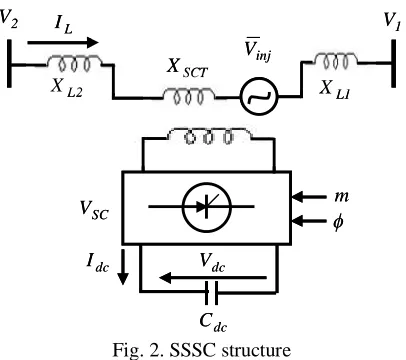
Fig. 2. SSSC structure
The SSSC consists of a series coupling transformer (SCT) with the leakage reactance XSCT, a three-phase
GTO based voltage source converter (VSC) and a DC capacitor. The SSSC can be described as [21]:
j mkV
Vinj dc(cos
sin
) (5)I jI I
IL D Q L
(6)I
I
C
mk
dt
dV
Q D
dc
dc
(
cos
sin
)
(7)where Vinj is the injected ac voltage by the SSSC; m and are the modulation ratio and phase defined by
pulse width modulation (PWM), respectively; depending on the converter structure k is the ratio between
the ac and dc voltage; Vdcis the dc voltage; Cdc is the capacitance of the dc capacitor, and ID and IQ are
D-and Q components of the line current IL, respectively.
3. SSSC-BASED STABILIZERS
a) Phase-based stabilizer
Assuming a lossless SSSC, the ac voltage is kept in quadrature with the line current so that the SSSC only exchanges reactive power with the transmission line. By adjusting the magnitude of the injected voltage, the reactive power exchange can be controlled. When the SSSC voltage lags the line current by 90º, it emulates a series capacitor, when the voltage leads the line current by 90º it can also emulate a series inductor. Thus, a SSSC can be considered as a series reactive compensator, where the degree of compensation can be varied by controlling the magnitude of the injected voltage. In this paper, the SSSC is considered in capacitive mode. To keep the injected voltage in quadrature with the line current, a PI
controller, as shown in Fig. 3, has been used. Here, ref is the phase of the injected voltage in steady-state
and its value is considered as ref =-90º+ss , wheress is theangle of the line current in steady-state; Tsssc
is the time constant of the converter, KP and KI are the proportional and integral gains of the PI controller,
respectively. In the PI controller, a lead-lag stabilizer for damping the inter-area oscillations is included. In
this case, the stabilizer is called the phase-based stabilizer and for convenience in this paper, it is called
-based stabilizer. In this stabilizer, TW is the washout time constant; T is the stabilizer time constant, and x2,
x1 and x0 are parameters to be determined. The feedback signal for the stabilizer is selected among local
Damping Stabilizer dc V W W sT sT sT x s x s x 1 ) 1 ( 2 0 1 2 2 s K KP I
SSSC
sT
1
1
ref dcref V + + Vdc max U Vdc min U + + -Input signal Damping Stabilizer dc V W W sT sT sT x s x s x 1 ) 1 ( 2 0 1 2 2 s K KP ISSSC
sT
1
1
ref dcref V + + Vdc max U Vdc min U + + -Input signalFig. 3.SSSC phase controller with a damping stabilizer
b) Magnitude-based stabilizer
In order to control the magnitude of the injected voltage, the modulation ratio m can be controlled.
Fig. 4 shows the block diagram of the controller in this case, where Xref is the value of produced series
reactance by SSSC in capacitive mode, in steady state condition. A stabilizer for damping of inter-area
oscillations is included in the magnitude controller. This stabilizer is called m-based stabilizer.
ref X SSSC sT 1 1 m × × L
I kVdc
1 0 1 + Damping Stabilizer W W sT sT sT x s x s x 1 ) 1 ( 2 0 1 2 2 + Input signal ref X SSSC sT 1 1 m × × L
I kVdc
1 0 1 + Damping Stabilizer W W sT sT sT x s x s x 1 ) 1 ( 2 0 1 2 2 + Input signal
Fig. 4. SSSC magnitude controller with a damping stabilizer
4. QUADRATIC MATHEMATICAL PROGRAMMING TO DESIGN THE STABILIZER
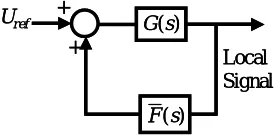
The design method used in this paper is an incremental method including two steps. In the first step, the
closed-loop system is considered as in Fig. 5, where G(s) and F(s) are the power system transfer matrix
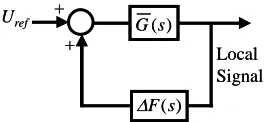
and the stabilizer transfer matrix, respectively. In the second step, the stabilizer transfer matrix is changed
by F. In this case, the closed-loop system changes as shown in Fig. 6, where G(s) is the transfer matrix
of the inner loop between G(s) andF(s).
+ ) (s G ) (s F Local Signal + Uref + ) (s G ) (s F Local Signal + Uref
+
) (s G
) (s F
Local Signal +
Uref +
) (s G
) (s F
Local Signal +
Uref
Fig. 6. Closed loop system in the second step
The details of the method for calculation F are presented in [3]. This method is summarized as
follows. Assuming variations of F are sufficiently small, the variation of the eigenvalue i can be
approximated as:
f
ii i
(
)
(i=1, 2, ..., n) (8)where n is the number of critical eigenvalues and i is the residue associated to the ith eigenvalue i of
) (s
G .
It is assumed that the stabilizer has a lead-lag structure as follows:
w w sT sT sT
x s x s x s f
1 ) 1 ( )
( 1 2 0
2
2 (9)
By substituting
s
i andx
m
x
m(m=1, 2, 3) in (9), the real and imaginary part variations of f (i)can be obtained as a linear function of x0, x1 and x2. Then, by substituting the real and imaginary parts
of f (i) in (8), the real and imaginary parts of i can be written as a linear function of x0, x1 and x2.
Considering i and i as the desired values of the real and imaginary parts of the critical eigenvalue i,
respectively, the following constraints can be obtained to shift the critical eigenvalues to the desired areas in the complex plane [3].
i i
i
i
x
x
x
2 2 1 1 0 0 (10)i i
i i
i
x
x
x
2 2 1 1 0 0 (11)
where 0i, 1i, 2i, 0i, 1i, and 2i are specified values. On the other hand, if the angle of residue i is
positive, the stabilizer must have a phase-lead characteristic; otherwise, it must have a phase-lag characteristic. For a phase–lead structure, it is assumed that zeros of the stabilizer are almost one decade closer to the imaginary axis than that of its poles and for the phase-lag structure the zeros are almost one
decade farther to the imaginary axis. Considering
x
m
x
m
x
m(m=1, 2, 3), the constraints on zeros canbe written for a lead-phase stabilizer as in (12) to (14) and for a phase-lag stabilizer as in (15) to (17) [3].
0 2 1 2 0 2 1
2
T
x
T
x
x
T
x
T
x
x
(12)0 2 1
2 0 2 1
2
10
T
x
100
T
x
x
10
T
x
100
T
x
x
(13)0 2 1
2 0
2 1
2
99
180
18
99
180
18
x
T
x
T
x
x
T
x
T
x
(14)0 2 1 2 0 2 1
2
T
x
T
x
x
T
x
T
x
x
(15)0 2 1 2
0 2 1
2
10
100
10
100
x
T
x
T
x
x
T
x
T
x
0 2 1
2 0
2 1
2
99
18
180
99
18
180
x
T
x
T
x
x
T
x
T
x
(17)where
x
0,x
1andx
2 are known values.The following function, as the gain of the stabilizer at the frequency
i, i=1, 2, . . . m, is considered as theobjective function [3].
2
1
min
m
i
i
j
f
J
(18)where
1,
2...,
m are a set of frequencies in the region where the critical eigenvalue must be shifted.By substituting (9) in (18) and considering
s
j
i, we can easily rewrite the objective function asX f X H X 2 1
J min
T
T
(19)where the matrix H and vector f are known and
X
[
x
x
x
]
T0 1 2
is the unknown vector to betuned. The objective function (19) along with constraints (10)-(11) and (12)-(14) or (15)-(17) forms a
quadratic mathematical programming problem. To solve this problem, thefunctionof quadprog embedded
inMatab Optimization Toolbox is applied here.
5. ZERO INPUT RESPONSE USING LINEAR AND MODAL SERIES METHODS
The dynamic behavior of a power system can be represented by a set of nonlinear equations as follows:
)
(
X
F
X
(20)where
X
R
N is the state vector andF
:
R
N
R
N is a smooth vector field.Let XSEP be a stable equilibrium point (SEP) of the system. By expanding the Taylor series around XSEP,
the equation (20) can be written as:
AX X H X
X T i
i i
2 1
(21)
where Aiis ith row in Jacobeans matrix
SEP
X
X
F
A
andSEP
X l k
i i
x
x
F
H
2
is the ith
N
N
sizedhessian matrix.
Let the right and left eigenvectors of matrix A be considered as U and V, respectively. Assuming the
eigenvalues of matrix A are distinct, using the transformation X=UY, equation (21) can be written in the
Jordan form as:
l k N
k N
l j kl j
j
j y C y y
y
1 1
(22)where
jkl p
T N
p T jp j
C U H U V
C
1
2 1
a) Linear modal method
In the linear modal method, only the first term in (21) is considered and higher order terms are
t jo j j e y t
y ( ) (23)
where yj0 is j
th
element in vector of 1 0
0
U
X
Y
and X0 is the initial condition vector in physical state –space.
Using transformation
Y
U
1X
, the approximate solution for ithstate variable in the original space would be as: t j N j ij N j j ij i j e y u t y u t
x 0
1 1 ) ( ) (
(24)
where uij is the i, j element of the right eigenvector matrix U.
b) Modal series method
In this method, beside linear terms, second order terms are also considered, but third and higher order terms are ignored.
In this case, second order closed form approximate solution of (22) for jth state variable in the Jordan form
will be as[12, 13]:
2 2 2 ∈ ) , , ( 1 1 ) , , ( 1 1 ) ( ) , , ( 1 1 0
∑∑
∑∑
∑∑
2 2 -) ( R j l k t lo ko N k N l j kl R j l k N k N l t lo ko j kl t R j l k N k N l lo ko j kl j j j l k j te y y C e y y h e y y h y t y (25)where 2 /( k l j)
j kl j kl C
h
andR
2
is all three triples(k,l,j) which satisfy the second order resonanceconditions
k
l
j. The second order approximate solution in the physical space can be representedas:
N k N l t i kl t N j N j i j i j j ij i l k j K ee t M L t y u t x 1 1 ) ( 1 1 ) ( )
( (26)
where :
2 ) , , ( 1 1 0 0 02
R j l k N k N l l k j kl j ij
uij
y
h
y
y
L
2 ) , , ( 1 00
∑
2R j l k N j j kl ij l k i
kl y y u h K 2 ) , , ( 0 0
1 1 kl j R
l k N k N l j kl ij i
j u C y y
M
Comparing the coefficients of individual and combination modes in (25) for jth Jordan variable leads to the
0 0 ,
0
0 0 ,
2 max
2 max )
(
l k j kl l k j
l k j kl l k
y y h y
y y h j
II
(27)
where 0 0
,
2
max
j k lkl l
k
h
y
y
is the complex form whenmax
,2
k0 l0j kl l
k
h
y
y
occurs.6. SIMULATION RESULTS
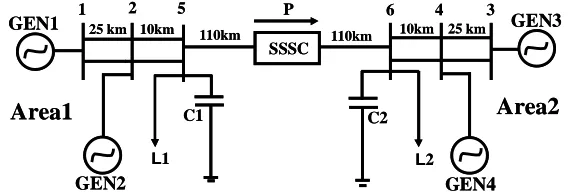
The test system here is a 2-area 4-machine power system. A single line diagram of the system is shown in Fig. 7 [23]. To control inter-area oscillations, a SSSC is installed in the tie-line between nodes 5 and 6. Data of this system and specific parameters used for the SSSC are given in the Appendix. The loads are modeled as constant impedances. No PSS is installed in the system. To increase transferred power, the load in area 2 has been increased and the load in area 1 has then been modified to achieve a given tie-line transferred power.
L1 C1
L2 C2
GEN4 GEN3
GEN2 GEN1
Area1 Area2
SSSC P
1 2 5 6 4 3
25 km 10km 110km 110km 10km 25 km
L1 C1
L2 C2
GEN4 GEN3
GEN2 GEN1
Area1 Area2
SSSC P
1 2 5 6 4 3
25 km 10km 110km 110km 10km 25 km
Fig. 7. One line-diagram of the test system
Table 1. Studied operating conditions
Loading conditions
Load of Area 1(MW)
Load of Area 2(MW)
Transmitted power(MW) Low stress 1000 1300 310
High stress 890 1410 410
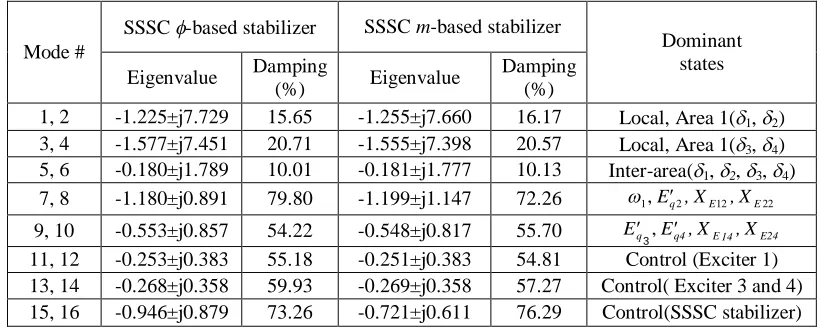
Summary of studied operating conditions are shown in Table 1. The oscillation modes in the open loop system for low and high stress loading conditions are shown in Table 2. This table shows that damping of inter-area mode is low, particularly in high stress conditions. To increase damping of this mode to a
desirable value, the parameters of SSSC -based and m-based stabilizers are calculated by a quadratic
mathematical programming method. The variation of line current magnitude is considered as the best input signal for both SSSC stabilizers [3]. As the desired damping ratio for inter-area mode, typically two
values of =7% for high stress loading conditions and =10% for low stress loading conditions have been
considered. The time constant of the stabilizers is considered to be T=0.4 s. Parameters of stabilizers to
achieve desired damping ratios of inter-area mode are shown in Table 3. Loop gains of the stabilizers
(f(j)) in a frequency close to frequency of inter-area mode are shown in the last column of the table.
Typically, this frequency is considered as =1.7 rad/s. This value is average of inter-area mode frequency
for different SSSC stabilizer and different operation conditions. Table 3 shows that for the same desired
damping ratio, the loop gains of the SSSC -based stabilizer is less than the SSSC m-based stabilizer. That
is, to achieve the same desired damping ratio for inter-area mode, control cost in the SSSC -based
stabilizer is lower compared with the SSSC m-based stabilizer. In other words, the SSSC -based
stabilizer is more effective for damping inter-area oscillations. Oscillation modes in closed loop systems
for SSSC and m-based stabilizer are shown in Tables 4 to 6. These tables show that damping ratio of
Table 2. Oscillation modes in open loop system
Mode #
P=310 MW P=410 MW
Dominant states Eigenvalue Damping (%) Eigenvalue Damping (%)
1,2 -1.225±j7.728 15.66 -1.244±j7.748 15.85 Local, Area 1(1, 2)
3,4 -1.577±j7.451 20.71 -1.554±j7.549 20.16 Local, Area 1(3, 4)
5,6 -0.088±j1.787 4.92 -0.028±j1.647 1.70 Inter-area(1, 2, 3, 4)
7,8 -1.151±j0.846 79.97 -1.320±j0.832 84.60 1,Eq2 ,XE12 ,XE22
9,10 -0.557±j 0.832 55.63 -0.585±j 0.826 57.79 Eq ,Eq4 ,XE14 ,XE24
3
11,12 -0.253±j0.383 55.12 -0.257±j0.393 54.84 Control (Exciter 1) 13, 14 -0.269±j0.358 60.07 -0.284±j0.361 61.79 Control( Exciter 3 and 4)
Table 3. Parameters of SSSC damping stabilizers
P(MW) (%) SSSC stabilize x2 x1 x0 f(j)
410
7 m-based 0.08602 0.04301 0.00538 0.1737 -based 0.00178 0.01169 0.04915 0.0330
10 m-based 0.14440 0.07220 0.00902 0.2915 -based 0.00275 0.03395 0.06764 0.0568
310 10 m-based 0.45702 1.22090 0.47085 1.5337 -based 0.00137 0.00901 0.03837 0.0258
Table 4. Oscillation modes in closed loop system for =10% and P=310 MW
Mode #
SSSC -based stabilizer SSSC m-based stabilizer
Dominant states Eigenvalue Damping
(%) Eigenvalue
Damping (%)
1, 2 -1.225±j7.729 15.65 -1.255±j7.660 16.17 Local, Area 1(1, 2)
3, 4 -1.577±j7.451 20.71 -1.555±j7.398 20.57 Local, Area 1(3, 4)
5, 6 -0.180±j1.789 10.01 -0.181±j1.777 10.13 Inter-area(1, 2, 3, 4)
7, 8 -1.180±j0.891 79.80 -1.199±j1.147 72.26 1,Eq2 ,XE12 ,XE22
9, 10 -0.553±j0.857 54.22 -0.548±j0.817 55.70 Eq3,Eq4 ,XE14 ,XE24
11, 12 -0.253±j0.383 55.18 -0.251±j0.383 54.81 Control (Exciter 1) 13, 14 -0.268±j0.358 59.93 -0.269±j0.358 57.27 Control( Exciter 3 and 4) 15, 16 -0.946±j0.879 73.26 -0.721±j0.611 76.29 Control(SSSC stabilizer)
Table 5. Oscillation modes in closed loop system for =7% and P=410 MW
Mode #
SSSC -based stabilizer SSSC m-based stabilizer
Dominant states Eigenvalue Damping
(%) Eigenvalue
Damping (%)
1,2 -1.244±j7.749 15.85 -1.250±j7.751 15.91 Local, Area 1(1, 2)
3,4 -1.554±j7.549 20.16 -1.557±j7.548 20.20 Local, Area 1(3, 4)
5,6 -0.123±j1.748 7.02 -0.119±j1.692 7.02 Inter-area(1, 2, 3, 4)
7, 8 -1.402±j0.927 83.42 -1.277±j0.739 86.64 1,Eq2 ,XE12 ,XE22
9, 10 -0.582±j0.854 56.29 -0.584±j0.826 57.73 Eq ,Eq4 ,XE14 ,XE24
3
For verification of the designed stabilizers a three-phase fault is applied to the test system at bus 6.
The clearing time of fault, tcr, is set as tcl=20 ms. The fault is cleared without line switching. Because the
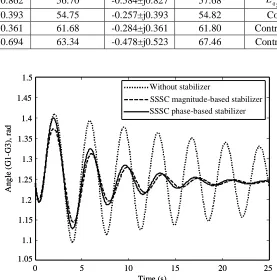
generators 1 and 3 have the most contribution in the inter-area mode, typically, swing angle of generator 1 with respect to generator 3 for different SSSC-based stabilizers at high stress operation conditions is shown in Fig. 8. This figure shows that SSSC stabilizers can effectively damp inter-area oscillations.
Table 6. Oscillation modes in closed loop system for =10% and P=410 MW
Mode #
SSSC -based stabilizer SSSC m-based stabilizer
Dominant states Eigenvalue Damping (%) Eigenvalue Damping (%)
1, 2 -1.244±j7.749 15.85 -1.254±j7.751 15.97 Local, Area 1(1, 2)
3, 4 -1.554±j7.549 20.16 -1.559±j7.546 20.24 Local, Area 1(3, 4)
5, 6 -0.172±j1.675 10.21 -0.168±j1.644 10.19 Inter-area(1, 2, 3, 4)
7, 8 -1.453±j0.841 86.54 -1.238±j0.704 86.93 1,Eq2 ,XE12 ,XE22
9, 10 -0.593±j0.862 56.70 -0.584±j0.827 57.68 Eq ,Eq4 ,XE14 ,XE24
3
11, 12 -0.257±j0.393 54.75 -0.257±j0.393 54.82 Control (Exciter 1) 13, 14 -0.283±j0.361 61.68 -0.284±j0.361 61.80 Control( Exciter 3 and 4) 15, 16 -0.568±j0.694 63.34 -0.478±j0.523 67.46 Control(SSSC stabilizer)
0 5 10 15 20 25
1.05 1.1 1.15 1.2 1.25 1.3 1.35 1.4 1.45 1.5
Time (s)
A
n
g
le
(
G
1
-G
3
),
r
ad
Without stabilizer
SSSC magnitude-based stabilizer SSSC phase-based stabilizer
0 5 10 15 20 25
1.05 1.1 1.15 1.2 1.25 1.3 1.35 1.4 1.45 1.5
Time (s)
A
n
g
le
(
G
1
-G
3
),
r
ad
Without stabilizer
SSSC magnitude-based stabilizer SSSC phase-based stabilizer
Fig. 8. Response of system without and with SSSC stabilizer for =10%, P=410 MW and tcl=20 ms
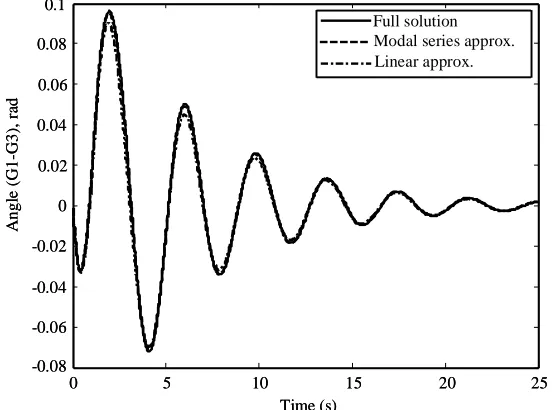
The response of the closed loop system for tcl=15 ms and 40 ms for SSSC -based and m-based
0 5 10 15 20 25 -0.1
-0.05 0 0.05 0.1 0.15
Time (s)
A
n
g
le
(
G
1
-G
3
),
r
ad
Full solution Modal series approx. Linear approx.
0 5 10 15 20 25
-0.1 -0.05 0 0.05 0.1 0.15
Time (s)
A
n
g
le
(
G
1
-G
3
),
r
ad
Full solution Modal series approx. Linear approx.
Fig. 9. Response of system with -based stabilizer for =10%, P=410 MW and tcr=15 ms
0 5 10 15 20 25
-0.3 -0.2 -0.1 0 0.1 0.2 0.3 0.4
Time (s)
A
ngl
e
(G
1
-G
3)
,
ra
d
Full solution Modal series approx.
Linear approx.
0 5 10 15 20 25
-0.3 -0.2 -0.1 0 0.1 0.2 0.3 0.4
Time (s)
A
ngl
e
(G
1
-G
3)
,
ra
d
Full solution Modal series approx.
Linear approx.
Fig. 10. Response of system with -based stabilizer for =10%, P=410 MW and tcr=40 ms
0 5 10 15 20 25
-0.08 -0.06 -0.04 -0.02 0 0.02 0.04 0.06 0.08 0.1
Time (s)
A
n
g
le
(
G
1
-G
3
),
r
ad
Full solution Modal series approx. Linear approx.
0 5 10 15 20 25
-0.08 -0.06 -0.04 -0.02 0 0.02 0.04 0.06 0.08 0.1
Time (s)
A
n
g
le
(
G
1
-G
3
),
r
ad
Full solution Modal series approx. Linear approx.
Full solution Modal series approx. Linear approx.
0 5 10 15 20 25
-0.4 -0.3 -0.2 -0.1 0 0.1 0.2 0.3
Time (s)
A
n
g
le
(
G
1
-G
3
),
r
a
d
Full solution Modal series approx. Linear approx.
0 5 10 15 20 25
-0.4 -0.3 -0.2 -0.1 0 0.1 0.2 0.3
Time (s)
A
n
g
le
(
G
1
-G
3
),
r
a
d
Fig. 12. Response of system with m-based stabilizer for =10%, P=410 Mw and tcr=40 ms
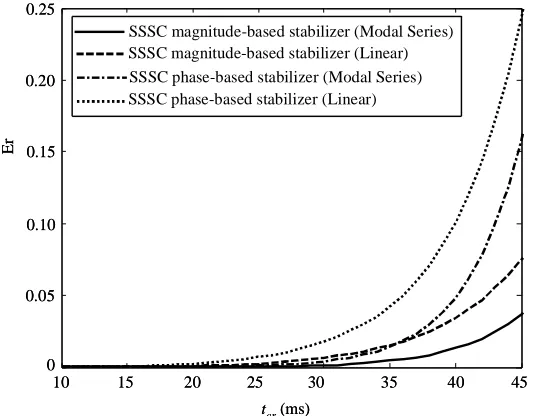
To evaluate the precision of the approximate solutions, an error index is used as follows [24].
dt t x t x T i
Er
T i i0 ( )
~ ) ( 1 )
( (28)
where, T is the simulation time, xi(t) and ~xi(t)are full and approximate response for ith state variable,
respectively.
According to (28), the error index for different values of fault duration for closed loop system in high stress loading conditions for different SSSC stabilizers is shown in Fig. 13. This figure shows that when
fault duration is increased the error index for the system with m-based stabilizer is lower in comparison
with -based stabilizer. In other words, the nonlinear effects are higher in the system with -based
stabilizer. Also, this figure shows that for different values of fault duration, the error index for approximate response obtained by the modal series is lower than the approximate response obtained by the linear method.
10 15 20 25 30 35 40 45
0 0.05 0.10 0.15 0.20 0.25
tcr(ms)
E
r
SSSC phase-based stabilizer (Modal Series) SSSC phase-based stabilizer (Linear)
SSSC magnitude-based stabilizer (Modal Series) SSSC magnitude-based stabilizer (Linear)
10 15 20 25 30 35 40 45
0 0.05 0.10 0.15 0.20 0.25
tcr(ms)
E
r
SSSC phase-based stabilizer (Modal Series) SSSC phase-based stabilizer (Linear)
SSSC magnitude-based stabilizer (Modal Series) SSSC magnitude-based stabilizer (Linear)
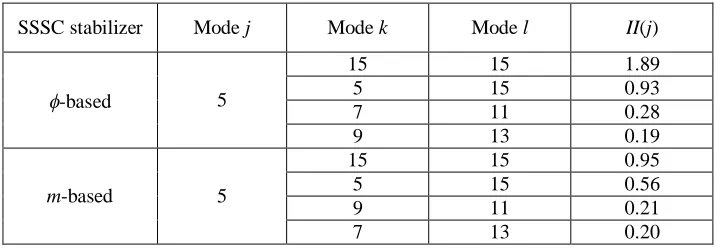
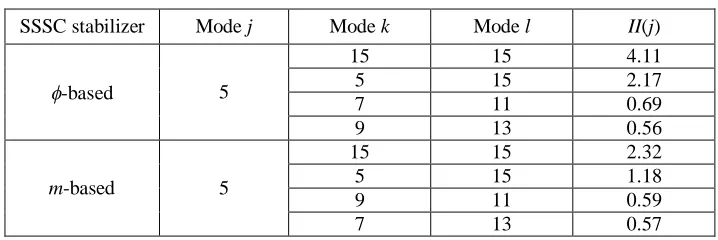
According to (27), in some cases, the values of nonlinear modal interaction index for inter-area mode at fault duration of 35 ms are calculated and shown in Tables 7 to 10. According to these tables, the following results can be concluded:
I. According to Table 7, modal interactions between inter-area mode and control modes related
to exciters are not severe in the open loop system.
II. Tables 8 to 10 show that, in the closed loop system, modal interactions between inter-area
mode and control modes related to SSSC stabilizers are higher than that of exciter control modes.
III. Comparing Tables 8 and 10 shows that by increasing stress on the system, modal interactions
between inter-area mode and SSSC stabilizer control modes are increased.
IV. It can be seen from Tables 8 to 10 that modal interactions between inter-area mode and
control mode related to SSSC -based stabilizer are higher than the m-based stabilizer.
V. From Tables 8 and 10, it can be concluded that by increasing desired damping ratio, for
inter-area mode in a certain value of transferred power, the modal interactions between inter-inter-area mode and SSSC stabilizer control modes are increased.
Table7. Nonlinear modal interaction index for inter-area mode in the open loop system for P=410 MW
Mode j Mode k Mode l II(j)
5
5 11 0.62
7 11 0.42
9 13 0.37
5 5 0.11
Table 8. Nonlinear modal interaction index for inter-area mode in the closed loop system for =10% and P=310 MW
SSSC stabilizer Mode j Mode k Mode l II(j)
-based 5
15 15 1.89
5 15 0.93
7 11 0.28
9 13 0.19
m-based 5
15 15 0.95
5 15 0.56
9 11 0.21
7 13 0.20
Table 9. Nonlinear modal interaction index for inter-area mode in the closed loop system for =7% and P=410 MW
SSSC stabilizer Mode j Mode k Mode l II(j)
-based 5
15 15 3.18
5 15 1.72
7 11 0.72
9 13 0.59
m-based 5
15 15 1.84
5 15 0.87
9 11 0.61
Table 10. Nonlinear modal interaction index for inter-area mode in the closed loop system for =10% and P=410 MW
SSSC stabilizer Mode j Mode k Mode l II(j)
-based 5
15 15 4.11
5 15 2.17
7 11 0.69
9 13 0.56
m-based 5
15 15 2.32
5 15 1.18
9 11 0.59
7 13 0.57
For more stress on the system, loads L1 and L2 are set in the values 1430 and 870 MW, respectively.
In this case, transferred power between two areas is about P=430 MW. The mechanical and control oscillation modes in the open loop system are shown in Table 11. This table shows that inter-area mode is unstable for this condition. Mechanical and control modes in the closed loop system, with parameters of
Table 3 related to P=410 MW and =10%, are presented in Table 12. This table shows that damping ratio
of inter-area mode in the closed loop system has been reduced by increasing transmitted power. Also, it
can be seen from this table that the damping of inter-area mode with the -based stabilizer is somewhat
higher than the m-base stabilizer. Swing angle of generator 1 with respect to generator 3 for the -based
and m-based stabilizer at different values of fault duration are shown in Figs. 14 and 15, respectively.
Figure 14 shows that when fault clearing time is 10 ms (small disturbance) the system is stable. This
condition is coincident with eigenvalue results. By increasing fault duration to tcr=25.3 ms, damping of
oscillations would be approximately zero and the oscillations are repeated periodically without decaying or diverging. Lastly, in fault duration of 26.5 ms, the system is faced with oscillatory instability and loses its synchronism after about 20 seconds.
Table 11. Oscillation modes in the open loop system for P=430 MW
Mode # Eigenvalue Damping (%) Dominant states 1,2 -1.247±j7.760 15.87 Local, Area 1(1, 2)
3,4 -1.539±j7.585 19.88 Local, Area 1(3, 4)
5,6 0.024±j1.476 -1.63 Inter-area(1, 2, 3, 4)
7, 8 -1.431±j0.718 89.38 1,3,Eq2 ,XE12 ,XE22
9, 10 -0.584±j0.822 57.92 Eq ,Eq4 ,XE14 ,XE24
3
11, 12 -0.257±j0.397 54.34 Control (Exciter 1) 13,14 -0.288±j0.361 62.36 Control( Exciter 3 and 4)
Table 12. Oscillation modes in the closed loop system (with parameters of Table 3 related to P=410 MW and =10%) for P=430 MW
Mode # SSSC -based stabilizer SSSC m-based stabilizer Dominant states
Eigenvalue Damping (%) Eigenvalue Damping (%)
1,2 -1.246±j7.760 15.85 -1.256±j7.763 15.97 Local, Area 1(1, 2)
3,4 -1.539±j7.585 19.88 -1.543±j7.583 19.94 Local, Area 1(3, 4)
5,6 -0.052±j1.432 3.63 -0.043±j1.419 3.03 Inter-area(1, 2, 3, 4)
7, 8 -1.662±j0.684 92.47 -1.224±j0.616 89.33 1,3,Eq2 ,XE12 ,XE22
9, 10 -0.595±j0.859 56.94 -0.580±j0.823 57.61 Eq3,Eq4 ,XE14 ,XE24
0 5 10 15 20 25 -0.4 -0.3 -0.2 -0.1 0 0.1 0.2 0.3 0.4 0.5 0.6 Time (s) A n g le ( G 1 -G 3 ), r ad
tcl=10 ms
tcl=25.3 ms
tcl=26.5 ms
0 5 10 15 20 25
-0.4 -0.3 -0.2 -0.1 0 0.1 0.2 0.3 0.4 0.5 0.6 Time (s) A n g le ( G 1 -G 3 ), r ad
tcl=10 ms
tcl=25.3 ms
tcl=26.5 ms
Fig. 14. Response of the system for SSSC -based stabilizer (with parameters of Table 3 related to P=410 MW and =10%) for P=430 MW at different values of fault duration
0 5 10 15 20 25
-0.4 -0.3 -0.2 -0.1 0 0.1 0.2 0.3 0.4 0.5 0.6 Time (s) A n g le ( G 1 -G 3 ), r ad
tcl=10 ms
tcl=26.5 ms
tcl=32.3 ms
0 5 10 15 20 25
-0.4 -0.3 -0.2 -0.1 0 0.1 0.2 0.3 0.4 0.5 0.6 Time (s) A n g le ( G 1 -G 3 ), r ad
tcl=10 ms
tcl=26.5 ms
tcl=32.3 ms
Fig. 15. Response of the system for SSSC m-based stabilizer (with parameters of Table 3 related to P=410 MW and =10%) for P=430 MW at different values of fault duration
The fault clearing time for first swing instability for both SSSC stabilizers is shown in Fig. 16. Comparing Figs.14 and 16, it can be seen that fault clearing time for oscillatory instability is about 8 ms less than the
clearing time for the first swing instability. Figure 15 shows that the system with SSSC m-based stabilizer
at tcl=26.5 ms is stable (unlike -base stabilizer). Also, comparing this figure to Fig. 16 shows that fault
clearing time for instability of the system is close to that of for first swing instability.
0 5 10 15 20 25
-0.5 0 0.5 1 1.5 2 2.5 3 Time (s) A n gl e (G 1 -G 3), ra d
SSSC magnitude-based stabilizer with tcr=35.18 ms
SSSC phase-based stabilizer with tcr=34.48 ms
0 5 10 15 20 25
-0.5 0 0.5 1 1.5 2 2.5 3 Time (s) A n gl e (G 1 -G 3), ra d
SSSC magnitude-based stabilizer with tcr=35.18 ms
SSSC phase-based stabilizer with tcr=34.48 ms
ForP=410 MW, modal interaction index between inter-area mode and SSSC stabilizer control modes for
fault duration of 25 ms is shown in Table 13. This table confirms that modal interactions for SSSC
-based stabilizer are severe in comparison with m-based stabilizer.
It can be seen from the above results that modal interactions can deteriorate damping of a mechanical mode that causes the system to become unstable. However, the system is recognized as stable due to a small disturbance.
Table 13. Nonlinear modal interaction index for inter-area mode in the closed loop system (with parameters of Table 3 related to P=410 MW and =10%) for P=430 MW
SSSC
stabilizer Mode j Mode k Mode l II(j)
-based 5
15 15 5.68
5 15 3.17
7 11 0.98
9 13 0.86
m-based 5
15 15 3.38
5 15 2.10
9 11 1.06
7 13 0.92
7. CONCLUSION
In this paper, modal series method is extended to a multi-machine power system installed with a SSSC-based stabilizer. Phase and magnitude control channels are considered for the SSSC stabilizer. Parameters of the SSSC stabilizer are calculated by a quadratic mathematical programming method. Results show that for small disturbance analysis (eigenvalue analysis), the gain (the control cost) of the stabilizer to improve
damping of an inter-area oscillation mode to a desired value with SSSC -based stabilizer is less than the
m-based stabilizer. By increasing the fault duration (magnitude of disturbance) in certain operating
conditions, modal interactions between inter-area mode and control mode related to SSSC -based
stabilizer are higher than the m-based stabilizer. Also, results show that in a certain heavy loading
condition, the system with -based stabilizer is faced with an oscillatory instability whose clearing time is
less noticeable than that for the first swing instability. Therefore, to select the optimal control channel for a SSSC stabilizer, in stressed power systems in which modal interactions between an inter-area mode and control modes are high, eigenvalue analysis (small disturbance analysis) alone may not be sufficient and effects of modal interactions must be considered. In other words, a trade-off between linear and nonlinear analysis must be done.
REFERENCES
1. Gyugyi, L., Schauder, C. D. & Sen, K. K. (1997). Static synchronous series compensator: a solid-state approach to the series compensation of transmission lines. IEEE Trans. Power. Deliv., Vol. 12, No. 1, pp. 406-417. 2. Ghaisari, J. & Bakhshai, A. (2006). An advanced robust MIMO SSSC control technique for power oscillation
damping improvement. Iranian Journal of Science and Technology, Transaction B: Engineering, Vol. 30, No. B6, pp. 667-679.
3. Shakarami, M. R. & Kazemi, A. (2011). Assessment of effect of SSSC stabilizer in different control channels on damping inter-area oscillations, energy. conver. manag., J., Vol. 52, No. 3, pp. 1622-1629.
4. Vittal, V., Bhatia, N. & Fouad, A. A. (1991). Analysis of the inter-area mode phenomenon in power systems following large disturbances. IEEE Trans. Power Syst., Vol. 6, No. 4, pp.1515-1521.
6. Amano, H., Kumano, T. & Inoue, T. (2006). Nonlinear stability indexes of power swing oscillation using normal form analysis. IEEE Trans. Power Syst., Vol. 21, No. 2, pp. 825-834.
7. Amano, H. & Inoue, T. (2007). A new PSS parameter design using nonlinear stability analysis. IEEE, Power Engineering Society General Meeting, Tampa, Florida.
8. Lin, C. M., Vittal, V., Kliemann, W. & Foad, A. A. (1996). Investigation of modal interaction and its effects on control performance in stressed power systems using normal forms of vector fields. IEEE Trans. Power Syst., Vol. 11, No. 2, pp. 781-787.
9. Jang, G., Vittal, V. & Klimann, W. (1998). Effect of nonlinear modal interaction on control performance: Use of normal forms technique in control design, Part I: General theory and procedure. IEEE Trans. Power Syst., Vol. 13, No. 2, pp. 401-407.
10. Jang, G., Vittal, V. & Klimann, W. (1998). Effect of nonlinear modal interaction on control performance: Use of normal forms technique in control design, Part II: Case studies. IEEE Trans. Power Syst., Vol. 13, No. 2, pp. 408-413.
11. Thapar, J., Vittal, V., Kliemann, W. & Foad, A. A. (1998). Application of the normal form of vector fields to predict inter-area separation in power systems. IEEE Trans. Power Syst., Vol. 2, No. 2, pp. 844-850.
12. Shanechi, H. M., Pariz, N. & Vaahedi, E. (2003). General nonlinear modal representation of large scale power systems. IEEE Trans. Power Syst., Vol. 18, No. 3, pp.1103-1109.
13. Pariz, N., Shanechi, H. M. & Vaahedi, E. (2003). Explaining and validating stressed power systems behavior using modal series. IEEE Trans. Power Syst., Vol. 18, No. 3, pp. 778-785.
14. Zou, Z. Y., Jiang, Q. Y., Cao, Y. J. & Wang, H. F. (2005). Application of the Normal Forms to analyze the interactions among the multiple-control channel of UPFC. Int. J. Electric Power Energy Syst., Vol. 27, No. 8, pp. 584-593.
15. Soltani, S., Pariz, N. & Gazi, R. (2009). Extending the perturbation technique to the modal representation of nonlinear systems. Elect. Pow. Syst. Res., Vol. 79, No. 8, pp. 1209-1215.
16. Messina, A. R. & Barocio, E. (2003). Nonlinear analysis of inter-area oscillations: Effect of SVC voltage support. Elect. Pow. Syst. Res., Vol. 64, No. 1, pp. 17-26.
17. Barocio, E. & Messina, A. R. (2003). Normal form analysis of stressed power systems: incorporation of SVC models. Int. J. Elect. Pow. Energy Syst., Vol. 25, No. 1, pp. 79-90.
18. Zou, Z. Y., Jiang, Q. Y., Cao, Y. J. & Wang, H. F. (2005). Normal form analysis of interactions among multiple SVC controllers in power systems. IEE Proc. Gener. Transm. Distrib., Vol. 152, No. 4, pp. 469-474.
19. Sauer, P. & Pai, M. (1998). Power system dynamics and stability. Prentice Hall, New Jersey.
20. Anderson, P. M. & Fouad, A. A. (1977). Power system Control and stability. Iowa, Iowa State Univ.
21. Wang, H. F. (2000). Static synchronous series compensator to damp power system oscillation. Elect. Pow. Syst. Res., Vol. 54, No. 2, pp. 113-119.
22. Naghshbandy, A. (2008). Study of fault location effects on low frequency inter-area oscillations in stressed power systems. Dissertation, Iran University of science and technology, Iran.
23. Liu, S., Messina, A. R. & Vittal, V. (2005). Assessing placement of controllers and nonlinear behavior using normal form analysis. IEEE Trans. Power Syst., Vol. 20, No. 3, pp. 1486-1495.
24. Wu, F. X., Wu, H., Han, Z. X. & Gan, D. Q. (2007). Validation of Power system non-linear modal analysis methods. Elect. Pow. Syst. Res., Vol. 77, No. 10, pp. 1418-1424.
APPENDIX A: Data used for simulations
Data of SSSC (in p.u. except indicated): TSSSC=0.01 s, k=1, XSCT=0.15, CDC=1, Vdcref=1, Xref=0.12, KP=25, KI=200. Data of generator and network:
1. Synchronous generator data: Table A1.
3. Exciter parameters: Table A2.
4. Load flow data (in p.u.) on base 100 MVA): QC1=2.551, QC2=2.543, Ql1=2.50,Ql2=2.50, Pg1=6.644,
Pg2=6.644, Pg4=5, V3=1.020 (swing bus), |V1|=1.02, |V2|=1.02, |V4|=1.02.
Table A1. Generator data (in p.u. except indicated)
Parameter G1 G2 G3 G4
Ra 0.0025 0.0025 0.0025 0.0025
xd 1.8 1.8 1.8 1.8
xq 1.7 1.7 1.7 1.7
d
x 0.3 0.3 0.3 0.3
q
x 0.3 0.3 0.3 0.3
do
T (s) 8 8 8 8
qo
T (s) 0.4 0.4 0.4 0.4
H (s) 6.5 6.5 6.5 6.5
D 9 1 11 1.2
Sbase (MVA) 900 900 900 900
Table A2. Exciter data (in p.u.)
Generator KA TA TC TB TR