Please cite this article as: A. Ghannadiasl, S. Khodapanah Ajirlou, Dynamic Response of Multi-cracked Beams Resting on Elastic Foundation, International Journal of Engineering (IJE), IJE TRANSACTIONS B: Applications Vol. 31, No. 11, (November 2018) 1830-1837
International Journal of Engineering
J o u r n a l H o m e p a g e : w w w . i j e . i rDynamic Response of Multi-cracked Beams Resting on Elastic Foundation
A. Ghannadiasl*, S. Khodapanah Ajirlou
University of Mohaghegh Ardabili, Ardabil, Iran
P A P E R I N F O
Paper history: Received 10 July 2018
Received in revised form 17 August 2018 Accepted 26 October 2018
Keywords:
Crack
Multi-cracked Bea Dynamic Analysis Elastic Boundary Condition Elastic Foundation
A B S T R A C T
Cracks cause to change dynamic response of beams and make discontinuity in slope of the deflection of the beams. The dynamic analysis of the Euler-Bernoulli cracked beam on the elastic foundation subjected to the concentrated load is presented in this paper. The stiffness of the elastic foundation and elastic supports influence on vibrational characteristics of the cracked beam. The Dynamic Green Function is applied to solve the governing equation. Thus, the dynamic response of the cracked beam is determined by Laplace Transform method. The effects of depth and location of the crack on natural frequency and deflection of the cracked beam on an elastic foundation are evaluated. In order to demonstrate the capability of the present approach, several numerical examples are worked out and the results are discussed.
doi: 10.5829/ije.2018.31.11b.05
NOMENCLATURE M Bending moment that transmitted by the cracked section
EI Flexural rigidity Dh' The non-dimensional constant spring model
W
K Stiffness of elastic foundation k The stiffness of massless torsional spring
,q x t The applied load L Length of the beam
,
W x t The deflection of beam h Height of the beam
(.)
H The Heaviside function b Width of the beam
io
x The exerted load location h' Depth of the crack h hc
h
4 4
4 1
(0) i
i i
W x
Boundary condition Greek Symbols;
LT RT
K K The transfer spring stiffness at the left and right support Mass per unit length of the beam
;
LR RR
K K The rotational spring stiffnessat the left and right support . Dirac delta function y
Slope in deflection of beam
Material density1. INTRODUCTION1
The foundation plays the important role in most of the engineering structures. Various researchers are investigated the dynamic response of the cracked beam. Bovsunovsky and Matveev [1] assessed the dynamic behavior of the beam with a closing crack. The effect of
*Corresponding Author Email: [email protected] (A. Ghannadiasl)
according to changes in modal energy and natural frequencies was provided by Kim and Stubbs [4].
In order to obtain the nonlinear vibration of the cracked beam on the elastic foundation, a discrete physical model is presented by Khnaijar and Benamar [5]. The cracked section and soil stiffness are modeled by the spiral and the vertical spring, respectively. The influences of soil parameters and large amplitude vibration are assessed. Chang and Chen [6] investigated the cracked beam by the spatial wavelet analysis to detect the location and depth of cracks. They used modal shape to anticipate locations of cracks, and natural frequencies for various depth of the cracks. Xiang et al. [7] worked on the cracked and non-cracked beams to predict the location and size of the crack. Hence, the B-spline wavelet approach is used to gain the first three frequencies for analysis of cracked beams [7]. The identification of the dynamiccharacteristics of the double cracked beam is analyzed numerically and experimentally by Yoon et al. [8]. They modeled the damaged section of the cracked beam by a local flexibility matrix, also they recognized the dynamic behavior of the cracked beam using Hamilton’s principle. Sekhar [9] briefed the different assessments on the cracked beam and assessed the methods effects. Xiaoqing et al. [10] investigated the natural frequencies of various boundary condition cracked beam based on the bending vibration theory. Deokar and Wakchaure [11] researched the location and crack depth using natural frequencies. They plotted the first three natural frequencies to find the intersection of them in order to identify the location and depth of crack [11].
Attar et al. [12] studied the cracked Timoshenko beam that supported by elastic foundation. A lattice spring model is used to represent the transverse shear deformation and the rotary inertia. The LSM is applied to discrete beam into the one-dimensional segment. A fluid conveying micro-beams is used to analyze dynamic behavior of the micro-structure resting on the foundation by Kural and Ozkaya [13]. The Hamilton’s principle is applied to solve the nonlinear equations of motion. Batihan and Kadioğlu [14] investigated the cracked beam on a Pasternak and generalized elastic foundations. Both the Euler-Bernoulli and the Timoshenko theories were used to analyze the cracked beam and determine the natural frequency in different location and depth of the crack. Cracked nano-beam is investigated by TadiBeni et al. [15]. The effect of crack position on natural frequency is studied in this paper. They found that the effect of this characteristics is significant. Frequency analysis is employed to obtain the natural frequency of the stepped and cracked Timoshenko beam by Sadeghian and Ekhteraei [16]. The various boundary condition and the elastic foundation are considered and the dynamic response of cracked beam is determined. Analysis of the
non-uniform cracked beam using employing optimization method is presented by Ranjbaran et al. [17]. Free vibration of the cracked beam based on functionally graded materials and using Euler-Bernoulli, Rayleigh and Timoshenko theory is studied by Sherafatnia et al. [18]. In this study, the influences of material properties are evaluated. The modeling of the cracked section as beam element is introduced by Nakhaei et al. [19]. A stepped cross-section is used to take in account characteristics of crack. Also, Zhao et al. [20] studied the damped multi-cracked beam using Green function method. The results are compared with the finite element method and it is observed that there are insignificant errors.
In most studies, the effect of elastic support, and in particular the use of the Green Function method for solving the governing equations of the elastic foundation of the cracked beam, is not considered. The influences of elastic foundation and boundary condition are studied and the dynamic response of cracked beam is obtained, in this paper.
2. MODELING OF MULTI-CRACKED EULER-BERNOULLI BEAM BY GREEN FUNCTION
The governing equation of the Euler-Bernoulli beam supported on elastic foundation is defined as follows [21]:
4 2
4 2
( , ) ( , )
0 ( , )
W x t W x t
EI Kw q
x t
x t
(1)
Now, let us assume that q(x, t) and W( , )x t are a harmonic function. The terms of load and deflection are written as follows:
( , ) ( ) ( ) q x t q x T t
(2) ( , ) ( ) ( )
W x t W x T t
whereT t( ) is defined as T t( )Exp i( t). By substituting Equation (2) in Equation (1), the following relation obtained:
2 4
4
Ω
( ) ( )
( ) W
K
W x q x
W
EI EI
x
x
(3)
In the above equation, on taking the Green's function method the resulting equation may be obtained as follows [22]:
2 4
0 4
Ω
( ) KW x x
G x
G x
EI EI
x
(4)
0 0 4 4 4 1 4 0 3 1 4 4 1 ( ) ( ; ) 4 (0) ( ( )) 1 ( ) 4 i i i n n n i i n n n
H x x
G x x
EI
W
x
Exp x x
Exp x
(5)The terms and nare defined as the following expression:
2 0.25
Ω KW
EI
(6)
1, 1, ,
n i i
(7)
In this paper, the multi-cracked Euler-Bernoulli beam on elastic foundation with elastic boundary condition is modeled as Figure 1. The cracks divide beam into n1 parts. For each part, the Equation (5) is expanded. According to Figure 1, for the first and last segments of multi-cracked beam, the Equation (5) is presented as follows:
0
0 4
0
4 3 3 2
3 2
2 2 3
2 2 3 3
3 1 ( ) 4 ) 4 ( ; 1 ( (0) (0 ( ) ) (0) (0 ) ) ) 1 [ ( ) 4 ( )] ( i
i i i
i
n n i i
n
n
n
n i n i
LT LR
n i i
i
H x x
E x x I G n w
Exp x x
x w
k x k x
w w x x EI Exp
(8a) 0 0 4 04 3 3 2
3 2
2 2 3
2 2 3 3
3 1 ( ) 4 ) 4 ( ; 1 ( (0) (0 ( ) ) (0) (0 ) ) ) 1 [ ( ) 4 ( )] ( n
n n n
n
n n n n
n
n
n
n n n n
LT LR
n n n
n
H x x
E x x I G n w
Exp x x
x w
k x k x
w w x x EI Exp
(8b)In addition, the following equation for the middle segments of cracked beam can be expressed as follows:
Figure 1. Multi-cracked Euler-Bernoulli beam on elastic foundation
1 1 ( 1)0
1 ( 1)0
( 1)0
3
4 1
1
2 2 3
1 1
2 2 3 3
1 4 1 4 3 1 ( , ) (0) (0) ( ( ) 4 0) (0) ) 1 [ 4 ] ( ( ( ))
i i i
i i i n n n i n i
n i i
i n n i n n
G x x
x x x w w x w w x x H EI x Exp x Exp
(9)The continuity of the cracked beam must be satisfied. For this purpose, the continuity relation for i-th segment
1 i n 1
may be written as follows:1
1 0 0
i i i
i x L Gi x
G (10) 1 2 2 1 2 2 1 0 0
i i i
i i
i x L i x
G G x x 1 3 3 1 3 3 1 0 0
i i i
i i
i x L i x
G G x x 1 1 2 1 1 2 1 0 1 0 1 0
i i i i
i i i
i x L i x i x
G G G
x k x x
The last segment continuity relation has the following expression [24]:
1 1
1 0
n n n n
n x L n x L
G G (11) 1 1 2 2 1 2 2 1 0
n n n n
n n
n x L n x L
G G x x 1 1 3 3 1 3 3 1 0
n n n n
n n
n x L n x L
G G x x 1 1 2 1 1 2 1
1 0 0
1
0
i i i i
i i i
i x L i x i x
G G G
x k x x
By substituting the Equations (8) and (9) in continuity relation, the matrix form equation of the multi-cracked beam is obtained and the natural frequency is determined by computing the determinant of matrix.
Existence crack in beam make local flexibility in crack location. The massless torsional spring is used to
Oi Xi
Yi
Xn
Yn
KLT KRT
KLR Li Oi+1 Xi+1 Yi+1 On-1 Xn-1 Yn-1
Li+1 Ln-1 Ln
KRR
cracked section. Crack during length of the beam discretes beam and creates discontinuity. The stiffness of massless torsional spring is given as follows:
h' EI kh D
(12)
From mechanics fracture, the non-dimensional constant
Dh' can be calculated. After evaluating various
theories of Dh', Bilello [25] proposed the fallowing relation for (Dh') based on the depth of the crack ratio:
' 2
2 0.9 1
h
h h
D
h
(13)
3. NUMERICAL EXAMPLES
3. 1. Free Vibration of Clamped Cracked Beamon Elastic Foundation The natural frequency of clamped cracked beam on elastic foundation, based on Batihan and Kadioğlu data's [14] presented in Table 1. The crack located in L 8 and the crack ratio varies from 0.02 to 0.5. In order to modeling the clamped beam the value of kLT,kRT,kLR and kRR is considered
a large number. As illustrated in Table 1, there are insignificant error in the results.
3. 2. The Natural Frequencies of Elastic-elastic Cracked Beam on Elastic Foundation The
elastic– elastic cracked beam under concentrated load at
2
L has the following properties (see Figure 1):
3
L m, 9
2 10
E Pa, 7850kg 3 m
0.2
b h m , h'0.5
4 2
6.71 10 W
K N m
1, 2
LT RT LR RR
k k k k k k
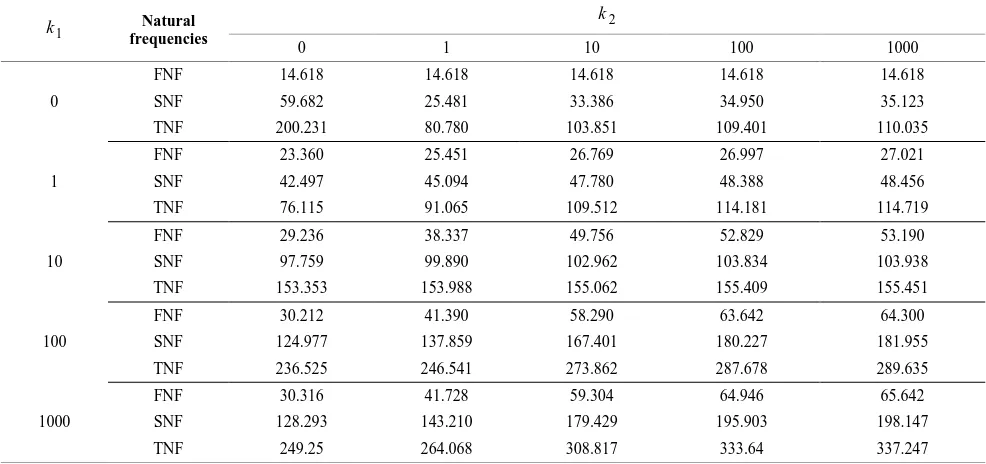
The first three natural frequencies of elastic-elastic beam on elastic foundation with a crack at L 2 are provided in Table 2. According to Table 2, increasing the stiffness of the springs lead to increasing natural frequencies. In the case whichk10, second and third natural frequency changes are more evident. In the case
1 2 1000
k k , the action of cracked beam is as same as clamped cracked beam and also, in case which
1 1000
k and k2 0, the cracked beam behave such as a simply supported cracked beam.
TABLE 1. Natural frequency of clamped cracked beam on elastic foundation
Crack ratio Ref. [14] Present study Error (%)
0.02 83.532 83.661 0.1841
0.04 83.523 83.626 0.1771
0.2 83.267 83.257 0.0144
0.4 82.420 82.438 0.0267
0.5 81.673 81.756 0.1248
TABLE 2. The first three natural frequencies of elastic-elastic cracked beam on elastic foundation
1
k Natural
frequencies
2 k
0 1 10 100 1000
0
FNF 14.618 14.618 14.618 14.618 14.618
SNF 59.682 25.481 33.386 34.950 35.123
TNF 200.231 80.780 103.851 109.401 110.035
1
FNF 23.360 25.451 26.769 26.997 27.021
SNF 42.497 45.094 47.780 48.388 48.456
TNF 76.115 91.065 109.512 114.181 114.719
10
FNF 29.236 38.337 49.756 52.829 53.190
SNF 97.759 99.890 102.962 103.834 103.938
TNF 153.353 153.988 155.062 155.409 155.451
100
FNF 30.212 41.390 58.290 63.642 64.300
SNF 124.977 137.859 167.401 180.227 181.955
TNF 236.525 246.541 273.862 287.678 289.635
1000
FNF 30.316 41.728 59.304 64.946 65.642
SNF 128.293 143.210 179.429 195.903 198.147
TNF 249.25 264.068 308.817 333.64 337.247
3. 3. Dynamic Response of Cracked Clamped-elastic Beam The cracked beam with clamped-elastic boundary conditions illustrated in Figure 2. The following properties are assumed for beam:
L=2.1m, b=0.25m, h=0.1m, h´=0.6 E=2.01×10⁹ N/m2, ρ=7800 kg/m3
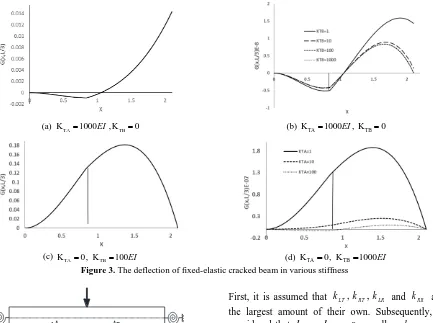
The results of the cracked beam with variety of the stiffness values in support A and B are illustrated in Figure 3. The vertical dash line shows the crack location and the vertical axis denotes the beam displacement. Comparison of results show:
When there is no stiffness in support B, the reached displacement in first segment has more value (see Figures 3A and 3B). In addition, when support A has no stiffness, the effects of support A reaction on beam displacement in Figure 3C is evident. By increasing the stiffness value of support A, the cracked beam can absorb the applied load then the effect of support A reaction decrease (see Figure 3D).
3. 4. Force Vibration of Double Cracked Elastic-elastic Beam with Different Foundation Stiffness The double cracked beam according to the specifications of section 3.2 is presented. As showed in Figure 4, the elastic foundation is placed between two cracks. In this example, the concentrated load with
7rad s/
is applied at center point of the cracked beam.
Figure 2. Cracked beam with fixed-elastic conditions
(a) KTA1000EI , KTB0 (b) KTA1000EI, KTB0
(c) KTA0 , KTB100EI (d) KTA0 , KTB1000EI
Figure 3. The deflection of fixed-elastic cracked beam in various stiffness
Figure 4. Double-cracked beam with partial elastic foundation
First, it is assumed that kLT,kRT
,
kLR and kRR are inthe largest amount of their own. Subsequently, it is considered that kLR kRR 0as well as kLT and kRT
are in the largest value. Figures 5 and 6 are represented the deflection of the cracked beam withh'0.5
.
Conforming to Figures 5 and 6, by increasing theA B
2L/5 L/2
L/3
L
A B
stiffness of the elastic foundation leads to decrease the deflection, especially variations of kW 0 are more evident than kW 100EI.It is note that the simply supported beam is more sensitive against the stiffness of elastic foundation than clamped beam.
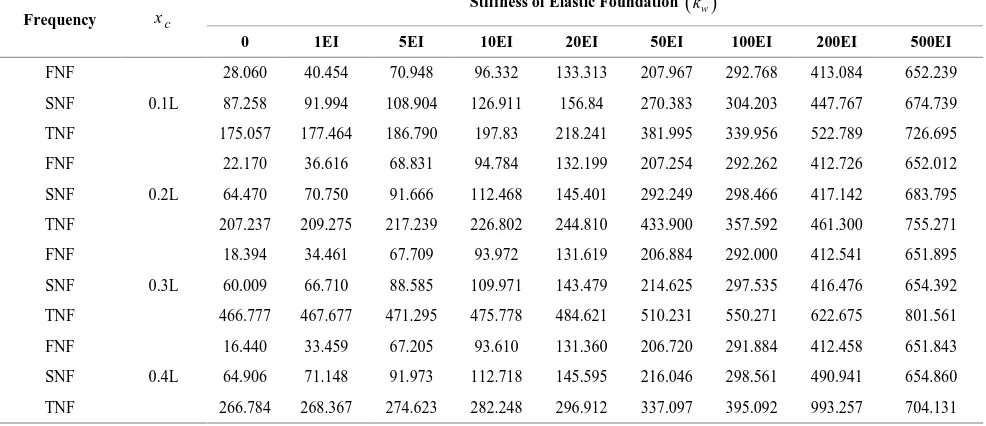
3. 5. The Effects of Stiffness of Elastic Foundation on First Three Natural Frequencies The double simply supported cracked beam on elastic foundation with h'0.7 under concentrated load is exhibited in Figure 7. The beam properties are same as section 3.2. The first three natural frequency in various stiffness of elastic foundation are provided in Table 3.
Figure 5. The deflection of clamped-clamped cracked beam on elastic foundation with various stiffness
Figure 6. The deflection of simply supported cracked beam on elastic foundation with various stiffness
Figure 7. Double-cracked beam with different cracks location
According to Table 3, by increasing stiffness of elastic foundation(kw), natural frequencies enhance. In high value of the stiffness of elastic foundation, the characteristics of simply supported cracked beam are changed.
TABLE 3. The first three natural frequencies of simply supported beam in various stiffness of elastic foundation
Frequency xc
Stiffness of Elastic Foundation
kw0 1EI 5EI 10EI 20EI 50EI 100EI 200EI 500EI
FNF
0.1L
28.060 40.454 70.948 96.332 133.313 207.967 292.768 413.084 652.239
SNF 87.258 91.994 108.904 126.911 156.84 270.383 304.203 447.767 674.739
TNF 175.057 177.464 186.790 197.83 218.241 381.995 339.956 522.789 726.695
FNF
0.2L
22.170 36.616 68.831 94.784 132.199 207.254 292.262 412.726 652.012
SNF 64.470 70.750 91.666 112.468 145.401 292.249 298.466 417.142 683.795
TNF 207.237 209.275 217.239 226.802 244.810 433.900 357.592 461.300 755.271
FNF
0.3L
18.394 34.461 67.709 93.972 131.619 206.884 292.000 412.541 651.895
SNF 60.009 66.710 88.585 109.971 143.479 214.625 297.535 416.476 654.392
TNF 466.777 467.677 471.295 475.778 484.621 510.231 550.271 622.675 801.561
FNF
0.4L
16.440 33.459 67.205 93.610 131.360 206.720 291.884 412.458 651.843
SNF 64.906 71.148 91.973 112.718 145.595 216.046 298.561 490.941 654.860
TNF 266.784 268.367 274.623 282.248 296.912 337.097 395.092 993.257 704.131
4. CONCLUSION
The force and free vibration of multi-cracked beam with elastic support and elastic foundation is investigated
based on Dynamic Green Foundation method in this paper. The natural frequencies of clamped beam in various depth of the crack obtained and compared with Batihan and Kadioğlu investigation the result showed
L
A B
that there are insignificant errors. The deflection and natural frequencies of various boundary condition as well as the various stiffness cracked beam supports studied. As denoted by increasing the stiffness of supports, the natural frequency ascended. The effects of elastic foundation on natural frequencies and deflection studied and the results of simply supported and clamped cracked beam is presented. The results demonstrated that the simply supported double cracked beam is more sensitive than clamped double cracked beam.
5. REFERENCES
1. Bovsunovsky, A. P., Matveev, V. V. "Analytical approach to the determination of dynamic characteristics of a beam with a closing crack", Journal of Sound and Vibration, Vol 235, No. 3, (2000), 415-434.
2. Khiem, N. T., Lien, T. V. A. "Simplified method for natural frequency analysis of a multiple cracked beam", Journal of
Sound and Vibration, Vol 245, No. 4, (2001), 737-751.
4. Kim, J. T., and Stubbs, N. "Crack detection in beam-type structures using frequency data", Journal of Sound and
Vibration, Vol 259, No. 1, (2003), 145-160.
5. Khnaijar, A., and Benamar, R., "A discrete model for nonlinear vibrations of a simply supported cracked beams resting on elastic foundations", Diagnostyka, Vol. 18, No. 3, (2017), 39-46.
6. Chang, C. C., Chen, L. W, "Detection of the location and size of cracks in the multiple cracked beam by spatial wavelet based approach", Mechanical Systems and Signal Processing, Vol. 1, No. 1, (2005), 139-155.
7. Xiang, J. W., Chen, X. F., Li, B., He, Y. M., He, Z. J, "Identification of a crack in a beam based on the finite element method of a B-spline wavelet on the interval", Journal of Sound
and Vibration, Vol 296, No. 4, (2006), 1046-1052.
8. Yoon, H. I., Son, I. S., Ahn, S. J, "Free vibration analysis of Euler-Bernoulli beam with double cracks", Journal of
Mechanical Science and Technology, Vol 21, No3, (2007),
476-485.
9. Sekhar, A. S. "Multiple cracks effects and identification",
Mechanical Systems and Signal Processing, Vol. 22, No. 4,
(2008), 845-878.
10. Xiaoqing, Z., Qiang, H., Feng, L, "Analytical approach for detection of multiple cracks in a beam", Journal of Engineering
Mechanics, Vol 136, No. 3, (2010), 345-357.
11. Deokar, A. V., Wakchaure, V. D. "Experimental Investigation of Crack Detection in Cantilever Beam Using Natural Frequency as Basic Criterion", Institute of Technology, Nirma University, Ahmedabad, (2011).
12. Attar, M., Karrech, A., andRegenauer-Lieb, K., "Free vibration analysis of a cracked shear deformable beam on a two-parameter elastic foundation using a lattice spring model", Journal of
Sound and Vibration, Vol. 333 No. 11, (2014), 2359-2377.
13. Kural, S., Özkaya, E., "Size-dependent vibrations of a micro beam conveying fluid and resting on an elastic foundation",
Journal of Vibration and Control, Vol. 23 No. 7, (2017),
1106-1114.
15. TadiBeni, Y., Jafaria, A., andRazavi, H, "Size effect on free transverse vibration of cracked nano-beams using couple stress theory", International, Journal of Engineering, Transactions
B: Applications, Vol. 28, No. 2, (2015), 296-304
16. Sadeghian, M., EkhteraeiToussi, H., "Frequency analysis for a timoshenko beam located on an elastic foundation", Journal of Engineering, Transactions A: Basics, Vol. 24, No. 1, (2011), 87-105
17. Ranjbaran, A., Hashemi, S., Ghaffarian, A. R., "A new approach for buckling and vibration analysis of cracked column", Journal
of Engineering, Transactions A: Basics, Vol. 21, No. 3, (2008),
225-230
18. Sherafatnia, K., Farrahi, G. H., Faghidian, S. A., "Analytic approach to free vibration and buckling analysis of functionally graded beams with edge cracks using four engineering beam theories", International. Journal of Engineering, Transactions
C: Aspects, Vol. 27, No. 6, (2014), 979-990
19. Nakhaei, A., Dardel, M., Ghasemi, M., andPashaei, M. (2014), "A simple method for modeling open cracked beam",
International Journal of Engineering-Transactions B: Applications, 28(2), 321-329.
20. Zhao, X., Zhao, Y. R., Gao, X. Z., Li, X. Y., Li, Y. H, "Green's functions for the forced vibrations of cracked Euler–Bernoulli beams", Mechanical Systems and Signal Processing, Vol 68, (2016), 155-175.
21. Ghannadiasl, A., Mofid, M,"An analytical solution for free vibration of elastically restrained Timoshenko beam on an arbitrary variable Winkler foundation and under axial load",
Latin American Journal of Solids and Structures, Vol. 12,
No. 13, (2015), 2417-2438.
22. Ghannadiasl, A., Mofid, M, "Dynamic Green function for response of Timoshenko beam with arbitrary boundary conditions", Mechanics Based Design of Structures and
Machines, Vol. 42, No. 1, (2014), 97-110.
23. Abu-Hilal, M., "Forced vibration of Euler–Bernoulli beams by means of dynamic Green functions", Journal of Sound and
Vibration, Vol 267, No. 2, (2003), 191-207.
24. Fernandez-Saez, J., Rubio, L., Navarro, C, "Approximate calculation of the fundamental frequency for bending vibrations of cracked beams", Journal of Sound and Vibration, Vol 225, No. 2, (1999), 345-352.
25. Bilello, C. "Theoretical and experimental investigation on damaged beams under moving systems" (Doctoral dissertation, Ph. D. Thesis, Universitadegli Studi di Palermo, Italy, (2001). 3. Qiang, J., Furman, M. A., Ryne, R. D. "Strong-strong
beam-beam simulation using a Green function approach", Physical
Review Special Topics-Accelerators and Beams, Vol 5, No. 10,
(2002), DOI: 10.1103/PhysRevSTAB.5.104402.
Dynamic Response of Multi-cracked Beams Resting on Elastic Foundation
A. Ghannadiasl, S. Khodapanah Ajirlou
University of Mohaghegh Ardabili, Ardabil, Iran
P A P E R I N F O
Paper history: Received 10 July 2018
Received in revised form 17 August 2018 Accepted 26 October 2018
Keywords:
Crack
Multi-cracked Bea Dynamic Analysis Elastic Boundary Condition Elastic Foundation
هدیکچ
یم ریت ناکم رییغت بیش رد یگتسویپان ندمآ دوجو هب ثعاب ریت لوط رد کرت دوجو .دوش
لیلحت کرت اب ریت یکیمانید یاه
کیتسلاا رتسب یور رب ددعتم رد نیرگ عبات شور زا هدافتسا اب
یهاگ هیکت طیارش اب راد کرت ریت .تسا هدش هعلاطم هلاقم نیا
یم یسررب هعلاطم نیا رد کیتسلاا رتسب نینچمه و کیتسلاا .دوش
رگ عبات ی ن ارب ی ت ی ر ارش اب ی ط کت ی ه هاگ ی هدش لح فلتخم
تسا سناکرف نینچمه و ناکم رییغت یور رب فلتخم یزرم طیارش ریثات و کرت ریت یعیبط یاه
تسا هدش هعلاطم راد هولاع .
ا رب ی ن ، عقوم رد کرت رثا یت
قمع و فلتخم ت ی ر سررب ی یم هاگ هیکت و رتسب یتخس ریثات .دوش ریت یکیمانید خساپ یور رب اه
کرت تسا هدش یبایزرا زین راد و
ارب ی اقم ی هس لاثم ،رتهب یاه ددعتم ی .تسا هدش هئارا