Portfolio optimization with robust possibilistic
programming
Maghsoud Amiri*
*Corresponding author, Prof., Department of Industrial Management, Faculty of management and Accounting, Allameh Tabataba'i University, Tehran, Iran. (Email: [email protected])
Mohammad Saeed Heidary
Ph.D. Candidate, Department of Finance, Faculty of management and accounting, Allameh Tabataba'i University, Tehran, Iran. (Email: [email protected])
Abstract
Portfolio selection is one of the most important financial and investment issues. Portfolio selection seeks to allocate a predetermined capital (wealth) over one or multiple time periods between assets and stocks in a such way that the wealth of investor (portfolio owner) is maximized the risks are minimized. In the paper, we first propose a mathematical programming model for Portfolio selection to maximize the minimum amount Sharpe ratios of portfolio in all periods (max-min problem). Then, due to the uncertain property of the input parameters of such a problem, a robust possibilistic programming model (based on necessity theory) has been developed, which is capable of adjusting the robust degree of output decisions to the uncertainty of the parameters. The proposed model has been tested on 27 companies active in the Tehran stock market. At the end, the results of the model demonestrate the good performance of the robust possibilistic programming model.
Keywords: Portfolio Optimization, Sharpe ratio, Robust Possibilistic Programming.
Introduction
Portfolio formation and diversification of assets are among the most fundamental strategies for reducing and controlling investment risks. A good Portfolio selection with high returns and low risk is demanded by all investors. Hence, there are many models for Portfolio selection and many efforts have been made to improve these models. In fact, Portfolio selection of assets is one of the most important issues in the field of investment management.
Several optimization methods have been developed following Markowitz's innovation and his minimum risk model. These methods have tried to generate the highest quality portfolios in terms of risk and return, by adding more metrics in the target function and intelligent constraints. In recent years, in addition to the optimization of portfolios’ risk and return, the discussion of the sustainability of results and the need for a gradual change in the weight of assets in the investment portfolio has been raised, given the existence of an uncertainty factor in the level of risk and return of financial assets. Also, using stochastic, fuzzy logic and robustification approaches, attempts have been made to optimize the level of uncertainty in addition to achieving the optimal combination of risk and return. Therefore, risk and return both play a vital role in the investment portfolio, so in designing each model for optimization, it is necessary to consider return and risk maximization in the target function simultaneously. This can be done in the form of a Multi-objective function or by targeting a measurement in a function that is a combination of risks and returns and to target the measurement of maximization/minimization. One approach is using sharpe; that is, a measurement having a risk and return at the same time. Therefore, the Sharpe statistics/ratio was selected.
: Portfolio return
: Risk-free rate of return
: Portfolio Standard deviation (risk measurement)
function is not known, and it is necessary to use Chebyshev inequality, where even the worst types of distributions (distributions with negative skewness, etc.) can be applied to the model, and inject robustification to the model in practice.
In another aspect, due to the competitive and risky space in the stock market, decision-making is often faced with a lack of information or uncertain information; therefore, the model programming should take this into account. Robust optimization is presented in recent years to deal with uncertainty, in which the optimization is addressed when the worst happens. The Robust approach was proposed to solve optimization problems with data uncertainty and has recently been widely explored and developed. The main advantages of this approach are as follows (Alem, Morabito, 2012):
1. Robust optimization is easier than the probabilistic approach in terms of solving the model.
2. There is no need for clear knowledge of the possibilistic distribution of data with uncertainty.
In the subject matter discussed in this paper, due to the incompleteness and unavailability of information, we face uncertainty in data that is of a kind of epistemic uncertainty (Asadujjaman,2019), therefore, robust possibilistic programming has been used to model the problem. It is superior to possibilistic programming for the following reasons:
1. In robust optimization, the confidence level of constraint satisfaction is determined by the model itself and its value is optimal,
2. In robust optimization, the final answer has Optimality Robustness and Feasibility Robustness
3. Considering the objective function deviations due to the uncertainty of the parameters, it avoids heavy and irreparable costs for managers and investors. In the case of possibilistic programming, the following issues are not taken into consideration.
Background and Literature review
So far, many research have been done in the optimization of stock portfolios due to the increasing development of global financial markets and the impact of this optimization on economic returns and profits.
In 2009, Huang used the combination of Fuzzy c-means (FCM), a variable-precision rough set (VPRS) model, Autoregressive with exogenous input (ARX) and a gray-system theory for Portfolio selection investing.
with integer constraints and the market share of various industries to optimize Markowitz's MV model.
Chang et al. (2009) introduced a genetic algorithm to solve optimization problems with different risk measurements on the model.
Tiriaki et al. (2009) combined the fuzzy AHP with Portfolio selection. The main approach in AHP was to design and implement a model for combining corporate risk behavior with the investor risk class (low, medium and high), investor goals and internal and external factors.
Montazar et al. (2010) proposed a method for designing a fuzzy expert system for recommending and introducing investment portfolios in the Tehran Stock Exchange.
Zymler et al. (2011) combine a robust optimization portfolio with a classic insurance portfolio model to cover risks from rare events.
Sajjadi and Seyyed Hosseini (2011) proposed a multi-period dynamic fuzzy model for Portfolio Selection of stocks, in which borrowing and lending are possible in real terms (different rates of cash borrowing and lending).
Jun and Lu (2012) used a Mini-Max -based robust ranking model in integer programming.
The constraints in this model are generated using a network streaming model, and ultimately used for portfolio optimization.
Looking deeper into robust investment portfolios, Fabozzi et.al. (2014) analyzed the behavior of these portfolios formed with Robust Optimization. Their research suggested that by increasing robust optimization of investment, optimal weights would be directed towards that portfolio, whose variance is described to the highest by specific factors.
Wu Chang Kim et al. (2014) introduced a new approach to the robustation portfolio of the minimum variance to control the kurtosis and skewness (third and fourth torque) without the aid of higher torques. The main idea in this article is that the robust investment portfolio, in the worst-case scenario, is prone to skewness and opposed to kurtosis.
Pishvaee, Razmi, and Torabi (2012) used robust possibilistic programming to design a supply chain.
Millt and Takkapi (2015) presented robust models to meet the needs of investors looking for a global minimum variance portfolio and a rule against robust uncertainty.
In this paper, the Monte Carlo simulation showed the robust portfolio superiority to unrobust portfolios in different dimensions of the risk and variance based adjusted return. They found that the robust investment portfolio had a minimum variance, lower turnover, and a Sharpe ratio compared to traditional portfolios.
Zulfagar and Ayoub (2015), based on a study conducted on the Karachi stock exchange in the area of using the robust downside index, showed that the use of this statistics, especially in relation to assets whose curtailment curves are greater than those of kurtosis, are much better performing compared to Markowitz's Mean-Variance Model.
Balabas and Balabas (2016) put forward the concept of ambiguity with risk in their paper to create a robust portfolio optimization model, and in particular to solve the shortcomings of capital asset pricing models.
Han, Zia and Lee (2016) developed the robust asymmetric model of the absolute mean standard deviation that covers asymmetry in the returns distribution.
They tested various strategies for robustification in emerging markets and falling markets and showed that the model was able to identify lucrative stocks.
In the recent period, and since 2009, Some important points of foreign research include:
A) Among the researches, the use of the Sharpe index as a performance measurement was very high and had a significant difference with other methods. The most significant measurements are CVAR, Torque, kurtosis, Alpha and Treynor ratio.
B) Mathematical modeling, Fuzzy logic, and genetic algorithm are the most widely used algorithms to optimize portfolios of assets. Other algorithms include particle swarm optimization approach, quadrilateral programming model, expert system methodology and goal programming.
Research gap
financial field has made it impossible to achieve such a model, since any model of a universal nature will change the behavior of investors in financial markets and ultimately reduce the performance of the model.)
The development of new Investment Portfolio Selection approaches and models with more comprehensiveness that deals with diffrences, conflicts and is more flexible in dealing with the risk phenomenon (goals (with no definitive means to measure it)) is a perpetual gap.
The research also aims to develop a new model with Robust Optimization and Fuzzy Logic as the goal of Investment Portfolio Selection.
The question now is, what method for portfolio design (in terms of type, volume, and number of financial assets used in the portfolio) should be used in this model, which can maintain its credibility and efficiency over an acceptable time frame, despite the ongoing Volatilities of financial markets.
None of the research on stock portfolio programming in uncertainty has used the robust possibilistic programming approach to deal with this issue. Using this approach will make the model responses determined so that the feasibility robustness and optimality robustness are guaranteed and, consequently, the cost of implementing real-world decisions are reduced. Therefore, sources of uncertainty in the stock market should be effectively managed. And, in order to manage the uncertainty surrounding this environment and to have sufficient confidence in the results, robust programming must be done so that managers can be sure of their results and reduce the risk of their decision making. Programming robust is one of the new and reliable approaches.
Research methodology
Dantzig et al. (1993) proposed a standard framework for multi-period asset allocation problems. They assume risky assets in the capital market; trading periods, linear transaction costs for trading stock and one riskless asset e.g. risk-free deposit, and we have used this framework for portfolio making and objective function based on sharpe ratio.
Non-deterministic model of stock portfolio optimization
are not definite numbers and are predictable fuzzy numbers. Given the dynamic nature and Volatility of some of the important parameters (Sharpe ratio and stock return), the following equations provide a method for modeling imprecise parameters, and can be defined by their four prominent points (Pishvaee et al. 2012):
̃ ( ( )، ( )، ( )، ( ))
̃ ( ( )، ( )، ( )، ( ))
̃ represents the fuzzy sharpe ratio in time period t, and ̃ represents fuzzy rate of return in time period t
The robust possibilistic programming model
The evaluation of definitive parameters for long-term decision-making is difficult and sometimes impossible. Even if one could estimate a possibilistic distribution function for these two parameters, these parameters may not have the same behavior as the past data. Different approaches, including possibilistic programming, have been used to address the uncertainty. It should be noted that the uncertainty parameters are suited for the possibilistic functions, such as triangular or trapezoidal possibilistic functions, based on inadequate data or knowledge and experience of modeling decision makers. Therefore, in this paper, uncertain parameters are considered as fuzzy data at any time when it changes in a long-term programming horizon. If the possibilistic programming method is used, in order to control the level of confidence in creating these uncertain limits, the concept of decision can achieve the minimum level of assurance as a safe margin for any of these constraints. To do this, two fuzzy standard methods and practices are commonly used. It is worth noting that the optimistic fuzzy (NEC) indicates the optimistic probability level of an uncertain event involving uncertain parameters, while the pessimistic fuzzy (POS) indicates a pessimistic decision about an uncertain event. However, it is more conservative to use a pessimistic fuzzy, that is, we assume that the decision has a pessimistic (conservative) constraint to create uncertainties; Currently, based on the ambiguous parameters mentioned and the use of the expected value for the objective function and the pessimistic action for uncertain constraints, the obvious equivalent of the uncertain model can be formulated. To do this, one must first consider the abbreviation for the proposed model (tanaka,2000):
(1)
(2)
(3)
(4)
(5)
{ ، }، ،
It is assumed that vectors and are presented in the non-deterministic parameters in the above model. Regarding the generic non-deterministic finite program, the expected value of the pseudo-objective and fuzzy function is obtained, respectively, for dealing with the objective function and the uncertain limit. Now with the abbreviation, the basic possibilistic programming model is as follows:
(6)
(7)
{ ̃ }
(8)
{ ̃ }
(9)
(10)
، ، ،
In which β and α control the minimum degree of certainty for establishing a non-deterministic constraint with a pessimistic decision-making approach. Regarding the distribution of the trapezium probability for ambiguous parameters, the general form of relations 6-10 can be defined as follows (tanaka,2000):
(11)
(12)
(( ) )
(13)
(( ) ( ) ( ) ( ))
(14)
(15)
(16)
، ، ،
In the possibilistic programming models, the minimum level of confidence to establish a non-deterministic constraint should be determined in terms of decision preferences. As seen, in the proposed model, the objective function is not sensitive to the deviation from its expected value, which means that gaining robust solutions in the possibilistic programming model is not guaranteed. In such cases, there may be a high risk in many real cases of decision-making, especially in strategic decisions that the robustness of the solution is vital. In fact, possibilistic programming has important shortcomings. In probabilistic programming, the constraint satisfaction level is a parameter determined by the decision maker, which does not optimize the confidence level. In the possibilistic programming model, there is little interest in the feasibility of robustness and optimality robustness. On the other hand, the lack of attention to the deviations of the objective function due to the uncertainty of the parameters can lead to irreversible costs for managers and organizations, and this must not be considered in possibilistic programming. Therefore, Pishvaee et al. (2012) proposed a robust optimizing program called robust possibilistic programming using the concept of robust optimization. This approach takes advantage of both robust optimization and possibilistic programming, which clearly distinguishes it from other programming uncertainty approaches. The robust possibilistic programming form in the previous model is as follows:
(17)
( ( ) )
( ( ) ) ( ( ) )
(18)
(( ) )
(19)
(( ) ( ) ( ) ( ))
(20)
(( ) ( ) ( ) ( ))
(21)
(22)
، ، ،
(23)
In the first objective function, equation 17 of the first expression refers to the expected value of the first objective function, using the mean values of the non-deterministic parameters of the model. The second, third, and fourth lines indicate the total cost of the deviation from the non-deterministic parameter. Hence, the parameter ξ is the weight function of the objective function, η1, and η2, the penalty for not estimating the uncertainty parameter.
The parameters β and α represent the correction factor at the fuzzy numbers, based on pishvaee (2012) which should be between 0.5 and 1.
research findings
In this section, a dynamic model is designed to invest in a limited number of financial assets (Tehran Stock Exchange and risk-free deposits) over a period of time and with a specified cash budget and at the end of each period on the basis for risk and return data, investments reviewed, some sold, and some new assets purchased. One of the best benchmarks and measurements for the selection of a mass of stocks and financial assets is the Sharpe ratio of each share/asset. In order to achive real diversification, the weight assigned to each share in the portfolio of investment placed in a certain range (Floor and ceiling) (fabozzi,2007) has been determined, and we have attempted on designing and presenting a conservative portfolio consistent with the facts of real capital markets.
Definitive modeling
Sharpe ratio of ith share in the time period t
Return of ith share in the time period t
Cash profit (risk free deposit) in the time period t
( )
The maximum weight of the share 𝑖th in the portfolio in the time period t
The minimum weight of the share 𝑖th in the portfolio in the time period t
Number of authorized shares in the portfolio
Purchase fee (about 0.5% of transaction value)
Decision variable
Continuous variable
Weight of ith share in the time period t
Cash amount in the time period t
( )
Standard deviation of portfolio in time period t
Weight of ith share in the time period t (The result of the
∑ )
Sale amount of ith share in the time period t
Purchase amount of ith share in the time period t
Binary variable, (if = 1 then >0, and F_it = 0 then
=0)
(24)
( ∑ ( )
√∑ ∑ ( )
)
(25)
∑
، ، ، ، ، 𝑖 ، ، ،
(26)
( ( )) ( ) ، ، ، ، ، 𝑖 ، ، ،
(27)
( ) ( ( )( )) ( )( ) ∑( )
∑( )
،
، ، ،
(28)
∑
، ، ، ،
(29)
( ) =1000
(30)
، ، ، ، ، ، ، 𝑖 ، ، ،
(31)
Relation 24 represents the objective function of the model. Constraint 25 specifies that the weight of each share must not exceed the set minimum and maximum values. Constraint 26 defines the weight of each share in each period, based on the share weight in the previous period and the amount of the transaction.
Constraint 27 specifies the amount of cash. Constraint 28 specifies upper and lower bound of the number of shares to be selected per period, Constraints 30 and 31 also specify the range of decision variables.
(32)
(33)
∑ ( )
√∑ ∑ ( )
، ، ، ،
(34)
∑
، ، ، ، ، 𝑖 ، ، ،
(35)
( ( )) ( ) ، ، ، ، ، 𝑖
، ، ،
(36)
( ) ( ( )( )) ( )( ) ∑( )
∑( )
،
، ، ،
(37)
∑
، ، ، ،
(38)
( ) =1000
(39)
، ، ، ، ، ، ، 𝑖 ، ، ،
(40)
، ، ، ، ، 𝑖 ، ، ،
The proposed robust possibilistic programming model for stock portfolio optimization
The purpose of this section is to allow constraint 55 to exceed a certain level. Given that a pessimistic fuzzy is used to ensure greater reliability, then relation 55 is converted as follows:
(41) (∑ ∑ ̃
According to the above, the robust possibilistic programming model is as follows:
(42) MAX) y ( ∑ ( )
√∑ ∑ ( )
( ) ∑ ( )
√∑ ∑ ( )
∑ ( )
√∑ ∑ ( ) ))
s.t
(43) ∑ ( )
√∑ ∑ ( )
+(1- )* ∑ ( )
√∑ ∑ ( )
,
، ، ، ، 𝑖 ، ، ،
(44)
∑
، ، ، ، ، 𝑖 ، ، ،
(45)
(( ) ( ( )) ( ) ( ( ))) ( )
، ، ، ، ، 𝑖 ، ، ،
(46)
(( ) ( ( )) ( ) ( ( ))) ( )
، ، ، ، ، 𝑖 ، ، ،
(47)
( ) ( ( )( )) ( )( ) ∑( )
∑( )
، ، ، ،
(48) ∑
(49)
( ) =1000
(50)
، ، ، ، ، ، ، 𝑖 ، ، ،
(51)
، ، ، ، ، 𝑖 ، ، ،
(52) ،
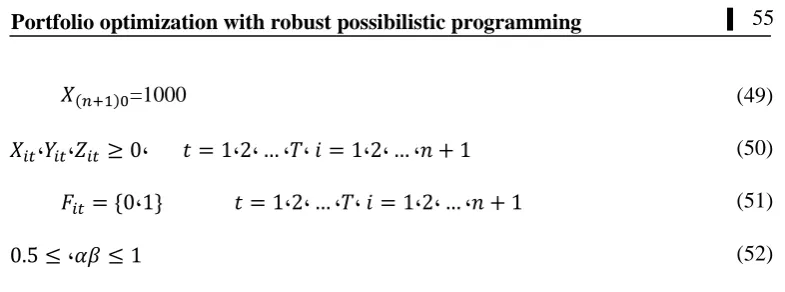
Relation 42 shows the objective function of robust possibilistic based on the proposed model. Constraints 43, 45 and 46 are also rewritten according to robust possibilistic programming rules. Other constraints are the same as the proposed definitive model.
Computational results
In this section, at first, 27 companies active on the iran stock market were selected in 6 time periods(weekly) for problem-solving. The model was solved using GAMS software and BONMIN Solver and with the help of the 3 GB RAM, the Core 2 Duo CPU system and the outputs of the problem are also shown. The sensitivity analysis was performed on some of the parameters of the model and the objective function and decision variables were compared. This sensitivity analysis has two main objectives: a) Creating managerial insights and new scientific achievements; b) Ensuring the validity of the model (Sensitivity analysis on some parameters does not really mean much and does not lead to new knowledge. But this analysis and observing the change in the value of the objective function help us make sure that his model is valid and not technically problematic.)
Problem-Solving in a Real Sample of Companies in Stock market
Table 1. The definitive parameters used in problem-solving
Parameter Value Parameter Value
Number of authorized shares per Portfolio
5 Purchase fee 0.005
The maximum weight of the share 0.5 Sales fee 0.006
The minimum weight of the share 0.1 Initial investment 1000 According to table 1, the maximum objective function in the above problem is 1520.056.
Sensitivity analysis
Number of authorized shares per portfolio
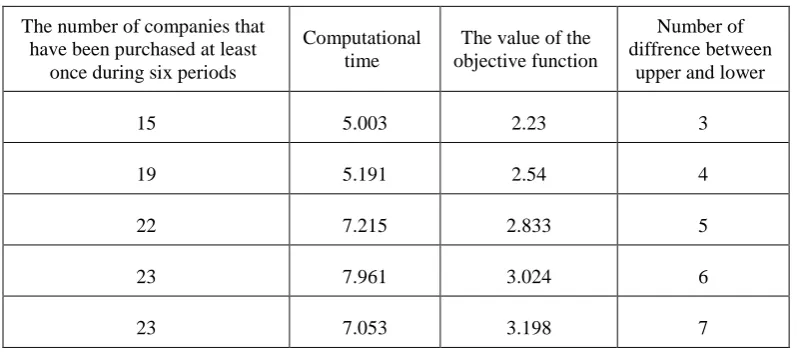
Initially, the sensitivity of the problem is analyzed on the difference between minimum and maximum number of authorized stocks in each portfolio. Thus, the objective function and the computational time are shown in Table 3.
Table 2. Changes in the amount of objective function and computational time by changing the difference between upper and lower number of authorized stocks
Number of diffrence between
upper and lower The value of the
objective function Computational
time The number of companies that
have been purchased at least once during six periods
3 2.23
5.003 15
4 2.54
5.191 19
5 2.833
7.215 22
6 3.024
7.961 23
7 3.198
7.053 23
Figure 1. Change the objective function value by changing the difference between upper and lower number of authorized stocks
Figure 2. Chart of total companies by changing the difference between upper and lower number of authorized stocks
2.23
2.54
2.833 3.024
3.198 0 0.5 1 1.5 2 2.5 3 3.5
3 4 5 6 7
Th e valu e o f th e o b jec tiv e fu n ctio n
Number of diffrence between upper and lower
15
19
22 23 23
0 5 10 15 20 25
1 2 3 4 5
Th e n u m b er o f co m p an ie s th at h av e b ee n p u rch ase d a t le ast o n ce d u rin g s ix p eriod s
Risk-free rate of return
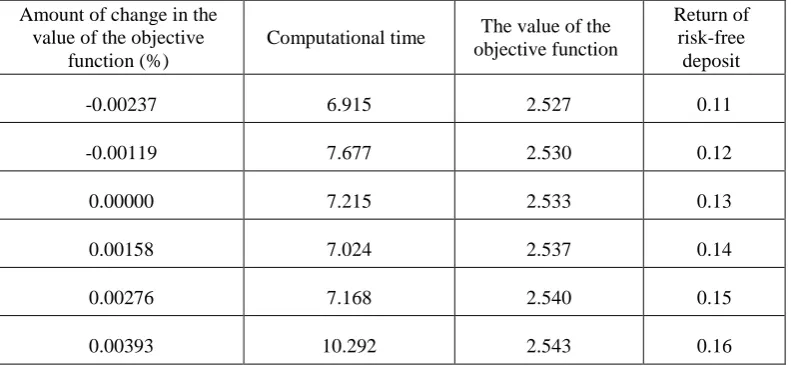
In the remainder of this section, with the assumption of constant consideration of 5 shares in each portfolio of purchases in each time period, the objective function and the computational time of the problem solving are calculated by changing the risk-free rate of return. Table 3 shows the changes in these indicators in different amounts of the risk-free rate of return.
Table 3. Change the value of the objective function and computational time by changing the risk- free rate of return
Return of risk-free
deposit The value of the
objective function Computational time
Amount of change in the value of the objective
function (%)
0.11 2.527
6.915 -0.00237
0.12 2.530
7.677 -0.00119
0.13 2.533
7.215 0.00000
0.14 2.537
7.024 0.00158
0.15 2.540
7.168 0.00276
0.16 2.543
10.292 0.00393
Figure 3. Change in the percentage of total profit by changing the risk-free rate of return
Uncertainty rates
Due to the nature of possibilistic Robust optimization model, the uncertainty rate is implemented as a decision variable in modeling, which is included in the objective function and computational time calculated in β and α between 0.5 and 1. This section is shown in Table 4 by changing the uncertainty rate.
Table 4. Change the value of the objective function and computational time by changing the uncertainty rate
The value of the objective function Computational time 0.9 0.5 0.850 6.173 0.6 0.852 5.374 0.7 0.854 5.844 0.8 0.856 5.125 0.9 0.858 5.721 1 0.860 6.337 0.95 0.5 1.553 3.985 0.6 1.552 4.146 0.7 1.550 4.879 0.8 1.549 4.457 0.9 1.548 4.15 1 1.547 4.436 1 0.5 2.533 7.215 0.6 2.528 8.552 0.7 2.523 6.113 0.8 2.518 6.555 0.9 2.513 6.148 1 2.508 7.421 -0.00300 -0.00200 -0.00100 0.00000 0.00100 0.00200 0.00300 0.00400 0.00500
0.11 0.12 0.13 0.14 0.15 0.16
A mo u n t o f ch an ge in T h e va lu e o f th e o b je cti ve fun cti o n (% )
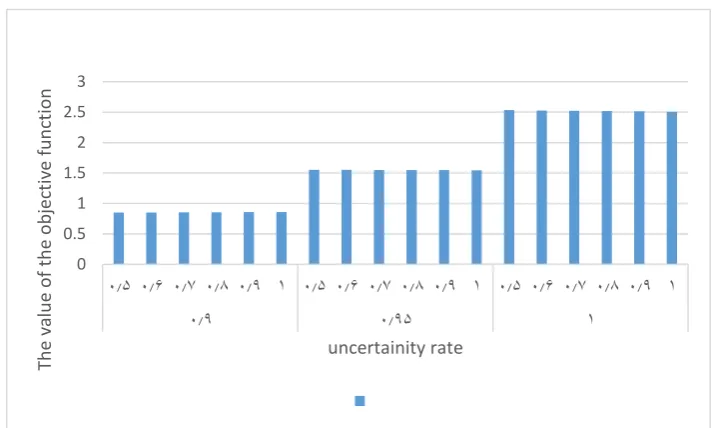
According to the results of Table 4, the maximum profit earned in the uncertainty rate α and β is 1 and 0.5, respectively. Figure 4 shows the trend of variations in the objective function value at different rates of uncertainty.
Figure 4. Change the value of the objective function with changes in uncertainty rate
Conclusion and suggestions
In today's competitive atmosphere, it's important and essential to design a robust model for stock portfolio selection. Over the past decades, sudden Volatilities and the issue of coping with their adverse effects on the stock market have become a major challenge for financial managers of organizations or investors. Due to the uncertain nature of input parameters in the stock market, in this paper, we have developed a new robust possibilistic programming model based on the Sharpe ratio to deal with the uncertainty of the parameters and the low quality of the decisions made by this factor. In the following, a real problem based on the fuzzy data of 27 companies active in the stock market have been presented to show the performance of the proposed model, as well as the high-performance and functionality of the robust possibilistic programming model. Finally, it's worth noting that according to the outputs of the model, determining the exact amount of fines (penalty) in the possibilistic programming model is very important because fines are the main factor in the performance of the model and the determination of the confidence levels of non-deterministic parameters.
0 0.5 1 1.5 2 2.5 3
0.5 0.6 0.7 0.8 0.9 1 0.5 0.6 0.7 0.8 0.9 1 0.5 0.6 0.7 0.8 0.9 1
0.9 0.95 1
Th
e
valu
e o
f
th
e o
b
jec
tiv
e
fu
n
ctio
n
Other robust optimization approaches can also be used in future research. One can also use the opinions of various experts to increase the credibility of describing the sensitive parameters.
References
Alem, D. J., Morabito, R., (2012), "Production planning in furniture settings via robust optimization", Computers & Operations Research 39 (2),139-150.
Chang, T. J., Yang, S. C., & Chang, K. J. (2009)." Portfolio optimization problems in different risk measures using genetic algorithm". Expert Systems with Applications, 36(7), 10529-10537
Dantzig G, Infanger G (1993). “Multi-stage stochastic linear programs for portfolio optimization”. Ann. Oper. Res., 45(1): 59-76.
Fabozzi ،frank j. kolm ،petter n. pachamanova ،dessislava a. focardi ،sergio m. 2007. Robust Portfolio Optimization and Management ،John Wiley & Sons ،Inc.
Garman M.B., M.J. Klass, (1980), "On the Estimation of Security Price Volatility from Historical Data", Journal of Business, 53(1), 67-78.
Holland, J. H. (1992). "Adaptation in natural and artificial systems: an introductory analysis with applications to biology, control, and artificial intelligence". MIT press.
Huang, K. Y. (2009). "Application of VPRS model with enhanced threshold parameter selection mechanism to automatic stock market forecasting and portfolio selection". Expert Systems with Applications, 36(9), 11652-11661
Markowitz,H. (1952) "Portfolio selection," Journal of Finance, 7(1), 77–91. Md. Asadujjaman, Kais Zaman (2019) “Robustness-based portfolio optimization under epistemic uncertainty” Journal of Industrial Engineering International June 2019, Volume 15, Issue 2, pp 207–219
Montazer, G. A & Fasanghari, M. (2010). "Design and implementation of fuzzy expert system for Tehran Stock Exchange portfolio recommendation", Expert Systems with Applications, 37(9), 6138-6147.
Nils H Hakansson , (1971)" Multi-Period Mean-Variance Analysis: Toward A General Theory of Portfolio Choice ", Journal of Finance, 26(4), 857-84
Parkinson M., (1980), "The Extreme Value Method for Estimating the Variance of the Rate of Return", Journal of Business, 53(1), 61-65.
Pishvaee, M.S., Razmi, J., and Torabi, S., (2012), "Robust possibilistic programming for socially responsible supply chain network design: A new approach", Fuzzy sets and systems 206, 1-20
S.J. Sadjadi, S.M. Seyedhosseini, Kh. Hassanlou (2011), " Fuzzy multi period portfolio selection with different rates for borrowing and Lending", Applied Soft Computing 11, 3821–3826
Quantitative Analysis, 2(2), 76-84
Sharpe, w (1963)."a simplified model for portfolio analysis" management science, 9, 277-293
Soleimani, H., Golmakani, H. R., & Salimi, M. H. (2009). "Markowitz-based portfolio selection with minimum transaction lots, cardinality constraints and regarding sector capitalization using genetic algorithm". Expert Systems with Applications, 36(3), 5058-5063.
Tiryaki, F., & Ahlatcioglu, B. (2009). "Fuzzy portfolio selection using fuzzy analytic hierarchy process". Information Sciences, 179(1), 53-69.
Taguchi, G., Chowdhury, S., & Taguchi, S. (2000). "Robust engineering: learn how to boost quality while reducing costs & time to market". McGraw-Hill Professional Pub.
TANAkA, H., GUO, P., TURKSEN, B., (2000). "Portfolio selection based on fuzzy probabilities and possibility distributions", Fuzzy sets and systems 111 (3), 387– 397.
Wu, J. CF and Hamada, M.(2000). "Experiments: Planning, analysis, and parameter design optimization." Wiely &sons, Inc. Hoboken, new jersey
Woo ChangKim, Jang HoKim, Frank J.Fabozzi (2014), " Deciphering robust portfolios ", Journal of Banking & Finance 45, 1-8
Woo Chang Kim, Frank Fabozzi (2014), "Controlling portfolio skewness and kurtosis without directly optimizing third and fourth moments", Economics Letters, 122(2), 154-158
Zymler, S., Rustem, B., & Kuhn, D. (2011). Robust portfolio optimization with derivative insurance guarantees". European Journal of Operational Research,210(2), 410 -424.
Bibliographic information of this paper for citing:
Amiri, Maghsoud & Heidary, Mohammad Saeed (2018). Portfolio optimization with robust possibilistic programming. Iranian Journal of Finance, 2(4), 41-63.