One Health: much more than a slogan
Robert Hall
A,Cand David N. Durrheim
BA
School of Public Health and Preventive Medicine, Monash University
B
Hunter Medical Research Institute
C
Corresponding author. Email: [email protected]
We are in an era when public health slogans abound; we have had ‘the new public health’, ‘emerging infectious diseases’, and now ‘One Health’ joins this lexicon.
So, what is ‘One Health’? How does this concept help us think through, and perhaps solve, public health problems? One Health places disease, particularly infection, in a broad ecological context. Many agents of infection target hosts beyond humans, and One Health seeks to understand and explain the public health implications of broad host ranges.1 One Health is a modern restatement of the old epidemiologi-cal triad of host, agent and environment.
It has long been known that many infections cross the species barriers between humans, domesticated animals and wildlife. Our view of this has traditionally been some-what compartmentalised; those who work in food produc-tion and regulaproduc-tion are aware of the importance of
Salmonellainfections and how modern intensive
agricul-ture, food production, trade and marketing interact to deter-mine their epidemiology. The more complex interactions between domesticated animals and wildlife that govern the spread of well-known infections such as influenza, rabies, Ross River and other arbovirus infections, and newly recognised infections such as Nipah and Hendra virus infection still tease expert minds.2
There are some specific puzzles. What determines pathoge-nicity of agents, with species specificity? What, in particu-lar, makes bats an efficient vector of so many newly described infections? How do we determine whether an agent is a true pathogen? What factors determine whether an infection will cross a species barrier? What measures will most effectively limit the burden placed on veterinary and human health? The solutions to these problems will come
only from cross-disciplinary work involving epidemiolo-gists, epizootiologists of both wild and domesticated ani-mals, veterinarians, public health practitioners, laboratory scientists and clinicians.
The One Health concept is focused on infectious diseases and their transmission. However, this is not the only way that health can be affected across species. To date, we have focused largely on animal infection, but microbiological and plant infections also impact health. An example of a cross-species impact on health was potato blight with its first impact directly on plants, and a second impact through starvation of humans. Global warming is also predicted to have an enormous impact on agricultural production (most of which will not be due to infection), while having a secondary health impact on humans.
The One Health concept has largely been the domain of microbiologists and wildlife ecologists. More exploration and discussion of the epidemiological and epizootiological background is needed to characterise the importance of these infections to human and animal public health. This special edition of the NSW Public Health Bulletin begins to explore One Health issues of recent or emerging impor-tance in New South Wales. Adamson et al reflect on the level of coordination that already exists between state health, veterinary and primary industry players, and Dwyer et al demonstrate how this partnership strengthened the response to the 2009 influenza pandemic and calls for expansion of these collaborative efforts. Hendra virus is a classic example of an emerging infectious disease with potentially profound human and animal health consequences, and Hess et al provide practical management advice while highlighting the need for a One Health partnership to gain a better understanding of this virus and its ecology. Paterson et al argue that current surveillance systems do not provide reassurance for early detection and characterisation of emerging pathogens that present with an encephalitis syn-drome. Their argument for a standardised algorithm for diagnostic work up would allow the remarkable develop-ments in virological science, elucidated by Wang, to rapidly
CONTENTS – See back page w w w . p u b l i s h . c s i r o . a u / j o u r n a l s / p h b
NSW PUBLIC HEALTH
BULLETIN
characterise new pathogens, to be harnessed for directing human and veterinary public health action.
NSW Health staff recently contributed to the first Interna-tional One Health Congress. Box 1 contains a link to the Congress website where copies of the papers presented are available for further information. Also presented is a glossary to assist the reader with terms that are used in this issue (Box 2).
Emerging disease threats demand a team approach that capitalises on the complementary expertise and knowledge of animal and human health professionals. The One Health approach has the potential to improve the lives of all species, whether human or animal.
An update on Hendra virus infection from the Editors
Hendra virus infection is carried by Flying-foxes in Australia. Occasionally the infection is passed to horses, presumably through exposure to virus excreted by Flying-foxes. There have been seven human infections with Hendra virus (including four deaths) identified in Australia to date, all following significant exposures to infectious horses. No human infections have followed direct expo-sure to a Flying-fox or another person with the infection.
On 1 July 2011, the NSW Department of Primary Industries reported a confirmed case of Hendra virus infection in a horse that had died on a property near Wollongbar on the NSW North Coast. On 6 July, the Department of Primary Industries reported a second unrelated Hendra virus infec-tion in a horse that died on a property near Macksville on the Mid North Coast. The horses were buried and the properties placed in quarantine. Several Queensland properties were also quarantined around the same time following confirma-tion of unrelated Hendra virus infecconfirma-tions in horses there.
Nine people were identified as having potential contact with the first NSW horse while it was potentially infec-tious, and six with the second horse. NSW Health urgently convened expert panels including public health and infec-tious disease expertise from NSW and Queensland after the diagnosis was confirmed in each horse and the contacts
had been interviewed. The panels evaluated the risk of infection to each person based on their exposures to the horses according to national protocols (see: http://www. health.nsw.gov.au/factsheets/guideline/hendra.html).
All 15 potential contacts were assessed as having had either no, negligible, low or medium level risk of exposure to the infectious horses. All previous human Hendra virus infec-tions have occurred following high level exposures to infected horses. North Coast Public Health Unit staff coun-selled contacts about their risk and the disease, and initiated symptom monitoring for the incubation period for Hendra virus infection in humans (3 weeks from last exposure).
For further information on Hendra virus infection see: http://www.dpi.nsw.gov.au/agriculture/livestock/horses/ health/general/hendra-virus and http://www.health.nsw. gov.au/factsheets/infectious/hendra.html
References
1. Heymann DL. Social, behavioural and environmental factors
and their impact on infectious disease outbreaks.J Public Health
Policy2005; 26(1): 133–9. doi:10.1057/palgrave.jphp.3200004 2. Kahn LH. Confronting zoonoses, linking human and veterinary
medicine.Emerg Infect Dis2006; 12(4): 556–61.
Box 1. The first International One Health Congress
The first International One Health Congress was held in
Melbourne on 14]16 February 2011 with the aim of exploring
the interdependencies between human, animal and wildlife health. Over the 3 days of the Congress, about 150 papers were presented on these issues, and the Congress concluded that a practical program of collaboration was needed to address the scientific, policy and social questions raised by these interdependencies.
An overview of the Congress and copies of the papers are
available at the Congress website at: http://www.
onehealth2011.com/index.php
Box 2. Glossary of terms used in this issue
Ardeid waterbirds: the Ardeidae family of birds encompass the herons, egrets, night herons and the bitterns. They are geographically widespread and are found on all continents (except Antarctica) and islands around the world. These birds feed in water and usually live in wetlands, including swamps but also near tidal areas and streams. They like to roost and build their nests in trees. (http://tolweb.org/Ardeidae/26331) Enzootic: of, relating to, or denoting a disease that regularly affects animals in a particular district or at a particular season. (Oxford Dictionary)
Epizootiology: the study of the character, ecology and causes
of outbreaks of animal diseases. (Webster Medical Dictionary)
Novel virus: newly discovered virus.
One Health: the collaborative effort of multiple disciplines]
working locally, nationally and globally]to attain optimal
health for people, animals and our environment. (American Medical Veterinary Association)
Vector: in infectious disease epidemiology, an insect or any living carrier that transports an infectious agent from an infected individual or its wastes to a susceptible individual or its food or immediate surroundings. The organism may or may not pass through a developmental cycle within the vector. (A Dictionary of Epidemiology, 4th edition]John M. Last) Zoonosis: an infection or infectious disease transmissible under natural conditions from vertebrate animals to humans. Examples include rabies and plague. May be enzootic or
A review of the epidemiology and surveillance
of viral zoonotic encephalitis and the impact
on human health in Australia
Beverley J. Paterson
A,E, John S. Mackenzie
B,C,
David N. Durrheim
Aand David Smith
DA
School of Medicine and Public Health, Faculty of Health, The University of Newcastle
B
Faculty of Health Sciences, Curtin University
C
The Burnet Institute, Melbourne
D
Division of Microbiology and Infectious Diseases, Western Australian Centre for Pathology and Medical Research
E
Corresponding author. Email: beverley.paterson@hnehealth. nsw.gov.au
Abstract:Human encephalitis in Australia causes substantial mortality and morbidity, with frequent severe neurological sequelae and long-term cog-nitive impairment. This review discusses a number of highly pathogenic zoonotic viruses which have recently emerged in Australia, including Hendra virus and Australian bat lyssavirus which present with an encephalitic syndrome in humans. Encephalitis surveillance currently focuses on animals at sentinel sites and animal disease or definitive diagnosis of notifiable conditions that may present with encephalitis. This is inadequate for detecting newly emerged viral encephalatides. Hospital-based sentinel surveillance may aid in identifying increases in known pathogens or emer-gence of new pathogens that require a prompt public health response.
Human encephalitis causes substantial morbidity and mor-tality in Australia, frequently resulting in severe neurolog-ical sequelae and long-term cognitive impairment. While herpes simplex virus is the most commonly identified causative pathogen, the majority of adult encephalitis hospitalisations (70%, range 62–79%) have no specific pathogen identified1 and an increasing proportion of encephalitis deaths are due to ‘unknown’ causes – from 47% between 1979 and 1992 to 57% between 1993 and 2006.2 Recently emerged or resurging pathogens
in Australia, including Murray Valley encephalitis virus, West Nile virus (Kunjin clade), Japanese encephalitis virus, Hendra virus and Australian bat lyssavirus, cause a human encephalitis syndrome; consequently, encephalitis surveillance may be useful for signalling the emergence of novel infectious diseases, particularly viral zoonoses that may impact on human health.
Emerging infectious diseases pose a substantial threat in Australia and globally due to increased urbanisation, climate change, new farming practices, virus re-assortment and changes in human behaviours.3–5The close interaction between animals and humans has provided opportunities for viruses to jump between species with 60% of known human infectious diseases and 75% of emerging infectious diseases being of animal origin.5,6A One Health approach, which recognises the interdependence of human and ani-mal health and the environment, is required to improve the surveillance of and response to Australian emerging infec-tious diseases.
Surveillance for viral zoonotic encephalitis
Surveillance for human viral zoonotic encephalitis in Aus-tralia depends on four different systems: notifications of specific infections to state and Commonwealth governments under public health legislation; serological surveillance of sentinel animals for flaviviruses; confirmatory testing of bats submitted after human contact for Australian bat lyssavirus; and mosquito surveillance for flaviviruses.
Zoonotic encephalitis viruses
Zoonotic encephalitis viruses fall into two groups, each with their own particular wildlife hosts, transmission mechanisms and ecologies. The first are the vectorborne and transmitted flaviviruses: Japanese encephalitis virus, Murray Valley encephalitis virus and West Nile virus (Kunjin clade). The second are the batborne viruses where bats act as the reservoir host: Hendra virus and Australian bat lyssavirus.
Vectorborne flaviviruses
The three flaviviruses Japanese encephalitis virus, Murray Valley encephalitis virus and West Nile virus (Kunjin clade) are closely related members of the Japanese encephalitis serological complex. Their maintenance hosts are ardeid waterbirds and their vectors are Culex spp. mosquitoes.
Japanese encephalitis virus (JEV)
JEV is the major cause of childhood viral encephalitis and associated disability in Asia.10,11Only 1:25–1:300 infec-tions result in clinical disease12,13but 25% of clinical cases are fatal and 50% of affected humans experience neuro-logical sequelae. Transmission cycles involveCulexspp. mosquitoes (especially Cx. tritaeniorhynchus), ardeid birds, such as black-crowned night herons (Nycticorax
nycticorax), and pigs as vertebrate amplifying hosts.14
Humans become infected by a bite from an infected mosquito but they are incidental, dead-end hosts. It is worth noting that JEV also causes encephalitis in horses, and they too are incidental, dead-end hosts.
JEV emerged unexpectedly in the Torres Strait in 1995 (probably following importation from Papua New Guinea), causing three human cases of encephalitis in Badu, two of whom died. A further case occurred in Badu in 1998, as well as the first human JEV case on mainland Australia near the mouth of the Mitchell River, Cape York.15Virus activity has been detected in the Torres Strait in almost all years since 1995, and in Cape York on the Australian mainland in 1998 and 2004.
Sentinel pig herds were kept on various Torres Strait islands and locations in northern Cape York for serological surveillance but, as these sites were usually close to human habitation and pigs are major virus amplifiers, the sentinel pig program was discontinued except for a single site on Cape York. Sporadic opportunistic mosquito collections are made by Queensland Health for virus isolation. Future JEV activity surveillance may be incorporated in the National Arbovirus Monitoring Program of Animal Health Australia, as cattle are safe animals for surveillance.16
A safe and effective inactivated, cell culture propagated JEV vaccine is available for those living or travelling in endemic areas,17 and several newer vaccines with
potentially greater efficacy and safety are undergoing clinical trial.
Murray Valley encephalitis virus (MVEV)
Encephalitis outbreaks due to MVEV were first detected on Australia’s east coast in the early 20th century, and then re-emerged as epidemics in the Murray-Darling River basin in 1951 and 1974.18 MVEV is now considered enzootic in the Kimberley and possibly the adjacent areas of the Northern Territory. The virus is maintained in a cycle primarily involving Cx. annulirostris and ardeid waterbirds, and variable activity occurs every year in these areas.18Virus activity outside these enzootic areas gener-ally follows heavy rainfall and flooding within normgener-ally arid areas of northern and central Australia, as infected waterbirds migrate across the flooded areas.19,20This may explain the reappearance of MVEV encephalitis in central Australia and western NSW in 2000–2001.21 It now appears that low level MVEV activity may occur occa-sionally in NSW, and may have resulted in a locally acquired human infection in 2008.22 MVEV throughout Australia is predominantly genetically homogeneous, con-sistent with a single major enzootic source.23,24
Clinical MVEV encephalitis cases are uncommon in Aus-tralia with an average of 2–3 cases each year since the late 1970s. The incubation period ranges from 1 day to 4 weeks, and most infections are either asymptomatic or the patient only develops a self-limiting febrile illness with or without headache. Encephalitis occurs in only 1:500–1:1000 infected individuals with a mortality rate of 20%; about half of all survivors have significant residual neurological deficits, with worse outcomes in the very young and elderly.
Infection risk depends on the degree of mosquito exposure during a period of MVEV activity. Generally, all residents and travellers are susceptible, with cases in all ages, except amongst Indigenous communities where there is regular virus activity, with infection more likely in young Indige-nous children due to protective immunity in older children and adults.25,26
Currently, there is neither a vaccine nor any specific antiviral therapy for MVEV. Sero-surveillance is carried out using sentinel chicken flocks in Western Australia, the Northern Territory, NSW and Victoria,27and by opportu-nistic mosquito sampling for virus isolation.
West Nile virus (Kunjin clade) (WNV-KUN)
WNV-KUN is believed to have caused 11% of encephalitis cases in the 1974 Murray Valley outbreak.28During the following three decades, three encephalitis cases caused by WNV-KUN were reported (all non-fatal), while 68 MVEV encephalitis cases were confirmed. The incubation period appears similar to MVEV infection but the encephalitic illness is more benign with complete or near complete recovery.29
Currently, there is neither a vaccine nor any specific antiviral therapy for WNV-KUN infection. MVEV senti-nel chicken flocks are also tested for WNV-KUN infection.
Batborne viruses
Hendra virus (HeV)
HeV was first described in 1994 during an outbreak of severe respiratory disease amongst racehorses and humans in Brisbane.30,31A second outbreak occurred at the same time but was unrecognised for a further 13 months. A Mackay farmer, infected while assisting with an equine autopsy, suffered mild meningitis and recovered, but 13 months later relapsed with fatal encephalitis.32There have been 12 further outbreaks;33,34 11 in Queensland and one near Murwillumbah in NSW. There have been seven confirmed human HeV infections, with four deaths. Flying foxes of the genusPteropusare the reservoir host,35but all human infections to date have been epidemiologically linked to horses, the major spill-over host. Horses are believed to become infected after grazing on pastures contaminated with bat urine, birthing fluids or spats (fibrous plant material remaining after mastication by bats). Humans become infected by the virus entering through cuts or grazes after exposure to equine bodily fluids, but humans are dead-end hosts and there is no evidence of human-to-human infection.
HeV is one of two members of the genus Henipavirus, the other being Nipah virus, the cause of fatal encephalitis affecting pigs and humans in Malaysia in 1999.33Nipah virus, like HeV, is a virus of Pteropid bats, but with pigs as the spill-over hosts. Very recent studies have indicated that pigs could also potentially act as spill-over hosts for HeV.36 Human-to-human transmission with Nipah virus resulting in cases of clinical disease has been documented, with some of the cases probably being due to ingestion of bat-contaminated palm juice, whereas others may be due to other routes of infection.33,37Human-to-human transmis-sion of HeV has not been reported. Over the past decade, sero-epidemiological studies have shown that HeV and Nipah virus, or closely related viruses, are widely distrib-uted over the range of Pteropid bats.33,34,38
There is no active surveillance for HeV in Australia, in either humans or animals, and spill-over infections are uncovered when there is clinical evidence of infection in horses. Veterinarians and others likely to be exposed to
infected bats or horses should take appropriate personal protection measures. It is not practical to prevent all interactions between flying foxes and horses, and no vaccines are available, although post-exposure prophylaxis is currently being investigated and shows promise.
Australian bat lyssavirus (ABLV)
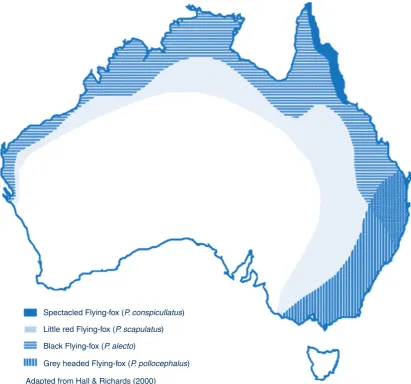
ABLV was first isolated in 1996 in NSW from the brain of a black flying fox (Pteropus alecto) which was behaving strangely.39It is closely related to rabies virus,40 but is distinguishable genetically and thus classified as lyssa-virus serotype 1, genotype 7.34,41ABLV has been found in all four species of Australian flying fox (genusPteropus) throughout their geographic range, and in at least one species of insectivorous microbat, the yellow-bellied sheath-tailed bat (Saccolaimus flaviventris), in Queens-land.34,42Serological evidence of infection has also been found in a number of other genera, and the ecology and diversity of this virus is yet to be fully understood. Less than 1% of flying foxes in the wild are infected with ABLV, but this increases to as many as 15% of sick or injured flying foxes and about 3% of yellow-bellied sheath-tailed bats.43 Limited studies to infect terrestrial wildlife have failed, although experimental exposure of domestic cats and dogs can produce mild signs and seroconversion but with no evidence of viral persistence.44
ABLV has caused two human deaths in Australia. The first was a bat carer who had been scratched by a yellow-bellied sheath-tailed bat 5 weeks earlier45,46 and the second, a woman bitten 2 years prior by a flying fox.47 In both patients the disease was similar to classical rabies, with non-suppurative encephalitis accompanied by hypersali-vation, aggression and agitation. Currently available cell-culture derived vaccines appear efficacious in protecting against ABLV infection in exposed humans.48,49Bat carers and others at risk of ABLV exposure are offered pre-exposure vaccination and those exposed are given standard preparations of vaccine and the rabies immune
globu-lin.17,43 It is important that, wherever possible, the bat
responsible for the potential exposure is sent for testing.
Discussion
potential to miss encephalitis cases caused by notifiable conditions, and is particularly inadequate for detecting newly emerged viral encephalitides.2 A recent study examining the diagnostic assessment of encephalitis in three Regional Referral Hospitals in NSW determined that only 15% of encephalitis patients were tested for flaviviruses and 0–7% were tested for specific zoonotic encephalitis viruses.54
Conclusion
Given that viral encephalitis generally causes relatively serious illness resulting in hospitalisation,55the utility of hospital sentinel surveillance of adults or paediatric medi-cine inpatients deserves prompt investigation, as does the use of a standardised diagnostic and testing algorithm which includes viral zoonotic encephalitides. Improve-ments in encephalitis surveillance at the animal, human, environment interface would aid in earlier identification of known pathogens and in alerting authorities to the emer-gence of new pathogens or outbreaks that may require public health investigation and action.
Editor’s note
During 2011 there has been a resurgence in MVE across Australian states with 14 confirmed cases notified in the National Notifiable Diseases Surveillance System, includ-ing one in NSW, and two deaths. Canadian authorities also confirmed the additional death of a Canadian tourist who was infected in the Northern Territory.56–59
References
1. Huppatz C, Durrheim DN, Levi C, Dalton C, Williams D, Clements MS et al. Etiology of encephalitis in Australia,
1990-2007.Emerg Infect Dis2009; 15(9): 1359–65.
doi:10.3201/eid1509.081540
2. Huppatz C, Kelly PM, Levi C, Dalton C, Williams D, Durrheim DN. Encephalitis in Australia, 1979–2006: trends and
aetiologies.Commun Dis Intell2009; 33(2): 192–7.
3. Morens DM, Folkers GK, Fauci AS. The challenge of emerging
and re-emerging infectious diseases.Nature2004; 430(6996):
242–9. doi:10.1038/nature02759
4. Morse SS. The public health threat of emerging viral disease.
J Nutr1997; 127(5, Suppl): 951S–7S.
5. Organisation Mondiale de la Sante Animale. One world, one health 2009.
6. Jones KE, Patel NG, Levy MA, Storeygard A, Balk D, Gittleman
JL et al. Global trends in emerging infectious diseases.Nature
2008; 451(7181): 990–3. doi:10.1038/nature06536
7. Australian Government Department of Health and Ageing. Arbovirus and malaria surveillance. Available from: http:// www.health.gov.au/arbovirus (Cited 9 September 2010.)
8. Hess IMR, Massey PD, Walker B, Middleton DJ, Wright TM.
Hendra virus: what do we know?N S W Public Health Bull2011;
22(5–6): 118–22. doi:10.1071/NB10077
9. Trevejo RT. Acute encephalitis hospitalizations, California,
1990–1999: unrecognized arboviral encephalitis?Emerg Infect
Dis2004; 10(8): 1442–9.
10. Halstead SB, Jacobson J. Japanese encephalitis.Adv Virus Res
2003; 61: 103–38. doi:10.1016/S0065-3527(03)61003-1
11. Mackenzie JS, Williams DT, Smith DW. Japanese encephalitis virus: the geographic distribution, incidence, and spread of a virus with a propensity to emerge in new areas. In: Tabor E, editor. Emerging viruses in human populations. Amsterdam: Elsevier; 2007. pp. 201–68.
12. Burke DS, Leake CJ. Japanese encephalitis. In: Monarth TP, editor. The arboviruses: Epidemiology and Ecology. Boca Raton: CRC Press; 1988. pp. 63–92.
13. Vaughn DW, Hoke CH, Jr. The epidemiology of Japanese
encephalitis: prospects for prevention.Epidemiol Rev1992;
14: 197–221.
14. Endy TP, Nisalak A. Japanese encephalitis virus: ecology and
epidemiology.Curr Top Microbiol Immunol2002; 267: 11–48.
15. Mackenzie JS, Johansen CA, Ritchie SA, van den Hurk AF, Hall RA. Japanese encephalitis as an emerging virus: the emergence
and spread of Japanese encephalitis virus in Australasia.Curr
Top Microbiol Immunol2002; 267: 49–73.
16. Peiris JS, Amerasinghe FP, Arunagiri CK, Perera LP, Karunaratne SH, Ratnayake CB et al. Japanese encephalitis in Sri Lanka: comparison of vector and virus ecology in different
agro-climatic areas.Trans R Soc Trop Med Hyg1993; 87(5):
541–8. doi:10.1016/0035-9203(93)90080-A
17. National Health and Medical Research Council. The Australian Immunisation Handbook. 9th ed. 2008. Available from: http:// www.health.gov.au/internet/immunise/publishing.nsf/Content/ Handbook-japanese (Cited 14 September 2010.)
18. Mackenzie JS, Lindsay MD, Coelen RJ, Broom AK, Hall RA, Smith DW. Arboviruses causing human disease in the
Australasian zoogeographic region.Arch Virol1994;
136(3–4): 447–67. doi:10.1007/BF01321074
19. Broom AK, Lindsay MD, Plant AJ, Wright AE, Condon RJ, Mackenzie JS. Epizootic activity of Murray Valley encephalitis virus in an aboriginal community in the southeast Kimberley region of Western Australia: results of cross-sectional and
longitudinal serologic studies.Am J Trop Med Hyg2002;
67(3): 319–23.
20. Cordova SP, Smith DW, Broom AK, Lindsay MD, Dowse GK, Beers MY. Murray Valley encephalitis in Western Australia in
2000, with evidence of southerly spread.Commun Dis Intell
2000; 24(12): 368–72.
21. Brown A, Bolisetty S, Whelan P, Smith D, Wheaton G. Reappearance of human cases due to Murray Valley encephalitis virus and Kunjin virus in central Australia after an absence of
26 years.Commun Dis Intell2002; 26(1): 39–44.
22. Evans IA, Hueston L, Doggett SL. Murray Valley encephalitis
virus.N S W Public Health Bull2009; 20(11–12): 195–6.
doi:10.1071/NB09022
23. Johansen CA, Susai V, Hall RA, Mackenzie JS, Clark DC, May FJ et al. Genetic and phenotypic differences between isolates of Murray Valley encephalitis virus in Western Australia,
1972–2003.Virus Genes2007; 35(2): 147–54. doi:10.1007/
s11262-007-0091-2
flaviviruses and alphaviruses enzootic in Australia.Virus Genes
1995; 11(2–3): 225–37. doi:10.1007/BF01728662
25. Broom AK, Lindsay MD, Harrington SA, Smith DW. Investigation of the southern limits of Murray Valley encephalitis activity in Western Australia during the 2000
wet season.Vector Borne Zoonotic Dis2002; 2: 87–95.
doi:10.1089/153036602321131887
26. Smith DW, Broom AK, Wallace MJ. Prevalence of antibody to Murray Valley encephalitis virus in Aboriginal communities in
the Kimberley region of Western Australia in 1995.Arbovirus
Research in Australia1997; 7.
27. Spencer JD, Azoulas J, Broom AK, Buick TD, Currie B, Daniels PW et al. Murray Valley encephalitis virus surveillance and control initiatives in Australia. National Arbovirus Advisory Committee of the Communicable Diseases Network Australia.
Commun Dis Intell2001; 25(2): 33–47.
28. Doherty RL, Carley JG, Filippich C, White J, Gust ID. Murray Valley encephalitis in Australia, 1974: antibody response in
cases and community.Aust N Z J Med1976; 6(5): 446–53.
doi:10.1111/j.1445-5994.1976.tb03033.x
29. Hall RA, Broom AK, Smith DW, Mackenzie JS. The ecology
and epidemiology of Kunjin virus.Curr Top Microbiol Immunol
2002; 267: 253–69.
30. Murray K, Selleck P, Hooper P, Hyatt A, Gould A, Gleeson L et al. A morbillivirus that caused fatal disease in horses and
humans.Science1995; 268(5207): 94–7. doi:10.1126/
science.7701348
31. Selvey LA, Wells RM, McCormack JG, Ansford AJ, Murray K, Rogers RJ et al. Infection of humans and horses by a newly
described morbillivirus.Med J Aust1995; 162(12): 642–5.
32. O’Sullivan JD, Allworth AM, Paterson DL, Snow TM, Boots R, Gleeson LJ et al. Fatal encephalitis due to novel paramyxovirus
transmitted from horses.Lancet1997; 349(9045): 93–5.
doi:10.1016/S0140-6736(96)06162-4
33. Eaton BT, Mackenzie JS, Wang LF. Henipaviruses. In: Knipe DM, Howley PM, editors. Fields Virology. 5th ed. Philadelphia: Lippincott Williams & Wilkins; 2007. pp. 1587–600.
34. Mackenzie JS, Childs JE, Field HE, Wang LF, Breed AC. The role of bats as reservoir hosts of emerging neurological viruses. In: Reiss CS, editor. Neurotropic Viral Infections. Cambridge: Cambridge University Press; 2008. pp. 382–406.
35. Halpin K, Young PL, Field HE, Mackenzie JS. Isolation of Hendra virus from pteropid bats: a natural reservoir of Hendra
virus.J Gen Virol2000; 81(Pt 8): 1927–32.
36. Li M, Embury-Hyatt C, Weingartl HM. Experimental
inoculation study indicates swine as a potential host for Hendra
virus.Vet Res2010; 41(3): 33. doi:10.1051/vetres/2010005
37. Luby SP, Rahman M, Hossain MJ, Blum LS, Husain MM, Gurley E et al. Foodborne transmission of Nipah virus,
Bangladesh.Emerg Infect Dis2006; 12(12): 1888–94.
38. Hayman DT, Suu-Ire R, Breed AC, McEachern JA, Wang L, Wood JL et al. Evidence of henipavirus infection in West
African fruit bats.PLoS ONE2008; 3(7): e2739. doi:10.1371/
journal.pone.0002739
39. Fraser GC, Hooper PT, Lunt RA, Gould AR, Gleeson LJ, Hyatt AD et al. Encephalitis caused by a Lyssavirus in fruit bats in
Australia.Emerg Infect Dis1996; 2(4): 327–31. doi:10.3201/
eid0204.960408
40. Gould AR, Hyatt AD, Lunt R, Kattenbelt JA, Hengstberger S, Blacksell SD. Characterisation of a novel lyssavirus isolated
from Pteropid bats in Australia.Virus Res1998; 54(2): 165–87.
doi:10.1016/S0168-1702(98)00025-2
41. Delmas O, Holmes EC, Talbi C, Larrous F, Dacheux L, Bouchier C et al. Genomic diversity and evolution of the lyssaviruses.
PLoS ONE2008; 3(4): e2057. doi:10.1371/journal.pone. 0002057
42. Mackenzie JS, Field HE. Emerging encephalitogenic viruses: lyssaviruses and henipaviruses transmitted by frugivorous bats.
Arch Virol Suppl2004; (18): 97–111.
43. Ewald B, Durrheim D. Australian Bat Lyssavirus: examination
of post-exposure treatment in NSW.N S W Public Health Bull
2008; 19(5–6): 104–7. doi:10.1071/NB07050
44. McColl KA, Chamberlain T, Lunt RA, Newberry KM, Westbury HA. Susceptibility of domestic dogs and cats to Australian bat
lyssavirus (ABLV).Vet Microbiol2007; 123(1–3): 15–25.
doi:10.1016/j.vetmic.2007.03.024
45. Hooper P, Lunt R, Gould A, Samaratunga H, Hyatt A, Gleeson L. A new Lyssavirus: the first endemic rabies related virus
recognised in Australia.Bull Inst Pasteur1997; 95: 209–18.
doi:10.1016/S0020-2452(97)83529-5
46. Allworth A, Murray K, Morgan J. A human case of encephalitis
due to a lyssavirus recently identified in fruit bats.Commun Dis
Intell1996; 20: 504.
47. Hanna JN, Carney IK, Smith GA, Tannenberg AE, Deverill JE, Botha JA et al. Australian bat lyssavirus infection: a second
human case, with a long incubation period.Med J Aust2000;
172(12): 597–9.
48. Brookes SM, Parsons G, Johnson N, McElhinney LM, Fooks AR. Rabies human diploid cell vaccine elicits cross-neutralising and cross-protecting immune responses against European and
Australian bat lyssaviruses.Vaccine2005; 23(32): 4101–9.
doi:10.1016/j.vaccine.2005.03.037
49. Rupprecht CE, Gibbons RV. Clinical practice. Prophylaxis
against rabies.N Engl J Med2004; 351(25): 2626–35.
doi:10.1056/NEJMcp042140
50. Weaver SC, Reisen WK. Present and future arboviral threats.
Antiviral Res2010; 85(2): 328–45. doi:10.1016/j.antiviral. 2009.10.008
51. Barclay AJ, Paton DJ. Hendra (equine morbillivirus).Vet J2000;
160(3): 169–76. doi:10.1053/tvjl.2000.0508
52. Samaratunga H, Searle JW, Hudson N. Non-rabies Lyssavirus human encephalitis from fruit bats: Australian bat
Lyssavirus (pteropid Lyssavirus) infection.Neuropathol
Appl Neurobiol1998; 24(4): 331–5. doi:10.1046/j.1365-2990.1998.00129.x
53. Mackenzie JS. Emerging zoonotic encephalitis viruses: lessons
from Southeast Asia and Oceania.J Neurovirol2005; 11(5):
434–40. doi:10.1080/13550280591002487
54. Huppatz C, Gawarikar Y, Levi C, Kelly PM, Williams D, Dalton C et al. Should there be a standardised approach to the diagnostic workup of suspected adult encephalitis? A case series from
Australia.BMC Infect Dis2010; 10: 353.
doi:10.1186/1471-2334-10-353
55. Whitley RJ, Gnann JW. Viral encephalitis: familiar infections
and emerging pathogens.Lancet2002; 359(9305): 507–13.
56. Australian Government Department of Health and Ageing. National Notifiable Diseases Surveillance System. Available from: http://www9.health.gov.au/cda/source/CDA-index.cfm (Cited 15 June 2011.)
57. Government of Western Australia Department of Health. Mosquito-borne disease risk extends to south-central regions of WA. Media Release 16 May 2011. Available from: http://www.
health.wa.gov.au/press/view_press.cfm?id¼994 (Cited 15 June
2011.)
58. SA Health. Murray Valley encephalitis. Media Release, 3 May 2011. Available from: http://www.sahealth.sa.gov.au/wps/wcm/
connect/publicþcontent/saþhealthþinternet/healthþ
information/news/mediaþreleases/murrayþvalleyþ
encephalitis (Cited 15 June 2011.)
59. ProMED-mail. Murray Valley encephalitis – Australia (07): Canada ex Australia (Northern Territory). 26 May 2011. Archive 20110526.1610. Available from: http:www.promedmail.org (Cited 15 June 2011.)
...
...
...
...
...
...
...
...
...
...
...
...
One Health in NSW: coordination of human
and animal health sector management
of zoonoses of public health significance
Sheena Adamson
A,C, Andrew Marich
Aand Ian Roth
BA
Centre for Health Protection, NSW Department of Health
BDepartment of Primary Industries C
Corresponding author. Email: [email protected]. nsw.gov.au
Abstract:Zoonoses of public health significance may occur in wildlife, livestock or companion animals, and may be detected by the human or animal health sectors. Of particular public health interest are foodborne, arboviral and emerging zoonoses (known/unknown, endemic/exotic). A coordinated One Health approach to the man-agement of zoonoses in NSW uses measures including: mutually agreed intersectoral proce-dures for detection and response; surveillance and notification systems for defined endemic and exotic diseases; joint meetings and exercises to ensure currency of response plans; and inter-sectoral communication during a response. This One Health approach is effective and ensures the interests of both the human health and animal health sectors are addressed.
Zoonoses are infectious diseases that are transmissible between vertebrate animals and humans under natural conditions.1 Zoonoses are caused by a wide variety of microorganisms and a subset of zoonotic infections may have significant public health implications that require a coordinated approach across human health and animal health sectors.
People who are exposed to animals at home, at work or elsewhere tend to be at greatest risk of zoonotic diseases. Examples of people who are especially at risk of exposure to zoonotic diseases include veterinarians and veterinary staff, wildlife officers, zoo keepers, farmers, shooters, abattoir workers, animal carers and pet owners. Because
pathogens tend to have specific host species, certain infections tend to be associated with certain animal species.
This paper provides an overview of how the human and animal health sectors work collaboratively in New South Wales (NSW) to manage zoonoses. Planning for and responding to zoonotic public health threats and incidents requires an integrated, intersectoral approach that recog-nises the interrelationships between humans, animals and the environment, and the different interests of the sectors. This is sometimes described as the One Health approach.
Methods
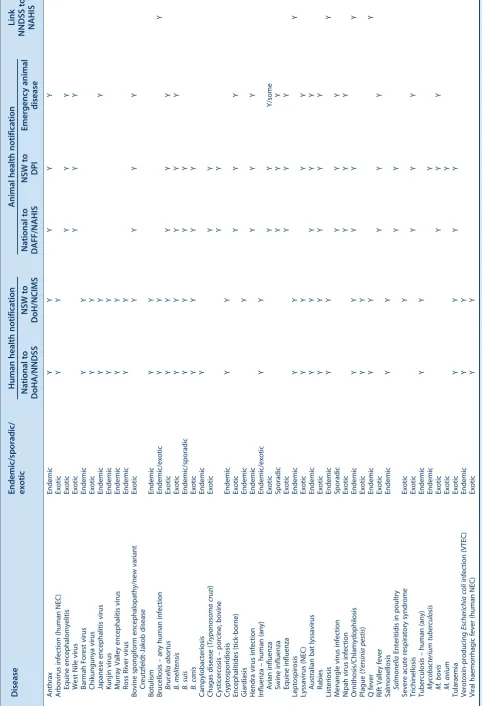
Zoonotic diseases of public health significance in NSW were identified (Table 1). The arrangements for prepared-ness, detection, analysis and response activities across both the human and animal health sectors were compared, with particular focus on the comparative roles of NSW Health and the NSW Department of Primary Industries. Local and statewide strategies for prevention and preparedness, detection of individual clinical cases and surveillance, analysis of data, response and control were included.
Results
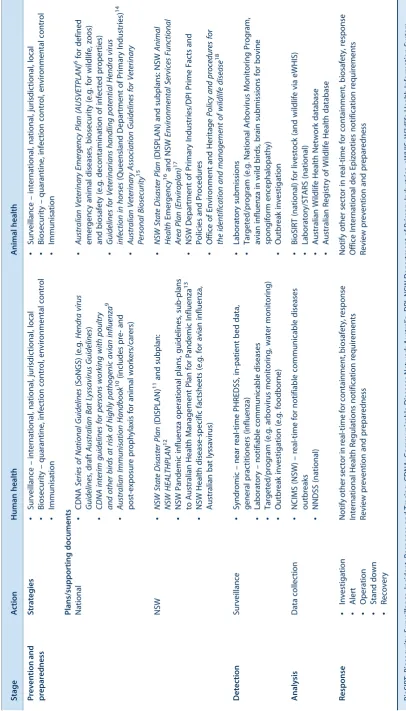
Management of zoonoses in NSW occurs in both the human and animal health sectors at the local and state level using the following strategies (Table 2).
General arrangements
Human health sector
NSW Health, including local health districts, has the main responsibility for human health issues in NSW, including zoonotic diseases. The Centre for Health Protec-tion within the PopulaProtec-tion Health Division oversees both communicable diseases and environmental health issues. The Communicable Diseases Branch coordinates surveil-lance and response activities for statewide infectious disease issues, including zoonotic diseases, and coordi-nates policy development.
disease issues of public health significance and forge relationships with local stakeholders; for zoonoses, this includes those in the animal health sector.
Animal health sector
The animal health sector includes wildlife, livestock and companion animals. Overseeing the health of livestock and companion animals falls under the jurisdiction of the Department of Primary Industries (DPI). Although primar-ily concerned with minimising any adverse impact of disease on productivity and trade, the DPI is also interested in ensuring that human health is not compromised by zoonotic diseases. The DPI works closely with Livestock Health and Pest Authorities who employ veterinarians to undertake disease control work predominately with livestock.
District Veterinarians with Livestock Health and Pest Authorities and Veterinary Officers within the DPI detect and respond to local incidents of infectious disease, including zoonotic diseases of public health significance. Regional Veterinary Officers within the DPI forge rela-tionships and undertake most of the contact with local stakeholders, such as the local public health unit.
The health of wildlife and zoo animals falls under the jurisdiction of the NSW Office of Environment and Heritage. However, most wildlife diseases are reported through the Australian Wildlife Health Network which maintains a register of wildlife diseases and provides coordination and guidance on these diseases. The Aus-tralian Registry of Wildlife Health laboratory services include investigation of zoonoses in wildlife. The DPI coordinates significant diseases in wildlife and assists with diagnostic and field investigations.
Other sectors
Human health and safety in the workplace is the primary concern of the WorkCover Authority of NSW. WorkCover NSW is part of the Compensation Authorities Staff Divi-sion and sits within the Treasury portfolio.
The NSW Food Authority provides the regulatory frame-work for industry to produce safe foods and reports to the NSW Minister for Primary Industries.
Prevention and preparedness
Mutually agreed policies and procedures for managing zoonoses of public health significance are in place in both the national and jurisdictional human and animal health sectors. These are developed and maintained for currency through intersectoral agency links with contributions from other professional organisations, research facilities and universities, such as those involved with human and animal health, microbiology, epidemiology, infection control, agriculture, environment and food manufacture.
Plans for managing human and animal health emergencies, including zoonoses, are supplemented by disease-specific plans, policies, guidelines and factsheets (Table 2) which are targeted to appropriate audiences (e.g. general public, human/animal health professionals, other animal workers and carers). An important part of the management of zoonoses is the prevention of transmission, and these plans and advice sheets include recommendations for measures such as infection control and biosecurity, as well as prophylaxis through immunisation.
The national and NSW plans are tested in periodic inter-sectoral exercises, which in recent years have examined the response to avian influenza (Exercise EleusisandExercise Hippolytus) and pandemic influenza (Exercise
Cump-ston).2–4 They have also been tested in NSW in recent
emergencies including equine influenza, pandemic (H1N1) 2009 influenza in humans and swine, and a suspected equine Hendra virus infection investigation.
Detection
Human health sector
Zoonotic diseases in humans are diagnosed by clinicians, and selected zoonotic diseases are notifiable by clinicians and laboratories under the NSWPublic Health Act 1991. Public health units enter data into a statewide database, the Notifiable Conditions Information Management System (NCIMS) and these data are analysed for the local area, the state and nationally. Data are reported daily to the Australian Government Department of Health and Ageing through the National Notifiable Diseases Surveillance System. In addition, the Public Health Real-time Emer-gency Department Syndromic Surveillance system is occasionally used to provide complementary surveillance data arising from attendances at selected emergency departments across NSW.
Public health units also report any significant zoonotic event to the Communicable Diseases Branch when it may be of statewide significance or if the incident may have ramifications for other sectors. The Communicable Diseases Branch maintains open communication lines with counterparts in the DPI, and nationally.
In addition, public health units maintain good working relationships with DPI Regional Veterinary Officers; these officers are often the source of information about local zoonotic incidents that may have health consequences for humans.
Animal health sector
industry or education, or through government, private and industry-specific laboratories.
National and jurisdictional surveillance and notification systems are used by the DPI to monitor the occurrence of defined endemic and exotic infectious diseases, including zoonoses, and to comply with international reporting requirements.5Surveillance in the animal health sector is also used widely to demonstrate freedom from defined diseases for export and interstate trade purposes.
Nationally, notifiable diseases are reported quarterly by the DPI to the Australian Government Department of Agriculture, Fisheries and Forestry through the National Animal Health Information System administered by Ani-mal Health Australia. Some additional diseases are only reported within NSW to the DPI. Some notifiable diseases are also defined as emergency animal diseases with a specific response prescribed in AUSVETPLAN.6,7 Syn-dromic surveillance is not currently available in the animal health sector, although a national pilot is in progress.
Targeted surveillance programs
Targeted surveillance is also used in both sectors in NSW (e.g. by human health for arboviruses and waterborne diseases, and by animal health for arboviruses through the National Arbovirus Monitoring Program, and for avian influenza in wild birds).
Analysis
Human health sector
Analysis of routinely collected data on human zoonotic notifications occurs regularly at local, statewide and national levels. Single case reports of selected notifiable zoonoses prompt individual risk assessment which may involve public health unit staff interviewing the case or contacts to ascertain possible exposures, site visits, work-place assessment, enhanced surveillance and further laboratory characterisation of the organism. The outbreak management function of NCIMS facilitates additional targeted and enhanced surveillance where necessary. Geomapping capability in NCIMS, while currently limited is being developed and will be a useful epidemiological tool.
Where a risk assessment is complex or involves several local health districts, the Communicable Diseases Branch offers advice and coordinates the risk assessment.
Animal health sector
The outbreak management system used by the DPI, the Biosecurity Surveillance, Incident, Response and Tracing (BioSIRT) system, is a relatively new surveillance system with geomapping capability that is being introduced for routine use in most states to record on-farm animal health
events. BioSIRT is currently being used in NSW for emergency situations and there are plans to link it with the Wildlife Health Information System (eWHIS), the national real-time reporting system used for wildlife incidents. BioSIRT will also link with other databases including laboratory information management systems for uploading test results (this will be facilitated through the Sample Tracking and Reporting System project), and the NSW Property Identification Codes database which can provide information about a property’s ownership, location and livestock.
Although these surveillance and notification systems are primarily used to record incidents of defined notifiable diseases, eWHIS in the wildlife animal health sector may indicate the occurrence of known or unknown emerging infectious diseases, including zoonoses. The national Wildlife Event Investigations Team may be convened by the Australian Chief Veterinary Officer to support the investigation of emerging infectious diseases in wildlife, including the potential for zoonotic disease.
Response
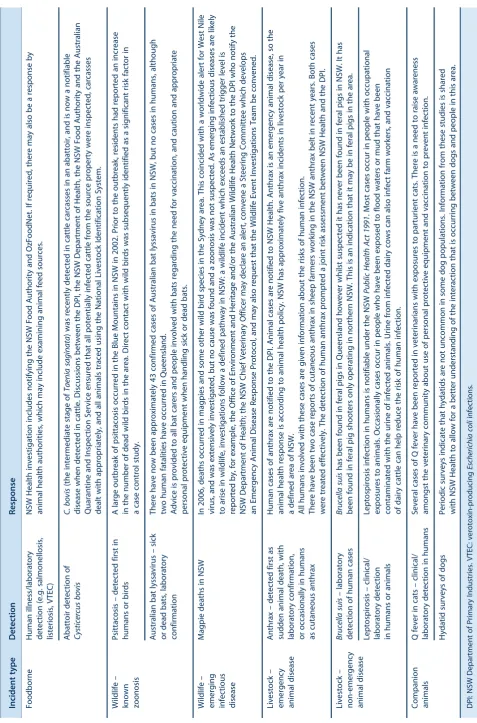
A zoonotic disease may be detected in the human or animal health sector. Table 3 describes examples of some recent zoonotic disease incidents not elsewhere described in this issue. Timely communication between the sectors during a response ensures coordinated risk assessment and effective management and that the different interests of each sector are addressed.
Human health sector
Management of notifiable diseases, including zoonoses, by public health units follows disease-specific protocols found in theNSW Notifiable Diseases Manual.8For some notifications, the DPI is notified as part of the routine response. Depending on the nature of the zoonosis, the public health intervention may be to disseminate informa-tion to the case and others who may have been exposed, or to recommend or arrange treatment or prophylaxis for cases or contacts.
In recent times, the Communicable Diseases Network Australia has recognised the need to harmonise public health responses across all Australian states and territories and this has led to the development of the Series of
National Guidelines (SoNGs) for selected diseases.
Cur-rently, SoNGs are being developed for Hendra virus infections and for rabies/Australian bat lyssavirus infec-tions and exposures to animals potentially infected with rabies/Australian bat lyssavirus.
Animal health sector
Table 3. Examples of intersectoral responses to recent zoonotic disease incidents in NSW by NSW Health and the NSW Department of Primary Industries Incident type Detection Response Foodborne Human illness/laboratory detection (e.g. salmonellosis, listeriosis, VTEC) NSW Health investigation includes notifying the NSW Food Authority and OzFoodNet. If required, there may also be a response by animal health authorities, which may include examining animal feed sources. Abattoir detection of Cysticercus bovis C. bovis (the intermediate stage of Taenia saginata ) was recently detected in cattle carcasses in an abattoir, and is now a notifiable disease when detected in cattle. Discussions between the DPI, the NSW Department of Health, the NSW Food Authority and the Australian Quarantine and Inspection Service ensured that all potentially infected cattle from the source property were inspected, carcasses dealt with appropriately, and all animals traced using the National Livestock Identification System. Wildlife – known zoonosis Psittacosis – detected first in humans or birds A large outbreak of psittacosis occurred in the Blue Mountains in NSW in 2002. Prior to the outbreak, residents had reported an increase in the number of dead wild birds in the area. Direct contact with wild birds was subsequently identified as a significant risk factor in a case control study. Australian bat lyssavirus – sick or dead bats, laboratory confirmation There have now been approximately 43 confirmed cases of Australian bat lyssavirus in bats in NSW, but no cases in humans, although two human fatalities have occurred in Queensland. Advice is provided to all bat carers and people involved with bats regarding the need for vaccination, and caution and appropriate personal protective equipment when handling sick or dead bats. Wildlife –
emerging infectious disease
The response to emergency animal diseases may include convening a specific Consultative Committee on Emer-gency Animal Disease with a representative from the human health sector.
Discussion
The collaborative intersectoral approach to the manage-ment of zoonotic diseases in NSW ensures a timely and effective response. Established relationships between key officers in the different sectors are a major factor in ensuring effective communication. Regular joint meetings help ensure that this occurs, and that each agency understands the needs and constraints on the other agencies.
Management of endemic and exotic zoonoses continues to utilise significant resources in both the human and animal health sectors in NSW; this is particularly so for the investigation of foodborne diseases. Recent exotic zoono-ses responzoono-ses have included the provision of post-exposure prophylaxis against rabies for a number of people returning from Bali following dog bites, and the DPI involvement with rabies control projects in Bali. A positive outcome of collaborative management has been the implementation of improved infection control and biosecurity procedures for veterinarians and others associated with animal care and handling. For example, the occurrence of Hendra virus in horses and the fact that the symptoms in horses are not specific has resulted in more horse practitioners using personal protective equipment. It is also now recognised by veterinarians that Q fever is not just a disease of farm animals and that cases have been recorded in companion animals. This has necessitated the need for routine personal protective equipment/infection control use in a wider range of situations.
The following offer the potential to improve zoonotic disease management:
• The introduction of BioSIRT could potentially enable the collation of real-time reporting in a single national database which will be particularly useful for cross-border incidents.
• Currently, human and animal health surveillance and laboratory data are held within each sector, but data regarding zoonotic incidents could be shared (e.g. through automated intersectoral real-time alerts). • Due to the different interests of each sector in zoonoses,
and variable regional incidence, zoonosis notification is inconsistent between and within the sectors, and could be aligned to ensure timely and effective management. • Arbovirus monitoring programs are conducted in mos-quitoes and animals for each sector in NSW, but are targeted for diseases specific to that sector. There is potential for greater collaboration (e.g. sharing of speci-mens to look for diseases of interest to the other sector).
Conclusion
A coordinated One Health approach by the human and animal health sectors in NSW provides effective man-agement of zoonoses of public health significance, and ensures the different interests of each sector are addressed. National health reforms and consequent reorganisation of the NSW Health system is likely to change some of the arrangements for delivering public health services in the state. It will be important for both sectors to maintain effective working relationships as the organisational struc-tures within the health system evolve. Particular chal-lenges include detection and management of emerging zoonoses, especially in wildlife, and the changing human– animal interface with increasing urbanisation.
References
1. NSW Department of Primary Industries. NSW Zoonoses – diseases transmissible to humans. NSW DPI Prime Fact 814, July 2008. Available from: http://www.dpi.nsw.gov.au/__data/ assets/pdf_file/0011/334001/Zoonoses-animal-diseases-transmissible-to-humans.pdf (Cited April 2011.)
2. Australian Government Department of Agriculture. Fisheries and Forestry. Exercise Eleusis ’05 Evaluation Report – Key findings. 2006. Available from: http://www.daff.gov.au/ animal-plant-health/emergency/exercises/eleusis (Cited January 2011.)
3. Australian Government Department of Agriculture. Fisheries and Forestry. Exercise Hippolytus Evaluation Report. July 2007. Available from: http://www.daff.gov.au/animal-plant-health/emergency/exercises/exercise_hippolytus (Cited January 2011.)
4. Australian Government Department of Health and Ageing. National Pandemic Influenza Exercise – Exercise Cumpston 06 Report. 2007. Available from: http://www.flupandemic.gov.au/ internet/panflu/publishing.nsf/Content/cumpston-report-1 (Cited January 2011.)
5. NSW Department of Primary Industries. Notifiable animal diseases in NSW. NSW DPI Prime Fact 402, 4th ed., December 2008. Available from: http://www.dpi.nsw.gov.au/__data/ assets/pdf_file/0015/114414/Notifiable-animal-disease s-in-nsw.pdf (Cited April 2011.)
6. Animal Health Australia. Australian Veterinary Emergency Plan (AUSVETPLAN). Commonwealth of Australia, 2007. Available from: http://www.animalhealthaustralia.com.au/ programs/eadp/ausvetplan/ausvetplan_home.cfm (Cited April 2011.)
7. NSW Department of Primary Industries. Emergency animal diseases. NSW DPI Prime Fact 588, 2nd ed., November 2008. Available from: http://www.dpi.nsw.gov.au/__data/assets/ pdf_file/0014/121109/Emergency-animal-diseases.pdf (Cited April 2011.)
8. NSW Health. Notifiable Diseases Manual. Available from: http://www.health.nsw.gov.au/publichealth/Infectious/control guide.asp (Cited April 2011.)
influenza (CDNA, 2008). Available from: http://www.health. gov.au/internet/main/publishing.nsf/Content/avian-influenza-poultry-guidelines.htm (Cited April 2011.)
10. Australian Government Department of Health and Ageing. Australian Immunisation Handbook. 9th ed. 2008.
Available from: http://www.health.gov.au/internet/immunise/ publishing.nsf/Content/Handbook-home (Cited April 2011.)
11. NSW Government Emergency Management NSW. NSW State Disaster Plan (DISPLAN). 2006. Available from: http://www. emergency.nsw.gov.au/plans/displan (Cited April 2011.)
12. NSW Health. HEALTHPLAN – NSW. PD2009_008, February 2009. Available from: http://www.health.nsw.gov.au/policies/ pd/2009/PD2009_008.html (Cited April 2011.)
13. Australian Government Department of Health and Ageing. Australian Health Management Plan for Pandemic Influenza (AHMPPI). 2009. Available from: http://www.health.gov.au/ internet/panflu/publishing.nsf/Content/ahmppi-2009-l (Cited April 2011.)
14. Queensland Government Department of Employment, Economic Development and Innovation. Guidelines for
veterinarians handling potential Hendra virus infection in horses. Queensland Department of Primary Industries. Available from: http://www.dpi.qld.gov.au/4790_13371.htm (Cited April 2011.)
15. Australian Veterinary Association. Guidelines for Veterinary Personal Biosecurity. June 2011. Available from: http://www. ava.com.au/biosecurity-guidelines (Cited June 2011.)
16. NSW Government Emergency Management NSW. NSW Animal Health Emergency Sub-plan: A Sub-plan of the NSW State Disaster Plan. December 2005. Available from: http://www.emergency.nsw.gov.au/content.php/545.html (Cited April 2011.)
17. NSW Government Emergency Management NSW. NSW Environmental Services Functional Area Plan (Enviroplan): Supporting plan to NSW Disaster Plan. November 2005. Available from: http://www.emergency.nsw.gov.au/content. php/561.html (Cited April 2011.)
Discovering novel zoonotic viruses
Lin-Fa Wang
CSIRO Livestock Industries, Australian Animal Health Laboratory Email: [email protected]
Abstract: From the emergence of Hendra virus and Menangle virus in Australia to the global pandemics of severe acute respiratory syndrome and influenza viruses (both H5N1 and H1N1), there has been a surge of zoonotic virus outbreaks in the last two decades. Although the drivers for virus emergence remain poorly understood, the rate of discovery of new viruses is accelerating. This is due to a combination of true emergence of new pathogens and the advance of new technolo-gies making rapid detection and characterisation possible. While molecular approaches will con-tinue to lead the way in virus discovery, other technological platforms are required to increase the chance of success. The lessons learnt in the last 20 years confirm that the One Health approach, involving inclusive collaborations between physi-cians, veterinarians and other health and environ-mental professionals, will be the key to combating future zoonotic disease outbreaks.
Globalisation of travel and trade, changes in agricultural practice (e.g. intensive farming and land use) and climate change are some of the drivers responsible for the emergence of novel pathogens affecting humans and livestock.1 Early detection and/or identification of the causative agent plays a pivotal role in minimising the impact of any infectious disease outbreak, especially for those caused by previously unknown pathogens. This review describes some of the recent zoonotic viral disease outbreaks both in Australia and abroad and focuses on the approaches and impact of virus discovery during disease investigation. It also summarises current virus discovery strategies and future trends in this area. While this review focuses on the importance of molecular techniques in virus discovery, it should be emphasised that virus isola-tion and serological investigaisola-tion is equally important in the investigation of diseases caused by previously unknown viruses.
A brief review of virus discovery with or without associated diseases
Hendra virus
In September 1994, a mysterious disease outbreak, with primarily respiratory presentation, occurred in a horse stable in Hendra, Brisbane. It claimed the life of the horse trainer and 13 of his high value horses. A stable hand on the property also suffered a severe respiratory illness, but survived the infection. Three days after receiving horse specimens at the CSIRO Australian Animal Health Laboratory, cytopathic effect was observed in cultures of Vero cells inoculated with lung homogenates from deceased horses. Similar results were observed with human specimens a few days later. Electron microscopic analysis indicated the presence of a viral agent with a morphology resembling paramyxovirus. Further polymerase chain reaction (PCR) analysis using degenerate primers demonstrated a partial sequence of the matrix protein gene most similar to the cognate genes of morbilliviruses in the familyParamyxoviridae. A challenge experiment conducted under stringent biocontainment con-ditions at the CSIRO Australian Animal Health Laboratory demonstrated that the isolated virus was able to kill horses 4–5 days after infection and a similar clinical presentation, and the virus was re-isolated from infected animals, fulfilling all four requirements of the original Koch’s postulate. Hendra virus was therefore the causative agent of the zoonotic viral disease outbreak.2About a year later it was determined that flying foxes are the natural reservoir of this novel virus.3Since 1994, there have been 14 recorded Hendra virus outbreaks, together responsible for the death of more than 40 horses and four humans.
Nipah virus
From late 1998 to early 1999 in peninsular Malaysia, an unusual surge of encephalitic disease was detected in people dealing with live pigs. The incidents coincided with outbreaks of respiratory disease in pigs. A novel virus was isolated from human patients, which was closely related to the Hendra virus.4It was named Nipah virus after the name of the village of the index case, and later proved to be the causative agent of both the human and pig disease. It is now known that different strains of Nipah virus are widely distributed in bats from Indonesia, Malaysia, Thailand, India, Bangladesh, Madagascar and west African nations.5 Since the Malaysian outbreaks, Nipah virus has emerged almost annually in Bangladesh. In total, the virus has claimed the lives of more than 250 humans with mortality rates ranging from 40 to 100%.
In addition to the isolation of Nipah virus, two new viruses were discovered: Tioman virus (a paramyxovirus) and Pulau virus (a reovirus). The significance of these ‘acci-dental’ discoveries will be explored later in this paper.
Menangle virus
Menangle virus was isolated in 1997 from stillborn piglets with deformities at a large commercial piggery in New South Wales.6The virus was found to be responsible for a single outbreak of reproductive disease, causing reduced farrowing rate and stillbirths with deformities. Serum samples from two humans, who were in close contact with infected pigs and suffered a flu-like illness, were found to have high levels of convalescent neutralising antibodies to Menangle virus. Extensive serological testing showed no evidence of any alternative cause. It is believed therefore that the human illness was caused by Menangle virus, demonstrating a zoonotic potential that is yet to be fully characterised. Although the exact origin of the virus was not known at the time of the outbreak, serological studies indicated the presence of neutralising antibodies in bats. The bat origin was further corroborated by comparative genome sequencing, which indicated that the Menangle virus is highly related to the batborne Tioman virus identified in Malaysia.7
SARS virus
The severe acute respiratory syndrome (SARS) corona-virus was responsible for the first serious and widespread zoonotic disease outbreak of the 21st century, having a huge global impact on health, travel and economy.8The great global impact of the SARS outbreak was in some ways intensified by the delay in identifying the causative agent of the disease. From November 2002, a mysterious disease known as ‘atypical pneumonia’ was rapidly spreading in southern China, exacerbated by several inten-sive nosocomial transmissions. It took almost 6 months before a novel coronavirus was isolated by the joint effort of the WHO SARS Collaborative Network.8Within a few weeks of virus identification, the whole genome sequence was determined. This in turn facilitated the development and distribution of molecular and serological tests which played an essential role in the eventual control of the global pandemic. It is important to note that the global outbreak was under control within 3 months of the discovery of the causative agent. The genomic sequence information also played an important role in the identification of civets as the main intermediate host responsible for transmitting the virus to humans and bats as a potential natural reservoir of the SARS virus and other highly related coronaviruses.8,9
Melaka virus
Reoviruses (respiratory enteric orphan viruses) were first discovered in the 1950s and named orphan viruses due to
the failure to associate them with any known human disease. As mentioned previously, Pulau virus was isolated during a search for Nipah virus in bat urine samples, which is closely related to Nelson Bay virus isolated from Australian bats in the early 1970s.10The disease-causing potential of neither virus was known. In 2006, during an investigation of a small cluster of patients in a Malaysian family suffering from severe flu-like symptoms, a virus was isolated and named Melaka virus. Electron micro-scopic examination revealed a reovirus-like structure. Using the sequence information and reagents developed for Pulau and Nelson Bay viruses, rapid confirmation of Melaka virus as a zoonotic reovirus was achieved within 2 weeks. Melaka virus represents the first reovirus known to cause severe acute disease in humans. Since then, at least two additional bat reoviruses have jumped species to infect humans and cause respiratory disease.11
A new arenavirus
In 2008, three Australian recipients of a visceral organ transplant from a single donor died of a febrile illness 4–6 weeks after transplantation. Due to the nature of the disease, involvement of an infectious agent was suspected. However, bacterial and viral culture revealed no candidate pathogens. PCR assays for most known human viral and bacterial pathogens, and pan-viral and pan-microbial oligo-nucleotide microarray analyses also failed to identify any potential agent. Eventually, the causative agent was iden-tified by unbiased high-throughput sequencing.12 Out of 103 632 sequencing reads obtained from total RNA extracted from different organ tissues of two patients, 14 sequences were shown to be related to Old World arenaviruses, with lymphocytic choriomeningitis virus being the most related. Subsequent virus isolation from frozen kidney samples was successful. While not all of Koch’s postulate conditions were fulfilled, the fact that all four patients (donor and three recipients) had virus-specific antibodies and all recipients had viral RNA in their circulation was considered compelling evidence that the arenavirus was the cause.12
Reston Ebola virus
lines were used for virus isolation. In addition to the isolation of the porcine reproductive and respiratory syn-drome virus, which was the main suspected causative agent, cytopathic effect was unexpectedly detected in Vero cells which are nonpermissive to the porcine virus. To investigate the identity of this virus, viral nucleic acid materials were tested using a pan-viral microarray. It was revealed that this unknown agent was the Reston Ebola virus.13This is a highly significant discovery, widening the host range of Ebola virus to domestic pigs. Of the 141 individuals who worked on pig farms or with swine products, six had Ebola-specific antibodies, confirming pig-to-human transmission.13
Different pathways to virus discovery
The examples of virus discovery reviewed in this paper were selected to highlight two points: (1) most are associ-ated with bats; and (2) virus discovery goes beyond finding previously unknown viruses: it is equally important to discover related viruses or new hosts of known viruses.
Although most of the discoveries of new viruses were made as a result of disease investigation, there are also examples where orphan viruses were ‘accidentally’ dis-covered, and later proved to be highly useful in the investigation of disease outbreaks caused by viruses closely related to them. Faced with the rapid technology advances in virus discovery, it is expected that more and more orphan viruses will be discovered. The appropriate sharing of orphan virus reagents and information in the interna-tional community will be crucial for effective future responses to infectious disease caused by novel viruses.
It should also be noted that the causal relationship between a virus and disease may be established by modern technologies without fulfilling all four conditions specified in the original Koch’s postulates.14This was best illustrated by the description of the identification of a new arenavirus as the causative agent of a disease that resulted in the deaths of three transplant patients from the same donor.12
Increasing importance of molecular approaches to virus discovery
It is evident from all the cases reviewed in this paper that molecular techniques played a pivotal role in the discovery of new viruses. The various molecular techniques currently being used for virus discovery are summarised in Table 1. While virus-specific PCR is a powerful tool for diagnosis and investigation of new host ranges of known viruses, its usefulness in the discovery of new viruses is rapidly being superseded by more advanced molecular technologies. Multiplex PCR-MS (mass spectroscopy) assays such as the Ibis T500 biosensor system15and the MassTag PCR16 are extremely powerful tools for investigating multiple microbe targets,17however very few laboratories can afford
the high cost equipment required. Microarrays containing oligonucleotide probes to all known viruses were at one stage considered the future of virus discovery,18,19but their performance has not met initial expectations due to issues with sensitivity and specificity when tissue samples are used. Currently, the most powerful and promising method of rapid agent identification is the unbiased high-throughput sequencing strategy.12,17 Although currently expensive, its application is expected to increase and with this the cost will decrease. Also, consideration of its speed (within days) and definitive nature will likely outweigh the cost, especially during the investigation of emergency disease outbreaks. The success rate of virus discovery in raw tissue samples can be increased by combining sub-tractive cDNA hybridization7 and high-throughput sequencing.
Conclusion
The most advanced molecular tools described in this paper are available in only a small number of specialised labora-tories around the world. Their effective application is therefore dependent on close international collaboration and networks involving both human and animal health professionals, and laboratories in both developed and developing nations. Technology advance in other areas will also play a role in shaping the future of virus discov-ery; these include the development of more efficient sequence data management and bioinformatics tools, the development of specialised cell lines to increase the chance of successful isolation of live viruses,20and the develop-ment of high density protein or peptide arrays for serologi-cal examination of antibodies cross-reactive with highly conserved epitopes of all known viral proteins.17
Acknowledgments
The virus discovery work conducted in the author’s group is mainly funded by the Australian Cooperative Centre for Emerging Infectious Diseases and a CSIRO OCE Science Leader Award. I thank Gary Crameri and Glenn Marsh for critical reading of the manuscript.
References
1. Morse SS. Factors in the emergence of infectious diseases.
Emerg Infect Dis1995; 1(1): 7–15. doi:10.3201/eid0101.950102 2. Murray K, Selleck P, Hooper P, Hyatt A, Gould A, Gleeson L
et al. A morbillivirus that caused fatal disease in horses and
humans.Science1995; 268(5207): 94–7. doi:10.1126/
science.7701348
3. Young PL, Halpin K, Selleck PW, Field H, Gravel JL, Kelly MA et al. Serologic evidence for the presence in Pteropus bats of a
paramyxovirus related to equine morbillivirus.Emerg Infect
Dis1996; 2(3): 239–40. doi:10.3201/eid0203.960315
4. Chua KB, Bellini WJ, Rota PA, Harcourt BH, Tamin A, Lam SK et al. Nipah virus: a recently emergent deadly paramyxovirus.