© James B. Freeman. Informal Logic, Vol. 33, No. 2 (2013), pp. 175–194.
Inductive Arguments by Analogy: Implications
for a General Theory of Ground Adequacy
J
AMESB.
F
REEMANDepartment of Philosophy
Hunter College of The City University of New York 695 Park Avenue
New York, NY 10065 U.S.A.
Abstract: In a priori analogies, the analogue is constructed in imagina-tion, sharing certain properties with the primary subject. The analogue has some further property clearly conse-quent on those shared properties. Ce-teris paribus the primary subject has that property also. The warrant in-volves non-empirical, e.g., moral intu-ition but is also defeasible. The argu-ment is thus neither deductive nor inductive, but an additional type. In an inductive analogy, the analogues back the warrant from below. Distinguish-ing these two types of arguments by analogy gives epistemic evaluative factors primacy over resemblance fac-tors in classifying arguments—a pres-cient insight on Govier’s part.
Résumé: Dans les analogies a priori, le sujet analogue se construit dans l'imaginaire et partage certaines pro-priétés avec le sujet principal. Le sujet analogue a une autre propriété claire-ment en conséquence de ces propriétés partagées. Ceteris paribus le sujet principal a aussi cette propriété. La loi de passage des raisons à leur conclu-sion (« warrant ») implique l’intuition non-empirique, par exemple, l'intui-tion morale, mais est également révo-cable. L'argument par analogie n'est donc ni déductif ni inductif, mais un autre type d’argument. Dans une anal-ogie inductive, les sujets analogues appuient la loi de passage de ci-dessous. Si on distingue ces deux types d'arguments par analogie, on donne primauté des facteurs d'évalua-tion épistémiques sur les facteurs de ressemblance dans la classification des arguments—une idée visionnaire de la part de Govier.
© James B. Freeman. Informal Logic, Vol. 33, No. 2 (2013), pp. 175–194. In her text, A Practical Study of Argument,1 Trudy Govier distin-guishes a priori from inductive arguments by analogy. In an a pri-ori analogy, one constructs an analogue in imagination having cer-tain properties. The primary subject, with which the analogue is compared, also has these properties and they constitute the similari-ties between primary subject and analogue argued from. The point is that this analogue need not be actual and typically it will be im-aginary. The analogue has some further property, the similarity ar-gued for. Hence, by analogy, i.e., by virtue of the relevant similari-ties argued from, one concludes, ceteris paribus that the primary subject has this further property also. The expectation is that the analogue’s having this further property is clear and that it is clear that the analogue has it because of having the properties it shares with the primary subject. Considered by itself, whether the primary subject has the similarity argued for is unclear. By virtue of the comparison and the need to treat like cases like, one can then “see” that the primary subject has this further similarity with the ana-logue.
One might want to say that the analogy is a priori because the analogue is constructed in imagination, not empirically ob-served. Govier endorses this explanation when she says “Because the analogue in this kind of consistency reasoning need not be something that actually happened, the analogy used may be called an a priori analogy” (Govier 2010, p. 328). Again, “In an a priori analogy, the analogue need not be a real case. It can be entirely hy-pothetical and may, in fact, be positively fanciful” (Govier 1999, p. 138). “The analogy will be a good one insofar as the analogue and the primary case share all the features which are logically relevant to the conclusion. Whether this is the case is something we can de-termine a priori, from reflective examination of the cases” (Govier 2010, p. 328).
By contrast with Govier, I believe that a proper understand-ing of why these arguments are properly classed as a priori
1
© James B. Freeman. Informal Logic, Vol. 33, No. 2 (2013), pp. 175-194. gies depends on factors other than the possibly hypothetical status of the analogue. The Toulmin model can bring this issue into prop-er focus. Goviprop-er has presented a model of a priori analogies. Where ‘A’ indicates the analogue, ‘B’ the primary subject, ‘x, y, z’ the similarities argued from and ‘W’ the similarity argued for, the schema
A has x, y, z B has x, y, z A is W.
Therefore, B is W
(Govier 1999, p. 140) constitutes the basic schema for a priori analogies. I believe it would be more perspicuous to reverse the order of the second and third premises, and to explicitly add the “ceteris paribus” qualifier.
A has x, y, z A is W. B has x, y, z
Therefore, ceteris paribus, B is W.
Why do these changes give us a better focus on a priori analogies? First, arguments by analogy are defeasible. Consider this recon-struction of Govier’s first example of an a priori analogy (Govier 1999, p. 141):
1. Eating half-chewed food from someone else’s plate or drinking water that had previously held someone’s teeth involves ingesting substances exposed to someone else’s bodily interior.
2. No one should be forced to eat half-chewed food from someone else’s plate or drink water that had previously held someone’s teeth.
© James B. Freeman. Informal Logic, Vol. 33, No. 2 (2013), pp. 175–194.
Therefore, ceteris paribus,
4. No one should be forced to inhale such second-had smoke.
We can easily see that this argument is defeasible. Although it might tax our imaginations, it is certainly not logically impossible that there be some reason for forcing people to breathe second-hand smoke, which could be offered as a rebutting defeater to the argument. We shall later see how this argument may supplement those Govier gives against reconstructing a priori analogies as de-ductive arguments.
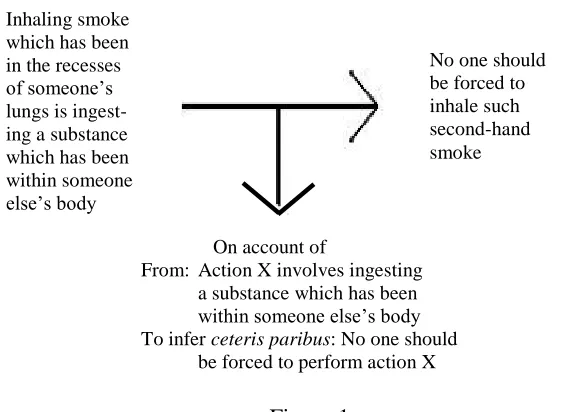
Why does switching the order of the second and third prem-ises in Govier’s model give a better focus on a priori analogies and what does Toulmin’s model have to do with it? Our claim is that B is W. Our data are that B has x, y, z. How then do the first two premises in the model function? On our view, they function to make perspicuous the warrant which sanctions the inferential step from x, y, z to W. As we see it, the function of the first two premis-es is not necpremis-essarily to back the warrant (give evidence for its asso-ciated qualified universal generalization) but to aid the recipient of this argument in seeing the inferential connection between being x, y, z and being W. How then is this warrant cognized? We shall ar-gue that the cognizing is a matter of a priori intuition, more specifi-cally moral intuition. Diagramming the argument according to the Toulmin model, we have Figure 1 (see next page):
© James B. Freeman. Informal Logic, Vol. 33, No. 2 (2013), pp. 175-194. not whether we may reflectively compare analogue and primary subject for similarities argued from.
Figure 1
One may ask how these a priori warrants are backed. If it is self-evident that from an act’s involving ingesting something which has been in someone else’s body we may infer (ceteris paribus) that the act is one that no person can be compelled to perform, then the warrant is self-backed. It needs no further backing. This is not to say that all warrants used in arguments by a priori analogy need be self-evident or be self-backed. The point is that many of these warrants are self-evident, and this gives a further reason for regard-ing them as a priori.
Moral arguments where one infers a conclusion about an act’s having a certain deontic property on the basis of its having certain non-deontic but deontically relevant properties are para-digm cases of arguments with synthetic a priori warrants.
From: X promised to do Y
To infer ceteris paribus: X ought to or has a duty to perform Y
Inhaling smoke which has been in the recesses of someone’s lungs is ingest-ing a substance which has been within someone else’s body
No one should be forced to inhale such second-hand smoke
On account of
From: Action X involves ingesting a substance which has been within someone else’s body To infer ceteris paribus: No one should
© James B. Freeman. Informal Logic, Vol. 33, No. 2 (2013), pp. 175–194. Our moral intuition lets us grasp that we may go from the deonti-cally relevant property of making a promise to the deontic property of having a duty to keep that promise. This is basically the insight of W. D. Ross in (1930). For Ross, principles of prima facie duty are synthetic a priori. On his account, we learn to recognize such principles in a way analogous to our learning elementary arithmetic truths. We see instances of two things and two things put together to make four. We grasp the general arithmetical principle not by inductive generalization but from these illustrations. Likewise, from examples of promise making we sense that the person making the promise is bound (ceteris paribus) to keep it. From these exam-ples, we intuit the general connection between promise making and having a duty to keep those promises.2
Ross proposes that our moral intuition grasps synthetic a pri-ori connections between deontically relevant properties and prima facie duties, what may be duties outright absent conflicts of duties. Following Rawls (1971, pp. 341-42), we regard our principles as carrying us to the duties themselves, but in a defeasible, not certain step. We speculate that Ross was unwilling to allow a priori prin-ciples to be defeasible. He regarded the step from deontically rele-vant properties to prima facie duties as certain, and then the step from a set of possibly conflicting prima facie duties to an overrid-ing duty as a matter of intuitively weighoverrid-ing prima facie duties against each other. We are allowing principles to be both a priori and defeasible. In this way, we avoid postulating a realm of prima facie duties in our moral ontology by taking what for some may be the audacious step of allowing a priori truths which are not certain. But if the warrants identified in arguments by a priori analogy are indeed a priori and synthetic, and if the arguments of which they are warrants are defeasible, we claim we have made our case.
Why then are these a priori warrants (or their associated gen-eral conditionals) not analytic, as the semantically necessary “All
2
© James B. Freeman. Informal Logic, Vol. 33, No. 2 (2013), pp. 175-194. bachelors are unmarried” is analytic? Consider. Making a promise is to perform a certain act. We may describe the performance of that action. But to see that performance of the communicative act binds one in some way to perform some further act, we must see a connection between the communicative act and being morally bound in a certain way. The concept of this connection is some-thing additional to the concept of having made a promise and is not contained in the latter as “ being unmarried” is contained in the concept of “bachelor.” To see why just look at the associated gen-eralization again. To be true, it must be qualified with “ceteris pa-ribus.” The unqualified general universal is subject to counterex-ample. Recalling the example from Plato’s Republic, if someone promises to return a weapon to its owner at a time when the owner is obviously mentally deranged, is that person absolutely obligated to return it?
© James B. Freeman. Informal Logic, Vol. 33, No. 2 (2013), pp. 175–194. That arguments by a priori analogy are defeasible constitutes a decisive objection to all attempts to show them to be deductive arguments. This is a point Govier is anxious to establish in (1999). She argues that the model of arguments by a priori analogy appar-ently presupposes “It is in virtue of x, y, z that A is W.” She then continues that “it is a very short step to a universal statement ... ‘All things which are x, y, z are W’” (1999, p. 142). We agree that the former statement is presupposed. But how is it presupposed? The warrant authorizing the step from “A is x, y, z” to “A is W” presupposes the statement as an assertion about conceptual connec-tion. But that warrant, as we have pointed out, is defeasible. Hence, although the step from
It is in virtue of x, y, z that A is W. to
All things which have x, y, z are W.
may seem short and innocent, it is really a big step and guilty of misunderstanding what “in virtue of” means in this context. True, that A has x, y, z is the reason why A is W, but the general connec-tion holds typically, not universally.
© James B. Freeman. Informal Logic, Vol. 33, No. 2 (2013), pp. 175-194. an assumption, but “this ‘assumption’ can play various roles. It might be a background assumption or it might be an unstated prem-ise” (1999, p. 146). It is precisely our point that the assumption is a background assumption, to wit a warrant.
If our case that a priori analogies presuppose defeasible syn-thetic a priori warrants is cogent, Govier’s point is established. These a priori analogies are defeasible and hence not deductive arguments. But their warrants are a priori, not inductively backed. Hence they are not inductive arguments. They constitute or are in-cluded in a further type of argument. We hold that this point has further implications for the general question of determining wheth-er the premises of an argument constitute adequate grounds for its conclusion. But before proceeding to discuss this point, we need to consider inductive analogies.
The analogue or analogues in an inductive analogy are ob-served, showing that they share certain properties with the primary subject. That the analogues satisfy some further property is again a matter of observation. But on the basis of the former points of simi-larity, the argument concludes that the primary subject has this fur-ther property, the similarity argued for. Like a priori analogies, in-ductive analogies presuppose
It is in virtue of a1, ..., an satisfying P1, ..., Pm that a1, ..., an
satisfy Q
where P1, ..., Pm are the similarities argued from and Q the
similari-ty argued for. Again, since inductive analogies are defeasible ar-guments, it is wrong to construe this presupposition as an unquali-fied universal generalization which, if taken as a premise, would convert the inductive analogy into a deductive argument. Rather, the inductive analogy presupposes a defeasible warrant:
From: x has P1, ..., Pm
© James B. Freeman. Informal Logic, Vol. 33, No. 2 (2013), pp. 175–194. We construe the information about a1, ..., an as empirical backing
for the warrant.
Recall that in an argument by analogy, whether a priori or inductive, we are trying to establish that the primary subject satis-fies some property, the similarity argued for. We are given a prem-ise that the primary subject satisfies one or more similarities argued from. We get from that premise to the conclusion by noting that one or more analogues satisfying the similarity argued from also satisfy the similarity argued for. The point of this assertion is to indicate a general connection between the similarities argued from and the similarity argued for. In an a priori analogy, the analogue illustrates this general connection, which is synthetic a priori. In an inductive analogy, the general connection between similarities ar-gued for and similarity arar-gued from is empirical. The analogues back the warrant inductively “from below,” giving these instances to justify reasoning according to the warrant.
© James B. Freeman. Informal Logic, Vol. 33, No. 2 (2013), pp. 175-194. argument trying to establish an empirical connection between the similarities argued from and the similarity argued for. If the con-nection is a priori, we see the concon-nection intuitively by being pre-sented with one (or more) analogies as illustrative examples.
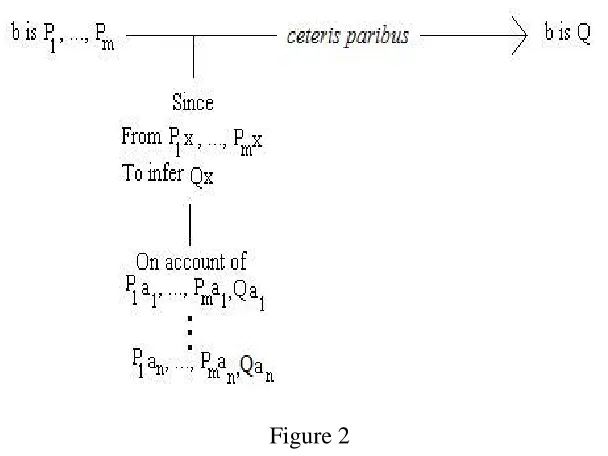
Note that we are not arguing that arguments by inductive analogy can be parsed into two subarguments, an inductive enu-meration argument to the unstated conclusion that all things satis-fying the similarities argued from also satisfy the similarity argued for (without qualification, not hedged with “ceteris paribus”) fol-lowed by a deductive quasi-syllogism from that generalization linked with the premise asserting that the primary subject satisfies the similarities argued from to the conclusion that the primary sub-ject satisfies the similarity argued for. Rather, we are suggesting that the premises which assert that the analogues satisfy both the similarities argued from and the similarity argued for are backing. The warrant licences the inference to the primary subject’s satisfy-ing the similarity argued for from the premise that it satisfies the similarities argued from. The difference between a priori and in-ductive analogies is that the warrant expresses an empirical, rather than a priori connection. Given the Toulmin model, we may dia-gram such arguments in the following way, where ‘a1, ..., an’
indi-cate the analogues, ‘b’ the primary subject, ‘P1, ..., Pm’ the
similari-ties argued from, and Q’ the similarity argued for (see Figure 2 on the next page):3
This parsing of inductive analogies resembles closely Mill’s analysis of quasi-syllogisms, i.e. arguments of the form
All F are G. a is F.
Therefore a is G
3Our placing of ‘
ceteris paribus’ interrupting the line from data to claim instead
© James B. Freeman. Informal Logic, Vol. 33, No. 2 (2013), pp. 175–194. Figure 2
in Book II, Chapters ii-iv of his (1973/1843). For Mill, inference is always from particulars to particulars. Having observed a number of particulars (analogues) which exhibit co-variation of F with G, we may record in a memorandum that we may infer x is G from x is F. In a quasi-syllogism, we are really inferring the conclusion directly from the premises of an inductive enumeration argument supporting the apparent universal premise. The argument really is
a1 is an F & a1 is a G
an is an F & an is a G
b is an F.
Therefore b is a G,
© James B. Freeman. Informal Logic, Vol. 33, No. 2 (2013), pp. 175-194. a1 is an F & a1 is a G
an is an F & an is a G
Therefore All F’s are G’s b is an F.
Therefore b is a G,
we need not include the move to an intermediate conclusion as an intermediate step. From childhood we reason from particulars to particulars, reasoning or inferring long before we could formulate a general proposition. This holds true of adults also. For Mill, gen-eral propositions are merely registers of such inferences already made, and short formulae for making more (1973/1843, p. 193). The conclusion of a syllogism is not an inference drawn from the formula, but an inference drawn according to the formula, i.e. at least in the context of a quasi-syllogism, the general proposition is a warrant and the information about co-variation furnishes the backing, as our construal according to the Toulmin model mani-fests.4
Having contrasted a priori and inductive analogies on the epistemic difference of how their warrants are backed, we are ready to both appreciate and critically revise the moral Govier draws from recognizing a class of a priori analogies: Arguments by analogy constitute a distinct type of argument, neither deductive nor inductive. Those analogical arguments that are neither deduc-tive nor inducdeduc-tive are rather a priori analogies. By contrast, induc-tive analogies are properly construed as inducinduc-tive arguments. But if a priori analogies are defeasible, yet the warrant linking premise and conclusion not backed by inductive enumeration or some other form of recognized inductive argument, a priori analogies are nei-ther deductive nor inductive.
4
© James B. Freeman. Informal Logic, Vol. 33, No. 2 (2013), pp. 175–194. This moral has an important corollary. We make the deduc-tive/inductive distinction because different standards and different procedures are appropriate in judging connection adequacy for these two types of arguments. We do not judge the adequacy of in-ductive enumeration arguments through Venn diagrams nor do we ask about the representativeness of a sample in judging whether a categorical syllogism is valid or invalid. The inductive/deductive typology basically concerns the criteria and methods of assessing connection adequacy. Resemblances between arguments, including structural resemblances, are secondary. By splitting arguments by analogy into two classes, we are holding that the structural similari-ties between the two classes are outweighed by properly identify-ing the factors on which their connection adequacy depends.
Our claim that a priori analogies are defeasible a priori ar-guments will be strengthened if we can show that there are other defeasible a priori arguments, that the classification is not ad hoc. We may easily identify such arguments. Certainly conductive ar-guments from premises asserting that some property relevant to either intrinsic, deontic, or aretaic value to a conclusion claiming that some instance of intrinsic, deontic, or aretaic value holds are defeasible a priori, where the premises establish a prima facie case for the conclusion. For example,
You promised to return those weapons to Jones when he asked for them, which he has just done. So you should return Jones’ weapons to him.
© James B. Freeman. Informal Logic, Vol. 33, No. 2 (2013), pp. 175-194. in virtue of making a promise is defeated, at least until Jones re-covers. Such conductive arguments, a prime concern of Wellman in (1971), are defeasible a priori.
We may reinforce this point by considering two further ex-amples which Wellman gives to motivate his claim that conductive arguments constitute a third type of argument beyond deductive and inductive.
This is a good book because it is interesting and thought provoking.
Although he is tactless and nonconformist, he is still a mor-ally good man because of his underlying kindness and real integrity. (Wellman 1971, p. 51)
anal-© James B. Freeman. Informal Logic, Vol. 33, No. 2 (2013), pp. 175–194. ogies are not the sole members of the class of defeasible a priori arguments.
Right at the beginning of his chapter on conductive argu-ments, Wellman allows that there are further types of arguments neither deductive nor inductive. He mentions arguments by analo-gy, if they “cannot be reduced to some sort of statistical inference” (1971, p. 52). Further
At some point statistical or probability inference will require a kind of reasoning that is neither deductive nor inductive. I also believe that there is something that might be called ex-planatory reasoning: reasoning from a body of data to a hy-pothesis that will render them intelligible. (1971, p. 52)
The case of explanation is especially intriguing in connection with the class of defeasible a priori arguments. Consider the prime prin-ciple of confirmation:
Whenever we are considering two competing hypotheses, an observation counts as evidence in favor of the hypothesis under which the observation has the highest probability. (Collins 1999; reprinted in Pojman and Rea 2012, p. 204)
We may express the principle more formally as the Likelihood Principle:
(LP) Observation O supports hypothesis H1 more than it supports hypothesis H2 if and only if Pr(O/H1) > Pr(O/H2). (Sober 2004, p. 100)
© James B. Freeman. Informal Logic, Vol. 33, No. 2 (2013), pp. 175-194. from the axioms of probability theory. Then the epistemic status of the principle becomes that of the probability axioms.
Set theory is commonly recognized as a foundation for much of mathematics. Thus, we shall expect that the axioms of the prob-ability calculus can be derived as theorems from the axioms of set theory. Hence the epistemic status of probability theory becomes the epistemic status of set theory. Quine (1970) has given a telling argument that set theory is not logic and that set-theoretical truths are not logical truths. “As soon as we admit ‘’ as a genuine predi-cate, and classes as values of quantifiable variables, we are em-barked on a substantive mathematical theory” (Quine 1970, p. 72). Mathematical truths are not logical truths. Hence, pace Quine’s re-jection of the analytic/synthetic dichotomy, they are not analytic and so neither are the axioms or theorems of probability theory. But they are not a posteriori either.
Now clearly, we may see the prime principle of confirmation backing the following warrant:
From: O & Pr(O/H1) > Pr(O/H2) To infer ceteris paribus: H1
Consider the following instance:
The defendant’s fingerprints are all over the gun and semen containing his DNA has been found on the body of the vic-tim. The probability of this evidence on the hypothesis that the defendant raped and murdered the victim is greater than on the hypothesis that some unknown stranger did it. Hence, ceteris paribus, the defendant is guilty of the rape and murder of the victim.
© James B. Freeman. Informal Logic, Vol. 33, No. 2 (2013), pp. 175–194. principle of confirmation. Hence, classifying a priori analogical arguments as defeasible a priori, neither deductive nor inductive, is not ad hoc. They are not the only type of argument with a defeasi-ble a priori warrant.
© James B. Freeman. Informal Logic, Vol. 33, No. 2 (2013), pp. 175-194. in formulating a general theory of connection adequacy. But that argument is the topic of another paper.5
References
Collins, R. (1999). “A scientific argument for the existence of God: The fine-tuning design argument.” In M.J. Murray (Ed.), Reason for the hope within, pp. 47–75. Grand Rapids, MI: Eerdmans.
Copi, I.M. (1986). Introduction to logic, 7th ed. New York: Mac-millan Publishing Company.
Freeman, J.B. (2005). Acceptable premises: An epistemic approach to an informal logic problem. Cambridge: Cambridge Universi-ty Press.
Freeman, J.B. (2011). Argument structure: Representation and theory. Dordrecht: Springer.
Freeman, J.B. (2013 forthcoming). What types of arguments are there? In D. Mohammed and M. Lesinski (Eds.), Virtues of Ar-gumentation: Proceedings of the Tenth OSSA Conference. Windsor, ON: OSSA (CD ROM).
Govier, T. (1999). Euclid’s disease and desperate violinists: Do analogies have missing premises? In J. Hoaglund (Ed.), The phi-losophy of argument, pp. 137-53. Newport News, VA: Vale Press.
Govier, T. (2012). A practical study of argument, 7th ed. Belmont, CA: Cengage Learning.
Harrison, J. (1967). Ethical objectivism. In P. Edwards (Ed. in chief), The encyclopedia of philosophy, Vol. 3, pp. 71-75. New York: Macmillan Publishing Co, Inc. and The Free Press.
Mill, J.S. (1973/1843). A system of logic ratiocinative and induc-tive: Being a connected view of the principles of evidence and
5
© James B. Freeman. Informal Logic, Vol. 33, No. 2 (2013), pp. 175–194. the methods of scientific investigation, Books I-III. Toronto: University of Toronto Press.
Pojman, L.P. and Rea, M. (2012). Philosophy of religion: An an-thology, 6th ed. Belmont, CA: Cengage Learning.
Quine, W.V. (1970). Philosophy of logic. Englewood Cliffs, NJ: Prentice-Hall, Inc.
Rawls, J. (1971). A theory of justice. Cambridge, MA: Harvard University Press.
Ross, W.D. (1930). The right and the good. Oxford: Oxford Uni-versity Press.