VOLUME NO.6(2016),ISSUE NO.12(
DECEMBER
) ISSN 2231-5756A Monthly Double-Blind Peer Reviewed (Refereed/Juried) Open Access International e-Journal - Included in the International Serial Directories
Indexed & Listed at:
Ulrich's Periodicals Directory ©, ProQuest, U.S.A., EBSCO Publishing, U.S.A., Cabell’s Directories of Publishing Opportunities, U.S.A., Google Scholar, Open J-Gage, India [link of the same is duly available at Inflibnet of University Grants Commission (U.G.C.)],
Index Copernicus Publishers Panel, Poland with IC Value of 5.09 & number of libraries all around the world.
VOLUME NO.6(2016),ISSUE NO.12(
DECEMBER
) ISSN 2231-5756CONTENTS
Sr.
No.
TITLE & NAME OF THE AUTHOR (S)
Page
No.
1
.
PERFORMANCE MANAGEMENT SYSTEM IN TELECOM INDUSTRY: COMPARISON OF INDIAN PUBLIC
AND PRIVATE SECTOR UNDERTAKINGS
ADITYA GAUTAM & SAMEEKSHA JAIN
1
2
.
SUPREME COURT OF INDIA ON GROUNDS OF SETTING ASIDE ARBITRAL AWARD
SUDHIR S. KOTWAL & DR. ASMITA A. VAIDYA
6
3
.
PERFORMANCE EVALUATION OF THE CYBERAGE SCHEME IN GOA: STUDENTS’ PERSPECTIVE
DR. GAJANAN MADIWAL
10
4
.
INFORMATION MANAGEMENT SYSTEM IN THE LIVELIHOOD PROJECT
DR. VIJAY KUMAR & AJAY PUROHIT
13
5
.
TESTING WEAK FORM OF EFFICIENT MARKET HYPOTHESIS IN INDIA: WITH SPECIAL REFERENCE TO
NIFTY MIDCAP 50 INDEX BASED COMPANIES
DR. N. N. PANDEY
18
6
.
THE RETAIL AVALANCHE: A STUDY ON CUSTOMER PERCEPTION
ZOHEB ALI K & DR. RASHMI KODIKAL
22
7
.
INVESTORS ATTITUDE TOWARDS SAFETY AS AN IMPORTANT CRITERION FOR MUTUAL FUND
INVESTMENT – WITH SPECIAL REFERENCE TO CHENNAI CITY
S. PRASANNA KUMAR & DR. T. JOSEPH
27
8
.
FDI IN INDIAN RETAIL SECTOR: BOON OR BANE?
YASMIN BEGUM R. NADAF & SHAMSHUDDIN M. NADAF
32
9
.
UNDERSTANDING THE RELATIONSHIP BETWEEN ETHICAL LEADERSHIP BEHAVIOR AND ETHICAL
CLIMATE IN PRIVATE SECTOR BANKS IN ERNAKULAM DISTRICT
ROHINI. S. NAIR & SMITHA RAJAPPAN
36
10
.
A STUDY ON LECTURERS’ PERCEPTION OF STUDENTS’ FEEDBACK ON COURSES AND TEACHING WITH
REFERENCE TO PRIVATE INSTITUTIONS IN BANGALORE CITY
ASHA RANI.K
39
11
.
THE CHANGING DYNAMICS OF TALENT ACQUISITION IN RECRUITMENT SERVICE CENTERS: A
CONCEPTUAL STUDY
NAMITHA.S
45
12
.
THE AMALGAMATION OF SBI AND ITS SUBSIDIARIES: OPPORTUNITIES AND CHALLENGES
ANAND DHANANJAY WALSANGKAR
49
13
.
ORGANIZATIONAL RESOURCES AND CAPABILITIES FOR KNOWLEDGE STRATEGY IN HIGH VELOCITY
ENVIRONMENTS: THE PERSPECTIVE OF BUSINESS STRATEGY ALIGNMENT
K.UMA LAKSHMI & DR. SUMITHA K
53
14
.
FINANCIAL DISTRESS AND ITS IMPACT ON STOCK PRICES OF MINING SECTOR FIRMS IN INDONESIA
STOCK EXCHANGE
FITRI WAHYUNI, LUKYTAWATI ANGGRAENI & TONY IRAWAN
59
15
.
DISTRICT WISE SITUATION OF THE CHILD LABOUR (AGE 5-14) IN ANDHRA PRADESH
DR. PARUPALLY ANJANEYULU & SRIPARNA BANERJEE
65
16
.
INVESTIGATION OF UNEMPLOYMENT REGISTRATION SYSTEM IN ADDIS ABABA: THE CASE OF BOLE,
ARADA AND YEKA SUB-CITIES
WUBALEM SERAW GEZIE
71
17
.
POVERTY: A COLOSSAL PEST IN INDIA
KHEM RAJ
77
18
.
EXTRADITION AND LAW
SHREEMANSHU KUMAR DASH
83
19
.
COMPARATIVE ANALYSIS OF FARMERS’ SUICIDE IN ODISHA WITH INDIA
IPSITA PRIYADARSINI PATTANAIK
86
20
.
NEED FOR CHANGE IN THE HISTORICAL LEGACY OF CURRENT FINANCIAL YEAR
GUNEEV BRAR
91
VOLUME NO.6(2016),ISSUE NO.12(
DECEMBER
) ISSN 2231-5756INTERNATIONAL JOURNAL OF RESEARCH IN COMMERCE, IT & MANAGEMENT
CHIEF PATRON
PROF. K. K. AGGARWAL
Chairman, Malaviya National Institute of Technology, Jaipur
(An institute of National Importance & fully funded by Ministry of Human Resource Development, Government of India)
Chancellor, K. R. Mangalam University, Gurgaon
Chancellor, Lingaya’s University, Faridabad
Founder Vice-Chancellor (1998-2008), Guru Gobind Singh Indraprastha University, Delhi
Ex. Pro Vice-Chancellor, Guru Jambheshwar University, Hisar
FOUNDER PATRON
LATE SH. RAM BHAJAN AGGARWAL
Former State Minister for Home & Tourism, Government of Haryana
Former Vice-President, Dadri Education Society, Charkhi Dadri
Former President, Chinar Syntex Ltd. (Textile Mills), Bhiwani
FORMER CO-ORDINATOR
DR. S. GARG
Faculty, Shree Ram Institute of Business & Management, Urjani
ADVISORS
PROF. M. S. SENAM RAJU
Director A. C. D., School of Management Studies, I.G.N.O.U., New Delhi
PROF. M. N. SHARMA
Chairman, M.B.A., Haryana College of Technology & Management, Kaithal
PROF. S. L. MAHANDRU
Principal (Retd.), Maharaja Agrasen College, Jagadhri
EDITOR
PROF. R. K. SHARMA
Professor, Bharti Vidyapeeth University Institute of Management & Research, New Delhi
CO-EDITOR
DR. BHAVET
Faculty, Shree Ram Institute of Engineering & Technology, Urjani
EDITORIAL ADVISORY BOARD
DR. RAJESH MODI
Faculty, Yanbu Industrial College, Kingdom of Saudi Arabia
PROF. SANJIV MITTAL
University School of Management Studies, Guru Gobind Singh I. P. University, Delhi
PROF. ANIL K. SAINI
Chairperson (CRC), Guru Gobind Singh I. P. University, Delhi
DR. SAMBHAVNA
VOLUME NO.6(2016),ISSUE NO.12(
DECEMBER
) ISSN 2231-5756DR. MOHENDER KUMAR GUPTA
Associate Professor, P. J. L. N. Government College, Faridabad
DR. SHIVAKUMAR DEENE
Asst. Professor, Dept. of Commerce, School of Business Studies, Central University of Karnataka, Gulbarga
ASSOCIATE EDITORS
PROF. NAWAB ALI KHAN
Department of Commerce, Aligarh Muslim University, Aligarh, U.P.
PROF. ABHAY BANSAL
Head, Department of I.T., Amity School of Engineering & Technology, Amity University, Noida
PROF. A. SURYANARAYANA
Department of Business Management, Osmania University, Hyderabad
PROF. V. SELVAM
SSL, VIT University, Vellore
DR. PARDEEP AHLAWAT
Associate Professor, Institute of Management Studies & Research, Maharshi Dayanand University, Rohtak
DR. S. TABASSUM SULTANA
Associate Professor, Department of Business Management, Matrusri Institute of P.G. Studies, Hyderabad
SURJEET SINGH
Asst. Professor, Department of Computer Science, G. M. N. (P.G.) College, Ambala Cantt.
FORMER TECHNICAL ADVISOR
AMITA
Faculty, Government M. S., Mohali
FINANCIAL ADVISORS
DICKIN GOYAL
Advocate & Tax Adviser, Panchkula
NEENA
Investment Consultant, Chambaghat, Solan, Himachal Pradesh
LEGAL ADVISORS
JITENDER S. CHAHAL
Advocate, Punjab & Haryana High Court, Chandigarh U.T.
CHANDER BHUSHAN SHARMA
Advocate & Consultant, District Courts, Yamunanagar at Jagadhri
SUPERINTENDENT
VOLUME NO.6(2016),ISSUE NO.12(
DECEMBER
) ISSN 2231-5756INTERNATIONAL JOURNAL OF RESEARCH IN COMMERCE, IT & MANAGEMENT
CALL FOR MANUSCRIPTS
We invite unpublished novel, original, empirical and high quality research work pertaining to the recent developments & practices in the areas of Com-puter Science & Applications; Commerce; Business; Finance; Marketing; Human Resource Management; General Management; Banking; Economics; Tourism Administration & Management; Education; Law; Library & Information Science; Defence & Strategic Studies; Electronic Science; Corporate Gov-ernance; Industrial Relations; and emerging paradigms in allied subjects like Accounting; Accounting Information Systems; Accounting Theory & Practice; Auditing; Behavioral Accounting; Behavioral Economics; Corporate Finance; Cost Accounting; Econometrics; Economic Development; Economic History; Financial Institutions & Markets; Financial Services; Fiscal Policy; Government & Non Profit Accounting; Industrial Organization; International Economics & Trade; International Finance; Macro Economics; Micro Economics; Rural Economics; Co-operation; Demography: Development Planning; Development Studies; Applied Economics; Development Economics; Business Economics; Monetary Policy; Public Policy Economics; Real Estate; Regional Economics; Political Science; Continuing Education; Labour Welfare; Philosophy; Psychology; Sociology; Tax Accounting; Advertising & Promotion Management; Management Information Systems (MIS); Business Law; Public Responsibility & Ethics; Communication; Direct Marketing; E-Commerce; Global Business; Health Care Administration; Labour Relations & Human Resource Management; Marketing Research; Marketing Theory & Applications; Non-Profit Or-ganizations; Office Administration/Management; Operations Research/Statistics; Organizational Behavior & Theory; Organizational Development; Pro-duction/Operations; International Relations; Human Rights & Duties; Public Administration; Population Studies; Purchasing/Materials Management; Re-tailing; Sales/Selling; Services; Small Business Entrepreneurship; Strategic Management Policy; Technology/Innovation; Tourism & Hospitality; Transpor-tation Distribution; Algorithms; Artificial Intelligence; Compilers & Translation; Computer Aided Design (CAD); Computer Aided Manufacturing; Computer Graphics; Computer Organization & Architecture; Database Structures & Systems; Discrete Structures; Internet; Management Information Systems; Mod-eling & Simulation; Neural Systems/Neural Networks; Numerical Analysis/Scientific Computing; Object Oriented Programming; Operating Systems; Pro-gramming Languages; Robotics; Symbolic & Formal Logic; Web Design and emerging paradigms in allied subjects.
Anybody can submit the soft copy of unpublished novel; original; empirical and high quality research work/manuscriptanytime in M.S. Word format
after preparing the same as per our GUIDELINES FOR SUBMISSION; at our email address i.e. [email protected] or online by clicking the link online
submission as given on our website (FOR ONLINE SUBMISSION, CLICK HERE).
GUIDELINES FOR SUBMISSION OF MANUSCRIPT
1. COVERING LETTER FOR SUBMISSION:
DATED: _____________
THE EDITOR
IJRCM
Subject: SUBMISSION OF MANUSCRIPT IN THE AREA OF .
(e.g. Finance/Mkt./HRM/General Mgt./Engineering/Economics/Computer/IT/ Education/Psychology/Law/Math/other, please specify)
DEAR SIR/MADAM
Please find my submission of manuscript titled ‘___________________________________________’ for likely publication in one of your journals.
I hereby affirm that the contents of this manuscript are original. Furthermore, it has neither been published anywhere in any language fully or partly, nor it is under review for publication elsewhere.
I affirm that all the co-authors of this manuscript have seen the submitted version of the manuscript and have agreed to inclusion of their names as co-authors.
Also, if my/our manuscript is accepted, I agree to comply with the formalities as given on the website of the journal. The Journal has discretion to publish our contribution in any of its journals.
NAME OF CORRESPONDING AUTHOR :
Designation/Post* :
Institution/College/University with full address & Pin Code : Residential address with Pin Code : Mobile Number (s) with country ISD code : Is WhatsApp or Viber active on your above noted Mobile Number (Yes/No) : Landline Number (s) with country ISD code :
E-mail Address :
Alternate E-mail Address :
Nationality :
* i.e. Alumnus (Male Alumni), Alumna (Female Alumni), Student, Research Scholar (M. Phil), Research Scholar (Ph. D.), JRF, Research Assistant, Assistant Lecturer, Lecturer, Senior Lecturer, Junior Assistant Professor, Assistant Professor, Senior Assistant Professor, Co-ordinator, Reader, Associate Profes-sor, ProfesProfes-sor, Head, Vice-Principal, Dy. Director, Principal, Director, Dean, President, Vice Chancellor, Industry Designation etc. The qualification of
VOLUME NO.6(2016),ISSUE NO.12(
DECEMBER
) ISSN 2231-5756NOTES:
a) The whole manuscript has to be in ONE MS WORD FILE only, which will start from the covering letter, inside the manuscript. pdf.
version is liable to be rejected without any consideration.
b) The sender is required to mention the following in the SUBJECT COLUMNof the mail:
New Manuscript for Review in the area of (e.g. Finance/Marketing/HRM/General Mgt./Engineering/Economics/Computer/IT/
Education/Psychology/Law/Math/other, please specify)
c) There is no need to give any text in the body of the mail, except the cases where the author wishes to give any specific message
w.r.t. to the manuscript.
d) The total size of the file containing the manuscript is expected to be below 1000 KB.
e) Only the Abstract will not be considered for review and the author is required to submit the complete manuscript in the first instance.
f) The journal gives acknowledgement w.r.t. the receipt of every email within twenty-four hours and in case of non-receipt of
acknowledgment from the journal, w.r.t. the submission of the manuscript, within two days of its submission, the corresponding author is required to demand for the same by sending a separate mail to the journal.
g) The author (s) name or details should not appear anywhere on the body of the manuscript, except on the covering letter and the cover page of the manuscript, in the manner as mentioned in the guidelines.
2. MANUSCRIPT TITLE: The title of the paper should be typed in bold letters, centeredand fully capitalised.
3. AUTHOR NAME (S) & AFFILIATIONS: Author (s) name, designation, affiliation (s), address, mobile/landline number (s), and
email/al-ternate email address should be given underneath the title.
4. ACKNOWLEDGMENTS: Acknowledgements can be given to reviewers, guides, funding institutions, etc., if any.
5. ABSTRACT: Abstract should be in fully Italic printing, ranging between 150 to 300 words. The abstract must be informative and
eluci-dating the background, aims, methods, results & conclusion in a SINGLE PARA. Abbreviations must be mentioned in full.
6. KEYWORDS: Abstract must be followed by a list of keywords, subject to the maximum of five. These should be arranged in alphabetic
order separated by commas and full stop at the end. All words of the keywords, including the first one should be in small letters, except special words e.g. name of the Countries, abbreviations etc.
7. JEL CODE: Provide the appropriate Journal of Economic Literature Classification System code (s). JEL codes are available at
www.aea-web.org/econlit/jelCodes.php. However, mentioning of JEL Code is not mandatory.
8. MANUSCRIPT: Manuscript must be in BRITISH ENGLISH prepared on a standard A4 size PORTRAIT SETTING PAPER. It should be free
from any errors i.e. grammatical, spelling or punctuation. It must be thoroughly edited at your end.
9. HEADINGS: All the headings must be bold-faced, aligned left and fully capitalised. Leave a blank line before each heading.
10. SUB-HEADINGS: All the sub-headings must be bold-faced, aligned left and fully capitalised.
11. MAIN TEXT:
THE MAIN TEXT SHOULD FOLLOW THE FOLLOWING SEQUENCE:
INTRODUCTION
REVIEW OF LITERATURE
NEED/IMPORTANCE OF THE STUDY
STATEMENT OF THE PROBLEM
OBJECTIVES
HYPOTHESIS (ES)
RESEARCH METHODOLOGY
RESULTS & DISCUSSION
FINDINGS
RECOMMENDATIONS/SUGGESTIONS
CONCLUSIONS
LIMITATIONS
SCOPE FOR FURTHER RESEARCH
REFERENCES
APPENDIX/ANNEXURE
VOLUME NO.6(2016),ISSUE NO.12(
DECEMBER
) ISSN 2231-5756INTERNATIONAL JOURNAL OF RESEARCH IN COMMERCE, IT & MANAGEMENT
12. FIGURES & TABLES: These should be simple, crystal CLEAR, centered, separately numbered & self-explained, and the titles must be
above the table/figure. Sources of data should be mentioned below the table/figure. It should be ensured that the tables/figures are
referred to from the main text.
13. EQUATIONS/FORMULAE: These should be consecutively numbered in parenthesis, left aligned with equation/formulae number placed
at the right. The equation editor provided with standard versions of Microsoft Word may be utilised. If any other equation editor is utilised, author must confirm that these equations may be viewed and edited in versions of Microsoft Office that does not have the editor.
14. ACRONYMS: These should not be used in the abstract. The use of acronyms is elsewhere is acceptable. Acronyms should be defined
on its first use in each section e.g. Reserve Bank of India (RBI). Acronyms should be redefined on first use in subsequent sections.
15. REFERENCES: The list of all references should be alphabetically arranged. The author (s) should mention only the actually utilised
references in the preparation of manuscript and they may follow Harvard Style of Referencing. Also check to ensure that everything
that you are including in the reference section is duly cited in the paper. The author (s) are supposed to follow the references as per
the following:
•
All works cited in the text (including sources for tables and figures) should be listed alphabetically.•
Use (ed.) for one editor, and (ed.s) for multiple editors.•
When listing two or more works by one author, use --- (20xx), such as after Kohl (1997), use --- (2001), etc., in chronologically ascending order.•
Indicate (opening and closing) page numbers for articles in journals and for chapters in books.•
The title of books and journals should be in italic printing. Double quotation marks are used for titles of journal articles, book chapters, dissertations, reports, working papers, unpublished material, etc.•
For titles in a language other than English, provide an English translation in parenthesis.•
Headers, footers, endnotes and footnotes should not be used in the document. However, you can mention short notes to elucidatesome specific point, which may be placed in number orders before the references.
PLEASE USE THE FOLLOWING FOR STYLE AND PUNCTUATION IN REFERENCES:
BOOKS
•
Bowersox, Donald J., Closs, David J., (1996), "Logistical Management." Tata McGraw, Hill, New Delhi.•
Hunker, H.L. and A.J. Wright (1963), "Factors of Industrial Location in Ohio" Ohio State University, Nigeria.CONTRIBUTIONS TO BOOKS
•
Sharma T., Kwatra, G. (2008) Effectiveness of Social Advertising: A Study of Selected Campaigns, Corporate Social Responsibility, Edited by David Crowther & Nicholas Capaldi, Ashgate Research Companion to Corporate Social Responsibility, Chapter 15, pp 287-303.JOURNAL AND OTHER ARTICLES
•
Schemenner, R.W., Huber, J.C. and Cook, R.L. (1987), "Geographic Differences and the Location of New Manufacturing Facilities," Jour-nal of Urban Economics, Vol. 21, No. 1, pp. 83-104.CONFERENCE PAPERS
•
Garg, Sambhav (2011): "Business Ethics" Paper presented at the Annual International Conference for the All India Management Asso-ciation, New Delhi, India, 19–23UNPUBLISHED DISSERTATIONS
•
Kumar S. (2011): "Customer Value: A Comparative Study of Rural and Urban Customers," Thesis, Kurukshetra University, Kurukshetra.ONLINE RESOURCES
•
Always indicate the date that the source was accessed, as online resources are frequently updated or removed.WEBSITES
VOLUME NO.6(2016),ISSUE NO.12(
DECEMBER
) ISSN 2231-5756ORGANIZATIONAL RESOURCES AND CAPABILITIES FOR KNOWLEDGE STRATEGY IN HIGH VELOCITY
ENVIRONMENTS: THE PERSPECTIVE OF BUSINESS STRATEGY ALIGNMENT
K.UMA LAKSHMI
RESEARCH SCHOLAR
ALLIANCE SCHOOL OF BUSINESS
ALLIANCE UNIVERSITY
BANGALORE
DR. SUMITHA K
VISITING FACULTY
CMRIT
BANGALORE
ABSTRACT
Knowledge is perceived as one of the firm’s most important resources and arguments are put forward that differences in knowledge resources or in the capability to create and renew them are the major determining factors of the firm’s competitive advantage. Modern strategic management theories like Resource Based View (RBV) proposed that Resources that are Valuable, Rare, imperfectly imitable and Non-substitutable (VRIN) are the sources of firm’s competitive advantage while Dynamic Capabilities Framework(DCF) insisted on renewal of resources and reconfiguring them into new capabilities from time to time for attaining sustainable competitive advantage. Knowledge Based View (KBV) extended RBV by placing knowledge as a specialized organizational resource. Yet, in practice, knowledge is seen more as an outcome of Information systems rather than strategic resource. Since competitive advantage is short lived in competition-intensive high velocity environments, knowledge strategy that works around knowledge related resources and capabilities needs constant renewal and has to be aligned with business strategy so as to ensure sufficient knowledge resource for strategic intent. Knowledge management capability follows knowledge strategy. This paper is to review and examine the organizational resources and capabilities of knowledge strategy namely organizational culture, organization learning, flexible Information infra-structure and knowledge management capability that can be aligned with business strategy. Consequently, the study proposes a comprehensive conceptual model for knowledge and business strategy alignment for high velocity environments. The importance of this research is reflected in the fact that the alignment of knowledge-business strategies has an impact on maintaining and improving its competitive position.
KEYWORDS
business strategy, competitive advantage, dynamic capabilities, knowledge management, knowledge strategy.
1. INTRODUCTION
igh velocity environments are characterized by extensive globalization, limited barriers to entry, high competition (Dutta & Segev, 1999), rapid use of Social Media, Mobility, Analytics & Cloud technologies (SMAC) along the value chain, information transparency & near-zero information search costs resulting in bargaining power of customers & suppliers and in turn resulting in economic uncertainties. In times when uncertainty is the only certainty, it is critical for businesses to assess the resource and capability base from time to time so as to remain competitive. Renewal of existing resource base and reconfiguring them into new capabilities on a continuous basis, explains the source of competitive advantage for firms in moderately competitive environments (Eisenhardt and Martin, 2000; Teece et al., 1997). Knowledge is perceived as firm’s one of the most important resources and arguments are put forward that differences in knowledge resources or in the ability to create and renew them are the major determining factors of the firm’s sustainable competitive advantage (Grant, 1996; Kogut and Zander, 1992). To establish competitive advantage that can be sustainable, it is not sufficient enough to have efficient access to internal and external information sources alone. Knowledge strategy has to reflect the integration of new information as well as learning from past experiences with organization’s existing knowledge base. This new knowledge has to be operationalized into renewal of production routines. It has been found that production/ operations routines allow firms to accumulate capabilities (Nelson and Winter, 1982) which, over a period of time, may transform into competencies that allow a particular firm to gain competitive advantage due to the inimitable basis upon which competencies are formed. Hence, managing knowledge continuously from information sources and experience is critical for firm’s competitive advantage. Most of the organizations do not possess well developed strategic models linking knowledge-oriented processes, technologies, and business strategy. Some organizations do have a knowledge strategy, but without adequate fit with organizational strategy (Zack, 1999). This necessitates alignment of knowledge strategy and business strategy (Asoh, 2003). There is dearth of knowledge management models for the context of corporate executives (Earl, 2001) and proven knowledge management strategies (Asoh, 2003). The learning paradoxes of - taking advantage of existing capabilities and routines, while continually innovating; and transferring learning within the firm, while disallowing imitation by competitors - are the major dilem-mas faced by managers (Vera and Crossan, 2004) for competitive advantage in data driven high velocity environments.
RESEARCH PROBLEM
The paper is organized around two primary research questions
1. In high velocity environments, what intent forms the basis for aligning knowledge strategy with business strategy?
2. As part of knowledge strategy (not knowledge management strategy), which organizational resource - capability combinations lead to sustained competency in high velocity environments when aligning with business strategy?
There have been questions regarding whether competitive advantage can be sustained in high velocity environments (Eisenhardt and Martin, 2000) since “Tomor-row’s competitors do not even register on most firms’ radar screens” (D’aveni, 1998). There are apprehensions too regarding strategic value of knowledge resource (Gupta and Govindarajan, 2000). In that case, Knowledge Strategy process has to align its resources and capabilities to support business strategy. As a subset of knowledge strategy, knowledge management process focuses on current knowledge gaps as opposed to future requirements, utilizing the unit level or firm level resources. Knowledge strategy has to aim at maximizing knowledge management capability. Firms with high KM capabilities in a key area can respond very quickly to strategic moves by competitors (Gold et al., 2001). Exploring the linkage between different dimensions of knowledge strategy and competitive advantage helps to model the alignment mechanisms that will support the business strategy in exploiting existing knowledge stores.
The paper is organized as follows. Firstly, it discusses the theoretical background of Resource-Capability-Competency model of Resource Based View and Dynamic Capabilities Framework. Secondly it attempts to position knowledge in RBV context with Knowledge Based View. And finally, resources and capabilities related to knowledge strategy namely knowledge management capability, organizational learning, organization culture and flexible information infrastructure are examined in the context of business strategy alignment literature to arrive at a conceptual model.
VOLUME NO.6(2016),ISSUE NO.12(
DECEMBER
) ISSN 2231-5756INTERNATIONAL JOURNAL OF RESEARCH IN COMMERCE, IT & MANAGEMENT
2. LITERATURE REVIEW
Strategic process is complex and dynamic (Mintzberg, 1990) and many economic theories and models have been proposed and practiced for organizational per-formance and competitiveness. The industrial and organization (IO) model proposed that firm’s competitiveness is a function of the characteristics of the environ-ment in which it operates. This is extended by Porter in the “five forces” model with consideration of industry competitors, suppliers, buyers, substitutes, and potential industry entrants with advocacy for the analysis of strengths, weaknesses, opportunities and threats (SWOT) for maintaining a basic competitive ad-vantage, either through low cost or product differentiation in narrow or broad target markets (Porter, 1980; Porter, 1985). While these are exogenous in nature focusing primarily on external environmental analysis(Lamb, 1984), early 1990s witnessed proliferation of endogenous theories of firm strategy that stressed on internal resource and capability analysis (See Fig. 1) for competitive advantage (Barney, 1995).
FIGURE 1: SWOT ANALYSIS
Source: Porter, 1980
2.1. RESOURCE-CAPABILITY-COMPETENCY MODELS
Modern strategic management theories have explained that the differences in firms’ performance are due to continuous renewal of sources of competitive ad-vantage. They have differentiated resources and capabilities from competency. Firm resources include all assets, capabilities, organizational processes, firm attrib-utes, information, knowledge, etc. controlled by a firm (Daft, 1983). Essentially these are the strengths for conceiving and implementing strategies (Porter, 1985). Further studies have distinguished capabilities from resources. A capability is the organizational ability to execute production and daily operations repetitively, efficiently, and predictably. Contrary to this, a competency refers to a company’s ability to improve its performance continuously. A competency is the source of differentiation for the company for offering unique products, services, and solutions to customers. Established companies possess many more capabilities than competencies while new companies may have more competencies and fewer capabilities. To penetrate markets, resources, capabilities and competencies must be aligned effectively. Resource Based View(RBV) theorizes that Resources that are Valuable, Rare, Imperfectly-imitable and Non-substitutable (VRIN) by them-selves or in combinations lead to competitive advantage (Wernerfelt, 1984; Barney, 1991) while sustainable competitive advantage needs continuous reconfiguring of resources to develop distinct dynamic capabilities (Teece et al., 1997). This finding is in line with Prahalad & Hamel’s core competencies. Core competencies that comprise distinct skills and technologies are difficult for competitors to imitate (Prahalad and Hamel, 1999).
2.2. KNOWLEDGE BASED VIEW (KBV)
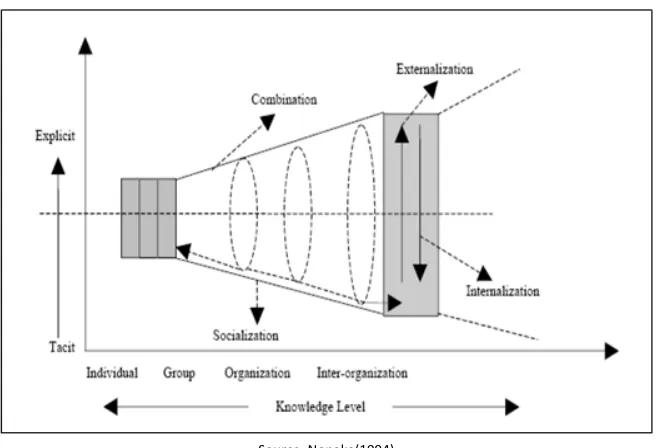
Based on the same philosophy as the RBV of the firm, the knowledge-based view (KBV) model of the firm has emerged focusing on knowledge as a specialized organizational resource. As “justified true belief”, knowledge is unambiguous and easily transferable Construct (Nonaka and Takeuchi, 1995). Earlier theories considered codified knowledge as organizational knowledge and that the knowledge is held by select individuals. Information systems perspective considers or-ganizations as information processing machines for interdependent work and environmental uncertainty (Santos, 1999; Eisenhardt, 2000). Then there is distinction between explicit and tacit knowledge (Polanyi, 1962) and both are deemed to be key resources for production (Drucker, 1994). Tacit knowledge is linked to the individual, and is very difficult to articulate like intuitions, unarticulated mental models, or embodied technical skills while Explicit knowledge is meaningful set of information articulated in clear language including numbers or diagrams (Polanyi, 1962). Tacit dimension of Knowledge is a potentially significant resource to the firm as it may possess valuable, rare, inimitable and non-substitutable characteristics (Grant, 1996; Barney, 1991; Kogut and Zander, 1992) and provides core competences (Prahalad, C.K. and G. Hamel, 1999). Knowledge is described as dynamic, as it is created in social interactions amongst individuals and organiza-tions(See Fig. 3) (Nonaka et al., 1994) and forms basis for firm’s dynamic capabilities (Teece et al., 1999) leading to sustainable competitive advantage (Alavi and Leidner, 1999; Grant, 1996). Since Tacit knowledge can get lost due to employee separation, transforming individual knowledge into organizational knowledge is one of the key management objectives (Kovacic et al., 2006; Rasula et al., 2012; Garvin, 1997). As a result, many organizations got engaged in multi-faceted activities collectively called as knowledge management (KM) to be competitive while coping with unpredictable business environments and shorter business cycles.
2.3. KNOWLEDGE STRATEGY- BUSINESS STRATEGY ALIGNMENT
Organizational effectiveness is driven by the “fit” among organizational processes and strategic decisions and thus contributes to competitive advantage (Quinn and Baily, 1994). Knowledge strategy is a set of guidelines and beliefs that shape an organization’s manipulation of knowledge resources and capabilities (Kasten, 2007) that might include identification, development, storage, management, retrieval, usage, and disposal of knowledge. Knowledge strategy is different from Knowledge Management (KM) strategy. KM strategy is the action taken by an organization to manage its knowledge. Knowledge management systems place knowledge strategy as the guiding principle. Basic drivers for creating knowledge strategy are: internally vs. externally sourced knowledge, enhanced vs. new knowledge, fast vs. slow speed of learning, and depth vs. breadth of knowledge base resulting in four generic knowledge strategies: explorer, exploiter, imitator, and passive learner (Bierly, 1999).
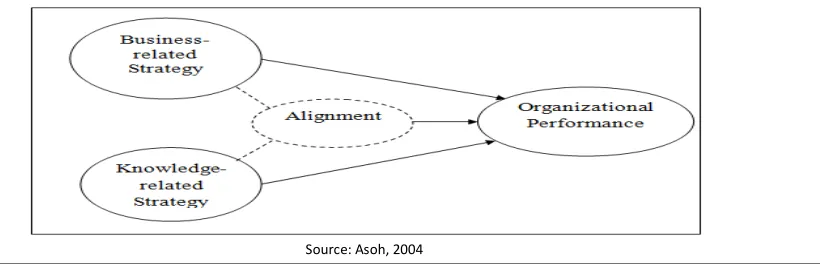
FIGURE 2: STRATEGIC ALIGNMENT MODEL
VOLUME NO.6(2016),ISSUE NO.12(
DECEMBER
) ISSN 2231-5756A Knowledge Strategy specifies how specific knowledge services will be implemented to bridge the gap between an organization’s current knowledge capabilities and the capabilities needed to accomplish its strategic objectives. It also outlines opportunities for exploiting existing knowledge stores. The idea of a knowledge strategy is an attempt to relate an organization’s competitive strategy with its intellectual resources & capabilities so as to provide knowledge required for offering products or services in ways superior to those of competitor (Bierly and Chakrabarti, 1999; Zack, 1999). At strategic level, knowledge has to ensure sufficiency of knowledge required to execute firm’s strategic intent and gap analysis has to be done between existing knowledge and required knowledge (Zack, 1999). A knowledge strategy provides a link between the organization’s strategic decisions and its knowledge structures & activities (Kasten, 2007). This infers that for each type of knowledge strategy there should be fit between strategic actions and other organizational practices & systems (Cabrera and Bonache, 1999). Thus The alignment between knowledge strategy and business strategy is an antecedent to predict organizational performance (See Fig 2) (Ulrich,1998).
P1: Alignment of knowledge strategy and business strategy positively impacts firm’s competitive advantage.
2.4. DIMENSIONS OF KNOWLEDGE STRATEGY
2.4.1. KNOWLEDGE MANAGEMENT (KM) CAPABILITY
Knowledge Management (KM) is a systematic process for capturing and communicating knowledge that people can use and it is the ability to mobilize and deploy KM-based resources in combination with other resources and capabilities (Chuang, 2004). KM practices are found to have positive impact on organizational per-formance (Kiessling et al., 2009; Rasula et al., 2012) through innovation, product improvement and employee improvement (Darroch, 2005; Kiessling et al.,2009; Fugate et al., 2009; Mostafa et al., 2011). Leveraging KM resources to create unique KM capabilities determines a firm’s overall effectiveness (Gold et al., 2001). The perspective that knowledge is slowly becoming the most important factor of production, next to labour, land and capital (Sher and Lee 2004; Sveiby,1997) has led to the development and implementation of knowledge management (KM) strategies (Earl, 2001). Combining the tacit-internal-oriented and explicit-external-oriented KM strategies indicates a complementary relationship, which implies synergistic effects of KM strategies on performance (Choi and Lee, 2002). Studies have highlighted leadership, culture, technology and best practice measurements as critical success factors for efficient KM implementation (Asoh et. al. 2002).
P2: Knowledge management capability has positive significant effect on competitive advantage.
2.4.2. ORGANIZATION CULTURE
Cultural KM resource, such as appropriate culture encourages employees to create and share knowledge within an organization (Holsaple and Joshi, 2001). The dynamic theory of organizational knowledge creation contains tacit and explicit knowledge types mutually complementing in individual or group human creative activities (See Fig.3). These interactions are socialization (from individual tacit knowledge to group tacit knowledge), externalization (from tacit knowledge to explicit knowledge), combination (from separate explicit knowledge to systemic explicit knowledge), and internalization (from explicit knowledge to tacit knowledge) (Nonaka and Takeuchi, 1995; Nonaka et al., 1996). Tacit knowledge development is dependent on other interpersonal relationships which may take years to develop (Mata et al., 1995) and tend to be highly local or organization specific (Sambamurthy and Zmud, 1992; Choi and Lee, 2002). Simultaneous man-agement of both tacit and explicit knowledge is important for the organization(Nevis et al., 1995; Jordan and Jones, 1997). Combination of degrees of managing explicit and explicit knowledge as low and high in a two by two matrix, obtained four KM styles – passive, system-oriented, human-oriented and dynamic. Dynamic KM Style (high explicit-oriented and high tacit -oriented KM activities) could lead to higher corporate performance (Choi and Lee, 2002). An organization is con-ceptualized as an organic Ba (Nonaka and Toyama, 2003) rather than information processing machine. Ba is a shared context in motion, can transcend time, space, and organization boundaries resulting in new conceptual artifacts and structures for interaction providing for possibilities and constrain the entities in consequent knowledge creation cycles (Nonaka and Toyama, 2003). The results of the study conducted by Zheng et al.(2010) suggest that KM fully mediates the impact of organizational culture on organizational effectiveness.
FIGURE 3: KNOWLEDGE CONVERSION IN ORGANIZATION
Source: Nonaka(1994)
P3: organizational culture has a significant positive effect on knowledge management capability
2.4.3. ORGANIZATIONAL LEARNING
Information that is actively processed in the mind of an individual through a process of reflection and learning can be more useful than massive information (Alavi and Leidner, 1999). Organizational learning is the capacity within an organization to maintain or improve performance based on experience (Nevis et al. 1995) and it is an important ingredient in maintaining firm competency. Strong organizational boundaries that separate complimentary knowledge and prevent communica-tion have the effect of fracturing core competencies since they disincentivize collaboracommunica-tion (Leonard-Barton, 1992). Quick imitacommunica-tion of knowledge resources is difficult since they require replication of time-consuming investments in learning (Mata et al., 1995). Superior capabilities can be developed through learning mechanisms, including repetition, experimentation, and even the analysis of small mistakes (Eisenhardt and Martin, 2000). When a competence no longer meets customers’ needs or cannot be extended further is - an exhausted competence - and becomes a “core rigidity” (Leonard-Barton, 1992). Dynamic learning may fundamentally be the most critical factor to knowledge strategy since it lets unlearning of the obsolete (Prahalad, 1998). The ability of an organization to learn, accumulate knowledge from its experiences, and reapply that knowledge is itself a competency providing strategic advantage (Zack,1999; Chai et. al. 2003). This explains the need for dynamic learning, within a company for superior performance.
VOLUME NO.6(2016),ISSUE NO.12(
DECEMBER
) ISSN 2231-5756INTERNATIONAL JOURNAL OF RESEARCH IN COMMERCE, IT & MANAGEMENT
2.4.4. FLEXIBLE INFORMATION TECHNOLOGY (IT) INFRASTRUCTURE
KM activities are supported by information infrastructures (Holsaple and Joshi, 2001, Sher and Lee, 2004; Tanriverdi, 2001; Zack, 1999). Information infrastructure facility often resulted in greater information infrastructure capabilities (Sher and Lee, 1994). Sher and Lee (2004) further suggested that more attention should be paid to the storage and retrieval of knowledge. This includes knowledge about products, production processes, customers, marketing strategies, financial results, strategic plans, goals etc. Thus storage of organizational knowledge constitutes an important aspect of organizational competitive advantage. It is found that an organization which was high quality in both KM and IT (a high-high fit) achieved high KM performance and satisfaction more frequently than those whose quality fitted low on either dimension or both. IT infrastructure of a firm may vary with firm resources, industry characteristics, information intensity etc. If information intensity is very high, then IT infrastructure is a strategic necessity. While innovating, IT infrastructure reduces cost and time of developing new systems. Though IT contradicts the requirements of Resource Based View (RBV) for being a competitive resource due to its imitability (Carr, 2003) ; continuous improvements in IT infrastructure or adding other resources to IT - adds to firm’s competitive advantage. IT infrastructure flexibility is very critical since users are expected from time to time to do things that are not designed to be done by existing systems. IT infrastructure flexibility follows alignment of Information Systems (IS) objectives with that of business objectives. (Nancy Bogucki Duncan,1995).
P6: Flexible IT infrastructure has a significant positive direct effect on knowledge management
3. DISCUSSION & FINDINGS
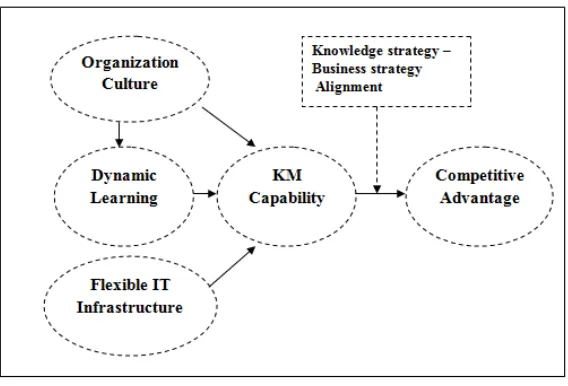
High velocity environments are characterized by limited barriers to entry and hyper competition, which may restore the social welfare benefits of perfectly com-petitive markets (Barney, 1991). To stay comcom-petitive, business has to assess and predict the opportunities and threats in the environment and accordingly renew its business strategy. The role of knowledge resource in this context is, availability in plenty with adequacy. There has to be sufficient knowledge base available for strategic renewal needs, which means that there is a need for knowledge strategy that exploits organizational resources and capabilities so as to ensure creation and utilization of tacit and explicit knowledge. That implies there have to be a favourable organization culture to allow knowledge conversions as noted by Nonaka et al (1995), a culture that facilitates dynamic learning according to the organizational knowledge needs. Information technology infrastructure that can invite external information, store it, process it, disseminate it- has to be flexible enough to adjust the data resources, storage needs and process requirements; which then contributes to dynamic knowledge management capabilities. This capability to create & utilize knowledge is the most important source of a firm’s sustainable competitive advantage (Nonaka I and Toyama R, 2003). The conceptual model depicted in Fig. 4 demonstrates these dimensions of knowledge strategy. Only when knowledge strategy is aligned with business strategy, competitive advantage is created.
Dynamic capabilities are the core of the mechanism that allows firms to obtain economic returns from their ownership of knowledge assets (Teece, 2000) by way of facilitating better decision making, reducing costs and increasing profits. Knowledge management capability as a core competence is difficult for competitors to imitate due to complex harmonization of individual skills (tacit knowledge), technologies (IT infrastructure) and production skills (dynamic learning culture)(Pra-halad and Hamel, 1999). Effective knowledge management typically requires an appropriate combination of all the above factors as indicated in the framework.
FIGURE 4: CONCEPTUAL MODEL OF ORGANIZATIONAL KNOWLEDGE STRATEGY
Source: Authors, Developed for this study
4. CONTRIBUTION AND IMPLICATIONS FOR FURTHER RESEARCH
Most of the research in knowledge area is more on knowledge management which focuses on project specific or process specific domains or on organizational knowledge requirements in general. There is limited literature on knowledge strategy for high velocity environments. At the outset, present study contributes to literature in two ways. First it tries to distinguish knowledge strategy from knowledge management strategy and highlights the knowledge needs for strategic intent. Thus sets the context for strategic alignment. Secondly it explores the resources and capabilities that can be part of knowledge strategy for getting aligned with business strategy. The importance of this research is reflected in the fact that the alignment of knowledge-business strategies has an impact on maintaining and improving its competitive position.
Knowledge strategy requires first understanding the business needs. Since technology investments are expensive and cultural change management is time con-suming, trial and error may prove costly for the organization. There have been frameworks for selecting knowledge strategy that is appropriate to the organization culture and KM project context (Kamara et al., 2002). Further research can provide insights into knowledge strategy choices and selection for high velocity envi-ronments.
5. CONCLUSION
VOLUME NO.6(2016),ISSUE NO.12(
DECEMBER
) ISSN 2231-5756REFERENCES
1. Alavi, M., Leidner, D.E. (1999). Knowledge Management Systems: Issues, Challenges and Benefits. Communications of the Association for Information Sys-tems, 1 (Article 7), 1-37.
2. Asoh, D. (2003). The Impact of Knowledge Management Strategies on Organizational Performance: Part I: Developing a Model to Test Earl’s Taxonomy. The Fourth European Conference on Organizational Knowledge, Learning and Capabilities, OKLC 2003, 13th – 14th April, 2003, Barcelona, Spain.
3. Asoh, D.A, Belardo, S. and Neilson,R. (2002). Knowledge management: issues, challenges and opportunities for governments in the new economy. in: R. Sprague (ed.), Proceedings of the 35th Hawaii International Conference on System Sciences 2002 (IEEE Press, Big Island, 2002) 129.
4. Asoh, D.A. (2004). Business and Knowledge Strategies: Alignment and Performance Impact Analysis, Unpublished Ph.D. dissertation, University of New York. 5. Barney, J. B. (1995). Looking Inside for Competitive Advantage, Academy of Management Executive, 9(4), 49-61.
6. Barney, J. (1991). Firm Resources and Sustained Competitive Advantage, Journal of Management, 17(1), 99-120. 7. Bierly P. E. (1999). Development of a generic knowledge strategy typology. Journal of business strategies, 16(1), 1-26.
8. Bierly, P. and A. Chakrabarti (1999). Generic Knowledge Strategies in the U.S. Pharmaceutical Industry. in knowledge and Strategy, M.H. Zack, (Ed.),Butter-worth Heinemann: Boston, 231-250.
9. Cabrera, E.F. and Bonache, J.(1999). An Expert HR System for Aligning Organizational Culture and Strategy, Human Resource Planning, 22(1), 51-60. 10. Carr, N.(2003). IT Doesn’t Matter, Harvard Business Review, 81(5), 41-50.
11. Choi, B. and H. Lee (2002), An Empirical Investigation of KM Styles and Their Effects on Corporate Performance. Information & Management, 1-15. 12. Chuang, S.H. (2004). A resource-based perspective on knowledge management capability and competitive advantage: An empirical investigation. Expert
System with Applications, 27, 459-465.
13. Daft, L.R., (1983). Organizational Theory and Designs, West Pub. Co., St. Paul. Cited in Wikipedia, http://en.wikipedia.org/wiki/Resource-based_view. (Ac-cessed date: 10th October 2016).
14. D'aveni, R.A. (1998). Waking Up to the New Era of Hyper competition, The Washington Quarterly, 21(1),183–195. 15. Drucker, P.F. (1994). The Age of Social Transformation, The Atlantic Monthly.
16. Duncan, N.B. (1995). Capturing Flexibility of Information Technology Infrastructure: A Study of Resource Characteristics and Their Measure. Journal of Man-agement Information Systems ,12(2).
17. Dutta, S.; Segev, A. (1999). Business Transformation on the Internet. European Management Journal. 17 (5), 466-476.
18. Eisenhardt, K. M. (2000). Knowledge-Based View: A new theory or strategy? in A.Pettigrew, H.Thomas and R. Whittington (Eds.), Handbook of Strategy and Management, Sage publications.
19. Eisenhardt, K. M., and Martin, J.(2000). Dynamic Capabilities: What Are They?, Strategic Management Journal, 21,1105-1121.
20. Fugate, B.S., Stank, T.P. & Mentzer, J.T. (2009). Linking improved knowledge management to operational and organizational performance. Journal of Opera-tions Management, 27, 247-264.
21. Garvin, D.A. (1997). A note on knowledge management, creating a system to manage knowledge. Harvard Business Review Reprint Collection, 55-74. 22. Gold, A.H., Malhotra, A. and Segars, A.H. (2001). Knowledge management: An organizational capabilities perspective. Journal of Knowledge Information
Systems, 18(1), 185-214.
23. Grant, R. M. (1996). Toward a Knowledge-Based Theory of the Firm. Strategic Management Journal, 7(Special Winter Issue), 109 - 122. 24. Gupta, A.K. and Govindarajan, V.(2000). Knowledge flow within multinational corporations. Strategic management journal, 21, 473-496. 25. Holsaple, C.W. and Joshi, K.D. (2001). Organizational knowledge resources. Decision Support Systems, 31(1), 39-54.
26. Jenny Darroch(2005). Knowledge management, innovation and firm performance. Journal of knowledge management, 9(3), 101-115. 27. Jordan, J. and P. Jones (1997). Assessing Your Company's Knowledge Style. Long Range Planning, 30(3), 392-398.
28. Kamara, J., Anumba M.C. and Carrillo, P.M.(2002). A CLEVER approach to selecting a knowledge management strategy. International Journal of Project Man-agement, 20, 205–11.
29. Kasten,J. (2007). Knowledge strategy and its influence on knowledge organization. Knowledge strategy and its influence on knowledge organization, 1, 44-54.
30. Kiessling, T.S. et al. (2009). Exploring knowledge management to organizational performance outcomes in a transitional economy. Journal of World Business, (44), 421-433
31. Kogut, B. and Zander, U. (1992). Knowledge of the firm, combinative capabilities and the replication of technology, Organisation Science, 3(3), 383-97. 32. Kovacic, A., Bosilj, V.V. and Loncar, A. (2006). A process-based approach to knowledge management. Economic Research, 19(2),53-66.
33. Leonard-Barton, D. (1992). Core capabilities and core rigidities: A paradox in managing new product development. Strategic Management Journal. Summer Special Issue: Strategy Process: Managing Corporate Self-Renewal., 13, 111-126.
34. Mata, F., Fuerst, W., Barney, J.(1995). Information technology and sustainable competitive advantage: a resource-based analysis. MIS Quarterly 19 (4), 487– 505.
35. Michael Earl(2001). Knowledge Management Strategies: Towards a Taxonomy. Journal of Management Information Systems/Summer, 18(1), 215-233. 36. Mintzberg, H. (1990). Strategy Formation: Schools of Thought. In: Frederickson, J., Ed., Perspectives on Strategic Management, Harper Business, New York,
105-237.
37. Mostafa moballeghi, Golnessa Galyani moghaddam (2011). Knowledge Management and Measuring its impact on Organisational Performance. 2011 Inter-national Conference on Financial Management and Economics IPEDR vol.11 (2011) © (2011) IACSIT Press, Singapore.
38. Nelson, R.R. and Winter, S.G. (1982). An Evolutionary Theory of Economic Change, Harvard University Press, Cambridge, MA.
39. Nevis, E. C., DiBella, A. J., and Gould, J. M. (1995). Understanding Organizations as Learning Systems. Sloan Management Review, 36(2), 73-85. 40. Nonaka, I. (1994). A dynamic theory of organizational knowledge creation, Organization Science, 5(1),14-37.
41. Nonaka,I. and Toyama, R.(2003). The knowledge-creating theory revisited: knowledge creation as a synthesizing process. Knowledge management research & practice, 1, 2–10.
42. Nonaka, I., Katsuhiro Umemoto and Dai Senoo (1996). From Information Processing to Knowledge Creation: A Paradigm Shift in Business Management. Technology In Society, 18(2),203-218.
43. Nonaka. I., and Takeuchi. H. (1995). The Knowledge-Creating Company. Oxford: Oxford University Press.
44. Polanyi, M. (1962), Personal Knowledge: Towards a Post-Critical Philosophy. The University of Chicago Press, Chicago, IL. 45. Porter, M., (1985). Competitive Advantage: Creating and Sustaining Superior Performance with new introduction, 34-43. 46. Porter, M.E. (1980). Competitive Strategy: Techniques for Analyzing Industries and Competitors, New York: The Free Press.
47. Prahalad, C.K. and G. Hamel (1999). The Core Competence of the Corporation, in Knowledge and Strategy, M.H. Zack (Ed.), Butterworth Heinemann: Boston: MA, 41-59.
48. Prahalad, C.K. (1998). Managing Discontinuities: The Emerging Challenges. Research Technology Management, 41(3),May. 49. Quinn, J.B. and Baily, M. (1994). Information Technology. Brookings Review, 12(3),36-41.
50. Rasula, J., Vuksic, V.B. and Stemberger, M.I. (2012). The impact of knowledge management on organizational performance. Economic and Business Review, 14(2), 147-168.
VOLUME NO.6(2016),ISSUE NO.12(
DECEMBER
) ISSN 2231-5756INTERNATIONAL JOURNAL OF RESEARCH IN COMMERCE, IT & MANAGEMENT
53. Sher, P.I. and Lee, V.C. (2004). Information technology as a facilitator for enhancing dynamic capabilities through knowledge management. Information and Management, 41(8), 933-945.
54. Sveiby, K.E., The New Organizational Wealth: Managing and Measuring Knowledge- Based Assets. First ed. 1997, San Francisco: Berrett- Koehler Publishers, 220.
55. Tanriverdi, H. (2001). Performance effects of corporate diversification: roles of knowledge resources. knowledge management capability and information technology. Boston University, School of Management.
56. Teece, D. J., Pisano, G., and Shuen, A.(1997). Dynamic Capabilities and Strategic Management. Strategic Management Journal, 18(7), 509-533. 57. Teece, D.J. (2000). Strategies for managing knowledge assets: the role of firm structure and industrial context. Long Range Planning, 33, 35-54.
58. Teece, D.J., G. Pisano, and A. Shuen (1999). Dynamic Capabilities and Strategic Management, in Knowledge and Strategy, M.H. Zack (Ed.), Butterworth Heine-mann: Boston, MA, 77-115.
59. Ulrich, D.O. (1998). Intellectual Capital = Competence × Commitment, Sloan Management Review, 39(2), 15-27.
60. Vera, D., & Crossan, M. (2004). Strategic Leadership and Organizational Learning. Academy of Management Review, 29(2), 222-240. 61. Wernerfelt, B. (1984). A Resource-based view of the firm, Strategic Management Journal, 5(2), 171-180.
62. Zack, M.H.(1999). Developing a Knowledge Strategy. California Management Review, 41(3), 125-145.
VOLUME NO.6(2016),ISSUE NO.12(
DECEMBER
) ISSN 2231-5756REQUEST FOR FEEDBACK
Dear Readers
At the very outset, International Journal of Research in Commerce, IT & Management (IJRCM) acknowledges
& appreciates your efforts in showing interest in our present issue under your kind perusal.
I would like to request you to supply your critical comments and suggestions about the material published
in this issue, as well as on the journal as a whole, on our e-mail
for further
improve-ments in the interest of research.
If you have any queries, please feel free to contact us on our e-mail
.
I am sure that your feedback and deliberations would make future issues better – a result of our joint effort.
Looking forward to an appropriate consideration.
With sincere regards
Thanking you profoundly
Academically yours
Sd/-
Co-ordinator
DISCLAIMER
VOLUME NO.6(2016),ISSUE NO.12(
DECEMBER
) ISSN 2231-5756