1
Comparing Competitive and Cooperative Content-Based
Instruction in Reading and Writing Classes
Hamid Marashi
1, Samira Sanatipoor
1(1) Islamic Azad University, Central Tehran, Iran
Abstract
.
The purpose of this study was to compare the impact of cooperative and competitive content-based instruction on EFL learners’ reading comprehension and writing. To fulfill the purpose, 60 female students of SAMA School of Mashhad, Iran were selected from among a total number of 90 based on their performance on a piloted sample KET and randomly put into two experimental groups. The same content was taught to both groups during 12 sessions with different methods of competitive and cooperative teaching being used in each class. A posttest, i.e. a reading and writing section of another KET, was administered after the treatment to both groups and their mean scores on the test were compared through an independent samples t-test and an ANCOVA. The results led to the rejection of both null hypotheses with the cooperative method of instruction being more effective on EFL learners’ reading comprehension and writing.Keywords: Content-based instruction, cooperative learning, competitive learning, writing, reading
1. Introduction
abilities, some of which are never fully achieved by many students even in their native language (Richards & Renandya, 2002).
The secret behind good writing is probably attempting to produce every sentence with its clearest components. Writing is thus a process of generating a text as a communicative bridge between the reader and the writer, and learning to write is an indispensable part of language learning. Accordingly, becoming more and more aware of this necessity, English language teaching circles are paying further attention to writing (Seidlhofer & Widdowson, 1999).
Indubitably, the ability to write well is very much correlated with reading well, as Hedge (1988, p. 11) states that “students benefit from the exposure of what constitutes good writing”. In a well quoted statement, Goodman (1967) writes that “reading is a selective process which involves partial use of available minimal language cues selected from perceptual input on the basis of the reader’s expectations” (p. 127). Grellet (1981) states that proficient readers do not concentrate on sentences and words. Instead, they engage upon a global understanding and then work toward the comprehension of detailed aspects of the reading. She maintains that “reading is an active skill as it constantly involves guessing, predicting, checking, and asking oneself questions” (p.8).
Among different methods of improving reading and writing, the theory and practice of cooperative learning vis-à-vis competitive learning is very much documented in the literature (e.g., Deutsch, Coleman, & Marcus, 2006; Johnson, Johnson, & Stanne, 2000; Warring, Maruyama, Johnson, & Nelson, 1985; Marashi & Baygzadeh, 2010; Shumway, Saunders, Stewardson, & Reeve, 2001).
Before the mid-1960s, cooperative learning was relatively unknown in education circles as formal elementary, secondary, and tertiary teaching which was then propelled by behaviorist thinking and social Darwinism was overwhelmingly dominated by competitive and individualistic learning (Hartup 1976; Ladd, 1991; Lewis & Rosenblum 1975).
(Bossert, 1988). This modality of learning has been defined as a classroom learning environment in which students work on academic tasks in small, heterogeneous groups. Accordingly, the teacher monitors groups to see that they are learning and functioning smoothly and team spirit is stressed with the learners engaging in learning how to learn through participation with their peers (Adams & Hamm, 1990; Kagan, 1994).
Competitive learning, in contrast, exists when one student’s goal is achieved while all other students fail to reach that goal (Johnson & Johnson, 1999). Competition results in individuals achieving different outcomes; when one person is successful in attaining a goal, others are prevented from doing so. Under individualistic conditions, each person’s outcome is independent of others (Deutsch et al., 2006; Lin, 1997). Both competitive and cooperative learning have been used in different teaching settings including content-based instruction (CBI). In the CBI class, students are tested on content and not language; thus, the focus tends to be on meaning, not form. Knowing that they will be tested on content, students are not tempted to review their grammar and memorize long lists of vocabulary words; rather, they listen closely to lectures, participate in discussions, do topic-related readings, and acquire a great deal of language in the process (Krashen, 1991).
Furthermore, CBI refers to an approach of second language acquisition which highlights the importance of content “in contrast to other approaches or methods which are centered around the language itself. Nevertheless, the approach does aim to develop the students’ language and academic skills but the skills are developed subconsciously through the content dealt with” (Richards & Rodgers, 2001, pp. 204-205).
Crandall & Tucker, 1990; Krashen, 1982; Mohan, Leung, & Davison, 2001; Snow, 2005; Stoller, 2004) with examples in the Iranian context (e.g., Marashi & Hatam, 2009).
While the majority of studies which have examined the consequences of cooperative and competitive learning methods on interpersonal relationships have also reported that more cross-ethnic friendship choices are made by learners in cooperative conditions than those in competitive or individual conditions (DeVries, Edward, & Slavin, 1978; Slavin, 1979; Warring et al., 1985; Ziegler, 1981), there are also some reports with mixed results not necessarily in favor of cooperative learning categorically (e.g., Marashi & Dibah, 2013).
With the abundant literature of studies conducted both on CBI and competitive/cooperative learning and also the overarching importance of the two skills of reading and writing in an ever-increasingly growing application of the two skills in communication technology and global media, the researchers were interested to see whether the reading and writing skills of EFL learners could be influenced differently by the use of competitive or cooperative language learning in CBI settings. Henceforth, the following null hypotheses were raised:
H01: There is no significant difference between the impact of
competitive and cooperative content-based instruction on EFL learners’ reading.
H02: There is no significant difference between the impact of
competitive and cooperative content-based instruction on EFL learners’ writing.
2. Method
2.1. Participants
standard deviation above and below the mean were chosen and divided randomly into the two experimental groups.
2.2. Instruments and materials
2.2.1. Key English Test (KET)
A sample KET was first piloted and subsequently administered in this study prior to the treatment for the participant selection process.
2.2.2. Posttests
The reading and writing paper of another sample piloted KET were used in this study as the posttests for both groups at the end of the treatment. The original reading paper was piloted a priori of course.
2.2.3. Textbooks
SAMA has published three books of science, math, and computer science which include a large number of technical words written in a simple way for the students. These books have six chapters and each chapter has some lessons that are followed by 4-5 questions in the form of multiple-choice, fill-in-the-blank, and explanatory items. There are also some shapes that are used for students’ brainstorming technique. The science course book was used in this study.
2.3. Procedure
At the beginning of the study, the already piloted KET was administered to 90 elementary EFL learners from among whom the 60 participants of the study were chosen and assigned randomly into two experimental groups. In the treatment process, both experimental groups underwent 12 sessions of 90 minutes held twice a week; a total of 60 minutes of each session was allocated to teaching reading and writing. Four units of the course book which comprised four titles for reading and writing were taught to both groups.
group work and alliance in class performance, while in the competitive class, every learner was responsible for her own performance without the help of other students.
In the cooperative group, the class began with the students’ being put into groups of three with everything which was taught to them being practiced among the group members. Each member of the group sought for outcomes that were beneficial to others. The group members were not the same all along the term as the teacher tried to teach the learners to work cooperatively with different individuals rather than a specific group.
The general method of teaching was the same for all chapters and the teacher and students’ duties in the class were the same in every session. Each session, the teacher tried to set up a friendly atmosphere through some techniques such as asking the students to introduce themselves to each other the very first session. They were supposed to be facing the other student instead of the teacher while introducing themselves to one another. Competitiveness was de-emphasized in each group while group work was encouraged.
In the competitive group, students believed they could achieve their goal only individually. So, they tried to be better than one another. The teacher taught and the students tried to take notes for themselves and learn the materials of instruction in a competitive atmosphere as every student sought to be the top student of the class. In this class, there was no group work at all.
A summary of one sample chapter of the cooperative group is as follows: The book had six chapters with each one lasting three sessions to be covered. Each chapter consisted of some texts with colorful pictures that were followed by a few questions in the form of multiple choice, fill-in-the-blank, and open-ended responses.
dictionaries and discuss them together while taking notes about everything related to that lesson.
Afterwards, the teacher wrote the summary of the lesson and put a suitable picture on the board with the students taking notes. Next, they tried to read the texts aloud and their pronunciation mistakes were corrected by the teacher. The learners were given time in class to answer the questions about the lesson in groups. The learners subsequently read aloud their answers for each other in each group and someone else in the group wrote the answers on the board; this would allow every person in a group to be involved.
Next, each group was assigned to read the text again, and write one to two paragraphs about this text. The teacher checked these writings and provided feedback to the groups.
The same procedure was conducted in the competitive group with the foundational difference that every step was implemented not in groups but individually. In this group, compared with the cooperative one, there was no cooperation in class and the teaching was conducted in a competitive atmosphere with every learner feeling that she should be the only winner of the class. Every learner had to answer the questions individually. Finally, at the end of the study, the two posttests were administered to both groups.
3. Results
A chronological order is applied in reporting the data analysis, hence, the participant selection process, the posttests, and the hypotheses testing are described one after the other.
3.1. Participant selection
3.1.1. Descriptive statistics of the KET administration
them for the study. The descriptive statistics of this process are presented below in Table 1 with the mean and standard deviation being 37.37 and 6.46, respectively.
Table 1. Descriptive statistics for KET
N Minimum Maximum Mean Std. Deviation KET Administration 90 20.0 50.0 37.367 6.4572 Valid N (listwise) 90
3.1.2. Assigning the participants to two groups
The next step was to randomly divide the 60 participants into two experimental groups: Group 1 undergoing the cooperative CBI instruction and Group 2 the competitive CBI instruction. Table 2 shows the descriptive statistics of these two groups’ scores based on their writing and reading scores in the previously administered KET. As the table shows, the mean and the standard deviation of the cooperative group in the writing test were 17.20 and 2.25, respectively, while those of the competitive group were 12.50 and 3.14, respectively. Besides, in the reading test, the mean of the cooperative group stood at 20.13 and the standard deviation was 4.47, while those of the competitive group were 20.30 and 3.45, respectively.
Table 2. Descriptive statistics of the KET writing and reading scores of the two groups at the outset
N Minimum Maximum Mean Std. Deviation Skewness
Statistic Statistic Statistic Statistic Statistic Statistic Std. Error KET Pre-Writing
Coop 30 12 20 17.20 2.250 -.790 .427
KET Pre-Writing
Comp 30 6 18 12.50 3.138 .011 .427
KET Pre-Reading
Coop 30 18 35 20.13 4.470 -.387 .427
KET Pre-Reading
Comp 30 16 31 20.30 3.446 -1.074 .427
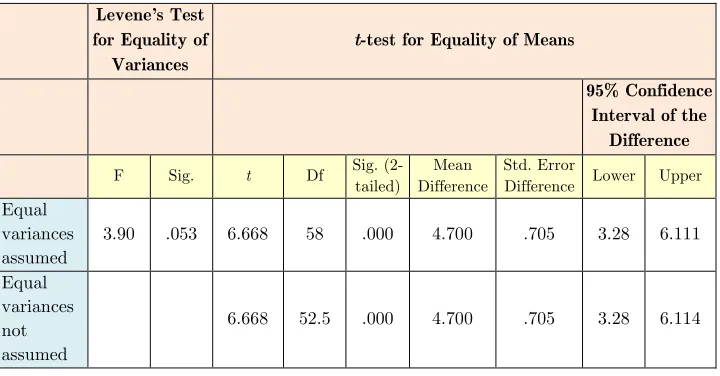
To make sure that the two groups manifested no significant difference at the outset in terms of their reading and writing, the means of both groups had to be statistically compared. The distribution of both groups in the writing test manifested normality with their skewness ratios (−0.790/0.427 = −1.85; 0.011/0.427 = 0.026) falling between the acceptable ±1.96 range; thus, running an independent samples t-test was legitimized. As is evident in Table 3 below, with the F value of 3.902, the significance level is 0.053 which is larger (albeit slightly) than 0.05; however, the variances of the two groups were not significantly different. Therefore, the results of the t-test with the assumption of homogeneity of the variances are reported here.
The results (t = 6.668, p = 0.000<0.05) indicate that there was a significant difference between the mean scores of the two groups at the outset in the writing. Hence, an ANCOVA would have to be run to test the hypothesis regarding the writing of the participants.
Table 3. Independent Samples t-test for the experimental groups’ mean on the KET writing section at the outset
Levene’s Test for Equality of Variances
t-test for Equality of Means
95% Confidence Interval of the
Difference
F Sig. t Df Sig.
(2-tailed)
Mean Difference
Std. Error
Difference Lower Upper Equal
variances assumed
3.90 .053 6.668 58 .000 4.700 .705 3.28 6.111
Equal variances not assumed
6.668 52.5 .000 4.700 .705 3.28 6.114
-2.52); hence, a nonparametric Mann-Whitney test had to be run. Tables 4 and 5 show the results for this statistical procedure.
Table 4. Mann-Whitney test: Ranks
Group N Mean Sum of ranks
Cooperative PreReading 30 31.43 943.00
Competitive PreReading 30 29.57 887.00
Total 60
Table 5. Mann-Whitney test: Test statistics
Score
Mann-Whitney U 422.000
Wilcoxon W 887.000
Z .479
Asymp. Sig. (2-tailed) .632
a. Grouping Variable: Group
According to Tables 4 and 5, the results of the Mann-Whitney test indicated that at the 0.05 level of significance, there was no significant difference between the mean rank of the cooperative group (31.43) and that of the competitive group (29.57) on the reading test (U = 422.00, N1=30, N2=30, p=0.632>0.05); consequently, any probable differences at the end of the treatment could be attributed to the effect of the treatment.
3.2. Posttests
3.2.1. Reading posttest
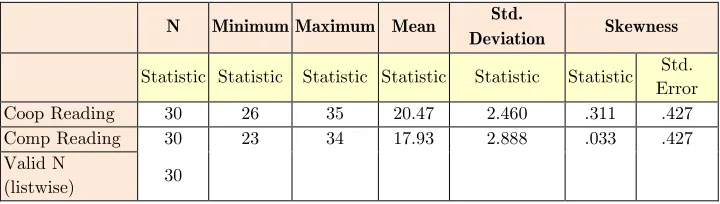
Following the piloting of reading posttest in which the reliability of the test stood at 0.80, the reading posttest was administered with the descriptive statistics being reported in Table 6 below. As shown in the table, the mean and standard deviation of the cooperative group were 20.47 and 2.46, respectively. In the competitive group, however, the mean was 17.93 while the standard deviation stood at 2.88.
N Minimum Maximum Mean Std.
Deviation Skewness
Statistic Statistic Statistic Statistic Statistic Statistic Std. Error Coop Reading 30 26 35 20.47 2.460 .311 .427 Comp Reading 30 23 34 17.93 2.888 .033 .427 Valid N
(listwise) 30
3.2.2. Writing posttest
The writing posttest was given to both groups with the descriptive statistics of this administration appearing in Table 7 below. As displayed in the table, the mean and standard deviation of the cooperative group were 16.07 and 2.68, respectively. In the competitive group, however, the mean was 14.77 while the standard deviation stood at 3.04.
Table 7. Descriptive statistics for the writing posttest in both groups
N Minimum Maximum Mean Std. Deviation Skewness
Statistic Statistic Statistic Statistic Statistic Statistic Std. Error
Coop Writing 30 9 20 16.07 2.677 -.777 .427
Comp Writing 30 7 19 14.77 3.036 -.345 .427
Valid N (listwise) 30
3.3. Testing the null hypotheses
3.3.1. Testing the first null hypothesis
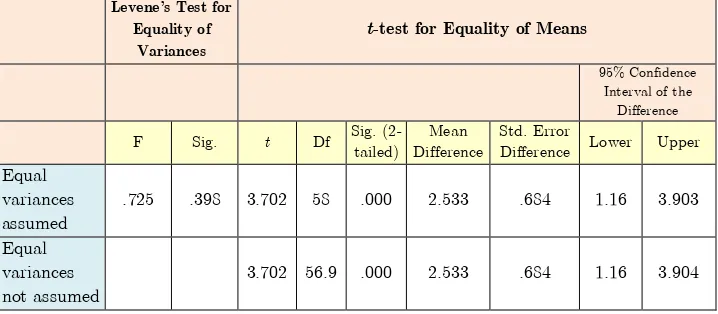
Table 8. Independent Samples t-test for the experimental groups’ means on the reading posttest
Levene’s Test for Equality of
Variances
t-test for Equality of Means
95% Confidence Interval of the
Difference
F Sig. t Df Sig.
(2-tailed)
Mean Difference
Std. Error
Difference Lower Upper Equal
variances assumed
.725 .398 3.702 58 .000 2.533 .684 1.16 3.903
Equal variances not assumed
3.702 56.9 .000 2.533 .684 1.16 3.904
The results (t = 3.702, p = 0.000 <0.05) indicate that there was a significant difference between the mean scores of the two groups in the reading posttest with the cooperative group who gained a higher mean outperforming the competitive group significantly. Hence, the first null hypothesis of this study was rejected meaning that content-based instruction in a cooperative setting had a significantly better impact on EFL learners’ reading compared to content-based instruction in a competitive setting.
Following the rejection of the null hypothesis, the researchers were interested to determine the strength of the findings of the research; accordingly, effect size was also estimated to be 0.83. According to Cohen (1988, p. 22), a value exceeding 0.8 is generally considered a large effect size. Therefore, the findings of the study may be considered strong enough for the purpose of generalization.
3.3.2. Testing the second null hypothesis
Table 9. Descriptive statistics of the two groups’ scores on the writing pre- and posttests
N Minimum Maximum Mean Std. Deviation Skewness Statistic Std. error Pre Coop 30 12 20 17.20 2.250 -.790 .427 Pre Comp 30 6 18 12.50 3.138 .011 .427 Post Coop 30 9 20 16.07 2.677 -.777 .427 Post Comp 30 7 19 14.77 3.036 -.345 .427 Valid (listwise) 28
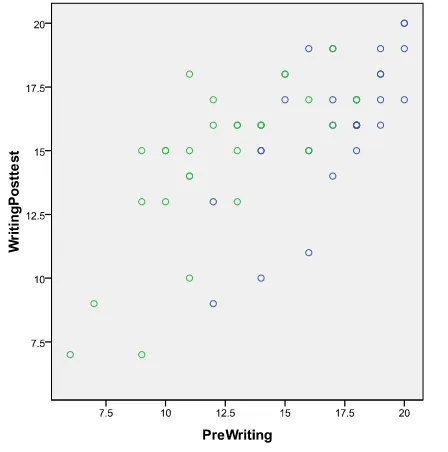
As is evident from Table 9, all scores in the four groups enjoyed normality of distribution (-1.85, 0.026, 1.81, & -0.81). Next, the Levene’s test for homogeneity of variance was run which proved the variances were not significantly different (F(1,54) = 0.304, p = 0.583 > 0.05). As one covariate was used in this study (writing pretest), the assumption of the correlation among covariates did not apply in this case. The next assumption is that of linearity between the dependent variable and the covariate. As displayed in figure 1 below, the relationship between the two appears to be very much linear.
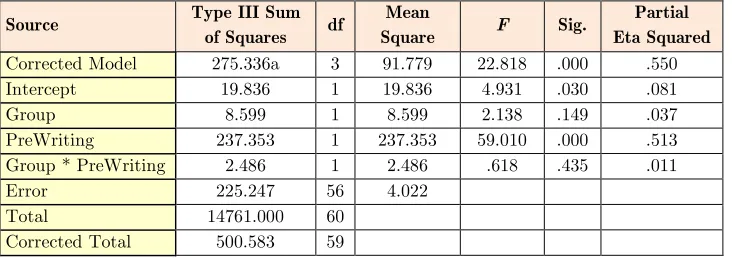
The last step was determining the homogeneity of regression slopes. Table 10 below shows that the interaction (i.e. Group*Prewriting) is 0.435 which is larger than 0.05. Thus indicating that the assumption of homogeneity of regression slopes has not been violated.
Table 10. Tests of between-subjects effects (1)
Source Type III Sum of Squares df
Mean
Square F Sig.
Partial Eta Squared Corrected Model 275.336a 3 91.779 22.818 .000 .550 Intercept 19.836 1 19.836 4.931 .030 .081
Group 8.599 1 8.599 2.138 .149 .037
PreWriting 237.353 1 237.353 59.010 .000 .513 Group * PreWriting 2.486 1 2.486 .618 .435 .011
Error 225.247 56 4.022
Total 14761.000 60
Corrected Total 500.583 59
a. R Squared = 0.932 (Adjusted R Squared = 0.929)
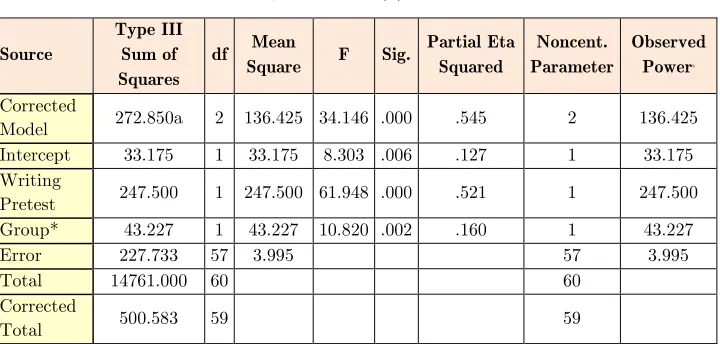
According to Table 11 below, the writing pretest scores (the covariate in the model) came out to be significant (F = 61.948, p = 0.000 < 0.05); thus, demonstrating that prior to the treatment, there was a significant difference between the two groups in terms of writing. With the eta squared of 0.521, the pretest covariate accounted for 52% of the overall variance. Despite the difference prior to the treatment, the effect of the treatment indeed turned out to be statistically significant (F=10.820,
Table 11. Tests of between-subjects effects (2)
Source
Type III Sum of Squares
df Mean
Square F Sig.
Partial Eta Squared
Noncent. Parameter
Observed Powerb
Corrected
Model 272.850a 2 136.425 34.146 .000 .545 2 136.425 Intercept 33.175 1 33.175 8.303 .006 .127 1 33.175 Writing
Pretest 247.500 1 247.500 61.948 .000 .521 1 247.500 Group* 43.227 1 43.227 10.820 .002 .160 1 43.227
Error 227.733 57 3.995 57 3.995
Total 14761.000 60 60
Corrected
Total 500.583 59 59
Dependent Variable: Writing Posttest
a. R Squared = 0.545 (Adjusted R Squared = 0.529)
The partial eta squared value was 0.160 which according to Cohen (1988) is a large effect size. Furthermore, there was a moderate relationship between the pre- and post-intervention scores on the writing test as indicated by the R squared of 0.545.
4. Discussion
The results of this study revealed that the cooperative group outperformed the competitive group in a CBI setting in their reading and writing. This finding is in-line with that of many studies (as discussed earlier in this paper) which generally portray the higher effectiveness of cooperative learning.
Throughout the treatment in both groups, it was clearly observed in class on many instances that the participants in the cooperative group demonstrated more motivation and alacrity in the process of the instruction. This is perhaps true as they were encouraged to engage and work with each other in this group. This of course is synonymous with more active participation which per se means enhanced learning (i.e., what is manifested by the results of the study).
a more insightful approach to the course. This was vividly traceable in both the quantity and quality of the questions they raised in class which of course is only further proof to the old saying that two brains work better than one. Such questions raised in class and the responses provided would of course consolidate and promote the participants’ learning.
5. Conclusion
To conduct cooperative CBI, teachers need to be given intensive training on how to implement this method and on the benefits of doing so before attempting to make it part of the curriculum. It is a sound idea that teachers share with one another their attitudes and experiences as well in this regard. Team teaching, establishing support groups in which teachers provide help and assistance to each other, and coordinating strategies for teaching difficult students are all examples of teacher cooperation. Such initiatives need to be complemented with support networks and ready-made materials to increase the likelihood that all teachers adopt this approach to teaching and learning in a proper way. Implementing CL approaches on a large scale takes serious commitment and resources. Without these, such approaches – regardless of their track record of success – will be doomed to failure. In simple terms, a shot-in-the-dark trial of CL will end nowhere; strategic thinking and adequate resource mobilization are required both at the managerial and implementation levels.
The findings of this research can also help syllabus designers and textbook writers to design textbooks which are conducive to cooperative learning. Cooperative tasks should be emphasized and given a significant bearing in the textbooks.
References
[2] Bossert, S. T. (1988). Cooperative activities in the classroom. Review of Educational Research, 15, 225-250.
[3] Cohen, J. (1988). Statistical power analysis for the behavioral sciences
(2nd ed.). Hillsdale, NJ: Lawrence Erlbaum.
[4] Crandall, J. A., & Tucker, G. R. (1990). Content-based language instruction in second and foreign languages. In S. Anivan (Ed.),
Language teaching methodology for the nineties (pp. 83-96). Singapore: SEAMEO Regional Language Centre.
[5] Curtain, H., & Pesola, C. (1994). Languages and children: Making the match. White Plains, NY: Longman.
[6] Deutsch, M., Coleman, P., & Marcus, E. (2006). The handbook of conflict resolution. San Francisco, CA: Jossey-Bass.
[7] DeVries, D. L., Edward, K. J., & Slavin, R. E.(1978). Biracial learning teams and race relations in the classroom: Four field experiments using teams games tournament. Journal of Educational Psychology, 70, 356-362.
[8] Goodman, K. (1967). Reading: A psycholinguistic guess game. Journal of the Reading Specialist, 126-135.
[9] Grellet, F. (1981). Developing reading skills. Cambridge: Cambridge University Press.
[10] Hamp-Lyons, L., & Heasly, B. (2006). Study writing. (2nd ed.). Cambridge: Cambridge University Press.
[11] Hartup, W. (1976). Peer interaction and the behavioral development of the individual child. In E. Schloper & R. Reicher (Eds.),
Psychopathology and child development (pp. 203-218). New York: Plenum.
[12] Hedge, T. (1988).Writing. Oxford: Oxford University Press. [13] Henry, A., & Roseberry, R. (1996): A corpus-based investigation of
implications for language teaching. Research in the Teaching of English, 30(4), 472-489.
[14] Johnson, D. W., & Johnson, R. (1999). Learning together and alone: Cooperative, competitive, and individualistic learning. Boston, MA: Allyn & Bacon.
[15] Johnson, D. W., Johnson, R. T., & Stanne, M. B. (2000).
Cooperative learning methods: A meta-analysis. Minneapolis, MN: University of Minnesota.
[16] Kagan, C. (1994). Learning to cooperate, cooperating to learn. New York: Plenum Press.
[17] Krashen, S. D. (1982). Principles and practices in second language acquisition. New York: Pergamon Press.
[18] Krashen, S. D. (1991). Bilingual education: A focus on current research. Washington, DC: National Clearinghouse for Bilingual Education.
[19] Krueger, M., & Ryan, F. (1993). Resituating foreign languages in the curriculum. In M. Krueger & F. Ryan (Eds.), Language and content. Discipline- and content-based approaches to language study (pp. 3-24). Lexington, MA: DC Heath.
[20] Ladd, G. (1991). Peer relationships and social competence during early and middle childhood. Annual Review of Psychology, 50, 333-359.
[21] Lewis, M., & Rosenblum, L. (1975). Friendship and peer relations. New York: Wiley.
[22] Lin, A. M. Y. (1997). Bilingual education in Hong Kong. In J. Cummins & D. Corson (Eds.), Encyclopedia of language and education, Volume 5: Bilingual education (pp. 281-289). Dordrecht, the Netherlands: Kluwer Academic Publishers.
[24] Marashi, H., & Dibah, P. (2013). The comparative effect of using competitive and cooperative learning on the oral proficiency of Iranian introvert and extrovert EFL learners. Journal of Language Teaching and Research, 4(3), 545-555.
[25] Marashi, H., & Hatam, G. (2009). Using tasks in a content-based program: Does it enhance vocabulary learning? Iranian Journal of Teaching English as a Foreign Language and Literature, 1(4), 73-91. [26] Mohan, B., Leung, C., & Davison, C. (2001). English as a second
language in the mainstream: Teaching learning and identity. New York: Longman.
[27] Richards, J. C., & Renandya, W. A. (2002). Methodology in language teaching: An anthology of current practice. New York: Cambridge University Press.
[28] Richards, J. C., & Rodgers, T. C. (2001). Approaches and methods in language teaching. Cambridge: Cambridge University Press. [29] Seidlhofer, B., & Widdowson, H. G. (1999). Coherence in summary:
The contexts of appropriate discourse. In W. Bublitz, U. Lenk, & E. Ventola (Eds.), Coherence in spoken and written discourse. How to create it and how to describe it. Selected papers from the
International Workshop on Coherence, Augsburg, 24-27 April 1997
(pp. 205-219). Amsterdam, PA: John Benjamins.
[30] Shumway, S., Saunders, W., Stewardson, G., & Reeve, E. (2001). A comparison of interpersonal goal structures and their effect on group problem-solving performance and student attitudes toward their learning environment. Journal of Industrial Teacher Education, 38(3), 6-24.
[31] Slavin, R. E. (1979). Effects of biracial learning teams on cross-racial friendships. Journal of Educational Psychology, 71(3), 381-387. [32] Snow, M. A. (2005). A model of academic literacy for integrated
[33] Stoller, F. L. (2004). Content-based instruction: Perspectives on curriculum planning. Annual Review of Applied Linguistics, 24, 261-283.
[34] Warring, D., Johnson, D. W., Maruyama, G., & Johnson, R. (1985). Impact of different types of cooperative learning on cross-ethnic and cross-sexrelationships. Journal of Educational Psychology, 77(1), 53-59.