A Monthly Double-Blind Peer Reviewed (Refereed/Juried) Open Access International e-Journal - Included in the International Serial Directories Indexed & Listed at:
Ulrich's Periodicals Directory ©, ProQuest, U.S.A., EBSCO Publishing, U.S.A., Cabell’s Directories of Publishing Opportunities, U.S.A., Open J-Gage, India [link of the same is duly available at Inflibnet of University Grants Commission (U.G.C.)],
VOLUME NO.3(2013),ISSUE NO.06(JUNE) ISSN 2231-5756
INTERNATIONAL JOURNAL OF RESEARCH IN COMMERCE, IT & MANAGEMENT
CONTENTS
CONTENTS
CONTENTS
CONTENTS
Sr.
No.
TITLE & NAME OF THE AUTHOR (S)
Page No.
1. ISSUES AND SUGGESTIONS FOR THE IMPLEMENTATION OF THE INDIA’S RIGHT TO INFORMATION ACT 2005 IN LIGHT OF THE LATIN AMERICAN COUNTRIES’ EXPERIENCE
DR. PRATIBHA J.MISHRA
1
2. AN EMPIRICAL STUDY ON JOB STRESS IN PRIVATE SECTOR BANKS OF UTTARAKHAND REGION
MEERA SHARMA & LT. COL. DR. R. L. RAINA
7
3. FOREIGN DIRECT INVESTMENT IN INDIA: AN OVERVIEW
DR. MOHAMMAD SAIF AHMAD
14
4. REFLECTIONS ON VILLAGE PEOPLE’S SOCIO - ECONOMIC CONDITIONS BEFORE AND AFTER NREGS: A DETAILED STUDY OF ARIYALUR DISTRICT, TAMIL NADU
DR. P. ILANGO & G. SUNDHARAMOORTHI
19
5. THE CAUSAL EFFECTS OF EDUCATION ON TECHNOLOGY IMPLEMENTATION – EVIDENCE FROM INDIAN IT INDUSTRY
S.M.LALITHA & DR. A. SATYA NANDINI
25
6. A STUDY ON ONLINE SHOPPING BEHAVIOUR OF TEACHERS WORKING IN SELF-FINANCING COLLEGES IN NAMAKKAL DISTRICT WITH SPECIAL REFERENCE TO K.S.R COLLEGE OF ARTS AND SCIENCE, TIRUCHENGODE, NAMAKKAL DISTRICT
SARAVANAN. R., YOGANANDAN. G. & RUBY. N
31
7. AN OVERVIEW OF RESEARCH IN COMMERCE AND MANAGEMENT IN SHIVAJI UNIVERSITY
DR. GURUNATH J. FAGARE & DR. PRAVEEN CHOUGALE
38
8. VARIABLE SELECTION IN REGRESSION MODELS
M.SUDARSANA RAO, M.SUNITHA & M.VENKATARAMANAIH
46
9. CUSTOMER ATTITUDE TOWARDS SERVICES AND AMENITIES PROVIDED BY STAR HOTELS: A STUDY WITH REFERENCE TO MADURAI CITY
DR. JACQUELINE GIGI VIJAYAKUMAR
50
10. QUALITY AND SUSTAINABILITY OF JOINT LIABILITY GROUPS AND MICROFINANCE INSTITUTIONS: A CASE STUDY OF CASHPOR MICROCREDIT SERVICES
DR. MANESH CHOUBEY
56
11. INDIAN MUTUAL FUND MARKET: AN OVERVIEW
JITENDRA KUMAR & DR. ANINDITA ADHIKARY
63
12. SMART APPROACHES FOR PROVIDING THE SPD’S (SECURITY, PRIVACY & DATA INTEGRITY) SERVICE IN CLOUD COMPUTING
M.SRINIVASAN & J.SUJATHA
67
13. A COMPARATIVE STUDY ON ETHICAL DECISION-MAKING OF PURCHASING PROFESSIONALS IN TAIWAN AND CHINA
YI-HUI HO
70
14. THE INTERNAL AUDIT FUNCTION EFFECTIVENESS IN THE JORDANIAN INDUSTRIAL SECTOR
DR. YUSUF ALI KHALAF AL-HROOT
75
15. STUDY ON ROLE OF EFFECTIVE LEADERSHIP ON SELLING VARIOUS INSURANCE POLICIES OF ICICI PRUDENTIAL: A CASE STUDY OF SUBHASH MARG BRANCH, DARYAGANJ
SUBHRANSU SEKHAR JENA
80
16. AN EMPIRICAL STUDY ON WEAK-FORM OF MARKET EFFICIENCY OF NATIONAL STOCK EXCHANGE
DR. VIJAY GONDALIYA
89
17. THE GOLDEN ROUTE TO LIQUIDITY: A PERFORMANCE ANALYSIS OF GOLD LOAN COMPANIES
DR. NIBEDITA ROY
94
18. STUDY ON THE MANAGEMENT OF CURRENT LIABILITIES OF NEPA LIMITED
DR. ADARSH ARORA
99
19. QUALITY OF MEDICAL SERVICES: A COMPARATIVE STUDY OF PRIVATE AND GOVERNMENT HOSPITALS IN SANGLI DISTRICT
SACHIN H.LAD
105
20. DIVIDEND POLICY AND BANK PERFORMANCE: THE CASE OF ETHIOPIAN PRIVATE COMMERCIAL BANKS
NEBYU ADAMU ABEBE & TILAHUN AEMIRO TEHULU
109
21. CUSTOMER KNOWLEDGE: A TOOL FOR THE GROWTH OF E-LEARNING INDUSTRY
DR. MERAJ NAEM, MOHD TARIQUE KHAN & ZEEBA KAMIL
115
22. THE EFFECTS OF ORGANIZED RETAIL SECTOR ON CONSUMER SATISFACTION: A CASE STUDY IN MYSORE CITY
ASHWINI.K.J & DR. NAVITHA THIMMAIAH
122
23. PERCEIVED BENEFITS AND RISKS OF ELECTRONIC DIVIDEND AS A PAYMENT MEDIUM IN THE NIGERIA COMMERCIAL BANKS
OLADEJO, MORUF. O & FASINA, H T
127
24. INDO - CANADIAN TRADE RELATION IN THE MATH OF POST REFORM PERIOD
ANITHA C.V & DR. NAVITHA THIMMAIAH
133
25. IMPACT OF BOARD STRUCTURE ON CORPORATE FINANCIAL PERFORMANCE
AKINYOMI OLADELE JOHN
140
26. WORK LIFE BALANCE: A SOURCE OF JOB SATISFACTION: A STUDY ON THE VIEW OF WOMEN EMPLOYEES IN INFORMATION TECHNOLOGY (IT) SECTOR
NIRMALA.N
145
27. SCHOOL LEADERSHIP DEVELOPMENT PRACTICES: FOCUS ON SECONDARY SCHOOL PRINCIPALS IN EAST SHOWA, ETHIOPIA
FEKADU CHERINET ABIE
148
28. EMOTIONAL INTELLIGENCE OF THE MANAGERS IN THE BANKING SECTOR IN SRI LANKA
U.W.M.R. SAMPATH KAPPAGODA
153
29. IMPACT OF CORPORATE SOCIAL RESPONSIBILITY PRACTICES ON MEDIUM SCALE ENTERPRISES
RAJESH MEENA
157
30. IMPACT OF CASHLITE POLICY ON ECONOMIC ACTIVITIES IN NIGERIAN ECONOMY: AN EMPIRICAL ANALYSIS
DR. A. P. OLANNYE & A.O ODITA
162
INTERNATIONAL JOURNAL OF RESEARCH IN COMMERCE, IT & MANAGEMENT
CHIEF PATRON
CHIEF PATRON
CHIEF PATRON
CHIEF PATRON
PROF. K. K. AGGARWAL
Chairman, Malaviya National Institute of Technology, Jaipur
(An institute of National Importance & fully funded by Ministry of Human Resource Development, Government of India)
Chancellor, K. R. Mangalam University, Gurgaon
Chancellor, Lingaya’s University, Faridabad
Founder Vice-Chancellor (1998-2008), Guru Gobind Singh Indraprastha University, Delhi
Ex. Pro Vice-Chancellor, Guru Jambheshwar University, Hisar
FOUNDER
FOUNDER
FOUNDER
FOUNDER PATRON
PATRON
PATRON
PATRON
LATE SH. RAM BHAJAN AGGARWAL
Former State Minister for Home & Tourism, Government of Haryana
Former Vice-President, Dadri Education Society, Charkhi Dadri
Former President, Chinar Syntex Ltd. (Textile Mills), Bhiwani
CO
CO
CO
CO----ORDINATOR
ORDINATOR
ORDINATOR
ORDINATOR
AMITA
Faculty, Government M. S., Mohali
ADVISORS
ADVISORS
ADVISORS
ADVISORS
DR. PRIYA RANJAN TRIVEDI
Chancellor, The Global Open University, Nagaland
PROF. M. S. SENAM RAJU
Director A. C. D., School of Management Studies, I.G.N.O.U., New Delhi
PROF. M. N. SHARMA
Chairman, M.B.A., Haryana College of Technology & Management, Kaithal
PROF. S. L. MAHANDRU
Principal (Retd.), Maharaja Agrasen College, Jagadhri
EDITOR
EDITOR
EDITOR
EDITOR
PROF. R. K. SHARMA
Professor, Bharti Vidyapeeth University Institute of Management & Research, New Delhi
CO
CO
CO
CO----EDITOR
EDITOR
EDITOR
EDITOR
DR. BHAVET
Faculty, Shree Ram Institute of Business & Management, Urjani
EDITORIAL ADVISORY BOARD
EDITORIAL ADVISORY BOARD
EDITORIAL ADVISORY BOARD
EDITORIAL ADVISORY BOARD
DR. RAJESH MODI
Faculty, Yanbu Industrial College, Kingdom of Saudi Arabia
PROF. SANJIV MITTAL
University School of Management Studies, Guru Gobind Singh I. P. University, Delhi
PROF. ANIL K. SAINI
VOLUME NO.3(2013),ISSUE NO.06(JUNE) ISSN 2231-5756
INTERNATIONAL JOURNAL OF RESEARCH IN COMMERCE, IT & MANAGEMENT
DR. SAMBHAVNA
Faculty, I.I.T.M., Delhi
DR. MOHENDER KUMAR GUPTA
Associate Professor, P. J. L. N. Government College, Faridabad
DR. SHIVAKUMAR DEENE
Asst. Professor, Dept. of Commerce, School of Business Studies, Central University of Karnataka, Gulbarga
ASSOCIATE EDITORS
ASSOCIATE EDITORS
ASSOCIATE EDITORS
ASSOCIATE EDITORS
PROF. NAWAB ALI KHAN
Department of Commerce, Aligarh Muslim University, Aligarh, U.P.
PROF. ABHAY BANSAL
Head, Department of Information Technology, Amity School of Engineering & Technology, Amity
University, Noida
PROF. A. SURYANARAYANA
Department of Business Management, Osmania University, Hyderabad
DR. SAMBHAV GARG
Faculty, Shree Ram Institute of Business & Management, Urjani
PROF. V. SELVAM
SSL, VIT University, Vellore
DR. PARDEEP AHLAWAT
Associate Professor, Institute of Management Studies & Research, Maharshi Dayanand University, Rohtak
DR. S. TABASSUM SULTANA
Associate Professor, Department of Business Management, Matrusri Institute of P.G. Studies, Hyderabad
SURJEET SINGH
Asst. Professor, Department of Computer Science, G. M. N. (P.G.) College, Ambala Cantt.
TECHNICAL ADVISOR
TECHNICAL ADVISOR
TECHNICAL ADVISOR
TECHNICAL ADVISOR
AMITA
Faculty, Government M. S., Mohali
FINANCIAL ADVISORS
FINANCIAL ADVISORS
FINANCIAL ADVISORS
FINANCIAL ADVISORS
DICKIN GOYAL
Advocate & Tax Adviser, Panchkula
NEENA
Investment Consultant, Chambaghat, Solan, Himachal Pradesh
LEGAL ADVISORS
LEGAL ADVISORS
LEGAL ADVISORS
LEGAL ADVISORS
JITENDER S. CHAHAL
Advocate, Punjab & Haryana High Court, Chandigarh U.T.
CHANDER BHUSHAN SHARMA
Advocate & Consultant, District Courts, Yamunanagar at Jagadhri
SUPERINTENDENT
SUPERINTENDENT
SUPERINTENDENT
SUPERINTENDENT
INTERNATIONAL JOURNAL OF RESEARCH IN COMMERCE, IT & MANAGEMENT
CALL FOR MANUSCRIPTS
CALL FOR MANUSCRIPTS
CALL FOR MANUSCRIPTS
CALL FOR MANUSCRIPTS
We invite unpublished novel, original, empirical and high quality research work pertaining to recent developments & practices in the areas of Computer Science & Applications; Commerce; Business; Finance; Marketing; Human Resource Management; General Management; Banking; Economics; Tourism Administration & Management; Education; Law; Library & Information Science; Defence & Strategic Studies; Electronic Science; Corporate Governance; Industrial Relations; and emerging paradigms in allied subjects like Accounting; Accounting Information Systems; Accounting Theory & Practice; Auditing; Behavioral Accounting; Behavioral Economics; Corporate Finance; Cost Accounting; Econometrics; Economic Development; Economic History; Financial Institutions & Markets; Financial Services; Fiscal Policy; Government & Non Profit Accounting; Industrial Organization; International Economics & Trade; International Finance; Macro Economics; Micro Economics; Rural Economics; Co-operation; Demography: Development Planning; Development Studies; Econometrics; Applied Economics; Development Economics; Business Economics; Monetary Policy; Public Policy Economics; Real Estate; Regional Economics; Political Science; Continuing Education; Labour Welfare; Philosophy; Psychology; Sociology; Tax Accounting; Advertising & Promotion Management; Management Information Systems (MIS); Business Law; Public Responsibility & Ethics; Communication; Direct Marketing; E-Commerce; Global Business; Health Care Administration; Labour Relations & Human Resource Management; Marketing Research; Marketing Theory & Applications; Non-Profit Organizations; Office Administration/Management; Operations Research/Statistics; Organizational Behavior & Theory; Organizational Development; Production/Operations; International Relations; Human Rights & Duties; Public Administration; Population Studies; Purchasing/Materials Management; Retailing; Sales/Selling; Services; Small Business Entrepreneurship; Strategic Management Policy; Technology/Innovation; Tourism & Hospitality; Transportation Distribution; Algorithms; Artificial Intelligence; Compilers & Translation; Computer Aided Design (CAD); Computer Aided Manufacturing; Computer Graphics; Computer Organization & Architecture; Database Structures & Systems; Discrete Structures; Internet; Management Information Systems; Modeling & Simulation; Neural Systems/Neural Networks; Numerical Analysis/Scientific Computing; Object Oriented Programming; Operating Systems; Programming Languages; Robotics; Symbolic & Formal Logic; Web Design and emerging paradigms in allied subjects.
Anybody can submit the soft copy of unpublished novel; original; empirical and high quality research work/manuscriptanytime in M.S. Word format
after preparing the same as per our GUIDELINES FOR SUBMISSION; at our email address i.e. [email protected] or online by clicking the link online submission as given on our website (FOR ONLINE SUBMISSION, CLICK HERE).
GUIDELINES FOR SUBMISSION OF MANUSCRIPT
GUIDELINES FOR SUBMISSION OF MANUSCRIPT
GUIDELINES FOR SUBMISSION OF MANUSCRIPT
GUIDELINES FOR SUBMISSION OF MANUSCRIPT
1. COVERING LETTER FOR SUBMISSION:
DATED: _____________
THE EDITOR IJRCM
Subject: SUBMISSION OF MANUSCRIPT IN THE AREA OF.
(e.g. Finance/Marketing/HRM/General Management/Economics/Psychology/Law/Computer/IT/Engineering/Mathematics/other, please specify)
DEAR SIR/MADAM
Please find my submission of manuscript entitled ‘___________________________________________’ for possible publication in your journals.
I hereby affirm that the contents of this manuscript are original. Furthermore, it has neither been published elsewhere in any language fully or partly, nor is it under review for publication elsewhere.
I affirm that all the author (s) have seen and agreed to the submitted version of the manuscript and their inclusion of name (s) as co-author (s).
Also, if my/our manuscript is accepted, I/We agree to comply with the formalities as given on the website of the journal & you are free to publish our contribution in any of your journals.
NAME OF CORRESPONDING AUTHOR:
Designation:
Affiliation with full address, contact numbers & Pin Code: Residential address with Pin Code:
Mobile Number (s): Landline Number (s): E-mail Address: Alternate E-mail Address:
NOTES:
a) The whole manuscript is required to be in ONE MS WORD FILE only (pdf. version is liable to be rejected without any consideration), which will start from the covering letter, inside the manuscript.
b) The sender is required to mentionthe following in the SUBJECT COLUMN of the mail:
New Manuscript for Review in the area of (Finance/Marketing/HRM/General Management/Economics/Psychology/Law/Computer/IT/
Engineering/Mathematics/other, please specify)
c) There is no need to give any text in the body of mail, except the cases where the author wishes to give any specific message w.r.t. to the manuscript. d) The total size of the file containing the manuscript is required to be below 500 KB.
e) Abstract alone will not be considered for review, and the author is required to submit the complete manuscript in the first instance.
f) The journal gives acknowledgement w.r.t. the receipt of every email and in case of non-receipt of acknowledgment from the journal, w.r.t. the submission of manuscript, within two days of submission, the corresponding author is required to demand for the same by sending separate mail to the journal.
2. MANUSCRIPT TITLE: The title of the paper should be in a 12 point Calibri Font. It should be bold typed, centered and fully capitalised.
3. AUTHOR NAME (S) & AFFILIATIONS: The author (s) full name, designation, affiliation (s), address, mobile/landline numbers, and email/alternate email address should be in italic & 11-point Calibri Font. It must be centered underneath the title.
4. ABSTRACT: Abstract should be in fully italicized text, not exceeding 250 words. The abstract must be informative and explain the background, aims, methods,
VOLUME NO.3(2013),ISSUE NO.06(JUNE) ISSN 2231-5756
INTERNATIONAL JOURNAL OF RESEARCH IN COMMERCE, IT & MANAGEMENT
5. KEYWORDS: Abstract must be followed by a list of keywords, subject to the maximum of five. These should be arranged in alphabetic order separated by commas and full stops at the end.
6. MANUSCRIPT: Manuscript must be in BRITISH ENGLISH prepared on a standard A4 size PORTRAIT SETTING PAPER. It must be prepared on a single space and
single column with 1” margin set for top, bottom, left and right. It should be typed in 8 point Calibri Font with page numbers at the bottom and centre of every page. It should be free from grammatical, spelling and punctuation errors and must be thoroughly edited.
7. HEADINGS: All the headings should be in a 10 point Calibri Font. These must be bold-faced, aligned left and fully capitalised. Leave a blank line before each
heading.
8. SUB-HEADINGS: All the sub-headings should be in a 8 point Calibri Font. These must be bold-faced, aligned left and fully capitalised.
9. MAIN TEXT: The main text should follow the following sequence:
INTRODUCTION
REVIEW OF LITERATURE
NEED/IMPORTANCE OF THE STUDY
STATEMENT OF THE PROBLEM
OBJECTIVES
HYPOTHESES
RESEARCH METHODOLOGY
RESULTS & DISCUSSION
FINDINGS
RECOMMENDATIONS/SUGGESTIONS
CONCLUSIONS
SCOPE FOR FURTHER RESEARCH
ACKNOWLEDGMENTS
REFERENCES
APPENDIX/ANNEXURE
It should be in a 8 point Calibri Font, single spaced and justified. The manuscript should preferably not exceed 5000 WORDS.
10. FIGURES &TABLES: These should be simple, crystal clear, centered, separately numbered & self explained, and titles must be above the table/figure. Sources of data should be mentioned below the table/figure. It should be ensured that the tables/figures are referred to from the main text.
11. EQUATIONS:These should be consecutively numbered in parentheses, horizontally centered with equation number placed at the right.
12. REFERENCES: The list of all references should be alphabetically arranged. The author (s) should mention only the actually utilised references in the preparation
of manuscript and they are supposed to follow Harvard Style of Referencing. The author (s) are supposed to follow the references as per the following:
•
All works cited in the text (including sources for tables and figures) should be listed alphabetically.•
Use (ed.) for one editor, and (ed.s) for multiple editors.•
When listing two or more works by one author, use --- (20xx), such as after Kohl (1997), use --- (2001), etc, in chronologically ascending order.•
Indicate (opening and closing) page numbers for articles in journals and for chapters in books.•
The title of books and journals should be in italics. Double quotation marks are used for titles of journal articles, book chapters, dissertations, reports, working papers, unpublished material, etc.•
For titles in a language other than English, provide an English translation in parentheses.•
The location of endnotes within the text should be indicated by superscript numbers.PLEASE USE THE FOLLOWING FOR STYLE AND PUNCTUATION IN REFERENCES: BOOKS
•
Bowersox, Donald J., Closs, David J., (1996), "Logistical Management." Tata McGraw, Hill, New Delhi.•
Hunker, H.L. and A.J. Wright (1963), "Factors of Industrial Location in Ohio" Ohio State University, Nigeria. CONTRIBUTIONS TO BOOKS•
Sharma T., Kwatra, G. (2008) Effectiveness of Social Advertising: A Study of Selected Campaigns, Corporate Social Responsibility, Edited by David Crowther & Nicholas Capaldi, Ashgate Research Companion to Corporate Social Responsibility, Chapter 15, pp 287-303.JOURNAL AND OTHER ARTICLES
•
Schemenner, R.W., Huber, J.C. and Cook, R.L. (1987), "Geographic Differences and the Location of New Manufacturing Facilities," Journal of Urban Economics, Vol. 21, No. 1, pp. 83-104.CONFERENCE PAPERS
•
Garg, Sambhav (2011): "Business Ethics" Paper presented at the Annual International Conference for the All India Management Association, New Delhi, India, 19–22 June.UNPUBLISHED DISSERTATIONS AND THESES
•
Kumar S. (2011): "Customer Value: A Comparative Study of Rural and Urban Customers," Thesis, Kurukshetra University, Kurukshetra. ONLINE RESOURCES•
Always indicate the date that the source was accessed, as online resources are frequently updated or removed. WEBSITESINTERNATIONAL JOURNAL OF RESEARCH IN COMMERCE, IT & MANAGEMENT
A COMPARATIVE STUDY ON ETHICAL DECISION-MAKING OF PURCHASING PROFESSIONALS IN TAIWAN
AND CHINA
YI-HUI HO
ASST. PROFESSOR
DEPARTMENT OF INTERNATIONAL BUSINESS
CHANG JUNG CHRISTIAN UNIVERSITY
GUEIREN
ABSTRACT
Purchasing professionals are recognized for their key role in keeping long-term relationships with suppliers. In the running of purchasing practices, ethics have been considered to be an essential requirement in maintaining a good buyer-supplier relationship. Considerable attention has been paid on ethical issues in purchasing management. Nevertheless, only a few studies analyzed ethical decision-making of purchasing professionals, and none of them provided a thorough analysis on purchasing professionals’ ethical decision-making. Most of them merely focused on a specific component of the ethical decision-making process. This paper attempts to explore the ethical decision-making of purchasing professionals in Taiwan and China. The study used a questionnaire survey to explore the differences in ethical decision-making between purchasing professionals in Taiwan and China. The Multidimensional Ethics Scales with purchasing-specific scenarios were used to measure purchasing professionals’ ethical decision-making. Research findings reveal significant differences in ethical decision-making between purchasing professionals in Taiwan and China.
JEL CODE
M00 - General
KEYWORDS
Ethical Decision-making, Purchasing Professionals, Taiwan, China, Multidimensional Ethics Scales.
INTRODUCTION
tudies about the nature of buyer-supplier relationships reveal that purchasing professionals in a company play a key role in keeping long-term relationships with suppliers and achieving the company’s strategic objectives. Purchasing professionals usually span the boundary between the company’s internal functions and its external suppliers by coordinating the flow of goods and services (Carter & Jennings, 2004; Landeros & Plank, 1996). They need to negotiate supply contracts with suppliers, and act as the interface between the company and its suppliers. In the running of purchasing practices, ethics have been recognized to be an essential requirement in maintaining a good buyer-supplier relationship. Suppliers usually view the ethics of their buyers as an important foundation to build relationships characterized by trust (Robertson & Rymon, 2001; Spekman & Carraway, 2006). Understanding purchasing professionals’ ethical decision-making will be helpful for those who want to build a close buyer-supplier relationship.
Research on ethical issues in purchasing practices has a rich conceptual and empirical history. However, only a few researchers studied ethical decision-making of purchasing professionals. Conducting research on purchasing professionals’ ethical decision-making may have an important bearing on the ethical predispositions that the suppliers bring with them to purchasing negotiation occasions (Ford, LaTour, Vitell & French, 1997). Previous studies on purchasing professionals’ ethical decision-making analyzed only a specific part of the process. Some focused on purchasing professionals’ ethical sensitivity (Razzaque & Hwee, 2002; Tadepalli, Moreno & Trevino, 1999), some on ethical judgment (Ford, LaTour & Henthorne, 2000; Lin & Ho, 2009), and some on ethical intention (Landeros & Plank, 1996; Robertson & Rymon, 2001). None of them analyzed two or more parts of ethical decision-making process simultaneously. Therefore, to fill the research gap, this paper attempts to analyze ethical sensitivity, ethical judgment and ethical intention of purchasing professionals.
This study takes purchasing professionals in Taiwan and China as research subjects. Because of the increasing importance of China and Taiwan to the global economic system, the necessity of understanding these purchasing professionals’ ethical behaviors is self-evident. However, although both China and Taiwan are influenced by the Chinese culture, these two societies have been separated and developed independently since 1949. They consequently exhibit quite different paths of political and economic development. Taiwan’s society is considered democratic and capitalistic; whereas China’s society is considered centralist and socialistic. Different political and economic conditions are potential factors which lead to differences in the values and behaviors of people between China and Taiwan. However, there is no literature that compared ethical decision-making of purchasing professionals in Taiwan and China. To fill the research gap, it is worthwhile to examine the difference in ethical decision-making between purchasing professionals in Taiwan and China. Therefore, the purpose of this paper is to explore the ethical decision-making of purchasing professionals in Taiwan and China, and to verify whether there is a difference in ethical decision-making between purchasing professionals in Taiwan and China.
LITERATURE REVIEW
ETHICAL ISSUES IN PURCHASING
As the importance of the purchasing function in businesses increases, there has been a concurrent increase in the importance of purchasing ethics. The purchasing function is critical to effective business operations while high-quality raw materials and supplies available on a timely basis are required for global competitive success. Successful companies understand the importance of ethical behavior in the purchasing function in maintaining dependable supplier relationships and, consequently, satisfied customers (Motwani, Kumar & Mohamed, 1998). Purchasing professionals are expected to serve as a communication link with the external business community and to develop and maintain long-term relationships with the firm’s vendors (Turner, Taylor & Harley, 1995). Of necessity, they are entrusted with spending millions of dollars of a company’s resources. Emergence of purchasing as a strategic function has not only broadened the scope of purchasing, it has also changed the responsibilities of the purchasing managers by empowering them to spend large sums of money in procuring goods and services. All these empowerment, responsibilities and pressure to succeed in today’s highly competitive business environment often leads to situations that require managers to take actions deemed questionable from ethical standpoint (Turner et al., 1995). However, this has also presented them with an array of ethical dilemmas involving questionable purchasing practices. Unethical purchasing practices retard fair business competitions since the kickback from a deal rather than concern for the company’s benefits becomes the basis for purchasing. With the business environment in general becoming increasingly competitive and tumultuous in recent years, purchasing professionals continue to face a challenging ethical environment. Hence, their ethical behavior when faced with such dilemmas has become an issue of concern.
Purchasing ethics is based on the principles which people act out of habit in the business world, and may be viewed as an extension of trade practices and rules which businesspeople in a society regard as important to maintain good relationships. (Joyce, 2006). Unethical behavior in the purchasing process is sometimes considered as even more unethical, possibly because larger amounts of money and personal enrichment of the individual are often involved. Unethical behavior by purchasers may damage relations within the purchasing department, the relationship with other departments in the company, and with suppliers as well (Badenhorst, 1994). Purchasing professionals are likely to face ethical issues, particularly as multiple suppliers compete for the business and may thus offer gifts or favors in return for securing a sale (Badenhorst, 1994; Browning & Zabriskie, 1983; Trawick, Swan & Rink, 1989; Turner et al., 1995; Wood, 1995). As boundary
VOLUME NO.3(2013),ISSUE NO.06(JUNE) ISSN 2231-5756
INTERNATIONAL JOURNAL OF RESEARCH IN COMMERCE, IT & MANAGEMENT
spanners of a company, purchasing professionals also face ethical issues more subtle than gift giving because tension may occur between the purchasing professional’s responsibility to both the employer and the supplier. Acting as an agent for the company, the purchasing professional's responsibility is to achieve the best possible negotiation with the supplier with regard to quality, price, and delivery date. Purchasing professionals could interpret this responsibility to mean that deception and manipulation of the supplier is an accepted means of achieving the desired outcomes.
An amount of researchers have proposed several ethical issues encountered by purchasing professionals. Forker and Janson (1990) concluded eight ethical issues in purchasing: (1) exaggerating a buyer’s or a supplier’s problem to achieve a desired outcome, (2) giving preferential treatment to purchasers or suppliers that top management prefers, (3) allowing personalities to influence buying/selling transactions, (4) engaging in the practice of reciprocity, (5) offer/acceptance of free gifts, meals, and trips, (6) seeking/giving information on competitors’ quotes, (7) gaining competitive information unfairly, and (8) showing bias against salespeople who circumvent the purchasing department. According to a survey conducted by Cooper, Frank and Kemp (1997) on the members of National Association of Purchasing Management, of the forty-four ethics-related issues in purchasing management, the top three ethical issues ranked by the purchasing professionals were (1) showing partiality toward suppliers preferred by upper management, (2) allowing personalities to improperly influence the buying decision, and (3) failure to provide prompt, honest responses to customer inquiries and requests. Carter (2000) suggested that ethical issues encountered by purchasing managers consist of two dimensions: deceitful practices and subtle practices. Deceitful practices include activities such as using obscure contract terms to gain advantage of suppliers; subtle practices encompasses somewhat more subtle activities such as showing favoritism when selecting suppliers. In general, gifts and bribes, accepting business meals, preferential treatment for certain suppliers or bidders, reciprocity, lying or exaggeration to suppliers, and allowing personal likes or dislikes to enter into negotiations have been identified as possible ethical issues in purchasing (Razzaque & Hwee, 2002).
Up to date, considerable attention has been paid to the ethics of purchasing professionals. However, only a few studies was made to study ethical decision-making of purchasing professionals (Ford et al., 2000; Landeros & Plank, 1996; Lin & Ho, 2009; Motwani et al., 1998; Plank et al., 1994; Razzaque & Hwee, 2002; Robertson & Rymon, 2001; Tadepalli et al., 1999; Turner et al., 1994, 1995). Plank et al. (1994) designed five vignettes to assess U.S. purchasing professionals’ ethical perceptions of questionable purchasing situations, and found that the respondents’ ethical decision- makings were primarily based on values of professional responsibility, beneficence, justice, and truth. Turner et al. (1994) explored U.S. purchasing professionals’ intention to accept gratuities, and concluded that formal written policies and upper level management have significant impacts on reducing the acceptance of gratuities. Turner et al. (1995) investigated U.S. business students’ perceptions of gratuity acceptance, and also concluded that formal written ethics policies would decrease respondents’ intention to accept gratuities.
Landeros and Plank (1996) used the Multidimensional Ethics Scale (MES) to assess U.S. purchasing professionals’ ethical intention to conduct five questionable purchasing situations, and validated the applicability of the MES. Motwani et al. (1998) explored Indian purchasing managers’ awareness of some questionable purchasing practices, and found that the respondents reacted less ethically to questionable situations than the U.S. managers. Tadepalli et al. (1999) compared the difference in ethical perceptions regarding some questionable purchasing situations between the U.S. and Mexican purchasing professionals, and concluded that culture would affect purchasing professionals’ ethical perceptions.
Ford et al. (2000) used the Defining Issues Test (DIT) to assess ethical judgment development of Japanese purchasing professionals, and found that the respondents would focus more on the conventional level than on the post-conventional level of ethical judgment while making ethical decisions. As the conventional level is characterized by the adherence to norms which have been established by external groups such as society and peer groups (Kohlberg, 1969), these conventional-level purchasing managers may be concerned with mutually satisfying outcomes and group harmonization while making ethical decisions. Robertson and Rymon (2001) studied the deceptive behavior of purchasing professionals, and found that purchasing professionals’ intention to conduct deceptive behavior was influenced by the perceived pressure to perform and ethical ambiguity of ethics codes. Razzaque and Hwee (2002) used the MES to assess Singaporean purchasing professionals’ ethical perceptions for some questionable purchasing practices, and argued that their ethical awareness would be associated with some individual and organizational factors. Lin and Ho (2009) used the DIT to compare ethical judgment development of purchasing professionals in Taiwan and China, and found that purchasing professionals in these two areas focused more on the conventional level than on the post-conventional level of ethical judgment. Chinese purchasing professionals focused more on the post-conventional level and less on the post-post-conventional level than Taiwanese respondents.
In summary, previous studies on purchasing professionals’ ethical decision-making analyzed only one part of the ethical decision-making process. Some focused on ethical sensitivity and awareness (Motwani et al., 1998; Razzaque & Hwee, 2002; Tadepalli et al., 1999); some on moral development (Ford et al., 2000; Lin & Ho, 2009; Plank et al., 1994); and some on ethical intention (Landeros & Plank, 1996; Robertson & Rymon, 2001; Turner et al., 1994, 1995). None of them analyzed two or more parts of ethical decision-making process simultaneously. According to Rest’s (1986) ethical decision-making model, a widely accepted model about ethical action, the process of ethical decision making consists of ethical sensitivity, ethical judgment, ethical intention, and ethical behavior. Therefore, to fill the research gap, it is necessary to analyze simultaneously ethical sensitivity, ethical judgment and ethical intention of purchasing professionals.
ETHICAL DECISION-MAKING
Ethics is a set of societal-based principles that specify the right and wrong ways to conduct oneself in intentional situations and that have the potential to affect others in positive or negative ways. Ward, Ward, and Deck (1993) define ethics as a process used to determine what is right for a given situation balancing of both inner and outer considerations tempered by each individual’s unique combination of experiences and learning. Ethics shapes the principles that provide prevailing justifying reasons for pursuing any course of action (Duska & Duska, 2003). It refers to the field of inquiry that concerns the actions of people, in situations where these actions have effects on the welfare of both oneself and others. An individual will make an ethical decision when he/she faces an ethical dilemma that there is uncertainty about how to balance competing benefits and values.
Ethical decision-making is a complicated and sophisticated psychological process. Several ethical decision-making models have been proposed in the literature. However, when discussing theories related to an individual’s ethical decision-making, it is hardly to neglect James Rest’s (1986) four-component model of ethical action. This model describes the process of ethical decision making, and is perhaps the most widely accepted model about ethical decision-making in psychology (Jones, Massey & Thorne, 2002; Loe, Ferrell & Mansfield, 2000; Trevino, Weaver & Reynolds, 2006). While making ethical decision, an individual must be able to interpret a situation and understand the possible actions, who would be affected, and how affected parties might perceive the effects on their welfare; to engage in ethical judgment when a course of action is formulated; to decide which values are most important in a situation containing a moral dilemma; and to execute and implement a plan of action (Rest, 1986). The four components in Rest’s (1986) model include ethical sensitivity (awareness), ethical judgment, ethical intention (motivation), and ethical behavior (character).
INTERNATIONAL JOURNAL OF RESEARCH IN COMMERCE, IT & MANAGEMENT
According to Rest’s (1986) model, the ethical decision-making process is initiated by ethical sensitivity, that is, the recognition that a particular situation will affect the welfare of others. Ethical sensitivity is the first step toward making an ethical decision. Specifically, it is a general ability to recognize the moral issues inherent in a situation and to interpret a situation as involving moral components (Rest, 1986). Jones (1991) states that ethical sensitivity involves the ability to recognize that one’s action will affect others and that those actions are voluntarily chosen and not committed under duress. Furthermore, although professional codes of conduct can provide people guidelines in business activities, the incompleteness and vagueness of these rules sometimes require employees to make professional judgment for situations without unequivocal technical solutions. Professional judgment frequently involves the resolution of ethical dilemmas (Gaa, 1994; Lampe & Finn, 1992; Moizer, 1995; Thorne, 2000). Ethical dilemmas may be decisions for which there is no single, ethically correct answer. Ethical judgment is a necessary component of ethical decision-making because many difficult dilemmas are ethically ambiguous, meaning that they can be viewed from a strategic perspective (non-ethical perspective), an ethical perspective, or a perspective that involves a combination of both (Butterfield, Trevino, & Weaver, 2000). In addition to ethical sensitivity and ethical judgment, ethical intention is the third component of Rest’s (1986) model of ethical action. It refers to making a decision to act on the basis of ethical judgment. Intention is the indication of how hard an individual is willing to try, and of how much of an effort he or she is willing to exert in order to perform a behavior (Ajzen & Fishbein, 1980). According to the theory of planned behavior (Ajzen, 1985), intention is the immediate antecedent of behavior, though there may be a number of factors that can influence the relationship between intention and behavior (Ajzen, 1985). Therefore, a person’s ethical intention will be a direct predictor of his or her ethical behavior. For instance, accountants who possess higher ethical intention will be more likely to act ethically.
Although there are some arguments about whether or not all of these components are interrelated (Chan & Leung, 2006; Karande, Shankarmahesh, Rao & Rashid, 2000; Thorne, 2000; Trevino, 1986), Rest, Narváez, Bebeau and Thoma (1999) assume that the overall progress of moral development can be viewed in terms of how well the progress in all four components leads to externally recognizable moral behavior. Rest’s (1986) model that describes how various cognitive structures and processes combine to produce an individual’s response to an ethical dilemma has been successfully applied to provide insights into ethical decision-making in various research areas (e.g., Jones, 1991; Jones et al., 2002; O’Fallon & Butterfield, 2005; Thorne, 2000; Trevino et al., 2006).
In summary, ethical decision-making is a way of resolving conflicts where such ethical conflicts are present. Rest’s (1986) model of ethical action is the most widely accepted model in ethical decision process. Researchers have found it to be a valid model of ethical decision-making in business on a global scale (Jones et al., 2002; Loe et al., 2000; Trevino et al., 2006). Therefore, this paper will explore ethical decision-making of purchasing professionals based on Rest’s model. We will investigate purchasing professionals’ ethical sensitivity, ethical judgment, and ethical intention in the study.
RESEARCH HYPOTHESIS
Both Taiwan and China are influenced by the Chinese culture; however, these two societies have been separated and developing independently for about 60 years. Taiwan has developed to some extent following the Western free-market model while retaining traditional Chinese culture. On the other hand, China has long been socialist. The Cultural Revolution in the 1960s, an ideological movement, has left China scarred with great cultural and economic losses. Taiwan is regarded as a capitalistic and democratic society; whereas China is considered a socialistic and centralist society. Under different political and economic systems, people in Taiwan and China are likely to have some differences in behaviors and cultural values. Hofstede’s survey (Hofstede & Hofstede, 2005) also showed that these two countries scored more or less differently on each cultural dimension.
Up to date, to the best of authors’ knowledge, there is no literature comparing ethical decision-making of purchasing professionals in Taiwan and China. Only a few studies have revealed that businesspeople and business students in Taiwan behave to a certain extent differently from those in China. Using samples of purchasing professionals in Taiwan and China, Chang and Ding (1995) found that significant differences existed between Taiwanese and Chinese respondents in the integration and Confucian work dynamism dimensions measured by the Chinese Value Survey. Wu (2003) found that business students in these two societies showed more or less differences in ethical decision making for selected scenarios. Chinese business students displayed different levels of moral development from their Taiwanese counterparts. Lin and Ho (2009) used the DIT to compare the development of ethical judgment of purchasing professionals in Taiwan and China, and found that Chinese purchasing professionals focused more on the conventional level and less on the post-conventional level than Taiwanese respondents. Therefore, this study proposed a research hypothesis that purchasing professionals in Taiwan and China will demonstrate differences in ethical decision-making process.
RESEARCH METHODOLOGY
MEASUREMENT
The Multidimensional Ethics Scales (MES) was used to measure purchasing professionals’ ethical decision making which includes ethical sensitivity, ethical judgment, and ethical intention. The MES, developed by Reidenbach and Robin (1988), uses well-constructed hypothetical business-specific scenarios to examine subjects’ ethical responses. The MES comprises a multi-item scale on which respondents indicate the extent to which they believe that a particular action, described in a scenario at the start of the instrument, is ethical or otherwise, according to a given ethical criterion. The MES permits insights into the cognitive ethical decision making process. Reidenbach and Robin (1988, 1990) summarized five ethical philosophies and included them in the MES instrument. These five ethical philosophies are justice, relativism, egoism, utilitarianism and deontology. The measuring scale of MES consists of several items which are grounded in each of the five philosophies.
Since its initial development, the MES has been widely used in the area of business ethics research (e.g., Cohen, Pant & Sharp, 2001; Hudson & Miller, 2005; Kujala & Pietiläinen, 2007). While the MES is a useful instrument in business ethics research, only a limited number of studies apply the MES to purchasing ethical issues. Landeros and Plank (1996) used the MES to assess U.S. purchasing professionals’ ethical intention to conduct five questionable purchasing situations, and validated the applicability of the MES. Razzaque and Hwee (2002) used the MES to assess Singaporean purchasing professionals’ ethical perceptions for some questionable purchasing practices, and argued that their ethical awareness would be associated with some individual and organizational factors. However, these studies only use one purchasing scenario in the MES instrument, and did not simultaneously analyze the ethical sensitivity, ethical judgment, and ethical intention of purchasing professionals. In the study, we attempted to use the MES to explore the differences between purchasing professionals from Taiwan and China in ethical sensitivity, ethical intention, and ethical judgment to well-known ethics philosophies.
SAMPLE
To test research hypotheses, data were collected through a mail survey of purchasing professionals across a broad spectrum of industries in Taiwan and China. Because of difficulty in getting a list of all purchasing professionals in these areas, we employed the snowball sampling concept to build the sample frame. With the aid of purchasing associations, some professionals in Taiwan and China were invited to participate on the basis of their having purchasing responsibilities for their organizations. Starting with these participants, the snowball sampling method was used to identify other professionals who had purchasing responsibilities for their organizations. Respondents who agreed to participate were asked to suggest the names of other individuals that were then contacted, either by e-mail or telephone. Care was taken to ensure that the individuals were actually involved in purchasing functions. Because several Taiwanese companies have invested in China, some purchasing professionals in Mainland China came from Taiwan. These professionals were categorized into Taiwanese group. Thus, we built a list of purchasing professionals in Taiwan and China.
VOLUME NO.3(2013),ISSUE NO.06(JUNE) ISSN 2231-5756
INTERNATIONAL JOURNAL OF RESEARCH IN COMMERCE, IT & MANAGEMENT
To evaluate the non-response bias, it would be desirable to compare respondents with non-respondents along known characteristics. Unfortunately, we were unable to have access to information about non-respondents that could allow us to perform this analysis. Following the suggestion that late respondents tend to be more similar to non-respondents than early respondents in mail surveys (Armstrong and Overton, 1977), we were, however, able to use the wave analysis, which measures non-response bias by comparing respondents who respond readily to the survey with those who respond after the follow-up steps are taken. Comparisons of survey results that were received after the mailing and after the follow-up revealed no significant differences between the two groups in the level of variables. Therefore, the non-response bias is not significant in the study.
RESEARCH FINDINGS AND DISCUSSIONS
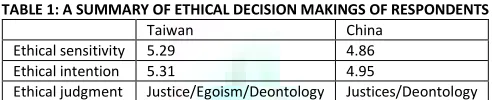
A summary of the ethical decision makings of respondents is illustrated in Table 1. According to the t test, there are significant differences in ethical sensitivity, ethical intention and ethical judgment between purchasing professionals in Taiwan and China.
TABLE 1: A SUMMARY OF ETHICAL DECISION MAKINGS OF RESPONDENTS
Taiwan China Ethical sensitivity 5.29 4.86 Ethical intention 5.31 4.95
Ethical judgment Justice/Egoism/Deontology Justices/Deontology
The Taiwanese purchasing professionals evaluate ethical dilemma significantly according to justices, egoism and deontology; but their Chinese counterparts evaluate dilemma by justices and deontology. Justice refers to the idea of fairness to all. It can be taken as a virtue ethics (Flory, Phillips, Reidenbach & Robin, 1992). An individual chooses to perform an action for reasons of justice because of his/her belief in moral equity, to create equitable treatment or to make all scales seem fair for everyone concerned with the given ethical dilemma. Egoism means the extent to which one chooses an action based on self-interest. Egoistic actions are presumed ethical if they promote an individual’s long-term interests. Deontology means the extent to which an action is consistent with an individual’s duties or unwritten obligations. Deontological actions focus on the principles of right and wrong but only to the duties defined by the actor, which may include unwritten or implied contracts or social obligations. However, relativism and utilitarianism are not significantly taken into account while both Taiwanese and Chinese purchasing professionals evaluate ethical dilemma. Relativism can also be taken as a virtue ethics. It is the extent to which an action is considered acceptable in a culture. Actions taken for relativistic reasons are those where certain rules may not seem universal, i.e., the professional-specific rules that may be acceptable in one culture may not be so in another. Utilitarianism is the extent to which an action leads to the greatest good for the greatest number of people. Utilitarian actions are those done for the greatest good, in contrast to egoistic actions (Flory et al., 1992).
CONCLUSIONS
This study has explored the ethical decision-making of purchasing professionals in Taiwan and China. The research findings have revealed that there are significant differences in ethical sensitivity, ethical intention and ethical judgment between purchasing professionals in Taiwan and China. The study can contribute to a better understanding of ethical decision-making of purchasing professionals in Taiwan and China. While most previous studies focused on purchasing ethics in the Western society, the current study can make significant contributions towards the ethics literature by providing valuable empirical insight into ethical decision making in the context of purchasing in Taiwan and China – a non-Western environment.
The study also contributes to make up for the lack of research on analyzing simultaneously two or more components of ethical decision-making of purchasing professionals. This project provides a thorough analysis of ethical decision-making of purchasing professionals by analyzing purchasing professionals’ ethical sensitivity, ethical judgment, and ethical intention, and the influences of individual and organizational factors on ethical decision making process. Furthermore, the research findings have profound implications for Taiwanese and Chinese businesses as it can provide a basis for understanding their purchasing professionals’ ethical decisions towards questionable practices in purchasing situations. This study might help top management to establish guidelines to help purchasers to act ethically when facing dilemmas and to prevent them from resorting to unethical practices. Our study can give an insight into ethical decision making of Chinese and Taiwanese purchasing professionals, and helps Western marketers to uncover the basic values of these people with whom they negotiate.
Like any other ethics research, this study has the potential to suffer from responses that state what is socially desirable, not what is practiced. The fact that the survey was conducted voluntarily and anonymously may have minimized this problem to some extent. In addition, this study has limited external validity as the sample frame is restricted to Taiwan and China. This might limit the generalization of the results of the study to the other countries. Making generalizations about the ethical decision making of purchasing professionals in other countries based on the results of this study may not be appropriate without further research. With the increasing globalization in business environment, contemporary industrial marketers have increasing opportunities to communicate with purchasing professionals with different cultural backgrounds. The current study has provided the evidence that ethical decision makings of purchasing professionals are apparently influenced by the country factor as well as several demographic and institutional variables. Culture plays such a potentially important role in ethical decision making. Therefore, understanding the possible cross-cultural differences in ethical decision makings of purchasing professionals is a relevant work. Future research can put more attention on examining the ethical decision makings of purchasing professionals in multi-country settings.
REFERENCES
1. Ajzen, I. (1985). From intentions to actions: A theory of planned behavior. In J. Kuhl, & J. Beckmann (Eds.), Action control: From cognition to behavior (pp. 11-39). New York: Springer.
2. Ajzen, I., & Fishbein, M. (1980). Understanding the attitudes and predicting social behavior. Englewood Cliffs, NJ: Prentice-Hall Inc. 3. Armstrong, J. S., & Overion, T. S. (1977). Estimating nonresponse bias in mail surveys. Journal of Marketing Research, 14(3), 396-402.
4. Badenhorst, J. A. (1994). Unethical behaviour in procurement: A perspective on causes and solutions. Journal of Business Ethics, 13(9), 739-745. 5. Browning, J., & Zabriskie, N. B. (1983). How ethical are industrial buyers? Industrial Marketing Management, 12(4), 219-224.
6. Butterfield, K. D., Trevino, L. K., & Weaver, G. R. (2000). Moral awareness in business organizations: Influences of issue-related and social context factors. Human Relations, 53(7), 981-1018.
7. Carter, C. R. (2000). Ethical issues in international buyer-supplier relationships: A dyadic examination. Journal of Operations Management, 8(2), 191-208. 8. Carter, C. R., & Jennings, M. M. (2004). The role of purchasing in corporate social responsibility: A structural equation analysis. Journal of Business Logistics,
25(1), 145-186.
9. Chan, S. Y. S., & Leung, P. (2006). The effects of accounting students’ ethical reasoning and personal factors on their ethical sensitivity. Managerial Auditing Journal, 21(4), 436-457.
10. Chang, K., & Ding, C. G. (1995). The influence of culture on industrial buying selection criteria in Taiwan and Mainland China. Industrial Marketing Management, 24(4), 277-284.
11. Cohen, J. R., Pant, L. W., & Sharp, D. J. (2001). An examination of differences in ethical decision-making between Canadian business students and accounting professionals. Journal of Business Ethics, 30(4), 319-336.
12. Cooper, R. W., Frank, G. L., Kemp, R. A. (1997). The ethical environment facing the profession of purchasing and materials management. International Journal of Purchasing and Materials Management, 33(2), 2-11.
INTERNATIONAL JOURNAL OF RESEARCH IN COMMERCE, IT & MANAGEMENT
14. Flory, S. M., Phillips, T. J., Jr., Reidenbach, R. E., & Robin, D. P. (1992). A multidimensional analysis of selected ethical issues in accounting. The Accounting Review, 67(2), 284-302.
15. Ford, J. B., LaTour, M. S., & Henthorne, T. L. (2000). Cognitive moral development and Japanese procurement executives: Implications for industrial marketers. Industrial Marketing Management, 29(6), 589-600.
16. Ford, J. B., LaTour, M. S., Vitell, S. J., & French, W. A. (1997). Moral judgment and market negotiations: A comparison of Chinese and American managers. Journal of International Marketing, 5(2), 57-76.
17. Forker, L. B., & Janson, R. L. (1990). Ethical practices in purchasing. Journal of Purchasing and Materials Management, 26(1), 19-26.
18. Gaa, J. C. (1994). The ethical foundations of public accounting. Research Monograph of Canada Research Foundation (No. 22). Vancouver: CGA-Canada Research Foundation.
19. Hofstede, G., & Hofstede, G. J. (2005). Cultures and organizations: Software of the mind (2nd ed.). New York: McGraw-Hill.
20. Hudson, S., & Miller, G. (2005). Ethical orientation and awareness of tourism students. Journal of Business Ethics, 62(4), 383-396.
21. Jones, J., Massey, D. W., & Thorne, L. (2002). A review and synthesis of the empirical research on the ethical dimension of accountants' professional judgment. Paper presented at the meeting of American Accounting Association, Professionalism and Ethics Symposium, San Antonio, TX.
22. Jones, T. M. (1991). Ethical decision-making by individuals in organizations: An issue-contingent model. Academy of Management Review, 16(2), 366-395. 23. Joyce, W. B. (2006). Accounting, purchasing and supply chain management. Supply Chain Management: An International Journal, 11(3), 202-207.
24. Karande, K., Shankarmahesh, M. N., Rao, C. P., & Rashid, Z. M. (2000). Perceived moral intensity, ethical perception, and ethical intention of American and Malaysian managers: A comparative study. International Business Review, 9, 37-59.
25. Kohlberg, L. (1969). Stage and sequence: The cognitive developmental approach to socialization. In D. A. Goslin (Ed.), Handbook of socialization theory and research. (pp.347-480). Chicago: Rand-McNally.
26. Kujala, J., & Pietiläinen, T. (2007). Developing moral principles and scenarios in the light of diversity: An extension to the multidimensional ethics scale. Journal of Business Ethics, 70(2), 141-150.
27. Lampe, J. C., & Finn, D. W. (1992). A model of auditors' ethical decision processes. Auditing: A Journal of Practice and Theory, 11(Supplement), 33-59. 28. Landeros, R., & Plank, R. E. (1996). How ethical are purchasing management professionals? Journal of Business Ethics, 15(7), 789-803.
29. Lin, C. Y., & Ho, Y. H. (2009). Cultural influences on moral reasoning capacities of purchasing managers: A comparison across the Taiwan Strait. Social Behavior and Personality: An International Journal, 37(2), 203-208.
30. Loe, T. W., Ferrell, L., & Mansfield, P. (2000). A review of empirical studies assessing ethical decision making in business. Journal of Business Ethics, 25(3), 185–204.
31. Moizer, P. (1995). An ethical approach to the choices faced by auditors. Critical Perspectives on Accounting, 6(5), 415-431.
32. Motwani, J., Kumar, A., & Mohamed, Z. (1998). Ethical behavior of Indian purchasing managers. Transportation Research Part E: Logistics and Transportation Review, 34(2), 161-168.
33. O’Fallon, M. J., & Butterfield, K. D. (2005). A review of the empirical ethical decision-making literature: 1996-2003. Journal of Business Ethics, 59(4), 375-413.
34. Plank, R. E., Landeros, R., & Plank, L. F. (1994). Values driving decisions in questionable purchasing situations. International Journal of Purchasing and Materials Management, 30(4), 44-53.
35. Razzaque, M. A., & Hwee, T. P. (2002). Ethics and purchasing dilemma: A Singaporean view. Journal of Business Ethics, 35(4), 307-326.
36. Reidenbach, R. E, & Robin, D. P. (1988). Some initial steps toward improving the measurement of ethical evaluations of marketing activities. Journal of Business Ethics, 7(11), 871-879.
37. Rest, J. R. (1986). Moral development: Advances in research and theory. New York, NY: Praeger Publishers.
38. Rest, J. R., Narváez, D., Bebeau, M. J., & Thoma, S. J. (1999). Postconventional moral thinking: A Neo-Kohlbergian approach. Mahwah, NJ: Lawrence Erlbaum Associates, Inc.
39. Robertson, D. C., & Rymon, T. (2001). Purchasing agents’ deceptive behavior: a randomized response technique study. Business Ethics Quarterly, 11(3), 455-479.
40. Spekman, R. E., & Carraway, R. (2006). Making the transition to collaborative buyer-seller relationships: An emerging framework. Industrial Marketing Management, 35(1), 10-19.
41. Tadepalli, R., Moreno, A., & Trevino, S. (1999). Do American and Mexican purchasing managers perceive ethical situations differently? An empirical investigation. Industrial Marketing Management, 28(4), 369-380.
42. Thorne, L. (2000). The development of two measures to assess accountants’ prescriptive and deliberative moral reasoning. Behavioral Research in Accounting, 12, 139-169.
43. Trawick, I. F., Swan, J. E., & Rink, D. (1989). Industrial buyer evaluation of the ethics of salesperson gift giving; value of the gift and customer vs. prospect status. Journal of Personal Selling and Sales Management, 9(1), 31-37.
44. Trevino, L. K. (1986). Ethical decision-making in organizations: A person-situation interactionist model. Academy of Management Review, 11(3), 601-617. 45. Trevino, L. K., Weaver, G. R., & Reynolds, S. J. (2006). Behavioral ethics in organizations: A review. Journal of Management, 32(6), 951-990.
46. Turner, G. B., Taylor, G. S., & Hartley, M. F. (1994). Ethics policies and gratuity acceptance by purchasers. International Journal of Purchasing and Materials Management, 30(3), 42-47.
47. Turner, G. B., Taylor, G. S., & Hartley, M. F. (1995). Ethics, gratuities, and professionalization of the purchasing function. Journal of Business Ethics, 14(9), 751-760.
48. Ward, S. P., Ward, D. R., & Deck, A. B. (1993). Certified public accountants: Ethical perception skills and attitudes on ethics education. Journal of Business Ethics, 12(8), 601-610.
49. Wood, G. (1995). Ethics in purchasing: The practitioner's experience. Business Ethics: A European Review, 4(1), 95-101.
VOLUME NO.3(2013),ISSUE NO.06(JUNE) ISSN 2231-5756
INTERNATIONAL JOURNAL OF RESEARCH IN COMMERCE, IT & MANAGEMENT
REQUEST FOR FEEDBACK
Dear Readers
At the very outset, International Journal of Research in Commerce, IT and Management (IJRCM)
acknowledges & appreciates your efforts in showing interest in our present issue under your kind perusal.
I would like to request you to supply your critical comments and suggestions about the material published
in this issue as well as on the journal as a whole, on our E-mail i.e.
for further
improvements in the interest of research.
If you have any queries please feel free to contact us on our E-mail
.
I am sure that your feedback and deliberations would make future issues better – a result of our joint
effort.
Looking forward an appropriate consideration.
With sincere regards
Thanking you profoundly
Academically yours
Sd/-