Reliability Analysis of FSO Communication Links using
Aberrated Divergent Rectangular Partially
Coherent Flat-
Topped Beam
B. Ghafary*, F. D. Kashani* and E. Kazemian*
Abstract: In the present paper, the effects of aberration on the Bit-Error-Rate (BER) and reliability of Free-Space Optical (FSO) communication links are investigated. Based on aberrated divergent rectangular partially coherent flat-topped beam formula on the receiver plane and considering the atmosphere losses due to absorption, scattering and turbulence, numerical values for Power-In-Bucket (PIB), Signal to Noise Ratio (SNR) and BER are calculated. Using these values, the effects of source parameters on link reliability are described. The results are illustrated by graphs obtained by calculation and simulation.
Keywords: Aberration, Divergence, Free-space Optical Communication (FSO), Rectangular Partially Coherent Flat-Topped Beam.
1 Introduction1
In recent years, the demand for a backup and complementary link to the radio frequency technology particularly for the “last mile” in access network based on the FSO system has increased considerably [1, 2]. This is due to a number of key advantages including a large unregulated and license free transmission bandwidth spectrum, a large data transmission, consumption of low power, security as well as immunity to the electromagnetic interference [3-5]. Despite these advantages, the performances of FSO links largely depend on the atmospheric condition [6]. Therefore, various methods have been proposed to overcome or reduce the atmosphere-induced degradation of laser beams [7]. It was shown that partially coherent beams are less affected by turbulent atmosphere than fully coherent beams [8-10]. Thus, a considerable number of investigations have paid attention to the characterizations of partially coherent light propagating through turbulent atmosphere [11-13]. Also because of less effectiveness of Partially Coherent Flat- Topped (PCFT) beams in turbulent atmosphere, these types of beams have been widely studied [14]. However, almost all of the related papers using fully collimated aberration- free case and almost no beam is perfect and fully collimated. As it is well- known, the
Iranian Journal of Electrical & Electronic Engineering, 2013. Paper first received 27 Sep. 2012 and in revised form 30 Jan. 2013. * The Authors are with the Department of Physics, Iran University of Science and Technology, Tehran, Iran.
E-mails: [email protected], [email protected] and e_kazemian@ iust.ac.ir.
aberrations may emerge while laser beam passes through an optical system or atmosphere; or it could be inherent like astigmatism in laser diode. On the other hand, almost all beams- even when propagated through a good collimator - have a small amount of divergence.
As it is mentioned before, atmosphere has a significant influence on link quality as well as source parameters. The quality of FSO links, expressed by availability and BER, is determined by the parameters of link and the statistical properties of the atmosphere [15]. These quality factors are basically affected by some phenomenon, such as atmospheric effects (absorption, scattering and turbulence), Source parameters (order of flatness, initial beam divergence angle, aberration, correlation length) and etc. We analyze the effects of source parameters in the presence of atmosphere phenomena.
The purpose of this paper is to study quality of an FSO link using aberrated divergent Rectangular Partially Coherent Flat-Topped (RPCFT) beam, in the presence of the atmospheric losses. To achieve this goal, the current paper is organized as following. First, we introduce an analytical formula for intensity distribution of aberrated divergent RPCFT beams which propagated through atmospheric turbulent. Then we calculate the atmospheric transmission as well as receiving power, based on numerical methods. Finally, we investigate the amount of SNR and BER for some source conditions while considering the effects of the atmospheric extinction on communication link performance.
2. Propagation Equation of Aberrated Astigmatic Rectangular Partially Coherent Flat-Topped Beam through an Atmospheric Turbulence
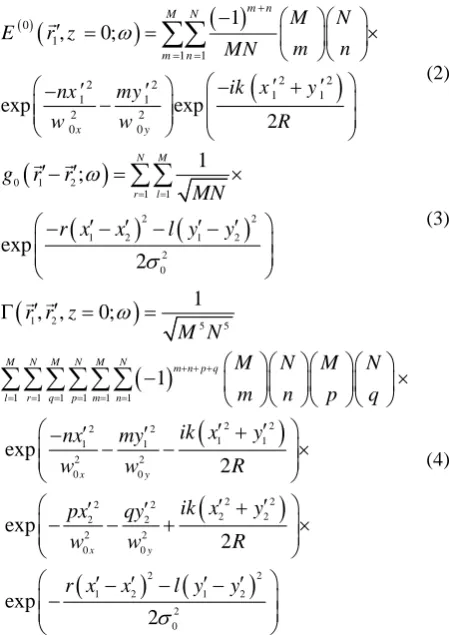
We consider a field propagation from the plane z=0 into the half space, z>0, where the turbulence exists (Fig.1). RPCFT beam propagation can be investigated by using the cross-spectral density [16]:
(
r r z1, ,2)
E r z(
1, ;ω) (
E r z2, ;ω) (
g r1 r2)
∗
Γ r r ≡ r r r r−
(1)
where E r z
(
r, ;ω)
is the complex electric vector at a point specified by the transverse position vector rr, the asterisk stands for the complex conjugate. Angle brackets represent the average, taken over an ensemble of realizations of the electric field in the sense of the coherence theory in the space-frequency domain.(
1 2)
g rr r−r is the degree of the spatial coherence.
For the divergent rectangular PCFT source
( )0
(
)
1, ,2 0; r r z′ ′ ωΓ r r = can be written as:
( )
(
)
( )
(
)
0 1 1 1 2 2 2 2 1 1 1 1 2 2 0 0 1 , 0; exp exp 2 m n M N m n x y M NE r z
m n
MN
ik x y
nx my R w w ω + = = − ⎛ ⎞⎛ ⎞ ′ = = ⎜ ⎟⎜ ⎟× ⎝ ⎠⎝ ⎠ ⎛− ′ + ′ ⎞ ⎛− ′ − ′ ⎞ ⎜ ⎟ ⎜ ⎟ ⎜ ⎟ ⎜ ⎟ ⎝ ⎠ ⎝ ⎠
∑∑
r (2)(
)
(
)
(
)
0 1 2
1 1
2 2
1 2 1 2
2 0 1 ; exp 2 N M r l
g r r
MN
r x x l y y
ω
σ
= = ′ ′− = × ⎛− ′− ′ − ′− ′ ⎞ ⎜ ⎟ ⎜ ⎟ ⎝ ⎠∑∑
r r (3)(
)
( )
(
)
(
)
(
)
1 2 5 5
1 1 1 1 1 1
2 2 2 2 1 1 1 1 2 2 0 0 2 2 2 2 2 2 2 2 2 2 0 0 2 1 2 1 , , 0;
1 exp 2 exp 2 exp
M N M N M N
m n p q l r q p m n
x y
x y
r r z
M N
M N M N
m n p q
ik x y
nx my
w w R
ik x y
px qy
w w R
r x x
ω
+ + + = = = = = =
′ ′
Γ = =
⎛ ⎞⎛ ⎞⎛ ⎞⎛ ⎞ − ⎜ ⎟⎜ ⎟⎜ ⎟⎜ ⎟× ⎝ ⎠⎝ ⎠⎝ ⎠⎝ ⎠ ⎛− ′ − ′ − ′ + ′ ⎞× ⎜ ⎟ ⎜ ⎟ ⎝ ⎠ ⎛ ′ ′ ′ + ′ ⎞ − − + × ⎜ ⎟ ⎜ ⎟ ⎝ ⎠ ′− ′ − −
∑∑∑∑∑∑
r r(
)
21 2
2 0
2
l y y
σ ⎛ ′− ′ ⎞ ⎜ ⎟ ⎜ ⎟ ⎝ ⎠ (4)
where w0x and w0y are the waist sizes of an
elliptical Gaussian beam in x-and y-directions, respectively. M and N are orders of flatness in x- and y- directions. σ0 is the correlation length of
the Gaussian Schell Model (GSM).
Assuming that the degree of the spatial coherence only depends on the distance between points r′1
r and
2
r′r , and one can represent the
degree of spatial coherence as a finite sum of Gaussian functions with different parameters, as Eq. (3).
The cross-spectral density function at these two paints:
( )
r z1,r and
(
)
2,
r zr in transverse plane z= constant>0 are given by [9]:
(
)
( )(
)
(
) (
)
(
)
(
)
(
)
(
)
(
)
(
) (
)
2 2 21 2 1 2
2 2
1 1 2 2
0 1 2
1 1 2 2 1 2
1 1 2 2
2
1 2 1 2
, , ;
2
, , 0; exp
2
exp , , ; , , ; ,
exp , , ; , , ;
exp .
m
m k
r r z d r d r
z
ik r r r r
r r
z
r r z r r z k r r
r r z r r z
r r r r
ω π
ω
ψ ω ψ ω
ψ ω ψ ω
∗ ∗
⎛ ⎞
′ ′ ′ ′
Γ =⎜ ⎟ ×
⎝ ⎠
⎛ ⎡⎣ − ′ − − ′ ⎤⎦⎞
⎜ ⎟
′ ′
Γ ⎜ ⎟×
⎝ ⎠ ′ + ′ ′ ′ ⎡ ⎤ ⎣ ⎦ ′ + ′ ≅ ⎡ ⎤ ⎣ ⎦ ′ − + −
∫∫
∫∫
r rr r r r
r r
r r r r r r
r r r r
r r r r
(
r) (
)
( )
2
1 2 2 2
2 2 3 0
3 n
r r r r
k z
d
π ∞κ φ κ κ
⎡⎡⎣ − ′ + − ′ ⎤⎦× ⎣ − ⎤ ⎥ ⎦
∫
r r r
(5)
where the quantity 3
( )
0n d
φ
κ κ κ
∞
∫
describes the effect ofturbulence, φ κn
( )
being the spectrum of the refractive-index fluctuations that can be characterized by the Tatarskii model and Kolmogorov model [17]. In the above equation, ...mdenotes averaging over the ensemble of statistical realization of the atmospheric turbulence. It is assumed that the fluctuation of the light beam and of the turbulent atmosphere is irrelevant. As the aberration is taken into consideration here, the aberration function should be added as a propagation factor. The propagator k is given in the following formula [18]:
(
)
(
( ) ( )
)
( )
(
)
2
2
1 1 2
2
, exp ,
a
k r r ik r
C
r
r x y
ϕ ϕ ϕ ′ ′ ′ = ⎡ ′ − ′⎤⎦ ′ ′ = − ⎣
r r r r
r (6)
where ϕ and Ca are wave aberration function for astigmatism and astigmatism coefficient, respectively. By substituting the Eqs. (4, 6) in Eq. (5), choosing
1 2
rr = =rr rr, and calculating the related integral, the average intensity distribution at output plane,
(
, ;)
I r zr ω , is obtained as:
Fig. 1 System diagram of aberrated beam propagation
(
)
( )
(
)
2
5
2 2
1 1 1 1 1 1
3 4 2 2 2 1 2 2 3 4 1 , ; exp , ,
1 2 2 2
0 0
2 2
4 4
3 2 4 6 4 1 3 5
1 1
1 2 2
,
2 2
0 0
,
m n p q
M N M N M N l r q p m n
k I z
z MN
M N M N
m n p q
k
y x
z
m q n p
w w
y x
n r ik z R w x ρ ω β β β β β β β β
β α α α β α α α
α σ + + + = = = = = = − = × ⎛ ⎞⎛ ⎞⎛ ⎞⎛ ⎞ ⎜ ⎟⎜ ⎟⎜ ⎟⎜ ⎟ ⎝ ⎠⎝ ⎠⎝ ⎠⎝ ⎠ × ⎛− ⎛ + ⎞⎞ ⎜ ⎜ ⎟⎟ ⎜ ⎝ ⎠⎟ ⎝ ⎠ + + = = = − = − ⎛ = + − −
∑∑∑∑∑∑
r( )
2 2 2
0 0
3 2 2
0 0
4 2 2
0 0
5 2 6 2
0 0
1
2 3 2
0 6 12
2 5 5
1 1 2 2 1 1 2 2 1 1 2 2
2 , 2
0.5465 0.49 , , , a y a x a y n n M ikC a m l ik
M ikC
w z R
p r ik
M ikC
w z R
q l ik
M ikC
w z R
r l
M M
C l k z Tatarskii spectrum M C k α σ α σ α σ α α σ σ − ⎞ + − ⎜ ⎟ ⎝ ⎠ ⎛ ⎞ = + − ⎜ − ⎟+ + ⎝ ⎠ ⎛ ⎞ = + + ⎜ − ⎟+ + ⎝ ⎠ ⎛ ⎞ = + + ⎜ − ⎟+ − ⎝ ⎠ = − − = − − = 6
5 Kolmogorov spectru
z m
⎧⎪ ⎨ ⎪⎩
(7)
where 2
n
C being the refractive index structure parameter and l0 is the inner scale of turbulence. On the other
hand, as the detector just can receive power in the special bucket, the received power must be calculated at a circular area with radius “a” as follow [19]:
( )
2 0 0 , a aP I r z r d dr π
ϕ
=
∫ ∫
r (8)Substituting Eq. (7) in Eq. (8), the power on the surface of optical receiver can be calculated numerically. By using the amount of power on the receiver aperture, another useful parameter for characterizing beam quality which is a measure of laser powerwithin a given bucket, PIB, can be calculated as [20]:
( )
( )
2 0 0 2 0 0 , , aI r z r d dr PIB
I r z r d dr π π ϕ ϕ ∞ =
∫ ∫
∫ ∫
r r(9)
In received power calculation, the atmospheric effects (absorption and scattering losses) and optical losses have not been included. However, the effect of
atmospheric turbulence is taken into account as M parameter. To have an appropriate link budgeting, it is necessary to apply transmission function of atmosphere and optical systems. In the next section, the atmospheric transmission function due to absorption and scattering is calculated.
3. Atmospheric Optical Transmission
Atmospheric transmission is affected by absorption, scattering and turbulence. In the previous section the effects of turbulence take into account with averaging on intensity distribution. The transmission of radiation, TA-S, traveling through the atmosphere (due to
absorption and scattering) can be described by Beer’s law as follow [21]:
( )
( )
0r z A S P z T e P σ −
− = = (10)
where P zr
( ) ( )
P 0 is the ratio between detected power, P zr( )
, at the location z and initially launched power, P( )
0 , and σ is the attenuation or total extinction coefficient (per unit length). The attenuation is given as [22]:3.91 550 q V nm λ σ − ⎛ ⎞ = ⎜ ⎟
⎝ ⎠ (11)
where
V = Visibility (in km)
λ = Wavelength (in nm)
q = The size distribution of the scattering particles
= 1.6 for high visibility (V> 50 km)
= 1.3 for averaging visibility (6 km<V<50 km) = 0.16V+0.34 for haze visibility (1 km<V< 6 km)
= V-0.5 for mist visibility (0.5 km<V<1 km) = 0 for fog visibility (V<0.5 km)
Atmospheric transmission (T) for some weather conditions are calculated based on Bear’s law and are collected in Table 1 along with their visibility (V). Therefore the total optical transmission of the FSO communication link path can be calculated as follow:
Total A S Opt
T =T T−
(12)
where Topt is transmission of optical elements
(lenses of transmitter and receiver). As mentioned before, the effects of turbulence on intensity and consequently received power is considered in previous section.
Table 1 A number of weather conditions along with their visibility and transmission.
Weather condition T (dB/km) V (km)
Light mist -2.4203 3
-1.9095 3.5
Very light mist
-1.5379 4 -1.2583 4.5 -1.0424 5 -0.8722 5.5
4 Some Useful Communication Link Parameters The quality of FSO link expressed by availability and BER, is determined by the parameters of link and statistical properties of the atmosphere. The BER parameter
for OOK modulated signal is a function of signal to noise ratio (SNR). SNR can be given as follow:
0
r
n
P
SNR
P
=
(13)where Pr and Pn0 are received power at the detector and
detectors NEP (Noise equivalent power), respectively. It is worth mentioning that the other noise such as thermal noise have a small amount and can be neglected. Pr is calculated as bellow:
r a Total
P =P T (14)
in which Pa and TTotal are received power at receiver’s aperture plane without considering atmosphere effects based on Eq. (8) and total optical transmission, respectively. The relation between BER and SNR for OOK modulated signal is as follow [7]:
1 1
2 2 2
BER= erfc⎛⎜ SNR⎞⎟
⎝ ⎠ (15)
Equations (9, 13, 15) are the basis of the next section calculations.
5 Results and Discussions
In this section we calculate the amount of PIB, SNR and BER based on the presented analysis while considering the effects of source parameters (such as order of flatness, aberration coefficient, initial beam divergence angle, … ) in the presence of atmosphere attenuation (absorption, scattering and turbulence effects). Turbulence condition assumed in our simulation is strong turbulent regime ( 2 1014 23
n
C = − m− ). We consider that N=M and w0x =w0y, which is equivalent to square symmetry.
In our simulation we used rectangular partially coherent beam which its initial divergence angle is 1.5 mrad
.
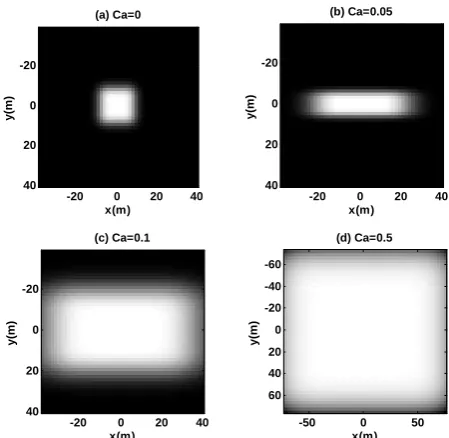
Fig. 2 shows the effects of astigmatic aberration on intensity distribution. As it is shown, any increase in astigmatism coefficient causes an increase in beam spread.In order to described and analyze the effect of astigmatism coefficient on link quality, Power In special Bucket (PIB) is shown for some astigmatic coefficient (see Fig. 3).
As it is shown, increasing astigmatism coefficient and consequently an increase in beam spread, causes a decrease in PIB value. Fig. 4 shows SNR and BER versus propagation path length for different astigmatism coefficients. As it is expected any decrease in PIB value leads to decrease in received power, SNR and therefore BER is grown. It is clear that astigmatism coefficient has a strong effect on availability of link. The other parameter that can have an influence on beam propagation is the order of flatness.
x(m)
y(m
)
(a) Ca=0
-20 0 20 40 -20
0
20
40
x(m)
y(m
)
(b) Ca=0.05
-20 0 20 40 -20
0
20
40
x(m)
y(m
)
(d) Ca=0.5
-50 0 50 -60
-40 -20 0 20 40 60
x(m)
y(m
)
(c) Ca=0.1
-20 0 20 40 -20
0
20
40
Fig. 2 The intensity distribution in the plane Z=5 km for different values of the astigmatism, (a) Ca = 0 m−1, (b) Ca =
0.05 m−1, (c) Ca = 0.1 m− 1
, (d) Ca = 0.5 m− 1
. The other parameters are chosen as: λ =1550 nm, θ=1.5 mrad, σ0 =
0.0025 m, 2 14 2/3
10− −
= m
Cn , w0x = w0y = 0.025 m, M = N = 4,
V = 4 km
Fig. 3PIB values versus propagation path length for different values of the astigmatism. The other parameters are the same as Fig. 2
(a)
(b)
Fig. 4 a) SNR values versus propagation path length for four different astigmatism coefficients, b) BER values versus propagation path length for four different astigmatism coefficients, all parameters are the same as Fig. 2
(a)
(b)
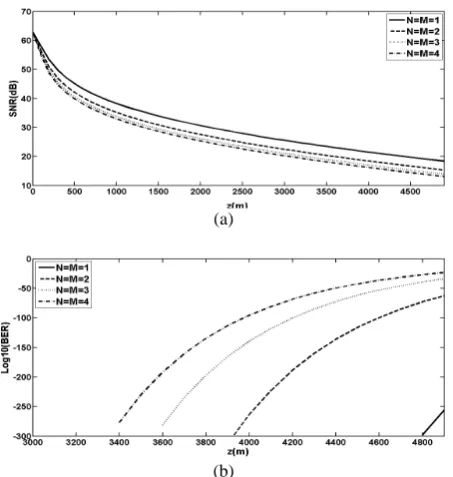
Fig. 5 a) SNR values versus propagation path length for four different order of flatness values, b) BER values versus propagation path length for order of flatness values, Ca = 0.05
m−1, the other parameters are the same as Fig. 2
The effects of order of flatness are shown in Fig. 5. In this figure, SNR and BER values show versus propagation path length for different order of flatness. At it is known [13], increasing order of flatness causes increased beam spread. Therefore, the increasing order of flatness causes a decrease in SNR value and leads to BER arise.
(a)
(b)
Fig. 6 The normalized intensity distribution of astigmatic rectangular PCFT beams are plotted versus (a) “x” and (b) “y” for different correlation lengths, A) σ0=∞, B) σ0 = 0.025 m,
C) σ0 = 0.005 m, D) σ0 = 0.0025 m. The other parameters are
chosen as: λ=1550nm, θ =1.5 mrad, Ca = 0.05 m−1, 3
/ 2 14 2
10− −
= m
Cn , w0x = w0y = 0.025 m, M = N = 4, V = 4 km
A
B
Fig. 7 a) SNR values versus propagation path length for different correlation lengths, b) BER values versus propagation path length for different correlation lengths, The parameters are chosen as: λ=1550 nm, θ =1.5 mrad, Ca =
0.05 m−1, Ca = 0.05 m−1, w0x = w0y = 0.025 m, M = N = 4, V =
4 km, A) σ0 =∞, B) σ0 = 0.025 m, C) σ0 = 0.005 m, D) σ0 =
0.0025 m
For analyzing correlation length on SNR and BER, at first, normalized intensity distribution is shown for four different correlation length values (see Fig. 6).
It is shown that the correlation length does not affect intensity distribution. Therefore, it is expected that it has no effect on SNR and BER. Fig. 7 shows the effects of correlation length on link quality factors. Our analysis shows that source parameters have significant effects on link design.
6 Conclusions
In this article, the effects of some source parameters such as order of flatness and astigmatism coefficient on PIB, SNR and BER of FSO link using aberrated divergent rectangular partially coherent flat-topped beam are analyzed. The effects of atmospheric phenomena such as absorption, scattering and turbulence are taken into account. It is shown any increase in order of flatness and astigmatism coefficient causes a decrease in PIB and SNR values which it is leads to an increase in BER. It is shown that the correlation length has no effect on link quality. Finally we hope that the presented derived analytical results find its application to problems involving free space optical communication systems as well as optical imaging.
References
[1] Xiaoming Z. and Kahn J. M., “Free-Space optical communication through atmospheric turbulence channels”, IEEE Transaction on communications, Vol. 50, No. 8, pp. 1293-1300, 2002.
[2] Leitgeb E., Gebhart M. and Birnbacher U., “Optical network, last mils access and applications”, Journal of optical and Fiber Communications Research, Vol. 2, No. 1, pp. 56-85, 2005.
[3] Majumdar A. K. and Ricklin J. C., Free Space laser communication, Principles and advantages, Springer Science , USA, 2008.
[4] Bouchet O., Sizun H., Borisrobert C., Fornel F. d. and Favennec P., Free-Space Optics, Propagation and Communication, 1st Ed. London, UK: ISTE, 2006.
[5] Muhammad I., Ghassemlooy Z., Minh H. Le, Rajbhandari S., Perez J. and Gholami A., “Bit error rate measurement of free space optical communication links under laboratory controlled conditions”, 16th European Conference on Networks and Optical Communications (NOC), USA, pp. 52-55, 2011.
[6] Harris D., “The attenuation of electromagnetic waves due to atmospheric fog”, International Journal of Infrared and Millimeter Waves, Vol. 16, No. 6, pp. 1091-1108, 1995.
[7] Andrews L. C. and Phillips R. L., Laser Beam Propagation in Turbulent Atmosphere, 2nd Ed., SPIE Press, Belington, 2005.
[8] Cai Y. and He S., “Propagation of partially coherent twisted anisotropic Gaussian Schell- model beam in a turbulent atmosphere”, App. Phys. Lett., Vol. 89, No. 4, pp. 041117, 2006. [9] Chen Z., and Pu J., “Propagation characteristics
of aberrant stochastic electromagnetic beam in a turbulent atmosphere”, J. Opt. A. pure. Appl. Opt., Vol. 9, No. 12, pp. 1123-1130, 2007.
[10] Cai Y., korotkova O., Eyyuboglu H. T. and Baykal Y., “Active laser radar systems with stochastic electromagnetic beams in turbulent atmosphere”, Opt. Express, Vol. 16, No. 20, pp. 15834-15846, 2008.
[11] Korotkova O., Andrews L. C. and Philips R. L., “A model for a partially coherent Gaussian beam in atmospheric turbulence with application in laser com”, Opt. Eng. Vol. 43, No. 2, pp. 330-334, 2004.
[12] Shirai T., Dogariu A. and Wolf E., “Mode Analysis of spreading of partially coherent Beam propagating through atmosphere turbulence”, J. Opt. Soc. Am., Vol. 20, pp. 1094-1102, 2003. [13] Kashani F. D. and Ghafary B., “Characteristics of
aberrated partially coherent flat-topped beam in turbulent atmosphere”, In proceeding of the 2008 IAJC-IJME International Conference.
[14] Alavinejad M., Ghafary B. and Kashani F. D., “Analysis of the propagation of flat-topped beam with various beam orders through turbulent atmosphere”, Optics and Lasers in Engineering, Vol. 46, No. 1, pp. 1-5, 2008.
[15] Kvicala R., Kvicera V., Grabner M. and Fiser O., “BER and availability measured on FSO link”, Radio Engineering, pp. 7-12, 2007.
[16] Wolf E., “Unified theory of coherence and polarization of statistical electromagnetic beams”, Phys. Lett. A, Vol. 312, pp. 263-267, 2003. [17] Korotkova O., Salem. M. and Wolf E., “Beam
conditions for radiation generate by an electromagnetic Gaussion Schell model source”, Opt. Lett., Vol. 29, No. 11, pp. 1173-1175, 2004. [18] Pedrotti F. L., Pedrotti L. M., Pedrotti L. S.,
Introduction to Optics, 3th ed., Prentice Hall Inc., 2007.
[19] Saleh B. E. A. and Teich M. C., Fundamentals of Photonics, 2nd ed., Wiley series in pure and applied, 2007.
[20] Seigman A. E., “How to (maybe) measure laser beam quality”, OSA Trends Opt. Photon., Vol. 17, pp. 184-202, 1998.
[21] Kashani F. D., Hedayati Rad M. R. and Mahzoun M. R., “Reliability analysis of the auto- tracked FSO communication links”, 5th International Symposium on Telecommunication (IST), pp. 452-457, 2010.
[22] Hedayati Rad M. R., Kashani F. D., Khandagh Abadi M. S. and Mahzoun M. R., “The effects of Gaussian laser beam divergence on the BER of
FSO communication link”. Proceedings of the seventh IEEE, IET International Symposium on Communication Systems, Networks and Digital Signal Processing (CSNDSP), pp. 596-600, 2010.
Bijan Ghafary was born in September 1962 in Tehran. He got his B.Sc. and M.Sc. in physics from Tabriz University and then Ph.D. in photonics from Ritsumeikan University in Japan. His Current research includes photonic devices, wave propagation and coherent imaging systems. Now he is associated professor in Iran University of Science and technology.
Fatemeh Dabbagh kashani was born in September 1982 in Tehran. She got his B.Sc. and M.Sc. and Ph.D. in physics from Iran University of Science and technology. Her Current research includes optical communication, wave propagation and coherent imaging systems. Now she is assistant professor in Iran University of Science and technology.
Esmail Kazemian was born in February, 1971in Tehran. He got his B.Sc. in physics from Tabriz University and M.Sc. in physics from Amirkabir University of Technology (Tehran Polytechnic). Now, he is Ph.D. candidate at physics Department of Iran University of Science and technology. His Current research includes wave propagation, optical communication and coherent imaging systems.