A Monthly Double-Blind Peer Reviewed (Refereed/Juried) Open Access International e-Journal - Included in the International Serial Directories Indexed & Listed at:
VOLUME NO.5(2015),ISSUE NO.04(APRIL) ISSN 2231-5756
CONTENTS
Sr.
No.
TITLE & NAME OF THE AUTHOR (S)
Page
No.
1
.
ROBUST FACE IDENTIFICATION USING MOVIE
SUGANYA.C, SIVASANKARI.A & SANGEETHA LAKSHMI.G
1
2
.
IMPACT OF ECONOMIC AND NON ECONOMIC VARIABLES ON CORPORATE GOVERNANCE COMPLIANCE
AND DISCLOSURE PRACTICES OF LISTED AND UNLISTED DEFENCE PUBLIC SECTOR ENTERPRISES IN INDIA
DR. U. PADMAVATHI
4
3
.
IMPACT OF YOGA ON SCHOOL STUDENTS PERFORMANCE: A STUDY
DR. C. ANURADHA, DR. J. ANURADHA & DR. S. GOPALSAMY
12
4
.
A STUDY ON MUTUAL FUND INVESTMENT PERSPECTIVES IN INDIA
S. CHAKRAVARTHI, DR. M SARADADEVI & N.SAIBABU
16
5
.
ADVANCED ESSENTIALS BASED ON AGRICULTURE USING SOLAR TRACTOR WITH WIRELESS SENSOR
NETWORKS
K.DEEPASHREE, G.SANGEETHALAKSHMI & A.SIVASANKARI
19
6
.
AN INVESTIGATION INTO THE DETERMINANTS OF SERVICE QUALITY IN COMMERCIAL BANKS
M. RAMESH, DR. G. VAMSHI & C. SIVARAMI REDDY
24
7
.
THE IMPACT OF ATM SERVICES IN CANARA BANK IN MYSORE CITY
GEETHA S & DR. C S RAMANARAYANAN
28
8
.
A CASE STUDY ON CORPORATE SOCIAL RESPONSIBILITY OF JINDAL STEEL WORK'S LTD, BELLARI
(KARNATAKA)
VENKATESHA K & DR. RAMESH.OLEKAR
32
9
.
A STUDY OF LIQUIDITY AND PROFITABILITY ANALYSIS OF AN INDUSTRIAL UNIT IN ODISHA
JAYASHREE JETHY, SUPRAVA SAHU & MALAY K MOHANTY
37
10
.
TRAINING AND MANAGEMENT DEVELOPMENT FOR PROMOTABILITY IN GHANAIAN ORGANIZATIONS
IDDIRISU ANDANI MU-AZU
41
11
.
CROWD FUNDING AS INVESTMENT TOOL: DISCOVERING SOMETHING ADDITIONAL
REKHA SHARMA & NEHA THAKUR
44
12
.
CHILD SEXUAL ABUSE AND EXPLOITATION: ROLE OF JUDICIARY
DR. MANPREET KAUR
48
13
.
GREEN MARKETING AND MNCs: GO GREEN PROCESS IN INDIA
SEEMA BANGAR
50
14
.
A STUDY STRESS MANAGEMENT AMONG TRAFFIC CONSTABLES WITH SPECIAL REFERENCE TO MYSURU
CITY
DR. A.C.PRAMILA
54
15
.
MARKETING STRATEGIES OF PHARMACEUTICAL COMPANIES IN INDIA: A COMPARATIVE STUDY OF LUPIN
AND RANBAXY
RUCHI MANTRI, ANKIT LADDHA & PRACHI RATHI
56
16
.
GREEN MARKETING: EVOLUTION, REASONS, ADVANTAGES AND CHALLENGES
MANJU KAMBOJ & RENU BALA
58
17
.
IMPORTANCE OF RECORDS MANAGEMENT IN AN ORGANIZATION
DR. JUSTINA I. EZENWAFOR
63
18
.
FACTORS RELATED TO JOB SATISFACTION OF ACADEMIC STAFF IN SRI LANKA INSTITUTE OF ADVANCED
TECHNOLOGICAL EDUCATION (SLIATE)
S.ANTONY
67
19
.
WORKING CAPITAL ANALYSIS WITH SPECIAL REFERENCE TO SESHASAYEE PAPER AND BOARDS LIMITED,
ERODE
M.ANAND SHANKAR RAJA & SHENBAGAM KANNAPPAN
72
20
.
IMPACT OF ENVIRONMENTAL AWARENESS ON YOUNG FEMALE CONSUMER ATTITUDES IN SELECTION
AND PURCHASE OF ECO-FRIENDLY APPARELS IN SELECTED CITIES OF UTTATAKHAND
JUBILEE GOYAL
77
CHIEF PATRON
PROF. K. K. AGGARWAL
Chairman, Malaviya National Institute of Technology, Jaipur
(An institute of National Importance & fully funded by Ministry of Human Resource Development, Government of India)
Chancellor, K. R. Mangalam University, Gurgaon
Chancellor, Lingaya’s University, Faridabad
Founder Vice-Chancellor (1998-2008), Guru Gobind Singh Indraprastha University, Delhi
Ex. Pro Vice-Chancellor, Guru Jambheshwar University, Hisar
FOUNDER PATRON
LATE SH. RAM BHAJAN AGGARWAL
Former State Minister for Home & Tourism, Government of Haryana
Former Vice-President, Dadri Education Society, Charkhi Dadri
Former President, Chinar Syntex Ltd. (Textile Mills), Bhiwani
CO-ORDINATOR
AMITA
Faculty, Government M. S., Mohali
ADVISORS
PROF. M. S. SENAM RAJU
Director A. C. D., School of Management Studies, I.G.N.O.U., New Delhi
PROF. M. N. SHARMA
Chairman, M.B.A., Haryana College of Technology & Management, Kaithal
PROF. S. L. MAHANDRU
Principal (Retd.), Maharaja Agrasen College, Jagadhri
EDITOR
PROF. R. K. SHARMA
Professor, Bharti Vidyapeeth University Institute of Management & Research, New Delhi
CO-EDITOR
DR. BHAVET
Faculty, Shree Ram Institute of Business & Management, Urjani
EDITORIAL ADVISORY BOARD
DR. RAJESH MODI
Faculty, Yanbu Industrial College, Kingdom of Saudi Arabia
PROF. SANJIV MITTAL
University School of Management Studies, Guru Gobind Singh I. P. University, Delhi
PROF. ANIL K. SAINI
Chairperson (CRC), Guru Gobind Singh I. P. University, Delhi
DR. SAMBHAVNA
VOLUME NO.5(2015),ISSUE NO.04(APRIL) ISSN 2231-5756
DR. MOHENDER KUMAR GUPTA
Associate Professor, P. J. L. N. Government College, Faridabad
DR. SHIVAKUMAR DEENE
Asst. Professor, Dept. of Commerce, School of Business Studies, Central University of Karnataka, Gulbarga
ASSOCIATE EDITORS
PROF. NAWAB ALI KHAN
Department of Commerce, Aligarh Muslim University, Aligarh, U.P.
PROF. ABHAY BANSAL
Head, Department of Information Technology, Amity School of Engineering & Technology, Amity
University, Noida
PROF. A. SURYANARAYANA
Department of Business Management, Osmania University, Hyderabad
DR. SAMBHAV GARG
Faculty, Shree Ram Institute of Business & Management, Urjani
PROF. V. SELVAM
SSL, VIT University, Vellore
DR. PARDEEP AHLAWAT
Associate Professor, Institute of Management Studies & Research, Maharshi Dayanand University, Rohtak
DR. S. TABASSUM SULTANA
Associate Professor, Department of Business Management, Matrusri Institute of P.G. Studies, Hyderabad
SURJEET SINGH
Asst. Professor, Department of Computer Science, G. M. N. (P.G.) College, Ambala Cantt.
TECHNICAL ADVISOR
AMITA
Faculty, Government M. S., Mohali
FINANCIAL ADVISORS
DICKIN GOYAL
Advocate & Tax Adviser, Panchkula
NEENA
Investment Consultant, Chambaghat, Solan, Himachal Pradesh
LEGAL ADVISORS
JITENDER S. CHAHAL
Advocate, Punjab & Haryana High Court, Chandigarh U.T.
CHANDER BHUSHAN SHARMA
Advocate & Consultant, District Courts, Yamunanagar at Jagadhri
SUPERINTENDENT
CALL FOR MANUSCRIPTS
We invite unpublished novel, original, empirical and high quality research work pertaining to recent developments & practices in the areas of Computer Science & Applications; Commerce; Business; Finance; Marketing; Human Resource Management; General Management; Banking; Economics; Tourism Administration & Management; Education; Law; Library & Information Science; Defence & Strategic Studies; Electronic Science; Corporate Governance; Industrial Relations; and emerging paradigms in allied subjects like Accounting; Accounting Information Systems; Accounting Theory & Practice; Auditing; Behavioral Accounting; Behavioral Economics; Corporate Finance; Cost Accounting; Econometrics; Economic Development; Economic History; Financial Institutions & Markets; Financial Services; Fiscal Policy; Government & Non Profit Accounting; Industrial Organization; International Economics & Trade; International Finance; Macro Economics; Micro Economics; Rural Economics; Co-operation; Demography: Development Planning; Development Studies; Applied Economics; Development Economics; Business Economics; Monetary Policy; Public Policy Economics; Real Estate; Regional Economics; Political Science; Continuing Education; Labour Welfare; Philosophy; Psychology; Sociology; Tax Accounting; Advertising & Promotion Management; Management Information Systems (MIS); Business Law; Public Responsibility & Ethics; Communication; Direct Marketing; E-Commerce; Global Business; Health Care Administration; Labour Relations & Human Resource Management; Marketing Research; Marketing Theory & Applications; Non-Profit Organizations; Office Administration/Management; Operations Research/Statistics; Organizational Behavior & Theory; Organizational Development; Production/Operations; International Relations; Human Rights & Duties; Public Administration; Population Studies; Purchasing/Materials Management; Retailing; Sales/Selling; Services; Small Business Entrepreneurship; Strategic Management Policy; Technology/Innovation; Tourism & Hospitality; Transportation Distribution; Algorithms; Artificial Intelligence; Compilers & Translation; Computer Aided Design (CAD); Computer Aided Manufacturing; Computer Graphics; Computer Organization & Architecture; Database Structures & Systems; Discrete Structures; Internet; Management Information Systems; Modeling & Simulation; Neural Systems/Neural Networks; Numerical Analysis/Scientific Computing; Object Oriented Programming; Operating Systems; Programming Languages; Robotics; Symbolic & Formal Logic; Web Design and emerging paradigms in allied subjects.
Anybody can submit the soft copy of unpublished novel; original; empirical and high quality research work/manuscriptanytime in M.S. Word format
after preparing the same as per our GUIDELINES FOR SUBMISSION; at our email address i.e. [email protected] or online by clicking the link online
submission as given on our website (FOR ONLINE SUBMISSION, CLICK HERE).
GUIDELINES FOR SUBMISSION OF MANUSCRIPT
1. COVERING LETTER FOR SUBMISSION:
DATED: _____________
THE EDITOR IJRCM
Subject: SUBMISSION OF MANUSCRIPT IN THE AREA OF .
(e.g. Finance/Marketing/HRM/General Management/Economics/Psychology/Law/Computer/IT/Education/Engineering/Mathematics/other, please specify)
DEAR SIR/MADAM
Please find my submission of manuscript entitled ‘___________________________________________’ for possible publication in your journals.
I hereby affirm that the contents of this manuscript are original. Furthermore, it has neither been published elsewhere in any language fully or partly, nor is it under review for publication elsewhere.
I affirm that all the authors have seen and agreed to the submitted version of the manuscript and their inclusion of names as co-authors.
Also, if my/our manuscript is accepted, I/We agree to comply with the formalities as given on the website of the journal & you are free to publish our contribution in any of your journals.
NAME OF CORRESPONDING AUTHOR :
Designation :
Institution/College/University with full address & Pin Code :
Residential address with Pin Code :
Mobile Number (s) with country ISD code :
WhatsApp or Viber is active on your above noted Mobile Number (Yes/No) :
Landline Number (s) with country ISD code :
E-mail Address :
Alternate E-mail Address :
Nationality :
NOTES:
a) The whole manuscript is required to be in ONE MS WORD FILE only (pdf. version is liable to be rejected without any consideration), which will start from the covering letter, inside the manuscript.
b) The sender is required to mention the following in the SUBJECT COLUMN of the mail:
New Manuscript for Review in the area of (Finance/Marketing/HRM/General Management/Economics/Psychology/Law/Computer/IT/
Engineering/Mathematics/other, please specify)
c) There is no need to give any text in the body of mail, except the cases where the author wishes to give any specific message w.r.t. to the manuscript. d) The total size of the file containing the manuscript is required to be below 500 KB.
e) Abstract alone will not be considered for review, and the author is required to submit the complete manuscript in the first instance.
f) The journal gives acknowledgement w.r.t. the receipt of every email and in case of non-receipt of acknowledgment from the journal, w.r.t. the submission of manuscript, within two days of submission, the corresponding author is required to demand for the same by sending separate mail to the journal.
g) The author (s) name or details should not appear anywhere on the body of the manuscript, except the covering letter and cover page of the manuscript, in the manner as mentioned in the guidelines.
2. MANUSCRIPT TITLE: The title of the paper should be in a 12 point Calibri Font. It should be bold typed, centered and fully capitalised.
3. AUTHOR NAME (S) & AFFILIATIONS: The author (s) full name, designation, affiliation (s), address, mobile/landline numbers, and email/alternate email address should be in italic & 11-point Calibri Font. It must be centered underneath the title.
VOLUME NO.5(2015),ISSUE NO.04(APRIL) ISSN 2231-5756
5. ABSTRACT: Abstract should be in fully italicized text, not exceeding 250 words. The abstract must be informative and explain the background, aims, methods, results & conclusion in a single para. Abbreviations must be mentioned in full.
6. JEL CODE: Provide the appropriate Journal of Economic Literature Classification System code (s). JEL codes are available at www.aeaweb.org/econlit/jelCodes.php
7. KEYWORDS: JEL Code must be followed by a list of keywords, subject to the maximum of five. These should be arranged in alphabetic order separated by commas and full
stops at the end.
8. MANUSCRIPT: Manuscript must be in BRITISH ENGLISH prepared on a standard A4 size PORTRAIT SETTING PAPER. It must be prepared on a single space and single column with 1” margin set for top, bottom, left and right. It should be typed in 8 point Calibri Font with page numbers at the bottom and centre of every page. It should be free from grammatical, spelling and punctuation errors and must be thoroughly edited.
9. HEADINGS: All the headings should be in a 10 point Calibri Font. These must be bold-faced, aligned left and fully capitalised. Leave a blank line before each heading.
10. SUB-HEADINGS: All the sub-headings should be in a 8 point Calibri Font. These must be bold-faced, aligned left and fully capitalised.
11. MAIN TEXT: The main text should follow the following sequence:
INTRODUCTION REVIEW OF LITERATURE NEED/IMPORTANCE OF THE STUDY STATEMENT OF THE PROBLEM OBJECTIVES
HYPOTHESES
RESEARCH METHODOLOGY RESULTS & DISCUSSION FINDINGS
RECOMMENDATIONS/SUGGESTIONS CONCLUSIONS
LIMITATIONS
SCOPE FOR FURTHER RESEARCH REFERENCES
APPENDIX/ANNEXURE
It should be in a 8 point Calibri Font, single spaced and justified. The manuscript should preferably not exceed 5000 WORDS.
12. FIGURES & TABLES: These should be simple, crystal clear, centered, separately numbered & self explained, and titles must be above the table/figure. Sources of data should be mentioned below the table/figure. It should be ensured that the tables/figures are referred to from the main text.
13. EQUATIONS/FORMULAE: These should be consecutively numbered in parentheses, horizontally centered with equation/formulae number placed at the right. The equation editor provided with standard versions of Microsoft Word should be utilized. If any other equation editor is utilized, author must confirm that these equations may be viewed and edited in versions of Microsoft Office that do not have the editor.
14. ACRONYMS: These should not be used in the abstract. The use of acronyms is elsewhere is acceptable. Acronyms should be defined on first use in each section: Reserve
Bank of India (RBI). Acronyms should be redefined on first use in subsequent sections.
15. REFERENCES: The list of all references should be alphabetically arranged. The author (s) should mention only the actually utilised references in the preparation of manuscript and they are supposed to follow Harvard Style of Referencing. Also check to make sure that everything that you are including in the reference section is cited in the paper. The author (s) are supposed to follow the references as per the following:
•
All works cited in the text (including sources for tables and figures) should be listed alphabetically.•
Use (ed.) for one editor, and (ed.s) for multiple editors.•
When listing two or more works by one author, use --- (20xx), such as after Kohl (1997), use --- (2001), etc, in chronologically ascending order.•
Indicate (opening and closing) page numbers for articles in journals and for chapters in books.•
The title of books and journals should be in italics. Double quotation marks are used for titles of journal articles, book chapters, dissertations, reports, working papers, unpublished material, etc.•
For titles in a language other than English, provide an English translation in parentheses.•
Headers, footers, endnotes and footnotes may not be used in the document, but in short succinct notes making a specific point, may be placed in number orders following the references.PLEASE USE THE FOLLOWING FOR STYLE AND PUNCTUATION IN REFERENCES: BOOKS
•
Bowersox, Donald J., Closs, David J., (1996), "Logistical Management." Tata McGraw, Hill, New Delhi.•
Hunker, H.L. and A.J. Wright (1963), "Factors of Industrial Location in Ohio" Ohio State University, Nigeria. CONTRIBUTIONS TO BOOKS•
Sharma T., Kwatra, G. (2008) Effectiveness of Social Advertising: A Study of Selected Campaigns, Corporate Social Responsibility, Edited by David Crowther & Nicholas Capaldi, Ashgate Research Companion to Corporate Social Responsibility, Chapter 15, pp 287-303.JOURNAL AND OTHER ARTICLES
•
Schemenner, R.W., Huber, J.C. and Cook, R.L. (1987), "Geographic Differences and the Location of New Manufacturing Facilities," Journal of Urban Economics, Vol. 21, No. 1, pp. 83-104.CONFERENCE PAPERS
•
Garg, Sambhav (2011): "Business Ethics" Paper presented at the Annual International Conference for the All India Management Association, New Delhi, India, 19–23 UNPUBLISHED DISSERTATIONS•
Kumar S. (2011): "Customer Value: A Comparative Study of Rural and Urban Customers," Thesis, Kurukshetra University, Kurukshetra. ONLINE RESOURCES•
Always indicate the date that the source was accessed, as online resources are frequently updated or removed. WEBSITESROBUST FACE IDENTIFICATION USING MOVIE
SUGANYA.C
RESEARCH SCHOLAR
DEPARTMENT OF COMPUTER SCIENCE
DKM COLLEGE FOR WOMEN’S (AUTONOMOUS)
VELLORE
SIVASANKARI.A
HEAD
DEPARTMENT OF COMPUTER SCIENCE
DKM COLLEGE FOR WOMEN’S (AUTONOMOUS)
VELLORE
SANGEETHA LAKSHMI.G
ASST. PROFESSOR
DEPARTMENT OF COMPUTER SCIENCE
DKM COLLEGE FOR WOMEN’S (AUTONOMOUS)
VELLORE
ABSTRACT
Automatic identification of face in movies has drawn important concept research interests and led to interesting applications. It is a challenging problem due to the many variation in the appearance of each face. Although demonstrate promising results in best environment, the performances are restricted in complex movie scenes due to the noises producted during the face tracking and face clustering process.we present two schemes of global face-name matching based framework for face identification. The contributions of this work include the following. 1) A babel dead sign attachment model is include. 2) We launch an edit control dependent on graph algorithm. 3) Complicated face changes are dealwith coinciding graph division and graph coincide. 4) Beyond existence type identify application, we accessory execute an in-depth sensitive analysis by launching two types of simulated shouting. The aim schemes demonstrate state execute on movie face identification in many generous of movies.
KEYWORDS
Tracking, framework, coincide, shouting, generous.
1. INTRODUCTION
1.1 MOTIVATION
he proliferations of movies and TV provide large amount of digital data. This has led to the requirement of efficient and effective technique for video contents understand and collected. Automatic annotations is key technique. focus is on annotations characters in the movie and TVs, called movies character identification. The objectives is to identify the faces of the characters in the videos and label them with the corresponded name in the casts. The textual cue, like cast , scripts, subtitles and closed captions are usually exploited. In a movie, character are the focus center of interest for the audience. Their occurrence provides lot of clue about the movie structures and contents. Automatic character identifications is essential for semantic movie indexs and retrieval scene segmentations, summarizations and other application. Character identification, though very intuition to humans, is a shocking challengs task in computerized vision. The reasons is four:
1) Weak supervised text cue. There are ambiguity problems in establishing the related between names and faces: ambiguity can arise from a action shot where the person saying may not be shown in the frame ; ambiguity can also arises in partial lable frames when there are many speakers in scene. 2) Face identifications in video is more complex than in images . Low resolution, occlusion, non rigid deformations, large motion, complex culture and other
not control state make the issue of face tracking and route not reliable. In movie, the spot is even worsen. This broughts inevitables sounds to the character identification.
3) The same character comes quite differently during the movie . There may be large pose, expressions and illumination variations, wearing, clothing, even makeup and hair changes. many, characters in few movies go through various age stage, e.g., from youth to old age. Sometime, there will even be different actors playing various ages of the same type.
4) The determination for the number of identical faces is not trivial .Due to the remarkable intra-class variances the same character name will correspond to faces of variantion appearances. It will be not reasonable to set the number of identical faces just consider to the number of symbol in the cast. Our study is motivated by these challenginges and aims to find solutions for a robust framework for movie character identification.
In this paper is going to explain the Robust Face identification for Movie type and how we did the face detection and recognition in it. The images will explain about the Movie fetching details.
VOLUME NO.5(2015),ISSUE NO.04(APRIL) ISSN 2231-5756
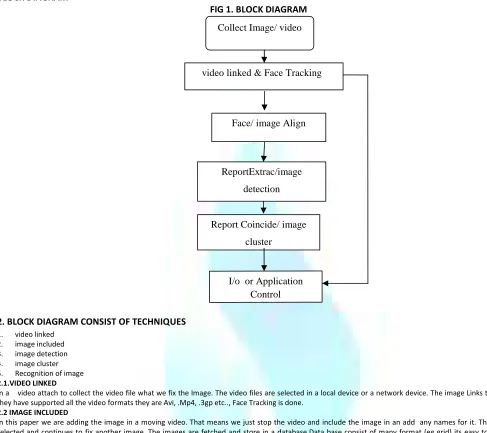
BLOCK DIAGRAM
FIG 1. BLOCK DIAGRAM
2. BLOCK DIAGRAM CONSIST OF TECHNIQUES
1. video linked 2. image included 3. image detection 4. image cluster 5. Recognition of image
2.1.VIDEO LINKED
In a video attach to collect the video file what we fix the Image. The video files are selected in a local device or a network device. The image Links techniques they have supported all the video formats they are Avi, .Mp4, .3gp etc.., Face Tracking is done.
2.2 IMAGE INCLUDED
In this paper we are adding the image in a moving video. That means we just stop the video and include the image in an add any names for it. The image is selected and continues to fix another image. The images are fetched and store in a database.Data base consist of many format (eg grid) its easy to track the image structure and also algorithm,which is used to different between single and multiple image groups.
2.3. IMAGE DETECTION
we are going to detect the face of the movie characters. In this a module we are using the emgu0cv library we must install the emgu1cv library. After installing the emgu1cv lib in our concept we need to add reference with the name emgu.2cv, emgu1.cv.util, emgu.1cv.ui. When you will complete the references will get in the emgu1 controls.
2.4. IMAGE CLUSTER
Face cluster modules to group all the detected face in a one place. The concept of cluster is grouping the objects. The detecting faces are stored in a random name and collect all the face images in a one directory this is main use in face cluster concepts.
2.5. RECOGNITION
we are going to recognize the face of the movie type which is we previously stored on the grid database. We just found that the give the real name of it or any other to it. This is going to be done here. we are using the help of these eigen Object Recognizer we are going to recognize the image shape.
3. SYSTEM ANALYSIS
In this paper is used to detect the face of movie type and recognize the characters and the existing system are taking the too much time to detects the face. But this one we can do it in a minute process.
In the previous process the time taken for detecting face is too long in windows processed .In this Robust Face identification using Movie is used to detect the face of movie characters and the Proposed system is taking the minimum time to detected the face. In this one we can do it in a minute process.
In the process the time taken for detecting face in minimum (min) time only in windows processed. The input design is the link between the information system and user. It comprises the developing specification and procedures for data preparation and those steps are necessary to put transaction data in to a usable form for processing can be achieved by inspecting the computer to read data from a written or printed document or it can occur by having people keying the data directly to the system. The design of input focuses on controlling the amount of inputs required, controlling the errors, avoids delay, avoiding extra steps and keeping the techniques simple. The input is designed in such a way so that it provides security and ease of use with retaining the privacy.
Input Design consider the following things: 1. What data should be given as inputs? 2. How the data should be arrange or codes?
3. The speech to guide the operation personnel in provides inputs.
4. Method for preparing input validation and steps to follow when errors occur.
Input Design is the process of converting a user-oriented description of the input into a computerized-based system. This design is important to avoid errors in
Collect Image/ video
ReportExtrac/image
detection
Face/ image Align
video linked & Face Tracking
Report Coincide/ image
cluster
It is achieved by creating user-friendly screens for the data entry to handle large volumes of data. The goal of designs input is to make data entry easier and to be escape from errors. The data entry screen is designed in such a way that all the data manipulates can to be performed. Its provides record viewing facilities. When the data is entered it will check to its validity. Data can be entered with the aid of screens. Appropriate messages are provided as when needed so that the user will not be in maizes of instant. Thus the objective of input design is to create an input layout that is easy to follow.
A quality output is one, which meets the requirements of the end user and presents the concept clearly. In any system results of processing are communicated to the users and to other system through the outputs. In output design it is determined how the information is to be displaced for immediate need and complex copy of output. It is the most important and direct source content to the user. Efficient and intelligent output design improves the system’s relationship to help user decision-making.
Designing computer output should proceed in an organizes, well thought out manner; the right output must be developed while ensuring that each output element is designed so that people will find the system can use easily and to effectively. When analysis design system output, they should Identify the specific output that is needed to meet the requirements.
Select methods for presenting content prepare document, report, or other formats that contain information produced to the system. The output form of an information system should accomplish one or more of the following objectives.
Convey information about later activities, current status or projections 1. Signal important events, opportunity, problems, or warnings. 2. Trigger an action.
3. Confirm an action.
ALGORITHM
The hop crafts carp (g=(v1 U v2,E)) alg is given as M=0
Repeat
P=maximum set of paths(g=(v1 U v2 ,E) m) If p! =null then
M=m + p Until p=null Return m
4. CONCLUSION
We have shown that the proposed two schemes are useful to improve results for clustering and identification of the Image tracks extracted from not controlled image videos. From the sensitive analysis, we have also shown that few degree, have good robust to noise in constructing affinity graphs than the traditional methods. A conclusion is a principle for developing robust type identification method: intensity a like noises must be emphasized more than the coverage alike noises. In the future, we will extend to investigate the optimal function for different movie generous. Another goal is to exploit more character relations, e.g., the sequential statistics for the speaks, affinity graphs and improve the robustness.
5. ACKNOWLEDGEMENT
My heartful thanks to my entire family members, members of the department of computer science and also for management D.K.M College for women’s(Autonomous) Vellore for their help to analysis the research paper.
REFERENCES
1. C. Liang, C. Xu, J. Cheng, and H. Lu, “Tvparser: An automatic tv video parsing method,” in CVPR, 2011, pp. 3377–3384. 2. J. Sang and C. Xu, “Character-based movie summarization,” in ACM MM, 2010.
3. J. Sang, C. Liang, C. Xu, and J. Cheng, “Robust face name identification and the sensitivity analysis,” in ICME, 2011, pp. 1–6.
4. M. Everingham, J. Sivic, and A. Zissserman, “Taking the bite out of automated naming of characters in tv video,” in Jounal of Image and Vision Computing, 2009, pp. 545–559.
VOLUME NO.5(2015),ISSUE NO.04(APRIL) ISSN 2231-5756
REQUEST FOR FEEDBACK
Dear Readers
At the very outset, International Journal of Research in Commerce, IT & Management (IJRCM)
acknowledges & appreciates your efforts in showing interest in our present issue under your kind perusal.
I would like to request you tosupply your critical comments and suggestions about the material published
in this issue as well as on the journal as a whole, on our E-mail
for further
improvements in the interest of research.
If youhave any queries please feel free to contact us on our E-mail
.
I am sure that your feedback and deliberations would make future issues better – a result of our joint
effort.
Looking forward an appropriate consideration.
With sincere regards
Thanking you profoundly
Academically yours
Sd/-
Co-ordinator
DISCLAIMER