*Corresponding author:Ismail Alam Elmahdi ISSN: 0976-3031
Research Article
THE EFFECTIVENESS OF CONTINUING PROFESSIONAL DEVELOPMENT PROGRAM IN
ENHANCING TEACHERS’ COMPETENCIES TO ACHIEVE TEACHERS’ STANDARDS
Ismail Elmahdi
1*, Sana Saeed Al-Haddad
2and Rafeda Al-Hariri
31
Department of Education Studies, Bahrain Teachers College, University of Bahrain, Bahrain
2
Department of Math and Science, Bahrain Teachers College, University of Bahrain, Bahrain
3
Department of Education Studies, Bahrain Teachers College, University of Bahrain, Bahrain
DOI: http://dx.doi.org/10.24327/ijrsr.2019.1002.3159
ARTICLE INFO ABSTRACT
This study was conducted to analyse the perception of teachers participating in the continuing professional development program at Bahrain Teachers College. It aims at measuring the effectiveness of the program in improving teachers’ skills in light of teachers’ standards that was set by the Ministry of Education in Bahrain. 340 in-service teachers participated in the study. Both quantitative and qualitative research methods were used in data collection; questionnaire was used to collect quantitative data and open-ended questions were used to collect qualitative data. The
combination of qualitative and quantitative method in this study, known as Triangulation, aims at
addressing the problem in question from different angles to strengthen the validity of the data. The results of the study showed that in-service teachers expressed high appreciation for the role of the continuing development program in enhancing their capabilities based on teachers’ standards (with an arithmetic mean of 3.89 and standard deviation of 0.69).
INTRODUCTION
A number of research studies indicated that teachers’ efficiency at all stages of the education system is the cornerstone for the success of educational process; i.e. the positive or negative impact of the teacher on the student cannot be matched by any other factor, as teacher looked at an inspiration and role model for his students (Fieman-Nemser, 2001; Danielson, 2007). Therefore, most countries are giving high priority to organizing and preparing good programs for training teachers and setting the necessary standards to ensure the efficiency of teachers. Effective continuing professional development, as reported by the Organization for Economic Co-operation and Development (OECD, 2009), in which the Kingdom of Bahrain has membership, includes training, practice and feedback, and provides sufficient time for follow-up and support to teachers. Successful programs provide teachers with learning activities that are similar to those they will use with their students in classrooms and encourage the development of continuing learning communities for teachers. Centralization of educational systems led many countries to create teachers’
standards determine teachers’ quality. According to Ingersoll (2007) “This culminated in the 2002 No Child Left Behind Act–the largest and most comprehensive federal educational reform effort to date” (P. 7). There is growing interest in developing schools to become educational learning communities, in ways that allow teachers to share their experiences and knowledge more systematically.
The interest of the Kingdom of Bahrain in education in general and in preparation of its teachers in particular has not only been at the top of the kingdom's concerns but has also been and continues to be the focal point for Bahrain Vision 2030. One of the outcomes of this vision was the establishment of the Bahrain Teachers College with world-class planning and programs, making it an example to many circles concerned with teacher preparation programs in the region and around the world. The role of this young institution is not limited to the graduation of large numbers of new teachers. It was extended to contribute to the continued professional development for in-service teachers, by supporting them through multiple programs covering a wide range of different disciplines.
International Journal of
Recent Scientific
Research
International Journal of Recent Scientific Research
Vol. 10, Issue, 02(D), pp. 30946-30951, February, 2019
Copyright © Ismail Alam Elmahdi, 2019, this is an open-access article distributed under the terms of the Creative Commons Attribution License, which permits unrestricted use, distribution and reproduction in any medium, provided the original work is properly cited.
DOI: 10.24327/IJRSR
CODEN: IJRSFP (USA)
Article History:
Received 4th November, 2018
Received in revised form 25th
December, 2018
Accepted 18th January, 2018
Published online 28th February, 2019
Key Words:
In mid-2017, the Ministry of Education in the Kingdom of Bahrain issued new standards for teachers and directed concerned authorities to put them into practice. Dr. Mohammed Mubarak Juma, Undersecretary of the Ministry of Education for Resources and Services, issued the following directive (translated from Arabic):
It is my pleasure to provide you with a list of standards for educational practices in schools as approved by the Ministry as well as the Board of Directors of the Bahrain Teachers College, hoping that you will take the necessary action to ensure that the teachers are informed and use the available resources (including programs of the Bahrain Teachers College) and training workshops, to establish these as daily practices. (M. Jumaa, personal communication, July 12, 2017).
Accordingly, the objective of this study was to investigate the effectiveness of the continuing professional development program in enhancing the efficiency of teachers to achieve the teachers standards set by the Ministry of Education in the Kingdom of Bahrain. The objectives of this study can be summarized as follows:
Highlight the effectiveness of the continuing professional development program at Bahrain Teachers College.
Demonstrate the compatibility of continuing professional development program with the new teachers’ standards approved by the Ministry of Education.
Propose to Bahrain Teachers College the best methods for in-service teacher training so that learners can acquire the required skills as per the new teachers’ standards.
This study is expected to contribute to supporting the Department of Continuing Professional Development program at the Bahrain Teachers College in determining whether its in-service teacher training programs conform with the teachers standards accredited by the Ministry of Education. In other words, the study is expected to answer the following question: Does the Bahrain Teachers College provide good training for teachers during the continuing professional development program that provide them with the competencies stipulated in the new teachers’ standards issued by the Ministry of Education? “The new [teachers’] standards had to provide a benchmark of minimum requirement that should be expected of trainees and teachers” (Blatchford, 2017, p.3).
As for schools in the Kingdom of Bahrain, the study will contribute to improving the continuing professional development program, thus improving and developing the educational process in different schools. It is clear beyond any doubt that when teachers in schools are competent and effective, the society as a whole benefits a lot as this will definitely lead to students’ success.
Theoratical Framework
As a theoretical framework for this study, the researchers adopt "The Framework for Teaching" of Charles Danielson, which is closely linked to the new teachers’ standards approved by the Ministry of Education in the Kingdom of Bahrain. Danielson (2007) argues that many educators, in the United States and elsewhere, have found that the educational framework is crucial in planning for programs to prepare teachers to meet the requirements of taking up important education roles. It is
important to point out that this framework be based on the constructivist theory, which also adopted by the researchers in this study. This is reflected in the selection and organization of the themes identified in this study, as these themes are so interrelated to give a comprehensive understanding of the research subject. In addition, this framework is of a general nature which means that it can be used to evaluate teachers at different levels and stages within the educational system and corresponds to the new teachers’ standards in terms of its coverage to the entire educational system.
Literarure Review
The growing need for professional development of teachers has become the focus of many academics, administrators and policy makers around the world. The importance of providing teachers with the appropriate training was eloquently presented by Fieman-Nemser (2001) in the following statement:
Policymakers and educators are coming to see that what the students learn is directly related to what and how teachers teach; and what and how teachers teach depends on the knowledge, skills, and commitments they bring to their teaching and the opportunities they have to continue learning in and from their practice.(p. 1013)
Therefore, many researchers have engaged in investigating and analyzing the effectiveness of professional development programs for teachers’ training. Al-Naqa and Abu Ward (2009) study the process of preparing teachers and developing them professionally in light of future challenges. Their study aims to identify contemporary trends in teacher's preparation and professional development, and to show how the effective professional teacher development programs can contribute to the advancement of teaching standard and teachers’ career progress in line with contemporary trends. The study also shows that preparation of teachers is a continuous process including pre-service preparation and on-the-job training. They concluded that teacher professional development is a continuous process and does not end after the student leaves college. The study made several recommendations, the most important of which are:
Review the current global trends in developed countries in the field of preparing and training teachers in order to apply them as appropriate.
Set plans for teacher preparation based on a scientific approach.
Initiate the development of colleges of education through committees and teams from the Ministry of Higher Education to implement high quality standards in teacher training to include all areas related to the educational process and ensure their achievement and sustainability.
Transition from traditional learning methods to e-learning.
shared with professional development and boost teachers' use of teaching strategies:
Professional development in which the method of study is conducted in team spirit and modern communication networks rather than traditional workshop method.
Professional development programs that are coherent and sustainable.
Professional development conducted by a group of teachers from one school, one department or one level working together enthusiastically.
Abu Atwan (2008) carries out a research study that intended to identify the obstacles to training of in-service teachers and ways to overcome them. The results of the study showed that lack of material and moral incentives, absence of feedback by teachers on their training needs, the conflict between timing of the training and school working hours, and lack of modern technologies in professional development programs are among the most significant obstacles to professional development training. The researcher suggested developing an effective system of material and moral incentives and employing modern technological methods in professional development programs. Luft and Hewson (2014) conducted a research study aimed at improving the performance of science teacher through professional development programs. The study addressed how to develop teachers professionally and how to ensure the success of the professional development programs when implemented. The study also stressed the need to review the objectives of teacher preparation and professional development policy so as to make this policy part of the school culture and link it to the needs of students. The study recommended that the professional development policy be directly related to students learning and target improving their academic achievement as a result of the teacher receiving adequate training.
Research Method
In this study, researchers used a combination of quantitative and qualitative research methods. The basic data collection method was questionnaire (quantitative). The secondary data collection method was through open ended questions (qualitative). The combination of qualitative and quantitative research methods in a single study, which known as triangulation aims at addressing the problem in question from more than one dimension, which supports and increases the credibility of the study. The researchers used SPSS program to analyse the quantitative data. As for qualitative data, the authors first collected the participants’ responses then classified and tabulated them, and the themes that emerged have been identified.
Study Sample
The study sample consisted of teachers participating in the continuing professional development program at the Bahrain Teachers College. This program is designed to train teachers working in Bahraini public schools and is known as on-the-job training. The number of participants in the study was 340 male and female in-service teachers from different levels of general education.
Data Collection
The questionnaire used in this study included five main areas of teacher competencies. Each area consisted of a number of questions evaluated on the Likert scale, with five levels ranging from one (Strongly Disagree) to five (Strongly Agree). All the data contained in this questionnaire have been approved as part of the new teachers’ standards of the Ministry of Education. The questionnaire was verified by the researchers to ensure its validity and was then tested and reviewed by specialized experts. The questionnaire included open questions to give teachers an opportunity toy express their views on their experience in the continuing professional development program at the Bahrain Teachers College.
The analysis proved that reliability of data contained in this study was high at all domains as shown in the results and analysis section.
RESULTS AND ANALYSIS
Table 1 Reliability of the Data Collection Instrument
Cronbach's Alpha
Cronbach's Alpha Based
on Standardized Items N of Items
.985 .985 45
Reliability of data is defined as the ability of the measuring instrument to achieve the same results if the measurement is repeated more than once on the same sample and under the same conditions. Reliability is also known as the internal consistency of data. The table above shows that data reliability for this study was high among all items. It is close to one, which is the upper limit of Cronbach’s Alpha Coefficient. This means that data collection tools are free from errors that may affect the measurement, i.e., the extent to which the test can measure the effectiveness of the continuing professional development program in improving the efficiency of trainees to achieve teachers’ standards issued by the Ministry of Education in the Kingdom of Bahrain.
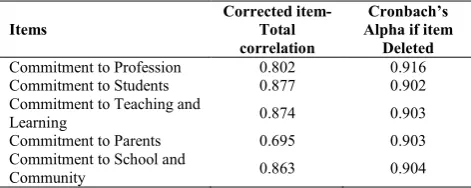
Table 2 Statistical description of the effectiveness of continuing professional development program
Items
Corrected item-Total correlation
Cronbach’s Alpha if item
Deleted
Commitment to Profession 0.802 0.916
Commitment to Students 0.877 0.902
Commitment to Teaching and
Learning 0.874 0.903
Commitment to Parents 0.695 0.903
Commitment to School and
Community 0.863 0.904
The results were the same regarding ‘commitment to students, i.e., participants' approval was similar to the previous result (with arithmetic mean of 3.91 and a standard deviation of 0.74). The perceptions of participants regarding the role of the continuing professional development program in improving their competencies in areas of commitment to teaching and learning and commitment to the community and school, was consistent with the two previous areas with (arithmetic mean = 3.94 and standard deviation = 0.73) and (arithmetic mean = 3.93 and standard deviation = 0.76) respectively. These findings can be supported by responses of many participants to the open-ended questions, confirming that their experience with the professional development program was "appropriate, excellent and beneficial to the development of teacher skills"
The only inconsistent result compares the results in other areas regarding approval of the role of continuing professional development program in increasing the efficiency of students to achieve teachers standards was for ‘commitment to parents’, (with arithmetic mean = 3.65 and standard deviation = 0.90). This is due to the fact that the professional development program does not include materials that directly address this area. When looking at the answers to open-ended questions, there is one response that agreed that the program promotes this area "helped in dealing with students and colleagues to overcome the difficulties".
Although the results of the quantitative analysis showed considerable acceptance to the role of the continuing development program in increasing the efficiency of teachers to achieve these standards, some participants in their responses to open-ended questions expressed what could be considered weaknesses in the continuing professional development program. For example:
Similarity, repetition and “nothing new” [in some courses]
[Some courses] do not meet the aspirations of teachers; merely theoretical information
The courses are too many, and their timing is not appropriate
The program does not reflect the reality
The program lacks authentic examples of educational situations
Teaching sessions are far apart. The teacher complete one course per year
Some participants in the study also presented constructive and useful proposals for the development of the program, the most important of which are:
Courses must be in Arabic language
It is better for the trainees to choose the courses that suits their needs
Courses need to be designed based on teachers specializations
Table 3 The correlation between the variables "number of professional development hours" and "the effectiveness of the
continuing professional development program”
Number of Professional Development
hours
Means of all Sections of Commitment
Number of Correlation 1 0.037
Professional Development hours
Coefficient
Sig – (2-tailed) 0.496
N 340 340
Means of all Sections of Commitment
Correlation
Coefficient 0.037 1
Sig – (2-tailed) 0.496
N 340 340
The null hypothesis of the correlation between the two variables above means that there is no statistically significant correlation between them
0
. The alternative hypothesis, which is more realistic, is that the correlation between the number of hours of professional development and the extent to which teachers can attain the teachers’ standards is likely to be strong and positive, because the trainees undergo more training that includes verity of courses during the period of continuing professional training.The results of the research analysis revealed that the correlation between the number of hours of professional development and the rate of teachers' efficiency improvement to achieve the required teachers’ standards was not as expected. As shown in the table 3 below, although the correlation coefficient (Pearson Correlation) was positive, it was very weak (0.037). In other words, there is no statistically significant correlation between the variables were the value of Sig (0.496) is much greater than the significance level (0.05)
Since the value of sig (0.496) is greater than significance level (0.05), the null hypothesis is accepted, and the alternative hypothesis rejected. There is no statistically significant correlation between the number of professional development hours and the effectiveness of the continuing professional development program in raising teachers’ competencies to achieve teachers’ standards. This can be supported by a number of responses to the open-ended questions indicating that the learning materials presented to them are repeated and traditional, which leads to boredom, and a number of them say that "teaching methods depend on dictating and are boring." Also, the lack of correlation between these two variables can be attributed to the timing of the program, according to some trainees, "timing is not appropriate." This is consistent with the findings of OECD study (2009, 2009) regarding inappropriate timing of the professional development program. According to participants in this study 47 percent of participants indicated that the timing of the professional development program was inappropriate for them and conflicted with their family obligations.
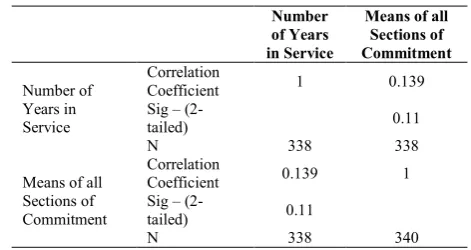
Table 4 The correlation between the variables: "Number years in
service" and "the effectiveness of the continuing professional development program"
Number of Years in Service
Means of all Sections of Commitment
Number of Years in Service
Correlation
Coefficient 1 0.139
Sig –
(2-tailed) 0.11
N 338 338
Means of all Sections of Commitment
Correlation
Coefficient 0.139 1
Sig –
(2-tailed) 0.11
N 338 340
correlation between the two variables. On the contrary, the alternative hypothesis, shows that there is a negative correlation between the two variables. The results as shown in the above table are:
Null hypothesis: The null hypothesis “There is no statistically
significant correlation between the two variables”
0
is incorrect, and the alternative hypothesis “There is a statistically significant correlation between the two variables”
0
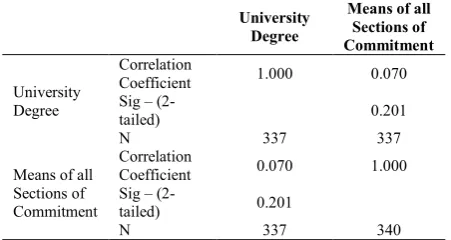
happened to be correct, with correlation coefficient (0.139) and sig value of (0.011), less than the significance level (0.05). This means that the alternative hypothesis is accepted, and null hypothesis rejected. The reason for this correlation can be attributed to the fact that most participants who have more years of service are not graduates of the Bahrain teachers College; therefore, the professional development program provides them with effective teaching strategies as required by the Ministry of Education.Table 5 The correlation between the variables "level of education"
and "the effectiveness of the continuing professional development"
University Degree
Means of all Sections of Commitment
University Degree
Correlation
Coefficient 1.000 0.070
Sig –
(2-tailed) 0.201
N 337 337
Means of all Sections of Commitment
Correlation
Coefficient 0.070 1.000
Sig –
(2-tailed) 0.201
N 337 340
For the correlation between these two variables, the null hypothesis indicates that there is no statistically significant correlation between the two variables. On the contrary, the alternative hypothesis is the most likely to have a negative correlation between the two variables. The results are as shown in the above table.
The null hypothesis “There is no statistically significant correlation between the two variables”
0
is incorrect, and the alternative hypothesis “There is a statistically significant correlation between the two variables”
0
happened to be correct, with correlation coefficient (0.070) and sig value of (0.201), higher than significance level (0.05). This means that the alternative hypothesis is accepted, and the null hypothesis rejected. The reason for this correlation can found in the answers of some respondents to the open-ended questions. For instance, "The learner does not need these courses because he has already received them as part of education diploma program." Trainees also have no opportunity to choose the materials they need. Some respondents argued that "it is better if the trainee chooses the courses for his/her training, while other preferred diversified courses. Similarly argued Fieman-Nemser (2001) that “professional development opportunities are usually sporadic and disconnected, rarely tied to teachers' classroom work and lacking any follow-up” (p. 1014). This is also consistent with OECD study (2009). "It is not surprising that there is a significant negative correlation between the extent to which teachers view the professional development as inappropriate, compared to the level of professionaldevelopment that they are actually receiving " (p. 73). Ali and Elmahdi (2001) argued that “…unless what is learned can be applied to actual work or life situations, the learning will not be effective or long lasting. Skills acquired should be transferable to daily life activities” (p. 72).
CONCLUSION AND RECOMMENDATIONS
The study emphasized the important role of continuing professional development in the Bahrain teachers College in improving the efficiency of teachers in Bahraini schools and preparing them to achieve teachers’ standards set by the Ministry of Education in the Kingdom, demanding all teachers at all stages of public education to abide by these standards. Although the general results of the research showed considerable agreement to the role of continuing professional development program in improving the efficiency of teachers to obtain these standards (with arithmetic mean of 3.89 and a standard deviation of 0.69), a number of participants emphasize the need of modifying the program to become more practical in nature. In support to the participants’ assertion, Al-Hattami, Muammar and Elmahdi (2013) argued that “good professional training program needs to combine both theoretical and classroom practices to achieve the intended learning outcomes” (p. 44). This study recommends the following:
Introduce new courses covering all of teachers’ categories or specializations
Focus on courses that are practical in nature rather than theoretical ones, which also meet teachers' aspirations
Introduce specialized courses in all fields
Introduce and implement courses for senior teachers and those who teach students with special needs
Prepare and agree on a plan between Bahrain Teachers College and Ministry of Education for suitable times to conduct the continuing professional development program
Provide the opportunity for teachers to choose the appropriate courses according to their professional needs and specific interests
Redrafting nomination plans to shorten the duration of enrolment in the program.
Use both Arabic and English languages in instruction
Introduce professional development courses of a contemporary technical nature
Self-education programs through distance learning. An idea shared by Al-Naqa and Abu Ward (2009) recommending the transition from traditional learning methods to e-learning for teachers training.
Self-education programs through online courses Self-education programs through computer software
Conduct more procedural research on the effectiveness of professional development programs for each category or specialty of teachers
Allow for the opportunity to conduct studies on teaching methods used and their role in enhancing the efficiency of teachers
References
Abu Atwan, A. (2008). Mwawigat tadreeb almwalimeen athna alkhidma wa subol altagalub aliyha bi Muhafazat Gaza. [Obstacles to training of in-service teachers and ways to overcome them in Gaza District]. (Unpublished master’s thesis) Islamic University, Gaza District. Al-Hattami, A., Muammar, O., and Elmahdi, I. (2013).The
need for professional training programs to improve faculty members teaching skills. European Journal of Research on Education, 2013, 1(2), 39-45.
Al-Naqa, A. and Abu Ward, I. (2009). Iydad almualim wa tanmiyatihi mihaniyan fi daw altahadiyat almustagbaliya [Preparing teachers and developing them professionally in light of future challenges]. A paper presented to the educational conference - the Palestinian teacher reality and hope. Islamic University, Gaza.
Ali, A. & Elmahdi, I. (2001). The wired Professor: A collaborative learning experience in one-on-one mentoring. Journal of Computing in Teacher Education, 18(2), 68 – 73.
Blatchford, R. (2017). The Teachers’ Standards in the classroom (3ed.). UK: SAGE.
Darling Hammond, L., Holtzman, D., Gatlin, S. and Vasquez Heili, J. (2005) Does teacher preparation matter? Evidence about teacher certification, Teach for America, and Teacher Effectiveness. Education Policy
Analysis Archives (EPAA), 13.
http://dx.doi.org/10.14507/epaa.v13n42.2005
Danielson, C. (2007). Enhancing Professional Practice: A Framework for Teaching. (2nded.) Alexandria, VA: ASCD (Association for Supervision and Curriculum Development)
Desimone, L., Porter, A., Garet, M., Yoon, K. and Birman, B. (2002). Effects of professional development on teachers’ instruction: Results from a Three-year Longitudinal Study. Educational Evaluation and policy Analysis, 24 (2) 81-110.
Fieman-Nemser, S. (2001). From preparation to practice: Designing a continuum to strengthen and sustain teaching. Teachers college Record, 103(6), 1013 – 1055. Retrieved from https://goo.gl/kco9TE
Luft, J. and Hewson, P. (2014). Research on Professional development for science teachers. In Abell, S.K. and Lederman, N.G. (Eds.) Handbook of Research on Science Education (second edition) (pp. 1-80). New York, NY: Routledge.
Ingersoll, R. (Ed) (2007). A comparative study of teacher preparation and qualifications in six nations. Consortium for Policy Research in Education (CPRE), 1-17. Retrieved from: https://goo.gl/TGe9pZ
OECD (2009) Creating Effective Teaching and Learning Environments: First Results from TALIS – ISBN 978-92-64-05605-3. Retrieved May 27,2018 from: https://goo.gl/ee5x78
How to cite this article:
Ismail Alam Elmahdi,.2019, The Effectiveness of Continuing Professional Development Program in Enhancing Teachers’ Competencies To Achieve Teachers’ Standards. Int J Recent Sci Res. 10(02), pp.30946-30951
DOI: http://dx.doi.org/10.24327/ijrsr.2019.1002.3159