A b s t r a c t. Technological value of grain of new hybrid triticale lines achieved due to crossbreeding X Triticosecale Wittmack withAegilopssp. was studied as compared to standard triticale varieties to select lines with the best technological value. It was found that the new triticale lines under evaluation were characterized by usually higher 1000-kernel weight than standard Bogo cv., but this value depended on the year of the study when compared to Presto cv. The hybrid strains were characterized by lower volume weight than Presto cv., but exceeded or were similar to Bogo cv. Grain shapeliness and uniformity for the lines studied were usually significantly lower than for standard triticale varieties. Great differentiation of vitreousness within the lines was found; vitreousness of strain 3 and 6 grain even exceeded that for both standard varieties. Total protein content was also higher for both strains than for Presto cv. The hybrid triticale strains were distinguished with lower wet gluten content than the standard varieties. Flour extract from triticale with Aegilops cross-combination grain was significantly lower than from Presto cv., but similar to Bogo cv. Among the strains studied, No 4 and 5 were characterized by the highest value of that trait and the best rheological properties of dough. Evaluation of baking and its organoleptic features revealed the superiority of strain 4 over standard Presto cv. Strain 4 deserves attention as a material for the baking industry.
K e y w o r d s: triticale,Aegilopssp., hybrids, technological value
INTRODUCTION
Cereals of good technological value can broaden the assortment of bakery products for consumers. Introduction of genes responsible for the improvement of their breeding and technological traits through inter-genus crossbreeding of triticale (X Triticosecale Wittmack) with Aegilops
(Aegilopssp.) is one of the methods of quality improvement of triticale (Gruszecka, 1998; Gruszecka and Kowalczyk, 2000). Triticale is a fodder cereal which can also be utilized in flour milling, baking, dough cooking and as a component of breakfast mixtures and even for noodle production (B³a¿ewicz, 1993; Cegliñska and Cacak-Pietrzak, 1996, Haber, 1989; Haberet al., 1993; Tambros and Briggs, 1984). Species of theAegilopsgenus are characterized by resistan-ce to disease-forming factors, pests, unfavorable environ-mental conditions, as well as by a high content and good quality of protein (Berzensky and Kimber, 1987; Frauenstein and Hammer, 1985; Hammer, 1985; Rivoalet al., 1993). Remote hybridization and selection may facilitate accumu-lation of genes responsible for good technological quality of hybrids better than in triticale.
The aim of the study was to assess the technological value of seeds of new hybrid triticale lines achieved due to the crossbreeding of X Triticosecale Wittmack with Aegilops sp., as well as the selection of the best lines as compared to standard triticale varieties.
MATERIAL AND METHODS
Four hybrid lines of three crossbred combinations of triticale withAegilopsconstituted the material for the study: Ae. crassa4x Boiss × CZR 1125/90 (strain 3),Ae. juvenalis 6x (Thell.) Eig × 1125/90 (strains 4 and 5), CZR 1421/89 × Ae. juvenalis 6x (Thell.) Eig (strain 6), and two standard triticale varieties: Bogo and Presto (strains 1 and 2) (Table 1). The material originated from a comparative experiment set in four replications along with standards and performed for
Evaluation of grain technological quality of X
Triticosecale
Wittmack
with
Aegilops
sp. hybrids
D. Gruszecka
1, D.Kulpa
2, and E. Makarska
31
Institute of Genetics and Plant Breeding, University of Agriculture, Akademicka 15, 20-934 Lublin
2
Department of Food Technology and Storage, University of Agriculture, Skromna 8, 20-704 Lublin
3
Department of Chemistry, University of Agriculture, Akademicka 15, 20-934 Lublin
Received August 18, 2003; accepted September 23, 2003
© 2004 Institute of Agrophysics, Polish Academy of Sciences
A
A
Agggrrroooppphhyhyysssiiicccsss
w
w
two vegetation seasons (1997/1998 and 1998/1999) at the Experimental Station Czes³awice on a dust soil of loess origin.
The following determinations were made: 1000-kernel weight, volume weight, shapeliness and uniformity, share of vitreous grains, grain humidity and total protein content (N × 6.25). Trial grinding was performed using a QC 109/2 laboratory grinder, and the flour obtained was subjected to technological and farinographic analysis. Trial laboratory baking of chosen strains was performed. Analyses were made in 2 or 3 replications according to standards for cereal products (Jakubczyk and Haber, 1983).
The results of the study were statistically processed; verification of differences among mean values for particular strains and standard triticale varieties was performed using variance analysis and multiple T-Tukey’s intervals.
RESULTS AND DISCUSSION
On the basis of the study, it was found that the new triticale strains were usually characterized by a higher 1000-kernel weight (48.2 g in 1997 and 42.3 g in 1998) than the standard Bogo cv. (38.3 and 43.3 g, respectively). As compared to Presto cv. (42.1 and 51.8 g, respectively), this value depended on the year of the study (Table 2). The results achieved are similar to those obtained for triticale varieties (Cegliñskaet al., 2000): 34.1-49.5 g. Gil (2001), when testing triticale grain in the same years, achieved lower mean values for that trait (37.3 g in 1997 and 33.2 g in 1998). The high 1000 kernel weight for the hybrids of triticale with Aegilops proves their good shapeliness and high sowing potential.
Although the hybrid strains were characterized by a lower density (64.2 kg hl-1in 1997 and 65 kg hl-1in 1998)
Strain Variety/Cross combination Generation1996/1997 Generation1997/1998
1 2 3 4 5 6
Bogo Presto
Ae. crassa4x Boiss x CZR 1125/90
Ae. juvenalis6x (Thell.) Eig x CZR 1125/90 (1) Ae. juvenalis6x (Thell.) Eig x CZR 1125/90 (2) CZR 1421/89 xAe. juvenalis6x (Thell.) Eig
-B3/F2
B2/F3
B2/F3
B2/F2
-B3/F3
B2/F4
B2/F4
B2/F3 T a b l e 1.Material for study
Strain
Harvest year
1000 kernel weight
(g)
Density
(kg hl–1) Shapeliness Uniformity Vitreousness
Total protein (Nx6.25) (%)
1
2
x
3
4
5
6
x
1997 1998
1997 1998
1997 1998
1997 1998
1997 1998
1997 1998
1997 1998
1997 1998
38.3**
43.3
42.1* 51.8*
40.2 47.5
45.2* 43.5**
51.6***
38.8***
51.7***
40.5***
44.2* 46.6***
48.2 42.3
60.9**
66.4
68.2* 72.9*
64.5 69.6
63.5***
65.8**
66.7***
63.5***
66.6***
64.4***
59.8***
66.3**
64.2 65.0
91.8 96.0
95.2 97.9
93.5 97.0
76.2***
89.5***
88.9 75.3***
88.4 79.7***
76.3***
92.3***
74.9 84.2
91.8 96.0
95.2 97.9
93.5 97.0
76.2***
89.5***
88.9 75.3***
88.4 79.7***
76.3***
92.3***
74.9 84.2
31 24
28 27
29.5 25.5
39***
37***
23* 19
25 22
36**
36***
30.8 28.5
15.1 13.8
13.5 11.9*
14.3 12.9
14.1 12.3*
13.3 12.0*
11.9* 12.4*
14.9 12.4*
13.5 12.2
Statistically significant difference as compared to:*Bogo cv. at P=0.01,**Presto cv. at P=0.01.
than Presto cv. (68.2 and 72.9 kg hl-1, respectively), they exceeded or were almost the same as the Bogo cv. (60.9 and 66.4 kg hl-1, respectively) (Table 2), which indicates similar endosperm to fruit-seed cover ratio and shapeliness. Biskupskiet al. (1992) observed similar values for triticale, and Haberet al. (1993) as well as Cegliñskaet al. (2000) (67.2-78.8 kg hl-1) and Gil (2001) (71-71.4 kg hl-1) proved higher grain density at the strewed state.
Strains 4 and 5, in whichAe. juvenaliswas the maternal form, had higher 1000-kernel weight and density than strain 6 with Ae. juvenalis as the paternal form.
Grain shapeliness and uniformity for the strains under study (75.3-92.3%) were usually significantly lower than for the standard triticale varieties (91.8-97.9%) (Table 2). Haberet al. (1993) presented similar results (65.5-91%).
Evaluation of the kernel vitreousness indicates a great influence of the genetic factor on the trait development, and less of the weather conditions (Table 2). Strains 3 and 6 were characterized by significantly higher vitreousness (37-39 and 36%, respectively) than the other two strains (19-25%) and even the standard triticale varieties (24-31%). Vitreousness differences between two years reached only 4%. However, other conclusions were drawn by Gil (2001), who found the that triticale grain vitreousness and, to a lesser extent, inter-variety traits, were affected by the weather. Results of a study performed upon triticale by Achremowicz and Podgórska (1989), as well as that by Biskupskiet al. (1992), showed higher vitreousness than the values achie-ved in the present study. Cegliñskaet al. (2000) observed a
much lower value of that trait. High grain vitreousness that proves a high protein content was also confirmed in the present paper. Strains with high vitreousness (3 and 6) were characterized by a higher total protein content.
Most of the hybrid triticale strains were characterized by a significantly lower total protein content (11.9-14.9%) than the standard Bogo cv. (13.8-15.1%), and by a similar level to that of Presto cv. (11.9-13.5%). Similar values for triticale were achieved by Cegliñska et al. (2000) (10.2-12%), and by Biskupskiet al. (1992) (11.1-17.7%). Lower values (9.7-10.8%) were obtained by Cegliñska and Haber (1997), as well as by Achremowiczet al. (1998) (9.1%, on average). Moreover, a decrease of protein content for all the studied forms was observed in the second year, which can be explained by worse weather conditions. Gil (2001) also observed a similar phenomenon when comparing the total protein content in triticale grains in 1997 (13.4%) and 1998 (12.7%).
It was found that flour extract from the hybrid triticale withAegilopscombinations was significantly less than that from Presto cv., and similar to Bogo cv. (Table 3). Among the strains studied, No. 5 and 4 were characterized by the highest values of that trait (46.5 and 49.5%, at the first, and 42.7 and 49.2%, respectively at the second year). Cacak-Pietrzaket al. (1995) achieved higher flour extracts (65.7-75.3%), but Achremowicz and Podgórska (1989) lower ones (40.8-47%).
Ash content in flour made from the hybrid strains was 0.64-0.97% and thus it was higher then in flour prepared
Strain Harvestyear Flour extract Bran efficiency Losses (%)
1
2
x
3
4
5
6
x
1997 1998
1997 1998
1997 1998
1997 1998 1997 1998 1997 1998 1997 1998 1997 1998
44.49**
48.41
51.48* 52.17*
47.98 50.29
41.45**
45.77***
42.73**
49.20**
46.49 49.45**
42.63**
42.35***
43.32 46.7
54.31**
50.90
47.49* 46.91*
50.80 48.9
57.99**
53.56**
55.77**
50.02**
53.13 49.61 56.19**
56.75***
55.77 52.48
1.20 0.69
1.03 0.92
1.11 0.80
0.56 0.66 1.50 0.77 0.38 0.94 1.18 0.90 0.80 0.81
Statistically significant difference as compared to:*Bogo cv. at P=0.01, Presto cv. at P=0.01.
from Presto cv. (0.63-0.73%). The high level of ash in the material studied proves large amounts of minerals. Ash content in flour from the hybrid forms was comparable to that achieved for triticale by Cegliñska and Haber et al. (2001) (0.73-0.98%).
Wet gluten content in the strains analyzed varied within the range of 15.7 to 21.3% (Table 4). Those values were significantly lower than for the standard triticale varieties (24.2-28.1%), which points out to the opportunity of using flour made from triticale withAegilopshybrids in the baking industry, for baking cakes and cookies that do not require high levels of gluten. Clear differences in the gluten content were observed between strain 3 (20% in 1997 and 21.3% in 1998) and strain 6 (15.8 and 17.7%, respectively), which in the case of strain 3 was associated with a high total protein content. Slightly less gluten in triticale flour was found by Achremowicz and Podgórska (1989) (10-24%). Biskupski et al. (1992) and Czubaszek (1995) determined a wider variability range for that trait (7.5-39 and 8.2-32.3%, respectively).
On the basis of farinographic studies, it was found that mean water absorption of the hybrids tested was higher (59.9% in 1997 and 64.1% in 1998) than the mean water absorption of the standards (53.0 and 62.1%, respectively) (Table 4). Strains 4 and 5 were positively distinguished in this respect (61-65.4%).
Although mean development time of dough made of the triticale withAegilopshybrid strains (1.1 min in 1997 and 0.9 min in 1998) did not differ from the mean values for this trait in the standard triticale varieties (1 min in both years), oscillations between particular samples were significant (strain 6: 0.4-0.8 min, strain 4: 1.2-1.3 min). Similar differences among the strains and varieties studied also referred to dough stability time, but the influence of harvest year was accentuated: mean dough stability was 1.3 min for the hybrids, 1.4 min for triticale in 1997; and 1.9 min for the hybrids, 2 min for triticale varieties in 1998. These two traits form dough resistance whose values oscillated within 1.3-3.1 min in 1997 and 2.7-3.1 min in 1998 for the hybrids, and 2.1-2.6 min in 1997 and 2.9-3.3 min in 1998 for triticale. From these analyses it follows that dough development and stability times, therefore dough resistance, are a factor that differentiates the breeding material, although they also depend on the weather and soil conditions during the vegetation and harvest.
Dough softening varied at the level from 140 jB (strain 4) up to 275 jB (strain 6). The much lower value of dough softening for strain 4 in 1997 than for triticale dough (205-250 jB) indicates probable usefulness of that hybrid for baking purposes. Also dough elasticity was at the highest level (80-90 jB) among all the studied strains.
Strain Harvest year Ash Wet gluten Water absorption Dough develop-ment Dough stability Dough
softening Elasticity Resistance
(%) (min) (jB) (min)
1 2 x 3 4 5 6 x 1997 1998 1997 1998 1997 1998 1997 1998 1997 1998 1997 1998 1997 1998 1997 1998 0.76 0.76 0.63 0.73 0.69 0.74 0.80 0.77 0.64 0.80 0.83 0.85 0.97 0.66 0.81 0.77 25.9 28.1 24.2 28.1 25.1 28.1
20.0***
21.3***
19.6***
15.7***
18.4***
19.6***
17.7***
15.8* ** 18.9 18.1 61.1 64.2 56.6 60.0 53.0 62.1 60.4 65.2 61.0 65.4 62.0 63.8 56.2 62.0 59.9 64.1 1.1 1.3 0.9 0.8 1.0 1.0 0.8 1.0 1.2 1.3 1.6 0.9 0.8 0.4 1.1 0.9 1.5 1.6 1.2 2.5 1.4 2.0 1.2 1.8 1.7 1.8 1.5 1.9 0.8 2.3 1.3 1.9 205 240 250 220 228 230 180 220 140 210 200 210 275 230 199 217 95 90 85 90 90 90 50 60 80 90 90 80 75 90 74 80 2.6 2.9 2.1 3.3 2.4 3.1 2.0 2.8 2.9 3.1 3.1 2.8 1.7 2.7 2.4 2.8
Statistically significant difference as compared to:*Bogo cv. at P=0.01,
**Presto cv. at P=0.01.
Strain
Harvest year
Dough efficiency
Stove loss Total baking loss
Bread efficiency
Baking volume
Baking volume made from 100 g
of flour
(%) (cm3)
2
3
4
1997 1998 1997 1998 1997 1998
138.0 163.6
-161.7
140.6 164.5
14.1 11.3 -9.5 12.9 12.2
14.6 13.0 -12.2 14.0 14.4
117.8 142.4
-141.3 120.9 140.8
530 550 -500 570 650
292.5 360.0
-323.4 320.6 427.8
T a b l e 5.Characteristics of trial baking of baking from flour of Presto cv. and hybrid triticale strains
tu bêdzie kolorowa fotografia (do wmontowania w drukarni)
Intersection of bread baked using flour of Presto cv. (No. 2) and strainAe. juvenalis6x (Thell.) Eig × 1125/90 (No. 4). Strain
Har-vest year
Baking shape
Crust Crumb Baking
flavour
Baking taste Colour Surface
Thick-ness (mm)
Colour Elasti-city
Porosity Bulki-ness
Humidity and viscosity
2
3
4 1997
1998
1997 1998
1997
1998
proper
flat
-flat
proper
proper spherical
brown
brown
-brown
golden
golden
smooth
smooth
-porous
porous
smooth 3
3
-2
3
3
cream-grey cream-grey
- cream-grey
cream
cream
suffi-cient suffi-cient
- suffi-cient
good
good
uniform
uniform
-uniform
fine uniform fine uniform
crumby
crumby
-crumby
dense cracking dense
wet and viscous wet and viscous
-wet and viscous
dry
dry
proper
proper
-nasty
proper
proper
proper
proper
-insipid
proper
proper
It can be stated on the basis of the analyses made that grain of the triticale withAegilopshybrids does not differ from standard material (Bogo and Presto cv.) with respect to farinographic traits, and flour made of strain 4 was distinguished by even better properties. Haberet al. (1993), Gil (1997) and Achremowiczet al.(1998) observed similar values when evaluating triticale flour.
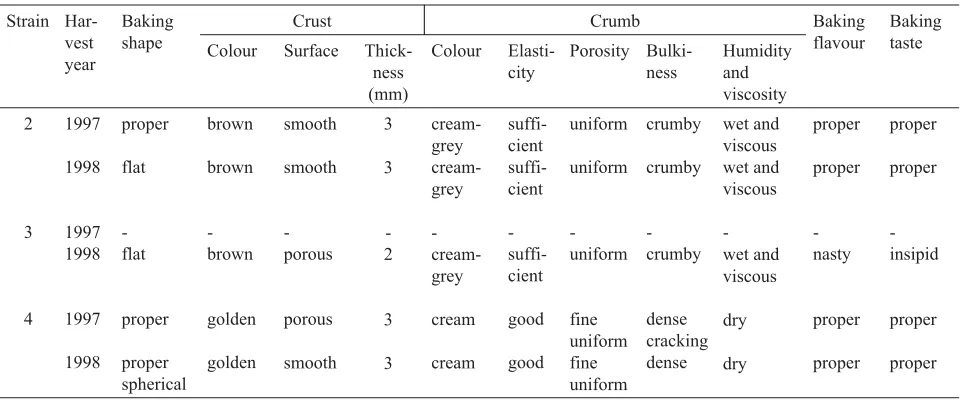
Strain 4 was characterized by the best farinographic traits of flour in both study years (the longest dough development and stability times, the highest dough elasticity and resistance as well as the lowest softening), and Presto cv. was chosen for trial baking. In the second year, strain 3 was additionally taken into account due to its high vitreousness, total protein and wet gluten contents (Tables 5 and 6). Organoleptic assessment of baking produced from strain 4 was the confirmation of its positive grain and flour features. The bread was of spherical shape, smooth skin of golden color and 3 mm thickness (Fig. 1). Its crumb was bright and
cream-coloured, with good elasticity, fine and uniform pores, nice flavour and proper taste. This strain appeared to be better than standard Presto cv. Strain 3, despite its high total protein and wet gluten contents, high dough and bakery efficiency as well as low stove and baking loss, had less favourable features during organoleptic assessment (flat shape, brown skin, crumb elastic only to some extent, nasty flavor and insipid taste).
CONCLUSIONS
1. Grain of the triticale with Aegilops hybrids was characterized by good technological quality.
2. Strains 4 and 5, in which Ae. juvenalis was the maternal form, had more favourable technological features than strain 6 withAe. juvenalisas the paternal form.
REFERENCES
Achremowicz B., Mazurkiewicz J., and Tarkowski C., 1998.
Ocena wybranych cech technologicznych ziarna nowych rodów pszen¿yta (in Polish). Biul. IHAR, 208, 79-87.
Achremowicz B. and Podgórska E., 1989. Fizyczna i
technologiczna ocena nowych rodów Triticale (in Polish). Zesz. Probl. Post. Nauk Roln., 354, 9-14.
Berzensky W.A. and Kimber G., 1987. The tolerance to
aluminium of Triticum N - genome amphiploides. Plant Breeding, 103, 37-42.
Biskupski A., Bogdanowicz M., and Subda H., 1992.Wartoœæ technologiczna ziarna pszen¿yta (in Polish). Czêœæ I. Charakterystyka biochemiczna i technologiczna. Hod. Roœl. Aklim. i Nas., 36, 3-4, 73-89.
B³a¿ewicz J., 1993.Estimation of the usability of Triticale malts in brewing industry. Pol. J. Food Nutr. Sci., 43, 2, 1, 39-45.
Cacak-Pietrzak G., Haber T., Duszyñska R., and Sitkowski T., 1995. Wartoœæ przemia³owa nowych krajowych odmian pszen¿yta (in Polish). Przegl. Zbo¿. M³yn. 8, 23-24.
Cegliñska A. and Cacak-Pietrzak G., 1996. Charakterystyka technologiczna wybranych krajowych odmian pszen¿yta w zale¿noœci od miejsca uprawy (in Polish). Przegl. Zbo¿.-M³yn., 7, 26-28.
Cegliñska A., Cacak-Pietrzak G., Haber T., JóŸwiak J., and Czerwiñska E., 2000. Cechy fizykochemiczne ziarna rodów pszen¿yta ozimego (in Polish). Przegl. Zbo¿.-M³yn., 7, 27-28.
Cegliñska A. and Haber T., 1997.Wp³yw iloœci i jakoœci glutenu mokrego na wartoœæ wypiekow¹ m¹ki pszen¿ytniej (in Polish). Biul. Kat. Technol. Zbó¿, Nasion Oleistych i Koncentratów Spo¿. SGGW Warszawa, 5. Dodatek do Przegl. Piek. I Cukierniczego, 7, 35-36.
Cegliñska A. and Haber T., 2001. Wartoœæ technologiczna wybranych odmian pszen¿yta ozimego (in Polish). Biul. IHAR, 218/219, 315-321.
Czubaszek A., 1995.Charakterystyka technologiczna pszen¿yta hodowli polskiej na podstawie metod poœrednich i wypieku laboratoryjnego. Cz. III. Wartoœæ wypiekowa odmian pszen¿yta (in Polish). Hod. Roœl. Aklim. i Nas., 3, 95-109.
Frauenstein K. and Hammer K., 1985. Pruefung von
Aegilops-Arten auf Resistenz gegen Echten Mehltau, Erysiphe graminis D. C., Braunrost, Puccinia recondita Rob. Ex Desm. und Spelzenbraeune, Septoria nodorum Berk. Kulturpflanze, 33, 37-42.
Gil Z., 1997. Wspó³zale¿noœæ pomiêdzy niektórymi cechami jakoœciowymi ziarna i m¹ki pszen¿yta jarego i ozimego (in Polish). Biul. IHAR, 201, 123-131.
Gil Z., 2001. Charakterystyka cech fizycznych, chemicznych i przemia³owych ziarna pszen¿yta jarego i ozimego (in Polish). Biul. IHAR, 220, 139-146.
Gruszecka D., 1998. Charakterystyka niektórych cech
mieszañców X Triticosecale Wittmack z Aegilops sp. generacji B2/F1 i F2 (in Polish). Biul. IHAR, 205/206, 163-174.
Gruszecka D. and Kowalczyk K., 2000. Charakterystyka
wybranych cech iloœciowych mieszañców pszen¿yta (X Triticosecale Wittmack) z kozieñcami (Aegilops sp.) (in Polish). Folia Univ. Agric. Stetin., 201, 82, 83-88.
Haber T., 1989. Pszen¿yto - nowa roœlina zbo¿owa.
Charakterystyka technologiczna i mo¿liwoœci wykorzystania (in Polish). Biul. Central. Labor. Techn. Przetwórstwa i Przechow. Zbó¿ w Warszawie, 6. Dodatek do Przegl. Zbo¿.-M³yn., 11-12, 17-21.
Haber T., Lewczuk J., and Pachelska A., 1993.Charakterystyka technologiczna nowych, krajowych odmian pszen¿yta (in Polish). Biul. Kat. Technol. Zbó¿, Nasion Oleistych i Koncentr. Spo¿., 2. Dodatek do Przegl. Zbo¿-M³yn., 8, 13-17.
Hammer K., 1985. Vorarbeiten zur Monographischen
Darstellung von Wildpflanzensortimenten: Aegilops L. Resistenzuntersuchungen. Kulturpflanze, 33, 123-131.
Jakubczyk T. and Haber T., 1983.Analiza zbó¿ i przetworów zbo¿owych (in Polish). Skrypt SGGW Warszawa.
Rivoal R., Jahier J., and Hulle H., 1993.Partial resistance to Heterodera avenae in wheat lines with the 6 Mv chromosome from Aegilops ventricosa. Soc. Of Nematologiste, J. Nematel., 25, 2, 265-269.
Tambros S. and Briggs D. B., 1984.Micromalting triticale. J. Inst. Brew. 90, 4, 263-265.