VOLUME NO.5(2015),ISSUE NO.12(DECEMBER) ISSN 2231-5756
A Monthly Double-Blind Peer Reviewed (Refereed/Juried) Open Access International e-Journal - Included in the International Serial Directories
Indexed & Listed at:
VOLUME NO.5(2015),ISSUE NO.12(DECEMBER) ISSN 2231-5756
INTERNATIONAL JOURNAL OF RESEARCH IN COMMERCE, IT & MANAGEMENT
CONTENTS
Sr.
No.
TITLE & NAME OF THE AUTHOR (S)
Page
No.
1
.
THE IMPACT OF USE OF ICT FOR BUSINESS PROCESS MANAGEMENT IN e-TOURISM
VIDYULLATA V. PAWAR & DR. S. D. MUNDHE
1
2
.
A ROLE OF KNOWLEDGE BASED SYSTEM IN INFORMATION SYSTEM AUDIT
A. B. DEVALE & DR. R. V. KULKARNI
3
3
.
XML DATABASE: PAST, PRESENT AND FUTURE
KUMAR KALAMADI
6
4
.
CRITICAL CHALLENGES AND TRANSFORMATIONS IN EDUCATION IN NIGERIA: SYNTHESIS AND
PROGNOSIS
TITUSAMODU UMORU
8
5
.
IMPACT OF INFORMATION AND COMMUNICATION TECHNOLOGY (ICT) AMONG EXPORTER: A
CRITICAL REVIEW OF LITERATURE
S.SHOBANA & DR. M. RAJAPRIYA
12
6
.
SCOPE OF INFORMATION TECHNOLOGY IN THE BANKING SECTOR
SHRI VALLABH H. LELE
21
7
.
PROBLEMS AND CHALLENGES OF COLLECTION DEVELOPMENT IN DIGITAL LIBRARIES
S.R. MANDALE & DR. KHOT N. B.
23
8
.
IMPLEMENTATION OF ARTIFICIAL NEURAL NETWORK IN CONCURRENCY CONTROL OF
DISTRIBUTED DATABASE SYSTEM
A. A. SATTIKAR & A. A. GOVANDE
26
9
.
RESEARCH INFORMATION TECHNOLOGY: BEHAVIORAL ACCOUNTING
PATIL BHAGWAN SHANKAR
30
10
.
A STUDY ON USERS’ PREFERENCE TOWARDS MATRIMONIAL SITES IN COIMBATORE CITY
R.MONISHA
33
11
.
FEDENA: EFFECTIVE ICT TOOL FOR EDUCATION MANAGEMENT SYSTEM
VARSHA P. DESAI
36
12
.
SYSTEMATIC AND SCIENTIFIC APPROACH OF WEB DESIGNING
NILESH RAYGONDA PATIL
40
13
.
PROMINENCE OF LISTENING EXPERTISE IN COMMUNICATION
DEEPA PATIL
42
14
.
A REVIEW ON THE ROLE OF MOBILE BANKING IN SELECTED AREAS OF KARAD
SANTOSH B. POTADAR
44
15
.
CHALLENGES IN WIRELESS NETWORK
SARIKA BABAN GAIKWAD
46
16
.
RURAL INVESTORS’ PERCEPTION TOWARDS MUTUAL FUND DISTRIBUTION
L. MEENA
48
17
.
IMPACT OF GENETIC ALGORITHM IN CODE COVERAGE FOR TEST SUIT BY JUNIT IN DYNAMIC
CONVERSION
SASHIBHUSAN NAYAK & ANIL KUMAR BISWAL
52
18
.
A STUDY ON CUSTOMER SERVICES OF NATIONALISED BANKS IN BANGALORE CITY
NANDINI.N
56
19
.
A CRITICAL APPRAISAL OF RISK MANAGEMENT STRATEGIES OF MICROFINANCE INSTITUTIONS IN
GHANA
ALHASSAN BUNYAMINU & CHARLES BARNOR
63
20
.
CONSUMER TRUST IN ONLINE SHOPPING IN THE DOABA REGION OF PUNJAB
SHABNAM GULATI & DUSHANT NARULA
71
VOLUME NO.5(2015),ISSUE NO.12(DECEMBER) ISSN 2231-5756
CHIEF PATRON
PROF. K. K. AGGARWAL
Chairman, Malaviya National Institute of Technology, Jaipur
(An institute of National Importance & fully funded by Ministry of Human Resource Development, Government of India)
Chancellor, K. R. Mangalam University, Gurgaon
Chancellor, Lingaya’s University, Faridabad
Founder Vice-Chancellor (1998-2008), Guru Gobind Singh Indraprastha University, Delhi
Ex. Pro Vice-Chancellor, Guru Jambheshwar University, Hisar
FOUNDER PATRON
LATE SH. RAM BHAJAN AGGARWAL
Former State Minister for Home & Tourism, Government of Haryana
Former Vice-President, Dadri Education Society, Charkhi Dadri
Former President, Chinar Syntex Ltd. (Textile Mills), Bhiwani
FORMER CO-ORDINATOR
DR. S. GARG
Faculty, Shree Ram Institute of Business & Management, Urjani
ADVISORS
PROF. M. S. SENAM RAJU
Director A. C. D., School of Management Studies, I.G.N.O.U., New Delhi
PROF. M. N. SHARMA
Chairman, M.B.A., Haryana College of Technology & Management, Kaithal
PROF. S. L. MAHANDRU
Principal (Retd.), Maharaja Agrasen College, Jagadhri
EDITOR
PROF. R. K. SHARMA
Professor, Bharti Vidyapeeth University Institute of Management & Research, New Delhi
CO-EDITOR
DR. BHAVET
Faculty, Shree Ram Institute of Engineering & Technology, Urjani
EDITORIAL ADVISORY BOARD
DR. RAJESH MODI
Faculty, Yanbu Industrial College, Kingdom of Saudi Arabia
PROF. SANJIV MITTAL
University School of Management Studies, Guru Gobind Singh I. P. University, Delhi
PROF. ANIL K. SAINI
Chairperson (CRC), Guru Gobind Singh I. P. University, Delhi
DR. SAMBHAVNA
VOLUME NO.5(2015),ISSUE NO.12(DECEMBER) ISSN 2231-5756
INTERNATIONAL JOURNAL OF RESEARCH IN COMMERCE, IT & MANAGEMENT
DR. MOHENDER KUMAR GUPTA
Associate Professor, P. J. L. N. Government College, Faridabad
DR. SHIVAKUMAR DEENE
Asst. Professor, Dept. of Commerce, School of Business Studies, Central University of Karnataka, Gulbarga
ASSOCIATE EDITORS
PROF. NAWAB ALI KHAN
Department of Commerce, Aligarh Muslim University, Aligarh, U.P.
PROF. ABHAY BANSAL
Head, Department of I.T., Amity School of Engineering & Technology, Amity University, Noida
PROF. A. SURYANARAYANA
Department of Business Management, Osmania University, Hyderabad
PROF. V. SELVAM
SSL, VIT University, Vellore
DR. PARDEEP AHLAWAT
Associate Professor, Institute of Management Studies & Research, Maharshi Dayanand University, Rohtak
DR. S. TABASSUM SULTANA
Associate Professor, Department of Business Management, Matrusri Institute of P.G. Studies, Hyderabad
SURJEET SINGH
Asst. Professor, Department of Computer Science, G. M. N. (P.G.) College, Ambala Cantt.
FORMER TECHNICAL ADVISOR
AMITA
Faculty, Government M. S., Mohali
FINANCIAL ADVISORS
DICKIN GOYAL
Advocate & Tax Adviser, Panchkula
NEENA
Investment Consultant, Chambaghat, Solan, Himachal Pradesh
LEGAL ADVISORS
JITENDER S. CHAHAL
Advocate, Punjab & Haryana High Court, Chandigarh U.T.
CHANDER BHUSHAN SHARMA
Advocate & Consultant, District Courts, Yamunanagar at Jagadhri
VOLUME NO.5(2015),ISSUE NO.12(DECEMBER) ISSN 2231-5756
CALL FOR MANUSCRIPTS
We invite unpublished novel, original, empirical and high quality research work pertaining to recent developments & practices in the areas of Computer Science & Applications; Commerce; Business; Finance; Marketing; Human Resource Management; General Management; Banking; Economics; Tourism Administration & Management; Education; Law; Library & Information Science; Defence & Strategic Studies; Electronic Science; Corporate Governance; Industrial Relations; and emerging paradigms in allied subjects like Accounting; Accounting Information Systems; Accounting Theory & Practice; Auditing; Behavioral Accounting; Behavioral Economics; Corporate Finance; Cost Accounting; Econometrics; Economic Development; Economic History; Financial Institutions & Markets; Financial Services; Fiscal Policy; Government & Non Profit Accounting; Industrial Organization; International Economics & Trade; International Finance; Macro Economics; Micro Economics; Rural Economics; Co-operation; Demography: Development Planning; Development Studies; Applied Economics; Development Economics; Business Economics; Monetary Policy; Public Policy Economics; Real Estate; Regional Economics; Political Science; Continuing Education; Labour Welfare; Philosophy; Psychology; Sociology; Tax Accounting; Advertising & Promotion Management; Management Information Systems (MIS); Business Law; Public Responsibility & Ethics; Communication; Direct Marketing; E-Commerce; Global Business; Health Care Administration; Labour Relations & Human Resource Management; Marketing Research; Marketing Theory & Applications; Non-Profit Organizations; Office Administration/Management; Operations Research/Statistics; Organizational Behavior & Theory; Organizational Development; Production/Operations; International Relations; Human Rights & Duties; Public Administration; Population Studies; Purchasing/Materials Management; Retailing; Sales/Selling; Services; Small Business Entrepreneurship; Strategic Management Policy; Technology/Innovation; Tourism & Hospitality; Transportation Distribution; Algorithms; Artificial Intelligence; Compilers & Translation; Computer Aided Design (CAD); Computer Aided Manufacturing; Computer Graphics; Computer Organization & Architecture; Database Structures & Systems; Discrete Structures; Internet; Management Information Systems; Modeling & Simulation; Neural Systems/Neural Networks; Numerical Analysis/Scientific Computing; Object Oriented Programming; Operating Systems; Programming Languages; Robotics; Symbolic & Formal Logic; Web Design and emerging paradigms in allied subjects.
Anybody can submit the soft copy of unpublished novel; original; empirical and high quality research work/manuscriptanytime in M.S. Word format
after preparing the same as per our GUIDELINES FOR SUBMISSION; at our email address i.e. [email protected] or online by clicking the link online
submission as given on our website (FOR ONLINE SUBMISSION, CLICK HERE).
GUIDELINES FOR SUBMISSION OF MANUSCRIPT
1. COVERING LETTER FOR SUBMISSION:
DATED: _____________
THE EDITOR
IJRCM
Subject: SUBMISSION OF MANUSCRIPT IN THE AREA OF .
(e.g. Finance/Mkt./HRM/General Mgt./Engineering/Economics/Computer/IT/ Education/Psychology/Law/Math/other, please specify)
DEAR SIR/MADAM
Please find my submission of manuscript entitled ‘___________________________________________’ for possible publication in one of your journals.
I hereby affirm that the contents of this manuscript are original. Furthermore, it has neither been published elsewhere in any language fully or partly, nor is it under review for publication elsewhere.
I affirm that all the co-authors of this manuscript have seen the submitted version of the manuscript and have agreed to their inclusion of names as co-authors.
Also, if my/our manuscript is accepted, I agree to comply with the formalities as given on the website of the journal. The Journal has discretion to publish our contribution in any of its journals.
NAME OF CORRESPONDING AUTHOR :
Designation :
Institution/College/University with full address & Pin Code :
Residential address with Pin Code :
Mobile Number (s) with country ISD code :
Is WhatsApp or Viber active on your above noted Mobile Number (Yes/No) :
Landline Number (s) with country ISD code :
E-mail Address :
Alternate E-mail Address :
VOLUME NO.5(2015),ISSUE NO.12(DECEMBER) ISSN 2231-5756
INTERNATIONAL JOURNAL OF RESEARCH IN COMMERCE, IT & MANAGEMENT
NOTES:a) The whole manuscript has to be in ONE MS WORD FILE only, which will start from the covering letter, inside the manuscript. pdf.
version is liable to be rejected without any consideration.
b) The sender is required to mention the following in the SUBJECT COLUMNof the mail:
New Manuscript for Review in the area of (e.g. Finance/Marketing/HRM/General Mgt./Engineering/Economics/Computer/IT/ Education/Psychology/Law/Math/other, please specify)
c) There is no need to give any text in the body of mail, except the cases where the author wishes to give any specific message w.r.t.
to the manuscript.
d) The total size of the file containing the manuscript is expected to be below 1000 KB.
e) Abstract alone will not be considered for review and the author is required to submit the complete manuscript in the first instance.
f) The journal gives acknowledgement w.r.t. the receipt of every email within twenty four hours and in case of non-receipt of acknowledgment from the journal, w.r.t. the submission of manuscript, within two days of submission, the corresponding author is required to demand for the same by sending a separate mail to the journal.
g) The author (s) name or details should not appear anywhere on the body of the manuscript, except the covering letter and the
cover page of the manuscript, in the manner as mentioned in the guidelines.
2. MANUSCRIPT TITLE: The title of the paper should be bold typed, centeredand fully capitalised.
3. AUTHOR NAME (S) & AFFILIATIONS: Author (s) name, designation, affiliation (s), address, mobile/landline number (s), and
email/alternate email address should be given underneath the title.
4. ACKNOWLEDGMENTS: Acknowledgements can be given to reviewers, guides, funding institutions, etc., if any.
5. ABSTRACT: Abstract should be in fully italicized text, ranging between 150 to 300 words. The abstract must be informative and explain
the background, aims, methods, results & conclusion in a SINGLE PARA. Abbreviations must be mentioned in full.
6. KEYWORDS: Abstract must be followed by a list of keywords, subject to the maximum of five. These should be arranged in alphabetic order separated by commas and full stop at the end. All words of the keywords, including the first one should be in small letters, except special words e.g. name of the Countries, abbreviations.
7. JEL CODE: Provide the appropriate Journal of Economic Literature Classification System code (s). JEL codes are available at www.aeaweb.org/econlit/jelCodes.php, however, mentioning JEL Code is not mandatory.
8. MANUSCRIPT: Manuscript must be in BRITISH ENGLISH prepared on a standard A4 size PORTRAIT SETTING PAPER. It should be free from any errors i.e. grammatical, spelling or punctuation. It must be thoroughly edited at your end.
9. HEADINGS: All the headings must be bold-faced, aligned left and fully capitalised. Leave a blank line before each heading.
10. SUB-HEADINGS: All the sub-headings must be bold-faced, aligned left and fully capitalised.
11. MAIN TEXT:
THE MAIN TEXT SHOULD FOLLOW THE FOLLOWING SEQUENCE:
INTRODUCTION
REVIEW OF LITERATURE
NEED/IMPORTANCE OF THE STUDY
STATEMENT OF THE PROBLEM
OBJECTIVES
HYPOTHESIS (ES)
RESEARCH METHODOLOGY
RESULTS & DISCUSSION
FINDINGS
RECOMMENDATIONS/SUGGESTIONS
CONCLUSIONS
LIMITATIONS
SCOPE FOR FURTHER RESEARCH
REFERENCES
APPENDIX/ANNEXURE
VOLUME NO.5(2015),ISSUE NO.12(DECEMBER) ISSN 2231-5756
12. FIGURES & TABLES: These should be simple, crystal CLEAR, centered, separately numbered & self explained, and titles must be above the table/figure. Sources of data should be mentioned below the table/figure. It should be ensured that the tables/figures are referred to from the main text.
13. EQUATIONS/FORMULAE: These should be consecutively numbered in parenthesis, horizontally centered with equation/formulae number placed at the right. The equation editor provided with standard versions of Microsoft Word should be utilised. If any other equation editor is utilised, author must confirm that these equations may be viewed and edited in versions of Microsoft Office that does not have the editor.
14. ACRONYMS: These should not be used in the abstract. The use of acronyms is elsewhere is acceptable. Acronyms should be defined on its first use in each section: Reserve Bank of India (RBI). Acronyms should be redefined on first use in subsequent sections.
15. REFERENCES: The list of all references should be alphabetically arranged. The author (s) should mention only the actually utilised references in the preparation of manuscript and they are supposed to follow Harvard Style of Referencing. Also check to make sure that everything that you are including in the reference section is duly cited in the paper. The author (s) are supposed to follow the references as per the following:
•
All works cited in the text (including sources for tables and figures) should be listed alphabetically.•
Use (ed.) for one editor, and (ed.s) for multiple editors.•
When listing two or more works by one author, use --- (20xx), such as after Kohl (1997), use --- (2001), etc, in chronologically ascendingorder.
•
Indicate (opening and closing) page numbers for articles in journals and for chapters in books.•
The title of books and journals should be in italics. Double quotation marks are used for titles of journal articles, book chapters,dissertations, reports, working papers, unpublished material, etc.
•
For titles in a language other than English, provide an English translation in parenthesis.•
Headers, footers, endnotes and footnotes should not be used in the document. However, you can mention short notes to elucidate some specific point, which may be placed in number orders after the references.PLEASE USE THE FOLLOWING FOR STYLE AND PUNCTUATION IN REFERENCES:
BOOKS
•
Bowersox, Donald J., Closs, David J., (1996), "Logistical Management." Tata McGraw, Hill, New Delhi.•
Hunker, H.L. and A.J. Wright (1963), "Factors of Industrial Location in Ohio" Ohio State University, Nigeria.CONTRIBUTIONS TO BOOKS
•
Sharma T., Kwatra, G. (2008) Effectiveness of Social Advertising: A Study of Selected Campaigns, Corporate Social Responsibility, Editedby David Crowther & Nicholas Capaldi, Ashgate Research Companion to Corporate Social Responsibility, Chapter 15, pp 287-303.
JOURNAL AND OTHER ARTICLES
•
Schemenner, R.W., Huber, J.C. and Cook, R.L. (1987), "Geographic Differences and the Location of New Manufacturing Facilities,"Journal of Urban Economics, Vol. 21, No. 1, pp. 83-104.
CONFERENCE PAPERS
•
Garg, Sambhav (2011): "Business Ethics" Paper presented at the Annual International Conference for the All India ManagementAssociation, New Delhi, India, 19–23
UNPUBLISHED DISSERTATIONS
•
Kumar S. (2011): "Customer Value: A Comparative Study of Rural and Urban Customers," Thesis, Kurukshetra University, Kurukshetra.ONLINE RESOURCES
•
Always indicate the date that the source was accessed, as online resources are frequently updated or removed.WEBSITES
VOLUME NO.5(2015),ISSUE NO.12(DECEMBER) ISSN 2231-5756
INTERNATIONAL JOURNAL OF RESEARCH IN COMMERCE, IT & MANAGEMENT
CHALLENGES IN WIRELESS NETWORK
SARIKA BABAN GAIKWAD
ASST. PROFESSOR
SMT. KRP KANYA MAHAVIDYALAYA
ISLAMPUR
ABSTRACT
Today’s world is an electronic or digital world and Wireless technology play an important role in digital world .It reduces the human efforts for accessing data at various locations by replacing wired devices with wireless devices and also providing access to devices having mobility. Since wireless devices need to be small and bandwidth constrained, some of the challenges in wireless networks are mobility, data rate , Power management, security and Quality of service.
KEYWORDS
Wireless Local Area Networks (WLANs), IEEE 802.11, Wireless Personal Area Networks (WPAN), Wireless Wide Area Networks (WWAN).
1. INTRODUCTION
ireless networks take the rapid growth of the internet within the few years. It is the transport mechanism between devices and the traditional wired networks. Wireless networks are categorized into three groups based on their coverage range:
1. Wireless Wide Area Networks (WWAN) such as 2G cellular, Global system for mobile communication(GSM) etc,
2. Wireless local area networks (WLAN) such as IEEE 802.11, HiperLAN etc.
3. Wireless Personal Area Networks (WPAN) such as Bluetooth, InfraRed (IR) etc.
All of these technologies are “Wireless”—they receive information and transmit information using electromagnetic waves. Wireless technologies use wavelengths ranging from the radio frequency (RF) band up to and above the IR band. The frequencies in the RF band cover a significant portion of the EM radiation spectrum, extending from 9 KHz, the lowest allocated wireless communications frequency, to thousands of GHz.
Wireless communication continuous to enjoy growth in the cellular telephony, wireless internet. Now these devices allowed users access to stored data even when they travel. Users can carry their laptops anywhere and they can access all networking resources anywhere & anytime& this is the main aim of wireless networks. Currently, wireless access points give larger security than the early wired internet connections. As more wireless technology is wireless technology, this will be a good stepping-stone for providing a good secure solution to any wireless solution.
2. WIRELESS STANDARDS
Wireless technologies confirm to a variety of standards and offer varying levels of security features. The wireless standard follows the IEEE 802.11 standards and Ad hoc networks (Bluetooth), which was developed by a consortium of commercial companies making up the Bluetooth Special Interest Group (SIG). These standards are:
1. IEEE 802.11
IEEE 802.11 is a basic standard for Wireless Local Area Network (WLAN) communication. IEEE 802.11 standard was first introduced in 1997. It was envisioned for home and office environments for wireless local area connectivity and supports three types of transmission technologies namely
i) Infrared (IR)
ii) Frequency Hopping Spread Spectrum (FHSS)
iii) Direct Sequence Spread Spectrum (DSSS).
802.11 is the original WLAN standard, designed for 1 Mbps to 2 Mbps wireless transmissions. In 1999 two other transmission technologies were included Orthogonal Frequency Division Multiplexing (OFDM) and High Rate Direct Sequence Spread Spectrum (HR-DSSS). The second OFDM modulation scheme was introduced in 2001 for high data rates.
2. AD HOC NETWORKS
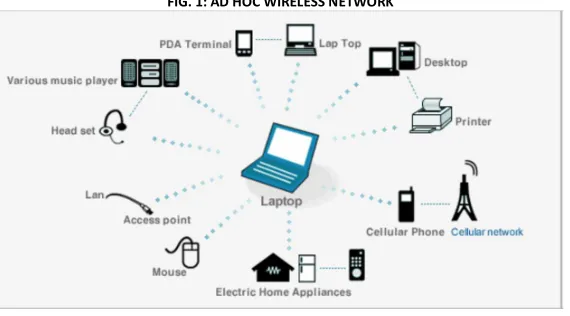
Ad hoc networks such as Bluetooth are networks designed to dynamically connect remote devices such as cell phones, laptops. These networks are termed “ad hoc” because of their shifting network topologies. Whereas WLANs use a fixed network infrastructure, ad hoc networks maintain random network configurations, relying on a master-slave system connected by wireless links to enable devices to communicate. In a Bluetooth network, the master of the piconet controls the changing network topologies of these networks. It also controls the flow of data between devices that are capable of supporting direct links to each other. As devices move about in an unpredictable fashion, these networks must be reconfigured on the fly to handle the dynamic topology. The routing that protocol Bluetooth employs allows the master to establish and maintain these shifting networks.
FIG. 1: AD HOC WIRELESS NETWORK
3. CHALLENGES OF WIRELESS NETWORK
Wireless devices need to be small and wireless networks are bandwidth limited, some of the key challenges in wireless networks are data rate, power Management, Security, Mobility ,Quality of Service (QoS) and Health Concern.
VOLUME NO.5(2015),ISSUE NO.12(DECEMBER) ISSN 2231-5756
A. DATA RATE
Improving the current data rates to support future high speed applications is essential, especially, if multimedia service are to be provided. Data rate is a function of various factors such as the data compression algorithm, interference mitigation through error-resilient coding, power control, and the data transfer protocol. Therefore, it is imperative that manufacturers implement a well thought out design that considers these factors in order to achieve higher data rates. Data compression plays a major role when multimedia applications are to be supported by a wireless network. Currently, compression standards such as MPEG-4 produce compression ratios of the order of 75 to 100. The challenge now is to improve these data compression algorithms to produce high quality audio and video even at these compression rates. A way to enhance the data rates would be to employ intelligent data transfer protocols that adapt to the time-varying network and traffic characteristics.
B. POWER MANAGEMENT
A mobile device is small in size and use to perform a certain set of functions; its power source may not be able to deliver power as much as the one installed in a fixed device. When a device is allowed to move freely, it would generally be hard to receive a continuous supply of power. To conserve energy, a mobile device should be able to operate in an effective and efficient manner. It should be able to transmit and receive in an intelligent manner so as to minimize the number of transmissions and receptions for certain communication operations.
C. SECURITY
Security is a big concern in wireless networking, especially in M-Commerce and E-Commerce applications. Current wireless networks contain authentication and data encryption techniques on the air interface to provide security to its users. The IEEE 801.11 standard describes wired equivalent privacy (WEP) that defines a method to authenticate users and encrypt data between the PC card and the wireless LAN access point. In large Business enterprises, an IP network level security solution could ensure that the corporate network and proprietary data are safe. Virtual private network (VPN) is an option to make access to fixed access networks reliable. Since hackers are getting smarter, it is imperative that wireless security features must be updated constantly.
D. MOBILITY
One of the primary advantages of wireless terminals is freedom of mobility. Therefore, system designs must accommodate handoff between transmission, boundaries and route traffic to mobile users. All devices in a wireless network are free to move. To support mobility, an ongoing connection should be kept alive as a user roams around. A mobile host moves from the coverage of a base station to that of another one. In an ad hoc network, the topology changes when a mobile host moves, means an ongoing data communication, the transmission route may need to be recomputed to, provide for the topological changes. Since an ad hoc network may consist of a large number of mobile hosts, this imposes a significant challenge on the design of an effective and efficient routing protocol that can work well in an environment with frequent topological changes.
E. QUALITY OF SERVICE (QoS)
Quality of Service is a measure of network performance that reflects the network's transmission quality and service availability. For each flow of network traffic, QoS can be characterized by four parameters: Reliability, Delay, Jitter, and Bandwidth.
There are several important and it arise because of wireless networks are inherently different from wireline networks. The characteristics of Wireless network include handoff, dynamic connections, and actuating transport QoS. In a wireline environment, the application layer can normally be assured that once a connection is established it will continue to exist until it is closed whereas, in a wireless environment, connections may temporarily break during a process termed handoff. It is unlikely that handoff can take place without at least a short connection interruption. Some applications may request a low interruption frequency so that the QoS perceived by the user remains satisfactory.
For example, an application may wish to guarantee that a voice connection will not be broken more than once per minute. A low interruption frequency implies that handoffs do not occur too often. It may be more desirable to have infrequent long breaks in a video connection, rather than frequent smaller breaks.
F. HEALTH CONCERN
The increasing popularity of wireless networks has raised a lot of concern regarding their impact on human health. The transmission power of cellular phone is typically higher than that of wireless system such as WLANs and PANs. A cellular phone is operated at close proximity to the human brain. When used for voice calls they emit radiation for entire duration of the call. A lot of time will have to pass before we possess such knowledge on health concerns regarding wireless network. Networks should be designed to minimize the power transmitted by network devices. For infrared (IR) WLAN systems, optical transmitters must be designed to prevent vision impairment.
4. CONCLUSION
In this paper describes the various challenges available in the wireless Network. We first presented an overview groups wireless network based on coverage range. Then We presented an overview of a challenges of the wireless network like Data rates, mobility, power management, security and the quality of service and health Concern of wireless networks .The popularity of wireless networks growing at a exponential rate, the data rate enhancements, minimizing size, cost, low power networking, user security and the best requirement to obtain the required QoS problems becomes more challenging. Wireless networks are rapidly becoming popular, and user demand for useful wireless applications is increasing.
REFERENCES
1. Chip Craig J. Mathias Principal, Farpoint Group COMNET 2003, Wireless Security: Critical Issues and Solutions, 29 January 2003
2. Gast, M. 802.11 Wireless Networks: The Definitive Guide Creating and Administering Wireless Networks, O’Reilley Publishing, April 2002.
3. Jim Kurose ―Open issues and challenges in providing quality of service in high-speed networks Computer Communication Review, 23(1):6-15, January 1993.
4. K. C. Chen, “Medium Access Control of Wireless LANs for Mobile Computing,” IEEE Network, vol. 8, no. 5, Sept. 1994, pp. 50–63.
5. R.O. LaMaire et al., “Wireless LANs and Mobile Networking: Standards and Future Directions,” IEEE Commun. Mag., vol. 34, no. 8, Aug. 1996,pp. 86–94.
6. Sandra Kay Miller ―Facing the Challenge of Wireless Security, July 2001
7. Wireless LAN Security. Symantec Corporation, 2002.
8. Wireless Network by P.Nicopolitidis, M.S. Obaidat,G.I. Papadimitriou sans A.S. Pomportsis , WILEY Publishing 2014
WEBSITE
VOLUME NO.5(2015),ISSUE NO.12(DECEMBER) ISSN 2231-5756
INTERNATIONAL JOURNAL OF RESEARCH IN COMMERCE, IT & MANAGEMENT
REQUEST FOR FEEDBACK
Dear Readers
At the very outset, International Journal of Research in Commerce, IT & Management (IJRCM) acknowledges
& appreciates your efforts in showing interest in our present issue under your kind perusal.
I would like to request you to supply your critical comments and suggestions about the material published
in this issue as well as on the journal as a whole, on our E-mail
for further
improvements in the interest of research.
If you have any queries, please feel free to contact us on our E-mail
.
I am sure that your feedback and deliberations would make future issues better – a result of our joint effort.
Looking forward an appropriate consideration.
With sincere regards
Thanking you profoundly
Academically yours
Sd/-
Co-ordinator
DISCLAIMER