VOLUME NO.6(2016),ISSUE NO.01(JANUARY) ISSN 2231-5756
A Monthly Double-Blind Peer Reviewed (Refereed/Juried) Open Access International e-Journal - Included in the International Serial Directories Indexed & Listed at:
VOLUME NO.6(2016),ISSUE NO.01(JANUARY) ISSN 2231-5756
INTERNATIONAL JOURNAL OF RESEARCH IN COMMERCE, IT & MANAGEMENT
CONTENTS
Sr.
No.
TITLE & NAME OF THE AUTHOR (S)
Page
No.
1
.
KNOWLEDGE SHARING AND THE PERFORMANCE OF TEACHERS IN KENYA
DR. DANIEL AUKA & ESTHER GATHONI KIARIE
1
2
.
A CRITICAL STUDY OF CONTRIBUTION OF INFORMATION TECHNOLOGY COMPANIES IN STANDARD
OF LIVING OF IT COMPANY EXECUTIVES IN VIDARBHA REGION
ABHAY KIMMATKAR & DR. SHAKIL SATTAR
10
3
.
ROLE OF AWH IN EMPOWERING THE DISABILITIES FOR HIGHER EDUCATION
DR. RASHMIRANI AGNIHOTRI H.R & DR. K.S MALIPATIL
12
4
.
CASH MANAGEMENT IN SMALL SCALE INDUSTRIES
P. VENKATADRI REDDY & DR. HAMPANNA
18
5
.
A STUDY OF HUMAN ASSET VALUATION MODELS IN INDIAN ENTERPRISES
DR. SAMIR M. VOHRA
24
6
.
AN INTUITIVE APPROACH OF SAVINGS AND INVESTMENT PATTERNS OF SELF HELP GROUP WOMEN
M.J.CECILIA SHOBANA & DR. V. K. SOMASUNDARAM
27
7
.
FREIGHT COST OPTIMISATION IN LOGISTICS WITH REFERENCE TO AMARA RAJA BATTERIES LTD.,
TIRUPATHI
C. UMADEVI & DR. P. CHITTI BABU
31
8
.
EFFECTS OF BRAND AWARENESS, BRAND AUGMENTATION ON BRAND PURCHASE INTENTION OF
MOBILE PHONE BRANDS: EMPIRICAL ASSESSMENT FROM KENYA
JOSPHINE CHEPCHIRCHIR & MARK LETING KIPRUTO
45
9
.
MANAGEMENT OF TECHNOLOGY IN BANKS
DR. NEERU CHADHA
50
10
.
B-LOYALTY TO E-LOYALTY IN THE CONTEXT OF E-COMMERCE
P.PHANI BHASKAR & DR. D. PRASANNA KUMAR
56
11
.
CORPORATE SOCIAL RESPONSIBILITY: BEFORE AND AFTER THE NEW COMPANIES ACT
DR. BINDIYA KANSAL & SHARANJIT KAUR
61
12
.
MOTIVATIONAL FACTORS: A STUDY ON WOMEN MICRO ENTREPRENEURS IN TIRUPUR CITY
K.PRABHA KUMARI
65
13
.
KNOWLEDGE PAPER ON SKILL GAP IN BANKING SECTOR IN INDIA
DINESH TANDON
73
14
.
HOUSING LOAN SCHEME: A STUDY ON ICICI HOUSING LOAN BENEFICIARIES IN TENKASI TALUK,
TAMILNADU
A. KENNEDY
76
15
.
PER-CAPITA CONSUMPTION EXPENDITURE AND LABOUR AND CAPITAL INCOME IN INDIA
DARSHINI.J.S
80
16
.
A STUDY OF THE RELATIONSHIP BETWEEN EMOTIONAL INTELLIGENCE AND THE PERFORMANCE: A
CASE STUDY OF MELLI BANK
MEHDI ROUHOLAMINI & SOUDEH KIAIEDRONKOLA
82
17
.
MODERN TECHNOLOGY IN BANKING AND ITS IMPACT ON JOB SATISFACTION
DHARMENDER KUMAR & KAMAL JEET SINGH
87
18
.
A STUDY OF INFRASTRUCTURE AND LOGISTIC SUPPLY PROBLEMS AT AWCs: IN RURAL ICDS BLOCK
(MEHAM) HARYANA
SONIA HOODA & JYOTI SANGWAN
91
19
.
ROLE OF MANUFACTURING SECTOR IN INDIA
KIRAN DEVI
94
20
.
IMPACT OF WORK LIFE BALANCE POLICIES ON THE JOB SATISFACTION OF FEMALE SCHOOL TEACHERS:
A STUDY OF CHITTORGARH DISTRICT, RAJASTHAN
SAHDEEP CHHATRAPATI
97
VOLUME NO.6(2016),ISSUE NO.01(JANUARY) ISSN 2231-5756
CHIEF PATRON
PROF. K. K. AGGARWAL
Chairman, Malaviya National Institute of Technology, Jaipur
(An institute of National Importance & fully funded by Ministry of Human Resource Development, Government of India)
Chancellor, K. R. Mangalam University, Gurgaon
Chancellor, Lingaya’s University, Faridabad
Founder Vice-Chancellor (1998-2008), Guru Gobind Singh Indraprastha University, Delhi
Ex. Pro Vice-Chancellor, Guru Jambheshwar University, Hisar
FOUNDER PATRON
LATE SH. RAM BHAJAN AGGARWAL
Former State Minister for Home & Tourism, Government of Haryana
Former Vice-President, Dadri Education Society, Charkhi Dadri
Former President, Chinar Syntex Ltd. (Textile Mills), Bhiwani
FORMER CO-ORDINATOR
DR. S. GARG
Faculty, Shree Ram Institute of Business & Management, Urjani
ADVISORS
PROF. M. S. SENAM RAJU
Director A. C. D., School of Management Studies, I.G.N.O.U., New Delhi
PROF. M. N. SHARMA
Chairman, M.B.A., Haryana College of Technology & Management, Kaithal
PROF. S. L. MAHANDRU
Principal (Retd.), Maharaja Agrasen College, Jagadhri
EDITOR
PROF. R. K. SHARMA
Professor, Bharti Vidyapeeth University Institute of Management & Research, New Delhi
CO-EDITOR
DR. BHAVET
Faculty, Shree Ram Institute of Engineering & Technology, Urjani
EDITORIAL ADVISORY BOARD
DR. RAJESH MODI
Faculty, Yanbu Industrial College, Kingdom of Saudi Arabia
PROF. SANJIV MITTAL
University School of Management Studies, Guru Gobind Singh I. P. University, Delhi
PROF. ANIL K. SAINI
Chairperson (CRC), Guru Gobind Singh I. P. University, Delhi
DR. SAMBHAVNA
VOLUME NO.6(2016),ISSUE NO.01(JANUARY) ISSN 2231-5756
INTERNATIONAL JOURNAL OF RESEARCH IN COMMERCE, IT & MANAGEMENT
DR. MOHENDER KUMAR GUPTA
Associate Professor, P. J. L. N. Government College, Faridabad
DR. SHIVAKUMAR DEENE
Asst. Professor, Dept. of Commerce, School of Business Studies, Central University of Karnataka, Gulbarga
ASSOCIATE EDITORS
PROF. NAWAB ALI KHAN
Department of Commerce, Aligarh Muslim University, Aligarh, U.P.
PROF. ABHAY BANSAL
Head, Department of I.T., Amity School of Engineering & Technology, Amity University, Noida
PROF. A. SURYANARAYANA
Department of Business Management, Osmania University, Hyderabad
PROF. V. SELVAM
SSL, VIT University, Vellore
DR. PARDEEP AHLAWAT
Associate Professor, Institute of Management Studies & Research, Maharshi Dayanand University, Rohtak
DR. S. TABASSUM SULTANA
Associate Professor, Department of Business Management, Matrusri Institute of P.G. Studies, Hyderabad
SURJEET SINGH
Asst. Professor, Department of Computer Science, G. M. N. (P.G.) College, Ambala Cantt.
FORMER TECHNICAL ADVISOR
AMITA
Faculty, Government M. S., Mohali
FINANCIAL ADVISORS
DICKIN GOYAL
Advocate & Tax Adviser, Panchkula
NEENA
Investment Consultant, Chambaghat, Solan, Himachal Pradesh
LEGAL ADVISORS
JITENDER S. CHAHAL
Advocate, Punjab & Haryana High Court, Chandigarh U.T.
CHANDER BHUSHAN SHARMA
Advocate & Consultant, District Courts, Yamunanagar at Jagadhri
SUPERINTENDENT
VOLUME NO.6(2016),ISSUE NO.01(JANUARY) ISSN 2231-5756
CALL FOR MANUSCRIPTS
We invite unpublished novel, original, empirical and high quality research work pertaining to recent developments & practices in the areas of Computer Science & Applications; Commerce; Business; Finance; Marketing; Human Resource Management; General Management; Banking; Economics; Tourism Administration & Management; Education; Law; Library & Information Science; Defence & Strategic Studies; Electronic Science; Corporate Governance; Industrial Relations; and emerging paradigms in allied subjects like Accounting; Accounting Information Systems; Accounting Theory & Practice; Auditing; Behavioral Accounting; Behavioral Economics; Corporate Finance; Cost Accounting; Econometrics; Economic Development; Economic History; Financial Institutions & Markets; Financial Services; Fiscal Policy; Government & Non Profit Accounting; Industrial Organization; International Economics & Trade; International Finance; Macro Economics; Micro Economics; Rural Economics; Co-operation; Demography: Development Planning; Development Studies; Applied Economics; Development Economics; Business Economics; Monetary Policy; Public Policy Economics; Real Estate; Regional Economics; Political Science; Continuing Education; Labour Welfare; Philosophy; Psychology; Sociology; Tax Accounting; Advertising & Promotion Management; Management Information Systems (MIS); Business Law; Public Responsibility & Ethics; Communication; Direct Marketing; E-Commerce; Global Business; Health Care Administration; Labour Relations & Human Resource Management; Marketing Research; Marketing Theory & Applications; Non-Profit Organizations; Office Administration/Management; Operations Research/Statistics; Organizational Behavior & Theory; Organizational Development; Production/Operations; International Relations; Human Rights & Duties; Public Administration; Population Studies; Purchasing/Materials Management; Retailing; Sales/Selling; Services; Small Business Entrepreneurship; Strategic Management Policy; Technology/Innovation; Tourism & Hospitality; Transportation Distribution; Algorithms; Artificial Intelligence; Compilers & Translation; Computer Aided Design (CAD); Computer Aided Manufacturing; Computer Graphics; Computer Organization & Architecture; Database Structures & Systems; Discrete Structures; Internet; Management Information Systems; Modeling & Simulation; Neural Systems/Neural Networks; Numerical Analysis/Scientific Computing; Object Oriented Programming; Operating Systems; Programming Languages; Robotics; Symbolic & Formal Logic; Web Design and emerging paradigms in allied subjects.
Anybody can submit the soft copy of unpublished novel; original; empirical and high quality research work/manuscript anytime in M.S. Word format after preparing the same as per our GUIDELINES FOR SUBMISSION; at our email address i.e. [email protected] or online by clicking the link online submission as given on our website (FOR ONLINE SUBMISSION, CLICK HERE).
GUIDELINES FOR SUBMISSION OF MANUSCRIPT
1. COVERING LETTER FOR SUBMISSION:
DATED: _____________
THE EDITOR
IJRCM
Subject: SUBMISSION OF MANUSCRIPT IN THE AREA OF .
(e.g. Finance/Mkt./HRM/General Mgt./Engineering/Economics/Computer/IT/ Education/Psychology/Law/Math/other, please specify)
DEAR SIR/MADAM
Please find my submission of manuscript entitled ‘___________________________________________’ for possible publication in one of your journals.
I hereby affirm that the contents of this manuscript are original. Furthermore, it has neither been published elsewhere in any language fully or partly, nor is it under review for publication elsewhere.
I affirm that all the co-authors of this manuscript have seen the submitted version of the manuscript and have agreed to their inclusion of names as co-authors.
Also, if my/our manuscript is accepted, I agree to comply with the formalities as given on the website of the journal. The Journal has discretion to publish our contribution in any of its journals.
NAME OF CORRESPONDING AUTHOR :
Designation :
Institution/College/University with full address & Pin Code :
Residential address with Pin Code :
Mobile Number (s) with country ISD code :
Is WhatsApp or Viber active on your above noted Mobile Number (Yes/No) :
Landline Number (s) with country ISD code :
E-mail Address :
Alternate E-mail Address :
VOLUME NO.6(2016),ISSUE NO.01(JANUARY) ISSN 2231-5756
INTERNATIONAL JOURNAL OF RESEARCH IN COMMERCE, IT & MANAGEMENT
NOTES:
a) The whole manuscript has to be in ONE MS WORD FILE only, which will start from the covering letter, inside the manuscript. pdf. version is liable to be rejected without any consideration.
b) The sender is required to mention the following in the SUBJECT COLUMN of the mail:
New Manuscript for Review in the area of (e.g. Finance/Marketing/HRM/General Mgt./Engineering/Economics/Computer/IT/ Education/Psychology/Law/Math/other, please specify)
c) There is no need to give any text in the body of mail, except the cases where the author wishes to give any specific message w.r.t. to the manuscript.
d) The total size of the file containing the manuscript is expected to be below 1000 KB.
e) Abstract alone will not be considered for review and the author is required to submit the complete manuscript in the first instance.
f) The journal gives acknowledgement w.r.t. the receipt of every email within twenty four hours and in case of non-receipt of acknowledgment from the journal, w.r.t. the submission of manuscript, within two days of submission, the corresponding author is required to demand for the same by sending a separate mail to the journal.
g) The author (s) name or details should not appear anywhere on the body of the manuscript, except the covering letter and the cover page of the manuscript, in the manner as mentioned in the guidelines.
2. MANUSCRIPT TITLE: The title of the paper should be bold typed, centeredand fully capitalised.
3. AUTHOR NAME (S) & AFFILIATIONS: Author (s) name, designation, affiliation (s), address, mobile/landline number (s), and email/alternate email address should be given underneath the title.
4. ACKNOWLEDGMENTS: Acknowledgements can be given to reviewers, guides, funding institutions, etc., if any.
5. ABSTRACT: Abstract should be in fully italicized text, ranging between 150 to 300 words. The abstract must be informative and explain the background, aims, methods, results & conclusion in a SINGLE PARA. Abbreviations must be mentioned in full.
6. KEYWORDS: Abstract must be followed by a list of keywords, subject to the maximum of five. These should be arranged in alphabetic order separated by commas and full stop at the end. All words of the keywords, including the first one should be in small letters, except special words e.g. name of the Countries, abbreviations.
7. JEL CODE: Provide the appropriate Journal of Economic Literature Classification System code (s). JEL codes are available at www.aeaweb.org/econlit/jelCodes.php, however, mentioning JEL Code is not mandatory.
8. MANUSCRIPT: Manuscript must be in BRITISH ENGLISH prepared on a standard A4 size PORTRAIT SETTING PAPER. It should be free from any errors i.e. grammatical, spelling or punctuation. It must be thoroughly edited at your end.
9. HEADINGS: All the headings must be bold-faced, aligned left and fully capitalised. Leave a blank line before each heading.
10. SUB-HEADINGS: All the sub-headings must be bold-faced, aligned left and fully capitalised.
11. MAIN TEXT:
THE MAIN TEXT SHOULD FOLLOW THE FOLLOWING SEQUENCE:
INTRODUCTION
REVIEW OF LITERATURE
NEED/IMPORTANCE OF THE STUDY
STATEMENT OF THE PROBLEM
OBJECTIVES
HYPOTHESIS (ES)
RESEARCH METHODOLOGY
RESULTS & DISCUSSION
FINDINGS
RECOMMENDATIONS/SUGGESTIONS
CONCLUSIONS
LIMITATIONS
SCOPE FOR FURTHER RESEARCH
REFERENCES
APPENDIX/ANNEXURE
VOLUME NO.6(2016),ISSUE NO.01(JANUARY) ISSN 2231-5756
12. FIGURES & TABLES: These should be simple, crystal CLEAR, centered, separately numbered & self explained, and titles must be above the table/figure. Sources of data should be mentioned below the table/figure. It should be ensured that the tables/figures are referred to from the main text.
13. EQUATIONS/FORMULAE: These should be consecutively numbered in parenthesis, horizontally centered with equation/formulae number placed at the right. The equation editor provided with standard versions of Microsoft Word should be utilised. If any other equation editor is utilised, author must confirm that these equations may be viewed and edited in versions of Microsoft Office that does not have the editor.
14. ACRONYMS: These should not be used in the abstract. The use of acronyms is elsewhere is acceptable. Acronyms should be defined on its first use in each section: Reserve Bank of India (RBI). Acronyms should be redefined on first use in subsequent sections.
15. REFERENCES: The list of all references should be alphabetically arranged. The author (s) should mention only the actually utilised references in the preparation of manuscript and they are supposed to follow Harvard Style of Referencing. Also check to make sure that everything that you are including in the reference section is duly cited in the paper. The author (s) are supposed to follow the references as per the following:
•
All works cited in the text (including sources for tables and figures) should be listed alphabetically.•
Use (ed.) for one editor, and (ed.s) for multiple editors.•
When listing two or more works by one author, use --- (20xx), such as after Kohl (1997), use --- (2001), etc, in chronologically ascending order.•
Indicate (opening and closing) page numbers for articles in journals and for chapters in books.•
The title of books and journals should be in italics. Double quotation marks are used for titles of journal articles, book chapters, dissertations, reports, working papers, unpublished material, etc.•
For titles in a language other than English, provide an English translation in parenthesis.•
Headers, footers, endnotes and footnotes should not be used in the document. However, you can mention short notes to elucidate some specific point, which may be placed in number orders after the references.PLEASE USE THE FOLLOWING FOR STYLE AND PUNCTUATION IN REFERENCES:
BOOKS
•
Bowersox, Donald J., Closs, David J., (1996), "Logistical Management." Tata McGraw, Hill, New Delhi.•
Hunker, H.L. and A.J. Wright (1963), "Factors of Industrial Location in Ohio" Ohio State University, Nigeria. CONTRIBUTIONS TO BOOKS•
Sharma T., Kwatra, G. (2008) Effectiveness of Social Advertising: A Study of Selected Campaigns, Corporate Social Responsibility, Edited by David Crowther & Nicholas Capaldi, Ashgate Research Companion to Corporate Social Responsibility, Chapter 15, pp 287-303.JOURNAL AND OTHER ARTICLES
•
Schemenner, R.W., Huber, J.C. and Cook, R.L. (1987), "Geographic Differences and the Location of New Manufacturing Facilities," Journal of Urban Economics, Vol. 21, No. 1, pp. 83-104.CONFERENCE PAPERS
•
Garg, Sambhav (2011): "Business Ethics" Paper presented at the Annual International Conference for the All India Management Association, New Delhi, India, 19–23UNPUBLISHED DISSERTATIONS
•
Kumar S. (2011): "Customer Value: A Comparative Study of Rural and Urban Customers," Thesis, Kurukshetra University, Kurukshetra. ONLINE RESOURCES•
Always indicate the date that the source was accessed, as online resources are frequently updated or removed. WEBSITESVOLUME NO.6(2016),ISSUE NO.01(JANUARY) ISSN 2231-5756
INTERNATIONAL JOURNAL OF RESEARCH IN COMMERCE, IT & MANAGEMENT
A STUDY OF THE RELATIONSHIP BETWEEN EMOTIONAL INTELLIGENCE AND THE PERFORMANCE: A CASE
STUDY OF MELLI BANK
MEHDI ROUHOLAMINI
ASST. PROFESSOR
DEPARTMENT OF BUSINESS MANAGEMENT
BABOL BRANCH
ISLAMIC AZAD UNIVERSITY
BABOL
SOUDEH KIAIEDRONKOLA
STUDENT
DEPARTMENT OF MANAGEMENT
BABOL BRANCH
ISLAMIC AZAD UNIVERSITY
BABOL
ABSTRACT
The main objective of this research is to identify the relationship between emotional intelligence and the performance of the managers in Mazandaran province's Melli (national) banks. The research method, depending on the nature of the research , has been a description of the type of correlation .The statistical group in this study contained the senior managers of all branches of Iranian Melli banks all around the Mazandaran state (146 individuals ) among which 108 managers were selected as a sample group through Kerjesy and Morgan tables and simple random sampling method .The process of information gathering was performed by using both the Shiring's questionnaire of emotional intelligence and Golafshany's questionnaire of job performance .The results of this research revealed that there is a meaningful and positive relationship between emotional intelligence and also its all five divisions including : self-awareness ,self-control ,self-motivation ,empathy , social skills and the managers' performance in the branches of Mazandaran'sMelli bank .The results of regression analysis for this study also showed that all factors ,as predictive agents , can explain the criterion variable that is the managers' performance .
KEYWORDS
emotional intelligence, performance of managers, Melli bank of Mazandaran province.
1. INTRODUCTION
ne of the key factors in organizations is having capable managers and human resources. By employing efficient human capitals, organizations make attempts to increase their efficiency and effectiveness. In recent years the role of human resources has been paid more attention than other resources of the incorporation and the researchers seek to study agents and factors which cause rise in the efficiency of human resources. One of these factors is the emotional intelligence. (Shooshtarian, et all, 2009)
Emotional intelligence extracted from the concept of social intelligence, first introduced by Sorendic in 1920. He defined emotional intelligence as the capability in understanding and directing people so as to act wisely in social communications. Salovi and Mayer defined it as people's ability in understanding and controlling their feelings and emotions as well as in their recognition of other people's feelings in order to lead their thought and actions. In 1993, Gardner stated about emotional intelligence to be consisted of two internal and external alternatives. Internal intelligence refers to the people's power to control themselves, and is related to a complicated set of individual feelings and external intelligence refers to people's ability in guiding and controlling other people's behavior and caring about or distinguishing individuals based on recognition of their traits and feelings. Baron (2000) defined emotional intelligence to be a set of knowledge and emotional, social capabilities of people that affect effectively their general ability in response to environmental needs.
2. THE PROBLEM STATEMENT
Emotional intelligence extracted from the concept of social intelligence, first introduced by Sorendic in 1920. He defined emotional intelligence as the capability in understanding and directing people so as to act wisely in social communications. Salovi and Mayer defined it as people's ability in understanding and controlling their feelings and emotions as well as in their recognition of other people's feelings in order to lead their thought and actions. In 1993, Gardner stated about emotional intelligence to be consisted of two internal and external alternatives. Internal intelligence refers to a people's power to control themselves and is related to a complicated set of individual feelings and external intelligence refers to people's ability in guiding and controlling other people's behavior and caring about or distinguishing individuals based on recognition of their traits and feelings. Baron (2000) defined emotional intelligence to be a set of knowledge and emotional, social capabilities of people that affect effectively their general ability in response to environmental needs.
Managers should coordinate their staff with the pace of changes .this fact indicates the importance of leadership .A simple influential leader can help the organization flexible rather than a manager who tries to achieve this goal relying on some particular techniques and spending much more time .The significant point is the fact that the reasoning along with emotion has more power and value .Leaders who possess high emotional intelligence always consider this fact to justify their decisions to people .researches have made it clear that emotions are the activating energy for moral values such as confidence ,strength of character, empathy, honesty, flexibility, and also requirement for social capitals that is the ability to create and maintain beneficial, reliable business relationships. (Sarfarazi and Memarzadem, 2010). Management is at the present time an impressive topic to discuss. Peter Draker points out that managers are the main and rare resources of every kind of organizations. (cited in Nasirypur ,et all 2011). The results of recent studies over two decades have showed that emotional intelligence skills are considered the major factor influencing the managers' leadership and job situations (Babaee and Momeni, 2010). Emotional intelligence could be defined as applying the personal capabilities of yours and others in individual and group behavior to attain the maximum result .(Aqayar and SharifiDaramady, 2007). Emotional intelligence is useful for all organizational levels. But for management level, it’s a vital component. The managers with high capability of emotional intelligence show a constructive , efficient treatment of others , make use of their positive feelings and emotions in decision making ,and have better performance in the workplace .They also confronting stressful situations and psychological problems dominate themselves ,are less likely to get irritated ,depressed or leave work and try to achieve their ideal aim .Low emotional intelligence in the working area , undoubtedly can have a damaging effect on the ultimate results and if continues, it can lead in the organization collapse. (NasiriPur, et al, 2011)
The topic emotional intelligence is a new subject in the field of psychology which has recently entered into the field of management. In a few past years many books, articles, researches have been published about it. Most of these studies confirm the fact that emotional intelligence as a decisive factor of people's success, has a special place in their lives. Emotional intelligence is the same as managing emotions of yourself and others. (Aqayar and SharifiDaramady, 2006). Emotional
VOLUME NO.6(2016),ISSUE NO.01(JANUARY) ISSN 2231-5756
intelligence plays an important role in the work environment. According to the researchers of emotional intelligence, it can have an effect on the managers' activities regarding the results related to the job, colleagues, external organizations, consequently their efficiency. Recent researches have revealed that the managers with high emotional intelligence create positive job attitudes , altruistic behavior which causes the employees experience job satisfaction and high performance .As a result managers themselves will have more positive performance and efficiency .The managers with high emotional intelligence facilitate the staff's performance by managing the both sides' emotions through which they foster the employees' creativity ,flexibility , confidence and make them capable of doing .So they can take efficient steps toward the organization's objectives. (Safary and Abedi, 2012).
Naturally, taking the subject of emotional intelligence into account studying its relationship and that of its various dimensions with the managers' performance can illuminate, although a small part of this topic and give a clear understanding of it and add information although limited about the topic to the managers' current theoretical knowledge of emotional intelligence. (the importance of this research in the science world). Additionally, studying and identifying the relationship between emotional intelligence and the managers' performance while finding present weaknesses, we can find solutions to improve the present situation and upgrade the existing policies to make the managers control their feelings and increase the emotional intelligence skills. Consequently, we can improve performance level of managers of Melli bank. (importance of this research in the world of practice).
Based on the importance of the managers' performance in upgrading the efficiency of the organization and of course the significant role of emotional intelligence in obtaining this aim , the researcher tries to find an answer to the basic question if there's a positive ,meaningful relationship between the emotional intelligence of Mazandaran Melli bank's managers and their performance .Here ,the researcher also seeks to assess the relationship between its different components and elements with the managers' performance.
3. LITERATURE REVIEW
Hashemi, et all, (2013) in their research studied the relationship between emotional intelligence and the performance of traffic managers of Tehran city. For this, they selected 45 traffic managers of Tehran as a sample group. Findings showed that there is no meaningful relationship between demographic features and the dimensions of emotional intelligence, but there is a positive, meaningful relationship between dimensions of emotional intelligence (self-control, self-awareness, self -motivation, social consciousness, and social skills) and the performance of the traffic managers.
Safari and Abedi (2012) in a research they studied the correlation between the emotional intelligence, cognitive intelligence, its five levels and the job performance of school managers of three educational grades in the region high schools of the given region were selected as a sample group. Research findings revealed that based on the scores of emotional and cognitive intelligence we can predict 17 percent of job performance. There was a meaningful correlation between emotional, cognitive intelligence and the performance of managers, but there wasn't such a correlation between the cognitive intelligence and the job performance. Between cognitive intelligence and emotional one there was a positive meaningful correlation. These results are the indicative of the importance of emotional intelligence in school management.
Arab, et all (2011) in a study , investigated the rate of managers' emotional intelligence and its relationship with their performance in the private and governmental selected hospitals of Tehran .Their research community consisted of all senior and middle managers of the private and governmental hospitals affiliated to medical science universities of Tehran ,Iran and Shahid Beheshti among which 120 individuals were selected as a sample group .The research findings showed that there has been a relationship between the managers 'emotional intelligence and performance . Among the different dimensions of emotional intelligence, social skills held the highest rate (60 percent) and self-motivation held the lowest rate (50 percent) and the rate of managers' total emotional intelligence was 56 percent.
NasiriPur, et all (2011) in a research studied the relationship between the emotional intelligence and the managers' stress and performance in the ministry of health, treatment and medical education by means of path analysis Their sample research group contained 100 staff managers of the ministry of health who were selected through cluster sampling method .The results showed that of the managers under study there was a meaningful relationship between emotional intelligence and stress ,stress and the performance ,emotional intelligence and performance .Based on the regression test ,the relationship between performance and emotional intelligence and stress was statistically meaningful .In fact emotional intelligence directly and indirectly had an effect on (by reducing stress ) on the performance and stress has acted as an interface agent .
Sarafrazi and Memarzade (2010) in a research studied the influence of emotional intelligence on improving the quality of the managers' performance in the medical science university of Fars province .All the managers including 100 individuals were selected as a sample group through Census method .Findings revealed that there was a meaningful relationship between the emotional intelligence and the quality of the managers 'performance .They also were indicative of this fact that emotional intelligence brought about improvement in the managers' performance . The emotional intelligence caused increase in people's power of individual and group work, easy decision making, improvement in their communication with others, increase in their creativity for solving problems and conflicts and increase in skills for group work.
Soleimani and Alibeygi (2009) in a research studied the relationship between the managers' emotional intelligence in training groups and their self –efficacy in the branches of Azad university of the country's region 10 .Their research statistical community covered all the managers of the university's training groups ,115 individuals , out of which 83 managers were selected as a sample group by the stratified random method .The findings showed that between the managers' emotional intelligence and their self- efficacy ,there was a meaningful relationship .And also between the components of managers' motivation, empathy and their efficacy , there was a meaningful relationship but between the components of the managers' awareness ,control , social skills and their self-efficacy, no relationship was observed . The results for regression analysis also showed that among the components of emotional intelligence, the component motivation was a meaningful, predictive agent for self-efficacy.
Raeisi, et all (2005) did a research titled ;the relationship between the emotional intelligence and the managers' performance in the training hospitals of Kermansha .Their research community consisted of 60 managers of different management levels in Kermansha's training hospitals ,all of whom were selected as a sample group .The research findings showed that the managers' skills in the components relationship management and self-management were the strongest and the weakest components of emotional intelligence respectively . The rates of managers’ skills in the components awareness, social awareness and self-motivation were put in the second, third and fourth place respectively. The results also revealed that there was a positive meaningful relationship between the managers' emotional intelligence and their job performance. In addition to that between each of the five dimensions of emotional intelligence and the managers' performance, positive meaningful relationships were observed.
Anbazhagan and Nagarajan (2014) in a research studied the relationship between the emotional intelligence and the employees' job performance in the treadmill factory of Tamilnadu state, India. To do that, 450 employees of the given industry were selected through stratified sampling method. The results showed that between the emotional intelligence and all of its dimensions and the job performance, also all of its dimensions and aspects in the employees, there were positive, meaningful relationships.
Irshad, et all (2014) studied the influence of the managers' emotional intelligence on the employees' performance using the mediator variable of the leadership process .Their research statistical community contained managers'.
The employees of the public service section in Pakistan. The results showed that all dimensions of the emotional intelligence except for thought facilitation had an indirect impact on the employees' performance by means of the mediator variable of the managers' leadership process.
The results of Stage and Lee's research (2003) have shown that the emotional intelligence compared to personality traits and intelligence quotient, makes more and better predictions of the job performance. The results also indicated that the emotion management and control have a positive, meaningful relationship with the employees' performance.
VOLUME NO.6(2016),ISSUE NO.01(JANUARY) ISSN 2231-5756
INTERNATIONAL JOURNAL OF RESEARCH IN COMMERCE, IT & MANAGEMENT
HYPOTHESES
H1 : There is a meaningful relationship between the emotional intelligence and the managers' performance H1a : There is a meaningful relationship between the managers' self-awareness and their performance H1b : There is a meaningful relationship between the managers' self-control and their performance H1c : There is a meaningful relationship between the managers' self-motivation and their performance H1d : There is a meaningful relationship between the managers' empathy and their performance H1e : There is a meaningful relationship between the managers' social skills and their performance.
4. THE RESEARCH METHOD
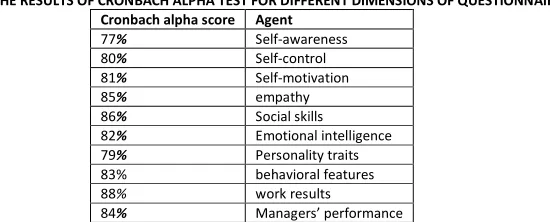
The research method, depending on the nature of the research , has been a description of the type of correlation .The statistical group in this study contained the senior managers of all branches of Iranian Melli banks all around the Mazandaran state (146 individuals ) among which 108 managers were selected as a sample group through Kerjesy and Morgan tables and simple random sampling method .The questionnaire of emotional intelligence was completed by the managers themselves and the questionnaire of managers' performance assessment was replied by 108 employees of these managers . For data collection, in this study we made use of library and field methods. In the field method we applied two Shiring's questionnaire of emotional intelligence containing 33 questions on the five components (self- awareness, self-management, self-motivation, social awareness, relationship management). The answer choices were based on the degree and order (always, often, sometimes, hardly ever, never). The second questionnaire was the one created by the researcher about the managers' performance including 30 questions with the Likert's five choices (strongly disagree, disagree, have no idea, agree, strongly agree) which the scores of 1 to 5 are assigned respectively. Cronbach alpha score of items in both questionnaires is given in table 1, separately.
TABLE 1: THE RESULTS OF CRONBACH ALPHA TEST FOR DIFFERENT DIMENSIONS OF QUESTIONNAIRES Agent
Cronbach alpha score
Self-awareness 77% Self-control 80% Self-motivation 81% empathy 85% Social skills 86% Emotional intelligence 82% Personality traits 79% behavioral features 83% work results 88% Managers’ performance 84%
For data analysis we used descriptive statistical indicators such as frequency, percentage, frequency distribution tables, mean, standard deviation .in inferential statistics, based on the rating quality of data, we applied the K-S test and due to normal distribution of data we used Pierson correlation test and then step by step regression with the help of the software SPSS.
5. THE ANALYSIS OF DATA AND RESEARCH FINDINGS
The results driven from the analysis of respondents' demographic information showed that all of managers and most of employees were males. most of the managers was more than 40 years old. About more than half of employees under study were more than 35 years old. Around half of managers and employees had B.A. degrees and a few of them had the high school diplomas. The number of individuals with higher educational degrees (M.A. degree and higher ) for managers was nearly a quarter but for the employees was very low .Almost all of managers had experiences of more than 20 years but about the employees the results showed that most of them had experiences below 20 years.
TABLE 2: STATUS OF EMOTIONAL INTELLIGENCE STATEMENTS IN RESPONDENTS
row Parameters Mean Standard deviation 1 Self-awareness
84/2 63%
2 Self-control
40/3 54%
3 Self-motivation
38/3 68%
4 empathy
05/3 57%
5 Social skills
41/3 69%
6 Emotional intelligence 20/3
51%
As it can be seen in table 2 the respondents have evaluated their emotional intelligence above the average. The spectrum of obtained averages extends from 2/84 for; self-awareness; to 3/41 for; social skills.
TABLE 3: THE STATUS OF THE MANAGERS' PERFORMANCE
Row Parameters Mean Standard Deviation 1 Personality traits
89/3 72%
2 Behavioral features 72/3
65%
3 Work results
93/3 62%
4 Managers' performance 84/3
68%
As the data inserted in the table 3 shows ,the respondents have evaluated the status of the managers' performance above the average and somewhat good. Among the three variables examined ,the work results with the average of 3/93 has gained the highest mean .personality traits with the average of 3/89 is in the second place and finally the behavioral features with the average of 3/72 stands in the last place.
The results driven from the analysis of dimensions of the managers' performance questionnaire also showed that the employees under study evaluated the status of their managers' performance in all of the three dimensions, that is, personality traits, behavioral features and work results, above the average and to a degree good.
TABLE 4: THE RESULTS OF RESEARCH HYPOTHESES TEST
Hypothesis Correlation coefficient P.Value Test result main 825% 00%
Rejection of zero hypothesis
H1a 724%
00%
Rejection of zero hypothesis
H1b 595%
00%
Rejection of zero hypothesis
H1c 668%
00%
Rejection of zero hypothesis
H1d 775%
00%
Rejection of zero hypothesis
H1e 756%
00%
VOLUME NO.6(2016),ISSUE NO.01(JANUARY) ISSN 2231-5756
The results of the research hypotheses test showed that between the emotional intelligence and its dimensions and the performance of Melli bank's managers, there was a positive meaningful relationship .Therefor in all cases ,the rejected zero hypothesis and the contrary hypothesis or the research hypothesis have been proved.
Based on the correlations between all the agents of emotional intelligence , the step by step regression was taken from the predictive variables correlative to the criterion variable , that is ,the managers' performance whose results are given below.
To determine the multiple correlation coefficient between variables , all the predictive variables were put in the multi-variable regression equation by the step by step method .The regression model recognized all the agents as predictive agents in the managers' performance.
TABLE 5: THE BRIEF REGRESSION MODEL
ROW MODEL
R R2 MODIFIED R2
1 EMPATHY 775% 601% 598% 2 SELF-AWARENESS 803% 645% 638% 3 SOCIAL SKILLS 826% 683% 673% 4 SELF-MOTIVATION 835% 697% 686% 5 SELF-CONTROL 831% 690% 681%
For the first agent ;empathy; the multiple correlation coefficient (R ) equals %775 and the square of the modified multiple correlation coefficient (R2) is %598 which shows 59/8 percent of the variance of the managers' performance can be explained by this agent . When the second agent ;self-awareness ; comes ,the multiple correlation coefficient (R ) becomes %803 and the square of the modified multiple correlation coefficient (R2) equals %638 which shows 63/8 percent of variance of the managers' performance can be explained by these two agents .With the arrival of the third agent ; social skills ; the multiple correlation coefficient (R ) is %826 and the square of the modified multiple correlation coefficient ( R2 ) equals %673 which shows 67/3 percent of the variance of the managers' performance can be explained by these three agents .When the fourth agent ; self- motivation ; comes , the multiple correlation coefficient ( R ) becomes %835 and the square of the modified multiple correlation coefficient ( R2 ) equals %686 which shows 68/6 percent of the variance of the managers' performance can be explained by these four agents .Ultimately with the arrival of the fifth agent ; self-control ; the multiple correlation coefficient (R) is %831 and the square of the modified multiple correlation coefficient ( R2) becomes %681 which shows 68/1 percent of the variance of the managers' performance can be explained by the sum of these agents.
TABLE 6: THE MEANINGFULNESS TABLE OF THE MODEL
ROW MODEL TOTAL SQUARES FREEDOM DEGREES F P 1 EMPATHY
738/15367 1
904/159 00%
2 SELF-AWARENESS 522/16479
2 331/95 00%
3 SOCIAL SKILLS 992/1744
3 529/74 00%
4 SELF-MOTIVATION 539/17822
4 351/59 00%
5 SELF-CONTROL 702/17626
5 073/77 00%
To determine the meaningfulness of the regression , we made one-agent variance analysis (ANOVA ) .Based on the score of meaningfulness level (%00 ) which is smaller than its critical value %05, it can be concluded that the resultant regression is meaningful for all the assumed agents.
TABLE 7: REGRESSION COEFFICIENTS
VARIABLE COEFFICIENT B
STANDARD DEVIATION B BETA COEFFICIENT
t MEANINGFULNESS LEVEL t
FIXED NUMBER 410/35
962/4
---
137/7 00%
EMPATHY 156/3
250/0 775/0
645/12 00%
SELF-AWARENESS 839/0
234/0 319/0
586/3 001%
SOCIAL SKILLS 367/1
389/0 342/0
513/3 001%
SELF-MOTIVATION 619/0
275/0 174/0
251/2 026%
SELF-CONTROL 754/0
264/0 212/0
854/2 005%
The regression coefficients shows that the agent; empathy; with the beta coefficient of %775 could explain 77/5 percent of variance of the criterion variable, the agent; self-awareness; with the beta coefficient of %319 could explain by itself 31/9 percent of the variance of the criterion variable, the agent; social skills; with the beta coefficient of %342 could explain by itself 34/2 percent of the variance of the criterion variable, the agent; self-motivation; with the beta coefficient of %174 could explain by itself 17/4 percent of the variance of the criterion variable and the agent; self-control; with the beta coefficient of %212 could explain by itself 21/2 percent of the variance of the criterion variable.
6. DISCUSSION AND CONCLUSION
The results of the research main hypothesis showed that there was a positive, meaningful relationship between the emotional intelligence and the managers' performance in the Melli banks of Mazandaran province. The findings of the present research correspond with the findings of researches by Hashemi, et all (2013), Safari and Abedi (2012), Heydarifar ,et all (2011 ), Arab, et all (2011 ), Nasiripur met all (2011), Rad, et all (2010), Sarafrazi and Memarzade (2010), Golparvar and Khaksar (2010), Shooshtarian, et all (2009), Reisi, et all (2005), Stage and Lee (2003) , Vangh and Lav (2002) . They, in their researches have achieved the results as well that there is a positive meaningful relationship between the emotional intelligence and the managers and the employees' performances. The results of the research's first hypothesis(H1a) test revealed that there was a positive ,meaningful relationship between the self-awareness and the performances of the managers under study .The findings of researches done by Hashemi ,et all (2013 ) , Safari and Abedi (2012 ) , Heydari far ,et all (2011 ), Shariatmadari and Darande (2011 ) , Soleimani and Alibeigi ( 2009 ) , Reisi , et all (2005 ) confirms the findings of this research . They also in their studies concluded that there was a positive, meaningful relationship between self-awareness and the performances of managers and employees.
The results of the research's second hypothesis(H1b) test showed that there was a positive, meaningful relationship between self-control and the managers' performances in the Melli banks of Mazandaran province. The findings of the present research were consistent with the findings of researches by Hashemi ,et all (2013 ) , Safari and Abedi (2012 ) , Heydari far ,et all (2011 ) , Shariatmadari and Darande (2011 ) and Reiei ,et all (2005 ) .They also in their researches got the conclusion that between self-control and the performances of the managers and employees ,there was a positive ,meaningful relationship . However the findings of Soleimani and Alibeygi's research (2009 ) showed no relationship between the self-control and the managers 'effectiveness .
The results of the research's third hypothesis(H1c) test also shows that between the self-motivation and the performances of the managers under study ,there was a meaningful relationship .The findings of this research matched up the findings of researches by Hashemi ,et all (2013 ) , Safari and Abedi (2012 ) , Shariatmadari and Darande (2011 ) , Soleymani and Alibeygi (2009 ) and Reisi ,et all (2005 ) .Because they also in their researches concluded that there was a positive ,meaningful relationship between the managers and employees' self-motivation and their performances .
The results of the research's fourth hypothesis (H1d) test showed that between the empathy and the managers' performances in the Melli banks of Mazandaran province, there was a positive, meaningful relationship. . The findings of the present research corresponded with the findings of the researches by Hashemi ,et all (2013 ) , Safari and Abedi (2012 ) , Shariatmadari and Darande (2011 ) , Soleymani and Alibeygi , Reisi ,et all (2005 ) . They also in their researches found out that there was a positive, meaningful relationship between the managers 'empathy and their performances.
VOLUME NO.6(2016),ISSUE NO.01(JANUARY) ISSN 2231-5756
INTERNATIONAL JOURNAL OF RESEARCH IN COMMERCE, IT & MANAGEMENT
and Darande (2011 ) , Reisi ,et all (2005 ) . They also in their researches concluded that between the managers' social skills and their performances, there was a positive, meaningful relationship. However the findings of Soleimani and Alibeygi's research (2009) showed that there was no relationship between the managers' social skills and their effectiveness.
Based on the confirmation of the present research's findings by the findings of similar researches , we can conclude that strengthening the managers' emotional intelligence and paying attention to these capabilities can play an impressive and important role in increasing their efficiency and productivity and also have a direct influence on their performances .
According to the research findings ,seemingly an increase in the Melli bank managers' skills of emotional intelligence can lead in their more recognition of their own features and personality traits ,emotion management and self-control ,empathy with others and getting along with different traits ,dedication to work and giving services ,understanding the personal differences, having transparent relationship with others and eagerness to group work . Naturally, any individual with these characteristics can perform the tasks with more motivation and energy, consequently show better performance .This fact has been proven through this research and other similar studies .A person with emotional intelligence that can monitor his or her behaviors, communicate with people around easily and off course people admit them pleasingly.
The managers with high capability of emotional intelligence show a constructive , efficient treatment of others , make use of their positive feelings and emotions in decision making ,and have better performance in the workplace .They also confronting stressful situations and psychological problems dominate themselves, are less likely to get irritated ,depressed or leave work and try to achieve their ideal aim .Low emotional intelligence in the working area , undoubtedly can have a damaging effect on the ultimate results and if continues ,it can lead in the organization collapse .( NasiriPur , et all ,2011) .
7. SUGGESTION
Based on the studies and the research hypotheses test and the confirmation of the relationship between the emotional intelligence and the managers' performance, the following suggestions are proposed.
1. Appointing managers with high emotional intelligence to the management section of the bank branches 2. Holding workshops and different training classes to upgrade the managers and employees' emotional intelligence
3. planing certain courses relevant to emotional intelligence in universities for preparing managers and employees with high emotional intelligence. 4. Encouraging successful managers by bank officials to increase their self-confidence and strengthen managers' self-awareness and self-motivation 5. Holding consultation classes for managers and employees to increase their empathy
6. Holding cultural and sport classes to increase cheerfulness and create a friendly atmosphere for managers and employees 7. Teaching social and communicational skills to the managers through workshops.
REFERENCES
1. Abbas Zadegan, Mohammad and Mahoozhan, Armen (1996). Organizational Behavior of "Contingency Approach". Tehran: Allameh Tabatabai University. 2. Aghayar, Sirus and Sharifi Daramadi, Parviz (2007). Organizational Emotional Intelligence: Application of Emotional Intelligence in Workplace, Learning,
Communications, Motivation, Organizational leadership and Psychic patients. Isfahan: Sepahan.
3. Anbazhagan, A. & Nagarajan, S. K. (2014). A study on relationship between emotional intelligence and work performance among the Traedmill employees with reference to tirunelveli district Tamil Nadu. International Journal of Business and Management Invention, 3 (2), 30-34.
4. Arab, Mohammad and Colleagues (2010). Studying the Emotional Intelligence Rate of Managers and its relation with their Performance in Tehran City's Selected Private and State Hospitals. Hospital Quarterly, 10 (2), p.1-7.
5. Babi, Mohsen and Momeni, Nader (2010). Emotional Intelligence and its Effect on Performance of Managers. Management Policy Journal, p. 12, 25-34 6. Barrick, M. R., Stewart. G.L. Piotriwki, M. (2002). Personality and job performance: Test of the mediating effects of motivation among sales representatives.
Journal of Applied Psychology, 87 (1), 1-9.
7. Chan, D. W. (2002). Stress, self-efficacy, social support and psychological distress among prospective teachers in Hong Kong. Educational Psychology, 22, 557-569.
8. Fazli, Safar and Azar, Adel (2002). Designing Mathematical Model of Evaluating the Manager's Performance Using Data Envelopment Analysis (DEA). Modarres Journal, 6 (3), p.99-134.
9. Gardner, H. (1993). Multiple intelligence: The theory in practice. New York: Basic Books. 10. Golman, D. (1996). Emotional intelligence. London: Bloomsbury.
11. Golman, D. (1998). Working with emotional intelligence. London: Bloomsbury.
12. Hashemi, Nezam; Sadeghi, Mohammad SADEGH; Shakib, Mehdi and Ghanbari, Ali (2012). Relation of Emotional Intelligence with the Performance of Managers of Tehran's Traffic. Journal of Management on Disciplinary Education Studies, 6 (3), p. 67-93.
13. Hersey, P. & Blanchard, K. (1993). Management of organizational behavior. New Jersey: Prentice Hall.
14. Irshad, R., Hashmi, M. S., Arshad, S. & Akram, S. (2014). Does managers emotional intelligence impact employees performance? Assessing mediating role of transformational leadership. Journal of Basic and Applied Scientific Research, 4 (5), 6-12.
15. Martinez, M. N. (1997). The smart that count. HR Magazine, 42 (11), 72-78.
16. Moss, F. A., Hunt, T., Omwake, K. T & Bonning, M. H. (1927). Social intelligence test. Washington DC: Center for Psychological Service.
17. Nasiri Poor, Amir Ashkan; Raisi, Pooran and Kazemini, Nasim (2011). Relation between Emotional Intelligence with Stress and Performance of Health, Treatment and Medicine Education Ministry Headquarters' Managers Using Path Analysis. Medicine and Purification Journal, 20 94), p.7-15.
18. Raisi, Puran; Nasiri poor, Amir Ashkan and Karami, Shirzad (2000). Relation of Emotional Intelligence with the Performance of Managers of Kemanshah's Educational Hospitals. Health Management Scientific- Research Quarterly, 8 (22), p.47-75.
19. Sadeghi Shahmirzadi, Fatemeh (2004). Comparing Family and Personality Characteristics of Students with Exceptional Talents (NODET) with Average Students, M.A Thesis, Educational Management Course, Azad Islamic University, Sari Unit.
20. Safarazi, Mehrzad and Memar Zadeh, Gholam Reza (2010). Studying the effect of Emotional Intelligence on improvement of Managers' Performance Quality: Case Study of Medical Science University of Fars Province. Research Journal of Management of Emotional Intelligence, 64, 59- 120.
21. Safari, Yad Allah and Abedi, Ahmad (2012). Correlation between Emotional Intelligence, Cognitive Intelligence and its Five Fold Level with Professional Performance of Three in three course's time in Lahijan, Isfahan. Modern Educational Approaches Journal, 2(7), p.121- 140.
22. Seyed Javadin, Reza and Moshfegh, Mehdi (2008). Studying the effect of evaluating the Staff on Performance Improvement in University. Case Study pf Imam Sadegh University. Management thought Journal, 2(2), p. 95-122.
23. Shariatmadari,Ali (1993).Educational Psychology. Tehran: Amir Kabir Publication.
24. Shushtarian, Zakieh; Ameli, Fatemeh and Amin Lari, Mahmood (2009). Studying of the effect of Emotional Intelligence on Attitude and Professional Performance of Work force. Healthy Work Quarterly, 2(7), p. 47-57.
25. Soleimani, Nader and Ali Beigi, Farzaneh (2009). Studying the relation of Emotional Intelligence of Educational Group's Managers with their Self- efficiency at Country's 10th region Azad Islamic University Units. Educational Leadership and Management Quarterly, Azad Islamic University, Garmsar Unit, 3(4),
p.137-154.
26. Stage, M. & Lee, J. (2003). The relationship among emotional intelligence, task performance and organizational citizenship. Human Performance Journal, 19 (4), 403-419.
VOLUME NO.6(2016),ISSUE NO.01(JANUARY) ISSN 2231-5756
REQUEST FOR FEEDBACK
Dear Readers
At the very outset, International Journal of Research in Commerce, IT & Management (IJRCM) acknowledges
& appreciates your efforts in showing interest in our present issue under your kind perusal.
I would like to request you to supply your critical comments and suggestions about the material published
in this issue as well as on the journal as a whole, on our E-mail
for further
improvements in the interest of research.
If you have any queries, please feel free to contact us on our E-mail
.
I am sure that your feedback and deliberations would make future issues better – a result of our joint effort.
Looking forward an appropriate consideration.
With sincere regards
Thanking you profoundly
Academically yours
Sd/-
Co-ordinator
DISCLAIMER
VOLUME NO.6(2016),ISSUE NO.01(JANUARY) ISSN 2231-5756