*Corresponding author: Sigmundo Preissler Junior ISSN: 0976-3031
Research Article
KNOWLEDGE ENGINEERING AND MANAGEMENT CONTRIBUTIONS FOR SCIENTIFIC
RESEARCH IN THE THERMAL SMART ENERGY CONTEXT
Sigmundo Preissler Junior
1,2and Alexandre Leopoldo Gonçalves
11
Knowledge Engineering and Management Department at
Federal University of Santa Catarina. Brazil
2
Computer Science Department at Sapienza University of Rome. Italy
DOI: http://dx.doi.org/10.24327/ijrsr.2017.0804.0138
ARTICLE INFO ABSTRACT
Scientists and researchers have been increasingly studying and seeking alternatives to solve problems related to the power consumption, aiming at environmental conservation and financial savings. In this paper, Smart Energy (SE) is the term used to refer to energy studies in the areas of Smart Grids, Smart Cities, Smart Homes or Buildings. This paper has as a guiding question: how have the scientific studies in Knowledge Engineering and Management (KEM) area contributed to the SE area? The goal of this research is to present a systematic literature review of the scientific research on KEM area in SE context, particularly in thermal heating in Smart Building context, throughout the last 10 years. This systematic literature review, organized in a bibliometric study format uses syntax and content analysis and was conducted in eight stages of research in which were used three known and relevant scientific databases. The present study analyzed 61.662 papers in eight stages. The result was 18 papers strongly related to the scope of this research. The analyses point to a set of researches that mainly use the Elicitation, the Acquisition and the Knowledge Discovery as the most used KEM processes. From the point of view of the use of Information Technology (IT) approaches, it can be highlighted: Machine Learning, Artificial Intelligence algorithms and especially the proposition of their own algorithms.
INTRODUCTION
Due to the high levels of CO2 emissions and to the growth in
power consumption it is becoming increasingly important to carry out scientific studies in order to reduce environmental impacts and to contribute to financial savings of final users. In this sense, some approaches and terminologies have been established in the areas of intelligent power consumption such as Smart Grids (SG), Smart Cities (SC), Smart Homes (SH) and Smart Buildings (SB).
The term SG is related to the use of Information Technology applied to the management and operation of electrical networks. The term SC has many applications. One of them, in particular, it is the study of consumption and production of sustainable electricity. Finally, SH and SB have the same bias, although being distinct terms, both refer to the study of smart environments such as buildings or houses. The term “smart” is commonly used to equally describe the use of technological innovation and ITs for automation purposes and resource savings, Lund et al. (2012). Such areas of study have many
points of convergence. In this study the term Smart Energy (SE), Preissler Junior (2015) is used to refer to research and development initiatives in the cited areas of study. Here, however, the terms are applied to research focusing on energy context. Furthermore, the Knowledge Engineering and Management is an interdisciplinary field which over the past 25 years has been using IT as a tool to “operationalize” the Knowledge Management (KM), Nonaka (2008), Rus and Lindvall (2002). Assuming that the term “smart” is related to the use of IT and considering that IT is also an important area of KEM studies, this article deals with IT as the main point of convergence between SE and KEM.
Bearing this in mind, this research guide question is: how has Knowledge Engineering and Management contributed to Scientific Research in Heating and Smart Energy Context? To answer this question, it is necessary to investigate on the relationship between the aforementioned terms. Such research focused on analyzing the results from searches in scientific databases over the past 10 years.
Available Online at http://www.recentscientific.com
International Journal of
Recent Scientific
Research
International Journal of Recent Scientific Research
Vol. 8, Issue, 4, pp. 16367-16372, April, 2017
Copyright © Sigmundo Preissler Junior and Alexandre Leopoldo Gonçalves, 2017, this is an open-access article distributed under the terms of the Creative Commons Attribution License, which permits unrestricted use, distribution and reproduction in any medium, provided the original work is properly cited.
Article History:
Received 15th January, 2017 Received in revised form 25th February, 2017
Accepted 23rd March, 2017 Published online 28th April, 2017
DOI: 10.24327/IJRSR
Key Words:
Knowledge Engineering, Knowledge Management, Smart Energy, Heating, Systematic Literature Review
This study is characterized as a systematic literature review in a
bibliometric study format containing quantitative (syntax) and
content analyzes (semantic). First of all, the keywords related to the topics studied were chosen, and then three scientific databases were elected to be used. Following, the direct search was performed and then the abstracts were read in order to filter the content. Finally, the complete reading from selected papers in the previous step was done. Partial and final results are analyzed and described throughout this document. The final results as well as future forward in relation to the themes are discussed at the end.
This paper is structured as it follows: section 2 presents the definitions of KEM concepts and foundations for the terms SG, SC, SH, SB and SE. Section 3 presents the hypotheses of this study, followed by the methodology, included in section 4. In addition, section 5 reports the research process and section 6 the entire research development as well as its outcomes with the results presentation. Section 7 presents a textual content analysis from the final set of papers. Final remarks are presented in section 8.1 and conclusions in section 8.
Knowledge Engineering and Smart Studies
This section is responsible for providing references and definitions of key terms used in this research. Here the relations between studies in the KEM and Smart Energy areas are presented.
KEM is an interdisciplinary study area which aims to capitalize on organizations’ intellectual capital, Rus and Lindvall (2002), Alavi and Leidner (2001). One important definition given by Davenport (1994) is that “knowledge management is the process of capturing, distributing, and effectively using knowledge”. Moreover the Knowledge Engineering (KE) definition was made by Feigenbaum and McCorduck (1983) explaining that knowledge engineering is inseparably connected with solutions in the IT area: “knowledge engineering involves integrating knowledge into computer systems in order to solve complex problems”, Jooß et al. (2015).
Although the KM concept emerged in the mid-1980s, Rus and Lindvall (2002), it was only in the early ’90s that the two disciplines KM and KE were able to merge, forming a new subject KEM, Nonaka (2008). This merging made possible to use the techniques of both mother areas and then a new area
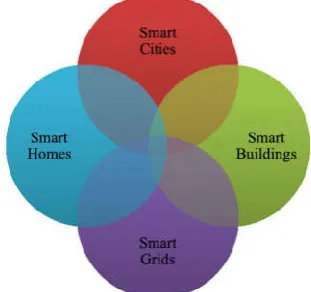
was formed, making possible to understand and study the problems related to business and business environment using as support or means for managing the IT. In this paper, the term Smart Energy (SE) refers to the common area among SG, SC, SH or SB study areas with respect to the energy context. Fig. 1 shows the relationship among the smart areas while the dark areas represent SE on the energy context.
Equation 1 complements Fig. 1, which illustrates the concept of the term SE used in this study by a logical expression. Where ES represent “Energy Studies”.
SE = {ES ∧(SG ∨ SC ∨ SH ∨ SB)} (1)
The term SG is designed to integrate advanced communication and networking technologies into electrical power grids to make them “smarter”, Gao et al. (2012), Alto (2008). It refers to the application of information technology to power systems. The SG uses unified communications and control system on the existing power delivery infrastructure to provide the right information to the right entity (...) at the right time to take the right action, Lund et al. (2012). The goal of SG applications is to optimize power supply and delivery minimizing losses. It is also self-healing, enables next-generation energy efficiency and demands response applications, Nonaka (2008), Lund et al. (2012).
SG grids should not be seen as separate neither from the other energy sectors nor from what the integration of the other sectors means for the identification of proper solutions to the integration problem, Lund et al. (2012). In spite of being widely used nowadays the term SC is still not a clear and consistent understanding of the concept among practitioners and academia, Chourabi et al. (2012).
Nevertheless, an important meaning for SC is that it combines digital environment to intelligent growth, a type of development based on information and communication technologies, Chourabi et al. (2012), Anttiroiko (2006). A SC can be defined as a community that has made a conscious effort to use information technology to transform, significantly and fundamentally, the live and work within its territory, instead of following an incremental way, Communities (2001).
The SC concept can be subdivided into several areas such as planning and management, human and infrastructure, government and agency administration, public safety, social programs, health care, education, transportation and water energy, environmental and smarter buildings and urban planning. Despite this diversity, this study is focused on those related to the energy sector, Townsend et al. (2010). The SH and SB terms share some functional and technical commonalities, Martins et al. (2012). The term SH, however, is mainly used to describe residential homes while SB refers to tertiary buildings (office buildings, industrial premises, hospitals, schools, etc.), Preissler et al. (2016) .
These two terms can be defined as a place equipped with computing and information technology which anticipates and responds to the needs of the occupants, working to promote their comfort, convenience, security and entertainment through the management of technology within the place and connections to the world beyond Aldrich. The term “smart” is related to SH or SB when one of those has some sort of
International Journal of Recent Scientific Research Vol. 8, Issue, 4, pp. 16367-16372, April, 2017
automation and where there is an interactive technology with the final user. This intelligent automation principle emerges from the needs of its occupants. So, it can provide better work or home life experience to occupants with intuitive user interfaces and without overpowering them with complex technologies, Preissler (2016). In this study the terms SH and SB are used only related to the automation and control of power consumption.
Hypothesys
As presented before, the SE is a common study area among SG, SC, SH and SB in the Energy context. In this study, the KEM area, which is a discipline that deals with studies related to knowledge management and making use of information technology as a way to operationalize it, was included. So it can be seen that the main common point between SE and KEM is IT. Based on these statements, this study intended to carry out a systematic literature review in three important scientific databases. Having, therefore, this purpose, the hypotheses h ∈ {1, 2, 3} are presented:
Hypothesis h1 - Since KEM makes use of information technology as the main tool to operate their applications and the SE area also uses the information technology as a tool, it is assumed that most studies related to these two themes will be subordinate to the Computer Science area.
Hypothesis h2 - Having KEM area emerged in the 90’s and
being also recent the Smart Grid, Smart Cities, Smart Homes and Smart Buildings terminologies, it is assumed that the greatest number of publications which relates the two subjects will be found mainly in recent years.
Hypothesis h3 - Knowing KEM as an interdisciplinary area, it is assumed that a large number of documents found in the databases will be discarded between the second and final analysis.
METHODOLOGY
This paper aims to present, through a bibliometric study, one systematic literature review in the proposed theme. The goal is to present analyzes for the results of searches from three important scientific databases over the past 10 years using quantitative (syntax) and content analyzes (semantic). They are: IEEE Xplore (IEEEx), Scopus and Web of Science (WoS). The tools used for the analysis were Microsoft Excel and Endnote software.
The present document is characterized as descriptive, analytical
and bibliometric. It can be characterized as a descriptive study
because it seeks to describe all information collected during the research in all its stages. It is also analytic because at the end of each presented stage or along its steps the collected information is analyzed in order to check the hypotheses as well as presenting content analysis.
Bibliometry
The bibliometry is the study of quantitative aspects of production, dissemination and use of recorded information, Macias-Chapula (1998). Its purpose is to show one condensed representation of information for storage and future inquiries, Bardin (1977).
Although they do not have a content analysis character, bibliometry studies are important in the generation of quantitative surveys documented with respect to a quantity of articles, author, year of publication, among other indicators. These indicators could be used for the scientific community in future researches.
Research Process
This systematic literature review is also given in x stages let x =
{1, ..., 8}. Where Sx is the set of papers selected in each x stage.
These stages and their results can be seen in Fig. 7. It is was also conducted in two steps: (a) systematic literature search and (b) analysis and synthesis of bibliometric information. Both steps occur in parallel, i.e. after each completed stage
Sx(a), an analysis of the results obtained is done Sx(b).
Literature Search Procedure - step (a)
Firstly, the keywords related to the topics researched were chosen. Then the scientific databases to be used were selected and after that the direct search was carried out. In order to execute the direct search, the terms above are also set on the search engine in the following categories: titles, abstracts and keywords (meta-data only). The parameter indicates that it was intended to list only the most recent publications and those publications must be in English in order to be readable by the authors.
Analysis and Synthesis Procedure - step (b)
After carrying out the direct searches conducted with the settings of the search terms, the abstracts were read in order to filter the content and verify whether the selected paper was aligned with the search terms. Finally, the report generation which is presented in Sec. 6 was developed.
RESEARCH DEVELOPMENT
The present section aims to present the steps of this research process. There are eight phases of analysis based on syntax, where the papers are eliminated by the use of keywords and then content analysis, by reading abstracts and full texts. Stage S1
A previous search S1(a) with the terms t given in Eq. 2 was
conducted. The purpose of this previous search was to check the entire sample space of scientific research in SG, SC, SH and SB in those three scientific bases (IEEEx, Scopus and WoS).
S1 = {t3∨ t4∨ t5∨ t6} (2)
Where:
S1 = set of found publications in stage 1
t3 = “smart grid*”
t4 = “smart cit*”
t5 = “smart home*”
t6 = “smart build*”
Stage S2
Furthermore, step S2(a) has applied the terms equivalent from Eq. 4 without parameters (y and lang) search resulted in the values presented in Table 2 from Eq. 3. The results indicate a significant reduction in the number of publications found after the terms t1 and t2 were added.
S2 = {S1∧ t1∧ t2} (3)
Where:
S2 = set of found publications in stage 2
t1 = “knowledg*”
t2 = “energ*”
Stage S3
In sequence, the parameters y and lang were added to the searches resulted in the values shown on Table 3. The search terms used in this stage S3(a) are presented in Eq. 4
S3 = {S2∧(y ≥ 2006) ∧(lang = Eng)} (4)
Where y is the year of publications and lang is the language. In that case Eng stands for English. By observing Tables 2 and 3 there is a total reduction of 91publications to be analyzed.
Stage S4
After this step the files were imported into EndNote references manager. After analyzing the 874 in the three databases were found 301 inconsistencies. These inconsistencies consisted in the lack of title, author names or abstracts or because there were duplicated documents among these bases. That is, the same document was indexed in more than one database, so appearing in duplicate or three times.
S4 = {S3} {duplicated records} (5)
That S4(a) stage (Eq. 5) took into consideration the author(s)’
name(s), paper’s title and the publisher. It resulted in 573 papers. Fig. 2(a) shows the amount of scientific works found grouped by year of publication. The year 2016 presents a significant drop in the number of publications. This is due, in large part, to the fact that this paper was finalized in the
beginning of the current year 2016, thus justifying these low numbers.
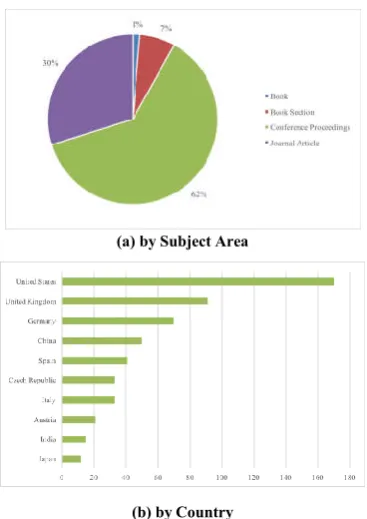
Fig. 2(b) objectives to show the percentage ratio among the types of found documents. More than half (62%) of these documents are from Conference Proceedings, followed by Articles category (30%), then Book Section (7%) and Book (1%). Still, Fig. 5(a) represents the documents by subject area. The vast majority is from the Computer Science (29%) and Engineering (25%) areas. Despite representing significant 23%, the category “others” includes many other areas of knowledge which individually account for 1% or less.
Table 1 Entire Sample Space
Database Frequency Percentage
IEEEx 26.094 42%
Scopus 23.053 37%
WoS 12.515 20%
Totals 61.662 100%
Table 2 Initial Sample without Parameters
Database Frequency Percentage
IEEEx 419 43%
Scopus 372 39%
WoS 174 18%
Totals 965 100%
Table 3 Initial Space
Database Frequency Percentage
IEEEx 409 47%
Scopus 303 35%
WoS 162 19%
Totals 874 100%
(a) by Year
(b) by Type
Figure 2 Published Items S4
(a) by Subject Area
(b) by Country
International Journal of Recent Scientific Research Vol. 8, Issue, 4, pp. 16367-16372, April, 2017
Fig. 5(b) shows the list of top 10 countries with the highest number of publications. United States tops the list with a significant difference to the second and later. Follow, in second and third positions are United Kingdom and Germany. The other countries have been omitted from this chart because they do not represent significant amount of production.
Stage S5
The next stage of this study consists in adding a new term t7 to
the sample space (Eq. 6). It is the t7 = heat term. This term is added to the search because it is intended to identify studies
related to KEM under thermal studies, specifically heating environments.
S5 = {S3∨ t7} (6)
This Step S5(a) resulted in a total of 48 papers. Then, the
abstracts were read to identify the correspondence to this paper propose and the found publications. The words and phrases that might identify the involved works with KEM search area were chosen based on literature relating to the area, Bovo (2011), Ppgegc (2014).
Stage S6
After the reading analysis, 5 publications were eliminated in Step S6(a) as it is presented by Eq. 7). The criterion used in the readings was to identify whether the abstracts had scientific research evidence related to the issues, but more specifically to the KEM and thermal studies areas.
S6 = {S5} {abstract unaligned} (7)
Stage S7
From those 43 papers selected by reading the abstracts, the search for files in electronic format was proceed. Only 37 papers were able to be downloaded (S7(b)) from the Internet.
Step S7(a) can be seen in Eq. 8).
Table 4 Approaches used by Areas and Process
A gg re ga ti o n/ Sh ar ing A cqu isi ti on /D isc o v er C la ssi fi cat io n E li ci ta ti on Im p ro ve m ent P roce ssi ng /D a ta M ini ng R ep re se nt at io n/ O nt ol o gi es R euse A rt ifi ci al N eur al N et w o rk B a y esi a n N et w or ks D istr ib ut ed Sy ste m s F uz zy L o gi c G a m e T he or y G U I Int er fa ce K -m ea ns al go ri th m M a chi ne L ea rni ng M ul ti -a g ent N ew H a rd w a re O w n A lgo rit hm Se m an ti c W eb Sy ste m s T hi nk ing
References KEM Process IT Approaches
Adhikari et al. (2012)
Al-Ali et al. (2012) X X
Albert and Rajagopal (2015)
Anders et al. (2013) X
Barnicoat and Danson (2015)
Chen and Cheng (2014) X
Deng et al. (2013) X
Dickert et al. (2012)
Fernandes et al. (2012) X X
Fernandes et al. (2015) X X
Fulpagare and Bhargav (2015)
Ghosh et al. (2015) X
Hong et al. (2014) X X X
Huang et al. (2013) X X X
Idowu et al. (2014) X X X X X
Javed et al. (2015) X X
Jorgensen et al. (2011) X
Keshtkar and Arzanpour (2014) X X X X
Kofler and Kastner (2010) X X X X
Macdougall et al. (2013)
Manfren (2012) X
Martirano et al. (2014a) X
Martirano et al. (2014b) X X
Mulyono (2015) X X
Pardo et al. (2015) X X
Qela and Mouftah (2012) X X X
Quattrocchi et al. (2013)
Reynders et al. (2013) X
Rocha Baiocchi et al. (2013) X X X X
Rowley et al. (2013) X X X
Sajjad et al. (2014) X X
She et al. (2013) X X
Viegas et al. (2015) X X X X
Wallenborn et al. (2011) X X X
Wastell et al. (2006) X X X
Welge et al. (2010) X X X X X
S7 = {S6} {download unavailable} (8)
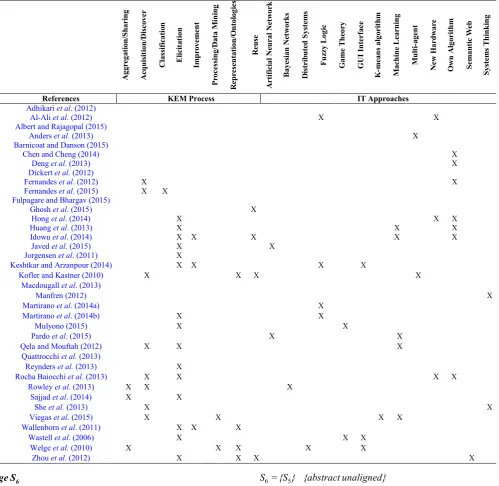
This occurred because there was trouble in downloading or because the files were not in readable digital format. Table 4 and Table 5 show the specific IT or KEM processes found in the S7(b). As KEM process were found: Knowledge
Aggregation or Sharing, Knowledge Acquisition or Discover,
Knowledge Classification, Knowledge Elicitation, Knowledge
Improvement (term used by the respective Reference authors),
Knowledge Processing or Data Mining, Knowledge
Representation or Ontology Studies and Knowledge Reuse.
For the IT approaches, could be found the following techniques: Artificial Neural Network, Bayesian Networks, Distributed Systems, Fuzzy Logic, Game Theory, GUI Interface, K-means Algorithm, Machine Learning, Multi-Agent, New Hardware Pro- posed, Own Algorithm Developed,
Semantic Web and Systems Thinking.
In Stage S7 the same main author appears in Martirano et al. (2014a) and Martirano et al. (2014b) as well as Fernandes et al. (2012) and Fernandes et al. (2015).
A summary analysis from the complete reading of these 37 papers (step S8(b)) can be seen in Table 5 In these tables the relationship between References and a summary of the text classification performed can be verified. The columns Explicit
IT and Explicit KEM refer to the fact that an explicit
relationship between the work and the IT or KEM processes was found in the reading. Columns Fit IT and Fit KEM are related to the adequacy of classification, made by these authors, to the themes IT or KEM. Following, column Keep has the final analysis criterion from the 37 papers: if they will be kept for the next stage S8 or not. In this table are presented the
methodology process proposed by each one of the 37 papers. The approaches found are Case study, Concept, Methodology,
Model, Short Paper and Survey or Review.
The last column is related to the Context in which the paper is proposed: Smart Buildings or Homes (SB), Smart Cities (SC) or Smart Grids (SG).
Stage S8
Stage S8 is the full text reading of the papers found on stage S7. Step S8(a) can be represented by Eq. 9. The stage S8 results in
18 papers.
Table 5 Research Method, Fitting and Context
E
x
pl
ic
it
IT
E
xp
li
ci
t
K
E
M
F
it
IT
F
it
K
E
M
K
ee
p
C
a
se
stu
dy
C
o
nc
ept
M
eth
o
do
lo
g
y
M
o
de
l
Sh
o
rt
P
a
pe
r
Su
rv
ey
/R
ev
iew
C
o
nt
ex
t
References Fitting Method
Adhikari et al. (2012) No No No No No X X SG
Al-Ali et al. (2012) Yes No Yes No No SB
Albert and Rajagopal (2015) No No No Yes No X SB
Anders et al. (2013) Yes No Yes Yes Yes SG
Barnicoat and Danson (2015) No No No Yes No X SC
Chen and Cheng (2014) Yes No Yes Yes Yes SG
Deng et al. (2013) Yes No Yes No No SB
Dickert et al. (2012) No No No No No X SB
Fernandes et al. (2012) Yes Yes Yes Yes Yes X X SG
Fernandes et al. (2015) No Yes Yes Yes Yes X X SB
Fulpagare and Bhargav (2015) No No Yes No No X SB
Ghosh et al. (2015) No Yes No Yes No SB
Hong et al. (2014) Yes Yes Yes Yes Yes X SG
Huang et al. (2013) Yes No Yes Yes Yes SG
Idowu et al. (2014) Yes No Yes Yes No X SC
Javed et al. (2015) Yes No Yes Yes Yes SB
Jorgensen et al. (2011) No No No Yes No X SG
Keshtkar and Arzanpour (2014) Yes No Yes Yes Yes SB
Kofler and Kastner (2010) Yes Yes Yes Yes Yes X SB
Macdougall et al. (2013) No No No No No X X SG
Manfren (2012) Yes No Yes No No X SG
Martirano et al. (2014a) Yes No Yes No No X X SB
Martirano et al. (2014b) Yes No Yes Yes Yes X SB
Mulyono (2015) Yes Yes Yes Yes Yes X X SG
Pardo et al. (2015) Yes No Yes Yes Yes X SB
Qela and Mouftah (2012) Yes Yes Yes Yes Yes X SB
Quattrocchi et al. (2013) No No No No No SG
Reynders et al. (2013) No No No Yes No X SG
Rocha Baiocchi et al. (2013) Yes No Yes Yes No X X SB
Rowley et al. (2013) Yes Yes Yes Yes Yes SC
Sajjad et al. (2014) No Yes No Yes No X X SB
She et al. (2013) Yes No Yes Yes Yes X SG
Viegas et al. (2015) Yes Yes Yes Yes Yes X SB
Wallenborn et al. (2011) No Yes No Yes No X SC
Wastell et al. (2006) Yes Yes Yes Yes Yes X X SB
Welge et al. (2010) Yes Yes Yes Yes Yes SB
Sigmundo Preissler Junior and Alexandre Leopoldo Gonçalves. Knowledge Engineering and Management Contributions for Scientific Research in the Thermal Smart Energy Context
S8 = {S7} {reading unaligned} (9)
A title word cloud is presented by Fig. 4 - (a) from those 18 papers found in step S8. The most used words are: Smart,
Energy, System and Management.
Only in the abstract word cloud (Fig. 4 - (c)) it is possible to clearly identify the word Knowledge. The most used are:
Energy, Systems, Smart, Management, Algorithm and
Knowledge.
The used methodology approaches are represented by Fig. 5(a). In which 33% propose a new Methodology, 28% Case Study,
22% Model and 17% are Not Classified. This last is due to a
not declared methodology or because it was not possible a classification by these authors.
In Fig. 5(b) the percentage of Context classification from the 18 papers is presented. It shows that the majority, 56% are classified in Smart Buildings or Smart Homes studies. This percentage is followed by 39% of Smart Grids and the last 5% of Smart Cities context.
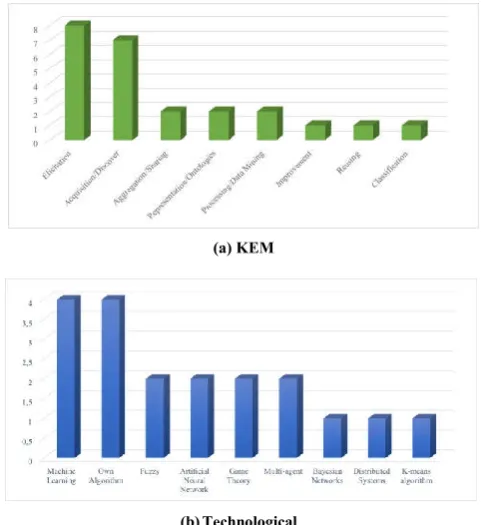
Figure 6(a) shows a graph where the KEM areas ordered by the quantity of use in those 18 papers can be seen. The most used KEM process are: Elicitation (explicit or implicit) and
Knowledge Acquisition or Discover.
Concerning to the Technological Approach Fig. 6 (b) presents a graph with the relationship between Frequency and IT Approaches identified in S8(b). The most used are: Machine
Learning and proposition of their Own Algorithm. This
information was obtained by reading explicit declaration of the used process.
Content Description
A resource allocation problem is studied by Anders et al. (2013). In this work a power plant management balance between energy production and consumption was proposed. The author uses a multi-agent IT method to solve one dynamic allocation problem. That work has no explicit fit with KEM process but it was categorized as Fit KEM because elements
Alg ori thm Time Data Imp lem en t ati on single Mak ing using t est
S
m
a
rt
sy
st e
m
En
erg
y
M
a
n
a
g
e
m
e
n
t
ba sed Ho mes Re sid e n tia l p ow er Analy sis Build ings Expe rimen tal Kn ow led ge dem and Co ntr ol W ireles s
Im prov ed
Heat ing o ptimiz ation SCADAbased Al locat ion Problem V en t ila t ion Air C ondit ion ing S HIM Platfor m Optim al Real Re spo nse Serv ice Reactive D esign ing
Cust omiz ed
Trust
Se rvices
So
lution Disagg
reg at ion Usage
t est ing
random
neu ral net w
ork
cont rol ler
Dy nam ic zone ch am ber Fuzzy Log ic De ma ndS ide Load
Users
B ase En erg yE cie nt Re sou rce
Sim ul at i on
sen sitivity Sy stem s fuzzyb ased building
aut om at ion
Grid Mutual su pport sector to ward resil ience On line Lea rning Co mbined Se ries
Forecasting
Suit abl e
Low Cost he at Se nsor N etw orks Nodes Observe Learn Adapt OLAAn Sensors Artic ial Intellig enceCom m unit ies
Advan ced
Acquis ition
consum pt ion
Susta inability Decision Multiob jective PEM Fuel Cell Du rab ility Elec tric ity pro le predict ion house ho ld cha rac te ristics Hom ew ard bound
microw orld st u dy dom estic information desi gn Integ ra t ing Mobile D ev ice s A ALEn vironm ents As sistance Co operatio nBased data
energy
sy stem
sm
ar
t
m
a
n
a
g
e
m
e
n
t
sy ste m s Dem and M o de l po we r Load User grid logic House he a ting e cie ncy b u ild in g co nsu mp tio n intell igent learn ing wire less fuzz y HVACopt im iza t ion S C AD A Com bined heat hom es t he ory
net w orks L igh tin g Prob lem s Grids Ve n tilation Air Con d it io n in g
Tru st
Un certainty
SHIM
(a) Titles (b) Keywords (c) Abstracts
Figure 4 Word Clouds S8
(a) Methodologies
(b) Research Context
Figure 5 Methodology Approach and Research Context S8
(a) KEM
(b) Technological
were found in the text demonstrating that it uses old knowledge and untrusted knowledge, as it was cited by the authors. Chen and Cheng (2014) present a paper in a power management for a residential user with renewable energy production context. It shows a study using photovoltaic inverter a battery. The authors propose an own algorithm based on Lyapunov optimization for residential users in Smart Grid context. Even without an explicit KEM process, it demonstrates knowledge reuse over its development.
In Fernandes et al. (2012) and Fernandes et al. (2015) the same main author appears. In the first one a (Supervisory Control and Data Acquisition) SCADA-based system is proposed in order to obtain a heat, power and consumption optimization. This algorithm works on Data Acquisition, a process which is frequently used in KEM. It also included a case study using real data. The second one proposes a Heating, Ventilation and Air Conditioning (HVAC) management methodology. It is placed in a Smart Building context and it has an explicit relationship with KEM process. This work takes into account the user knowledge and the other external parameters as temperatures. An experimental demand response service implementation for Smart Buildings is presented by Hong et al. (2014). A new hardware is proposed in order to control the heating devices. In that work it is possible to find the relationship between KEM and IT, where the authors use the expression “user expected price-based”. They also refer, over the development part, to the “user knowledge”. In this study, laboratory simulations are performed and those results are presented. Other energy service is proposed by Huang et al. (2013) focused on disaggregation of heating usage. Machine Learning method is used, and it is called Non-Intrusive Load Monitoring. Those authors cite knowledge transformation as their KEM process. A disaggregation algorithm estimates heating usage and these characteristics are used to predict the heat power.
An occupancy estimation is proposed by Javed et al. (2015). It is an experimental testing of a random neural network. This paper works with smart controller using a single zone test, so in a Smart Building context. That work uses prior knowledge for its methodology and as an IT approach is used an artificial neural network algorithm. Keshtkar and Arzanpour(2014) and Martirano et al. (2014b) use fuzzy logic systems as IT approach to solve heating problems. The first one works on Smart Buildings context as well as the second one. Sensors and real time information are used in Keshtkar and Arzanpour (2014) and Martirano et al. (2014b) works with sensitivity analysis and it works with a “building knowledge” propose. In the fuzzy logic rules, Keshtkar and Arzanpour (2014) used a natural framework to include expert knowledge in the form of linguistic rules.
Ontologies are used by Kofler and Kastner (2010). The authors use knowledge representation and reuse process. It is presented in a Smart Building context and one algorithm is proposed too. That paper suggests the usage of building information models as source and semantic web technologies as store of building data. A comparison between conventional grid and Smart Grid is presented by Mulyono (2015). In this work it is proposed a methodology in two steps using game theory to model an electricity usage behavior and mutual support interaction in
smart grid system. Authors show a case study in which a constant user interaction is used.
An online learning algorithm is proposed by Pardo et al. (2015). That work uses low cost wireless sensor networks nodes and artificial neural network back-propagation algorithm. Even the authors declare the algorithm do not need prior knowledge, their algorithm is fit KEM because it uses user knowledge and generate new knowledge by learning. An algorithm for energy management in SH using wireless sensors and artificial intelligence is proposed by Qela and Mouftah (2012). This process is called by authors as Observe, Learn and Adapt (OLA) method. The proposed algorithm utilizes the adaptable learning, system concepts and it uses integration of wireless sensors and artificial intelligence concepts. Knowledge Base and Adaptive learning are cited in this work.
One contribution for SH called advanced data acquisition and analysis for improved sustainability and decision making is described by Rowley et al. (2013). In this paper a “SmartNet” is developed and acquisition and knowledge sharing methods are used.
She et al. (2013) compares real parameters and parameters
obtained from the manufacturer using system identification method. These parameters are used as a multi-objective control for fuel cell system. The performance and stability is theoretically guaranteed by a Lyapunov-based proof. Two types of controller are developed. Although a knowledge base from parameters is used, its relationship with KEM is not clear.
Knowledge extraction is used by Viegas et al. (2015) when an electricity demand profile prediction based on household characteristics is proposed. This proposed model is a methodology for predicting the typical daily load profile of electricity usage based on static data obtained from surveys. It used k means clustering algorithm. This paper has a clear relationship with IT and KEM because it uses data mining and machine learning as IT approaches and knowledge extraction and classification as KEM process.
Wastell et al. (2006) makes a microworld study of domestic information system design. This paper proposes a GUI Interface focuses on the design of domestic heating management systems, specifically on the feedback support required to achieve energy savings. This paper uses design knowledge as KEM process.
An integrating mobile device is proposed by Welge et al. (2010) using knowledge based assistance systems. An adaptive assistance system is described to specific user preferences distributed by mobile devices building automation system. This work uses embedding methods of knowledge processing and knowledge aggregation. It also has a strong influence of KEM process using semantic knowledge description language and ontologies.
CONCLUSION
International Journal of Recent Scientific Research Vol. 8, Issue, 4, pp. 16367-16372, April, 2017
finally selected 18 (S8) which resulted as being strongly related
to the proposed theme.
General Discussions
The funnel, Fig. 7, presents the quantitative results (funnel left side) obtained in this re- search as well as the process used in each step (funnel right side). Where Sx represents the set of publications S obtained in each step x.
On stage S7 it was possible to verify that 44.44% of those 37 papers also apply their studies to cooling environments, 33.33% propose controller acting on the heating devices. More than half (66.67%) use parameter identification method to identify thermal heating characteristics from the building. Two of them use gray-box method to study heating parameters. The following approaches were also identified: Hybrid System, Probability Distribution, System Identification and Electrical-Thermal Analogy. Finally, on stage S8 it was identified that 83.33% of those 18 papers were published in the last 4 years proving h2. Parameter Identification method is used by 33.33% and 27.78% also covered thermal-cooling studies.
Acquisition and Knowledge Discovery as well as Elicitation were the KEM processes most used by the 18 finalist papers. Although well-distributed IT approaches, it is possible to highlight the use of GUI in the studies as well as the application of Machine Learning algorithms. Among the finalists it is possible to identify that 16.67% of them propose GUI Interfaces, 3 from those 18 propose controller acting on the heating devices. A new hardware is presented for 11.11% and one of them uses Systems Thinking, which is a method that brings together Computer Science and Engineering Technologies studies in the same field.
Several IT approaches have been used to address issues related to the Smart Energy area. Particular attention is given to Machine Learning methods and Artificial Intelligence algorithms. Based on these approaches, 21% of the authors have proposed their own technological solution (algorithm) to solve the problems studied by them. Through the non-syntactic analysis, it was possible to identify, in the reading stages (S6 and
S8), that the papers, in the majority make use of advanced computerized technical language while, on the other hand, do not make detailed reference to the KEM techniques used. There is a greater concern of the authors in detailing the
technical computational results than describing the KEM methods used.
Final Analysis and Future Works
The main contribution of this paper is related to the presentation of the profile from the scientific researches involving the KEM and SE areas and their features particularly in thermal-heating in Smart Building context.
The preliminary hypotheses were all checked and all of them were satisfied: h1 was satisfied, once Fig. 1 shows that 29% of
studies in the S4 refer to the Computer Science area; h2 was satisfied, as Fig. 2 - (a) shows that the greater number of publications has occurred over the past five years and also because on stage S8 it was identified that 83.33% of the works
were published in the last 4 years. Hypothesis h3 was satisfied because through the comparison between S2 and S8 it will be observed that 98.13% of the analyzed publications were rejected between the second and the last stage. The use of different keywords related to the KEM area to improve the assertiveness of the results in the second stage S1 and it can be
depicted as one of the suggestions given for future works. Moreover, for further bibliometric research, it will be advisable to use a local computer system with some sort of data mining in order to streamline the process between steps. Several initiatives can be found using KEM with IT applications to solve problems related to the SE context. The identified KEM processes however, are used often only to describe the technological approaches and not as a complete process per se. This factor can represent an important opportunity for SE solutions based 100% on KEM processes.
A closer look at the reality of a household user who consume
daily electricity from KEM’s point of view can significantly subsidize the decisions of algorithms and other approaches used by IT. Throughout the research it has been verified that the contribution of domestic users in the decision-making process of the algorithms makes the resource saving process even more efficient.
The union among: the use of household feedback (either automatic or without interaction), the use of technologies such as Internet of Things and even Machine Learning is a tendency pointed out in the researches and that can generate accurate results regarding the reduction in consumption of electric power and intelligent electrical systems. These conjoined approaches may represent promising research gaps. In conclusion, it can be seen from the diversity of existing processes in KEM that these can be further explored when applied to the studies of Smart Energy. As KE comes from AI and has a close connection with Computer Science and Engineering, in depth studies can be carried out connecting these related areas to the problems of the Energy area.
Acknowledgments
The authors would like to thank to BE Mundus Project from European Commission* and to the Support Fund for Maintenance and Development of Santa Catarina State-Brazil for Higher Education (UNIEDU).
*This publication reflects the views only of the authors, and the Commission
cannot be held responsible for any use which may be made of the information contained therein.
References
Adhikari, R., Aste, N., Manfren, M., 2012. Optimization concepts in district energy design and management-A case study. Energy Procedia 14, 1386-1391.
Al-Ali, A., Tubaiz, N.A., Al-Radaideh, A., Al-Dmour, J.A., Murugan, L., 2012. Smart grid controller for optimizing HVAC energy consumption, in: Computer Systems and Industrial Informatics (ICCSII), 2012 International Conference on, IEEE. pp. 1-4.
Alavi, M., Leidner, D.E., 2001. Review: Knowledge management and knowledge management systems: Conceptual foundations and research issues. MIS quarterly, 107-136.
Albert, A., Rajagopal, R., 2015. Thermal profiling of residential energy use. Power Systems, IEEE Transactions on 30, 602-611.
Aldrich, F., 2003. Smart Homes: Past, Present and Future in: Inside the Smart Home. Springer. London.
Alto, P., 2008. The Green Grid: Energy Savings and Carbon Emissions Reductions Enabled by a Smart Grid.
Anders, G., Steghofer, J.P., Siefert, F., Reif, W., 2013. A trust-and cooperation-based solution of a dynamic resource allocation problem, in: 2013 IEEE 7th International Conference on Adaptive and Self-Organizing Systems, IEEE. pp. 1-10.
Anttiroiko, A.V., 2006. Encyclopedia of digital government. IGI Global.
Bardin, L., 1977. Content analysis. Editions Lisbon. Barnicoat, G., Danson, M., 2015. The ageing population
and smart metering: A field study of householders’ attitudes and behaviours towards energy use in Scotland. Energy Research & Social Science 9, 107-115.
Bovo, A.B., 2011. A Knowledge Discovery Model of Inherent in the Temporal Evolution of the Relationships among Textual Elements. Ph.D. thesis. Ph. D. Federal University of Santa Catarina, Floriano´polis, Brazil.
Chen, S., Cheng, R.S., 2014. Optimal Real and Reactive Power Management for Residential Users in Smart Grid, in: Vehicular Technology Conference (VTC Fall), 2014 IEEE 80th, IEEE. pp. 1-5.
Chourabi, H., Nam, T., Walker, S., Gil-Garcia, J.R., Mellouli, S., Nahon, K., Pardo, T.A., Scholl, H.J., 2012. Understanding smart cities: An integrative framework, in: System Science (HICSS), 2012 45th Hawaii International Conference on, IEEE. pp. 2289-2297.
Communities, C.I.f.S., 2001. Ten Steps to Becoming a Smart Community. Available on: http://www.smart communities.org/library
Davenport, T.H., 1994. Saving IT’s Soul: Human-Centered Information Management. Harvard business review 72, 119-31.
Deng, W., Liu, F., Jin, H., Wu, C., 2013. Smartdpss: cost-minimizing multi-source power supply for datacenters with arbitrary demand, in: Distributed Computing Systems (ICDCS), 2013 IEEE 33rd International Conference on, IEEE. pp. 420-429.
Dickert, J., Hess, T., Schegner, P., Felsmann, C., 2012. Electrical Design of an Efficiency House Plus, in: Innovative Smart Grid Technologies (ISGT Europe), 2012 3rd IEEE PES International Conference and Exhibition on, IEEE. pp. 1-7.
Feigenbaum, E.A., McCorduck, P., 1983. The fifth generation. Addison-Wesley Pub.
Fernandes, F., Carreiro, A., Morais, H., Vale, Z., Gastaldello, D.S., do Amaral, H.L., de Souza, A.N., 2015. Management of Heating, Ventilation and Air Conditioning system for SHIM platform, in: Innovative Smart Grid Technologies Latin America (ISGT LATAM), 2015 IEEE PES, IEEE. pp. 275-280.
Fernandes, F., Morais, H., Faria, P., Vale, Z., Ramos, C., 2012. Combined heat and power and consumption optimization in a SCADA-based system, in: Innovative Smart Grid Technologies (ISGT Europe), 2012 3rd IEEE PES International Conference and Exhibition. pp. 1-8.
Fulpagare, Y., Bhargav, A., 2015. Advances in data center thermal management. Renewable and Sustainable Energy Reviews 43, 981-996.
Gao, J., Xiao, Y., Liu, J., Liang, W., Chen, C.P., 2012. A survey of communication/networking in Smart Grids. Future Generation Computer Systems 28, 391-404. Ghosh, S., Reece, S., Rogers, A., Roberts, S., Malibari, A.,
Jennings, N.R., 2015. Modeling the Thermal Dynamics of Buildings: A Latent-Force-Model-Based Approach. ACM Transactions on Intelligent Systems and Technology (TIST) 6, 7.
Hong, S.H., Li, Y.C., Park, J.H., Zhao, B., 2014. Experimental implementation of demand response service for residential buildings, in: Ultra Modern Telecommunications and Control Systems and Workshops (ICUMT), 2014 6th International Congress on, IEEE. pp. 277-282.
Huang, D., Thottan, M., Feather, F., 2013. Designing customized energy services based on disaggregation of heating usage, in: Innovative Smart Grid Technologies (ISGT), 2013 IEEE PES, IEEE. pp. 1-6.
Idowu, S., Ahlund, C., Schelen, O., 2014. Machine learning in district heating sys- tem energy optimization, in: Pervasive Computing and Communications Workshops (PERCOM Workshops), 2014 IEEE International Conference on, IEEE. pp. 224- 227.
Javed, A., Larijani, H., Ahmadinia, A., Emmanuel, R., Gibson, D., Clark, C., 2015. Experimental testing of a random neural network smart controller using a single zone test chamber. Networks, IET 4, 350-358.
Jooß, C., Thiele, T., Vossen, R., Richert, A., Jeschke, S., 2015. Integrative Knowledge Management in Interdisciplinary Research Clusters. International
Journal of Advanced Corporate Learning (IJAC) 8,
17-22.
Jorgensen, J., Sorensen, S., Behnke, K., Eriksen, P.B., 2011. Ecogrid EU-A prototype for European smart grids, in: Power and Energy Society General Meeting, 2011 IEEE, IEEE. pp. 1-7.
International Journal of Recent Scientific Research Vol. 8, Issue, 4, pp. 16367-16372, April, 2017
in: Electrical and Computer Engineering (CCECE), 2014 IEEE 27th Canadian Conference on, IEEE. pp. 1-5.
Kofler, M.J., Kastner, W., 2010. A knowledge base for energy efficient smart homes, in: Energy Conference and Exhibition (EnergyCon), 2010 IEEE International, IEEE. pp. 85-90.
Lund, H., Andersen, A.N., Østergaard, P.A., Mathiesen, B.V., Connolly, D., 2012. From electricity smart grids to smart energy systems a market operation based ap- proach and understanding. Energy 42, 96-102.
Macdougall, P., Roossien, B., Warmer, C., Kok, K., 2013. Quantifying flexibility for smart grid services, in: Power and Energy Society General Meeting (PES), 2013 IEEE, IEEE. pp. 1-5.
Macias-Chapula, C.A., 1998. The role of informetrics and scientometrics in the national and international perspective. Cieˆncia da Informac¸a˜o 27.
Manfren, M., 2012. Multicommodity network flow models for dynamic energy management. Mathematical formulation. Energy Procedia 14, 1380-1385.
Martins, J., Oliveira-Lima, J., Delgado-Gomes, V., Lopes, R., Silva, D., Vieira, S., Lima, C., 2012. Smart homes and smart buildings, in: Electronics Conference (BEC), 2012 13th Biennial Baltic, IEEE. pp. 27-38.
Martirano, L., Manganelli, M., Parise, L., Sbordone, D.A., 2014a. Design of a fuzzy- based control system for energy saving and users comfort, in: Environment and Electrical Engineering (EEEIC), 2014 14th International Conference on, IEEE. pp. 142-147. Martirano, L., Parise, G., Parise, L., Manganelli, M., 2014b.
Simulation and sensitivity analysis of a fuzzy-based building automation control system, in: Industry Applications Society Annual Meeting, 2014 IEEE, IEEE. pp. 1-7.
Mulyono, N.B., 2015. Mutual Support in Energy Sector: Toward Energy Resilience. Procedia Computer Science 60, 1041-1050.
Nonaka, I., 2008. The knowledge creating company. Harvard Business Review Press.
Pardo, J., Zamora-Martinez, F., Botella-Rocamora, P., 2015. Online Learning Algorithm for Time Series Forecasting Suitable for Low Cost Wireless Sensor Networks Nodes. Sensors 15, 9277-9304.
Ppgegc, 2014. Knowledge Engineering and Management process areas. Knowledge Engineering and Management Department. Federal University of Santa Catarina, Brazil.
Preissler, S.J., 2016. A framework for thermal parameter identification in a smart buildings context, in: Smart Cities Conference (ISC2), 2016 IEEE International, IEEE. pp. 1-4.
Preissler, S.J., Gonc¸alves, A.L., Fernandes, W.R., 2016. A Framework for Multi-zone Building Thermal Electrical Representation, in: 12th International Conference on Intelligent Environments. IEEE, London, United Kingdom.
Preissler Junior, S., 2015. How does the Knowledge Engineering has contributed for Smart Energy Technologies? Climate Innovation and Sustainable Development Systems.
Qela, B., Mouftah, H.T., 2012. Observe, learn, and adapt (OLA)-An algorithm for energy management in smart homes using wireless sensors and artificial intelligence. Smart Grid, IEEE Transactions on 3, 2262-2272. Quattrocchi, F., Boschi, E., Spena, A., Buttinelli, M.,
Cantucci, B., Procesi, M., 2013. Synergic and conflicting issues in planning underground use to produce energy in densely populated countries, as Italy: geological storage of CO2, natural gas,
geothermics and nuclear waste disposal. Applied
energy 101, 393-412.
Reynders, G., Nuytten, T., Saelens, D., 2013. Robustness of reduced-order models for prediction and simulation of the thermal behavior of dwellings, in: Proceedings of BS2013: 13th conference of international building performance simulation association, Chambe´ry, France.
Rocha Baiocchi, O., Mobus, G., Braga Soares de Carvalho, F., Moreira Bacurau, R., Ferreira Soares, S.A., 2013. Development of a Smart Building Wireless Sensors Network: Cooperation between University of Washington Tacoma and Brazilian Universities, in: Frontiers in Education Conference, 2013 IEEE, IEEE. pp. 1706- 1708.
Rowley, P., Gough, R., Doylend, N., Thirkill, A., Leicester, P., 2013. From smart homes to smart communities: Advanced data acquisition and analysis for improved sustainability and decision making, in: Information Society (i-Society), 2013 International Conference On, IEEE. pp. 263-268.
Rus, I., Lindvall, M., 2002. Knowledge management in software engineering. IEEE software 19, 26.
Sajjad, I.A., Chicco, G., Napoli, R., 2014. A probabilistic approach to study the load variations in aggregated residential load patterns, in: Power Systems Computation Conference (PSCC), 2014, IEEE. pp. 1-7. She, Y., Baran, M.E., She, X., 2013. Multiobjective control
of PEM fuel cell system with improved durability. Sustainable Energy, IEEE Transactions on 4, 127-135. Townsend, A., et al., 2010. The Future of Cities. IFF,
Information, and Inclusion. Institute for the Future. Palo Alto CA.
Wallenborn, G., Orsini, M., Vanhaverbeke, J., 2011. Household appropriation of electricity monitors.
International Journal of Consumer Studies 35, 146-152.
Wastell, D.G., Sauer, J.S., Schmeink, C., 2006. Homeward bound: a microworld study of domestic information system design., in: ECIS, pp. 546-557.
Welge, R., Kujath, A., Opel, O., 2010. Integrating Mobile Devices into AAL-Environments using Knowledge based Assistance Systems, in: Telecommunications: The Infrastructure for the 21st Century (WTC), 2010, VDE. pp. 1-6.
Zhou, Q., Natarajan, S., Simmhan, Y., Prasanna, V., 2012. Semantic information modeling for emerging applications in smart grid, in: Information Technology: New Generations (ITNG), 2012 Ninth International Conference on, IEEE. pp. 775-782.
How to cite this article: Sigmundo Preissler Junior and Alexandre Leopoldo Gonçalves. Knowledge Engineering and Management Contributions for Scientific Research in the Thermal Smart Energy Context. Int J Recent Sci Res. 8(4), pp. 16367-16372. DOI: http://dx.doi.org/10.24327/ijrsr.2017.0804.0138