*Corresponding author: Akram Belhadj Mohamed
ISSN: 0976-3031
Research Article
INDICATORS, DETERMINANTS AND STAGE OF DEVELOPMENT OF REGIONAL
COMPETITIVENESS: CASE OF THE EAST TUNISIAN CENTER
Akram Belhadj Mohamed*
Faculty of Economics and Management of Mahdia, Tunisia
DOI: http://dx.doi.org/10.24327/ijrsr.2017.0808.0729
ARTICLE INFO ABSTRACT
In this paper, we seek to see the evolution in time of the competitiveness of the Central East Tunisia through the study of a set of indicators and determinants, and to identify the stage of development of competitiveness and structural changes in the local economy. We will focus on the benefits that make and destroy local economies.
INTRODUCTION
The term territorial competitiveness (Porter, 1990) has become the leitmotif on which public development strategies. Competitiveness affects the capacity of a territory to be established, to prosper and to retain economic activities, skills and capital and to pass it on to the standard of living of its inhabitants'.
The concept then covers the notion of absolute advantage, which sees regions specializing in activities where they are absolutely better than the other regions' (Camagni and al, 2002), since they are not assured of being able to benefit continuously comparative advantages in the international division of labor '(Krugman, 1996). This potential depends on a set of indicators and determinants of competitiveness.
Indicators of the competitiveness of a region
There are different indicators that affect both the socio-economic side and the other the appropriation of technology and innovation. For the first type of indicator it is to seek to understand the determinants that make up the standard of living of a region. In this case the efficient and full use of the various factors of production makes the performance of an economy. An indicator of competitiveness can therefore be the growth of and the size of the unemployment rate in the economy.
To do this, you have to maximizing sustainable productivity of the economy at all levels by the real value of the supply of goods and services. By integrating the value added per worker and per capita, the first indicates the effectiveness of the processes productive and second the standard of living. Productivity is all the more the local economy is oriented towards the world market.
Similarly, a region is all the more prosperous because its attractiveness for investment foreign direct investment is good and the number of partnership contracts is high. To be done it is enough to create a business environment conducive to the mobility of factors, men and offer and market innovations. Two dimensions make competitiveness: one that makes and the other concerns the appropriation of technology. Today, different classification which allow us to compare the technological position of the especially with respect to human development indices. Investing in training and research and development through a university business partnership is a solutions to increase technological capacity. The latter is expressed through different indicators such as performance of education, expenditure on research and development, as well as the number of published scientific articles and patents. Finally, an industrial fabric is all the more prosperous mortality is low and the infrastructure is modern. The following Table summarizes the indicators to be measured to describe the competitiveness of a region (Table 1).
Recent Scientific
Research
International Journal of Recent Scientific Research
Vol. 8, Issue, 8, pp. 19607-19613, August, 2017
Copyright © Akram Belhadj Mohamed, 2017, this is an open-access article distributed under the terms of the Creative Commons Attribution License, which permits unrestricted use, distribution and reproduction in any medium, provided the original work is properly cited.
DOI: 10.24327/IJRSR
CODEN: IJRSFP (USA)
Article History:
Received 20th May, 2017
Received in revised form 29th
June, 2017
Accepted 30th July, 2017
Published online 28th August, 2017
Key Words:
Competitiveness: Case of The East Tunisian Center
Determinants of a region's competitiveness
The ability of a region to compete with others is the immediate result of intrinsic potentialities and degree of freedom in the decision-making communities. This decentralization is one of the most important elements to within the framework of a comprehensive economic policy to ensure a business on the local level. This type of environment has a greater impact on determinants of regional competitiveness, namely productivity and the propensity to innovation, macroeconomic policies or legal and fiscal provisions. In fact the studies have demonstrated the cause-and-effect relationship that exists between the four elements of the business environment and these two determinants of competitiveness at the regional level.
Factors of production
The factors of production differ according to the state of competitiveness in a region. Indeed a region that has a cheap labor force or a natural resource will seek to increase its competitiveness in minimizing costs. Only over time the local workforce begins to have a mastery and a production process and in this case we talk about competitiveness based on the quality of the product. The ultimate level is when companies innovate. The transition from an internship competitiveness to another is dependent on a number of conditions. The first condition affects the quality of the education system, the training and investment of the State in terms of research aid at the university level.
Market demand
The first of the conditions for making an attractive investment market foreigners is the mobility of factors inside and outside the regions. This mobility will allow a diversification of the supply of goods and services in the local market. This offer will be all the more important as local demand is high. In fact, populated areas are more attractive than others less inhabited.
The strategies adopted by companies
The agglomeration of companies in the same region will promote phenomena such as the different types of partnerships, subcontracting, spin-offs and mergers that will form of enterprise networks upstream and downstream of the production process. The success of such strategies depends on an administration tailored to the needs of companies and form of corruption and transparent. Initiatives such as the one-stop shop will potential investors to save time in the steps that implementation of their project.
Related industries and support institutions
The effects of proximity between companies, suppliers, service providers and organizations financial resources allow the said companies of the same region to benefit from the savings agglomerations. If the existence of profits in the agglomeration of economic activities is well established on a theoretical level, the empirical measurement of their impact is more difficult.
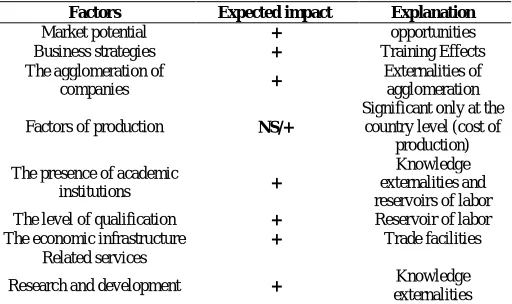
Such empirical work is at first confronted with a problem of identification. It is effectively ‘from a single observable one, the productivity of firms or the workers' salaries, to determine which of the mechanisms referred to above is actually at work’ (Rosenthal and Strange, 2003). The factors that make up the competitiveness of a region are shaped by a perpetual business environment fluctuations due to market conditions, demand and quality of factors of production. (Table 2).
Nature of factors and degrees of regional development
An embryonic stage of competitiveness is that based either on a manpower or on the availability of a natural resource. The price of the product is the leitmotif that structures competition. The technology used is often simple, the knowledge low productivity, distribution of wealth is unequal, and insignificant salaries with regard to the effort provided. Over time the local workforce begins to have a perfect mastery of the production process. Know-how and accumulated experience allows employees to claim better conditions wages and more comfortable working conditions. In this stage, development of efficiency and efficiency of the production process.
Moving to the last stage of development in a region is not easy. Indeed this companies require massive investments in the research and development. Local authorities must subsidize the creation of research laboratories. A decentralized and transparent administration will seek to encourage cooperation between enterprises and universities in projects innovative. Laws must be enacted and institutions created for the protection of intellectual property rights and patent rights. States should facilitate the emergence of specialized industrial concentration zones such as the Clusters (Table 3).
Table 1 Competitiveness indicators
Socio-economic indicators Innovation indicators
Productivity of factors of
production
Value added per capita
Jobs
Unemployment
GDP
GDP per capita
Number of enterprises with 10 or
more jobs
Number of exporting companies
Number of foreign-invested
enterprises
Number of research laboratories
Number of patents and
innovations, industrial models
Source: Salma. Z, (2006) : ‘La compétitivité de Sfax : Bilan, facteurs et opportunités Promotion de la compétitivité de la région de Sfax’, Chambre de commerce et d’Industrie de Sfax, Challenge Coopération Technique Tuniso-Allemande GTZ
Table 2 Expected impact of factors explaining competitiveness
Factors Expected impact Explanation
Market potential + opportunities
Business strategies + Training Effects
The agglomeration of
companies +
Externalities of agglomeration
Factors of production NS/+
Significant only at the country level (cost of
production) The presence of academic
institutions +
Knowledge externalities and reservoirs of labor The level of qualification + Reservoir of labor The economic infrastructure + Trade facilities
Related services
Research and development + Knowledge
externalities
Summary from the work of S. Zouari (CCIS-GTZ, 2006), C. Rousseau (Insee,
The competitiveness of the Central East region: results and
discussion
Central region between north and south of Tunisia, the Center East is home to more than 37% of the national population while occupying only 8% of the national area in 2014. This paradox is the result of an enviable geographical location in the Central strongly to make it an important relay with its national and international as it has, in particular, a basic infrastructure developed in land, sea and air transport (GP1, Tunis-Sfax motorway, metro the Sahel, the Skanes, Enfhida and Sfax airports and the ports of Sousse, Mahdia, Sfax and Sousse).
We are witnessing the emergence of a booming economic diversified, the fruit of important trade, the various manufacturing industries (especially the textile and clothing industries), tourism, industry agri-food and fisheries sectors. The region may now be able to accommodate more than 23% of the national business park and more than 27% of enterprises with more than 100 employees (INS1, 2014).
In addition, the Center-East region represents a national or even a regional tourism is home to more than 245 hotel units2, the majority of which are located in governorates of Sousse and Monastir. The region has also various important hospital complexes (HCUs and clinics) and universities (University of South Sfax, University of Sousse and University of Monastir) as well as cultural and holiday spaces.
Analysis of indicators
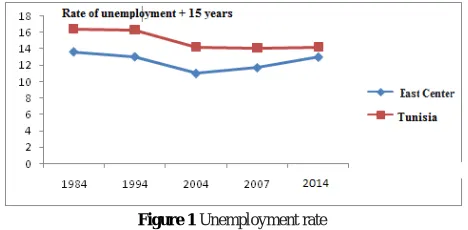
The influence of the economic pole of the East Tunisian Center now takes national or even international dimensions as evidenced by state investments in this region (airports, new tourist areas, industrial ... etc) and a rate of unemployment of the lowest in Tunisia which is close to 12.1% in 2014. The region includes three major economic growth clusters (Sfax, Monastir and Sousse) and a pole that has difficulty asserting itself (Mahdia). With three technopoles (information technology in Sfax, mechanical and electrical Sousse, textiles and clothing in Monastir), more than thirty training centers professional and now seven business incubators the central
1
INS: National Institute of Statistics
2Tunisian National Tourist Office: http://www.bonjour-tunisie.com/
region is Tunisian wants to become a pole of entrepreneurship and research and development.
Unemployment rate
Second industrial and economic pole of the country, the region of East Tunisia has unemployment rates still below the national average despite a slight in recent years. These figures should be put into perspective if the impact of migration between districts, which recorded for the years between 1999 and 2004 with a positive net balance approaching 50,000 people (figure 1). The rate of unemployment in the Central East has always been lower than in the country except for the governorate of Mahdia, which recorded both highs and lows, which shows instability and the main reason for this is the importance in the creation of the use of market gardening, which is dependent on the whims of time, and unemployment rates that are generally higher than the national average.
In this context, the agricultural and fisheries sectors constitute the pillars of the economy of the governorate since they employ 43% of the employed. The Governorate de facto occupies a privileged place in the national production, in terms of oil, milk, blue fish and seafood. The agri-food and textile industries development in the governorate of Mahdia, in the same way as the growth of the last ten years has brought it to the forefront of activities that attract local and foreign investors. The effect of training due to proximity the three poles cited before did not function fully to local economic dynamics upwards.
For the governorates of Monastir and Sfax there are trajectories lower than the national average for any period of study. In this case, unemployment is generally well absorbed in Monastir compared to the rest of the region. This governorate is illustrated by its opening on the outside since it has its own international airport and is considered a trusted name seaside resort with 10% of the capacity of national accommodation while it is distinguished by a textile sector clothing and an export-oriented industry. The textile and clothing occupies the top spot in terms of the number of enterprises and of jobs at the national level. The economic fabric in this region is increasingly to diversify into the industrial sector on the one hand and to specialize in crops in which the governorate ranks first at the national level on the other side.
Sfax continues to have significant performance in job creation, which makes it possible to mop up a large part of the population unemployment and a rate of more than 11% in 2014. The Region of Sfax draws its importance of the fact that it houses the second city of the country from the point of view of weight economic and population sectors. The opening up of the local economy to external markets is facilitated by the existence of a commercial port and an international airport the
Table 3 Stage of development of the competitiveness of the East Centre and political economic
Competitiveness based on factor cost
Competitiveness based on efficiency
Competitiveness based on innovation
Create and maintain
macroeconomic and political stability, establish the rule of law and institutions.
Create a basic physical
infrastructure and promote education for all.
Open markets
Create favorable
conditions for technology transfer and attract FDI.
Upgrade the physical
infrastructure, institutional framework and create a technological and scientific infrastructure
Encourage the
development of clusters or clusters
Building capacity to
improve foreign technologies
Deepening the
development of clusters
Create world-class
researchers
Creating the right
conditions for the development of unique strategies and innovation
Source: Salma. Z ; (2006) : ‘La compétitivité de Sfax : Bilan, facteurs et opportunités Promotion de la compétitivité de la région de Sfax’, Chambre de commerce et d’Industrie de Sfax, Challenge Coopération Technique Tuniso-Allemande GTZ
Competitiveness: Case of The East Tunisian Center
most active at national level. The economic fabric is diversified and complementary with sustained growth in manufacturing (mainly chemical) and services over the past two decades. In terms of energy, the governorate of Sfax contributes about 27% to national oil production.
Indeed, the field Achtarout occupies first place with 70% of the oil production of the governorate. Finally, the governorate of Sousse, which has always achieved unemployment rates close to national average suddenly experienced an increase during the last year of the study 4 points to exceed the 16% mark. This phenomenon is largely attributable to immigration coming mainly from the neighboring western center with nearly 37% of the flow of immigrants to that region during this period (Figure 2).
This region has seen an important development in the creation of employment during the first twenty years that our work covers to a slowdown and convergence towards national averages with job losses of up to 10% of the workforce, reflecting a loss of competitiveness of the Center-East.
Labor productivity and value added per capita
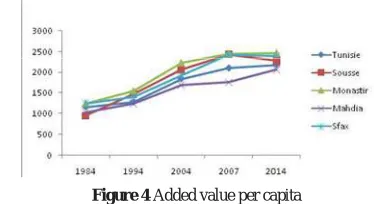
Labor productivity and value added per capita scores in Eastern Tunisia followed a rising trend and were consistently higher than the national average. The same is true of the governorates except Mahdia where the gap between these indicators tends to increase as well with the average than with the other governorates (see Figure 3).
In fact, from 1994 to 2014 there was an increase in productivity at work varying from two to four points. It should be pointed out in this context that between 2000 and 2004 it a convergence
of indicators towards the national average showing a loss of competitiveness of the Center-East and which was followed immediately by a resurgence of growth (see Figure 4).
Increase in the employed labor force
The Tunisian East Center is known as a region that has always represented a basin highly productive employment in terms of preservation and population growth active busy. However, since the early 2000s, the situation has been reversed. By Governorate, Mahdia continues to present itself as the weakest link in the region the creation of employment with results far inferior to those of the Tunisia. Sfax is illustrated with a remarkable recovery of its competitiveness after a relative stagnation to show annual population growth between 2004 and 2014 active busy who flirted with the 6%. Finally, the governorate of Monastir weakness of its local economy (see Figure 5).
Structure of the economy and foreign investment
From a sectoral point of view, the region of the East Tunisian Center is a pole economic situation since it absorbs more than 24% of national employment. By Moreover, this region suffers from a certain stagnation of its economic potential (see Figure 6).
If we observe the evolution of the economic structure of the manufacturing industries, notes a significant decline in the governorate of Sfax particularly in the textile sector, which quickly recovered after 2004, notably thanks to the encouraging results of the food and beverage manufacturing industry. mechanical and electrical industry. The governorates of Sousse and Monastir a decline in their attractiveness and which reflects a crisis, particularly in the textile clothing. This resulted in a relocation of this sector, which looks for less saturated spaces, particularly in Mahdia (Figure 7).
Figure 2 Job creation differential
Figure 3 Productivity at work
Figure 4 Added value per capita
Figure 5 Employed labor force
In addition, this region attracts about 40% of foreign-invested enterprises that have Tunisia in 2009. It is Monastir and Sousse that attract the most foreign-invested enterprises in the region with respectively 18.93% and 12.06%. The difference with Sfax and Mahdia is important in this respect, where they attract only of 3.4% and 6.7% respectively (see Figure 8).
Analysis of determinants
As an economic pole of prime importance in Tunisia, the Central competitiveness on various factors that are beginning to show what causes us to find out what are the causes of this stagnation and what opportunities to breathe new life into local economic dynamics.
Market potential
The Central East Economic Region is ranked second after the northeast the demographic plan for both the total population and the population (see Figure 9).
The infrastructure in the region (airport, commercial ports, etc.) opportunities for access to the international market, as evidenced by the number of exporting companies in the region with 35% of exporting firms from the country. In addition, major projects in the region (Sfax Highway Msaken, the Sfax-Ras Jdir Highway, Enfidha airport, the airport and port extension Sfax, etc.) are opportunities to reinforce the attractiveness of foreign investors in the Center-Est region (see Figure 10).
Firms strategies
Second region from the point of view of the implantation of large enterprises, however, the local economy remains dominated by medium-sized which represents a brake on the internalization of the economic fabric of this district. The analysis of this determinant in the case of the East Center (see Figure 11), shows that different activities remain vulnerable to the unfair competition the informal sector or that of the foreigner and remain mostly predominantly public. The local economic fabric encounters various paradoxes and tensions of the type: autonomy and interdependence, competition and cooperation and specialization against diversification. These paradoxes and tensions are potentially creating synergies and can a significant propensity for innovation and progress' (Zghal, 2005).
The agglomeration of industrial enterprises
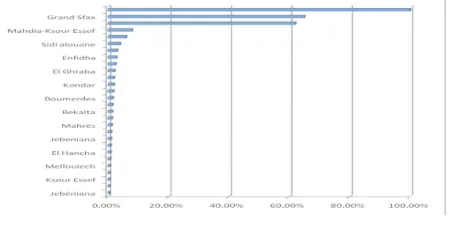
This region has a total workforce of 2089 companies with 10 or more jobs. Almost all of these enterprises are agglomerated in the three large urban centers which are, Sousse, Monastir and Sfax with no less than 93% of companies employing 10 people and more for 2014 (Figure 12).
The agglomeration index, calculated by weighting according to the number of in a registered agglomeration (Monastir), confirms the industrial concentration in the three governorates potential of industrial attractiveness of these poles. However, the benefits phenomenon of agglomeration and industrial concentration of undertakings should not mask the adverse
Figure 7 Manufacturing employment
Figure 8 Enterprises with foreign participation
Figure 9 Urban and rural population
Figure 10 Number of exporting firms 2014
Figure 11 Firms with more than 100 employees 2014
Competitiveness: Case of The East Tunisian Center
effects that have appeared in recent years. These externalities negative effects are caused by uncontrolled settlement, industrial pollution and the inadequacy of managed industrial areas. The latter have favored a tendency towards industrial loosening, which appears mainly in the three governorates of Sousse Monastir and Sfax3.
Monastir has a tendency of industrial loosening towards Zeramdine.
Sfax has a tendency of industrial loosening towards Agareb, El Ghraba and Jébéniana
Sousse has a trend of industrial loosening towards Kondar and Enfidha, and in one in Sidi El Héni.
Mahdia tends to industrial loosening towards Boumerdes, Ksour Essef, Sidi Alouene and Chebba.
Factors of production
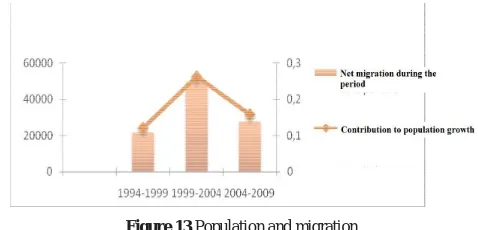
The East Center has always been attractive whether from an investment or labor migrant workers. This has continued in parallel with the increase in local population mainly from the three main urban centers which are: Sousse, Monastir and Sfax. The contrary is observed in Mahdia despite a slight increase in (Figure 13).
Academic and research institutions
There are three university clusters, with 33% of academic institutions of the country which classifies it as the second university center after that of Greater Tunis (see figure 14). At the level of the governorates, Sfax remains in pole position as the most important campus university of the region, closely followed by the rise of Sousse and to a lesser extent measure of Monastir. Mahdia, a recent university center, remains far behind of the governorate, whether in terms of the number or However, this factor, whatever the size of the university poles involved, remains qualitatively handicapped by the weak integration between the University and the company, and the absence of traditions of partnership, with the exception of a few joint projects.
3 Direction Générale de l’Aménagement du Territoire (2014)
State of regional competitiveness
The East Center of Tunisia represents an economic pole of first importance of share the diversity of activities and the share of investment at the national level.
The stage of development of competitiveness
The comparison by governorate implies specialization and complementarity a degree of integration of the regional economic fabric, which can hamper the competition in the attractiveness of investments whether local or foreigners. Sousse will be able to avail itself of a vocation in tourism and related services of national or even international dimensions. Monastir will constitute a central platform in the textile sector. Mahdia will specialize in agriculture and agri-food. Sfax, is a diversified industrial region with a dominant chemical. Other restructuring industries (such as textiles) can competitiveness and position themselves better on the international market if they were organized in Clusters. Competitiveness is based on efficiency, which implies:
Upgrade the physical infrastructure, the institutional framework and create a
technological and scientific infrastructure
Encourage the development of clusters or clusters
Building capacity to improve foreign technologies
Structural change in the economy
According to a region's share of national employment and its rate of increase between 1984 and 2014, four categories of sectors can be identified:
sectors whose shares in national sector employment and their growth rates are significantly below the regional average; these are the sectors for which region has no competitive advantage;
sectors whose shares in national sector employment and their growth rates are significantly higher than the regional average; these are the sectors for which region has traditional competitive advantage;
sectors, whose shares in national sectoral employment are lower than the regional share in sectoral employment and their growth rates are significantly higher than the region average. These are sectors with competitive advantage new.
sectors whose shares in national sectoral employment are higher than the share in sectoral employment and their growth rates are below the region's average. These are areas where there was a competitive advantage traditional but which, due to specific difficulties, are losing momentum.
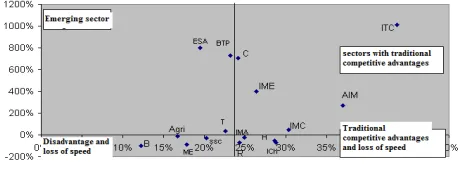
Trends in the structure of the economic sectors show a traditional competitive advantage in manufacturing and in particular textile clothing, as well as the mechanical and electrical industries and materials constructions and other manufacturing industries. Services related to education, health and administration as well as transport are emerging towards the character of traditional competitive advantages of the sector as they represent poles which attract a clientele from Central and Southern Tunisia, Libya for the case of Sfax. High-tech activities, particularly in Sousse, Monastir and Sfax will gain
Figure 13 Population and migration
by the realization of the technopoles which will boost the growth services related to a knowledge-based economy. Hotel and catering related to availability of natural resources at the local level is experiencing a slowdown due to the stifling traditional tourist areas. (figure 15).
Agri: agriculture forestry and fishing, construction and public works, ME: mine and energy, H:ITC: textile and leather industry, IMC: construction materials industries, AIM: other manufacturing industries, TR: transport and communication, R: real estate and repair, B: banking and insurance, IME: mechanical and electrical industries, SSC: social and cultural services, IMA: food manufacturing industry, C: commerce, Chi: chemical industries, ESA: education, health administration. With P: sectoral share in the regional economy.
CONCLUSION
The competitiveness of the regions is a product of the materialization of a set of indicators and determinants that shape the competitiveness of a territory at this mesoeconomic level. The Center-East has succeeded in safeguarding a diversified performance than national averages. The analysis of competitiveness in this level shows a shortening of the three major governorates (Sousse, Sfax and Monastir) as we witness the blossoming of Mahdia as a virgin pole of the future in the regional economy.
References
Camagni R, Gibelli M C, Rigamonti P (2002): Urban mobility and urban form: the social and environmental costs of different patterns of urban expansion, Ecological Economics, Elsevier, vol 40(2), pp 199-216
Krugman P, Venables A (1996): Integration, specialization and Adjustement, European Economic Review, vol 40, n_3-5, 959-967
Stuart S. R, William C S, (2003): Geography, Industrial Organization, and Agglomeration, The Review of Economics and Statistics, MIT Press, vol. 85(2), pages 377- 393, May.
Porter M (1990), The Competitive Advantage of Nations, HBR, March-April, p. 75
Institut National de la Statistique, INS (2010): recensement national de l’emploi: premiers résultats
Salma Z (2006): La compétitivité de Sfax : Bilan, facteurs et opportunités, Séminaire Promotion de la compétitivité de la région de Sfax Faculté des Sciences Economiques et de Gestion de Sfax
Institut National de la Statistique (2004): « annuaire statistique de la Tunisie»
Institut National de la Statistique (2005): annuaire statistique de la Tunisie
Institut National de la Statistique (2006): annuaire statistique de la Tunisie
Institut National de la Statistique (2007): annuaire statistique de la Tunisie
Institut National de la Statistique (2008): annuaire statistique de la Tunisie
Institut National de la Statistique (2009): annuaire statistique de la Tunisie
Institut National de la Statistique (2010): annuaire statistique de la Tunisie
Institut National de la Statistique (2012): annuaire statistique de la Tunisie
Institut National de la Statistique (2014): annuaire statistique de la Tunisie
Institut National de la Statistique (2009): Tunisie en chiffre Zghal R (2005): The economic dynamics as Feature of an
Area: The case of Sfax Entrepreneurs, Journal of Enterprising Culture, Vol XIII, nº1, pp 89-104
Figure 15 Sectoral Competitive Advantages
*******
How to cite this article: