AUT Journal of Mechanical Engineering
AUT J. Mech. Eng., 4(2) (2020) 201-214 DOI: 10.22060/ajme.2019.15913.5792
Dynamic Stability Analysis of Euler-Bernoulli and Timoshenko Beams Composed of
Bi-Directional Functionally Graded Materials
A. Ghorbanpour Arani*, Sh. Niknejad
Faculty of Mechanical Engineering, Department of Solid Mechanics, University of Kashan, Kashan, Iran
ABSTRACT: In this paper, dynamic stability analysis of beams composed of bi-directional functionally
graded materials rested on visco-Pasternak foundation under periodic axial force is investigated. Material properties of beam vary continuously in both the thickness and longitudinal directions based on the two types of analytical functions including exponential and power law distributions. Hamilton’s principle is employed to derive the equations of motion according to the Euler-Bernoulli and Timoshenko beam theories. Then, the generalized differential quadrature method in conjunction with the Bolotin method is used to solve the differential equations of motion under different boundary conditions. Various parametric investigations are performed for the effects of the gradient index, static load factor, length-to-thickness ratio and viscoelastic foundation coefficients on the dynamic stability regions of bi-directional functionally graded beam. The results show that the influence of gradient index of material properties along the thickness direction is greater than gradient index along the longitudinal direction on the dynamic stability of beam for both exponential and power law distributions. Also, the system become more stable and stiffer when beam is resting on visco-Pasternak foundation. Moreover, by increasing static load factor, the dynamic instability region moves to the smaller parametric resonance. The results of presented paper can be used to the optimal design and assessment of the structural failure and thermal rehabilitation of turbo-motor and turbo-compressor blades.
Review History: Received: 2 Mar. 2019 Revised: 9 Sep. 2019 Accepted: 22 Sep. 2019 Available Online: 1 Oct. 2019
Keywords: Dynamic stability
Bi-directional functionally graded materials
Visco-Pasternak foundation Periodic axial force
201
1- Introduction
Dynamic buckling behavior of structures is a complicated phenomenon which should be investigated through the response of equations of motion. Selection of proper criterion is the most important factor in description of a dynamically buckled structure. On the other hand, when the structure is slender and lightweight, the need to study on the dynamic buckling problem would be necessary.At the first time, Bolotin [1] introduced dynamic stability in elastic systems. Also, Simitses [2,3] presented a wealth review on the concept of dynamic buckling and its applications to solid structures. In recent years, different works are done in the field of dynamic stability and buckling of columns [4], beams [5-20], plates [21-23], shells [24-26] and etc. Iwatsubo et al. [4] solved the governing equations of motion for columns using Mathieu equations in conjunction with the Galerkin method and then, he determined the influences of internal and external damping on the regions of instability of the columns. Abbas and Thomas [5], Aristizabal-Ochoa [6], Briseghella et al. [7] and Ozturk and Sabuncu [8] employed Finite Element Method (FEM) to investigate the dynamic stability of beams. The stability parameter of simply supported and clamped beams were calculated by Shastry and Rao [9] for different locations of two symmetrically placed intermediate supports. Li [10] presented a unified method to investigate static and dynamic analysis of Functionally Graded Material (FGM)
beams of Euler-Bernoulli, Timoshenko and Rayleigh types. Ke and Wang [11] presented dynamic stability analysis of FGMs microbeams according to the Modified Couple Stress Theory (MCST) and Timoshenko beam theory. They assumed that the material properties of FGM vary in the thickness direction of beam based on the Mori–Tanaka homogenization technique. Mohanty et al. [12] studied the static and dynamic behavior of Functionally Graded (FG) ordinary beam and FG sandwich beam for pined-pined end condition. Based on the exponential and power law models which consider the variation of material properties through the thickness, they utilized First order Shear Deformation Theory (FSDT) to model beam and used FEM for the analysis. Fu et al. [13] obtained the nonlinear governing equation for the FGM beam with embedded piezoelectric actuators under clamped boundary conditions using Hamilton’s principle. Also, they studied the thermo-piezoelectric buckling, nonlinear free vibration and dynamic stability for this system, subjected to one-dimensional steady heat conduction in the thickness direction. Static and dynamic stability of a FG micro-beam based on MCST subjected to nonlinear electrostatic pressure and thermal changes regarding convection and radiation were investigated by Zamanzadeh et al. [14]. They obtained the static pull-in voltages in presence of temperature changes using Step-by-Step Linearization Method (SSLM) and the dynamic pull-in voltages by adapting Runge–Kutta approach. Using Timoshenko beam theory, Ke et al. [15] presented dynamic stability response of nanocomposite beams reinforced by
*Corresponding author’s email: [email protected]
A. Ghorbanpour Arani and Sh. Niknejad, AUT J. Mech. Eng., 4(2) (2020) 201-214, DOI: 10.22060/ajme.2019.15913.5792
202 Functionally Graded Single-Walled Carbon NanoTubes (FGSWCNTs). They employed the rule of mixture to estimate the material properties of FGSWCNT-reinforced composites. Ghorbanpour Arani et al. [16] investigated dynamic stability of double-walled boron nitride nanotube conveying viscous fluid using Timoshenko beam theory based on nonlocal piezoelasticity theory. They applied the mechanical harmonic excitation on double-walled boron nitride nanotube with zero electrical boundary condition in thermal environment and derived the equations of motion according to the von Kármán geometric nonlinearity. The nonlinear dynamic buckling and imperfection sensitivity of the FGM Timoshenko beam under sudden uniform temperature rise were presented by Ghiasian et al. [17]. They employed the Budiansky–Roth criterion to distinguish the unbounded motion type of dynamic buckling and observed that no dynamic buckling occurs based on it for beams with stable post-buckling equilibrium path. Xu et al. [18] developed the random factor approach to analyze the stochastic dynamic characteristics of FGM beams with random constituent material properties. They assumed that the effective material properties of this structure changes continuously through the thickness or axial directions according to the power law distribution. Shegokara and Lal [19] studied the dynamic instability response of un-damped elastically supported piezoelectric FG beams subjected to in-plane static and dynamic periodic thermo-mechanical loadings with uncertain system properties. They derived the nonlinear governing equations based on Higher order Shear Deformation beam Theory (HSDT) with von-Karman strain kinematics. Recently, Saffari et al. [20] determined dynamic stability regions of FG nanobeams exposed to the axial and thermal loadings using nonlocal Timoshenko beam theory. Also, they considered surface stress effects according to Gurtin-Murdoch continuum theory.Various new works are carried out on the importance of Bi-Directional Functionally Graded Materials (BDFGMs). Zamani Nejad et al. [27-29] considered bending, buckling and free vibration analysis of arbitrary 2 Dimensional (2D) FGM Euler–Bernoulli nano-beams based on nonlocal elasticity theory. They obtained governing equations using the principle of minimum potential energy and utilized Generalized Differential Quadrature (GDQ) method to solve them for various boundary conditions. Flexure of bi-directional FG circular beams using the kinematical assumptions of the Euler–Bernoulli theory were analyzed by Pydah and Sabale [30]. They assumed that the material properties change along thickness (radial direction) and the axis (tangential direction) of the beam and then, presented analytical results for statically-determinate circular cantilever beams under the action of various tip loads. In the next work, Pydah and Batra [31] developed a shear deformation theory using logarithmic function for thick bi-directional FG circular beams according to the exponential and power laws.
Karamanlı [32] examined the elastostatic behavior of 2D-FG
beams with various boundary conditions by using the Euler-Bernoulli, Timoshenko and Reddy-Bickford beam theories and the Symmetric Smoothed Particle Hydrodynamics (SSPH) method. Shafiei and Kazemi [33] and Shafiei et al. [34] studied buckling and vibration behavior of 2D-FG porous nano-/micro-beams. They considered the Eringen’s nonlocal elasticity and the Modified Couple Stress Theories (MCSTs) to derive the governing equations of micro-scaled imperfect beams. Recently, Trinh et al. [35] presented the free
vibration behavior of 2D-FG microbeams based on MCST. Based on the state-space concept, they solved the governing equations for natural frequencies and vibration mode shapes of microbeams under various boundary conditions. There are no significant researches about the dynamic stability of beams composed of BDFGMs in above works. In previous published papers, the dynamic stability of unidirectional functionally graded beams is investigated while in this article, the dynamic stability of BDFGMs beam rested on visco-Pasternak foundation under periodic axial force is studied. Material properties of BDFGMs beam vary continuously in both axial and thickness directions according to the exponential and power law distributions while in previous works, power law are mostly used to model the material properties distribution. By considering the Euler-Bernoulli and Timoshenko beam theories, the equations of motion of present system are obtained based on the Hamilton’s principle and solved numerically by the GDQ method and the Bolotin method under different boundary conditions.
2- Bi-Directional Functionally Graded Material
In 1984 during a space vehicle project, some Japanese material scientists presented the concept of functionally graded materials [36]. FGMs are made of two (or more) different materials which their properties such as mechanical strength and thermal conductivity vary continuously in a desired direction from point to point. It is the one of the most important advantages of FGMs against the classical laminated composites. Nowadays, the use of FGMs in many applications of engineering are developed such as aircrafts, space vehicles, defense industries, electronics and biomedical sectors due to their superior mechanical and thermal properties. It is seen from the literature survey that there are many worthwhile works in the case of conventional FG structures whose material properties vary in only one direction. Since the temperature or stress distribution in some advanced machines such as modern aerospace shuttles and craft develops in two or three directions, the need for a new type of FGMs is felt whose properties vary in two or three directions. Therefore, the number of researches about structures consist of BDFGMs is still very limited.As shown in Fig. 1, consider a BDFGM beam with length L, width b and thickness h which is rested on visco-Pasternak foundation includes springs (Kw), dampers (Cd) and shear layer (KG).
Also, the beam is exposed to a periodic axial force F(t). It should be noted that the origin of the coordinate system is chosen at the midpoint of the beam.
2- 1- Power law distribution
In this paper, it is assumed the beam is made of four different materials, and thus, the effective material properties in points
Pm1, Pm2, Pc1 and Pc2, are specified in Fig. 1. Also, Young’s modulus E, shear modulus G, and mass density
ρ
(except for Poisson’s ratioυ
) vary in both the thickness and longitudinal directions for BDFGM beam. Therefore, the effective material properties of BDFGM beam can be obtained by applying the rule of mixture as follows [32]:
,
c1 c1 c2 c2 m1 m1 m2 m2,A. Ghorbanpour Arani and Sh. Niknejad, AUT J. Mech. Eng., 4(2) (2020) 201-214, DOI: 10.22060/ajme.2019.15913.5792
203 where V is the volume fraction of materials. Based on the power law distribution, the volume fractions can be defined as:
1
2
1
2
1 1 ,
2
1 ,
2 1
1 1 ,
2 1 1 , 2 z x z x z x z x n n c n n c n n m n n m z x V h L z x V h L z x V h L z x V h L (2) (2)
where
n
xandn
z are the gradient indexes which dictate the material variation profile through in x and z directions, respectively.Substituting Eq. (2) into Eq. (1), the effective material properties can be found by:
1 1 1
2 2 2
1 , 1 2 1 , 2 z x z x n n
m c m
n n
m c m
z x
P x z P P P
h L
z x
P P P
h L (3) (3)
2- 2- Exponential distribution
Now, consider that the effective material properties of BDFGMs beam obey an exponential distribution through the thickness and length of the beam as following form [37]:
11 1 2 2 2 , exp 1 1 exp ln 2 1 exp 1 1
exp ln ,
2 x z x z n m n c m n m n c m P x
P x z e
e L P z P h P x e L P z P h (4) (4)
It should be noted that by setting nx =ny =0, the beam
becomes homogeneous in both exponential and power law distributions.
3- Governing Equations for Timoshenko Beam Theory Based on Timoshenko beam theory, the displacement field of BDFGMs beam can be given by:
, ,
,
, ,
,
,
,
,
u x z t
u x t
z x t
x z t
w x t
w
(5) (5)In which, u and w represent the axial and transverse displacements of the point on the x-axis, respectively, and
ϕ
is the rotation of the cross section about the y axis.The kinematic relations for Timoshenko beam can be expressed as follows:
,
,
xxxz
u
x
x
x
w
z
x
u
z
u
w
x
(6) (6)where
ε
xx is normal strain andγ
xz is the shear strain. Thus, the stress-strain relations according to the Hook’s law can be written as:
,
,
,
,
xx xx xz xzE x z
kG x z
(7) (7)where σxx and
τ
xz are the normal and shear stresses,respectively. Also, G x z( , )=E x z( , ) / 2 1( +υ). In addition, k is shear correction factor and equal to 5 5 / 6 5+ υ + υ for Timoshenko beam [38].
Based on the Hamilton’s principle, which states that the motion of an elastic structure during the time interval
1 2
t t t< < is such that the time integral of the total dynamics
A. Ghorbanpour Arani and Sh. Niknejad, AUT J. Mech. Eng., 4(2) (2020) 201-214, DOI: 10.22060/ajme.2019.15913.5792
204 potential is extremum [39]:
2 10,
t ext tT U W
dt
(8) (8)In which, U, T and Wext are the strain energy, kinetic energy and work done by external forces, respectively. The virtual strain energy can be calculated as:
,
ij ij
xx xx xz xz
U
d
d
(9) (9)where ∀ is the volume of beam. Substituting Eqs. (6) and (7) into Eq. (9) yields:
0
,
TBT L TBT TBTM
w
u
N
x
x
U
dx
x
Q
(10) (10)where subscript TBT refers to Timoshenko beam theory. Also, N, M and Q represent the axial force, bending moment and shear force, respectively. Generally, this terms can be obtained from: 2 2 2 2 2 2 2 2 2 2 2 2
,
,
,
h b xx h b h b xx h b h b xz h bN
dydz M
z
dydz Q
dydz
(11) (11)The kinetic energy for a beam can be written as:
2 21
,
,
2
u
w
T
x z
d
t
t
(12) (12)By substituting Eq. (5) into Eq. (12), for Timoshenko beam, the virtual kinetic energy can be expressed as follows:
0 0 1 0 2
,
Lu
u
w
w
I
I
t
t
t
t
u
u
T
I
dx
t
t
t t
I
t
t
(13) (13)where
2 2 2 0,1,2 2 2,
1, ,
.
h b
h b
I
x z
z z dydz
(14) (14)The external work variation done by visco-Pasternak foundation [39] and periodic axial forces [40] can be given by:
0
( )
,
L
ext f
w
w
W
F w F t
dx
x
x
(15) (15)where
2
2
,
( )
cos
cos
,
f w G d
static dynamic
cr cr
w
w
F
K w K
C
x
t
F t
N
N
t
N
N
t
(16) (16)In which, α and β are static and dynamic load factors, respectively, and Ω is parametric resonance.
By Substituting Eqs. (10), (13) and (15) into Eq. (8) and putting the coefficients of δu, δw and δϕ to zero, the equations of motion can be determined as follows:
2 2
0 2 1 2
,
TBT
N
I
u
I
x
t
t
(a)
2 2 0 22,
TBTf
Q
F F t
w
I
w
x
x
t
(b)2 2
1 2 2 2
,
TBT TBT
M
I
t
Q
I
u
A. Ghorbanpour Arani and Sh. Niknejad, AUT J. Mech. Eng., 4(2) (2020) 201-214, DOI: 10.22060/ajme.2019.15913.5792
205 Moreover, the appropriate boundary conditions given by Eq. (8) can be written as:
Clamped (C)
0,
u w
(a)Simple (S)
0, TBT 0,
u w M (b)
Free (F)
0, ( ) 0,
TBT MTBT QTBT F t w N x
(c)
(18)
Substituting Eq. (7) into Eq. (11), the normal force-strain, the bending moment-strain and the shear force-strain relations based on Timoshenko beam theory can be given by:
0 1
,
TBM
u
N
A
A
x
x
(a)
1 2
,
TBM
u
M
A
A
x
x
(b)
3
,
TBM
w
x
Q
A
(c)
(19) where
2 2 2 0,1,2 2 2 2 2 2 2 3,
1, ,
,
,
,
h b
h b h b
h b
A
x
E x z
z z dydz
x
kG x
ydz
A
z d
(20)
(20)The equations of motion of BDFGMs beam in terms of the displacements can be derived by substituting for N, M and Q
from Eq. (19) into Eq. (17) as follows:
2 2
0
0 2 1 2
2 2
1
0 2 1 2 ,
dA
u u
A A
x dx x x
dA I u I
dx x t t
(a)
3 2 2 2 3 2 2 0 2 2 2 , w G d dA wA K w
C w
x x dx x
w w w
K F t I
t x t
w x
(b)
2 2
1 2
1 2 2 2
2 2
3 1 2 2 2 ,
dA dA
u u
A A
x dx x x dx x
u
A I I
t w x t
(c) (21)Also, the appropriate boundary conditions in terms of the displacements can be given by:
Clamped
Clamped
0,
u w
(a)
Simple
1 2
0,
u
0,
u w
A
A
x
x
(b)
Free
3
0,
( )
0
u
A
w
w
x
x
x
F
t
x
(c)
(22)
4- Governing Equations for Euler-Bernoulli Beam Theory In this section, the Euler–Bernoulli beam theory is used to derive the equations of motion. Thus, the displacement field can be defined as:
,
,
, ,
,
,
, ,
,
w x t
u x z t
u x t
z
x
x z t
w x t
w
(23) (23)The only nonzero strain and stress are:
2 2, , , xx xx xxu z w
x u
x x
E x z
(24) (24)A. Ghorbanpour Arani and Sh. Niknejad, AUT J. Mech. Eng., 4(2) (2020) 201-214, DOI: 10.22060/ajme.2019.15913.5792
206
nz Source
nx
0 1
3
1 2
5
6 1
4 3
3
2 2
0
Present
paper 3.3032 3.7383 3.9127 4.1986 4.3171 4.5167 4.6012 4.8079
Reference
[44] 3.3018 3.7429 3.9148 4.1968 4.3139 4.5118 4.5956 4.8005
% Error 0.4240 0.1229 0.0536 0.0429 0.0742 0.1086 0.1219 0.1541
1 3
Present
paper 3.2189 3.5518 3.6791 3.8759 3.9534 4.0792 4.1307 4.2526
Reference
[44] 3.1542 3.5050 3.6305 3.8252 3.9022 4.0277 4.0792 4.2009
% Error 2.0512 1.3352 1.3391 1.3251 1.3125 1.2790 1.2634 1.2312
1 2
Present
paper 3.1997 3.4978 3.6099 3.7797 3.8455 3.9511 3.9939 4.0943
Reference
[44] 3.1068 3.4258 3.5397 3.7087 3.7745 3.8805 3.9236 4.0245
% Error 2.9902 2.1017 1.9832 1.9144 1.8810 1.8193 1.7917 1.7343
5 6
Present
paper 3.1570 3.4080 3.4984 3.6308 3.6810 3.7601 3.7918 3.8655
Reference
[44] 3.0504 3.3296 3.4206 3.5548 3.6059 3.6869 3.7194 3.7947
% Error 3.4946 2.3546 2.2745 2.1380 2.0827 1.9854 1.9466 1.8658
1
Present
paper 3.1366 3.3720 3.4542 3.5730 3.6179 3.6881 3.7161 3.7811
Reference
[44] 3.0359 3.2984 3.3819 3.5035 3.5495 3.6219 3.6508 3.7177
% Error 3.3170 2.2314 2.1379 1.9837 1.9270 1.8278 1.7886 1.7054
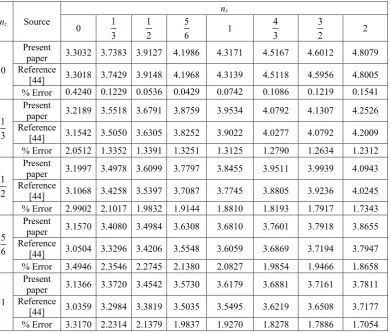
Table 1. Comparison of fundamental frequency parameter ( ) of BDFGMs beam with SS boundary conditions..
Table 2. Natural frequency (kHz) of BDFGMs beam rested on visco-Pasternak foundation with SS boundary conditions.
Mode
Theory
0.02
0.05
h/L
0.1
0.2
1
Euler-Bernoulli 0.158771 0.171958 0.294981 0.570033
Timoshenko
0.158744 0.171502 0.291014 0.541227
2
Euler-Bernoulli 0.376258 0.593961 1.116871 2.084482
Timoshenko
0.375937 0.587237 1.067453 1.825003
3
Euler-Bernoulli 0.679351 1.286848 2.444741 3.014204
Timoshenko
0.679535 1.25955 2.244661 2.964484
A. Ghorbanpour Arani and Sh. Niknejad, AUT J. Mech. Eng., 4(2) (2020) 201-214, DOI: 10.22060/ajme.2019.15913.5792
207
(a) (b)
(c) (d)
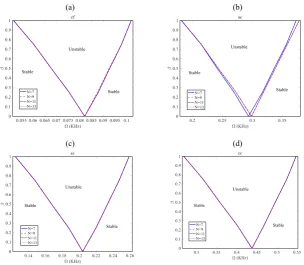
Fig. 2. The convergence of grid points of the GDQ method for a) CF, b) SS, c) SC, d) CC boundary conditions.
(a) (b)
(a) (b)
Fig. 4. Effects of static load factor on the dynamic stability of BDFGMs beam a) power law distribution, b) exponential distribution.
A. Ghorbanpour Arani and Sh. Niknejad, AUT J. Mech. Eng., 4(2) (2020) 201-214, DOI: 10.22060/ajme.2019.15913.5792
208
(a) (b)
(a) (b)
(a) (b)
Fig. 5. Effects of gradient index through in x direction (nx) on the dynamic stability of BDFGMs beam a) power law distribution, b) exponential distribution.
Fig. 6. Effects of gradient index through in z direction (nz) on the dynamic stability of BDFGMs beam a) power law distribution, b) exponential distribution.
A. Ghorbanpour Arani and Sh. Niknejad, AUT J. Mech. Eng., 4(2) (2020) 201-214, DOI: 10.22060/ajme.2019.15913.5792 209 written as: 2 2 0 , L
EBT u EBT
U N dx
x w M x
(25) (25)2 0 0 1 0 2 2 2 2
,
Lu
u
w
w
I
I
t t
t
t
u
u
T
I
dx
t
t
t t
t
w
w
x
x
w
w
x
x
I
t
(26) (26)where subscript EBT refers to Euler–Bernoulli beam theory. Using the Euler–Bernoulli beam theory, the equations of motion and boundary conditions of BDFGMs beam can be obtained by substituting Eqs. (15), (25) and (26) into Eq. (8) and setting the coefficients of δu and δw to zero as follows:
2
0 2 1 2
3
,
EBT
N
I
u
I
x
t
w
x
t
(a)
2 2 2 2 2 30 2 1 2 2 2
4 2
( )
,
EBT fM
F
F t
w
x
x
w
u
I
I
I
t
t
w
t
x
x
(b)
(27) Clamped0, w 0,
u w
x
(a)
Simple
0, EBT 0,
u w M (b)
Free
0, EBT ( ) 0,
EBT EBT M w
N M
x F t x
(c)
(28)
Substituting Eq. (24) into Eq. (11), the normal force-strain and the bending moment-strain relations based on the Euler– Bernoulli beam theory can be expressed as following form:
0 1
2 2
,
EBT
u
N
A
A
x
w
x
(a)
2 21 2
,
EBT
u
M
A
A
x
w
x
(b)
(29)By substituting Eq. (29) into Eq. (27), the equations of motion and boundary conditions in terms of the displacements can be obtained as:
2
0
0 2 1
2 1
0 2 1
2 3 2 2 3 3
,
dA
u
u
A
A
x
dx x
w
x
w
dA
I
u
I
dx
x
t
t
w
x
(a)
2 3 2 1 11 3 2 2
2 2 2 2 2 2 2 3
4 3 2
4 2
2 2
2 3
0 2 1 2 2
4
2 2
2
2
,
w G d
w
w
w
dA
d A
u
u
u
A
x
dx x
dx
x
dA
d A
A
dx
dx
w
w
K w K
C
F t
t
x
w
u
I
I
I
x
t
t
x
x
x
w
x
w
x
t
(b) (30) Clamped0
,
w
0
,
u w
x
(a)Simple 1 2 2 2
0,
0,
u
u w
A
A
x
w
x
(b) Free 2 2 2 31 2 3
2
0,
0.
0,
( )
u
x
u
w
A
A
x
F
x
w
x
w
t
x
(c) (31)5- Solution Method
A. Ghorbanpour Arani and Sh. Niknejad, AUT J. Mech. Eng., 4(2) (2020) 201-214, DOI: 10.22060/ajme.2019.15913.5792
210
(a) (b)
(a) (b)
Fig. 8. Effects of various foundation models on the dynamic stability of BDFGMs beam a) power law distribution, b) exponential distribution.
Fig. 9. Effects of Winkler parameter on the dynamic stability of BDFGMs beam a) power law distribution, b) exponential distribution.
(a) (b)
A. Ghorbanpour Arani and Sh. Niknejad, AUT J. Mech. Eng., 4(2) (2020) 201-214, DOI: 10.22060/ajme.2019.15913.5792
211
( ) 1
, ,
( ), ( ), ( ) ,
i
r
r x x
N r
ij j i j i j i
j
u w
x
A
u x w x
x
(32)(32)
where N is the number of total discrete grid points along the x axis and ( )r
ij
A are the weighting coefficients associated
with the rth order of derivative. Based on the Lagrangian polynomial interpolation, the weighting coefficients for the first derivative (i.e., r = 1) can be approximated by:
(1)
1, , 1,
(1) 1,
( ) ( ) ( )
1 ( )
( )
N N
ij i k j k
k k i j k k j N
ij
k k i i k
A x x x x i j
A i j
x x
for i j, 1,2,...,N
(33)
(33)
Similarly, higher order of derivative can be calculated as:
( 1) (1) ( )
1
for ,
1,2,...,
N
r r
ij ik kj
k
A
A A
i j
N
(34)(34)
On the other hand, the differential quadrature solutions usually deliver more accurate results with nonuniformly spaced sampling. A well accepted kind of sampling points can be obtained by the Chebyshev–Gauss–Lobatto normalized distribution equation:
1
1 cos
1
for
1,2,...,
2
1
i
i
x
i
N
N
(35) (35)By inserting Eq. (32) into Eqs. (21), (22), (30) and (31) and implementing the GDQ method, a set of discretized governing equations and the boundary conditions can be found in the matrix form as follows:
P
0 ,
M X
C X
K
P t K
X
(36) (36)In which M, C, K and KP represent the mass, damping,
stiffness and geometrical stiffness matrices, respectively. Also, X is the displacement vector (X u w= , ,ϕ ).
In 1964, Bolotin [1] suggested a method in order to determine the dynamic instability region. He indicates that the first instability region is wider than other regions and the structural damping becomes neutralized in higher regions. Based on this method, the displacement vector can be expressed in the Fourier series with the period 2T as following form:
1,3,5,...
sin
cos
,
2
2
k k
k
k t
k t
X
a
b
(37)(37)
where ak and bk are unknown constants. By introducing Eq.
(37) into Eq. (36) and setting the coefficients of each sine and cosine as well as the sum of the constant terms to zero, yield:
(a) (b)
A. Ghorbanpour Arani and Sh. Niknejad, AUT J. Mech. Eng., 4(2) (2020) 201-214, DOI: 10.22060/ajme.2019.15913.5792
212
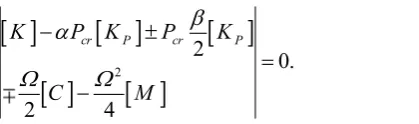
2
2 0.
2 4
cr P cr P
K P K P K
C M
(38)
(38)
Eq. (38) can be solved based on the eigenvalue problems, and the dynamic instability regions will obtain by plotting the variation of Ω with respect to β.
6- Numerical Results and Discussion
In this section, the influences of various parameters such as the gradient index of exponential and power law distributions, length-to-thickness ratio, different boundary conditions and viscoelastic foundation coefficients on the dynamic stability region of beam are discussed in details. Silicon (Si3N4),
zirconia (ZrO2), stainless steel (SUS304) and titanium
(Ti-6Al-4V) with the material properties at room temperature given in reference [43] are employed as ceramic1, ceramic2, metal1 and metal2, respectively. In addition, CC boundary condition is considered for BDFGMs beam except for the cases to be mentioned. Also, In order to obtain the results of this research, other parameters are selected as follows:
2m,
L= h L/ =0.04, 2
x z
n =n = =0.3
4 3
10 N/m ,
w
K = 10 N/m,3
G
K =
3 50 N.s/m ,
d
C = =0.2
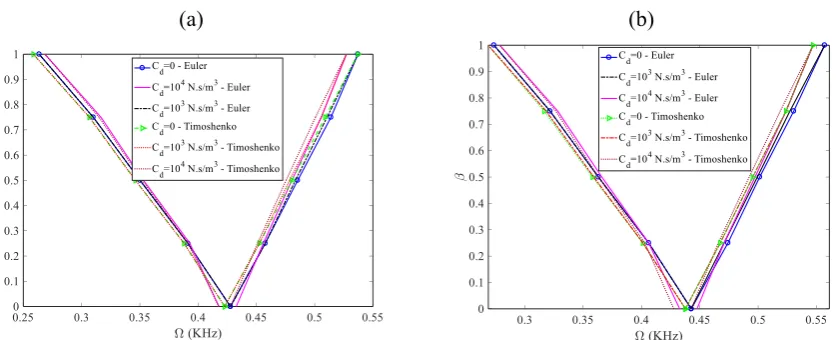
Fig. 2 indicates the convergence of grid points of the GDQ method used to evaluate the stability of the BDFGMs beam with arbitrary boundary conditions. The results show that the convergence occurs quickly for different boundary conditions and thus, N=11 selected to obtain the numerical results. This pattern of convergence of the numerical technique reflects its efficiency and reliability.By converging the grid points in
N=11, validation and convergence of the derived formulation must be checked now. For this purpose, in Table 1, the fundamental frequency parameters of BDFGMs beam with SS boundary conditions are compared with reference [44] where a finite element formulation based on Timoshenko beam theory was utilized. As can be seen, very good agreement between the results of present paper with reference [44].The effects of thickness-to-length ratio on the natural frequency (kHz) of BDFGMs beam rested on visco-Pasternak foundation with SS boundary conditions are studied in Table 2. Generally, increasing the thickness-to-length ratio leads to increase the natural frequency due to increase the stiffness of BDFGMs beam. Also, the natural frequencies predicted by Timoshenko beam theory are lower than Euler-Bernoulli beam theory. Furthermore, the results of two theories for thin beam are close to each other and by increasing the thickness-to-length ratio, the difference between results becomes more for thick beam.Based on Timoshenko and Euler-Bernoulli beam theories, the dynamic stability regions of BDFGMs beam for various boundary conditions are demonstrated in Fig. 3. As it can be seen from this figure, CC and CF boundary conditions have the highest and lowest parametric resonance. Also, the dynamic instability region for CC boundary condition is higher
than that for other boundary conditions.The dynamic stability regions of BDFGMs beam for various static load factor are shown in Fig. 4. It can be observed that by increasing static load factor, the dynamic instability region shift to the left and increase. This is expected as the increase of
α
means the increase of the time independent component of the axial force which reduces the effective stiffness of the beam. In addition, the parametric resonance obtained by Timoshenko beam theory is lower than Euler-Bernoulli beam theory but the extent of dynamic instability regions of two theories are very close to each other.Fig. 5 indicates the dynamic stability of BDFGMs beam for different gradient indexes through inx direction. According to this figure for both power law and exponential distributions, the parametric resonance increases with increasing of nx and will be approximately constant for
3
x
n ≥ . Fig. 6 illustrates the dynamic stability of BDFGMs beam for different gradient indexes through in z direction. It can be found that by increasing nz, the instability region decreases and moves to the side of smaller parametric resonance. Moreover, the influence of nz is greater than nx
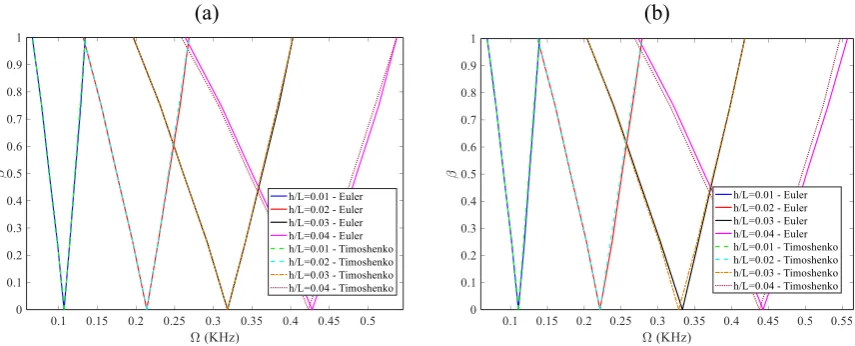
on the dynamic stability of present system by comparing Figs. 5 and 6.The dynamic stability regions of BDFGMs beam for different thickness-to-length ratio are depicted in Fig. 7. It is obvious that by increasing thickness-to-length ratio, the system becomes more stable and thus, parametric resonance increases and shifts to the right side of figure. Fig. 8 shows the effect of various foundation models on parametric resonance of BDFGMs beam. Four cases are considered to study the effect of foundation models, namely, case 1 (without foundation: Kw =0, KG =0,Cd =0), case 2
(Winkler foundation: Kw =50MN/m3,KG =0,Cd =0), case
3 (Pasternak foundation: Kw =50 MN/m3,KG=10 MN/m
,Cd =0) and case 4 (visco-Pasternak foundation: Kw =50
MN/m3, 10
G
K = MN/m, Cd =10KN.s/m3).
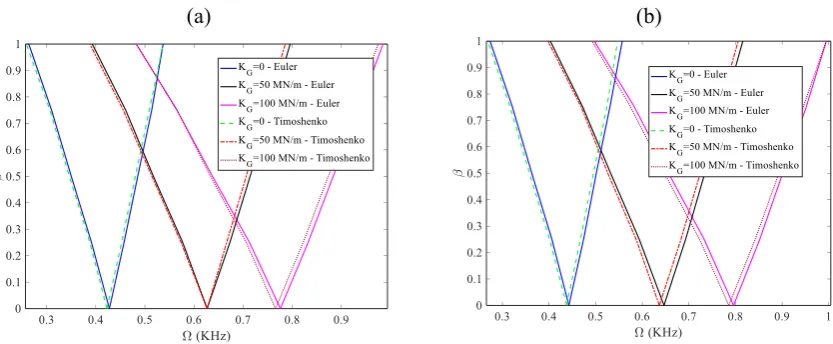
It is evident that by adding the effects of elastic substrate to the system, parametric resonance increases and the dynamic instability region shifts to the right. As can be seen, the dynamic instability region of the Pasternak model due to consider the effects of normal stresses and the transverse shear deformation is higher than that of Winkler or visco-Pasternak one. Generally, putting BDFGMs beam in an elastic substrate leads to increase the stability and stiffness of system.Figs. 9 to 11 demonstrate the effects of visco-Pasternak foundation parameters on the behavior of BDFGMs beam. Figs. 9 and 10 show the effects of Winkler and shear layer parameters on the dynamic stability regions of BDFGMs beam, respectively. By increasing this two parameters, stiffnessOf system increase and thus, parametric resonance increases and the dynamic instability region shifts to the right. Moreover, variations of shear layer parameter have more influence than Winkler parameter on the displacement of dynamic stability regions. Fig. 11 indicates the effects of damping parameter on the dynamic stability regions of BDFGMs beam. It can be seen from this figure that the dynamic instability region of BDFGMs beam reduces by increasing damping parameter. 7- Conclusions
A. Ghorbanpour Arani and Sh. Niknejad, AUT J. Mech. Eng., 4(2) (2020) 201-214, DOI: 10.22060/ajme.2019.15913.5792
213 equations obtained by utilizing the Hamilton’s principle according to the Euler-Bernoulli and Timoshenko beam theories and solved by GDQ method in conjunction with the Bolotin method.The results indicated that:
• The parametric resonance obtained by Timoshenko theory is lower than Euler-Bernoulli theory but the extent of dynamic instability regions of two theories are very close to each other. • The influence of gradient index of material properties along the thickness direction is greater than gradient index along the longitudinal direction on the dynamic stability of BDFGMs beam for both exponential and power law distributions. • Considering exponential law model in order to determine the material properties of BDFGMs beam causes to obtain the larger parametric resonance in comparison with power law model.
• Putting BDFGMs beam in an elastic substrate makes the system more stable and stiffer.
• The dynamic instability region moves to the smaller parametric resonance by increasing static load factor.
References
[1] V.V. Bolotin, The Dynamic Stability of Elastic Systems, Holden-Day, San Francisco, CA, 1964.
[2] G.J. Simitses, Instability of dynamically-loaded structures, Applied Mechanics Reviews 40(10) (1987) 1403-1408. [3] G.J. Simitses, Dynamic stability of suddenly loaded structures, Springer, New York, 1990.
[4] T. Iwatsubo, Y. Sugiyama, S. Ogino, Simple and combination resonances of columns under periodic axial loads, Journal of Sound and Vibration 33(2) (1990) 211–221. [5] B.A.H. Abbas, J. Thomas, Dynamic stability of Timoshenko beams resting on an elastic foundation, Journal of Sound and Vibration, 60(1) (1978) 33–44.
[6] J.D. Aristizabal-Ochoa, Statics stability and vibration of non-prismatic beams and columns, Journal of Sound and Vibration, 162(3) (1993) 441-455.
[7] L. Briseghella, C.E. Majorana, C. Pellegrino, Dynamic stability of elastic structures: a finite element approach, Computers and Structures, 69 (1998) 11-25.
[8] H. Öztürk, M. Sabuncu, Stability analysis of a cantilever composite beam on elastic supports, Composites Science and Technology, 65(13) (2005) 1982-1995.
[9] B.P. Shastry, G.V. Rao, Dynamic stability of columns with two symmetrically placed intermediate supports Journal of Sound and Vibration, 104(3) (1986) 524-527.
[10] X.F. Li, A unified approach for analyzing static and dynamic behaviors of functionally graded Timoshenko and Euler–Bernoulli beams, Journal of Sound and Vibration, 318(4-5) (2008) 1210-1229.
[11] L.L. Ke, Y.S. Wang, Size effect on dynamic stability of functionally graded microbeams based on a modified couple stress theory, Composite Structures, 93(2) (2011) 342-350. [12] S.C. Mohanty, R.R. Dash, T. Rout, Static and Dynamic Stability Analysis of a Functionally Graded Timoshenko Beam, International Journal of Structural Stability and Dynamics, 12(04) (2012) 1250025.
[13] Y. Fu, J. Wang, Y. Mao, Nonlinear analysis of buckling, free vibration and dynamic stability for the piezoelectric functionally graded beams in thermal environment, Applied Mathematical Modelling, 36(9) (2012) 4324-4340.
[14] M. Zamanzadeh, G. Rezazadeh, I. Jafarsadeghi-poornaki, R. Shabani, Static and dynamic stability modeling
of a capacitive FGM micro-beam in presence of temperature changes, Applied Mathematical Modelling, 37(10-11) (2013) 6964-6978.
[15] L.L. Ke, J. Yang, S. Kitipornchai, Dynamic Stability of Functionally Graded Carbon Nanotube-Reinforced Composite Beams, Mechanics of Advanced Materials and Structures, 20(1) (2013) 28-37.
[16] A. Ghorbanpour Arani, M. Hashemian, R. Kolahchi, Nonlocal Timoshenko beam model for dynamic stability of double-walled boron nitride nanotubes conveying nanoflow, Proceedings of the Institution of Mechanical Engineers, Part N: Journal of Nanoengineering and Nanosystems, 229(1) (2013) 2-16.
[17] S.E. Ghiasian, Y. Kiani, M.R. Eslami, Nonlinear thermal dynamic buckling of FGM beams, European Journal of Mechanics - A/Solids, 54 (2015) 232-242.
[18] Y. Xu, Y. Qian, J. Chen, G. Song, Stochastic dynamic characteristics of FGM beams with random material properties, Composite Structures, 133 (2015) 585-594. [19] N.L. Shegokara, A. Lal, Stochastic dynamic instability response of piezoelectric functionally graded beams supported by elastic foundation, Advances in aircraft and spacecraft science, 3(4) (2016) 471-502.
[20] S. Saffari, M. Hashemian, D. Toghraie, Dynamic stability of functionally graded nanobeam based on nonlocal Timoshenko theory considering surface effects, Physica B: Condensed Matter, 520 (2017) 97-105.
[21] A. Ghorbanpour Arani, A. Cheraghbak, R. Kolahchi, Dynamic buckling of FGM viscoelastic nano-plates resting on orthotropic elastic medium based on sinusoidal shear deformation theory, Structural Engineering and Mechanics, 60(3) (2016) 489-505.
[22] A. Ghorbanpour Arani, R. Kolahchi, M.S. Zarei, Visco-surface-nonlocal piezoelasticity effects on nonlinear dynamic stability of graphene sheets integrated with ZnO sensors and actuators using refined zigzag theory, Composite Structures, 132 (2015) 506-526.
[23] A. Ghorbanpour Arani, M.H. Jalaei, Nonlocal dynamic response of embedded single-layered graphene sheet via analytical approach, Journal of Engineering Mathematics, 98(1) (2015) 129-144.
[24] J.C. Yao, Dynamic Stability of Cylindrical Shells under Static and Periodic Axial and Radial Loads, AIAA Journal, 1(6) (1963) 1391-1396.
[25] K. Nagai, N. Yamaki, Dynamic stability of circular cylindrical shells under periodic compressive forces, Journal of Sound and Vibration, 58(3) (1978) 425-441.
[26] A. Ghorbanpour Arani, S.A. Mortazavi, Z.K. Maraghi, Dynamic stability of nanocomposite viscoelastic cylindrical shells coating with a piezomagnetic layer conveying pulsating fluid flow, Science and Engineering of Composite Materials, 24(3) (2017).
[27] M. Zamani Nejad, A. Hadi, Eringen’s non-local elasticity theory for bending analysis of bi-directional functionally graded Euler–Bernoulli nano-beams, International Journal of Engineering Science, 106 (2016) 1-9.
[28] M. Zamani Nejad, A. Hadi, A. Rastgoo, Buckling analysis of arbitrary two-directional functionally graded Euler–Bernoulli nano-beams based on nonlocal elasticity theory, International Journal of Engineering Science, 103 (2016) 1-10.
A. Ghorbanpour Arani and Sh. Niknejad, AUT J. Mech. Eng., 4(2) (2020) 201-214, DOI: 10.22060/ajme.2019.15913.5792
214 free vibration of bi-directional functionally graded Euler– Bernoulli nano-beams, International Journal of Engineering Science, 105 (2016) 1-11.
[30] A. Pydah, A. Sabale, Static analysis of bi-directional functionally graded curved beams, Composite Structures, 160 (2017) 867-876.
[31] A. Pydah, R.C. Batra, Shear deformation theory using logarithmic function for thick circular beams and analytical solution for bi-directional functionally graded circular beams, Composite Structures, 172 (2017) 45-60.
[32] A. Karamanlı, Elastostatic analysis of two-directional
functionally graded beams using various beam theories and Symmetric Smoothed Particle Hydrodynamics method, Composite Structures, 160 (2017) 653-669.
[33] N. Shafiei, M. Kazemi, Buckling analysis on the bi-dimensional functionally graded porous tapered nano-/micro-scale beams, Aerospace Science and Technology, 66 (2017) 1-11.
[34] N. Shafiei, S.S. Mirjavadi, B. MohaselAfshari, S. Rabby, M. Kazemi, Vibration of two-dimensional imperfect functionally graded (2D-FG) porous nano-/micro-beams, Computer Methods in Applied Mechanics and Engineering, 322 (2017) 615-632.
[35] L.C. Trinh, T.P. Vo, H.T. Thai, T.K. Nguyen, Size-dependent vibration of bi-directional functionally graded microbeams with arbitrary boundary conditions, Composites Part B: Engineering, 134 (2018) 225-245.
[36] M. Koizumi, FGM activities in Japan Composites Part B: Engineering, 28(1-2) (1997) 1-4.
[37] H. Deng, W. Cheng, Dynamic characteristics analysis of bi-directional functionally graded Timoshenko beams,
Composite Structures, 141 (2016) 253-263.
[38] T. Kaneko, On Timoshenko’s correction for shear in vibrating beams, Journal of Physics D: Applied Physics, 8 (1975) 1927-1936.
[39] A. Ghorbanpour Arani, E. Haghparast, H. BabaAkbar-Zarei, Nonlocal vibration of axially moving graphene sheet resting on orthotropic visco-Pasternak foundation under longitudinal magnetic field, Physica B: Condensed Matter, 495 (2016) 35-49.
[40] M. Mohammadimehr, B.R. Navi, A. Ghorbanpour Arani, Dynamic stability of modified strain gradient theory sinusoidal viscoelastic piezoelectric polymeric functionally graded single-walled carbon nanotubes reinforced nanocomposite plate considering surface stress and agglomeration effects under hydro-thermo-electro-magneto-mechanical loadings, Mechanics of Advanced Materials and Structures, 24(16) (2016) 1325-1342.
[41] C. Shu, Differential quadrature and its application in engineering, Springer, New York, 2000.
[42] C. Shu, H. Du, Implementation of clamped and simply supported boundary conditions in the GDQ free vibration analysis of beams and plates, Journal of Sound and Vibration, 34(7) (1997) 819–835.
[43] Y.W. Kim, Temperature dependent vibration analysis of functionally graded rectangular plates, Journal of Sound and Vibration, 284(3-5) (2005) 531-549.