IJMF
Online ISSN: 2383-0042Iranian Journal of Materials Forming
Journal Homepage: http://ijmf.shirazu.ac.ir
Application of Friction Stir Processing (FSP) as a Cladding Method to
Produce AA2024-AA1050 Multi-layer Sheets
A.Jaferi Salour, Z. Sadeghian∗ and B. Lotfi
ِDepartment of Materials Science and Engineering, Faculty of Engineering, Shahid Chamran University of Ahvaz, Ahvaz, Iran
A R T I C L E I N F O
A B S T R A C T
Article history:
Received 23 January 2019 R evi s ed 20 June 2019 Accepted 26 June 2019
Friction stir processing (FSP) was used as a cladding method for the fabrication of a AA2024 clad layer on a AA1050 sheet. Crossover multi pass FSP with 50% overlap was considered as the cladding method. Effects of the number of FSP passes and post heat treatment on the microstructure and properties of clad layers were evaluated. Microstructural evolutions during the FSP and heat treatment were investigated by field emission scanning electron microscopy (FESEM). The results showed that a defect free clad layer and a uniform metallurgical interface between the clad layer and base material can be achieved by the FSP. Moreover, clad layers exhibited higher hardness values in comparison to the base material. T4 Heat treatment of the FSPed samples resulted in comparatively high hardness values after natural aging. The highest hardness value of about 160 HV was achieved after heat treatment of the sample obtained from 3 intersecting FSP passes. Tensile strength of clad layers increased to 317 MPa after three intersecting FSP passes, compared to about 70 MPa of Al substrate.
© Shiraz University, Shiraz, Iran, 2019 Keywords:
Cladding
Friction stir processing AA 2024
1. Introduction
Aluminium and its alloys have been considered as prime materials for different applications such as
transportation, building, packaging and sport industries. AA2024 is a well-known Al alloy recognised for its high fatigue performance and formability, high damage
tolerance, and high durability. Hence it is widely used in aircraft applications, especially in fuselage skins [1]. The combination of the acceptable cost, low density, appropriate mechanical properties, structural integrity and ease of fabrication is attractive in every application
[1-3]. However, it is often difficult to attain a wide variety of requirements for a single material. To increase the persistence and performance, various methods have been developed to protect the components by distinctive
∗ Corresponding author
E-mail address: [email protected] (Z. Sadeghian)
coatings or clads. Coatings and clads of specific alloys and composites can provide a combination of various
properties such as hardness and wear resistance on the surface and high toughness in the substrate in comparison with metal matrix composites (MMCs) or
monolithic bulk materials [4].
Friction stir processing (FSP) is one of the techniques
to fabricate surface composites and modify
microstructural features. FSP has been derived from
friction stir welding process and can be used for surface
or in-volume processing of metals and alloys. This
process has been recognized as an effective treatment for
achieving microstructural refinement, densification and
homogenization, as well as eliminating defects in
castings and forgings [5-7].
IJMF Iranian Journal of Materials Forming Shiraz University
In FSP, a rotating tool that includes a shoulder and a pin is plunged into the surface of the material. Tool rotation creates frictional heat and the dynamic mixing of the metal underneath, which results in microstructural refinement and the incorporation and/or dispersion of the reinforcing particles into a matrix such as aluminium alloys, magnesium alloys and copper [8-9].
According to the literature, many researches have been involved in the butt and single seam lap joint configurations processed by FSW/FSP [10-11]. Recently, few attempts have been made to develop FSP/FSW as an alternative cladding technique, based on multi-seam friction stir lap welding. It has been reported that FSP/FSW can result in enhanced joint properties and reduced physical and metallurgical deficiencies in comparison with conventional cladding processes. An introductory study on the fabrication of AZ80/Al composite plate by the FSP was reported by Liu et al who indicated the formation of a dense composite Al layer with fine and uniform grains [12]. Lakshminarayanan and Annamalai studied the effects of the process parameters on the quality characteristics of dissimilar magnesium-aluminium alloy clad joints [13]. To the authors’ knowledge, using intersecting passes for the FSP cladding has not been presented in the literature before. The effects of the overlapping multi-passes in two directions on the mechanical properties and microstructure of AZ31 magnesium alloy were studied, and it was indicated that two this directional overlap results in a decreased grain size and increased uniformity of the grain distribution, hardness, yield strength, and ultimate strength [14].
The aim of the present study was to fabricate a clad layer of AA2024 alloy on the surface of AA1050 alloy. Three intersecting passes were applied by the FSP to provide bonding between the two Al alloy sheets. The microstructure of the FSPed clad layers was studied by optical microscopy and scanning electron microscopy. Hardness profiles of the claddings were obtained from hardness measurements, and the tensile properties of the clad layers at ambient temperature were studied by tensile tests.
2. Experimental Details
Commercially pure Al alloy (AA 1050) was used as the base material. Rolled sheets of 8 mm thickness were
cut to 140 mm× 140 mm specimens. AA 2024-T3 Al alloy with a thickness of 2 mm and 140 mm×140 mm area was considered as the cladding material. Chemical compositions of base and clad materials are presented in Table 1. Al2024 sheets were annealed at 380 oC for two
hours, before the FSP.
Table 1: Chemical composition of as-received AA1050 substrate and AA2024 clad layer.
Material Al Ti Zn Cr Mg Mn Cu Fe Si AA1050 99.70.006 0.0050.001 -- 0.001 0.001 0.17 0.048 AA2024 93 0.03 0.0210.002 1.4 0.51 4.75 0.1320.059
A milling machine (X52, Beijing No. 2 Machine Tool Works Co., Ltd.) was used to conduct the FSP experiments. A cylindrical threaded tool containing a pin of 6 mm diameter and 5 mm length, and a shoulder of 18 mm diameter made of hot worked H13 tool steel was used for the FSP. The tool was hardened to achieve a hardness of 53 HRC. Tool rotational speed of 1000 rpm with traverse speed of 40 mm/min at 2.5o tilt angle were
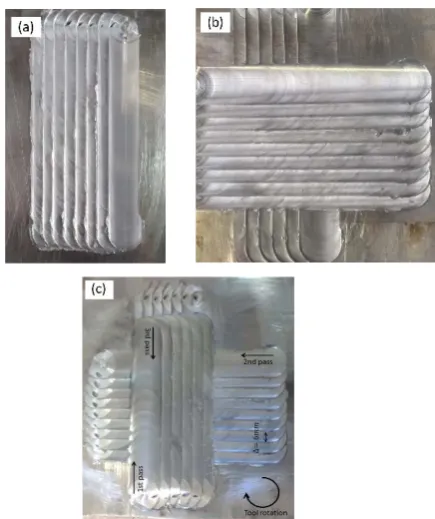
used for FSP cladding. The AA 2024 cladding sheet was overlaid on a AA 1050 substrate and fixed firmly by jigs. FSP Cladding was conducted by three intersecting FSP passes of about 50% overlap as shown in (fig. 1).
Fig. 1. Typical surface appearance of the FSPed samples
The FSPed samples were heat treated with T4
conditions (solution treatment at 480 oC for 1 h, water
quenched to room temperature and naturally aged). The
FSP cladded samples were sectioned and prepared by
metallographic techniques for microstructural
investigations. A Mira3 Tescan field emission scanning
electron microscope (FESEM) was used for the
microstructural investigation of the cross sections of the
samples. Samples for microstructural testing were cut
perpendicular to the direction of the latest FSP pass.
Vickers microhardness tests were carried out on the FSP
substrate and cladded samples before and after T4 heat
treatment to achieve cross sectional microhardness
profiles along the clad layer and from the FSPed 2024
clad layer to the base material. Microhardness
measurements were performed using a Nexus Innova
4300 microhardness testing machine under 100 g
loading for 10 seconds. Tensile properties were
determined by a SANTAM-STM-50KN machine
according to the ASTM E8M standard [15]. Flat tensile
specimens of 6.4 mm gauge length, 2.5 mm width and
1.5 mm thickness were machined out from the AA1050
base material and clad layers parallel to the latest FSP
pass. Tensile experiments were conducted at ambient
temperature with a strain rate of 10-3 s-1. A schematic
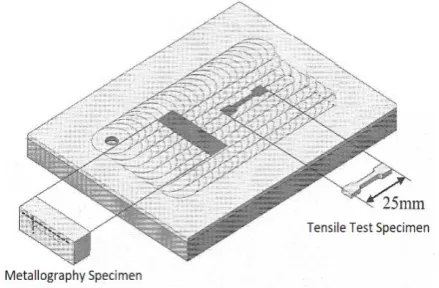
illustration of the metallography and tensile test
specimens is presented in (Fig. 2).
Fig. 2. schematic illustration of the metallography and
tensile test specimens according to the direction of the last FSP pass
3. Results and Discussion
Figure 2 shows the cross-sectional SEM micrographs
of the cladded samples after different FSP passes. The
resultant clad layers seem to be free of microstructural
defects such as tunnels and worm holes after three FSP
passes. This can be attributed to the sufficient stirring of
the material during the FSP as a result of the optimum
combination of the process parameters [8]. It should be
mentioned that other combinations of the FSP
parameters could not result in flawless samples. As
shown in (Fig. 2a), AA2024 was cladded successfully on
the surface of the Al substrate, even after the first FSP
pass. However, a few flaws can be seen in the clad layer
obtained from one FSP pass. The height of the stir zone
seems to be about 5 mm which is equal to the length of
the pin. Considering the thickness of AA2024 cladded
sheet (2 mm), it can be suggested that both clad and
substrate have been affected by the stirring effect of the
FSP. After the second FSP pass (intersectional
direction), a more uniform stir zone can be seen with no
significant difference in the thickness compared to that
obtained from the first pass, as shown in (Fig. 2b). The
sample obtained from three intersecting FSP passes
showed the most uniform AA2024 clad layer without
any apparent defects. Considering the advancing side
(AS) and the retreating side (RS) for each FSP pass,
shown in (Fig. 1c), the waviness of the clad surface can
be explained. On the surface of the clad layers obtained
from one and two FSP passes a somehow waved surface
with curling flashes can be seen.
Overlapped by the AS, a pronounced waved surface
is produced since the flashes are actually curling over the
previous pass, giving a wavelike finishing to the surface.
This feature has been changed after three FSP passes. In
the clad layer obtained from the third FSP pass, AS and
RS sides are opposing those of the first pass and this
could result in a smoother surface finish by the
successive destruction of the flashes on the AS of the two
previous passes. Gandra et al. reported similar results
after investigating the effect of the overlapping direction
(a)
(b)
3. Results and discussion
3.1. Microstructures
(c)
Fig. 3. SEM cross-sectional images of the FSPed AA2024
clad layers on the AA1050 obtained from a) one, b) two and c) three FSP passes.
Figure 3 shows distinct regions of the clad layers
obtained from different FSP passes, which are also
shown in (Fig. 2). Zone A is about 2 mm under the
surface of all the FSPed samples which can be
considered as the initial interface between AA2024
sheet and the substrate. Zone B demonstrates the
bottom of the stir zone considering the height of the
pin. As can be seen in the SEM micrographs, even in
zone B, which is about 2 mm underneath the interface
of the clad layer and the substrate, the precipitates
belonging to AA2024 sheet have been dispersed.
However, by increasing the number of the intersecting
FSP passes, a more uniform distribution of the
precipitates in zone B can be seen. It should be
mentioned that the quantity of the precipitates in zone
B is less than that in zone A.
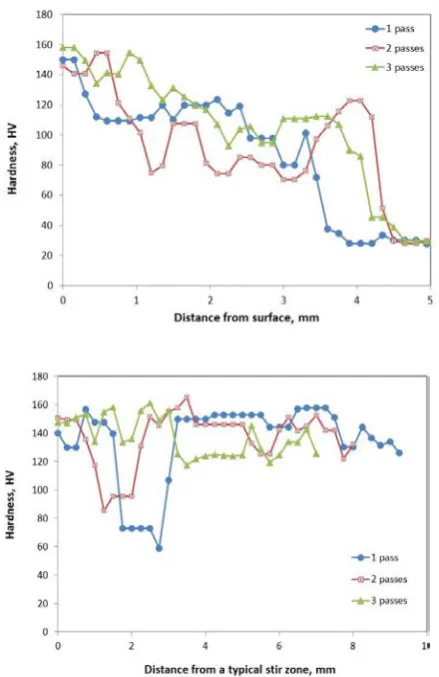
Figure 4 shows the microhardness profiles of the
AA2024 clad layers on the surface and across the layer
after different FSP passes. The mean hardness of the
clad layer obtained from the first FSP pass was about
80 HV and increased slightly to about 100 HV after
applying the second intersecting FSP pass. It has been
reported that during the FSP the material is affected by
the annealing effect of the process, which can reduce
the hardness as well as dynamic recrystallization that
can reversely enhance it [17-19]. Therefore, in the
present study, it can be concluded that the dynamic
recrystallization may have been dominant compared to
the annealing effect of the FSP. The same behaviour
has been reported for AA6063-T6 [17, 20]. Hardness
profiles of the FSPed samples from AA2024 clad layer
to Al substrate showed an increase from about 25 HV
in the substrate to a maximum of 100 HV on the
surface of the clad layer. It should be noticed that the
depth of the zone with increased hardness developed
to more than 3 mm after the second FSP pass.
Considering the thickness of AA2024 sheet (2 mm), it
can be concluded that at the interface the clad layer
was mixed with the substrate and this resulted in an
increase in the hardness. This is in agreement with the
SEM micrographs of the clad layers. After 3 FSP
passes, no significant increase in the hardness was
achieved. However, it is worth noticing that the
hardness value dropped at some points compared to
that obtained after 2 FSP passes. This may be
explained by the local over aging of the precipitates
due to a temperature rise during the FSP [21].
A
A
A B
B
Fig. 4. Cross-sectional SEM micrographs of AA2024 clad layers at different zones depicted in Fig. 1 after
a) one, b) two and c) three FSP passes.
Fig. 5. Microhardness profiles of the FSPed AA2024 clad
layers on Al substrate after different FSP passes; a) on the surface of clad layer and b) from the clad layer to the substrate.
The engineering stress-strain curves obtained from tensile experiments conducted on samples obtained from AA2024 clad layers after different FSP passes are shown in (Fig. 5). As can be observed all the FSPed clad layers show considerably higher yield and tensile strength compared to AA1050 substrate. It should be noted that increasing the number of the FSP passes also resulted in the improvement of the tensile properties. Enhancement of the mechanical properties due to the FSP has been attributed not only to the refining action of the microstructure induced by the dynamic recrystallization mechanisms during the process, but also to the elimination of the defects such as micro porosities or cracks [22]. The latter may be considered as the reason for simultaneously enhanced strength and ductility obtained from the sample produced by three intersecting FSP passes.
Fig. 6. Engineering stress strain curves obtained from the
base material and AA2024 clad layers after different FSP passes.
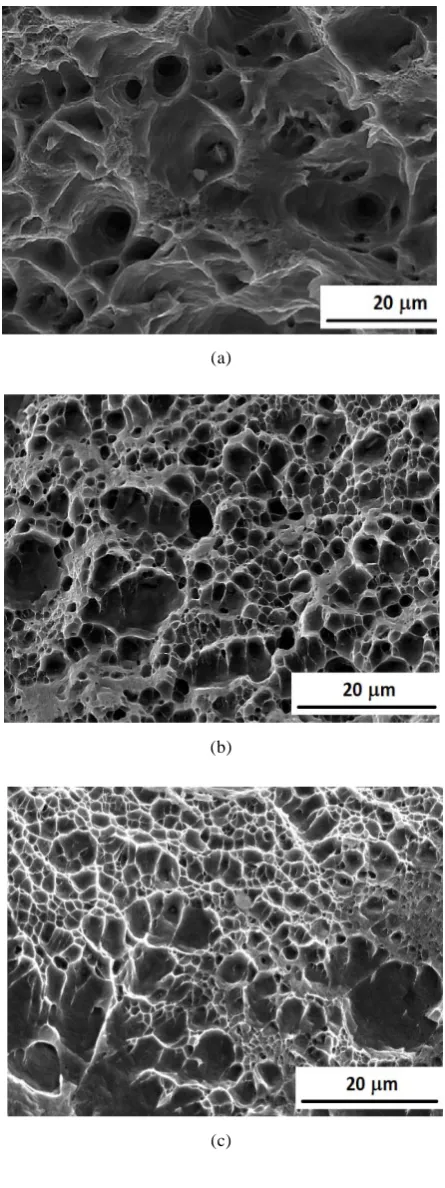
increasing the number of FSP passes to three, a relatively homogeneous distribution of very small and narrow dimples of about 1 µm can be observed in the SEM micrograph of the fracture surface. This can be related to the smaller grain size obtained after three FSP passes [17,23].
(a)
(b)
(c)
(d)
Fig. 6. Fracture surface SEM micrographs of a) AA1050,
and AA2024 clad layers obtained from b) one, c) two, and d) three FSP passes.
Figure 7 shows the microhardness profiles on the
surface and across AA2024 clad layers obtained from different FSP passes after T4 heat treatment. In comparison with (Fig. 4), it is evident thata significant increase in the microhardness occurred in the FSPed clad
layers after T4 heat treatment. In the AA2024 clad layer obtained from three FSP passes, a hardness of up to 160 HV could be achieved on the surface after natural aging. Meanwhile, the FSPed sample obtained from three
intersecting passes showed more uniform distribution of hardness values compared to other samples. It has been reported that the dissolution of coarse precipitates by solution annealing and re-precipitation of fine
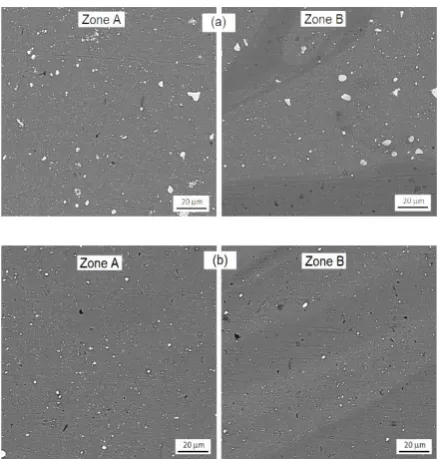
precipitates during aging is the reason for the increased hardness observed in the heat-treated samples [24]. FESEM micrographs of the T4 heat treated samples are shown in (Fig. 8). As can be observed, after T4 heat
treatment the size of the precipitates in all samples has decreased significantly, compared to that of the FSPed samples. It is worth noting that the AA2024-T4 clad layer obtained from three intersecting FSP passes
exhibited meaningful uniform distribution of smaller precipitates in comparison to other samples. This can be explained by the uniform distribution of the precipitates in this clad layer due to additional FSP passes (as seen
in (Fig. 3c), which resulted in the enhanced dispersion of the elements during solution annealing, and more uniform re-precipitation of GP-Zones during natural aging. A similar phenomenon has been reported and
Fig. 7. Microhardness profiles of the T4- heat treated FSPed AA2024 clad layers on Al substrate after different FSP
passes; a) on the surface of the clad layer and b) from the surface of the clad layer to the substrate.
(a)
(b)
(c)
Fig. 8. Cross-sectional SEM micrographs of AA2024
clad layers after T4 heat treatment a) one, b) two and c) three FSP passes.
4. Conclusion
The FSP was successfully applied for the cladding of
AA2024 alloy on AA1050 using three intersecting
passes. Clad layers obtained from different FSP passes
were sound and defect-free with a metallurgical
clad-substrate interface. The hardness of the clad layer
obtained from three intersecting FSP passes was about
100 HV compared to 25 HV of Al substrate, which
increased to 160HV after T4 heat treatment. Tensile
strength of 317 MPa was achieved in AA2024 clad layer
compared to about 70 MPa of Al substrate.
5.Acknowledgement
This study was financially supported by Shahid
Chamran University of Ahvaz under grant No. 867615.
6. References
[1] Z. Ahmad, Aluminium Alloys - New Trends in
Fabrication and Applications, first edition, In Tech,
United Kingdom, (2012) 48-97.
[2] P. Rambabu, N. Eswara Prasad, V.V. Kutumbarao,
R.J.H. Wanhill, Aluminium Alloys for Aerospace
Applications. In: Prasad N., Wanhill R. (eds)
Aerospace Materials and Material Technologies.
Indian Institute of Metals Series. Springer, Singapore,
(2017) 29-52. High
magnification
High magnification
[3] F. Casarotto, A.J. Franke R. Franke, Advanced Materials
in Automotive Engineering, edited by Jason Rowe,
Woodhead Publishing, Cambridge, UK, 109 (2012).
[4] Sergio Correia, Vitor Anes, Luis Reis, Effect of surface
treatment on adhesively bonded aluminium-aluminium
joints regarding aeronautical structures, Engineering
Failure Analysis, 84 (2018) 34-45.
[5] Y. Chi, G. Gu, H. Yu, C. Chen, Laser surface alloying on
aluminum and its alloys: A review, Optics and Lasers in
Engineering, 100 (2018) 23-37.
[6] W. Zhang, H. Ding, M. Cai, W. Yang, J. Li, Ultra-grain
refinement and enhanced low-temperature
superplasticity in a friction stir-processed Ti-6Al-4V
alloy, Materials Science and Engineering: A, 727 (2018)
90-96.
[7]H. Eskandari, R. Taheri, F. Khodabakhshi, Friction-stir
processing of an AA8026-TiB2-Al2O3 hybrid
nanocomposite: Microstructural developments and
mechanical properties, Materials Science and
Engineering: A, 660 (2016) 84-96.
[8] M. Balakrishnan, I. Dinaharan, R. Palanivel, R. Sathiskumar,
Effect of friction stir processing on microstructure and tensile
behavior of AA6061/Al3Fe cast aluminum matrix
composites, Journal of Alloys and Compounds (2019) in
press, https://doi.org/10.1016/j.jallcom.2019.01.211.
[9] Z. Ma, Friction Stir Processing Technology: A Review,
Metallurgical and Materials Transactions A, 39(3)
(2008) 642-658.
[10] O.S. Salih, H. Ou, W. Sun, D.G. McCartney, A review
of friction stir welding of aluminium matrix composites,
Materials & Design, 86 (2015) 61-71.
[11] G. Buffa, D. Baffari, A. Di Caro, L. Frantini, Friction
stir welding of dissimilar aluminium–magnesium
joints: Sheet mutual position effects, Science and
Technology of Welding and Joining, 20 (2015) 271−279.
[12] Y. Yong, Z. Da-tong, Q. Cheng, Z. Wen, Dissimilar
friction stir welding between 5052 aluminum alloy and
AZ31 magnesium alloy, Transactions of Nonferrous
Metals Society of China, 20 (2010) 619−623.
[13] F. Liu, Q. Liu, C. Huang, K. Yang, C. Yang, L. Ke,
Microstructure and corrosion resistance of AZ80/Al
composite plate fabricated by friction stir processing,
Material Science Forum, 747−748 (2013) 313−319.
[14] A.K. Lakshminarayanan, V.E. Annamalai, Fabrication
and performance evaluation of dissimilar magnesium–
aluminium alloy multi-seam friction stir clad joints,
Transactions of Nonferrous Metals Society of China,
27(1) (2017) 25-35.
[15] A. Alavi Nia, H. Omidvar, S.H. Nourbakhsh, Effects
of an overlapping multi-pass friction stir process and
rapid cooling on the mechanical properties and
microstructure of AZ31 magnesium alloy, Materials
and Design, 58 (2014) 298-304.
[16] Standard test methods for tension testing of metallic
materials, ASTM International, (2010).
[17] J. Gandra, R.M. Miranda, P. Vilaça, Effect of
overlapping direction in multi-pass friction stir
processing, Materials Science and Engineering: A, 528
(16–17) (2011) 5592-5599.
[18] T.R. McNelley, S. Swaminathan, J.Q. Su,
Recrystallization mechanisms during friction stir
welding/processing of aluminum alloys, Scripta
Materialia, 58 (5) (2008) 349-354.
[19] L. John Baruch, R. Raju, V. Balasubramanian, A. G.
Rao, I. Dinaharan, Influence of Multi-pass Friction Stir
Processing on Microstructure and Mechanical Properties
of Die Cast Al–7Si–3Cu Aluminum Alloy, Acta
Metallurgica Sinica (English Letters), 29(5) (2016)
431-440.
[20] K.V. Jata, S.L. Semiatin, Continuous dynamic
recrystallization during friction stir welding of high
strength aluminum alloys, Scripta Materialia, 43 (2000)
743-749.
[21] N. Nadammal, S.V. Kailas, J. Szpunar, S. Suwas,
Restoration Mechanisms During the Friction Stir
Processing of Aluminum Alloys, Metallurgical and
Materials Transactions A, 46 (7) (2015) 2823-2828.
[22] M.L. Santella, T. Engstrom, D. Storjohann, T.Y. Pan,
Effects of friction stir processing on mechanical
properties of the cast aluminum alloys A319 and A356,
Scripta Materialia, 53 (2) (2005) 201-206.
[23] A. Kumar, S.K. Sharma, K. Pal, S. Mula, Effect of
Process Parameters on Microstructural Evolution,
Mechanical Properties and Corrosion Behavior of
Friction Stir Processed Al 7075 Alloy, Journal of
Materials Engineering and Performance, 26 (3) (2017)
[24] D. M. Sekban, S. M. Aktarer, H. Shang, P. Xue, Z. Ma,
G. Purcek, Microstructural and Mechanical Evolution of
a Low Carbon Steel by Friction Stir Processing,
Metallurgical and Materials Transactions A, 48 (2017)
3869-3879.
[25] D. Ghanbari, M. Kasiri Asgarani, K. Amini, F.
Gharavi, Influence of heat treatment on mechanical
properties and microstructure of the Al2024/SiC
composite produced by multi–pass friction stir
ﯽﺷﺎﺸﺘﻏا ﯽﮐﺎﮑﻄﺻا ﺪﻨﯾاﺮﻓ زا هدﺎﻔﺘﺳا
(FSP)
ﺶﮐور شور ناﻮﻨﻋ ﻪﺑ
قرو ﺪﯿﻟﻮﺗ ياﺮﺑ يرﺎﮐ
ﻪﯾﻻﺪﻨﭼ يﺎﻫ
AA2024-AA1050
ﻰﻔﻄﻟ مﺎﻨﻬﺑ و نﺎﯿﻗدﺎﺻ هﺮﻫز ،رﻮﻟﺎﺳيﺮﻓﺎﺟ ﻦﯿﻣا
.ناﺮﯾا ،زاﻮﻫا ،زاﻮﻫا ناﺮﻤﭼ ﺪﯿﻬﺷ هﺎﮕﺸﻧاد ،ﻰﺳﺪﻨﻬﻣ هﺪﮑﺸﻧاد ،داﻮﻣ ﯽﺳﺪﻨﻬﻣهوﺮﮔ
هﺪــﯿﮑﭼ
ﯽﺷﺎﺸﺘﻏا ﯽﮐﺎﮑﻄﺻا ﺪﻨﯾاﺮﻓ
(
FSP)
ﺶﮐور شور ناﻮﻨﻋ ﻪﺑ
ﺶﮐور ﻪﯾﻻ ﺪﯿﻟﻮﺗ ياﺮﺑ يرﺎﮐ
AA2024
قرو يور
AA1050
.ﺪﺷ هدﺎﻔﺘﺳا
سﺎﭘ
يﺎﻫ
ﯽﻌﻃﺎﻘﺗ
FSP
ﯽﻧﺎﺷﻮﭙﻤﻫ ﺎﺑ
50
%
ﺶﮐور ي اﺮﺑ
ﺄﺗ .ﺪﺷ ﻪﺘﻓﺮﮔ ﺮﻈﻧرد يرﺎﮐ
سﺎﭘ ﺮﯿﺛ
يﺎﻫ
FSP
ﺗراﺮﺣ تﺎﯿﻠﻤﻋ و
ﺮﺑ يﺪﻌﺑ ﯽ
ﺶﮐور صاﻮﺧ و رﺎﺘﺧﺎﺳﺰﯾر
ﺎﻫ
ﻦﯿﺣ يرﺎﺘﺧﺎﺳﺰﯾر تاﺮﯿﯿﻐﺗ .ﺪﺷ ﯽﺑﺎﯾزرا
FSP
ﯽﻧاﺪﯿﻣرﺎﺸﺘﻧا ﯽﻧوﺮﺘﮑﻟا پﻮﮑﺳوﺮﮑﯿﻣ زا هدﺎﻔﺘﺳا ﺎﺑ ﯽﺗراﺮﺣ تﺎﯿﻠﻤﻋ زا ﺲﭘ و
(
FESEM)
.ﺪﺷ ﯽﺳرﺮﺑ
ﺪﻨﯾاﺮﻓ زا هدﺎﻔﺘﺳا ﺎﺑ ﯽﮑﯾژرﻮﻟﺎﺘﻣ ﺖﺧاﻮﻨﮑﯾ كﺮﺘﺸﻣ ﻞﺼﻓ ﺎﺑ ﺐﯿﻋ نوﺪﺑ ﺶﮐور ﻪﮐ داد نﺎﺸﻧ ﺞﯾﺎﺘﻧ
FSP
ﺖﺳا ﯽﺑﺎﯿﺘﺳد ﻞﺑﺎﻗ
ﻪﺑ .
ﻪﯾﻻ ،هوﻼﻋ
ﺶﮐور يﺎﻫ
ﯽﺗراﺮﺣ تﺎﯿﻠﻤﻋ .ﺪﻧداد نﺎﺸﻧ ﻪﯾﺎﭘ هدﺎﻣ ﻪﺑ ﺖﺒﺴﻧ ﯽﺘﺨﺳ ﺮﺗﻻﺎﺑ ﺮﯾدﺎﻘﻣ
T4
ﻪﻧﻮﻤﻧ يورﺮﺑ
يﺎﻫ
FSP
نﺪﺷﺮﯿﭘ زا ﺲﭘ يﺮﺗﻻﺎﺑ ﯽﺘﺨﺳ ﻪﺑ ﺮﺠﻨﻣ هﺪﺷ
ﯽﺘﺨﺳ راﺪﻘﻣ .ﺪﯾدﺮﮔ ﯽﻌﯿﺒﻃ
160
ﺑ ﯽﻌﻃﺎﻘﺗ سﺎﭘ ﻪﺳ زا ﻞﺻﺎﺣ ﻪﻧﻮﻤﻧ ﯽﺗراﺮﺣ تﺎﯿﻠﻤﻋ زا ﺲﭘ زﺮﮑﯾو
ﻪ
ﺸﺸﮐ مﺎﮑﺤﺘﺳا .ﺪﻣآ ﺖﺳد
ﻪﯾﻻ ﯽ
رد ﺶﮐور يﺎﻫ
مﺎﮑﺤﺘﺳا ﺎﺑ ﻪﺴﯾﺎﻘﻣ
MPa
70
ﺎﺗ ﻪﯾﺎﭘ ﺰﻠﻓ رد
MPa