AUT Journal of Mechanical Engineering
AUT J. Mech. Eng., 2(2) (2018) 217-232 DOI: 10.22060/ajme.2018.12712.5407
Nonlinear Aerothermoelastic Analysis of Functionally Graded Rectangular Plates
Subjected to Hypersonic Airflow Loadings
V. Khalafi1, H. Shahverdi2*, S. Noori2 1 Aerospace Research Institute, Tehran, Iran
2 Department of Aerospace Engineering, Amirkabir University of Technology, Tehran, Iran
ABSTRACT:In this study, the aerothermoelastic behavior of functionally graded plates under hypersonic airflow is investigated. The classical plate theory based on both mid-surface and the neutral surface position is used to model the structural treatment. Also, Von Karman strain-displacement relations are utilized to involve the structural nonlinearity. To consider the applied hypersonic aerodynamic loads, nonlinear (third-order) piston theory is employed to model unsteady aerodynamic pressure in hypersonic flow regime. Material properties of the functionally graded panel is assumed to be temperature dependent and altered in the thickness direction according to a simple power law distribution. The generalized differential quadrature method is used to transfer the governing partial differential equation into an ordinary differential equation. The onset of flutter instability, the stability boundaries, and the time response analysis of a functionally graded plate are determined by applying the fourth order Runge-Kutta method. Moreover, the effect of some important parameters such as Mach number, in-plane thermal load, plate thickness ratio, and volume fraction index on the plate aerothermoelastic behavior is examined. Comparison of the obtained results with the available results in the literature confirms the accuracy and reliability of the proposed approach to analyzing aerothermoelastic behavior of functionally graded plates in hypersonic flow.
Review History:
Received: 3 April 2017 Revised: 18 December 2017 Accepted: 31 January 2018 Available Online: 20 February 2018
Keywords:
Differential quadrature method Aerothermoelastic
Functionally graded material Hypersonic airflow
217 1- Introduction
Functionally Graded Materials (FGMs) usually made from a mixture of two materials; their material properties demonstrate a smooth change from one side to another by gradually varying the volume fraction of constituent materials. This gradual transition eliminates interface problems and mitigates thermal stress concentrations. So FGMs have attracted considerable interest as one of the advanced inhomogeneous composite materials in the engineering community, especially in high-temperature applications such as space re-entry vehicles and high-speed aircraft [1]. Panels and outer skins of these vehicles are exposed to combined effects of aerodynamic, thermodynamic, inertial, and elastic forces. Therefore, one of the key factors in the design of their outer skins is the aerothermoelastic considerations. It is observed from the existing literature, the aerothermoelastic behaviors of homogeneous panels have gained considerable attention of the researchers. However, limited works have been focused on the aerothermoelastic response of FGM panels in hypersonic regime. In supersonic/hypersonic regime, the well-known analytical relationship, called piston theory, has been commonly applied to compute aerodynamic pressure loads. Since, in the hypersonic regime, both structural and aerodynamic nonlinearities play an important role in the aeroelastic response of a panel. So linear piston theory is not applicable to such problems, and the nonlinear piston theory (third-order) seems more suitable.
The early study on the aerothermoelastic phenomenon can be traced back to the work of Houbolt [2]. He investigated the aerothermoelastic behavior of aircraft structures in high-speed flight. Bolotin [3] studied the nonlinear flutter of curved
panels and provided a general understanding of all factors contributing to the instability associated with non-conservative problems. Dowell [4] studied the aerothermoelastic stability boundaries and the post-flutter behavior of two and three-dimensional simply supported flat plates. He also collected many types of this research topic in his book [5]. Schaeffer and Heard [6] examined the effect of nonlinear temperature distribution on the aeroelastic response of a simply supported rectangular panel subjected to supersonic flow over one surface. They showed that nonlinear temperature distribution may have a significant effect on flutter instability.
V. Khalafi et al., AUT J. Mech. Eng., 2(2) (2018) 217-232, DOI: 10.22060/ajme.2018.12712.5407
218 Culler and McNamara [15] investigated aerothermoelastic
response of panel structures in hypersonic flow. They also
studied the impact of Fluid-Thermal-Structural coupling on response prediction of hypersonic skin panels [16].
In addition to the performed aeroelastic studies in the field of homogeneous panels, many research works have been carried out on aeroelastic analysis of FGM plates as well as static and dynamic response analyses. Prakash and Ganapathi [17] studied aeroelastic behavior of Functionally Graded (FG) plate in supersonic flow under thermal load using finite element method. Shen [18] analyzed thermal post-buckling of simply supported, shear deformable functionally graded plate using higher-order shear deformation plate theory including thermal effects. Sohn and Kim [19, 20] investigated aeroelastic instability and flutter characteristics of functionally graded plate in supersonic flow including thermal effect. and showed the effects of the volume fraction distributions, temperature changes, aerodynamic pressures and the boundary conditions
on the panel flutter. Fazelzadeh et al. [21] studied the thermal
divergence of FGM flat rectangular panel and geometric parameters such as plate aspect ratio and relative thickness, as well as gradient index on critical temperature and divergence boundaries for uniform and linear temperature distributions. Hosseini et al. [22] studied nonlinear flutter characteristics of functionally graded curved panels under high temperature supersonic flow. Marzocca et al. [23] presented a review of nonlinear aerothermoelasticity of functionally graded panels. Navazi and Haddadpour [24] investigated aeroelastic stability boundaries and nonlinear supersonic flutter behavior of functionally graded plate based on mid-surface formulation
and showed that under real flight conditions and using
coupled model, the aerodynamic heating is very severe and the type of instability is divergence. Sofiyev [25] investigated buckling of freely-supported FGM truncated and complete conical shells under external pressures in the framework of the shear deformation theory. He also studied the vibration and stability of FGM conical shells under a compressive axial load using Galerkin method [26].
So far, different numerical techniques have been utilized for flutter studies. However, the methods having greater accuracy and much less computational complexity (and effort) are of most interest to researchers. One method that has been widely considered in the recent years is Generalized Differential Quadrature Method (GDQM). In addition to the ease of implementation, GDQM also provides increased efficiency and accuracy by demanding less number of grid points in comparison to another method such as FEM [27]. The DQ method was first presented by Bellman and Casti [28]. The main idea behind DQM is that the derivative of a function with respect to a space variable at a given point is approximated as a weighted linear sum of the function values at all discrete points along the domain of that variable. DQM has been applied to solve various structural elements such as beams, plates and shells. Bert et al. [29] applied the DQM to investigate the static and dynamic response of structures for the first time, and afterward it was improved by Bert and Malik [30]. Also, Bert et al. [31] used DQM for composite plates for the first time and analyzed nonlinear bending of orthotropic rectangular plates. Then, Shu and Richards [32] presented the GDQM to simplify the computation of the
weighting coefficients. Shu and Wang [33] applied GDQM
for vibration analysis of a rectangular plate with combined
and non-uniform boundary conditions. Fazelzadeh et al. [34] investigated the vibration of a rotating thin walled blade made of functionally graded materials (FGMs) operating
under high-temperature supersonic gas flow with DQM.
GDQM applied by Tornabene et al. [35] to study the dynamic behavior of FGMs and laminated doubly-curved shells and panels of revolution with a free-form meridian. They verified the accuracy of GDQ method by using commercial programs such as Abaqus, Ansys, Nastran, Straus and Pro/Mechanica. Tornabene et al. [36] applied GDQM to investigate shear strains and stresses in statically deformed FG doubly-curved sandwich shell structures and shells of revolution using the generalized zigzag displacement field and the Carrera Unified Formulation (CUF). Also, Tornabene et al. [37] analyzed doubly-curved laminated composite shells using different kinematic expansions along the three orthogonal directions of the curvilinear shell model using Local Generalized Differential Quadrature method (LGDQM).They showed that the LGDQM compared to the GDQM needs a large number of grid points without losing accuracy and keeping the very good stability features of GDQM. Generalized Differential Quadrature Finite Element Method (GDQFEM) used by Fantuzzi et al. [38] to study the free vibration of moderately thick FGM plates with geometric discontinuities and arbitrarily curved boundaries. At last through 2015, an excellent review of Differential Quadrature Method in a complete way was presented by Tornabene et al. [39].
Shahverdi et al. [40] used GDQM for aerothermoelastic analysis of functionally graded plates and applied the first order piston theory to consider the supersonic aerodynamic loads on the plate. The material properties of the FG panel were assumed to be temperature independent. So the static and dynamic stability margins of simply support FG plates were analyzed for various volume fractions. Shahverdi and Khalafi [41] investigated aero-thermo-elastic behavior of 2-D functionally graded curved panels under simultaneous aerodynamic and thermal loads in hypersonic flow using GDQM.
To the best of the authors’ knowledge, GDQM has not been employed in hypersonic panel flutter studies in the literature. In present work, the hypersonic aeroelastic analysis of a FG flat plate in the presence of thermal loading is investigated using GDQM.
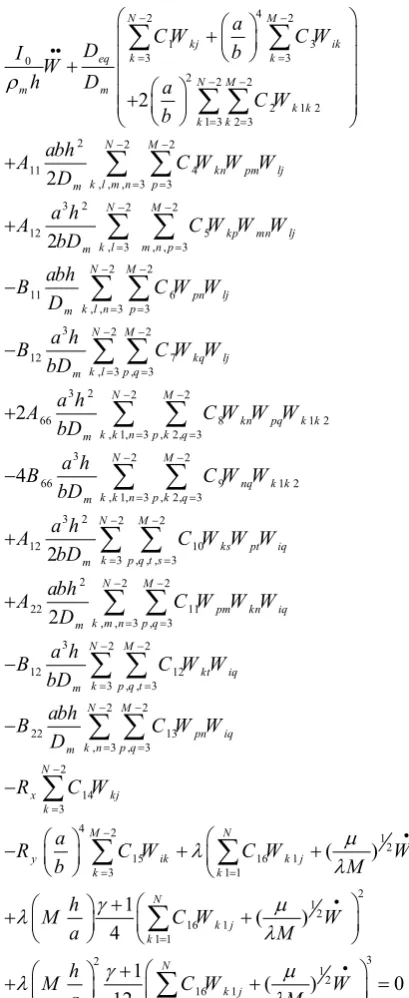
In this regard, the governing differential aeroelastic equations of a FG plate are first discretized using GDQM, and then the aerothermoelastic response of the plate is studied by the fourth order Runge-Kutta method. To show the accuracy and reliability of the GDQM, the dynamic stability boundaries of a FG plate are validated with available results presented in the literature. Also, the effects of some important parameters such as Mach number, in-plane thermal load, plate thickness ratio, and volume fraction index on the aerothermoelastic behavior of the FG plate are examined as well as physical neutral surface effect.
2- Formulation
2- 1- Structural model
A rectangular FG panel with length a, width b, and thickness h is considered. The airflow is assumed in the x-direction.
V. Khalafi et al., AUT J. Mech. Eng., 2(2) (2018) 217-232, DOI: 10.22060/ajme.2018.12712.5407
219 according to a simple power law [17]. Hence:
(
)
(
)
1 1 2 3
0 1 1 2 3
0 0 0 0 0 0 0 0 / 2 1 / 2
( 1 )
( , , ) ( , , , ) ( , , ) ( ) ( , , ) ( , , , ) ( , , ) ( ) ( , , , ) ( , , ) ( )dz n m m c
eff m m c c
n
eff c m m
z h V
h
V V
P P V PV
z h
P P P P
h
P P P T PT PT PT
w x y t u x y z t u x y t z z
x w x y t v x y z t v x y t z z
y w x y z t w x y t
zE z z − − + = + = = + + = − + = + + + + ∂ = − − ∂ ∂ = − − ∂ = =
(
)
(
)
2 2 2 2 2 0, 0, 2 0, 0,0, 0, 0, 0,
0 11 12 12 22 66 ( )dz 1 2 2 ( ) 2
0 , ( )
0 , (
0 0
h h h h
xx x x
yy y y
xy y x x y
xx yy xy xx xx yy xx xy E z u w v w
u v w w
w
z z w
w
Q Q z T T z
Q Q z T T
Q ε ε ε σ ε α σ ε α σ − − = + + − + − − − − ∆ = − ∆
∫
∫
(
)
011 22 2
12 2
66
)
( ) ( )
( ) 1 ( ) ( ) ( ) 1 ( )
( ) 2 1 ( )
xy z
T z T z T
E z
Q Q
z z E z Q z E z Q z ε ν ν ν ν ∆ = − = = − = − = + (1)
(
)
(
)
1 1 2 3
0 1 1 2 3
0 0 0 0 0 0 0 0 / 2 1 / 2
( 1 )
( , , ) ( , , , ) ( , , ) ( ) ( , , ) ( , , , ) ( , , ) ( ) ( , , , ) ( , , ) ( )dz n m m c
eff m m c c
n
eff c m m
z h V
h
V V
P P V PV
z h
P P P P
h
P P P T PT PT PT
w x y t u x y z t u x y t z z
x w x y t v x y z t v x y t z z
y w x y z t w x y t
zE z z − − + = + = = + + = − + = + + + + ∂ = − − ∂ ∂ = − − ∂ = =
(
)
(
)
2 2 2 2 2 0, 0, 2 0, 0,0, 0, 0, 0,
0 11 12 12 22 66 ( )dz 1 2 2 ( ) 2
0 , ( )
0 , (
0 0
h h h h
xx x x
yy y y
xy y x x y
xx yy xy xx xx yy xx xy E z u w v w
u v w w
w
z z w
w
Q Q z T T z
Q Q z T T
Q ε ε ε σ ε α σ ε α σ − − = + + − + − − − − ∆ = − ∆
∫
∫
(
)
011 22 2
12 2
66
)
( ) ( )
( ) 1 ( ) ( ) ( ) 1 ( )
( ) 2 1 ( )
xy z
T z T z T
E z
Q Q
z z E z Q z E z Q z ε ν ν ν ν ∆ = − = = − = − = + (2) where z is the coordinate in the thickness direction with origin at the plate mid-surface and n is the volume fraction index. Material properties of the functionally graded plate are assumed to vary continuously across the plate thickness according to the simple rule of mixtures as follows [17]:
(
)
(
)
1 1 2 3
0 1 1 2 3
0 0 0 0 0 0 0 0 / 2 1 / 2
( 1 )
( , , ) ( , , , ) ( , , ) ( ) ( , , ) ( , , , ) ( , , ) ( ) ( , , , ) ( , , ) ( )dz n m m c
eff m m c c
n
eff c m m
z h V
h
V V
P P V PV
z h
P P P P
h
P P P T PT PT PT
w x y t u x y z t u x y t z z
x w x y t v x y z t v x y t z z
y w x y z t w x y t
zE z z − − + = + = = + + = − + = + + + + ∂ = − − ∂ ∂ = − − ∂ = =
(
)
(
)
2 2 2 2 2 0, 0, 2 0, 0,0, 0, 0, 0,
0 11 12 12 22 66 ( )dz 1 2 2 ( ) 2
0 , ( )
0 , (
0 0
h h h h
xx x x
yy y y
xy y x x y
xx yy xy xx xx yy xx xy E z u w v w
u v w w
w
z z w
w
Q Q z T T z
Q Q z T T
Q ε ε ε σ ε α σ ε α σ − − = + + − + − − − − ∆ = − ∆
∫
∫
(
)
011 22 2
12 2
66
)
( ) ( )
( ) 1 ( ) ( ) ( ) 1 ( )
( ) 2 1 ( )
xy z
T z T z T
E z
Q Q
z z E z Q z E z Q z ε ν ν ν ν ∆ = − = = − = − = + (3)
(
)
(
)
1 1 2 3
0 1 1 2 3
0 0 0 0 0 0 0 0 / 2 1 / 2
( 1 )
( , , ) ( , , , ) ( , , ) ( ) ( , , ) ( , , , ) ( , , ) ( ) ( , , , ) ( , , ) ( )dz n m m c
eff m m c c
n
eff c m m
z h V
h
V V
P P V PV
z h
P P P P
h
P P P T PT PT PT
w x y t u x y z t u x y t z z
x w x y t v x y z t v x y t z z
y w x y z t w x y t
zE z z − − + = + = = + + = − + = + + + + ∂ = − − ∂ ∂ = − − ∂ = =
(
)
(
)
2 2 2 2 2 0, 0, 2 0, 0,0, 0, 0, 0,
0 11 12 12 22 66 ( )dz 1 2 2 ( ) 2
0 , ( )
0 , (
0 0
h h h h
xx x x
yy y y
xy y x x y
xx yy xy xx xx yy xx xy E z u w v w
u v w w
w
z z w
w
Q Q z T T z
Q Q z T T
Q ε ε ε σ ε α σ ε α σ − − = + + − + − − − − ∆ = − ∆
∫
∫
(
)
011 22 2
12 2
66
)
( ) ( )
( ) 1 ( ) ( ) ( ) 1 ( )
( ) 2 1 ( )
xy z
T z T z T
E z
Q Q
z z E z Q z E z Q z ε ν ν ν ν ∆ = − = = − = − = + (4)
where subscripts c and m refer to ceramic and metal, respectively, and Peff is the effective material properties of the plate corresponding to the modulus of elasticity E, Poisson’s ratio υ, density ρ and thermal α coefficient expansion . However, in high-temperature environments, the temperature dependency of material constituents must be taken into account. Thus, temperature-dependent properties, P, can be obtained as follows [20]:
(
)
(
)
1 1 2 3
0 1 1 2 3
0 0 0 0 0 0 0 0 / 2 1 / 2
( 1 )
( , , ) ( , , , ) ( , , ) ( ) ( , , ) ( , , , ) ( , , ) ( ) ( , , , ) ( , , ) ( )dz n m m c
eff m m c c
n
eff c m m
z h V
h
V V
P P V PV
z h
P P P P
h
P P P T PT PT PT
w x y t u x y z t u x y t z z
x w x y t v x y z t v x y t z z
y w x y z t w x y t
zE z z − − + = + = = + + = − + = + + + + ∂ = − − ∂ ∂ = − − ∂ = =
(
)
(
)
2 2 2 2 2 0, 0, 2 0, 0,0, 0, 0, 0,
0 11 12 12 22 66 ( )dz 1 2 2 ( ) 2
0 , ( )
0 , (
0 0
h h h h
xx x x
yy y y
xy y x x y
xx yy xy xx xx yy xx xy E z u w v w
u v w w
w
z z w
w
Q Q z T T z
Q Q z T T
Q ε ε ε σ ε α σ ε α σ − − = + + − + − − − − ∆ = − ∆
∫
∫
(
)
011 22 2
12 2
66
)
( ) ( )
( ) 1 ( ) ( ) ( ) 1 ( )
( ) 2 1 ( )
xy z
T z T z T
E z
Q Q
z z E z Q z E z Q z ε ν ν ν ν ∆ = − = = − = − = + (5) where P0, P−1, P1, P2, P3 are constants, and T (in Kelvin) is the environmental temperature.
the Classical Plate Theory (CPT) based on the position of the neutral surface is developed here.
Based on the Classical Plate Theory (CPT) and the physical
neutral surface concept, the displacement field of the plate is
[42]:
(
)
(
)
1 1 2 3
0 1 1 2 3
0 0 0 0 0 0 0 0 / 2 1 / 2
( 1 )
( , , ) ( , , , ) ( , , ) ( ) ( , , ) ( , , , ) ( , , ) ( ) ( , , , ) ( , , ) ( )dz n m m c
eff m m c c
n
eff c m m
z h V
h
V V
P P V PV
z h
P P P P
h
P P P T PT PT PT
w x y t u x y z t u x y t z z
x w x y t v x y z t v x y t z z
y w x y z t w x y t
zE z z − − + = + = = + + = − + = + + + + ∂ = − − ∂ ∂ = − − ∂ = =
(
)
(
)
2 2 2 2 2 0, 0, 2 0, 0,0, 0, 0, 0,
0 11 12 12 22 66 ( )dz 1 2 2 ( ) 2
0 , ( )
0 , (
0 0
h h h h
xx x x
yy y y
xy y x x y
xx yy xy xx xx yy xx xy E z u w v w
u v w w
w
z z w
w
Q Q z T T z
Q Q z T T
Q ε ε ε σ ε α σ ε α σ − − = + + − + − − − − ∆ = − ∆
∫
∫
(
)
011 22 2
12 2
66
)
( ) ( )
( ) 1 ( ) ( ) ( ) 1 ( )
( ) 2 1 ( )
xy z
T z T z T
E z
Q Q
z z E z Q z E z Q z ε ν ν ν ν ∆ = − = = − = − = + (6)
where u0 and v0 are in-plane displacement components, and w0 is out-of-plane displacement component of neutral surface. z0 is the distance of the neutral surface from the mid- surface of the plate and can be determined from the following equation as [43]:
(
)
(
)
1 1 2 3
0 1 1 2 3
0 0 0 0 0 0 0 0 / 2 1 / 2
( 1 )
( , , ) ( , , , ) ( , , ) ( ) ( , , ) ( , , , ) ( , , ) ( ) ( , , , ) ( , , ) ( )dz n m m c
eff m m c c
n
eff c m m
z h V
h
V V
P P V PV
z h
P P P P
h
P P P T PT PT PT
w x y t u x y z t u x y t z z
x w x y t v x y z t v x y t z z
y w x y z t w x y t
zE z z − − + = + = = + + = − + = + + + + ∂ = − − ∂ ∂ = − − ∂ = =
(
)
(
)
2 2 2 2 2 0, 0, 2 0, 0,0, 0, 0, 0,
0 11 12 12 22 66 ( )dz 1 2 2 ( ) 2
0 , ( )
0 , (
0 0
h h h h
xx x x
yy y y
xy y x x y
xx yy xy xx xx yy xx xy E z u w v w
u v w w
w
z z w
w
Q Q z T T z
Q Q z T T
Q ε ε ε σ ε α σ ε α σ − − = + + − + − − − − ∆ = − ∆
∫
∫
(
)
011 22 2
12 2
66
)
( ) ( )
( ) 1 ( ) ( ) ( ) 1 ( )
( ) 2 1 ( )
xy z
T z T z T
E z
Q Q
z z E z Q z E z Q z ε ν ν ν ν ∆ = − = = − = − = + (7)
The von Karman nonlinear strain-displacement relations, the nonlinear strains are expressed as:
(
)
(
)
1 1 2 3
0 1 1 2 3
0 0 0 0 0 0 0 0 / 2 1 / 2
( 1 )
( , , ) ( , , , ) ( , , ) ( ) ( , , ) ( , , , ) ( , , ) ( ) ( , , , ) ( , , ) ( )dz n m m c
eff m m c c
n
eff c m m
z h V
h
V V
P P V PV
z h
P P P P
h
P P P T PT PT PT
w x y t u x y z t u x y t z z
x w x y t v x y z t v x y t z z
y w x y z t w x y t
zE z z − − + = + = = + + = − + = + + + + ∂ = − − ∂ ∂ = − − ∂ = =
(
)
(
)
2 2 2 2 2 0, 0, 2 0, 0,0, 0, 0, 0,
0 11 12 12 22 66 ( )dz 1 2 2 ( ) 2
0 , ( )
0 , (
0 0
h h h h
xx x x
yy y y
xy y x x y
xx yy xy xx xx yy xx xy E z u w v w
u v w w
w
z z w
w
Q Q z T T z
Q Q z T T
Q ε ε ε σ ε α σ ε α σ − − = + + − + − − − − ∆ = − ∆
∫
∫
(
)
011 22 2
12 2
66
)
( ) ( )
( ) 1 ( ) ( ) ( ) 1 ( )
( ) 2 1 ( )
xy z
T z T z T
E z
Q Q
z z E z Q z E z Q z ε ν ν ν ν ∆ = − = = − = − = + (8)
The thermoelastic constitutive equations of the FG panels are:
(
)
(
)
1 1 2 3
0 1 1 2 3
0 0 0 0 0 0 0 0 / 2 1 / 2
( 1 )
( , , ) ( , , , ) ( , , ) ( ) ( , , ) ( , , , ) ( , , ) ( ) ( , , , ) ( , , ) ( )dz n m m c
eff m m c c
n
eff c m m
z h V
h
V V
P P V PV
z h
P P P P
h
P P P T PT PT PT
w x y t u x y z t u x y t z z
x w x y t v x y z t v x y t z z
y w x y z t w x y t
zE z z − − + = + = = + + = − + = + + + + ∂ = − − ∂ ∂ = − − ∂ = =
(
)
(
)
2 2 2 2 2 0, 0, 2 0, 0,0, 0, 0, 0,
0 11 12 12 22 66 ( )dz 1 2 2 ( ) 2
0 , ( )
0 , (
0 0
h h h h
xx x x
yy y y
xy y x x y
xx yy xy xx xx yy xx xy E z u w v w
u v w w
w
z z w
w
Q Q z T T z
Q Q z T T
Q ε ε ε σ ε α σ ε α σ − − = + + − + − − − − ∆ = − ∆
∫
∫
(
)
011 22 2
12 2
66
)
( ) ( )
( ) 1 ( ) ( ) ( ) 1 ( )
( ) 2 1 ( )
xy z
T z T z T
E z
Q Q
z z E z Q z E z Q z ε ν ν ν ν ∆ = − = = − = − = + (9)
(
)
(
)
1 1 2 3
0 1 1 2 3
0 0 0 0 0 0 0 0 / 2 1 / 2
( 1 )
( , , ) ( , , , ) ( , , ) ( ) ( , , ) ( , , , ) ( , , ) ( ) ( , , , ) ( , , ) ( )dz n m m c
eff m m c c
n
eff c m m
z h V
h
V V
P P V PV
z h
P P P P
h
P P P T PT PT PT
w x y t u x y z t u x y t z z
x w x y t v x y z t v x y t z z
y w x y z t w x y t
zE z z − − + = + = = + + = − + = + + + + ∂ = − − ∂ ∂ = − − ∂ = =
(
)
(
)
2 2 2 2 2 0, 0, 2 0, 0,0, 0, 0, 0,
0 11 12 12 22 66 ( )dz 1 2 2 ( ) 2
0 , ( )
0 , (
0 0
h h h h
xx x x
yy y y
xy y x x y
xx yy xy xx xx yy xx xy E z u w v w
u v w w
w
z z w
w
Q Q z T T z
Q Q z T T
Q ε ε ε σ ε α σ ε α σ − − = + + − + − − − − ∆ = − ∆
∫
∫
(
)
011 22 2
12 2
66
)
( ) ( )
( ) 1 ( ) ( ) ( ) 1 ( )
( ) 2 1 ( )
xy z
T z T z T
E z
Q Q
z z E z Q z E z Q z ε ν ν ν ν ∆ = − = = − = − = + (10) where T0, T(z) and α(z,T) are reference temperature, the temperature distribution in the plate thickness direction and thermal expansion coefficient, respectively. Qij is the stiffness coefficient matrix and is defined by:
(
)
(
)
1 1 2 3
0 1 1 2 3
0 0 0 0 0 0 0 0 / 2 1 / 2
( 1 )
( , , ) ( , , , ) ( , , ) ( ) ( , , ) ( , , , ) ( , , ) ( ) ( , , , ) ( , , ) ( )dz n m m c
eff m m c c
n
eff c m m
z h V
h
V V
P P V PV
z h
P P P P
h
P P P T PT PT PT
w x y t u x y z t u x y t z z
x w x y t v x y z t v x y t z z
y w x y z t w x y t
zE z z − − + = + = = + + = − + = + + + + ∂ = − − ∂ ∂ = − − ∂ = =
(
)
(
)
2 2 2 2 2 0, 0, 2 0, 0,0, 0, 0, 0,
0 11 12 12 22 66 ( )dz 1 2 2 ( ) 2
0 , ( )
0 , (
0 0
h h h h
xx x x
yy y y
xy y x x y
xx yy xy xx xx yy xx xy E z u w v w
u v w w
w
z z w
w
Q Q z T T z
Q Q z T T
Q ε ε ε σ ε α σ ε α σ − − = + + − + − − − − ∆ = − ∆
∫
∫
(
)
011 22 2
12 2
66
)
( ) ( )
( ) 1 ( ) ( ) ( ) 1 ( )
( ) 2 1 ( )
xy z
T z T z T
E z
Q Q
z z E z Q z E z Q z ε ν ν ν ν ∆ = − = = − = − = + (11)
where E(z) is the elastic modulus of a FG panel.
In-plane force resultant and out-of-plate moment resultant are obtained as follows:
{ }
{ }
(
)
0 2 2 2 2 0 0 2 2 2 ( ), (1, ) ( ) ( )
0
( , , ) (1,( ),( ) )
1 1 1
4 2 1 1 12 T T h T T h h h
ij ij ij ij
k
z
z z T z dz
A B D Q z z z z dz
w w M w w
U t x U t x
q p
M w w
M
U t x
ε α α γ γ − − ∞ ∞ ∞ ∞ = − = ∆ = − − ∂ +∂ + + ∂ +∂ ∂ ∂ ∂ ∂ ∆ = + ∂ ∂ + + ∂ ∂
∫
∫
N A B N
M B D M
N M Q
3 2 2 2 , , , , 2
, , , 2
2 2
0 2
2
( ) 0 ,
2
1 dz
( , )
( ) ( )
1 dz
K( , )
0 0 2 2 c m z h
m c m h
h
xx x xy y xy x yy y
xx xx xy xy yy yy xx
xy yy
h T T at z d K z dT
h
dz dz T T at z
K z T T z T T T
z T
N N
N N
w
M M M N
x
w w
N N p I w
x y y
− − ∞ = = = = = − = + − + = + = ∂ + + + ∂ ∂ ∂ + + + ∆ = ∂ ∂ ∂
∫
∫
.. 2 0 211 12 11
12 66 66
12 22 12
22 66 66
2 2
2 2
11 2 12 2 11 2 12 2
2 12 2 ( ) 0 0 h h yy xx xx
yy xy xy
yy
xx xx
yy xy xy
yy yy
xx xx
xx
I z dz
k
A A B
x x x
k k
B A B
x y y
k
A A B
y y y
k k
B A B
y x x
k k
B B D D
x x x x
B B y ρ ε ε ε ε ε ε ε ε ε − = ∂ ∂ + + ∂ ∂ ∂ ∂ ∂ ∂ ∂ + + + = ∂ ∂ ∂ ∂ ∂ + + ∂ ∂ ∂ ∂ ∂ ∂ ∂ + + + = ∂ ∂ ∂ ∂ ∂ ∂ + + ∂ + ∂ ∂ ∂ ∂ ∂ + + ∂
∫
2 2 2
22 2 12 2 22 2
2 2 2
66 66 2
2 2 ..
0 2
2 2
2
yy xx yy
xy xy xx xy yy k k D D
y y y
k w
B D N
x y x y x
w w
N N p I w
x y y
ε ε ∞ ∂ + ∂ + ∂ ∂ ∂ ∂ ∂ ∂ ∂ + + + ∂ ∂ ∂ ∂ ∂ ∂ ∂ + + + ∆ = ∂ ∂ ∂ (12)
Here, NT and MT are the thermal in-plane force moment resultant vectors. Thus
{ }
{ }
(
)
0 2 2 2 2 0 0 2 2 2 ( ), (1, ) ( ) ( )
0
( , , ) (1,( ),( ) )
1 1 1
4 2 1 1 12 T T h T T h h h
ij ij ij ij
k
z
z z T z dz
A B D Q z z z z dz
w w M w w
U t x U t x
q p
M w w
M
U t x
ε α α γ γ − − ∞ ∞ ∞ ∞ = − = ∆ = − − ∂ +∂ + + ∂ +∂ ∂ ∂ ∂ ∂ ∆ = + ∂ ∂ + + ∂ ∂
∫
∫
N A B N
M B D M
N M Q
3 2 2 2 , , , , 2
, , , 2
2 2
0 2
2
( ) 0 ,
2
1 dz
( , )
( ) ( )
1 dz
K( , )
0 0 2 2 c m z h
m c m h
h
xx x xy y xy x yy y
xx xx xy xy yy yy xx
xy yy
h T T at z d K z dT
h
dz dz T T at z
K z T T z T T T
z T
N N
N N
w
M M M N
x
w w
N N p I w
x y y
− − ∞ = = = = = − = + − + = + = ∂ + + + ∂ ∂ ∂ + + + ∆ = ∂ ∂ ∂
∫
∫
.. 2 0 211 12 11
12 66 66
12 22 12
22 66 66
2 2
2 2
11 2 12 2 11 2 12 2
2 12 2 ( ) 0 0 h h yy xx xx
yy xy xy
yy
xx xx
yy xy xy
yy yy
xx xx
xx
I z dz
k
A A B
x x x
k k
B A B
x y y
k
A A B
y y y
k k
B A B
y x x
k k
B B D D
x x x x
B B y ρ ε ε ε ε ε ε ε ε ε − = ∂ ∂ + + ∂ ∂ ∂ ∂ ∂ ∂ ∂ + + + = ∂ ∂ ∂ ∂ ∂ + + ∂ ∂ ∂ ∂ ∂ ∂ ∂ + + + = ∂ ∂ ∂ ∂ ∂ ∂ + + ∂ + ∂ ∂ ∂ ∂ ∂ + + ∂
∫
2 2 2
22 2 12 2 22 2
2 2 2
66 66 2
2 2 ..
0 2
2 2
2
yy xx yy
xy xy xx xy yy k k D D
y y y
k w
B D N
x y x y x
w w
N N p I w
x y y
ε ε ∞ ∂ + ∂ + ∂ ∂ ∂ ∂ ∂ ∂ ∂ + + + ∂ ∂ ∂ ∂ ∂ ∂ ∂ + + + ∆ = ∂ ∂ ∂ (13)
where A, B and D represent extensional, bending–extensional coupling, and bending stiffness matrices, and are given as follows:
{ }
{ }
(
)
0 2 2 2 2 0 0 2 2 2 ( ), (1, ) ( ) ( )
0
( , , ) (1,( ),( ) )
1 1 1
4 2 1 1 12 T T h T T h h h
ij ij ij ij
k
z
z z T z dz
A B D Q z z z z dz
w w M w w
U t x U t x
q p
M w w
M
U t x
ε α α γ γ − − ∞ ∞ ∞ ∞ = − = ∆ = − − ∂ +∂ + + ∂ +∂ ∂ ∂ ∂ ∂ ∆ = + ∂ ∂ + + ∂ ∂
∫
∫
N A B N
M B D M
N M Q
3 2 2 2 , , , , 2
, , , 2
2 2
0 2
2
( ) 0 ,
2
1 dz
( , )
( ) ( )
1 dz
K( , )
0 0 2 2 c m z h
m c m h
h
xx x xy y xy x yy y
xx xx xy xy yy yy xx
xy yy
h T T at z d K z dT
h
dz dz T T at z
K z T T z T T T
z T
N N
N N
w
M M M N
x
w w
N N p I w
x y y
− − ∞ = = = = = − = + − + = + = ∂ + + + ∂ ∂ ∂ + + + ∆ = ∂ ∂ ∂
∫
∫
.. 2 0 211 12 11
12 66 66
12 22 12
22 66 66
2 2
2 2
11 2 12 2 11 2 12 2
2 12 2 ( ) 0 0 h h yy xx xx
yy xy xy
yy
xx xx
yy xy xy
yy yy
xx xx
xx
I z dz
k
A A B
x x x
k k
B A B
x y y
k
A A B
y y y
k k
B A B
y x x
k k
B B D D
x x x x
B B y ρ ε ε ε ε ε ε ε ε ε − = ∂ ∂ + + ∂ ∂ ∂ ∂ ∂ ∂ ∂ + + + = ∂ ∂ ∂ ∂ ∂ + + ∂ ∂ ∂ ∂ ∂ ∂ ∂ + + + = ∂ ∂ ∂ ∂ ∂ ∂ + + ∂ + ∂ ∂ ∂ ∂ ∂ + + ∂
∫
2 2 2
22 2 12 2 22 2
2 2 2
66 66 2
2 2 ..
0 2
2 2
2
yy xx yy
xy xy xx xy yy k k D D
y y y
k w
B D N
x y x y x
w w
N N p I w
x y y
ε ε ∞ ∂ + ∂ + ∂ ∂ ∂ ∂ ∂ ∂ ∂ + + + ∂ ∂ ∂ ∂ ∂ ∂ ∂ + + + ∆ = ∂ ∂ ∂ (14)
Above neutral surface based formulation change to mid-surface formulation when z0=0.