Journal of Industrial Engineering and Management Studies
Vol. 6, No. 2, 2019, pp. 214-239 DOI: 10.22116/JIEMS.2019.94192
www.jiems.icms.ac.ir
Measuring performance of a hybrid system based on imprecise
data: Modeling and solution approaches
Ehsan Vaezi1, Seyyed Esmaeil Najafi1,*, Mohammad Hadji Molana1, Farhad Hosseinzadeh Lotfi2, Mahnaz Ahadzadeh Namin3
Abstract
Data Envelopment Analysis (DEA) is one of the methods most widely used for measuring the relative efficiency of DMUs in the world today. The efficiency evaluation of the network structure opens the “black box” and considers the internal structure of systems. In this paper, a three-stage network model is considered with additional inputs and undesirable outputs and obtains the efficiency of the network, as interval efficiency in presence of the imprecise datum. The proposed model of this paper simulates a factory in the factual world with a production area, three warehouses and two delivery points. This factory is taken into consideration as a dynamic network and a multiplicative DEA approach is utilized to measure efficiency. Given the non-linearity of the models, a heuristic method is used to linearize the models. Ultimately, this paper concentrates on the interval efficiency to rank the units. The results of this ranking demonstrated that the time periods namely, (24) and (1) were the best and the poorest periods, respectively, in context to the interval efficiency within 24 phases of time.
Keywords: Network DEA; Three-stage processes; Interval data; Additional inputs; Undesirable outputs; minimax regret-based approach.
Received: January 2019-06 Revised: August 2019-05 Accepted: October 2019-07
1. Introduction
Evaluation and the measurement of performance will lead to smart or intelligent systems with incentives for individuals for the desired behavior. A measurement of performance is one of the fundamental managerial processes, for analyzing one’s own performance and likewise, surveying the conformity between the performance and the set of goals. The outcome of the evaluation can provide the grounds for taking the correct measures in decision-making for the future. Performance appraisal is a key part in the formulation and implementation of organizational policies (Hajijabbari & Sarabadani, 2008).
* Corresponding author; [email protected]
1Department of Industrial Engineering, Science and Research Branch, Islamic Azad University, Tehran, Iran. 2Department of Mathematics, Science and Research Branch, Islamic Azad University, Tehran, Iran.
The data envelopment analysis (DEA) is utilized as a non-parametric mathematical programming method, to evaluate the relative efficiency of entities, capable of being compared to multiple inputs and several outputs. These comparable entities are called decision-making units (DMUs). (Khalili-Damghani et al., 2015). Farrell (1957) considered a model for performance evaluation with an input and an output for the first time. Charnes, Cooper and Rhodes developed Farrell’s model for multiple inputs and outputs and dubbed it as “CCR” in honor of its makers (Charnes et al., 1978). Charnes, Cooper and Banker extended the DEA models and registered this model as their own and known as “BCC” (Banker et al., 1984). A failure to consider the internal correlations and the intermediate variables of complex systems (i.e. two or multiple stage processes), was a major flaw or defect, which the classic DEA models, such as, the CCR and BCC were labeled with. In actual fact, these models considered the systems as black boxes and would only be satisfied with the initial inputs and final outputs (Tone and Tsutsui, 2009). In order to overcome this problem, Fare and Grosskopf (2000) introduced the Network Data Envelopment Analysis (NDEA) models. With the assistance of the sub-series and parallels, including the intermediate variables, complex systems were simulated and a more genuine evaluation was computed (Chen and Yan, 2011). From Kao’s viewpoint, NDEA models can be categorized into three groups, namely, series, parallel and hybrid models. When the activities of a system are prolonged in respect to each other, the network has a serial structure; and at times when the activities are parallel to each other, the network has a parallel structure. Similarly, it maintains a hybrid mode, when there is a combination between the series and parallel set-up (Kao, 2009). Generally, the multiplicative and additive approaches are used to compute the network performance in the parallel and serial mode, respectively, (kao, 2006). After introducing the NDEA models, numerous studies took place in this field; and a combination of this science with branches of the game theory, brought about NDEA studies in cooperative and non-cooperative modes, which can be mentioned as hereunder. Li et al. (2012) presented a model for a two-stage structure, a phase which holds a more important standpoint for managers; and they have named this phase as “leader” and the other is known as “follower”. In order to calculate the efficiency, initially, the efficiency of the leader phase was maximized to the optimum and thus, the efficiency of the follower phase was secured by maintaining a constant efficiency in the phase of the leader. This exemplary, was designated as a decentralized control or a Stackelberg Game, which has been widely utilized by researchers in recent years. Du et al. (2015) analyzed a parallel network in the cooperative and non-cooperative modes and stated that, the efficiency of the former was more than that of the latter mode. An et al. (2017) considered a network, comprising of two stages, which interacted with each other; and computed the efficiency of this network in a cooperative and non-cooperative mode or condition. In another research Zhou et al. (2018), evaluated a multi-stage network in the non-cooperative and black box mode and compared the results. In recent years, the Stackelberg Game was utilized by several researchers such as, Fard and Hajaghaei-Keshteli (2018), Fard et al. (2018), including Hajaghaei-Hajaghaei-Keshteli and Fathollahi-Fard (2018).
was handled by imposing a single downward conversion. In the past few years, the role of the undesirable factors in DEA models has made considerable progress and the tasks of Wang et al. (2013) and Wu et al. (2016) are significant in this respect.
Classic DEA models, such as, (CCR and BCC models), were proposed for certainty in data as it does not deal with datum uncertainty. In fact, the actual, fundamental assumption in these models is that the amount of data in relevance with the inputs and outputs is an accurate numerical value. Though, in most cases, in the business environment, determining values for inputs and outputs is not feasible in reality (Khalili-Damghani et al., 2015). Ben-Tal and Nemirovski (2000), have demonstrated that an extremely slight deviation in the data leads to an unjustified response or a considerable change in the efficiency results. Hence, they proclaimed that the results of the classical DEA methods with determined parameters are not reliable. Kao (2006) stated that the reason for the absence of the presence of reliability, in terms of human judgment and concept, DEA models with imprecise data can play a more important role in evaluating efficiency in factual issues. Wang et al. (2009) expressed that in the presence of imprecise data, DEA models are capable of drawing insights for companies in variable and ambiguous conditions, in order to have a more realistic assessment of their own. Thereby, it is extremely essential to consider the uncertainty in the data available and the manner of dealing with it during the evaluation of efficiency by utilizing DEA methods. In most of the initial DEA tasks, uncertainty was ignored, but in recent years, several models have been under discussion for imprecise or inaccurate data (Azizi, 2013). Cooper et al. (1999) utilized a technique for DEA to confront imprecise data. Cooper et al. (2001) developed a method for converting a nonlinear planning problem into linear programming, by taking the alternative variables into consideration for determining the efficiency of the DMUs in presence of imprecise data. Imprecise data have several criterions and varied models have been designed to oppose this aspect (Amirteimoori and Kordrostami, 2014). One of the most widespread approaches in context with data uncertainty conditions is utilizing an interval DEA model (Farzipoor Saen, 2009). Despotis and Smirlis (2002) developed the CCR model and rendered a model, in which the efficiency evaluation is calculated by taking the interval data into account. Entani et al. (2002) used DEA with a pessimistic approach in the presence of interval data. Despotis et al. (2006) rendered a method in which the unspecified and imprecise values were replaced with a series of intervals and utilized the DEA intervals for evaluating the efficiencies of units. Aghayi et al. (2013) modeled a two-stage network to consider the uncertainty in input and output data. In this research, uncertainty was modeled intermittently and the efficiency results were expressed in terms of the intervals with the upper and lower bounds. Khalili-Damghani (2015) ushered a model which calculated the efficiency evaluation in the presence of interval data and undesirable outputs.
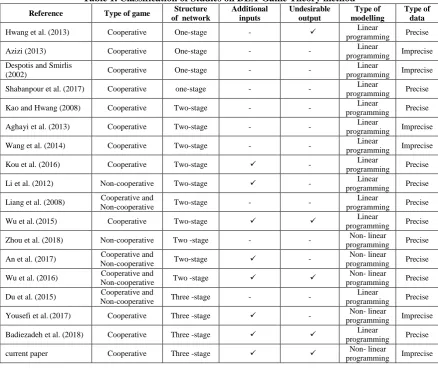
Table 1. Classification of Studies on DEA-Game Theory method
Reference Type of game Structure of network
Additional inputs
Undesirable output
Type of modelling
Type of data
Hwang et al. (2013) Cooperative One-stage - Linear
programming Precise
Azizi (2013) Cooperative One-stage - - Linear
programming Imprecise Despotis and Smirlis
(2002) Cooperative One-stage - -
Linear
programming Imprecise
Shabanpour et al. (2017) Cooperative one-stage - - Linear
programming Precise
Kao and Hwang (2008) Cooperative Two-stage - - Linear
programming Precise
Aghayi et al. (2013) Cooperative Two-stage - - Linear
programming Imprecise
Wang et al. (2014) Cooperative Two-stage - - Linear
programming Imprecise
Kou et al. (2016) Cooperative Two-stage - Linear
programming Precise
Li et al. (2012) Non-cooperative Two-stage - Linear
programming Precise
Liang et al. (2008) Cooperative and
Non-cooperative Two-stage - -
Linear
programming Precise
Wu et al.(2015) Cooperative Two-stage Linear
programming Precise
Zhou et al. (2018) Non-cooperative Two -stage - - Non- linear
programming Precise
An et al. (2017) Cooperative and
Non-cooperative Two-stage -
Non- linear
programming Precise
Wu et al. (2016) Cooperative and
Non-cooperative Two -stage
Non- linear
programming Precise
Du et al. (2015) Cooperative and
Non-cooperative Three -stage - -
Linear
programming Precise
Yousefi et al.(2017) Cooperative Three -stage - Non- linear
programming Imprecise
Badiezadeh et al. (2018) Cooperative Three -stage programming Linear Precise
current paper Cooperative Three -stage Non- linear
programming Imprecise
According to the abovementioned, in major, the researches performed in the network, focused on two stages. But the current research considers the three-stage processes, which in addition to intermediate measures, also has additional inputs and undesirable outputs. In actual fact, DEA signifies a theoretical framework in the way of analyzing efficiency, but its application in the grounds of production planning and inventory control is observed as being extremely low. In this paper we simulate a factory producing dairy products with a production area, three warehouses, two delivery points for goods and we analyze this network in a dynamic condition. Therefore, we are faced with a hybrid system, including a complex internal structure with three stages, six sub-DMUs, and undesirable outputs in the first stage, additional inputs and outputs in the second stage and additional inputs and undesirable outputs in the third stage. Interval data is utilized to evaluate efficiency, in order to make results more realistic. Likewise, in this paper, the cooperative approach is used to evaluate efficiency and a heuristic method is applied to convert nonlinear models to linear models. As a summarization, contributions of this paper are as follows:
A three-stage network is taken under consideration in respect to the additional desirable and undesirable inputs and outputs
A hybrid system with a complex internal structure is developed by a DEA approach.
Interval data is utilized to evaluate efficiency, in order to make results more realistic
Implementation of the suggested model on an authentic example. (We simulate a factory in a real world that has a production area and three warehouses for goods and two delivery points for first time .
The said factory is considered as a dynamic network.
In this simulation, all costs are considered, including, production costs, setup cost, maintenance costs of the products, warehouse reservation costs, transportation costs, delay penalty costs and the profit obtained from the sale of products.
The remainder of the paper is organized as follows: Section (2) describes the model and introduces the network and modeling from the cooperative perspective for interval data. Section (3) resolves the model and in this section a heuristic approach is used to solve the model. Section (4) describes a case-study, where, a factory is elaborated upon as an example in the factual world and ultimately Section (5) renders the results of the paper.
2. Model description
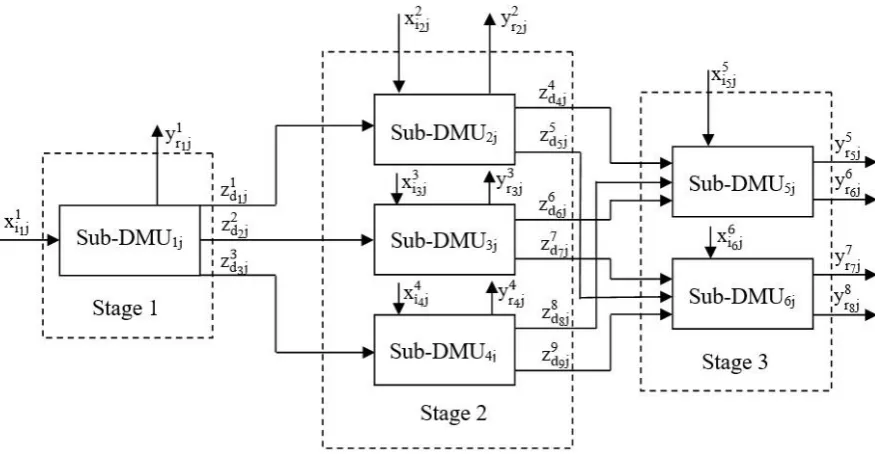
We consider a set of n homogeneous DMUs that are denoted by DMUj (j=1,..., n), and the each DMUj (j=1,…,n) has a three-stage with a complex internal structure, as shown in Fig. 1. We
denote, the inputs to sub-DMU1j, sub-DMU2j, sub-DMU3j, sub-DMU4j, sub-DMU5j and
sub-DMU6j by xi11j (i1=1,…,I1), xi22j (i2=1,…,I2), xi33j (i3=1,…,I3), xi44j (i4=1,…,I4), xi55j (i5=1,…,I5) and xi66j (i6=1,…,I6), respectively. We denote, the intermediate measures between stage 1 and 2 by zd11j (d1=1,…,D1), z2d2j (d2=1,…,D2) and zd33j(d3=1,…,D3), and between stage 2 and 3 by zd44j (d
4=1,…,D4), zd5j
5 (d
5 = 1, … , D5), zd6j
6 (d
6 = 1, … , D6), zd7j
7 (d
7 = 1, … , D7), zd8j 8
(d8=1,…,D8) and zd99j (d9=1,…,D9). We denote, the undesirable output of the first stage by yr11j (r
1=1,…,R1). The outputs of sub-DMU2j, sub-DMU3j and sub-DMU4j are denoted by yr22j(r
2=1,…,R2), yr3j
3 (r
3=1,…,R3) and yr4j
4 (r
4=1,…,R4), respectively. Finally, the outputs of sub-DMU5j and sub-DMU6j are denoted by yr55j (r5=1,…,R5), yr66j (r6=1,…,R6), yr77j (r7=1,…,R7) and yr88j (r8=1,…,R8), respectively where yr66j and yr88j are undesirable outputs. We adopt vi11, vi22, vi33, vi44, vi55 and vi66 as the weights of the inputs to sub-DMU1j, sub-DMU2j,
Figure. 1 The structure of three-stage network system with additional inputs and undesirable outputs
It is mainly for three reasons that researchers are most likely to use input-oriented models for efficiency analysis. Primarily, demand is in a state of growth and the estimation of demand is a complex issue. Secondly, managers have more control over inputs than outputs; and thirdly, this model reflects the initial goals or objectives of policy-makers, in being responsible for responding to the demands of the people and that the units should reduce costs and or limit the use of resources. Thereby, we utilize the input-axis model in this research. In accordance with Korhonen and Luptacik (2004), we signify the undesirable outputs in the models with a negative mark. Therefore, the efficiency of sub-DMU1o in the first stage can be calculated using the following model (1):
θo1= max
∑D1d1=1wd11zd1o1 + ∑D2d2=1wd22zd2o2 + ∑D3d3=1wd33zd3o3 - ∑ ur11y r1o1 R1 r1=1
∑I1i1=1vi11xi1o1
s.t. ∑ wd1
1 D1
d1=1 zd1j1 + ∑d2=1D2 wd22zd2j2 + ∑D3d3=1wd33zd3j3 - ∑R1r1=1ur11yr1j1
∑I1i1=1vi11xi1j1 ≤1, j=1,…,n (1)
ur11,vi1
1, w
d11,wd22,wd33≥ 𝜀; r1=1,…,R1; i1=1,…,I1; d1=1,…,D1; d2=1,…,D2; d3=1,…,D3.
In the second stage we have three sub-DMUs form a parallel structure and the sub-DMUs are independent. The efficiencies of sub-DMU2o, sub-DMU3o and sub-DMU4o are defined, respectively, as follows:
θo2= max
∑D4d4=1wd44zd4o4 + ∑d5=1D5 w5d5zd5o5 + ∑R2r2=1ur22yr2o2
∑I2i2=1vi22xi2o2 + ∑D1d1=1wd11 zd1o1
s.t. ∑ wd4
4 D4
d4=1 zd4j4 + ∑D5d5=1wd55zd5j5 + ∑R2r2=1ur22yr2j2
∑I2i2=1vi22xi2j2+ ∑D1d1=1wd11zd1j1 ≤1, j=1,…,n (2)
ur22,vi2
2, w
d1
1 ,w
d4
4 ,w
d5
5 ≥ 𝜀; r
2=1,…,R2; i2=1,…,I2; d1=1,…,D1; d4=1,…,D4; d5=1,…,D5.
θo3= max
∑D6d6=1wd66zd6o6 + ∑D7d7=1wd77zd7o7 + ∑ ur33y r3o 3 R3 r3=1
s.t. ∑ wd6
6 D6
d6=1 zd6j6 + ∑D7d7=1wd77zd7j7 + ∑R3r3=1ur33yr3j3
∑I3i3=1vi33xi3j3+ ∑D2d2=1wd22zd2j2 ≤1, j=1,…,n (3)
ur33,vi33, wd2
2 ,w
d6
6 ,w
d7
7 ≥ 𝜀; r
3=1,…,R3; i3=1,…,I3; d2=1,…,D2; d6=1,…,D6; d7=1,…,D7.
θo4= max
∑D8d8=1wd88 zd8o8 + ∑D9d9=1wd99zd9o9 + ∑ ur44y r4o4 R4 r4=1
∑I4i4=1vi44xi4o4 + ∑D3d3=1wd33zd3o3
s.t. ∑ wd8
8 D8
d8=1 zd8j8 + ∑D9d9=1wd99zd9j9 + ∑R4r4=1ur44yr4j4
∑I4i4=1vi44xi4j4 + ∑D3d3=1w3d3zd3j3 ≤1, j=1,…,n (4)
ur44,vi4
4, w
d3
3 ,w
d88,wd99≥ 𝜀; r3=1,…,R3; i4=1,…,I4; d4=1,…,D4; d8=1,…,D8; d9=1,…,D9.
Kao (2009) used the additive approach for the overall efficiency of a parallel structure where sub-DMUs are independent. We then define the efficiency of the second stage as: θo234=max (w1.θo2+w2.θo3+w3.θo4), where w1, w2 and w3 are weights specified by experts such that, w1 + w2 + w3 = 1. Chen et al. (2009), show that, the relative size of the inputs of a stage expresses the importance of that stage. Hence, based on the fact that our model is input-oriented, we compute the weights determined by the experts from the relative input value of each sub-DMU to implicit the value of inputs in the second stage. Thereby, we define w1,w2
andw3asfollows:
w1=
∑I2i2=1vi22xi2o2 + ∑D1d1=1wd11zd1o1
∑I2i2=1vi22xi2o2 + ∑D1d1=1wd11 zd1o1 + ∑I3i3=1vi33xi3o3 + ∑D2d2=1wd22zd2o2 + ∑i4=1I4 v4i4xi4o4 + ∑D3d3=1wd33 zd3o3 , (5)
w2=
∑I3i3=1vi33xi3o3 + ∑D2d2=1wd22zd2o2
∑I2i2=1vi22xi2o2 + ∑d1=1D1 w1d1zd1o1 + ∑I3i3=1vi33xi3o3 + ∑D2d2=1wd22zd2o2 + ∑I4i4=1vi44xi4o4 + ∑D3d3=1wd33 zd3o3 ,
w3=
∑I4i4=1vi44xi4o4 + ∑D3d3=1wd33zd3o3
∑I2i2=1vi22xi2o2 + ∑d1=1D1 w1d1zd1o1 + ∑I3i3=1vi33xi3o3 + ∑D2d2=1wd22zd2o2 + ∑I4i4=1vi44xi4o4 + ∑D3d3=1wd33 zd3o3
We defined w1, w2 and w3 as the parts of total input resources devoted to the sub-DMU2o, sub-DMU3o and sub-DMU4o, respectively. In order to make the models more convenient, we define Io234 and Oo234, as inputs and outputs to the second stage, respectively, as follows:
(Io234= ∑iI22=1vi22xi22o+ ∑ wd1
1 D1
d1=1 zd1o
1 + ∑ v
i33xi33o I3
i3=1 + ∑ wd2
2 D2
d2=1 zd2o
2 + ∑ v
i4
4x
i44o I4
i4=1 + ∑ wd3
3 D2
d2=1 zd3o
3 ) and
(Oo234= ∑dD44=1wd44z4d4o+ ∑Dd55=1wd55zd5o
5 + ∑ w
d66 D6
d6=1 zd66o+ ∑Dd77=1wd77z7d7o+ ∑Dd88=1wd88zd88o+ ∑dD99=1wd99zd99o
+ ∑Rr22=1ur22y2r2o + ∑ ur33yr33o
R2
r2=1 + ∑ ur44yr44o
R4
r4=1 ) (6)
Then, with models (2), (3) and (4) and formulas (5) and (6), the efficiency of the second stage is defined as follows:
θo234=max Oo
234
Io234
s.t. ∑ wd4
4 D4
d4=1 zd4j4 + ∑D5d5=1wd55zd5j5 + ∑R2r2=1ur22yr2j2
∑ wd6
6 D6
d6=1 zd6j6 + ∑D7d7=1wd77zd7j7 + ∑R3r3=1ur33yr3j3
∑I3i3=1vi33xi3j3+ ∑D2d2=1wd22zd2j2 ≤1, j=1,…,n (7)
∑ wd8
8 D8
d8=1 zd8j8 + ∑D9d9=1wd99zd9j9 + ∑R4r4=1ur44yr4j4
∑I4i4=1vi44xi4j4+ ∑D3d3=1wd33zd3j3 ≤1, j=1,…,n
ur22,ur33,ur44,vi2
2,v
i33,vi44,w1d1,wd22,wd33,wd44,wd55,wd66,wd77,wd88,wd99 ≥ 𝜀;
r2=1, …,R2; r3=1,…,R3; r4=1,…, R4; i2=1,…,I2; i3=1,…,I3; i4=1,…,I4; d1=1,…,D1; d2=1,…,D2;
d3=1,…,D3; d4=1,…,D4; d5=1,…,D5; d6=1,…,D6;d7=1,…,D7; d8=1,…,D8; d9=1,…,D9.
In the model (7) we measured the efficiency of the second stage, based on the efficiency of each DMU in the second stage being less than one. In the third stage we have two sub-DMUs from a parallel structure. In the same way we define the efficiency of the third stage, as we did in the second stage, as follows:
θo56= max Oo
56
Io56
s.t. ∑ ur5
5 R5
r5=1 yr5j5 - ∑R6r6=1ur66yr6j6
∑I5i5=1vi55xi5j5 + ∑D4d4=1wd44 zd4j4 + ∑D6d6=1w6d6zd6j6 + ∑D8d8=1wd88zd8j8 ≤1, j=1,…,n
∑ ur77
R7
r7=1 yr7j7 - ∑R8r8=1ur88yr8j8
∑I6i6=1vi66xi6j6 + ∑D5d5=1w5d5zd5j5 + ∑D7d7=1wd77zd7j7 + ∑D9d9=1wd99zd9j9 ≤1, j=1,…,n
(8)
u5r5,ur66,u7r7,ur88,vi5
5,v i6
6,w
d44,wd55,wd66,wd77,wd88,wd99 ≥ 𝜀;
r5=1, …,R5; r6=1,…,R6; r7=1,…, R7; r8=1,…,R8; i5=1,…,I5; i6=1,…,I6; d4=1,…,D4; d5=1,…,D5;
d6=1,…,D6;d7=1,…,D7; d8=1,…,D8; d9=1,…,D9.
Model (8) gains the performance of the third step and to alleviate the input and output values of the third stage we have denoted it in formula (9) as follows:
(Io56= ∑ vi55xi55o
I5
i5=1 + ∑ vi66xi66o
I6
i6=1 + ∑ wd4
4 D4
d4=1 zd4o
4 + ∑ w
d55 D5
d5=1 zd55o+ ∑ wd6
6 D6
d6=1 zd6o
6 + ∑ w
d7
7 D7
d7=1 zd7o
7
+ ∑ wd8
8 D8
d8=1 zd8o
8 + ∑ w
d9
9 D9
d9=1 zd9o
9 ) and (O
o
56= ∑ u
r5 5 R5
r5=1 yr5o
5 + ∑ u
r7 7 R7
r7=1 yr7o
7 - ∑ u
r6 6 R6
r6=1 yr6o
6 - ∑ u
r8 8 R8
r8=1 yr8o
8 )
(9)
θooverall=max
∑D1d1=1wd11zd1o1 + ∑D2d2=1wd22zd2o2 + ∑D3d3=1wd33zd3o3 - ∑R1r1=1ur11yr1o1
∑I1i1=1vi11xi1o1 .
Oo234 Io234.
Oo56 Io56
s.t. ∑ wd1
1 D1
d1=1 zd1j1 + ∑d2=1D2 w2d2zd2j2 + ∑D3d3=1wd33zd3j3 - ∑R1r1=1ur11yr1j1
∑I1i1=1vi11xi1j1 ≤1, j=1,…,n
∑ wd4
4 D4
d4=1 zd4j4 + ∑D5d5=1wd55zd5j5 + ∑R2r2=1ur22yr2j2
∑I2i2=1vi22xi2j2 + ∑D1d1=1wd11 zd1j1 ≤1, j=1,…,n
∑ wd6
6 D6
d6=1 zd6j6 + ∑D7d7=1wd77zd7j7 + ∑R3r3=1ur33yr3j3
∑I3i3=1vi33xi3j3 + ∑D2d2=1w2d2zd2j2 ≤1, j=1,…,n (10)
∑ wd8
8 D8
d8=1 zd8j8 + ∑D9d9=1wd99zd9j9 + ∑R4r4=1ur44yr4j4
∑I4i4=1vi44xi4j4 + ∑D3d3=1wd33zd3j3 ≤1, j=1,…,n
∑ ur55
R5
r5=1 yr5j5 - ∑R6r6=1ur66yr6j6
∑I5i5=1vi55xi5j5 + ∑D4d4=1wd44 zd4j4 + ∑D6d6=1w6d6zd6j6 + ∑D8d8=1wd88zd8j8 ≤1, j=1,…,n
∑R7r7=1ur77y7r7j- ∑R8r8=1ur88yr8j8
∑I6i6=1vi66xi6j6 + ∑D5d5=1wd55 zd5j5 + ∑D7d7=1w7d7zd7j7 + ∑D9d9=1wd99zd9j9 ≤1, j=1,…,n
ur11,ur22,ur33,ur44,ur55,ur66,u7r7,ur88,vi1
1,v i2
2,v i3
3,v i4
4,v i5
5,v i6
6,w
d1
1 ,w
d2
2 ,w
d3
3 ,w
d4 4 ,w d5 5 ,w d6 6 ,w d7 7 ,w d8 8 ,w d9
9 ≥ ε;
r1=1, …,R1; r2=1,…,R2; r3=1,…, R3; r4=1, …,R4; r5=1,…,R5; r6=1,…, R6; r7=1, …,R7; r8=1,…,R8;
i1=1,…,I1; i2=1,…,I2; i3=1,…,I3; i4=1,…,I4; i5=1,…,I5; i6=1,…,I6; d1=1,…,D1; d2=1,…,D2; d3=1,…,D3;
d4=1,…,D4; d5=1,…,D5; d6=1,…,D6;d7=1,…,D7; d8=1,…,D8; d9=1,…,D9.
In model (10) we measure the overall efficiency based on the efficiencies of the all sub-DMUs being less than one.
2.1. Interval DEA models
In view of not evading the entire subject, it shall be assumed that some of the data in model (10) due to being unreliable and are incapable of being accurately determined and we only know that they are within their upper and lower bounds. Despotis and Smirlis (2002) have calculated the efficiency of DMUs in the presence of intervals and have proposed models for the upper and lower bound efficiencies. Therefore, by developing the task of Despotis and Smirlis we shall modify model (10), with the assumption that the variables are bounded in the presence of undesirable outputs as in the figure below:
θooverall(U)=max
∑D1d1=1wd11zd1o1U+ ∑D2d2=1wd22 zd2o2U+ ∑D3d3=1wd33zd3o3U- ∑R1r1=1ur11yr1o1L
∑I1i1=1vi11xi1o1L .
Oo234U
Io234L.
Oo56U
Io56L (11)
s.t. ∑Dd11=1wd11zd1j
1L+ ∑ w
d22 D2
d2=1 zd2j
2L+ ∑ w
d3 3 D3
d3=1 zd3j
3L- ∑ u
r1
1y
r1j 1U R1
r1=1 - ∑iI11=1vi11xi1U1j ≤ 0, ∀j≠o
∑ wd4
4 D4
d4=1 zd4j
4L+ ∑ w
d5
5 D5
d5=1 zd5j
5L+ ∑ u
r2
2y
r2L2j R2
r2=1 - ∑ vi2
2x
i2j 2U I2
i2=1 - ∑ wd1
1 D1
d1=1 zd1j
1U ≤ 0, ∀j≠o
∑ wd6
6 D6
d6=1 zd6j
6L+ ∑ w
d7
7 D7
d7=1 zd7j
7L+ ∑ u
r3
3y
r3L3j R3
r3=1 - ∑ vi3
3x
i3j 3U I3
i3=1 - ∑ wd2
2 D2
d2=1 zd2j
2U ≤ 0, ∀j≠o
∑ wd8
8 D8
d8=1 zd8j
8L+ ∑ w
d9
9 D9
d9=1 zd9j
9L+ ∑ u
r4
4y
r4L4j R4
r4=1 - ∑ vi4
4x
i4j 4U I4
i4=1 - ∑ wd3
3 D3
d3=1 zd3j
3U ≤ 0, ∀j≠o
∑ ur55
R5
r5=1 yr5L5j- ∑ ur66
R6
r6=1 yr6U6j- ∑ vi5
5x
i5j 5U I5
i5=1 - ∑Dd44=1w4d4zd4U4j- ∑Dd66=1wd66zd6U6j- ∑Dd88=1wd88zd8U8j≤ 0, ∀j≠o
∑Rr77=1ur77yr7j
7L- ∑ u
r8 8 R8
r8=1 yr8j
8U- ∑ v
i6
6x
i6j 6U I6
i6=1 - ∑ wd5
5 D5
d5=1 zd5j
5U- ∑ w
d7
7 D7
d7=1 zd7j
7U- ∑ w
d9
9 D9
d9=1 zd9j
9U ≤ 0, ∀j≠o
∑Dd11=1wd11zd1U1o+ ∑dD22=1w2d2zd2U2o+ ∑dD33=1w3d3zd3U3o- ∑rR11=1ur11yr1L1o- ∑ vi11xi1L1o
I1
i1=1 ≤ 0
∑Dd44=1w4d4zd4U4o+ ∑dD55=1w5d5z5Ud5o+ ∑ ur22yr2U2o
R2
r2=1 - ∑ vi22xi2L2o
I2
i2=1 - ∑Dd11=1wd11zd1L1o ≤ 0
∑Dd66=1wd66zd6U6o+ ∑dD77=1wd77zd7U7o+ ∑ ur33yr3U3o
R3
r3=1 - ∑Ii33=1v3i3xi3L3o- ∑dD22=1wd22zd2L2o ≤ 0
∑Dd88=1w8d8zd8U8o+ ∑dD99=1w9d9z9Ud9o+ ∑ ur44yr4U4o
R4
r4=1 - ∑Ii44=1vi44xi4L4o- ∑dD33=1wd33zd3L3o ≤ 0
∑Rr55=1ur55yr5U5o- ∑ ur66
R6
r6=1 yr6L6o- ∑ vi5
5x
i5o 5L I5
i5=1 - ∑ wd4
4 D4
d4=1 zd4o
4L- ∑ w
d6
6 D6
d6=1 zd6o
6L - ∑ w
d8
8 D8
d8=1 zd8o
8L ≤ 0
∑Rr77=1ur77yr7U7o- ∑ ur88
R8
r8=1 yr8L8o- ∑ vi66xi6L6o
I6
i6=1 - ∑ wd5
5 D5
d5=1 zd5L5o- ∑ wd7
7 D7
d7=1 zd7o
7L - ∑ w
d9
9 D9
d9=1 zd9o
9L ≤ 0
u1r1,ur22,u3r3,ur44,ur55,ur66,u7r7,ur88,vi1
1,v
i22,vi33,vi44,vi55,vi66,wd11,w2d2,wd33,wd44,wd55,wd66,wd77,wd88,wd99 ≥ ε;
r1=1, …,R1; r2=1,…,R2; r3=1,…, R3; r4=1, …,R4; r5=1,…,R5; r6=1,…, R6; r7=1, …,R7; r8=1,…,R8;
i1=1,…,I1; i2=1,…,I2; i3=1,…,I3; i4=1,…,I4; i5=1,…,I5; i6=1,…,I6; d1=1,…,D1; d2=1,…,D2; d3=1,…,D3;
d4=1,…,D4; d5=1,…,D5; d6=1,…,D6;d7=1,…,D7; d8=1,…,D8; d9=1,…,D9.
θooverall(L)=max
∑D1d1=1wd11zd1o1L + ∑D2d2=1wd22zd2o2L + ∑D3d3=1wd33 zd3o3L- ∑R1r1=1ur11yr1o1U
∑I1i1=1vi11xi1o1U .
Oo234L
Io234U.
Oo56L
Io56U (12)
s.t. ∑ wd1
1 D1
d1=1 zd1j
1U+ ∑ w
d2
2 D2
d2=1 zd2j
2U+ ∑ w
d3
3 D3
d3=1 zd3j
3U- ∑ u
r1
1y
r1j 1L R1
r1=1 - ∑iI11=1vi11xi1L1j ≤ 0, ∀j≠o
∑ wd4
4 D4
d4=1 zd4j
4U+ ∑ w
d5
5 D5
d5=1 zd5j
5U+ ∑ u
r2
2y
r2U2j R2
r2=1 - ∑iI22=1v2i2xi2L2j- ∑ wd1
1 D1
d1=1 zd1j
1L ≤ 0, ∀j≠o
∑ wd6
6 D6
d6=1 zd6j
6U+ ∑ w
d7
7 D7
d7=1 zd7j
7U+ ∑ u
r3
3y
r3U3j
R3
r3=1 - ∑ vi33xi3L3j
I3
i3=1 - ∑ wd2
2 D2
d2=1 zd2j
2L ≤ 0, ∀j≠o
∑ wd8
8 D8
d8=1 zd8j
8U+ ∑ w
d9
9 D9
d9=1 zd9j
9U+ ∑ u
r4
4y
r4U4j
R4
r4=1 - ∑ vi44xi4L4j
I4
i4=1 - ∑ wd3
3 D3
d3=1 zd3j
3L ≤ 0, ∀j≠o
∑ ur55
R5
r5=1 yr5U5j- ∑ ur66
R6
r6=1 yr6L6j- ∑ vi5
5x
i5j 5L I5
i5=1 - ∑Dd44=1w4d4zd4L4j- ∑Dd66=1w6d6zd6L6j- ∑Dd88=1wd88zd8L8j≤ 0, ∀j≠o
∑ ur77
R7
r7=1 yr7U7j- ∑ ur88
R8
r8=1 yr8L8j- ∑iI66=1vi66x6Li6j- ∑dD55=1w5d5zd5j
5L- ∑ w
d7 7 D7
d7=1 zd7j
7L- ∑ w
d9 9 D9
d9=1 zd9j
9L ≤ 0, ∀j≠o
∑ wd1
1 D1
d1=1 zd1o
1L+ ∑ w
d2
2 D2
d2=1 zd2o
2L + ∑ w
d3
3 D3
d3=1 zd3o
3L- ∑ u
r1
1y
r1o 1U R1
r1=1 - ∑ vi1
1x
i1o 1U I1
i1=1 ≤ 0
∑ wd4
4 D4
d4=1 zd4o
4L + ∑ w
d5 5 D5
d5=1 zd5L5o+ ∑Rr22=1u2r2y2Lr2o- ∑ vi2
2x
i2o 2U I2
i2=1 - ∑ wd1
1 D1
d1=1 zd1o
1U ≤ 0
∑Dd66=1wd66zd6L6o+ ∑dD77=1wd77zd7L7o+ ∑ ur33yr3L3o
R3
r3=1 - ∑ vi33xi3U3o
I3
i3=1 - ∑Dd22=1wd22zd2U2o ≤ 0
∑Dd88=1w8d8zd8L8o+ ∑dD99=1w9d9z9Ld9o+ ∑ ur44yr4L4o
R4
r4=1 - ∑ vi44xi4U4o
I4
i4=1 - ∑Dd33=1wd33zd3U3o ≤ 0
∑Rr55=1ur55yr5o
5L- ∑ u
r6 6 R6
r6=1 yr6U6o- ∑Ii55=1vi55x5Ui5o- ∑ wd4
4 D4
d4=1 zd4o
4U- ∑ w
d6
6 D6
d6=1 zd6o
6U- ∑ w
d8
8 D8
d8=1 zd8o
8U≤ 0
∑Rr77=1ur77yr7L7o- ∑ ur88
R8
r8=1 yr8U8o- ∑ vi6
6x
i6o 6U I6
i6=1 - ∑ wd5
5 D5
d5=1 zd5o
5U- ∑ w
d7
7 D7
d7=1 zd7o
7U- ∑ w
d9
9 D9
d9=1 zd9o
9U ≤ 0
u1r1,ur22,u3r3,ur44,ur55,ur66,u7r7,ur88,vi1
1,v
i22,vi33,vi44,vi55,vi66,wd11,w2d2,wd33,wd44,wd55,wd66,wd77,wd88,wd99 ≥ ε;
r1=1, …,R1; r2=1,…,R2; r3=1,…, R3; r4=1, …,R4; r5=1,…,R5; r6=1,…, R6; r7=1, …,R7; r8=1,…,R8;
i1=1,…,I1; i2=1,…,I2; i3=1,…,I3; i4=1,…,I4; i5=1,…,I5; i6=1,…,I6; d1=1,…,D1; d2=1,…,D2; d3=1,…,D3;
Model (11) measures the efficiency under the most desirable conditions which is known as the ‘upper bound efficiency’; whereas, model (12) measures the efficiency under the most undesirable conditions and is known as the ‘lower bound efficiency’. It should be noted that the undesirable output have similar characteristics to that of the inputs, thereby, their boundaries are also considered alike the inputs. Models (11) and (12) are nonlinear and are obtained by multiplying their objective function. In the third section of this paper, an innovative approach is used to solve them. Let us assume that the models (11) and (12) are resolved, the interval efficiency of the network illustrated in Fig. 1 for DMU0 in the [θooverall(L),θooverall(U)] manner. In order to compare the interval efficiency and the ranking of DMUs, a minimax regret-based approach was proposed by Wang et al. (2005) and we shall use this approach to rank the units. Wang et al. has also stated that, the interval efficiency with the slightest waste of efficiency would be the optimal efficiency interval. They defined the criteria for the minimax regret-based approach for the efficiency interval as = 𝐴𝑖[𝑎𝑖𝐿, 𝑎𝑖𝑈], (𝑖 = 1 … 𝑛) which has been described in formula (13) as below:
𝑅(𝐴𝑖) = 𝑚𝑎𝑥 (max𝑗≠𝑖(𝑎𝑗𝑈) − 𝑎𝑖𝐿, 0) ,
(𝑖 = 1 … 𝑛) (13)
On the basis of which, we first calculate the maximum loss for each interval and consider the minimum loss, as the most desirable or favorable interval. In the next stage we eliminate the desirable interval and repeatedly, in the same manner, from the remaining n-1 select the optimal interval and this is iteratively performed until only one interval efficiency remains; and the lowest position is assigned to this.
3. Model solution
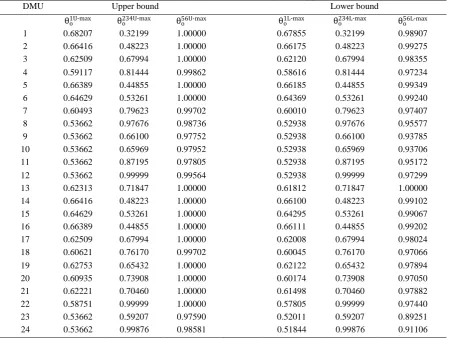
Models (11) and (12) cannot be turned into linear models because of the additional outputs in the first stage in relative to sub-DMU1o, the additional inputs and outputs in the second stage related to sub-DMU2o, sub-DMU3o and sub-DMU4o and the additional inputs in the third stage in relevance to sub-DMU5o and sub-DMU6o respectively. Thus, we propose the heuristic approach given hereunder, for solving models (11) and (12). This approach shall be founded on model (11). We are aware that the objective function of model (11) is the product of the efficiency of the three phases i.e. θooverall(U)=max θ1Uo . θo234U . θo56U. First, we measure the maximum efficiency of each stage provided that the efficiency of each sub-DMU in stage 1, stag 2 and stage 3 is less than one. Therefore, we define θo1U-max, θo234U-max and θo56U-max maximum efficiencies for stage 1, stage 2 and stage 3, respectively as follows:
θo1U-max=max { θo
1U | θ
j
1L ≤ 1, θ
j
2L ≤ 1, θ
j
3L ≤ 1, θ
j
4L ≤ 1, θ
j
5L ≤ 1, θ
j
6L ≤ 1, ∀j≠o,
θo1U ≤ 1, θo2U ≤ 1, θo3U ≤ 1,θo4U ≤ 1, θo5U ≤ 1, θo6U ≤ 1
} (14)
θo234U-max=max {θo
234U| θ
j
1L ≤ 1, θ
j
2L ≤ 1, θ
j
3L ≤ 1, θ
j
4L ≤ 1, θ
j
5L ≤ 1, θ
j
6L ≤ 1, ∀j≠o,
θo1U ≤ 1, θo2U ≤ 1, θo3U ≤ 1,θo4U ≤ 1, θo5U ≤ 1, θo6U ≤ 1
}
θo56U-max=max {θo
56U| θ
j
1L ≤ 1, θ
j
2L ≤ 1, θ
j
3L ≤ 1, θ
j
4L ≤ 1, θ
j
5L ≤ 1, θ
j
6L ≤ 1, ∀j≠o,
θo1U ≤ 1, θo2U ≤ 1, θo3U ≤ 1, θo4U ≤ 1, θo5U ≤ 1, θo6U ≤ 1
}
respectively. The objective function of model (11) is θo1U . θo234U . θo56U and an upper bound can be obtained for each one. We suggest a heuristic method to solve model (11) by using two models as follows:
Step 1: In the first model let us consider two stages for example θo1U and θo234U as two variables that change between intervals [0, θo1U-max ] and [0, θo234U-max ], respectively. Then the maximal efficiency of model (11) and the maximal and minimal efficiency of θo1U and θo234U are obtained, provided that the efficiency of model (11) is fixed or constant.
Step 2: In the second model consider another two stages for example θo234U and θo56U as two variables and as in the first model, it obtains the maximal efficiency of model (11) and the maximal and the minimal efficiency of θo234U and θo56U .
By using two abovementioned steps we obtain the maximal efficiency of the model (11) and the maximal and minimal efficiency of one stage twice, that is, with a very agreeable approximation, which is equivalent. We perform the two abovementioned steps three times and consider all the modes. In the continuation of this paper, we shall consider one of the modes. First, we convert model (11) to model (15) and use a heuristic method to solve it as follows:
θooverall(U)=max
{
θo1U. θo234U. θo56U
| |
θj1L ≤ 1, θj2L ≤ 1, θj3L ≤ 1, θj4L ≤ 1, θj5L ≤ 1, θj6L ≤ 1, ∀j≠o,
θo1U ≤ 1, θo2U ≤ 1, θo3U ≤ 1, θo4U ≤ 1, θo5U ≤ 1, θo6U ≤ 1
θo1U= Oo
1U
Io1L, θo
234U= Oo234U
Io234L, θo
1U ∈[0, θ
o 1U-max ],
θo234U ∈[0, θo234U-max ] }
(15)
In the models (15) all the variables are non-negative. It should be noted that in the model (15), we consider θo1U ,θo234Uas two variables in the objective function and the two constraints
which specify these two variables, together with the interval modifications are supplemented to the model by us. In model (1), we have described the efficiency of the first stage and in model (15) have briefly demonstrated byoutputs to inputs. In model (15) let us consider stage 1 and 2 as two variables θo1U and θo234U that change between intervals [0, θo1-max ] and [0,
θo234-max ], respectively. We should fix θ
o
1U and θ o
234U until model (15) becomes a linear
programing model and we can solve it. For this purpose, we define θo1U and θo234U as follows:
θo1U = θo1U-max - k1∆ε, k1=0,1,…, [θo
1U-max
∆ε ] +1 (16)
θo234U = θo234U-max - k2∆ε, k2=0,1,…, [θo
234U-max
∆ε ] +1
In the model (16), ∆𝜀 is a step size and we consider ∆ε =0.01. With the Charnes–Cooper (1962) converted models, model (15) can be turned into a linear model as follows:
Let T= 1
∑I5i5=1vi55xi5o5L+∑I6i6=1v6i6xi6o6L+∑D4d4=1w4d4zd4o4L +∑D5d5=1w5d5zd5o5L+∑D6d6=1w6d6zd6o6L+∑d7=1D7 wd77zd7o7L +∑D8d8=1w8d8zd8o8L +∑D9d9=1w9d9zd9o9L , thus:
θooverall(U) = max θo1U. θo234U. (∑rR55=1ur55y5Ur5o+ ∑ ur77
R7
r7=1 yr7U7o- ∑ ur66
R6
r6=1 yr6L6o- ∑ ur88
R8
r8=1 yr8L8o )
(17)
s.t. ∑dD11=1wd11zd1L1j+ ∑Dd22=1wd22z2Ld2j+ ∑Dd33=1wd33z3Ld3j- ∑ ur11yr1U1j
R1
r1=1 - ∑ vi11xi1U1j
I1
i1=1 ≤ 0, ∀j≠o
∑Dd44=1wd44zd4j
4L+ ∑ w
d5 5 D5
d5=1 zd5j
5L+ ∑ u
r2
2y
r2L2j R2
r2=1 - ∑Ii22=1vi22xi2U2j- ∑dD11=1wd11zd1j
1U ≤ 0, ∀j≠o
∑ wd6
6 D6
d6=1 zd6j
6L+ ∑ w
d7
7 D7
d7=1 zd7j
7L+ ∑ u
r3
3y
r3j 3L R3
r3=1 - ∑ vi3
3x
i3U3j I3
i3=1 - ∑ wd2
2 D2
d2=1 zd2j
2U ≤ 0, ∀j≠o
∑ wd8
8 D8
d8=1 zd8j
8L+ ∑ w
d9
9 D9
d9=1 zd9j
9L+ ∑ u
r4
4y
r4j
4L R4
r4=1 - ∑ vi44xi4U4j
I4
i4=1 - ∑ wd3
3 D3
d3=1 zd3j
∑Rr55=1ur55yr5L5j- ∑Rr66=1ur66yr6j
6U- ∑ v
i55xi5U5j I5
i5=1 - ∑ wd4
4 D4
d4=1 zd4j
4U- ∑ w
d6
6 D6
d6=1 zd6j
6U- ∑ w
d8
8 D8
d8=1 zd8j
8U≤ 0, ∀j≠o
∑Rr77=1ur77yr7L7j- ∑ ur88
R8
r8=1 yr8U8j- ∑ vi66xi6U6j
I6
i6=1 - ∑ wd5
5 D5
d5=1 zd5U5j- ∑dD77=1wd77zd7U7j- ∑Dd99=1wd99zd9U9j ≤0 ∀j≠o
∑dD11=1wd11z1Ud1o+ ∑Dd22=1wd22z2Ud2o+ ∑Dd33=1wd33z3Ud3o- ∑ ur11yr1L1o
R1
r1=1 - ∑iI11=1vi11xi1L1o ≤ 0
∑ wd4
4 D4
d4=1 zd4o
4U+ ∑ w
d5
5 D5
d5=1 zd5o
5U+ ∑ u
r2
2y
r2U2o R2
r2=1 - ∑iI22=1v2i2xi2L2o- ∑ wd1
1 D1
d1=1 zd1o
1L ≤ 0
∑ wd6
6 D6
d6=1 zd6o
6U+ ∑ w
d7
7 D7
d7=1 zd7o
7U+ ∑ u
r3
3y
r3o 3U R3
r3=1 - ∑ vi3
3x
i3o 3L I3
i3=1 - ∑ wd2
2 D2
d2=1 zd2o
2L ≤ 0
∑ wd8
8 D8
d8=1 zd8o
8U+ ∑ w
d9
9 D9
d9=1 zd9o
9U+ ∑ u
r4
4y
r4U4o R4
r4=1 - ∑ vi4
4x
i4o 4L I4
i4=1 - ∑ wd3
3 D3
d3=1 zd3o
3L ≤ 0
∑ ur55
R5
r5=1 yr5U5o- ∑ ur66
R6
r6=1 yr6L6o- ∑ vi55xi5L5o
I5
i5=1 - ∑Dd44=1wd44zd4L4o- ∑Dd66=1wd66zd6L6o- ∑Dd88=1wd88zd8L8o≤ 0
∑ ur77
R7
r7=1 yr7U7o- ∑ ur88
R8
r8=1 yr8L8o- ∑ vi66xi6L6o
I6
i6=1 - ∑dD55=1wd55zd5o
5L - ∑ w
d77 D7
d7=1 zd7L7o- ∑dD99=1w9d9zd9L9o ≤ 0
∑Ii55=1vi55x5Li5o+ ∑Ii66=1vi66x6Li6o+ ∑ wd4
4 D4
d4=1 zd4o
4L + ∑ w
d5 5 D5
d5=1 zd5L5o+ ∑ wd6
6 D6
d6=1 zd6o
6L + ∑ w
d7
7 D7
d7=1 zd7o
7L
+ ∑Dd88=1wd88zd8L8o+ ∑dD99=1wd99zd9L9o =1
Oo1U= Io1L. θo1U
Oo234U= Io234L. θo234U
θo1U ∈[0, θo1U-max ]
θo234U ∈[0, θo234U-max ]
u1r1,ur22,ur33,u4r4,ur55,ur66,ur77,u8r8,vi11,vi22,vi33,vi44,vi55,vi66,wd1
1 ,w
d22,wd33,wd44,wd55,wd66,wd77,wd88,wd99 ≥ ε;
r1=1, …,R1; r2=1,…,R2; r3=1,…, R3; r4=1, …,R4; r5=1,…,R5; r6=1,…, R6; r7=1, …,R7; r8=1,…,R8;
i1=1,…,I1; i2=1,…,I2; i3=1,…,I3; i4=1,…,I4; i5=1,…,I5; i6=1,…,I6; d1=1,…,D1; d2=1,…,D2; d3=1,…,D3;
d4=1,…,D4; d5=1,…,D5; d6=1,…,D6;d7=1,…,D7; d8=1,…,D8; d9=1,…,D9.
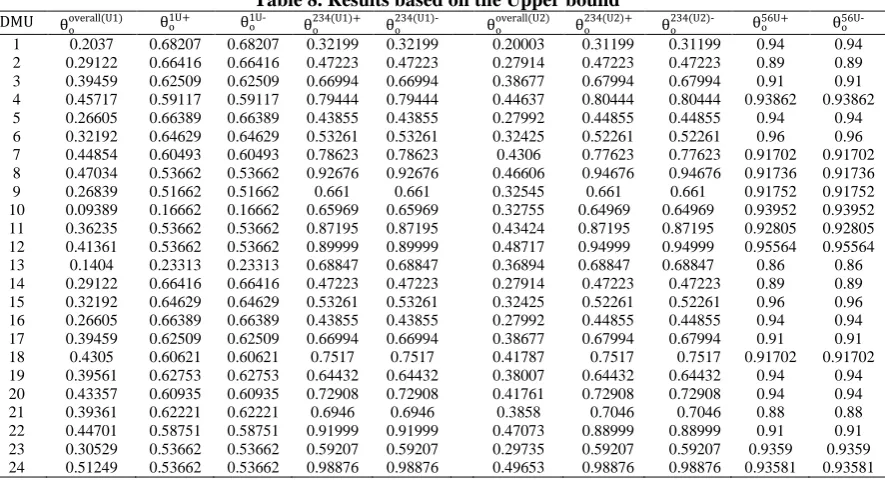
In model (17) we increase k1 and k2 from zero to the upper bound of each one of them independently and solve each linear model with both k1 and k2 and show the value of the objective function with θooverall(U1)(k1, k2). In comparing all the values of the objective function in model (17), we define the maximal overall efficiency as θooverall(U1)=max θooverall(U1)(k1, k2). The maximal and minimal efficiencies of the first stage are defined as θo1U+=max θo1U(k1) where, k1=min (k1 |θooverall(U1)(k1, k2) = θooverall(U1)) and θo1U-=min θo1U(k1) where,
k1=max (k1 |θooverall(U1)(k1, k2) = θooverall(U1)), respectively. Similarly, the maximal and
minimal efficiencies of the second stage are defined as θo234(U1)+=max θo234U(k2) where, k2=min (k2 |θooverall(U1)(k1, k2) = θoverall(U1)o ) and θo234(U1)-=min θo234U(k2) where, k2=max (k2 |θooverall(U1)(k1, k2) = θooverall(U1)), respectively. If θo1U+=θo1U- and
θo234(U1)+=θo234(U1)- we obtain a unique efficiency for the third stage as
follows: θo56U= θo overall(U1)
θo1U . θo234(U1)
. Or else, for measuring the maximal and minimal efficiency of the
θooverall(U)=max
{
θo1U. θo234U. θo56U
| |
θj1L ≤ 1, θj2L ≤ 1, θj3L ≤ 1, θj4L ≤ 1, θj5L ≤ 1, θj6L ≤ 1, ∀j≠o,
θo1U ≤ 1, θo2U ≤ 1, θo3U ≤ 1, θo4U ≤ 1, θo5U ≤ 1, θo6U ≤ 1
θo234= Oo
234
Io234, θo
56= Oo56
Io56,
θo234U ∈[0, θo234U-max ], θo56U ∈[0, θo56U-max ], j=1,…,n }
(18)
In model (18) we consider stages 2 and 3 as two variables θo234U and θo56U that change between intervals [0, θo234U-max ] and [0, θo56U-max ], respectively. We define θo234U and θo56U as follows:
θo234U = θo234U-max - k2∆ε, k2=0,1,…, [θo
234U-max
∆ε ] +1
(19)
θo56U = θo56U-max - k3∆ε, k3=0,1,…, [θo
56U-max
∆ε ] +1
In model (19) we consider ∆𝜀 =0.01. With the Charnes–Cooper (1962) converted model (18) can be turned into a linear model as follows:
Let T= 1
∑ vi11x
i1o 1L I1 i1=1
, thus:
θooverall(U) = max θo234U . θo56U. ( ∑ wd1
1 D1
d1=1 zd1o
1U+ ∑ w
d2
2 D2
d2=1 zd2o
2U+ ∑ w
d3
3 D3
d3=1 zd3o
3U- ∑ u
r1
1y
r1L1o R1
r1=1 ) (20)
s.t. ∑dD11=1wd11zd1L1j+ ∑Dd22=1wd22z2Ld2j+ ∑Dd33=1wd33z3Ld3j- ∑ ur11yr1j
1U R1
r1=1 - ∑iI11=1vi11xi1U1j ≤ 0, ∀j≠o
∑ wd4
4 D4
d4=1 zd4j
4L+ ∑ w
d5
5 D5
d5=1 zd5j
5L+ ∑ u
r2
2y
r2L2j R2
r2=1 - ∑iI22=1vi22xi2U2j- ∑ wd1
1 D1
d1=1 zd1j
1U ≤ 0, ∀j≠o
∑ wd6
6 D6
d6=1 zd6j
6L+ ∑ w
d7
7 D7
d7=1 zd7j
7L+ ∑ u
r3
3y
r3j
3L R3
r3=1 - ∑ vi33xi3U3j
I3
i3=1 - ∑ wd2
2 D2
d2=1 zd2j
2U ≤ 0, ∀j≠o
∑ wd8
8 D8
d8=1 zd8j
8L+ ∑ w
d9
9 D9
d9=1 zd9j
9L+ ∑ u
r4
4y
r4j
4L R4
r4=1 - ∑ vi44xi4U4j
I4
i4=1 - ∑ wd3
3 D3
d3=1 zd3j
3U ≤ 0, ∀j≠o
∑ ur55
R5
r5=1 yr5L5j- ∑ ur66
R6
r6=1 yr6U6j- ∑ vi55xi5U5j
I5
i5=1 - ∑Dd44=1wd44zd4U4j- ∑Dd66=1wd66zd6U6j- ∑Dd88=1wd88zd8U8j≤ 0, ∀j≠o
∑ ur77
R7
r7=1 yr7L7j- ∑ ur88
R8
r8=1 yr8U8j- ∑ vi66xi6U6j
I6
i6=1 - ∑dD55=1wd55zd5j
5U- ∑ w
d77 D7
d7=1 zd7U7j- ∑Dd99=1wd99zd9U9j ≤ 0, ∀j≠o
∑ wd1
1 D1
d1=1 zd1o
1U+ ∑ w
d2
2 D2
d2=1 zd2o
2U+ ∑ w
d3
3 D3
d3=1 zd3o
3U- ∑ u
r1
1y
r1L1o R1
r1=1 - ∑ vi1
1x
i1L1o I1
i1=1 ≤ 0
∑ wd4
4 D4
d4=1 zd4o
4U+ ∑ w
d55 D5
d5=1 zd5U5o+ ∑Rr22=1u2r2yr2U2o- ∑ vi2
2x
i2o 2L I2
i2=1 - ∑ wd1
1 D1
d1=1 zd1o
1L ≤ 0
∑Dd66=1wd66zd6U6o+ ∑dD77=1w7d7z7Ud7o+ ∑ ur33yr3U3o
R3
r3=1 - ∑ vi33xi3L3o
I3
i3=1 - ∑Dd22=1w2d2zd2L2o ≤ 0
∑Dd88=1wd88zd8U8o+ ∑dD99=1wd99zd9U9o+ ∑ ur44yr4U4o
R4
r4=1 - ∑ vi44xi4L4o
I4
i4=1 - ∑Dd33=1wd33zd3L3o ≤ 0
∑Rr55=1ur55yr5o
5U- ∑ u
r6
6 R6
r6=1 yr6L6o- ∑ vi5
5x
i5o 5L I5
i5=1 - ∑ wd4
4 D4
d4=1 zd4o
4L - ∑ w
d66 D6
d6=1 zd6o
6L - ∑ w
d8 8 D8
d8=1 zd8o
8L≤ 0
∑Rr77=1ur77yr7o
7U- ∑ u
r8 8 R8
r8=1 yr8o
8L- ∑ v
i66xi6L6o I6
i6=1 - ∑ wd5
5 D5
d5=1 zd5o
5L - ∑ w
d7
7 D7
d7=1 zd7o
7L - ∑ w
d9
9 D9
d9=1 zd9o
9L ≤ 0
∑ vi11xi1L1o
I1
i1=1 =1
Oo234U= θo234U.Io234L
Oo56U= θo56U. Io56L
θo234U ∈[0, θo234U-max ]
u1r1,ur22,ur33,u4r4,ur55,ur66,ur77,u8r8,vi11,vi22,vi33,vi44,vi55,vi66,wd1
1,w
d22,wd33,wd44,wd55,wd66,wd77,wd88,wd99 ≥ ε;
r1=1, …,R1; r2=1,…,R2; r3=1,…, R3; r4=1, …,R4; r5=1,…,R5; r6=1,…, R6; r7=1, …,R7; r8=1,…,R8;
i1=1,…,I1; i2=1,…,I2; i3=1,…,I3; i4=1,…,I4; i5=1,…,I5; i6=1,…,I6; d1=1,…,D1; d2=1,…,D2; d3=1,…,D3;
d4=1,…,D4; d5=1,…,D5; d6=1,…,D6;d7=1,…,D7; d8=1,…,D8; d9=1,…,D9.
We increase k2 and k3 from zero to the upper bound of each one of them, independently and solve each linear model with both k2 and k3 and show the value of the objective function with
θooverall(U2)(k2, k3). In comparing all the values of the objective function in the model (20), we
define the maximal overall efficiency as θooverall(U2)=max θooverall(U2)(k2, k3). The maximal and minimal efficiencies of the second stage are defined as θo234(U2)+=max θo234(k2) where, k2=min (k2 |θooverall(U2)(k2, k3) = θoverall(U2)o ) and θo234(U2)- = min θo234(k2) where, k2=max (k2 |θooverall(U2)(k2, k3) = θooverall(U2)), respectively. Similarly, the maximal and minimal efficiencies of the third stage are defined as θo56U+=max θo56U(k3) where, k3=min
(k3 |θooverall(U2)(k2, k3) = θooverall(U2)) and θo56U-=min θ
o
56U(k
3), where, k3=max (k3
|θooverall(U2)(k2, k3) = θooverall(U2)), respectively. Note, that the efficiency of structure as shown
in Fig. 1. is unique and with a very agreeable approximation we obtain:
θooverall(U)=θooverall(U1)= θooverall(U2); θo234U+=θ
o
234(U1)+= θ
o
234(U2)+;
θo234L-=θo234(L1)-= θo234(L2)-. We obtain the maximal efficiency of the system θooverall(U) and the
maximal and minimal efficiencies for the stages θo1U+, θo1U−, θ234U+o , θo234U−, θo56U+ and θo56U− respectively. Note, that if (θo1U+=θo1U− and θo234U+=θo234U−) or (θo1U+=θo1U− and θo56U+=θo56U−) or (θo234U+=θo234U− and θo56𝑈+=θo56U−) then we have a unique efficiency for each stage based on θooverall(U)= θo1U. θo234U. θo56U. We tested our proposed approach in three modes and each time denoted two different stages as variables. Given the fact that, the efficiency of a network is unique, hence, the results of these three methods were approximately very close and we took advantage of one of these three abovementioned conditions to describe our approach. It should be observed that, the objective function of model (12) is as rendered,
θooverall(L)=max θo1L . θ
o
234L . θ
o
56L For which, we also implemented the heuristic approach for
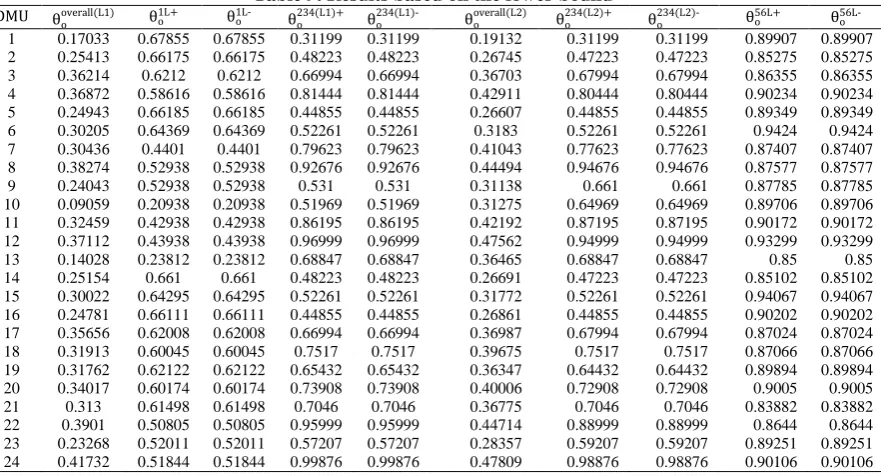
model (12). These results have been illustrated in the next part of the paper.
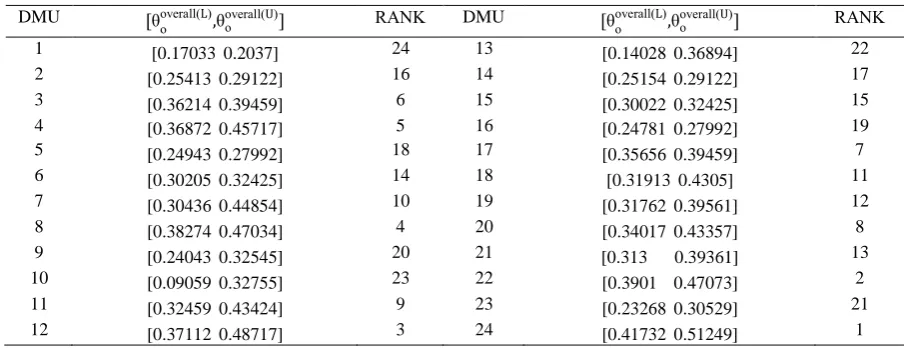
4. Case study description
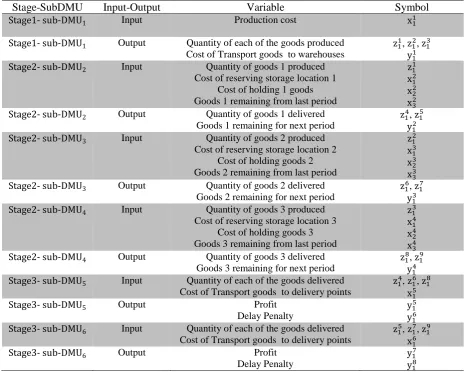
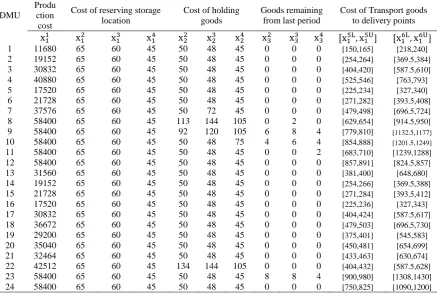
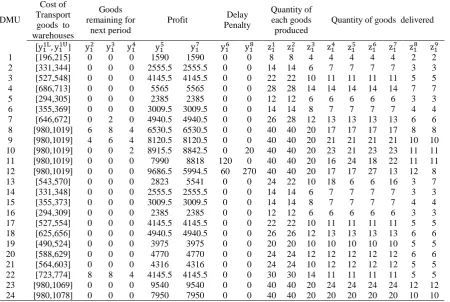
warehouse premises comprises of three warehouses within distances from each other, but in the same area; and a delivery point consisting of two locations, but situated at long distances from the warehouses. This factory produces three products and stores each product in a warehouse. We take this factory into consideration as a dynamic network for duration of 24 time periods and assume each time period as a DMU. In this network a number of outputs in the time period t in stage 2 are converted to a number of inputs to stage 2 during the time period t+1. The inputs-outputs of each DMU are defined as follows: the first stage is the production area and the inputs of the first stage are production costs (x11) for three goods. The intermediate measures between stage 1 and 2 are the quantity of each of the goods produced (z11, z12, z13). The undesirable output of the first stage is the cost of moving the goods from the production area to the warehouses ( y11). In the second stage we have three warehouses and additional inputs of each warehouse, which is the cost for reserving storage location (x12, x13, x14), the cost of holding goods in the warehouse (x22, x23, x24) and goods that have remained in the warehouse from the last period (x32, x33, x34). The desirable outputs of the warehouses in the second stage are defined by the goods remaining in each of the warehouses for the next period (y12, y13, y14). The intermediate measures between stages 2 and 3 are the quantity of goods delivered from each warehouse to every delivery point (z14, z15, z16, z17, z18, z19). The additional inputs in the third stage denotes the cost of moving goods from the warehouses to the delivery points (x15, x16). Finally, in the third stage the desirable and undesirable outputs are profits due to the sale of the goods (y15, y17) and the delay penalty (y16, y18), respectively. The inputs-outputs for each stage are summarized in Table (2).
Table 2. Variables of inputs and outputs
Stage-SubDMU Input-Output Variable Symbol
Stage1- sub-DMU1 Input Production cost x11
Stage1- sub-DMU1 Output Quantity of each of the goods produced
Cost of Transport goods to warehouses
z11, z12, z13
y11
Stage2- sub-DMU2 Input Quantity of goods 1 produced
Cost of reserving storage location 1 Cost of holding 1 goods Goods 1 remaining from last period
z11
x12
x22
x32
Stage2- sub-DMU2 Output Quantity of goods 1 delivered
Goods 1 remaining for next period
z14, z15
y12
Stage2- sub-DMU3 Input Quantity of goods 2 produced
Cost of reserving storage location 2 Cost of holding goods 2 Goods 2 remaining from last period
z12
x13
x23
x33
Stage2- sub-DMU3 Output Quantity of goods 2 delivered
Goods 2 remaining for next period
z16, z17
y13
Stage2- sub-DMU4 Input Quantity of goods 3 produced
Cost of reserving storage location 3 Cost of holding goods 3 Goods 3 remaining from last period
z13
x14
x24
x34
Stage2- sub-DMU4 Output Quantity of goods 3 delivered
Goods 3 remaining for next period
z18, z19
y14
Stage3- sub-DMU5 Input Quantity of each of the goods delivered
Cost of Transport goods to delivery points
z14, z16, z18
x15
Stage3- sub-DMU5 Output Profit
Delay Penalty
y15
y16
Stage3- sub-DMU6 Input Quantity of each of the goods delivered
Cost of Transport goods to delivery points
z15, z17, z19
x16
Stage3- sub-DMU6 Output Profit
Delay Penalty
y17