JIE
Journal Vol. 2, Nwww.jie
Calcu
case s
Y.C.Zan Abstrac Fuzzy re relatively disaster. is depict the opin attribute calculate linguistic Keywor Neishabo
Received: Revised: A Accepted:
1.
Int
Reliabil the field presente the fiel systems scale (e from ind about th product System ambiguo *Corresp 1 M.sc in 2 PhD St University 3 Associat University
MS
of Industria No. 1, pp. 1-ems.icms.ac.
ulation o
study
njani1, Z. R
ct
eliability is o y new meth
In this regar ted .Due to th nion of expe
d depending ed. Finally, b
c variables, u
rds
:
Fuzzyour train disa
: March 2014-2 April 2014-23 : August
2014-troductio
lity History d of reliabil ed at the air d of engin s, the role of eg, transpor dustrial pro he long-term ts with high
reliability a ous or inac
onding Author Industrial Eng tudent at the y, Tehran, Iran te Professor at y, Tehran, Iran
al Engineeri - 15
.ir
of the fu
Rafie Majd2,
often used in hod is presen
rds, by using he inability t erts, fuzzy lo g to the type by defuzzific unreliability y Reliability
aster; α-cut.
20
-17
on
goes back ity and in 1 r institute in neering and
f design eng rtation equi ocesses in pl m character er reliability analysis is ccurate info r.
gineering. Department n.
at the Departm n.
ing and Ma
uzzy reli
A.Mirzaza
n analyzing t nted to anal g the certain to provide ex ogic is appli e of each su cation and c of the system ; Triangular
to World W 962, the fir n Ohio (Dhi technology gineer in rem ipment acci lants (Alipo ristics of m y.
done in a s rmation or
of Industrial
ment of Industr
nagement S
iability i
adeh*, 3
the reliability yze Neishab and uncertai xact values f ied and trian ubsystem and comparing th
m is identifie r Membersh
War II. In 19 rst graduate
illon. 2006) y. In matte moval and r idents, whi our Dashbol materials an state of unc lack of suf
Engineering,
rial Engineerin Studies
in Neish
y in the larg bour (also ca in propositio for the unreli
ngular and G d the fuzzy he obtained v
ed.
hip Function
954, the firs school of s ). Today rel ers relating reduction of ich threaten lagh et al. 1 nd equipmen certainty. Th
fficient info
Faculty of E
ng, Faculty of
habour t
e industrial alled Nishap ns, unreliabi iability of ea Gaussian me
unreliability value with th
n; Gaussian
st meeting in system relia liability play
to the pro f defeat and ns lives and 1389, 1389)
nt will be his uncertai ormation. In
Engineering a
f Engineering
train dis
systems. In t pur, a city in ility circuit o ach subsystem
embership fu y value of th
he classificat
Membershi
n America w ability engin
ys a signifi oducts and d destruction d explosion ) ) is vital. I effective in inty may be n such a sit
and Technolog
and Technolo
saster; a
this paper, a n Iran) train of the system m, regarding functions are he system is tion table of
ip Function;
was held in neering was cant role in man-made n on a large ns resulting Information n designing e caused by tuation that
gy, Kharazmi
ogy, Kharazmi
a
a n m g e s f
;
n s n e e g n g y t
i
Y.C.Zanjani, Z. Rafie Majd, A.Mirzazadeh
Journal of Industrial Engineering and Management Studies (JIEMS), Vol. 2, No. 1 Page 2 uncertainty is not only due to an accident use of probability theory to deal with uncertainty is not enough and fuzzy logic theory should be used. Because unlike the classical reliability theory, a system does not comprise only two conditions, the failure mode and the operation mode, rather, the system performance is on a scale ranging from complete failure to full health and thus fuzzy logic theory is more appropriate to express the state of a system. In real world the information about system parameters always cannot be determined precisely and even with the most accurate experiments cannot be said decisively that how long is the lifetime of a system.
In 1974, for the first time, Mamdani et al studied in fuzzy control and fuzzy logic controllers and employed this theory in the field of control (control of the steam engine). During the years 1986 and 1987, for the first time fuzzy logic was used to automatic control of subway in Japan and shortly after hundreds fuzzy controller was designed and applied in Japan (Faghih et al. 1383). The use of fuzzy set theory in reliability has stated since Kaufman`s research (1975),he used possibility theory Instead of using probability theory to calculate the reliability.But at that time he could not justify the effectiveness of his theory in terms of the engineering and math. In fact, the major part of the application of fuzzy methodology in reliability has been after 1980. Most of these models have focused on determining the reliability of system components and simple systems (Cai. 2000).Here some of the most relevant articles in the field of fuzzy reliability are shown in Table 1.
Table 1: Classification of studies in the field of fuzzy reliability
Subjects year
Human reliability assessment for medical devices (Lin et al. 2014) 2014
solving multi-objective reliability optimization problems by fuzzy optimization technique (Garg et al. 2014)
Using fuzzy logic for allocating reliability in design process and initial development of engineering systems (Khanmohammadi et al. 2013)
A non-linear fuzzy regression for estimating reliability in a degradation process (Gonzalez et al. 2013)
2013 Interval optimization based line sampling method for fuzzy and random reliability analysis
(Luyi et al. 2013)
A novel approach for analyzing fuzzy system reliability using different types of intuitionist fuzzy failure rates of components (Kumar et al. 2012)
2012 A new fuzzy parameters reliability analysis model (Chen et al. 2012)
Fuzzy structural analysis based on fundamental reliability concepts (Hurtado et al. 2012)
Interpretations of alternative uncertainty representations in a reliability and risk analysis context (Aven et al. 2011)
2011 Simulation PATROL-F system in form of fuzzy to achieve reliability levels 2011) (Tajeddine et al.
Reliability optimization by using an ant colony approach (Ahmadizar et al. 2011)
Bayesian system reliability assessment under the vague environment (Taheri et al.2011)
Fuzzy Bayesian reliability and availability analysis of production systems (Görkemli et al. 2010)
2010
Hybrid probabilistic fuzzy and non-probabilistic model of structural reliability (Ni et al. 2010) Reliability analysis on competitive failure processes under fuzzy degradation data (Wang et al. 2011)
Fuzzy logic-based direct load control(DLC) of air conditioning loads(ACL) considering nodal reliability characteristics (Goel et al. 2010)
Reliability estimation based on fuzzy lifetime data (Viertl. 2009)
2009
A production inventory model with fuzzy random demand and with flexibility and reliability
considerations (Bag et al. 2009)
Calculation fuzzy shortest path with the highest reliability (Keshavarz et al. 2009)
Calculation of the fuzzy reliability in Neishabour train disaster; a case study
Journal of Industrial Engineering and Management Studies (JIEMS), Vol. 2, No. 1 Page 3 Fuzzy universal generating functions for multi-state system(MSS) reliability assessment (Ding et al. 2008)
2008
Moment Method Based on Fuzzy Reliability Sensitivity Analysis for a Degradable Structural System (Jun et al. 2008)
Assessment of human reliability factors by fuzzy approach (Bertolini. 2007) 2007
Bayesian reliability analysis for fuzzy lifetime data (Huang et al. 2006)
2006
Fuzzy Bayesian system reliability assessment based on exponential distribution 9Wu et al. 2006) Fuzzy multi-objective mathematical programming on reliability optimization model (Mahapatra et al. 2006)
Fuzzy reliability-based optimum design of laminated composites (Junhong et al. 2006)
Impact of interconnection photovoltaic/wind system with utility on their reliability using a fuzzy scheme (El-Tamaly et al. 2006)
Time-dependent reliability under consideration of fuzzy randomness (Moller et al. 2006) Reliability assessment method for pressure piping based on fuzzy probability (Zhou. 2005) 2005 Composite system reliability assessment using fuzzy linear programming(FLP) (Verma et al.
2005)
Evaluation of a power plant fuzzy reliability (Mohanta et al. 2004) 2004 Fuzzy reliability analysis of concrete structures (Biondini et al. 2004)
Fuzzy-based approaches to substation reliability evaluation (Bai et al. 2004) A numerical algorithm of fuzzy reliability (Jiang et al. 2003)
2003 A fuzzy logic based approach to reliability improvement estimation during product development (Yadav et al. 2003)
Analysis of structure reliability through fuzzy numerical software approach (Moller et al., Savoia. 2002)
2002
Incorporating fuzzy operators in the decision network to improve classification reliability (Chiang et al. 2002)
A practical engineering method for fuzzy reliability analysis of mechanical structures 9Bing et al. 2000)
2000 A fuzzy-based approach for generation system reliability evaluation (Narasimhan et al. 2000) Reliability analysis of slopes using fuzzy sets theory (Dodagoudar et al. 2000)
Before 2000, articles are emphasized on basic concepts and researches such as Fuzzy theory in reliability analysis, modeling concepts of fuzzy reliability analysis, analysis of reliability and fault tree On fuzzy sets, evaluation of fuzzy human errors in the Chernobyl accident and etc are done.
Before 2000
In this paper, Neishabour train disaster has been studied in terms of man- machine reliability and with describing the accident based on the relevant documents and evidences, accident system modeling provided.
2.
Background of the Neishabour event
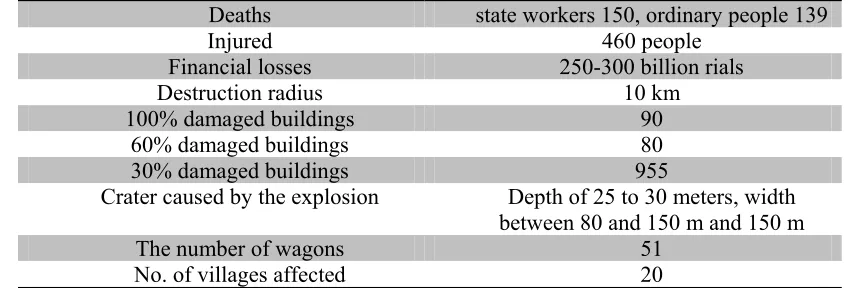
The incident began in near the city of Neishabour on 18 February 2004, where 51 railway wagons carrying sulfur, fertilizer, petrol and cotton broke loose from their siding at Abu Muslim Station and after taking a few kilometers some of them are upside down and catch on fire. In this accident over 300 people were killed and several villages were destroyed (IRNA news agency. 29 Bahman 1382, Mehr news agency. 29 Bahman 1382, Fars news. 3 Aban 1384, Mehr news agency. 30 Bahman 1382). This incident Damage is listed in Table 2.
Table 2: Neishabour accident damage [Mehr news agency. 29 Bahman 1382, Mehr news agency. 30 Bahman 1382, IRNA news agency. 7 Esfand 1382, Mehr news agency. 16 Esfand 1382 ]
Y.C.Zanjani, Z. Rafie Majd, A.Mirzazadeh
Journal of Industrial Engineering and Management Studies (JIEMS), Vol. 2, No. 1 Page 4 state workers 150, ordinary people 139 Deaths
460 people Injured
250-300 billion rials Financial losses
10 km Destruction radius
90 100% damaged buildings
80 60% damaged buildings
955 30% damaged buildings
Depth of 25 to 30 meters, width between 80 and 150 m and 150 m Crater caused by the explosion
51 The number of wagons
20 No. of villages affected
In order to further investigate two categories of propositions are collected in Table 3:Certain propositions and uncertain propositions of accident, using these propositions unreliability circuit of event (Figures 1 and 2) can be drawn.
Table 3: Classification of certain propositions and uncertain propositions of Neishabour accident
1. Scene of disaster (Abu Muslim Station, near Neishabour)
2. Time of the accident (18 February 2004)
3. wagons Freight: sulfur, fertilizer, petrol and cotton
4. Sloping road
5. Overturning of 48 wagons
Certain propositions
1. Breaking brake shoe due to Load pressure
2. Technical defect in the braking system of wagons
3. Probability of Staff carelessness in dragging the Parking
brake
4. Probability of Staff carelessness in placing the brake shoes
5. Earthquake
6. Due to human error
1.Wagon release
uncert
ain pr
opo
sitions 1. Probability that another wagon has caught on fire previously then have bop with overturned wagons.
2. Probability of ammonium nitrate explosion due to clash or
fire caused by clash. 2.Fire
1. Unlike the regulations, transportation of fuel, fertilizer,
sulfur and cotton together.
2. Wrong analysis by firefighters for selecting extinguishing
method.
3. Spread of petrol fire and sulfur due to the use of water
4. Using the wrong extinguisher
5. The absence of an expert before starting to fighting fire
6. Explosion of the remaining wagons containing ammonium
nitrate
7. Explosion of Petrol wagons due to heat transfer
8. Explosion of sulfur exposed to air or oxidizing materials
3.Explosion
3.
The unreliability of Neishabour accident
Calculat
Journal o depends incident
F
Accor Neishab
Figure
4.
Ca
To calcu and acc conside Befor obvious brake an direction brake: i 2002). E simultan
tion of the fu
of Industrial En s on unrelia t will not oc
Figure 1: Unr
rding to th bour acciden
e 2: Schemati
alculation
ulate the un cording to e red and ther e that and t sly that wag
nd brake sh n of the slo internal brak
Each of the neously an
zzy reliabilit
ngineering an ability in fi ccur (Zanjan
reliability cir
he mention nt is drawn
ic unreliabili
n of fuzzy
nreliability o expert's opin refore the fu to calculate
gons escape hoes are not ope (Akbari
ke for each ese brakes c d create ac
ty in Neishab
nd Managemen ire subsyste ni et al. 138
rcuit of Neish
ned certain in Figure 2
ty circuit of N
unreliabi
of this incid nions, for e fuzzy logic c the exact v e often occ t used for it et al. 1388 wagon and can stop the ctive redun
bour train dis
nt Studies (JIE em, In othe 89, Madani e
abour accide
and unce .
Neishabour a
ility
dent and giv each subsys can be used value of unre
curs when t ts harness an
). So train s d line brake e wagon sin ndancy and
saster; a cas
EMS), Vol. 2, er words, w
et al. 1390)
ent (Zanjani e
ertain propo
accident (Zan
ven the unre stem estima d.
eliability fo the train is
nd control, stopping sy e shoes (ext ngly. Thus, d given tha
se study
No. 1 with absenc
.
et al. 1389, M
ositions, un
njani et al. 13
eliability cir ated and ina or wagons e
without lo so the train stem is com ernal brake , these two at a brake
e of one o
Madani et al. 1
nreliability
89, Madani e
cuit shown accurate val escape sub s ocomotive a n began to m mposed of tw e) (Wiley. 2
types of b failure rate
Page 5 f them, the
1390)
circuit of
et al. 1390)
in Figure 2 lues can be system, it is and parking move in the wo types of 2006, Craig, brakes work e does not
5 e
f
Journal o influenc redunda In a p interval equal to R (t) =1 So if system r Althou specifie availabi system a non-re correctly Figure 3
And a system S0=X1X
S1= X1
S2=X1X
S3=X1X
So the a
A =P t
And th
U = 1-e
In oth inhibite and in th R (k, n The a accordin as a tria defined
μ x
of Industrial En ce on the o ancy with ho arallel syste until the o o 1(f / yr), re
1- 1 e
the time o reliability w ugh reliabil ed period o
ility is used downtime a epairable sy y (X1) and 3:
Fig
according t is:
X2 0 X2
X
X 2
availability
t P t
he non-avai
e + 2e
her hand and d (whether his case, the
,p)=∑ p
above calcu ng to railwa angle fuzzy
according t
0
ngineering an other brake ot standby. em consists occurrence eliability is f evaluation will be 0.600 lity describe f time, but d. In Neisha
and therefor ystem. Now brake shoe
gure 3: Diag
to calculati 0 Failure
1 Failure Failures of this syste
P t e
ilability of t
- e
d according by brake s e system rel
1 p
ulations ind ay experts c y number (a to the follow
, a , a , oth
nd Managemen es failure r
of two non of failure calculated b n is consid 0 and as a r es the abilit
for system abour train re wagons e w for calcula e work well
gram of state
ions, availa
em is equal
2e
this system g to railway shoes or int liability is c dicate that computation
a1وa2وa3), th
wing equati
x a
x a
herwise
nt Studies (JIE rates, as a n-repairable
follows an by the follo
dered 1 hou esult, system ty of a syst ms with a c disaster, sin escape is hap ating the wa
(X2),train
changing sys
ability and
to:
e e
is:
experts, if ternal brake calculated ac the exact u nal error for hus reliabil on:
, x∈ 0,1
Y.C.Z
EMS), Vol. 2, result, the elements in
exponentia owing formu ur leading t m unreliabi tem to funct continuous
nce employ ppened thus agon unrelia stopping sy
stem of two tr
non-availab
7 wagons o e), wagon e ccording to
unreliability r wagon esc lity in form
Zanjani, Z. Ra
No. 1 train brak n which for al distributi ula:
o accident, lity is 0.400 tion under operation a yees have n
s this system ability, whe ystem failur
rain wagons b
bility of tw
of the 51 wa escape wou following f y for wago cape reliabi m of a triang
afie Majd, A
ke system h r each eleme
ion and fai
then a wa 0.
stated cond another con not noticed t
m can be co n internal b re rate can b
brakes
wo train wa
agons were uld not have
formula: on failure i ility can be gular fuzzy
.Mirzazadeh
Page 6 has system ent the time lure rate is
(1) agon brakes
ditions for a ncept called the braking onsidered as brake works be drawn in
agon brake (2)
(3) (4) completely e happened (5) is 0.4.Also,
considered y number is
(6) h
6 m e s
s
a d g s s n
e
y d
Calculat
Journal o And th as follow
A
So th Systems
A
The in (from 5 calculat
R =[∑
In wh this form
R =[∑ 0.6
And reliabili
Human opportu (Konsta
Figure 4
tion of the fu
of Industrial En he α-cut int ws [Dutta e
a a α
e unreliabil s on all wag
0.4 0.2 α
ntended ove 1 wagons) ted using th
m
hichm and
mula, the
α-0.2
by continui ity of the sy
T
α
0 0. 0. 0. 0. 0. 0. 0. 0. 0. 1. functionin unistic and s andinidou et
4: Fuzzy sets
zzy reliabilit
ngineering an terval, based et al. 2012]:
a , a
lity of train gons are sim
α 0.2,
erall system worked the e following
1 m
m are the
-cut is as fo
2 α 0.2
ing the calc ystem is loca
Table 4: Fuzz
α
0 0
0 1
0 2
0 3
0 4
0 5
0 6
0 7
0 8
0 9
0 0
ng error p scrambled. t al. 2006)
representatio
ty in Neishab
nd Managemen d on the co
a α a
n wagon br milar, theref
0.6 0.4 α
m is a partial e accident h g formula:
, ∑
α-cut lower llows:
1 0.2 α
culations Ta ated in the i
zy unreliabili
One wag L
0.2 0.22 0.24 0.26 0.28 0.3 0.32 0.34 0.36 0.38 0.4 probability
According
on of the ‘act
bour train dis
nt Studies (JIE ncept of tria
a
rake is exp fore only on
α 0.6
l parallel sy ad not happ
m 1 m
r and upper
α 0.2
able 4 have interval (4.8
ity of wagon e
gon U 0.6 0.58 0.56 0.54 0.52 0.5 0.48 0.46 0.44 0.42 0.4 is divided to earlier re
tion failure pr 2006)
saster; a cas
EMS), Vol. 2, angular mem
pressed as ( ne α-cut is d
0.2 α 0
ystem, becau pened.α-cut
m ]
r bound in t
, ∑
e been obta 8053E -06, 0
escapes parti
Wagon e L 0.001684 0.000361 7.77E-05 1.76E-05 4.81E-06 2.31E-06 2.74E-06 5.72E-06 1.44E-05 3.77E-05 9.86E-05 d into four esearch, the
robability’ ou
se study
No. 1 mbership fu
(0.2, 0.4, 0 defined for s
0.2, 0.2 α
use if the br in partial p the analysis
0.2 α
ained. Acco 0.01349680
al parallel sy
escape subs
0.1 44
0.07 2
0.04 5
0.02 5
0.0 6
0.00 6
0.00 6
0.00 6
0.00 5
0.00 5
9.8 5
r categorie ey can be c
utput variabl
unction, can 0.6).Because subsystems:
α 0.6
rakes of jus parallel syst s for a wago
0.6 1
ording to th 07).
ystem
system U 107578
718858 442285 252706 134968 067735 032082 014398 006147 002509 86E-05 es: strategi
onsidered a
le. (Konstand
Page 7 n be written (7) e the brake (8) st 7 wagons tems can be (9) on. Thus in
0.2 α
(10) his table the
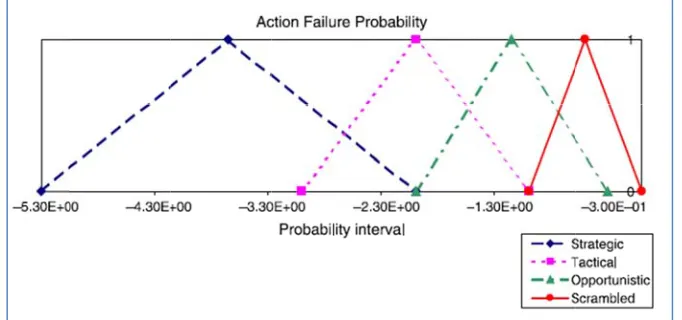
ic, tactical, as Figure 4.
dinidou et al.
7 n ) e ) s e
n
e
, .
Journal o Accor
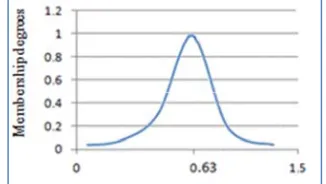
It is e might h subsyste error, ac α 0 0 0.1 0 0.2 0 0.3 0 0.4 0 0.5 0 0.6 0 0.7 0 0.8 0 0.9 0 1 Unrel slope of is consi On th mixture Oil). Am soit can ammoni The u Q=1-e With in abov of this center o Figure 5
of Industrial En rding to Fig
Ta enough that have occur ems, includ ccording to human er subsyste U 0 1 0. 0.97884 0.2 0.95545 0.3 0.92977 0.3 0.90178 0.4 0.87145 0.4 0.83873 0. 0.80359 0. 0.76599 0.6 0.72589 0.6 0.68327 iability of th f the road h
dered 1. he other han e, add the pe mmonium n n be concl
ium nitrate unreliability failure rate e formula i subsystem of 0.63.
5: Fuzzy unre
ngineering an gure 4, the p
able 5: Extent
strategic tactical opportunis
scramble in occurren rred, so hu ding the fou
the concept Tab scr rror em U L 1 .1099 0.95 17982 0.9 24686 0.86 31103 0.8 37238 0.77 43094 0.7 48676 0.68 53987 0.6 59029 0.59 63808 0.5 68327 he slope of ad definite nd, to make etrol or kero nitrate at a luded that existed. (Ta of the hittin
1 Fail/yr, th s equal to 0
can be con
eliability of h
nd Managemen probability o
t of human fu
functio c
stic ed
nce time of uman error ur errors (F t of this erro
ble 6: Unrelia
rambled L U 0.1 0.145 55 0.19 1 0.235 65 0.28 2 0.325 75 0.37 3 0.415 85 0.46 64 0.505 95 0.55 5
the road su effect on in e ammonium osene (liquid temperature the possibi aulbee et al, ng to ammo he failure fu 0.63. Due to nsidered wit
hitting to amm
nt Studies (JIE of functionin
unctioning err
oning error
f the event, r subsystem
Figure 6).It or, is consid
ability of hum
opportunis U 0 0.5 0.0 0.4755 0. 0.451 0.0 0.4265 0. 0.402 0.1 0.3775 0. 0.353 0.1 0.3285 0.2 0.304 0.2 0.2795 0.2 0.255 ubsystem ca ncident occu
m nitrate m d fuels) to i e of 325° C ility of for , 2009) onium nitrat
unction (in o the expon th Gaussian
monium nitra
Y.C.Z
EMS), Vol. 2, ng error is a
ror (Konstan
r probabili
only one o m is consid t should be dered only i
man error sub
stic U L 0.1 .01 0.095 0345 0.090 059 0.085 0835 0.080 108 0.075 1325 0.070 157 0.065 1815 0.060 206 0.055 2305 0.050 255
an be consid urrence, so t more sensitiv it (known as C, within 3
rming an e te can be ex
1 hour lead nential form n membersh
ate subsystem
Zanjani, Z. Ra
No. 1 as Table 5:
ndinidou et al
ity
×1<p< ×1<p ×0.5<p ×1<p< of the four dered as a e noted that in form of th
bsystem tactical L 0.001 0.00595 05 0.0109 01 0.01585 15 0.0208 02 0.02575 25 0.0307 03 0.03565 35 0.0406 04 0.04555 45 0.0505 05
dered as a no the unreliab ve and conv
s ANFO: A seconds ab explosive m xpressed as f
ding to accid mat of this fo
hip function
m with Gaussi
afie Majd, A
l. 2006)
< ×0.5 p< ×1
p< ×1 < ×1
aforementio a set of fo
t external i he opportun str U 0.01 0.0095 5 0.009 9 0.008501 5 0.008001 8 0.007501 5 0.007001 7 0.006501 5 0.006002 6 0.005502 5 0.005002 5 on-fuzzy va bility of this vert it to an Ammonium N
solutely exp mixture of
follows: dent) with S formula, fuz
n (Figure 5
ian membersh .Mirzazadeh Page 8 oned errors our parallel interference nistic error. rategic L 0.000005 0.000505 0.001005 0.001504 1 0.002004 1 0.002504 1 0.003004 1 0.003504 1 0.004003 2 0.004503 2 0.005003 2 ariable. The s subsystem n explosive Nitrite Fuel plodes, and petrol and (11) Substituting zzy variable 5), with the
Calculat
Journal o
And α
+3 σ], c
α μ
Accor conside Other probabi the unre circuit ( 0 mean subsyste quantita on expe conside
Given t fire sub ammoni
tion of the fu
of Industrial En α-cut interv can be writte
μ σ√ 2L
rding to fi red with an subsystem lity of each eliability of (except wha ning that th em is the m ative probab ert opinions red. The me
Figure
the unreliab bsystem (w ium nitrate,
zzy reliabilit
ngineering an al based on en as follow
Lnα, μ σ√
igure 5 an n average of ms, with li h of them is f this comp at was alrea his subsyste main reason bilities base s or subject embership f
6: Fuzzy unr
bility circuit which inclu , can be disp
ty in Neishab
nd Managemen n Gaussian ws:
√ 2Lnα
nd in Gaus f 0.63 and st ittle probab s not clear c plex system
dy mention em has not n to start fi ed on the fre
tive judgme functions ar
reliability of
t, members udes severa played in Ta
bour train dis
nt Studies (JIE membership
ssian mode tandard dev bility have certainly so m. In each o ned), a triang
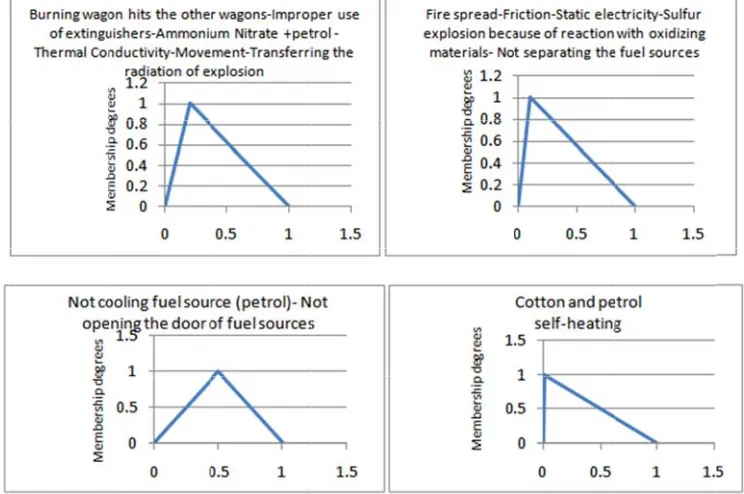
t created th ire. Recallin equency, ra ents. For ea re shown in
subsystems w
ship functio al parallel
able 7.
saster; a cas
EMS), Vol. 2, p function d
, members viation 1.
e triggered fuzzy conc of subsystem
gular fuzzy he ignition ng that the ather these a
ach subsyst Figure 6.
with triangula
ons and α-cu subsystems
se study
No. 1 definition in
hip functio wagons i cept has bee ms mention
variable ca n and point e considered
are qualitati tem differen
ar membersh
ut formula, s), with 3
n the interv
on estimati
ignition, bu en used to q ned in the u
an be consid t 1 meanin d probabilit ive probabi nt vertices
hip function
, unreliabili modes of
Page 9
val [μ-3σ, μ
(12) on can be ut because quantifying unreliability dered, Point ng that this ties are not ilities based centers are
ity α-cut of f hitting to
9 μ
e e g y t s t d e
Y.C.Zanjani, Z. Rafie Majd, A.Mirzazadeh
Journal of Industrial Engineering and Management Studies (JIEMS), Vol. 2, No. 1 Page 10
Burning wag
on hits the ot he r Fire spr ead Frictio n Sta tic elect ri cit y
Cotton self- heatin
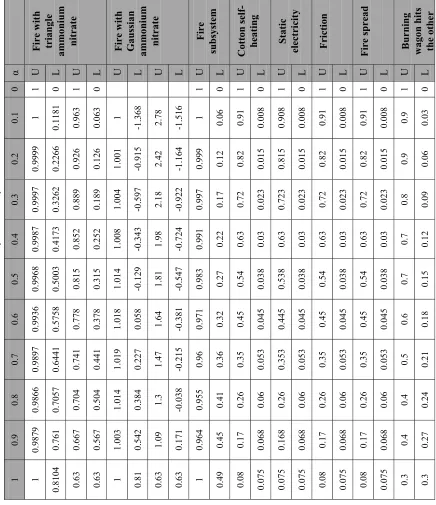
g Fire subs ystem F ire wit h Gaussi an ammon ium nitrate F ire wit h tria n gle ammon ium nitrate Tab le 7: Un re li ab ilit y of fire sub syst em L U L U L U L U L U L U L U L U L U L U α 0 1 0 1 0 1 0 1 0 1 0 1 0 1 0 1 0 0.03 0. 9 0. 008 0.91 0. 008 0.91 0. 008 0. 908 0. 008 0.91 0.06 1 -1 .5 16 2.78 -1 .3 68 1 0. 063 0. 963 0.11 81 1 0. 1 0.06 0.9 0.01 5 0.82 0.01 5 0.82 0.01 5 0.81 5 0.01 5 0.82 0.12 0.99 9 -1 .1 64 2.42 -0 .9 15 1.00 1 0.12 6 0.92 6 0. 2266 0. 9999 0.2 0.09 0. 8 0. 02 3 0.72 0. 02 3 0.72 0. 02 3 0. 72 3 0. 02 3 0.72 0.17 0. 99 7 -0.922 2.18 -0.597 1. 00 4 0. 18 9 0. 88 9 0. 3262 0. 9997 0. 3 0. 12 0.7 0. 03 0. 63 0. 03 0. 63 0. 03 0. 63 0. 03 0. 63 0. 22 0.99 1 -0 .7 24 1. 98 -0 .3 43 1.00 8 0.25 2 0.85 2 0. 4173 0. 9987 0.4 0.15 0. 7 0. 038 0.54 0. 038 0.54 0. 038 0. 538 0. 038 0.54 0.27 0. 983 -0 .5 47 1.81 -0 .1 29 1. 014 0. 315 0. 815 0. 5003 0. 9968 0. 5 0.18 0.6 0.04 5 0.45 0.04 5 0.45 0.04 5 0.44 5 0.04 5 0.45 0.32 0.97 1 -0 .3 81 1.64 0.05 8 1.01 8 0.37 8 0.77 8 0. 5758 0. 9936 0.6 0. 21 0.5 0.05 3 0. 35 0.05 3 0. 35 0.05 3 0.35 3 0.05 3 0. 35 0. 36 0. 96 -0 .2 15 1. 47 0.22 7 1.01 9 0.44 1 0.74 1 0. 6441 0. 9897 0.7 0.24 0. 4 0.06 0.26 0.06 0.26 0.06 0.26 0.06 0.26 0.41 0. 95 5 -0 .0 38 1. 3 0. 38 4 1. 01 4 0. 50 4 0. 70 4 0. 7057 0. 9866 0. 8 0.27 0. 4 0. 06 8 0.17 0. 06 8 0.17 0. 06 8 0. 16 8 0. 06 8 0.17 0.45 0. 96 4 0. 17 1 1.09 0. 54 2 1. 00 3 0. 56 7 0. 66 7 0. 76 1 0. 9879 0. 9 0.3 0.3 0.07 5 0. 08 0.07 5 0. 08 0.07 5 0.07 5 0.07 5 0. 08 0. 49 1 0. 63 0. 63 0. 81 1 0. 63 0. 63 0. 81 04 1 1
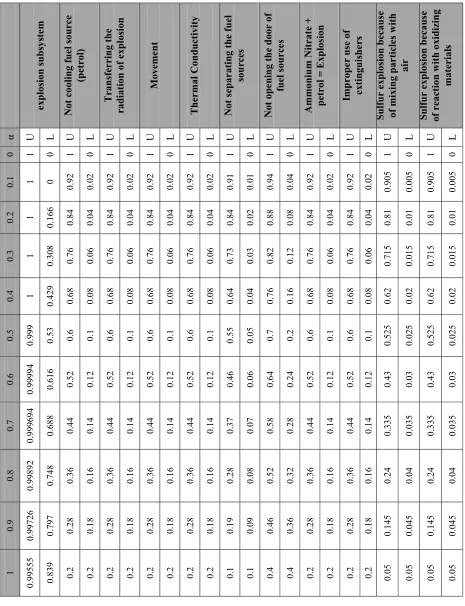
Similarly, α-cut of explosion subsystem (which includes several parallel subsystems), can be
Calculation of the fuzzy reliability in Neishabour train disaster; a case study
Journal of Industrial Engineering and Management Studies (JIEMS), Vol. 2, No. 1 Page 11
S u lf ur ex p los ion b ec aus e of reacti
on with ox
idizin g mat eri als S u lf ur ex p los ion b ec aus e of mi xi ng p
articles with air
Improper use of ex
ting uishers Am moniu m Nitrat e + petrol = Ex p losi on No t opening the door of fu el so urces N ot se para ting the fue l so urce s Thermal Conducti vity Movement Tr ansf erring the radi at io n of exp losi on N ot coo
ling fuel so
Journal o Conside of event
α 0 0.1 0.2
0 0.3
0 0.4
0 0.5
0 0.6
0 0.7 0.8
0 0.9
0 1
Accordi (respect nitrate s
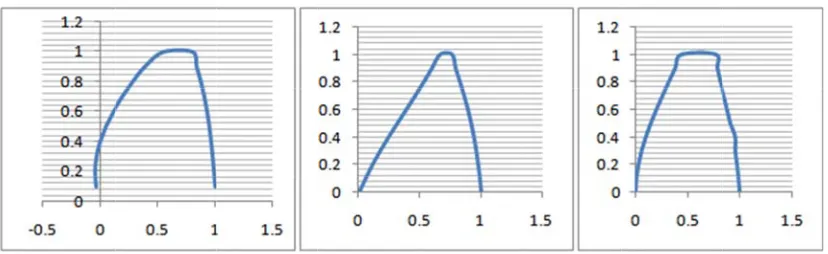
Fi
And to c
x∗
Thus, th case of subsyste reliabili high, th high.
of Industrial En ering the rel
t is defined
Gaussia nitrate
U 1.00004427
0.9894240 0.97749068 0.96417983 0.94874374 0.92967367 0.90495542 0.87300902 0.83512016 0.80251119
ing to the tively from subsystem, G
igure 7: The
convert the he unreliabi f triangle am
em is cons ity based on herefore the
ngineering an lationships as Table 9.
Table 9:
n ammoniu e subsystem L 0.0447 76
-0.0543 8
-0.0421 84
-0.0104 33
0.03957 47
0.1062 76
0.1871 24
0.2802 2
0.385 67
0.5481 93
Table 9, m right to lef Gaussian am
membership
fuzzy value ility in the mmonium n idered is e n the eleme unreliabilit
nd Managemen between su
: Unreliability
um m L
0.9
7103-
0.9 39544
0.9 13694
0.9 45603
0.9 71851
0.8 24393
1702 0 2393
0 599
0 1696
membership ft: regardles mmonium n
function diag
e to crisp va case of ign nitrate subsy
quivalent to ent fuzzy re
ty of the ov
nt Studies (JIE ubsystems in
y of Neishabo
triangle am nitrate su
U 1 88904642 75516423 59537397 40578028 18183003 91922972 0.8616 .827692 .792634 .764059
p function ss of ammo nitrate subsy
gram of the N
alue, follow noring the a ystem is 0. o 0.716. A eliability", t verall syste
Y.C.Z
EMS), Vol. 2, n unreliabili
our train acci
mmonium ubsystem
L 0.01 0.0617203 0.1187502 0.1816920 0.2497507 0.3211839 0.3939315 0.46595 0.53541 0.601512 0.66753
diagram o onium nitrat
ystem) is sh
Neishabour tr
wing formula ammonium n
.675 and w According to
he numeric m, which l
Zanjani, Z. Ra
No. 1 ity circuit, f
ident system
Rega n U 0.9888 364
0.975 241
0.9580 074
0.9366 792
0.9105 903
0.8798 574
0.84 1
0.81 8
0.78 2
0.76 5
f the syste te subsystem hown in Figu
rain disaster
a is used (S nitrate subs when Gaussi o "the lingu cal values 0
ed to the ac
afie Majd, A
finally the u
ardless of am nitrate subs
U 1
0. 879918
0 172048
0. 048468
0. 668086
0. 529071
0. 801499 45661 10705 8001 64059
em fuzzy u m, triangle
ure 7.
fuzzy unrelia
havandi, 13 system is 0. ian ammon uistic classi .65-0.75 ar ccident, wa
.Mirzazadeh
Page 12 unreliability
mmonium system
L 0 007999962 0.02754953
057622738 097093697 144481878 198029319 0.255895 0.316324 0.377766 0.438899
unreliability ammonium
ability
385): (13) .601, in the nium nitrate ification of re relatively as relatively h
2 y
2 8 7 8 9
y m
Calculation of the fuzzy reliability in Neishabour train disaster; a case study
Journal of Industrial Engineering and Management Studies (JIEMS), Vol. 2, No. 1 Page 13
5.
Conclusions
In accident analysis usually methods like risk analysis, crisis management and etc, are used. For more emphasis on the various components of the system, modeling and reliability analyzing can be used. In this method the relationship between the subsystems and their position in comparison with the total system will become more visible. So in this paper, the fuzzy reliability method is used to analyze the incident and the incident is considered with the systemic and humanitarian dimensions. In the first and to analyzing the incident, using certain and uncertain propositions, unreliability circuit of the event was plotted and then the whole incident was simplified to a serial trilateral system, because of the inability to provide exact values for the unreliability of each subsystem, regarding the opinion of experts, fuzzy logic was applied and depending on type of each subsystem, triangular and Gaussian membership functions were attributed to it. Then by using α-cut method, fuzzy unreliability value of system (In three cases: regardless of ammonium nitrate subsystem, triangle ammonium nitrate subsystem, Gaussian ammonium nitrate subsystem) was calculated. Finally by doing defuzzification for each of three mentioned cases separately and comparing the obtained result with the classification table of linguistic variables, unreliability of the system was identified.
Based on the results, by enhancing precision and discipline (in wagon escape subsystem), planning appropriate instruction for material arrangement inside the wagon also in putting wagons together (in fire subsystem) and finally by separating and cooling resources (in explosion subsystem), with high probability similar events do not occur.
References
1. Ahmadizar F., Soltanpanah H., 2011, “Reliability optimization of a series system with
multiple-choice and budget constraints using an efficient ant colony approach”, Expert Systems with
Applications 38, 3640–3646.
2. Akbari M, Ghiasvand S., Soleimani M., 1388, “Safety Equipment, Rail Systems”, Journal of
Railway Research Center.
3. Alipour Dashbolagh Z., 2010, “Application of Reliability Theory in the Design of Secure Systems,
Industrial Dust Explosion Phenomena”, 7th International Conference of Industrial Engineering,
Isfahan.
4. Alipour Dashbolagh Z., Monfared M.A.S., 2010, “Dust explosion phenomena and the processes and
systems”, industrial maintenance, 6th maintenance Conference.
5. Aven.T, 2011, “Interpretations of alternative uncertainty representations in a reliability and risk
analysis context”, Reliability Engineering and System Safety, 96, 353–360.
6. Bag S., Chakraborty D. , Roy A.R. , 2009, “A production inventory model with fuzzy random
demand and with flexibility and reliability considerations”, Computers & Industrial Engineering 56
,411–416.
7. Bai X. , Asgarpoor S. , 2004, “Fuzzy-based approaches to substation reliability evaluation”, Electric
Power Systems Research, 69, 197–204.
8. Bertolini M., 2007 , “Assessment of human reliability factors: A fuzzy cognitive maps approach”,
March 2007, International Journal of Industrial Ergonomics 37, 405–413.
9. Bing L. , Meilin Zh. , Kai X., 2000, “A practical engineering method for fuzzy reliability analysis of
mechanical structures”, Electric Power Systems Research 53, 133–138.
10. Biondini F. , Bontempi F. , Malerba P. G. , 2004, “Fuzzy reliability analysis of concrete structures”,
Computers and Structures, 82, 1033–1052.
11. Brauer, Roger L., 2006 “Safety and Health For Engineers, A JOHN WILEY & SONS, INC.”,
PUBLICATION.
12. Cai K. Y., 2000, “Towards a conceptual framework of software run reliability modeling”,
Information Sciences 126, 137-163.
13. Chen H., Lou X., 2012, “A new fuzzy parameters reliability analysis model, Physics Procedia”,
Y.C.Zanjani, Z. Rafie Majd, A.Mirzazadeh
Journal of Industrial Engineering and Management Studies (JIEMS), Vol. 2, No. 1 Page 14
14. Chiang J. H. , Chen Y.Ch. , 2002, “Incorporating fuzzy operators in the decision network to improve
classification reliability”, Computers and Electrical Engineering 28, 547–560.
15. Craig R., “Industrial fire protection handbook”, 2002, CRC Press LLC، Schroll.
16. Dhillon B. S., 2006, “Maintain ability, Maintenance, and Reliability for Engineering”, by Taylor &
Francis Group, LLC.
17. Ding Y. , Lisnianski A. , 2007, “Fuzzy universal generating functions for multi-state system
reliability assessment”, Fuzzy Sets and Systems 159 , 307 – 324.
18. Dodagoudar G.R., Venkatachalam G., 2000, “Reliability analysis of slopes using fuzzy sets theory”,
Computers and Geo-techniques 27, 101-115.
19. Dutta P., Ali T., 2012, “Uncertainty Modeling in Risk Analysis: A Fuzzy Set Approach”,
International Journal of Computer Applications, No.17, 35-39.
20. El-Tamaly H.H. , Mohammed A. A. E. , 2006, “Impact of interconnection photovoltaic/wind system
with utility on their reliability using a fuzzy scheme”, Renewable Energy 31 ,2475–2491.
21. Faghih N., Najafi Y., 2004, “Fuzzy Reliability in Industrial Systems”; published by Nasim Hayat (in
Persian).
22. Fars news (3 Aban 1384-2005).
23. Garg H., Rani M., Sharma S.P., Vishwakarma Y., 2014, “fuzzy optimization technique for solving
multi-objective reliability optimization problems in interval environment”, Expert Systems with
Applications, 3157–3167.
24. Gonzalez-Gonzalez D. S., Praga Alejo R. J., Cantú-Sifuentes M., Torres-Treviño L. M., Méndez G.
M., 2013, “A non-linear fuzzy regression for estimating reliability in a degradation process”, Applied
Soft Computing, available online.
25. Görkemli L. , Ulusoy S.K. , 2010, “Fuzzy Bayesian reliability and availability analysis of production
systems”, Computers & Industrial Engineering 59 , 690–696.
26. Goel L., Wu Q. ,Wang P. , 2010 , “Fuzzy logic-based direct load control of air conditioning loads
considering nodal reliability characteristics in restructured power systems”, Electric Power Systems
Research 80, 98–107.
27. Hurtado J. E., Alvarez D. A., Ramírez J., 2012, “Fuzzy structural analysis based on fundamental
reliability concepts”, Computers & Structures, 183–192.
28. Huang H. Z. , Zuo M. J.,Sun Zh. Q. , 2006, “Bayesian reliability analysis for fuzzy lifetime data”,
Fuzzy Sets and Systems 157, 1674 – 1686.
29. IRNA news agency (29 Bahman 1382- 2003).
30. IRNA news agency (7 Esfand 1382-2003).
31. Jiang Q., Chen Ch. H., 2003, “A numerical algorithm of fuzzy reliability”, Reliability Engineering
and System Safety 80, 299–307.
32. Jun S., Zhenzhou L., 2008, “Moment Method Based on Fuzzy Reliability Sensitivity Analysis for a
Degradable Structural System”, Chinese Journal of Aeronautics 21, 518-525.
33. Junhong W., Jianqiao Ch, Rui G., 2006, “Fuzzy Reliability-Based Optimum Design Of Laminated
Composites”, Acta Mechanica Solida Sinica, 255-263.
34. Keshavarz E., Khorram E., 2009, “A fuzzy shortest path with the highest reliability”, Journal of
Computational and Applied Mathematics 230, 204-212.
35. Khanmohammadi S., Sadeghpour Khameneh H., Lewis H. W., Chun-An C., 2013, “Prediction of
Mortality and Survival of Patients After Cardiac Surgery Using Fuzzy”, EuroSCORE System and
Reliability Analysis, Procedia Computer Science , 368–373.
36. Kumar M., Prasad Yadav Sh., 2012, “A novel approach for analyzing fuzzy system reliability using
different types of intuitionistic fuzzy failure rates of components”, ISA Transactions , 288–297.
37. Konstandinidou M. , Nivolianitou Z. , Kiranoudis Ch. , Markatos N. , 2006, “A fuzzy modeling
application of CREAM methodology for human reliability analysis”, Reliability Engineering and
System Safety 91, 706–716.
38. Lin Q. L., Wang D. J., Lin W. G., Liu H. C., 2014, “Human reliability assessment for medical
devices based on failure mode and effects analysis and fuzzy linguistic theory”, Safety Science, 248–
256.
39. Luyi Li, Zhenzhou Lu, 2013, “Interval optimization based line sampling method for fuzzy and
Calculation of the fuzzy reliability in Neishabour train disaster; a case study
Journal of Industrial Engineering and Management Studies (JIEMS), Vol. 2, No. 1 Page 15
40. Mahapatra G.S., Roy T.K., 2006, “Fuzzy multi-objective mathematical programming on reliability
optimization model”, Applied Mathematics and Computation 174, 643–659.
41. Madani F. M., Zanjani Y. C., Majd Z. R. , Alipur Dashblagh Z., 2011, “The Occurrence of Runaway
Freight Train Accident Neishabour in terms of Reliability with both Deterministic and Fuzzy
Vision”, Maintenance Conference, Tehran.
42. Mehr news agency (30 Bahman 1382-2003).
43. Mehr news agency (16 Esfand 1382-2003).
44. Mehr news agency (29 Bahman 1382-2003).
45. Mohanta D.K., Sadhu P. K. , Chakrabarti R., 2004, “Fuzzy reliability evaluation of captive power
plant maintenance scheduling incorporating uncertain forced outage rate and load representation”, Electric Power Systems Research 72, 73–84.
46. Moller B., Beer M., Graf W., Sickert J.U., 2006, “Time-dependent reliability of textile-strengthened
RC structures under consideration of fuzzy randomness”, Computers and Structures 84 585–603.
47. Moller B. , Graf W. , Beer M. , 2004, “Discussion on Structural reliability analysis through fuzzy
number approach, with application to stability”, Computers and Structures 82, 325–327.
48. Narasimhan S. , Asgarpoor S. , 2000, “A fuzzy-based approach for generation system reliability
evaluation”, Electric Power Systems Research 53, 133–138.
49. Ni Z., Qiu Z., 2009, “Hybrid probabilistic fuzzy and non-probabilistic model of structural
reliability”, Computers & Industrial Engineering 58, 463–467.
50. Savoia M., 2002, “Structural reliability analysis through fuzzy number approach, with application to
stability”, Computers and Structures 80, 1087–1102.
51. Shavandi H., 2006, “Fuzzy set theory and its application in industrial engineering and management”,
published by Gostaresh Danesh (in Persian).
52. Taheri S.M. , Zarei R. , 2011, “Bayesian system reliability assessment under the vague
environment”, Applied Soft Computing 11, 1614–1622.
53. Tajeddine A, Kayssi A, Ali Chehab A, Artail A, 2011, “Fuzzy reputation-based trust model”,
Applied Soft Computing 11, 345–355.
54. Unver H. O. ,Wendel G. , 2009, “A fuzzy quality control-decision support system for improving
operational reliability of liquid transfer operations in laboratory automation”, Expert Systems with
Applications 36, 8064–8070.
55. Verma A. K., Srividya A., Deka B. C. , 2005, “Composite system reliability assessment using fuzzy
linear programming”, Electric Power Systems Research 73, 143–149.
56. Viertl R. , 2009 , “On reliability estimation based on fuzzy lifetime data”, Journal of Statistical
Planning and Inference 139, 1750 – 1755.
57. Wang Z. , Huang H. Z. ,Du L. , 2011 , “Reliability analysis on competitive failure processes under
fuzzy degradation data “, Applied Soft Computing, 2964-2973.
58. Wu H. Ch., 2006, “Fuzzy Bayesian system reliability assessment based on exponential distribution”,
Applied Mathematical Modeling 30, 509–530.
59. Yadav O. P. , Singh N. , Chinnam R. B. , Goel P. S. , 2003 , “A fuzzy logic based approach to
reliability improvement estimation during product development”, Reliability Engineering and System
Safety 80, 63–74.
60. Zanjani Y. C., Monfared M.A.S., 2010, “Reliability of the of man - machine review System:
Neishabour train accident 82”, 7th International Conference of Industrial Engineering, Isfahan.
61. Zhou J., 2005, “Reliability assessment method for pressure piping containing circumferential defects