https://doi.org/10.5194/gmd-11-3929-2018 © Author(s) 2018. This work is distributed under the Creative Commons Attribution 4.0 License.
Improving collisional growth in Lagrangian cloud models:
development and verification of a new splitting algorithm
Johannes Schwenkel1, Fabian Hoffmann1,a,b, and Siegfried Raasch1
1Institute of Meteorology and Climatology, Leibniz Universität Hannover, Hannover, Germany acurrently at: Cooperative Institute for Research in Environmental Sciences (CIRES),
University of Colorado, Boulder, Colorado, USA
bcurrently at: NOAA Earth System Research Laboratory (ESRL) Chemical Sciences Division, Boulder, Colorado, USA Correspondence:Johannes Schwenkel ([email protected])
Received: 20 April 2018 – Discussion started: 17 May 2018
Revised: 10 August 2018 – Accepted: 10 September 2018 – Published: 28 September 2018
Abstract.Lagrangian cloud models (LCMs) are increasingly used in the cloud physics community. They not only enable a very detailed representation of cloud microphysics but also lack numerical errors typical for most other models. How-ever, insufficient statistics, caused by an inadequate num-ber of Lagrangian particles to represent cloud microphysi-cal processes, can limit the applicability and validity of this approach. This study presents the first use of a splitting and merging algorithm designed to improve the warm cloud pre-cipitation process by deliberately increasing or decreasing the number of Lagrangian particles under appropriate con-ditions. This new approach and the details of how splitting is executed are evaluated in box and single-cloud simulations, as well as a shallow cumulus test case. The results indicate that splitting is essential for a proper representation of the precipitation process. Moreover, the details of the splitting method (i.e., identifying the appropriate conditions) become insignificant for larger model domains as long as a suffi-ciently large number of Lagrangian particles is produced by the algorithm. The accompanying merging algorithm is es-sential to constrict the number of Lagrangian particles in or-der to maintain the computational performance of the model. Overall, splitting and merging do not affect the life cycle and domain-averaged macroscopic properties of the simu-lated clouds. This new approach is a useful addition to all LCMs since it is able to significantly increase the number of Lagrangian particles in appropriate regions of the clouds, while maintaining a computationally feasible total number of Lagrangian particles in the entire model domain.
1 Introduction
Lagrangian cloud models (LCMs) are a recently developed approach to simulate cloud microphysics (Shima et al., 2009; Sölch and Kärcher, 2010; Andrejczuk et al., 2010; Riechel-mann et al., 2012; Arabas et al., 2015; NauRiechel-mann and Seifert, 2015; Grabowski et al., 2018; Sardina et al., 2018). These models represent microphysics by individually simulated particles, so-called superdroplets, each representing a cer-tain number of identical real droplets. This number is called the multiplicity or weighting factor. These models have been successfully used to investigate various aspects of aerosol– cloud interactions (e.g., Andrejczuk et al., 2010; Hoffmann et al., 2015; Hoffmann, 2017) or precipitation processes (e.g., Naumann and Seifert, 2016; Hoffmann et al., 2017; Dziekan and Pawlowska, 2017).
simpli-fied to a couple of superdroplets (with accordingly large weighting factors, approximately 109for typical LES-LCM applications). In fact, a large number of superdroplets (in the magnitude of 10–100 per grid box with accordingly small weighting factors) is needed to represent this range ade-quately. Since this is usually not the case, a few of the largest superdroplets may unrealistically contain the majority of all liquid water. In order to improve the statistics of these par-ticles, Unterstrasser et al. (2017) suggested that the splitting of these particles can help to improve the representation of the precipitation process as it is already done for other mi-crophysical processes (e.g., nucleation in ice clouds; Unter-strasser and Sölch, 2014).
The present study introduces and verifies a splitting al-gorithm designed to improve the precipitation process. Ad-ditionally, an accompanying merging algorithm is proposed that is able to unite superdroplets that are not required for an adequate representation of the precipitation process. Thus, the merging algorithm is essential to improve the computa-tional performance of the LCM. Both algorithms are tested in zero-dimensional box simulations, a three-dimensional sim-ulation of a single cumulus cloud, and an established shal-low cumulus test case. This paper is structured as folshal-lows. The next section briefly summarizes the collection algorithm and the basic framework of the applied LCM. Section 3 in-troduces the splitting and merging algorithms, and Sect. 4 shows results in which splitting and merging are applied. Fi-nally, Sect. 5 concludes the paper.
2 Basic equations of the LCM
This section gives a short overview of the LCM basic equations. The applied LCM was initially developed by Riechelmann et al. (2012) and its current version is docu-mented in Hoffmann et al. (2017). Besides collection, the LCM calculates diffusional growth as well as the trans-port of the superdroplets. These processes are coupled to the PALM large-eddy simulation (LES) model (Maronga et al., 2015), which solves the non-hydrostatic incompress-ible Boussinesq-approximated Navier–Stokes equations, and prognostic equations for the water vapor mixing ratio and po-tential temperature. In addition to these coupled simulations, we use a zero-dimensional box model, in which the process of collision and coalescence is considered as the only micro-physical process.
In the following, the applied collection algorithm will be summarized to show how collection affects a superdroplet’s weighting factor, and to understand how collection and split-ting interact. The reader is referred to Unterstrasser et al. (2017) for a more rigorous description of this all-or-nothing approach and for comparisons with other LCM collection algorithms. For the following, it is assumed that all super-droplets are sorted by their weighting factor such thatAn> An+1 (the case ofAn=An+1 will be discussed further
be-low). For all superdroplet combinations with 1≤n < m≤ Np, whereNp is the number of superdroplets located in a grid box, the probability that one droplet of superdropletm
collects an arbitrary droplet of superdropletnis given by
pmn=K(rm, rn) 1t
1V ·An, (1)
where1t is the length of the collection time step,1V the volume of the grid box,rnthe radius of a droplet represented by superdropletn, andKis the collection kernel (based on Hall, 1980, for this study). Sincepmnis usually smaller than 1, collections only occur ifpmn> ξ, whereξ is a random number uniformly chosen from the interval[0,1]. This prob-abilistic approach ensures that the number of collections cal-culated in the model is identical to the number of collections resulting from Eq. (1) if averaged over a sufficiently long pe-riod of time.
If a collection takes place, each droplet of superdroplet
mwill collect one droplet of superdropletn. This results in commensurate changes in the weighting factorAn and the individual droplet massmm=Am·4/3π ρlrm3 with the liquid water densityρl, whileAmandmnremain unchanged: b
Am=Am and Abn=An−Am, (2)
b
mm=mm+mn and mbn=mn, (3)
where(. . .)d marks the variable after collection.
IfAm=An, the above-described collection would result in one superdroplet with a zero weighting factor. To avoid deleting this superdroplet, the droplets of the superdroplet that has grown by collection are distributed equally among the involved superdropletsmandn:
b
Am=Abn=Am/2, (4)
b
mm=mbn=2mm. (5)
Diffusional growth is described by
rn drn
dt = S Fk+Fd
f (rn). (6)
The ventilation effectf (rn)describes the accelerated evapo-ration of large drops.S is the supersaturation (calculated in the LES), andFk andFdare coefficients considering the ef-fects of heat conduction and the diffusion of water vapor, re-spectively (e.g., see Rogers and Yau, 1989). Note that curva-ture and aerosol solute effects, as well as gas-kinetic effects, are neglected in Eq. (6), but this equation is appropriate for the purpose of this study which focuses on the precipitation process, i.e., larger droplets for which these processes are ir-relevant.
Transport of each superdroplet is described by dXn
where Xn is the location of the superdroplet, u the LES-resolved velocity interpolated to the superdroplet’s location, and eu is a stochastic velocity component to parameterize subgrid-scale fluctuations unresolved in the LES (e.g., see Sölch and Kärcher, 2010).
3 Splitting and merging
The following subsections will introduce techniques for the interactive modification of the number of superdroplets by splitting and merging. This is different from most pre-vious LCM approaches, in which the number of super-droplets is set at the beginning of the simulation and re-mains constant thereafter (unless precipitation scavenges su-perdroplets). Note that the splitting and merging algorithms will be tested for the all-or-nothing collection approach, but they are similarly applicable to the average-impact approach introduced by Riechelmann et al. (2012).
3.1 Splitting
Splitting takes place if a superdroplet fulfills certain criteria. First, the radius of the superdroplet needs to be greater than or equal to a thresholdrspl. This is necessary to limit splitting to the region of interest, i.e., coalescing droplets for which an improved statistical representation is required. Second, the weighting factor of the superdroplet needs to be greater than or equal to a threshold Aspl to avoid excessive and poten-tially useless splitting. And finally,Aspl is required to be at least larger thanηspl, which is the number of superdroplets in which the superdroplet is split. This ensures that no super-droplets with an unrealistic weighting factor of less than 1 are created.
The numerical implementation of the splitting can be un-derstood as cloning of the superdroplet that has been deter-mined to be split. In addition to the already existing super-droplet,ηspl−1 new superdroplets are created. To conserve the total amount of represented droplets, the weighting factor of theseηsplsuperdroplets is reduced to
A∗n= An ηspl
. (8)
Note that allηsplsuperdroplets have identical properties im-mediately after splitting, including their location. However, each superdroplet will develop an individual trajectory inde-pendent from the others due to the stochastic velocity com-ponent in Eq. (7), which is determined individually for each superdroplet.
In a first straightforward approach, the thresholds rspl,
Aspl, and the splitting factorηsplare explicitly prescribed. In the following this method is abbreviated as Smode, where theSstands for simple.
In a more advanced method (abbreviatedG, standing for gamma distribution), the thresholdAspland the splitting fac-torηsplare estimated from an idealized gamma distribution,
which is assumed to describe the distribution of droplets larger thanrsplin each grid box of the simulated model do-main (e.g., Ulbrich, 1983):
n(r)=N0rµexp(−λr), (9)
wheren(r)·dr states the number of particles per unit vol-ume in the size range(r, r+dr). HereN0 is the intercept,
µis the shape, andλis the slope parameter of the gamma distribution. These parameters are calculated as
N0=
Nr 0(µ+1)λ
µ+1, (10)
λ=hπ ρl
6 (µ+3)(µ+2)(µ+1)xr −1i
1 3
, (11)
and
µ=(1−ζ )n+1
ζ−1 , (12)
whereNr is the number concentration of droplets withr≥ rspl,0is the gamma function,ρlis the density of liquid water, xris the mean geometric radius, andζ is a factor calculated as
ζ=M0M2
M12 , (13)
whereMkis thekth moment of the mass density distribution (see Seifert, 2008). The calculation of these moments in the LCM framework will be described in Sect. 4.1.1.
The assumed drop size distribution (DSD) is calculated fromnbin=100 logarithmically spaced bins. (Larger values fornbindid not alter the results.) The center of biniis calcu-lated as
rbc,i=10log10(rmin)+iν, (14)
where
ν=log10(rmax)−log10(rmin) nbin−1
. (15)
The minimum and maximum radius of the discretized spec-tra are denoted withrminandrmax, respectively. Here these values are set to rmin=rspl and rmax=5 mm, which en-sures that the whole spectrum of droplet sizes is included. Furthermore, the boundaries of bin i are given by rbb,i= 10log10(rmin)+(i−0.5)·ν andr
bb,i+1. Hence, the width of bin i is1ri=rbb,i+1−rbb,i.
It is assumed that the weighting factor of a superdroplet should be smaller than or equal to the approximated num-ber of droplets in the corresponding bin of the discretized gamma distribution. Thus, the weighting factor threshold is determined by
Aspl,i=max
ni(rbc,i)·1ri·1V ,1
Accordingly, the number of newly generated superdroplets depends on the ratio of the initial weighting factor to the es-timated number of droplets using the gamma distribution:
ηspl=
A
n Aspl,i
. (17)
Since only a positive integer of superdroplets can be gener-ated, the splitting factor is rounded down to the nearest whole number.
No matter which splitting mode is chosen, the splitting op-erations are executed at each time step of the LCM. Due to limited computational resources, the generation of new su-perdroplets must be restricted to a feasible amount. Hence, two limitations are introduced. The first restriction is the maximum splitting factorηmax, i.e., the maximum number of clones produced per splitting. This parameter is used for the
Gmode, in which Eq. (17) might not be well-defined in the case of large droplets for whichAspl,i approaches zero. The second limitation ensures a computationally feasible num-ber of superdroplets in every grid box by introducing a fixed maximumNP,max. Accordingly, splitting operations are only executed if the number of superdroplets in one grid box is smaller than NP,max. The latter threshold is applied for the
Gand theSmode. A suitable choice of these limits will be presented in Sect. 4.1.2.
3.2 Merging
As a consequence of the potentially massive generation of new superdroplets due to splitting, the total number of su-perdroplets may increase sharply, which makes simulations computationally very expensive. For this reason, a merging algorithm was developed to decrease the number of super-droplets in order to reduce the required computational re-sources.
To avoid an impact of merging on micro- or macrophys-ical properties of the cloud, the algorithm is only executed in non-cloudy grid boxes (liquid water is lower than ql< 0.01 g kg−1). Accordingly, cloudy regions, in which a high number of superdroplets are necessary for the correct repre-sentation of potential collisional growth, are left unaffected. Furthermore, it is required that the merged superdroplets are smaller or equal to rmer=0.1 µm, which ensures that only evaporated superdroplets are affected, and not raindrops that precipitate from the cloud. Additionally, merging is only ex-ecuted in grid boxes in which the initial superdroplet con-centration is exceeded and superdroplets exhibit a weighting factor that is smaller than a certain thresholdAmer, rationally chosen to be smaller or equal to the initial weighting factor. This is done to avoid decreasing the LCM’s baseline capabil-ity to represent DSDs set during initialization.
The algorithm is designed as follows. Based on the thresh-olds rmer and Amer, each superdroplet with rm≤rmer and
Am≤Amerin a non-cloudy grid box is merged with the next superdroplet of the same grid box. Here the next superdroplet
is the superdroplet located next in the memory, which en-ables an efficient execution of the merging algorithm. The new weighting factor of the remaining superdroplet (indexn) is mass-weighted and given byA∗n=An+Am·rm3/rn3, while the other superdroplet (indexm) is deleted. Accordingly, this leads to a new integral mass Mn∗=Mn+Mm, guarantee-ing mass conservation. An averagguarantee-ing of other superdroplet properties (e.g., velocity components, radius, and location) is not implemented and probably not necessary for the correct representation of the cloud since merging is restricted to a cloud-free environment. Moreover, a more advanced method was tested, in which the most similar droplets (within one grid box) concerning their mass are merged. These simula-tions show similar results. However, due to sorting processes the computing time is increased in comparison to the simple method.
The use of the merging algorithm inside certain regions of the cloud where collection plays only a subordinate role is also conceivable. However, the (probably sophisticated) de-termination of necessary thresholds is not within the scope of this study. Furthermore, it must be mentioned that the merg-ing algorithm does not conserve size and chemical composi-tion of the aerosol. Therefore, for studies that explicitly con-sider aerosols, the merging algorithm needs to be adapted.
4 Applications
4.1 Box model simulations
In the following box simulations, the sensitivity of the LCM collection process to the number of simulated superdroplets, different splitting approaches, and the approaches’ specific parameters is investigated. Therefore, the box model simula-tion considers collecsimula-tion as the only microphysical process. 4.1.1 Setup
Although zero-dimensional simulations do not have a spatial extent, allocating a certain weighting factor requires a ref-erence volume to represent a defined droplet concentration. Therefore, the volume of a grid box is 8×10³m3, which cor-responds to an isotropically spaced grid with 1x=1y= 1z=20 m. The simulation time is 3600 s with a constant time step of 1 s. To ensure adequate statistics, 25 344 boxes are calculated, and results are averaged over this ensemble. (The number of ensemble members represents the maximum amount of grid boxes which can be calculated on four com-puting nodes in an appropriate time.) In the following this method is referred to as a single-box model.
ensem-ble above, with cyclic boundary conditions among which the superdroplets are allowed to move. The stochastic velocity component is chosen in such a way that it corresponds to a ki-netic energy dissipation rate ofbox=0.01 m2s−3, which is typical for shallow cumulus clouds (e.g., Shaw et al., 1998).
This multi-box approach has one distinct advantage over the ensemble mean of the same amount of individual box model simulations (single-box model), which results from the difficulties to initialize a DSD with superdroplets of a constant weighting factor, as it is done in many applications of LCMs in the literature (e.g., Shima et al., 2009; Riechel-mann et al., 2012; NauRiechel-mann and Seifert, 2015; HoffRiechel-mann et al., 2017; Sardina et al., 2018). A single-box model sim-ulation suffers crucially from this initialization method due to a wrong representation of the largest and rarest super-droplets (Unterstrasser et al., 2017, their Fig. 17). In doing so, the rarest and largest, and therefore most important su-perdroplets for the collection process, are a priori over- or underestimated. An exchange of superdroplets between the collection boxes helps to mitigate this problem. Moreover, this new approach is closer to the representation of collection in three-dimensional simulations, in which a superdroplet is not bound to a single grid box.
The impact of different numbers of superdroplets per grid box and the use of splitting for the traditional single-box ap-proach will be discussed first; then, the new introduced multi-box approach will be presented for both splitting and non-splitting cases. Box model simulations will be compared to the results of Wang et al. (2007), who used a high-resolution bin model. The purpose of this study is, however, not the exact reproduction of these results but a computationally ef-ficient approximation to them using splitting. Accordingly, the initialization of the box simulation follows Wang et al. (2007), using an exponential initial DSD:
n(r, t=t0)= 3Ninit
r03 ·r
2exp −r3
r03 !
, (18)
whereNinit=300 cm−3is the droplet number concentration. The initial mean radius isr0=9.3 µm, which leads to a liq-uid water content of L0=1 g m−3. Following Wang et al. (2007), we set the minimum droplet radius tormin=1.5 µm. Superdroplet radii are then selected by a random generator which follows the distribution given by Eq. (18). All super-droplets receive the same initial weighting factor:
Ainit=
Ninit·1V
NP
, (19)
which ensures the number concentration of 300 cm−3. This method is also described asνconst-init in Unterstrasser et al. (2017), which has been chosen in this study to resemble the initialization of superdroplets in less-idealized applications but also significantly hinders collisional growth.
As reference, the “singleSIP” initialization of Unter-strasser et al. (2017) is also used for the single-box model. In
contrast to the previously described initialization, the initial DSD is discretized using logarithmically spaced bins. The number of bins corresponds to the number of superdroplets. To each bin, a superdroplet with a corresponding mean radius and weighting factor is assigned. The maximum radius of the initial distribution is approximately 33 µm, which corre-sponds to a number of concentrations of 1/1V. This avoids superdroplets with a weighting factor less than 1. Note that this (not always applicable) initialization technique repre-sents the inherent variability in droplet radii and their abun-dance across the initial spectrum much more accurately than the previously described method, and therefore results in a much better agreement with literature references.
In addition to analyzing the DSD directly, the temporal development of the zeroth and second moment of the mass density distributions is examined. Due to mass conservation in all applied approaches, the first moment is constant in time and will not be shown. The moments of the mass distribution
fmare defined as Mk=
Z
mkfm(m)dm, (20)
wheremis the mass andfm(m)denotes the number concen-tration distribution. Note that the zeroth momentM0 is the number concentration and the second momentM2is propor-tionate to the radar reflectivity, and thus highly sensitive to the largest droplets in the DSD.
For a given superdroplet ensemble the moments for each grid box are calculated with
Mk= NP
X
n=1
Anmkn/1V , (21)
wheremn is the single droplet mass (mn=4/3π ρlrn3) of a superdroplet.
4.1.2 Box model results
First, the sensitivity of the collision algorithm to the number of superdroplets is examined using the LCM as a single-box model. Second, the improvements by the splitting method on collisional growth is evaluated. Subsequently, those investi-gations are repeated for the multi-box approach.
Single-box approach
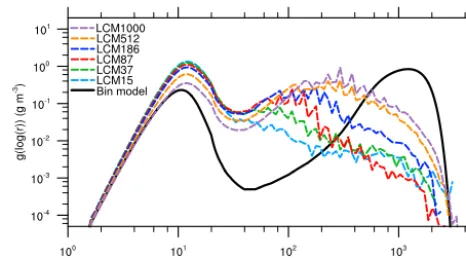
super-Figure 1.Mass density distribution for the single-box approach af-ter 3600 s for the “singleSIP” initialization. The black solid line de-notes the solution of Wang et al. (2007). The colored dashed curves show the solution of the LCM with different numbers of super-droplets per grid box.
Figure 2.Moments of the mass density distribution as a function of time obtained from the single-box simulations for the “singleSIP” initialization. The black solid line denotes the solution of Wang et al. (2007). The colored dashed curves show the solution of the LCM with different numbers of superdroplets per grid box.
droplets only leads to minor improvements. The small devi-ations between the bin model solution and the LCM can be traced back to the different solution of the collection equation (e.g., Dziekan and Pawlowska, 2017). Overall, it can be seen that the solution of the LCM converges with an increasing number of superdroplets. The moments of mass distribution (Fig. 2) also show convergence with an increasing number of superdroplets. This good representation of collision growth is in line with the results with Unterstrasser et al. (2017).
Now, Figs. 3 and 4 show the same quantities but for the initialization with identical weighting factors. In Fig. 3, a significant deviation of the mass density distribution of the
Figure 3.Mass density distribution for the single-box approach af-ter 3600 s. The black solid line denotes the solution of Wang et al. (2007). The colored dashed curves show the solution of the LCM with different numbers of superdroplets per grid box.
Figure 4.Moments of the mass density distribution as a function of time obtained from the single-box simulations. The black solid line denotes the solution of Wang et al. (2007). The colored dashed curves show the solution of the LCM with different numbers of su-perdroplets per grid box.
Figure 5.Mass density distribution for the single-box approach af-ter 3600 s. The black solid line denotes the solution of Wang et al. (2007), the black dashed curve the reference case (without split-ting). The colored dashed curves show solution for splitting simula-tion with different configurasimula-tions.
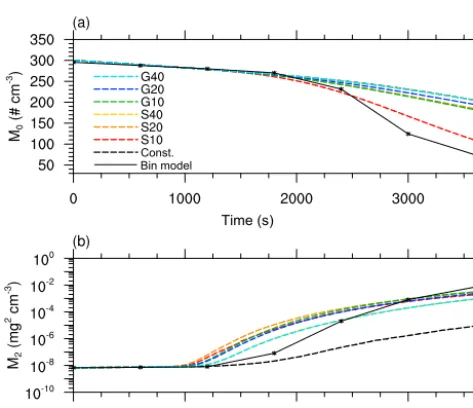
Figure 6. Moments of the mass density distribution as a function of time obtained from single-box simulations. The black solid line denotes the solution of Wang et al. (2007), the black dashed curve for the reference simulation (without splitting). The colored dashed curves show the solutions for different splitting configurations.
the bin model even though difference are still significant for 1000 superdroplets per grid box.
In Figs. 5 and 6 the mass density distribution after 3600 s and the temporal development of the moments applying the splitting algorithm in different configurations are shown. Again, the splitting modes are abbreviated with S for the simple splitting method andGfor using the splitting method based on a gamma distribution. The number followingSor
G indicates the splitting radius in microns. For all simula-tions, the maximum permissible number of superdroplets per grid box is limited to NP,max=1000. The maximum split-ting factor isηmax=20. By selecting these limits, which are
chosen to represent the upper limit of computationally fea-sible three-dimensional simulations, it is posfea-sible to obtain an estimate of the quality of the individual splitting methods. The influence of the choice of these parameters is discussed below. All simulations are initialized with NP=87 super-droplets per grid box.
The black dashed line (Const.) shows the reference LCM case in which no splitting is applied. Comparing the non-splitting case to non-splitting cases, the results are significantly improved with respect to the reference solution. More pre-cisely, the fluctuations that occur for large droplet radii are successfully removed by splitting. Furthermore, a better rep-resentation of the second maximum is also achieved by split-ting. Independent of the splitting mode, simulations with the same splitting radius provide similar results. The only ex-ception is between the simulationsG10andS10, in which the assumed gamma distribution enables effective splitting at slightly larger radii inG10compared toS10. This results in a better agreement ofS10with the bin reference. In gen-eral, a reduction of the splitting radius leads to an improved representation of the mass density distribution. However, for all splitting simulations the reduction of the first maximum is underestimated, while the second maximum is only inade-quately represented.
Similar conclusions are possible from Fig. 6, in which the time series of the zeroth and second moment of the DSD are shown. The best agreement for the number concentration is achieved byS10, where many superdroplets are cloned at a very early stage. For all splitting configurations, the sec-ond moment shows a strong improvement in comparison to the LCM reference case without splitting (Const.) where this value is largely underestimated. Accordingly, splitting leads to an improved representation of the collisional growth in LCMs but there are still very large deviations from the bin reference.
These results exhibit how strongly collisional growth suf-fers from the initialization with a constant weighting factor, consistent with Unterstrasser et al. (2017). Since large super-droplets are initialized only in a few grid boxes, collisional growth is subject to a great variability in the different re-alizations among the ensemble. Due to that, the following subsection will repeat this investigations using the multi-box approach, which reflects the collisional growth in 3-D appli-cations more appropriately.
Multi-box approach
Figure 7.Same as Fig. 3 but for the multi-box approach, i.e., inter-actions between the grid boxes are possible.
(a)
350 300
C?' 250 ---LCM 1000
5
200 ---LCM512LCM 186� 150 ---LCM87
-
0 ---LCM37� 100
50 ---Bin model LCM 15 0
0 1000 2000 3000
Time (s) (b)
10°
.-. 10-2
E 10-4 (.)
C\J
E 1
o-
6-
C\J� 1
o-s
10-10
0 1000 2000 3000
Time (s)
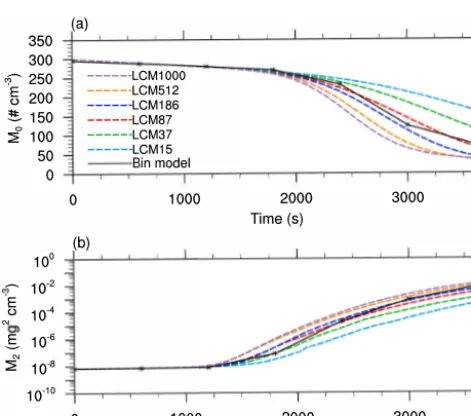
Figure 8.Same as Fig. 4 but for the multi-box approach, i.e., inter-actions between the grid boxes are possible.
can be attributed to accelerated accretion, which is favored by the combination of a few large droplets with an overesti-mated weighting factor and a large number of superdroplets with radii of about 10 µm. In contrast, a decelerated deple-tion of the first maximum and a weaker second peak are de-tected for simulations with a lower number of superdroplets. This results from the insufficient representation of the initial DSD, especially that of large droplets, which are crucial for effective collisional growth.
In Fig. 8, the temporal evolution of the number concentra-tion and the second moment are shown. In simulaconcentra-tions with a high number of superdroplets, a too strong reduction of the number concentration is predicted; and contrarily, the de-crease in the zeroth moment is underestimated in cases with only 15 and 37 superdroplets. This tendency is also observed for the second moment. Simulations with a high number of superdroplets overestimate the reference, whereas
simula-Figure 9.Same as Fig. 5 but for the multi-box approach, i.e., inter-actions between the grid boxes are possible.
tions with only a few superdroplets result in too low values. However, comparing the results of the non-splitting cases (Const.) in the single- and multi-box simulations, the lat-ter already provides improved results with respect to the bin model. The results show that this initialization artifact can be successfully mitigated by the newly introduced stochastic exchange between the grid boxes. For typical applications, however, the required amount of at least 512 superdroplets per grid box, necessary to derive satisfying results without splitting, is computationally unfeasible.
To maintain a reasonable amount of superdroplets, these box simulations will be repeated now, using the splitting ap-proach. Here all parameters (initializing all simulations with 87 superdroplets per grid box) and splitting thresholds are identical as for the single-box approach described above but the superdroplets are now allowed to move between grid boxes.
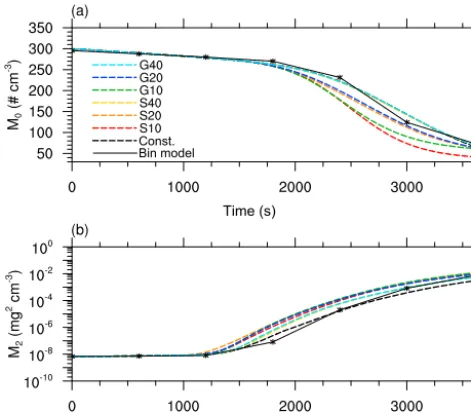
Figure 10.Same as Fig. 6 but for the multi-box approach, i.e., in-teractions between the grid boxes are possible.
by Wang et al. (2007) whatsoever. In general, the decreas-ing difference among the different LCM simulations, as it is occurring due to splitting, needs to be seen as a proof of con-cept, and not the comparison with the bin results.
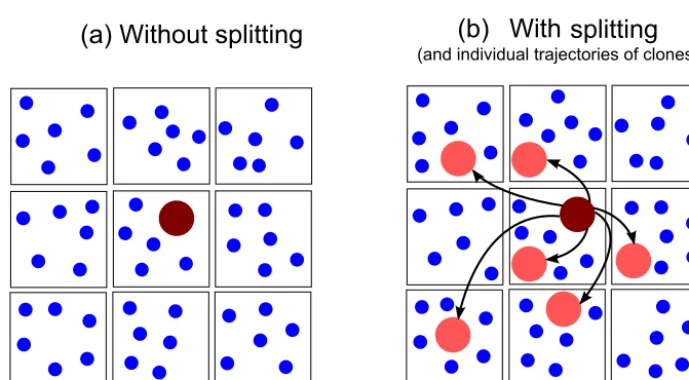
All in all, it is shown that collisional growth is better rep-resented by using the splitting method in both the single-and multi-box simulations. Furthermore, the choice of the splitting mode is secondary, but the splitting radius is identi-fied as the most crucial parameter. The multi-box simulations exhibit a distinct advantage over the single-box simulations. Due to the presence or absence of sufficiently large droplets that might initiate collision and coalescence, as a result of the initialization, collisional growth can be overestimated in cer-tain grid boxes while it is underestimated in others. Splitting and the subsequent stochastic exchange are able to distribute these so-called precipitation embryos among the entire en-semble where they are able to initiate collision and coales-cence as sketched in Fig. 11, which would not be possible in the single-box approach.
Sensitivity to splitting thresholds
The limiting parameters of the splitting algorithm are now examined in sensitivity studies using the multi-box approach. For this purpose, the parameters of the maximum possible number of superdroplets per grid boxNP,max, the maximum splitting factorηmax, and the splitting radius rspl are varied for the splitting modeG; the base state of this mode is de-fined as rspl=10 µm, ηmax=20, and NP,max=1000. This base state is varied by individually changing the parameters
rspl,ηmax, andNP,max. Furthermore, all simulation are identi-cally initialized withNinit=87 superdroplets per grid box.
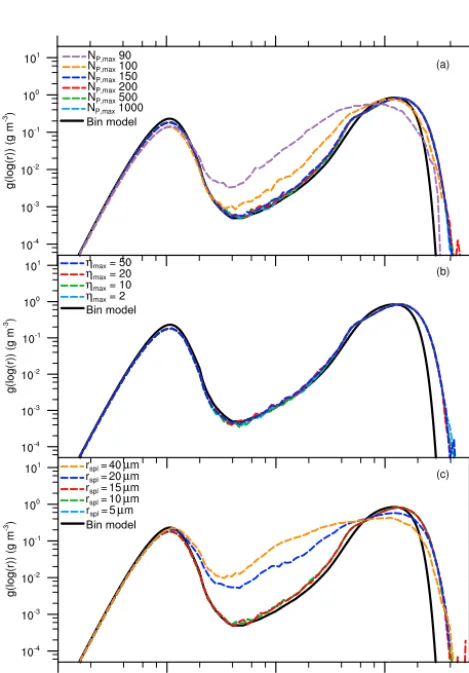
Figure 12a shows the mass density distributions after 3600 s for different values forNP,max. We find that a value of
NP,max=150 is sufficient to reach convergence for this setup. Since the initial superdroplet concentration isNinit=87 for all configurations ofNP,max, it can be concluded thatNP,maxis a necessary but not crucial parameter as long asNP,max>150. This reduction of the maximum number of superdroplets per grid box results in a reduction of the computational time by a factor of 15 compared to the simulation withNP,max=1000. The sensitivity studies for the maximum splitting factor show that this has no influence on the results (Fig. 12b). An explanation for this is that the algorithm is executed at ev-ery time step and thus only the clone rate but not the abso-lute number of the clones is affected. More precisely, a low value ofηmaxmay reduce how many clones are produced at a time step. However, results show that this effect is negligi-ble since a superdroplet will be cloned sufficiently fast at the subsequent time steps as long asNP≤NP,max.
As shown before, the development of the spectrum is highly sensitive to the choice of the splitting radius. Fig-ure 12c shows that the results converge with decreasing split-ting radius, with no significant deviations for configurations withrspl≤15 µm. This can be attributed to the fact that espe-cially the largest droplets (in this case with radii of approxi-mately 15 µm) are crucial for initiating the collisional growth. Accordingly, an improved representation of these droplets leads to an improved representation of the whole collisional growth process.
4.2 Single cloud 4.2.1 Setup
In this case, we are simulating an idealized shallow cumulus cloud in the form of a rising warm air bubble as in Hoffmann et al. (2017). The model domain is 1920 m×7680 m×3840 m in thex-,y-, andz-direction, respectively. An isotropic grid spacing of 20 m is used. The simulation time is 3000 s using a constant time step of 0.1 s. The warm air bubble is triggered by a Gaussian-shaped potential temperature perturbationθ∗ θ∗(y, z)=θ0·exp
−1
2·
y−yc
σy
+
z−zc
σz
, (22) whereθ0=0.4 K is the maximum temperature difference, which decreases with a standard deviation ofσy=200 m and σz=150 m in they- andz-direction, respectively. The cen-ter of the bubble is set toyc=3840 m andzc=170 m. Due to the two-dimensional character of the temperature excess, the initial temperature perturbation is elongated homogeneously along thexaxis.
(a) Without splitting
(b) With
splitting
(and individual trajectories of clones)
Figure 11.Schematic representation on how splitting affects the spatial distribution of large superdroplets. The squares outline the different grid boxes with superdroplets of the size of cloud droplets (blue) and superdroplets representing rain drops (dark red). Without splitting(a), the rain drop is represented by only one superdroplet. In the splitting case with the multi-box approach(b), this superdroplet is cloned into several superdroplets, which are able to move in other grid boxes (due to their individual subgrid-scale velocities) where they initiate or affect collisional growth.
distributed in the entire model domain. For all three direc-tions in space, the average distance of the superdroplets is initially 4.5 m. This results in a superdroplet concentration of approximately 87 superdroplets per grid box and roughly 4.55×10⁸ superdroplets in total. Using a weighting fac-tor ofAinit=9.0×10⁹, an initial cloud condensation nuclei (CCN) concentration of 100 cm−3is represented. Addition-ally, simulations with 15 and 186 superdroplets per grid box are carried out, in which the weighting factor is adjusted such that the CCN concentration of 100 cm−3is retained. If merging is applied, only superdroplets with a radius smaller thanrmer=0.1 µm and with a weighting factor smaller than
Amer=Ainit/2 are allowed to merge.
At the surface, superdroplets are absorbed if their radius is larger than 1.0 µm. For smaller particles, a reflection bound-ary condition is assumed to avoid the change that the surface acts as a CCN sink. Horizontal boundaries are prescribed with cyclic conditions. Moreover, for collision and coales-cence, the kernel by Hall (1980) is used. An overview of all conducted simulations is given in Table 1.
4.2.2 Single-cloud results Microphysical properties
Figure 13 shows the cloud-averaged mass density distribu-tion att=1800 s for the configurations listed in Table 1. The left part of the spectrum is reproduced quantitatively con-sistent in all cases. This implies that both the splitting and the merging processes have no artificial impact on the dif-fusional growth process, which prevails in this region of the spectrum. However, the right tail of the DSDs differs
signif-icantly when the splitting algorithm is applied. The biggest drops are almost 350 µm smaller for the reference case (black lines) compared to simulations with splitting. Furthermore, splitting effectively reduces the fluctuations which occur in the reference cases for radii above 100 µm. The mass den-sity distributions imply that the choice of the splitting mode does not affect cloud microphysical results. Likewise, the simulationS10, in which the splitting radius is reduced to
rspl=10 µm, shows almost no difference in the mass den-sity distribution compared to cases withrspl=20 µm. Thus, it can be deduced that a splitting radius ofrspl=20 µm is sufficient for this cloud. Further investigations (not shown) in whichrsplis successively increased to 30 µm show that a larger splitting radius leads to strong deviations from simula-tions with smaller splitting radii. This indicates that droplets with radii larger than 20 µm need to be represented in a statis-tically sufficient way to initiate the precipitation process cor-rectly. It should be emphasized, however, that these results are only valid for a cloud with a relatively strong diffusional radius growth. A reduction of the splitting radius might be re-quired for settings in which collisions dominate the droplet’s growth at smaller radii as it is the case in the previously pre-sented box simulations.
Table 1.Summary of the main parameters for the single-cloud simulations.
Simulation NP Initial weighting factor Splitting rspl NP,max ηspl/max Merging
Const.NP15 15 5.0×10¹⁰ no – - – no
Const.NP87 87 9.0×10⁹ no – - – no
Const.NP186 186 4.3×10⁹ no – - – no
S10 87 9.0×10⁹ yes 10 µm 150 20 no
S20 87 9.0×10⁹ yes 20 µm 150 20 no
S20 merging 87 9.0×10⁹ yes 20 µm 150 20 yes
G20 87 9.0×10⁹ yes 20 µm 150 20 no
G20 merging 87 9.0×10⁹ yes 20 µm 150 20 yes
Figure 12.Mass density distribution for the box simulation after 3600 s. The black solid line denotes the solution of Wang et al. (2007). In (a), sensitivity studies for different values of NP,max are presented. In(b), simulations for different values ofηmaxare shown. In(c), results for different splitting radii are displayed. All sensitivity studies are conducted using the splitting modeG.
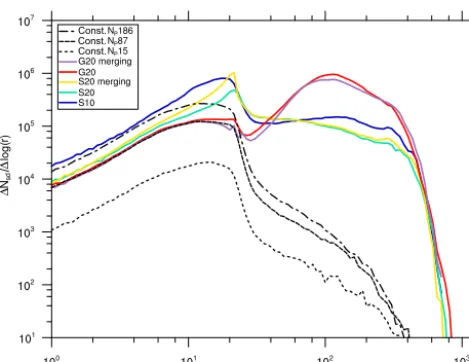
The improved statistics of large superdroplets are also shown in Fig. 14, where the absolute number of superdroplets per logarithmic radius (log(r)) bin is presented. It is notice-able that in the reference simulations, this number decreases significantly for larger droplets (starting from a radius of
ap-Figure 13.Mass density distribution after 1800 s for the idealized single-cloud simulations using parameters described in Table 1.
proximatelyr=20 µm). In simulations in which no splitting operations are carried out, the largest droplets are represented by only a few tens of superdroplets in the whole model do-main. For theSmode, the superdroplet concentration is kept almost constant (except in the right tail) for all splitting cases. For theGmode, a second maximum at 100 µm can be ob-served. This can be related to the calculation of the splitting criterion. The approximation of the mass density distribution by a gamma distribution results in a somewhat lower split-ting factor for superdroplets close to the splitsplit-ting radius in comparison to theSmode, which shifts the superdroplet pro-duction to larger radii in theGmode.
Macrophysical properties
Figure 14. Total number of superdroplets per logarithmic radius bin aftert=1800 s for the idealized single-cloud simulations using parameters described in Table 1.
observed when splitting is used, with maximum increase of about 15 % forS10. In all other splitting cases, the increase in superdroplet number is notably lower and starts approxi-mately 500 s later, which corresponds to the larger splitting radius of rspl=20 µm. The lowest increase in superdroplet number is observed in the merging cases in which the maxi-mum number of superdroplets is reached during the growing phase of the cloud and decreases in the dissipation stage.
Figure 15b and c show the temporal evolution of the liq-uid water path (LWP) and the rain water path (RWP). The RWP is defined as the integral mass of all droplets with
r≥40 µm. It is notable that the LWP is the same for all sim-ulations, which emphasizes the mass-conserving character of the splitting algorithm and its negligible impact on the gen-eral development of the cloud. In the reference simulations (represented as a mean of five ensembles for each case) of Figs. 15c and d, one can see an increase in the precipitation parameters (RWP, radar reflectivity, and precipitation sum) for an increased number of superdroplets. However, the dif-ferences among the ensemble members are quite large, which is shown by the range (gray area) and the band of plus–minus one standard deviation from the mean (light blue area) de-rived from all 15 ensemble members. Overall, the splitting simulations have a slight tendency to compare better with the reference cases using 87 and 186 superdroplets. Admittedly, since the results are (for the most part) within one standard deviation, it can be concluded that splitting has no significant influence on the global precipitation parameters.
Figure 15e and f display the precipitation rate and the total precipitation reaching the ground. The precipitation rate in the reference simulations without splitting exhibit high tem-poral variances (black lines). Those variances are success-fully reduced in all splitting simulations. This can be ex-plained by the better representation of precipitation in the
splitting simulations by a larger number of superdroplets, re-sulting in a more uniform removal of liquid water by precipi-tation. As expected from the RWP, splitting slightly increases the total precipitation.
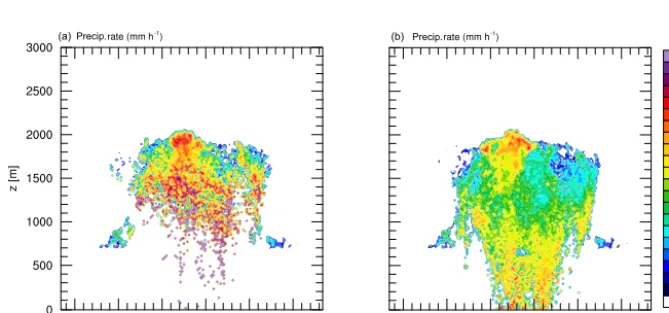
Figure 16 shows the effect of splitting on the spatial distri-bution of rain after 2100 s simulated time for theNP87 simu-lation (Fig. 16a) and theS20splitting simulation (Fig. 16b). Similar to the reduced temporal variance in the time series of the precipitation rate (Fig. 15e), the spatial variance is also significantly reduced using splitting. Again, the precipitation is represented by only a few superdroplets in the simulation without splitting, which leads to very high, localized precip-itation rates. Due to splitting, raindrops with large weight-ing factors are split into several superdroplets with smaller weighting factors, resulting in the more realistic spatial rep-resentation of the precipitation.
All in all, the splitting of large droplets, which results in an improved representation of the collision process and thus the DSD, also partly influences the macroscopic properties of the cloud. In particular, rain water content, radar reflec-tivity, and precipitation rate are represented in a more realis-tic manner. Due to the improved statisrealis-tics, the temporal and spatial variance of these parameters is significantly reduced. However, the whole cloud life cycle, which is driven by the general dynamics and thermodynamics, is largely unaffected by splitting. Additionally, the merging shows no influence on the physical outcomes.
To estimate the increase in computing time due to splitting, we conducted three simulations (Const.NP87,S20, andS20
merging) with comparable time measurements. Here we ob-serve that the splitting simulationS20requires 19.2 % more computing time than the reference simulationConst.NP87. If applied, merging allows a massive reduction of the number of superdroplets, reducing the computing time by 18 % and the storage demand (which is proportional to the number of superdroplets) by at least 7 % compared to simulations plying only splitting (Fig. 15a). All in all, the simulation ap-plying both splitting and merging is only 1.2% slower than the reference simulationConst.NP87.
4.3 Cloud field 4.3.1 Setup
Figure 15.Time series of different variables for the idealized single-cloud simulation for different initial numbers of superdroplets and splitting configurations. In(a), the ratio of the actual and initialized number of superdroplets in the whole model domain is shown. The liquid water path (LWP) and rainwater path (RWP) are displayed in panels(b)and(c), respectively. In(d), the total radar reflectivity is shown. Panels(e)and(f)show the precipitation rate and total precipitation, respectively. The reference simulations (runs without splitting) are presented as a mean of five ensembles for each case. Moreover, the light blue areas show the mean plus–minus one standard deviation and the gray areas show the range derived from all 15 ensemble members.
Figure 16.Vertical cross sections of the precipitation rate for the reference case(a)and the splitting caseS20(b).
Three different simulations will be presented. In the cases
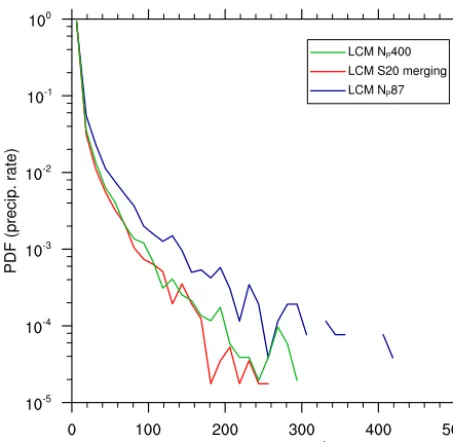
LCM NP87andLCM NP400, the number of superdroplets per grid box are 87 and 400, respectively. With initial weight-ing factors ofAinit=1.89×10¹²andAinit=7.0×10¹², re-spectively; these represent a CCN concentration of 100 cm−3 in each case. Moreover, one more simulation with splitting
and merging is carried out. For this configuration, in which the general settings ofLCMNP87are adopted, the splitting modeSwithrspl=20 µm,ηspl=20, andAspl=1x×1y×
Figure 17.Time series of(a)the liquid water path (LWP),(b)rainwater path (RWP),(c)ratio of the actual number of superdroplets to the initial number of superdroplets,(d)cloud cover,(e)precipitation rate, and(f)total precipitation for different initial numbers of superdroplets and splitting configurations. The gray areas in(a),(b), and(d)indicate the documented model variability in the simulated shallow cumulus case (vanZanten et al., 2011).
Based on the previously presented results, the maximum number of particles per grid box is set to NP,max=150. Merging is applied in non-cloudy grid boxes for super-droplets with a radius smaller than rmer=0.1 µm and a weighting factor smaller thanAmer=Ainit/2.
4.3.2 Cloud field results
The analysis is focused on the influence of splitting on the macroscopic properties of the shallow cumulus field. Fig-ure 17 shows time series of (a) the LWP, (b) RWP, (c) ra-tio of the current superdroplet number to its initial value, (d) cloud cover, (e) precipitation rate, and (f) total precipi-tation. Despite the superdroplet number, all these parameters agree in a statistical sense. In the cases without splitting, the total superdroplet number decreases slightly in the course of the simulation due to precipitation (Fig. 17c), while the sim-ulation with splitting increases the total superdroplet number by about 15 %. Note, however, that both LWP and RWP are at the top of model variability documented in vanZanten et al. (2011) (gray areas), which is in line with the results of Arabas and Shima (2013), who also used an LCM for the simulation of this shallow cumulus case.
Figure 18.Probability density function of precipitation rates for dif-ferent initial numbers of superdroplets and splitting configurations.
5 Conclusions
The main objective of this paper was the development and verification of a splitting algorithm to improve collisional growth in Lagrangian cloud models (LCMs). These mod-els are able to represent collision and coalescence well (Unterstrasser et al., 2017; Dziekan and Pawlowska, 2017). Under certain conditions, however, they are known to insufficiently represent this process. These conditions occur when the number of superdroplets is low and, accordingly, the number of real droplets represented by each superdroplet (the so-called weighting factor) is high, leading to an oversimplified representation of the droplet size distribution (DSD; Riechelmann et al., 2012; Unterstrasser et al., 2017). The introduced approach for splitting is carried out by cloning superdroplets of interest (large radius and high weighting factor) into a large number of identical super-droplets with commensurately reduced weighting factors, which improves the representation of the DSD in the desired areas. An accompanying merging algorithm has been also introduced. It is designed to merge two superdroplets into one, counteracting the (potentially) massive production of superdroplets due to splitting and hence a significant increase in computational cost.
The splitting and merging algorithms have been validated using box simulations, a simulation of a single cumulus cloud, and an established shallow cumulus test case. The box simulations confirmed that the capability of an LCM to rep-resent the temporal evolution of a DSD due to collision and coalescence depends crucially on the number of simulated superdroplets (Shima et al., 2009; Riechelmann et al., 2012; Unterstrasser et al., 2017; Dziekan and Pawlowska, 2017).
Without splitting, only simulations with more than 500 to 1000 superdroplets per grid box were acceptably reproduc-ing literature references. By applyreproduc-ing the new splittreproduc-ing al-gorithm, the results improved significantly using only up to 150 superdroplets per grid box. Furthermore, the box simula-tions revealed that the radius from which splitting is applied is the most important parameter of the splitting algorithm. A value of 15 µm, which corresponds to the typical radii of the first colliding droplets in clouds, was found to be appropri-ate. Other investigated parameters have shown only a minor impact on the results as long as a sufficiently large maximum number of superdroplets is allowed to be produced by split-ting (≥150).
In the idealized single-cloud simulation, splitting im-proved the representation of collisional growth with up to 70 % larger maximum radii. Moreover, splitting improves the spatial and temporal representation of precipitation by distributing the precipitable water on more superdroplets with an accordingly smaller weighting factor. It is impor-tant to note, however, that the life cycle and domain-averaged macroscopic properties are almost not affected by the split-ting process. If applied, the merging algorithm has been shown to reduce the computing time by 18 % and the stor-age demand by at least 7 % in comparison to simulations with splitting alone. Since merging is restricted to cloud-free regions, its application did not alter the simulated physics. Similar findings on the effect of splitting on the production of rain have been made for the shallow cumulus test case.
In light of the fact that LCMs become increasingly impor-tant in the field of modeling cloud microphysics, it is nec-essary to minimize the (typically) large demand of memory and computing time required for their application. Thus, a fixed number of superdroplets needs to be replaced by a dy-namic number, which adapts interactively to the given physi-cal and numeriphysi-cal requirements. In this regard, the presented methods follow the approaches by Grabowski et al. (2018), in which superdroplets are only created after activation, or Naumann and Seifert (2015), who restricted the superdroplet approach to the representation of raindrops. Of course, all these approaches have their specific advantages and disad-vantages, but they are necessary steps to apply LCMs in a wider range of future applications.
Code availability. The LES model used in this study (revision
2263) is publicly available at https://palm.muk.uni-hannover.de/ trac/browser/palm?rev=2263 (last access: 25 September 2018, PALM group, 2018). For analysis, the model has been extended and additional analysis tools have been developed. The extended code is available from the authors on request.
Author contributions. JS carried out the analysis. JS, FH, and SR
Competing interests. The authors declare that they have no conflict of interest.
Acknowledgements. All simulations have been carried out on
the Cray XC40 systems of the North-German Supercomputing Alliance (HLRN, https://www.hlrn.de/, last access: 25 September 2018).
The publication of this article was funded by the open-access fund of Leibniz Universität Hannover.
Edited by: Holger Tost
Reviewed by: two anonymous referees
References
Andrejczuk, M., Grabowski, W., Reisner, J., and Gadian, A.: Cloud-aerosol interactions for boundary layer stratocumulus in the Lagrangian Cloud Model, J. Geophys. Res., 115, D22214, https://doi.org/10.1029/2010JD014248, 2010.
Arabas, S. and Shima, S.-I.: Large-eddy simulations of trade wind cumuli using particle-based microphysics with Monte Carlo co-alescence, J. Atmos. Sci., 70, 2768–2777, 2013.
Arabas, S., Jaruga, A., Pawlowska, H., and Grabowski, W. W.: lib-cloudph++ 1.0: a single-moment bulk, double-moment bulk, and particle-based warm-rain microphysics library in C++, Geosci. Model Dev., 8, 1677–1707, https://doi.org/10.5194/gmd-8-1677-2015, 2015.
Dziekan, P. and Pawlowska, H.: Stochastic coalescence in La-grangian cloud microphysics, Atmos. Chem. Phys., 17, 13509– 13520, https://doi.org/10.5194/acp-17-13509-2017, 2017. Grabowski, W. W., Dziekan, P., and Pawlowska, H.: Lagrangian
condensation microphysics with Twomey CCN activation, Geosci. Model Dev., 11, 103–120, https://doi.org/10.5194/gmd-11-103-2018, 2018.
Hall, W. D.: A detailed microphysical model within a two-dimensional dynamic framework: Model description and prelim-inary results, J. Atmos. Sci., 37, 2486–2507, 1980.
Hoffmann, F.: On the limits of Köhler activation theory: how do collision and coalescence affect the activation of aerosols?, At-mos. Chem. Phys., 17, 8343–8356, https://doi.org/10.5194/acp-17-8343-2017, 2017.
Hoffmann, F., Raasch, S., and Noh, Y.: Entrainment of aerosols and their activation in a shallow cumulus cloud studied with a cou-pled LCM-LES approach, Atmos. Res., 156, 43–57, 2015. Hoffmann, F., Noh, Y., and Raasch, S.: The route to raindrop
forma-tion in a shallow cumulus cloud simulated by a Lagrangian cloud model, J. Atmos. Sci., 74, 2125–2142, 2017.
Maronga, B., Gryschka, M., Heinze, R., Hoffmann, F., Kanani-Sühring, F., Keck, M., Ketelsen, K., Letzel, M. O., Kanani-Sühring, M., and Raasch, S.: The Parallelized Large-Eddy Simulation Model (PALM) version 4.0 for atmospheric and oceanic flows: model formulation, recent developments, and future perspectives, Geosci. Model Dev., 8, 2515–2551, https://doi.org/10.5194/gmd-8-2515-2015, 2015.
Naumann, A. K. and Seifert, A.: A Lagrangian drop model to study warm rain microphysical processes in shallow cumulus, J. Adv. Model. Earth Syst., 7, 1136–1154, 2015.
Naumann, A. K. and Seifert, A.: Recirculation and growth of rain-drops in simulated shallow cumulus, J. Adv. Model. Earth Syst., 8, 520–537, 2016.
PALM group: The Parallelized Large-Eddy Simulation Model (PALM) –revision 2263, https://doi.org/10.25835/0044820, 2018.
Riechelmann, T., Noh, Y., and Raasch, S.: A new method for large-eddy simulations of clouds with Lagrangian droplets including the effects of turbulent collision, New J. Phys., 14, 065008, https://doi.org/10.1088/1367-2630/14/6/065008, 2012.
Rogers, R. R. and Yau, M. K.: A Short Course in Cloud Physics, Pergamon Press, New York, 1989.
Sardina, G., Poulain, S., Brandt, L., and Caballero, R.: Broadening of Cloud Droplet Size Spectra by Stochastic Condensation: Ef-fects of Mean Updraft Velocity and CCN Activation, J. Atmos. Sci., 75, 451–467, 2018.
Seifert, A.: On the parameterization of evaporation of raindrops as simulated by a one-dimensional rainshaft model, J. Atmos. Sci., 65, 3608–3619, 2008.
Shaw, R. A., Reade, W. C., Collins, L. R., and Verlinde, J.: Prefer-ential concentration of cloud droplets by turbulence: Effects on the early evolution of cumulus cloud droplet spectra, J. Atmos. Sci., 55, 1965–1976, 1998.
Shima, S., Kusano, K., Kawano, A., Sugiyama, T., and Kawahara, S.: The super-droplet method for the numerical simulation of clouds and precipitation: A particle-based and probabilistic mi-crophysics model coupled with a non-hydrostatic model, Q. J. Roy. Meteor. Soc., 135, 1307–1320, 2009.
Sölch, I. and Kärcher, B.: A large-eddy model for cirrus clouds with explicit aerosol and ice microphysics and Lagrangian ice particle tracking, Q. J. Roy. Meteor. Soc., 136, 2074–2093, 2010. Ulbrich, C. W.: Natural variations in the analytical form of the
rain-drop size distribution, J. Climate Appl. Meteor., 22, 1764–1775, 1983.
Unterstrasser, S. and Sölch, I.: Optimisation of the simulation par-ticle number in a Lagrangian ice microphysical model, Geosci. Model Dev., 7, 695–709, https://doi.org/10.5194/gmd-7-695-2014, 2014.
Unterstrasser, S., Hoffmann, F., and Lerch, M.: Collec-tion/aggregation algorithms in Lagrangian cloud microphysical models: rigorous evaluation in box model simulations, Geosci. Model Dev., 10, 1521–1548, https://doi.org/10.5194/gmd-10-1521-2017, 2017.
vanZanten, M. C., Stevens, B., Nuijens, L., Siebesma, A. P., Ackerman, A. S., Burnet, F., Cheng, A., Couvreux, F., Jiang, H., Khairoutdinov, M., Kogan, Y., Lewellen, D. C., Mechem, D., Nakamura, K., Noda, A., Shipway, B. J., Slawinska, J., Wang, S., and Wyszogrodzki, A.: Controls on precipitation and cloudiness in simulations of trade-wind cumulus as ob-served during RICO, J. Adv. Model. Earth Syst., 3, M06001, https://doi.org/10.1029/2011MS000056, 2011.