Developing mentors to support students in practice, supporting students in practice: Evidence-based Practice (4721 words)
Summary
Evidence-based Practice (EBP) is a feature of contemporary healthcare practice and subsequently is well embedded within preparation programmes for nursing, midwifery and Specialist Community Public Health Nursing (SCPHN) students. This article, the ninth in a series of eleven, seeks to delineate evidence-based practice, whilst discussing the importance and implementation of this approach within the context of the developmental role of mentors and practice teachers, in the preparation of nurses, midwives and SCPHNs. Furthermore, the aim is to provide guidance for both new and established mentors and practice teachers in relation to the domain ‘Evidence-based Practice’ specifically the outcomes for stage 2 Mentor and stage 3 Practice Teacher highlighted within the Nursing and Midwifery Council (2008) ‘Standards to Support Learning and Assessment in Practice’ (SSLAP). The text will be interspersed with these outcomes for mentors and practice teachers where they apply. In addition the activities indicated within this article will provide the opportunity for mentors and practice teachers to develop within their role, but also to generate evidence in order to map this on-going development against the NMC (2008) SSLAP
Introduction.
the requirement that all registrants ensure that their knowledge and skills are up to date, in order for them to maintain professional standards. This is a necessity when working within an environment which is forever changing, requiring registrants to evolve to ensure the delivery of high quality care (Ellis 2013). Furthermore at the turn of the century Nicklin and Kenworthy (2000) indicate that due to the advance of information technology, better informed service users will expect interventions based upon good research evidence. As such mentors and practice teachers, have a responsibility to ensure that students are supported in developing their knowledge and skills within this area.
Students are required to work and learn in tandem with registrants within the challenging milieu of professional practice, and this requirement is reflected in the NMC Guidance on professional conduct for nursing and midwifery students (2011); in that students enrolled upon nursing and midwifery programmes are expected to base the care they provide on a best available evidence and best practice approach.
Definition of Evidence-based Practice and its importance in nursing
are required to facilitate students in investigating new ways of working and the effect this may have on other roles (NMC 2008)
These elements are integral to the framework of clinical governance and as such healthcare professionals are under scrutiny in relation to whether their practice is both worthwhile and cost effective Ellis (2013). Within the context of clinical governance, a link can be established between clinical effectiveness and evidence-based practice (Cranston 2002). Indeed Sackett et al (2000) affirm that the integration of clinical expertise and best available evidence from systematic research is when evidence-based practice exits. The NHS (2013a), Public Health (2012) and the Adult Social Care Outcomes Framework (2013b) provides a starting point for nurses in establishing areas for reviewing current practices against a set of outcomes, in whichever sector they work within . For example the NHS framework sets out such outcomes focussed on five domains and highlights areas for improvement. Andalo’s ( (2006) cited in Kinnell and Hughes, 2010, p. 171) discussion highlight Lynne Maher’s claim, the Head of Innovation Practice and Improvement, that nurses being the largest working group in the NHS, have the capacity to improve service delivery, by establishing and implementing necessary changes.
As such competencies that all nursing students must demonstrate prior to registration on the nurses part of the register are set out within the competency framework, laid down by the NMC (2010, p. 14) and within the Professional values domain. More specifically:
‘All nurses must appreciate the value of evidence in practice, be able to understand
and appraise research, apply relevant theory and research findings to their work, and
identify areas for further investigation’
Evidently mentors and practice teachers have a role to play in facilitating students in
recognising the evidence base to practice, but to also support them in advancing their
knowledge and skills further, in relation to EBP, both throughout the educational programme
and beyond. Here one makes the assumption that all mentors and practice teachers are themselves proficient in the stages of engaging in EBP. Beyea and Slattery (2006) argue that a common barrier in the EBP process is the lack of expertise and experience, and as such poses a significant barrier to its implementation.
Barriers to the implementation of EBP
Time out activity 1
Consider your teams attitude towards the implementation and development of EBP
Reflect upon and evaluate the possible barriers to the development and /or implementation of evidence abased practice within your team.
approach may not be effective. Furthermore the lack of understanding of the need for change perpetuates resistance. Moreover there may be an element of what nurses consider ‘evidence’ and, where it is to be found
Certainly Mulhall (1999) suggests there is a perception that evidence is based entirely upon research, and intuitive clinical skills are largely ignored. The utilisation of clinical experience, which is an important facet to evidence-based practice as a process, it appears, is hampered by the lack of guidance to practitioners as to how this experience could be integral to the development and implementation of EBP (The Foundation of Nursing Studies 2011). Indeed many organisations employ clinical research nurses who may be a source of support and information for nurses, practice teachers and their students alike. For EBP to flourish mentors and practice teachers need to ensure that these barriers are overcome, though both their own development and by equipping students with the necessary skills to support this approach. Complete the brief time out activity below
Supporting and developing students in the process of applying EBP
From a mentor and practice teacher perspective there is a necessity to promote a set of skills
which prepares students to engage in practice development from an early stage and
Time out activity 2
Jenny is a first year, first placement student who has just observed you dressing a patients wound, she is a quiet and shy student and did not ask any questions throughout.
You have overheard her asking a nursing assistant that she would like to learn more about what you did and why during this
procedure, but she didn’t want to appear ‘stupid’ and so didn’t ask.
Consider how you would approach this in relation to nurturing the student’s critical thinking skills (e.g. Why do we do it this way? Is there evidence to support a different approach? How credible is the evidence?) How would you sign post Jenny to the evidence which supports your practice?
The development and utilisation of critical thinking is a feature found within many nursing
programmes of study and is fundamental to enquiry and reasoning within practice, as a
vehicle to maintain and develop standards in health care. Indeed, it is an essential skill that
student nurses must develop (Flesner et al 2010). ‘Critical thinking is defined...as the rational
examination of ideas, inferences, assumptions, principles, arguments, conclusions, issues,
statements, beliefs, and action’ (Bandman and Bandman 1995, p. 7 ) This process, should be
ongoing, and be an integral element of the application of EBP. Furthermore Nicklin and
Kenworthy (2000) assert that critical thinking skills are mechanistic in adapting performance
through experience, therefore highlighting the need for consideration of actions (practice) and
how approaches to care delivery are examined routinely.
Therefore in addition to facilitating students in the processes of implementing EBP, mentors
and practice teachers need to consider how they nurture critical thinking skills within their
learners. This will serve to develop their appraisal skills when considering the available
evidence. Consider the scenario in time out activity 2 by completing this; mentors can
contribute to the evidence for the outcome support students in applying an evidence base to
Mentors and practice teachers are required to ‘apply evidence-based practice to their own work and contribute to the further development of such a knowledge and practice’ (NMC 2008). In addition they must be aware of their own practice and how this is informed by the evidence and its origins. Indeed Students who think critically and therefore challenge and question both their own and others practice, will look to those who facilitate their learning for answers. This involves enabling the student in recognising practice within a setting, the source and value of the evidence base, whilst nurturing a desire for best practice (Walsh 2010). Furthermore, Emanuel et al (2011) assert that in order to develop student nurses in developing and implementing EBP, mentors must support and guide them but also facilitate them in recognising and locating the best available evidence. Moreover, those who facilitate nursing students are not expected to know everything; however they should at least be able to search for evidence and be confident in appraising it (Erickson-Owens and Kennedy 2001)
Types and sources of evidence.
In order to appreciate the best evidence mentors and practice teachers need to be aware of the
worth of what is available. A hierarchy can help to identify what is the strongest evidence,
furthermore they serve to allow practitioners to establish the level of trust they place in the
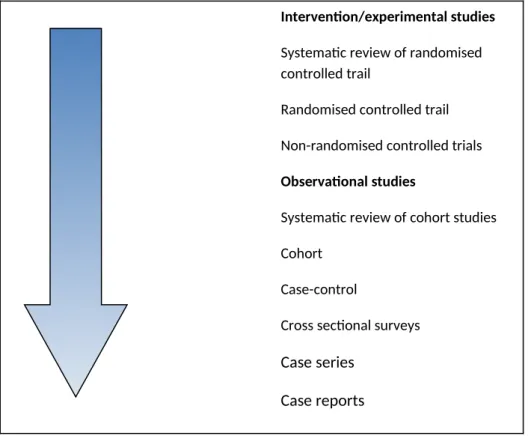
available evidence (Ellis 2013). Figure 1 below identifies the different types of evidence,
from the strongest (systematic review of randomised controlled trail) which is considered to
be gold standard to the weakest, case reports which could be based upon nursing observations
or experience. Indeed Penz and Bassendowski (2006) assert that although knowledge
acquired through research must be the foremost guide for practice, experience, including
Intervention/experimental studies
Systematic review of randomised controlled trail
Randomised controlled trail Non-randomised controlled trials Observational studies
Systematic review of cohort studies Cohort
Case-control
Cross sectional surveys Case series
Case reports
Figure 1 The hierarchy of evidence for questions about the effectiveness of an intervention/therapy
(Gibson and Glenny 2002)
Time out activity 3
Reflect on and evaluate your own position in terms of
knowledge and skills in developing and/or implementing EBP in your area of practice giving examples where possible. Think about the types of evidence available to you and where
you would locate this (Refer to figure 2 for guidance)
If necessary, develop an action plan for your portfolio their
skills
from a
practice perspective as part of their academic work, but they may be asked to undertake a review of available literature (Kinnell and Hughes 2010). Per se, students will have had some introduction as to where to look for evidence via their educational institution; perhaps however, mentors and practice teachers can only serve to enhance these skills in the practice setting by adding the dimension of context. Some examples of where the best evidence is available can be found in figure 2.
Figure 2 (Adapted from Ghopee 2010)
Sources of evidence
National clinical guidelines by e.g. NICE Specialism specific healthcare journals Trust based librarian
Journals on EBP, e.g. evidence-based medicine
Systematic reviews stored in databases, e.g. Cochrane library Specialist conference presentations
Knowledge and experience of CNs. ANPs, consultant nurses Senior doctors
Appraisal of the evidence
Having asked the question and locating evidence those who seek to apply the evidence to their practice must be able to determine the strength of the evidence. Indeed Ellis (2013) stresses that although some nurses may be able to embark upon a research study, all must have an understanding of how this is undertaken. He goes onto state that unless nurses are able to make a judgement in terms of the applicability and quality of the evidence, there would be implications as to this evidence to be applied in a meaningful way. The vast sources of evidence are beyond the scope of this article however in brief, Aveyard and Sharp (2009) suggest the following. Systematic literature review, an important source as a detailed review has been undertaken on numerous studies on the same topic. Research papers, with the caveat that one paper may not be enough; further evidence can be obtained from guidance and policy documents. Appraising evidence is a skill which is pivotal in the application of EBP, here mentors and practice teachers must have a level of proficiency worthy of perpetuating these skills within their students.
during such sessions as they provide a focus for questions during the appraisal activity. The author located various tools online, particularly in relation to Evidence Based Medicine.
Here mentors and practice teachers could perhaps facilitate such sessions particularly if there are a group of students in their own and other practice areas. By undertaking the extensive time out activity 4, the following outcomes may be evidenced:
Identify and apply research and evidence-based practice to their area of practice
Support students in applying an evidence base to their own practice-mentor
Contribute to strategies to increase or review the evidence base used to support
practice-Mentor
Identify areas of research and practice development based on interpretation of
existing evidence, Practice teacher
Advance their own knowledge and practice in order to develop new practitioners, at
both registration levels and education at a level beyond initial registration, to be able
to meet changes in practice roles and care delivery -Practice Teacher
Use local and national health frameworks to review and identify developmental needs
– Practice Teacher
Time out activity 4
Consider participating in/organising a journal club with students. If this isn’t possible you could work with an individual student:
Negotiate a topic relevant to a policy, guidelines or relevant outcome frameworks.
Work with the student/s in searching for the evidence which informs this guidance or policy
Facilitate students in appraising the evidence using an appraisal tool.
Discuss with the student/s how the available evidence might inform your practice.
Evidence for you portfolio here could include a reflective piece on the process as a development activity for yourself and the student. Ask your student for a testimony as to how this has helped their
development.
their practice that has always been effective in the past; furthermore making that change takes energy and hard work. This may, as a consequence, affect a nurse’s confidence and status (Ellis 2013) and here effective leadership is fundamental to drive that change whilst supporting staff through it and this aspect of mentorship will be addressed in article 10 in this series.
Time out activity 5
Reflect on the following - A patient in your care consumes a large amount of caffeine rich energy drinks and reports difficulty in sleeping. Although you may explain the effects of caffeine to the patient, do you have any evidence to support this and if not, where would you start to look for this?
evidence base. However, those who facilitate and support students in their development need to be aware themselves of the process involved in both appreciating and applying EBP. Brown (2008) advocates examining the effectiveness of nursing care and could this be improved upon, being able to locate, read and judge the research regarding its soundness. Ultimately, having decided upon the strength of the research in terms of application to nursing care, participate in developing procedures in their area of practice.
In line with this process, mentors and practice teachers should support students in asking questions in relation to practice. Barker (2013) asserts that this activity is fundamental to EBP and can arise from numerous situations including practice issues, outcomes of audits and interaction with patients or other health care professionals. She goes onto state however, that for the appropriate answers to be found, the question needs to be specific. Consider time out activity 5 below, a further way of developing your search skills in relation to specific evidence.
For EBP
Time out activity 6
With your student/s and colleagues, identify an area of your practice and using some of the sources of evident identified in Figure 2, examine the evidence base which informs this approach.
By involving service users, reflect on the teams approach and consider if this is the best approach based on the evidence available to you, or could this improved upon?
If so, involve your student/s and other team members in looking at ways to develop practice. If not, look what other areas of practice could be examined with your student/s.
Reflect upon and document this activity for your portfolio.
Encourage the students to do so for their professional development portfolio
Summary
References
Antoni, K. Knoppert, D. Keim, M. Woznuk, S. Capewell, V. (2003) Developing skills in critical appraisal: a new wave of enthusiasm for evidence-based practice has spread
throughout St. Joseph's health care, London, as nurses and other professionals are becoming more confident of their critical appraisal skills The Canadian Nurse 99.6 (Jun 2003): 24-27. Aveyard, H. Sharp, P. (2009) A Beginner’s Guide to Evidence-based Practice in Health and Social Care. Open University Press. Maidenhead.
Bailey- McHale, J. Hart, D. (2013) Mastering Mentorship. A practical guide for mentors of nursing, health and social care students. Sage . London
Bandman, E. L. Bandman, B. (1995) Critical thinking in nursing. Second edition. Appleton and Lange. Norwalk.
Barker, J. (2013) Evidence-Based Practice for Nurses, second edition. Sage. London . Beyea, S.C, Slattery, M.J. (2006) Evidence-based practice. A guide to successful implementation. HCPro. MA USA.
Brown, S. J. (2008) Evidence Based Nursing: The research-practice connection. Jones and Bartlett Publishers. London.
Cranston, M. (2002) Clinical effectiveness and evidence- based practice Nursing Standard.;16,:24, 39-43.
Department of Health (2013a) NHS Outcomes Framework 2014-15. DoH. London. Department of Health (2013b) Adult Social Care Outcomes 2014-2015. DoH. London. Department of Health (2012) The Public health Outcomes Framework for England2013-2016. DoH. London.
Ellis, P. (2013) Evidence-based Practice in Nursing, Second edition, Sage. London. Emanuel, V. Day, K. Diegnan, L. Pryce-Miller, M. (2011) Developing Evidence-based Practice among Students. Nursing Times 107: 21-23.
Erickson-Owens, D. A., & Kennedy, H. P. (2001). Fostering evidence based care in clinical teaching. Journal of Midwifery & Women’s Health, 46, 137-145.
Flesner, M. K. Miller, L. McDaniel, R. Rantz,M .(2010) From nursing process to nursing synthesis: evidence-based nursing education. In Malloch K, Porter-O’Grady T (Eds)
Introduction to evidence –based practice in nursing and health care. Second edition. Jones and Bartlett. London, pp. 57-76.
Gibson, F. Glenny A.M. (2002) Is the study good enough to use the findings? In Craig, J.V., Smyth, R.L. (eds) The evidence based practice manual for nurses. Churchill Livingstone. London, pp96-126.
Goodfellow, L. M. (2004). Can a journal club bridge the gap between research and practice? Nurse Educator, 29(3), 107-110.
Gopee, N. (2010) Practice teaching in healthcare. Sage. London.
Kaplan Jacobs, S, Rosenfeld, P. Haber, J. (2003) Information literacy as the foundation for Evidence-Based Practice in graduate nursing education: A curriculum-integrated approach. Journal of Professional Nursing 19, 5 pp.320-328.
Kedge, S. Appleby, B. (2009) Promoting a culture of curiosity within nursing practice. British Journal of Nursing 18:10 pp.635-637.
Kinnell, D. Hughes, P. (2010) Mentoring Nursing and Healthcare Students. Sage. London. Mantzoukas, S. (2007) A review of evidence-based practice, nursing research and reflection: levelling the hierarchy. Journal of Clinical Nursing 17: 214-223 .
Mulhall, A. (1999) Creating change in practice In:Mulhall, A. and May, A. (eds.) Nursing research: dissemination and implementation. Churchill Livingstone, Edinburgh, pp.151-175. NHS (2013a) The NHS outcomes framework. DoH.London.
Niklin, P. J. Kenworthy, N. (2000) Teaching and Assessing in nursing Practice: An experiential Approach (Eds) Bailliére Tindall. London.
Nursing and Midwifery Council. (2004a) Standards of Proficiency for Specialist Community Public Health Nurses, NMC. London.
Nursing and Midwifery Council. (2004b) Standards of Proficiency for Pre-registration Nursing Education. NMC. London.
Nursing and Midwifery Council. (2008) Standards to Support Learning and Assessment in Practice. Second edition, NMC. London.
Nursing and Midwifery Council. (2009) Standards for Pre-Registration Midwifery Education NMC. London.
Nursing and Midwifery Council. (2010) Standards for pre-registration nursing education. NMC. London.
Nursing and Midwifery Council. (2011) Guidance on professional conduct for nursing and midwifery students. NMC. London.
Penz, K L Bassendowski S L (2006) Evidence based nursing in clinical practice ; implications for nurse educators. The Journal of Continuing Education in Nursing · November/December 2006 · Vol 37, No 6.
Sackett, L. Strauss, S., Richardson. S.W., Rosenburg, W., Haynes, B. R. (2000)
Evidence-Based Medicine: How to Practice and Teach Evidence-Based Medicine. Churchill Livingstone. London.
Upton, D. Upton, P. (2005) Nurses attitudes towards evidence-based practice: impact of a national policy.British Journal of Nursing, 2005, 14, : 5 284-288.
Box 1.
Domain 7 Evidence-based Practice – Stage 2- Mentor
Identify and apply research and evidence-based practice to their area of practice
Contribute to strategies to increase or review the evidence base used to support
practice
Support students in applying an evidence base to their own practice
Domain 7 Evidence-based Practice– Stage 3 Practice Teacher
Identify areas of research and practice development based on interpretation of
existing evidence
Use local and national health frameworks to review and identify developmental
needs
Advance their own knowledge and practice in order to develop new
practitioners, at both registration levels and education at a level beyond initial registration, to be able to meet changes in practice roles and care delivery