Style and Strategies Practiced in Mathematics Class of
Secondary Schools of Nagaland
I
Sandip Ratna,
IIDr. Sujan Sinha,
IIIDr. Parijat Chakrabarty
IResearch Scholar, II, IIIResearch Guide
I,II,IIIAssam Down Town University, Guwahati, Assam, India
I. Introduction
Mathematics is the base of all spheres of life. In life, every move and step what one takes should be well calculated. Ignorance of Mathematics is a big loss of individual and nation. Students’ inspiration towards Mathematics subject depends to a great extent upon how Mathematics teacher deal with the subject inside the class room. Mathematics occupies a prominent place in men’s life: from an engineer to a technician, a labour to a finance minister and other businessmen, all need the help of Mathematics according to their requirements.
Being so important in all spheres of life hence in schools, Kothari Commission (1964-66) has explained about placing Mathematics as compulsory subject up to higher Secondary or tenth standard. All great educationists like Herbert, Pestalozzi, etc. has accepted Mathematics as a symbol of human development. Accepting Mathematics as one best means of intellectual and cultural development, these educationists have placed Mathematics on the top in the curriculum. Mathematics is the mirror of civilization. Mathematics has a pervasive influence on our everyday lives and contributes to the wealth of the country.
Schools are the foremost and the preferred places where student performance and prospective educational success is shaped. For this purpose teacher plays an important role to inspire learners to ensure success in achieving educational objectives. To accommodate students’ comfortability in the classroom, teachers must create warm and protective environment while maintaining professionalism. Teacher encompasses the responsibility to be acquainted with his/her students in the classroom.
When students are learning Mathematics, the teacher’s teaching style is a crucial factor to how much the student would understand and retain the material. The impact of teaching methods on students’ understanding of Mathematics can also be seen in Bayazit and Gray’s study. Another factor that may affect the teachers’ teaching
methods is the training that the teachers received, education background, and experience in math instruction. Teachers who were exposed to these interventions were able to easily instruct math in their classroom using innovative and engaging ways. Recent research into student learning indicates what students do in order to learn is of the greatest importance. Research educators have developed “learner-centered” or “Student-Centered” pedagogy that significantly influences students understanding level in the process of teaching-learning.
Learning styles can be seen as the preferred ways of using abilities that one possesses and significantly influence academic performance of the students. Specifically, Mathematics learning styles are part of a comprehensive learning system rather than just focusing on one dominant style in the learning of Mathematics. The National Curriculum Framework (NCF, 2005) also recommended that, Mathematics teachers should adopt in the schools by using constructivist approach of teaching-learning for exploiting the advantages coming through promoting learners’ learning styles and strategies.
II. Back Ground of The Study
The purpose of this study is to investigate teachers’ Teaching Style and Strategies and students’ Learning Style and Strategies of secondary school Mathematics students and to explore persisting practices of the students towards learning Mathematics. Students are expected to construct their own mathematical knowledge, discover relationships and find facts by using their own learning styles and strategies rather than memorizing mathematical formulas and procedures (Cangelosi, 1996). Park (2001) asserted that teachers need to match their teaching styles to students’ preferred learning styles for difficult tasks, and to reinforce the learning of contents by employing diverse teaching strategies. Abstract
Identifying the role of teachers with respect to preferred learning styles and strategies of secondary school students and to examine the prevailing practices that restrict them to inspire towards the subject Mathematics are focused upon. This study contributes in identifying students learning styles and strategies, provide feedback to the concerned Government bodies in the teaching learning processes of Mathematics in secondary schools.
This study is conducted taking into account of Private and Government Secondary Schools within the purview of Nagaland Board of Secondary Education-Kohima(NBSE). Normative survey method is employed in this study while the tools of the study are questionnaires and opinionnaire. Sample comprised of 120 Teachers (53 from Government and 67 from Private Secondary schools) and 560 students (208 from Government and 352 from Private Secondary schools) of class 9 and 10 from 70 secondary schools (26 Government and 44 Private) selected randomly.
Study Reflects a significant difference between trained and untrained teachers on students’ preferred learning style and strategies,
method of teaching, topic taught in Mathematics. Teachers need to be encouraged, supported and empowered to conduct action research so as to improve their pedagogic practices and bringing in innovations in their teaching learning approaches. The student assessment needs to be participatory, comprehensive and continuous. Capacity building of teacher is essential to be conducted frequently for the teachers.
Key Words
III. Objectives Of The Study
1. To differentiate between trained and untrained teachers role in teaching Mathematics of secondary schools.
2. The difference between boys’ and girls’ learning styles and strategies towards learning Mathematics of secondary schools.
3. The difference between students’ learning styles and strategies of Private and Government secondary schools in Mathematics.
IV. Hypotheses of The Study
Following are the hypotheses formulated for the present study. There is no significant difference between:
1. trained teachers and untrained teachers role in teaching-learning Mathematics with respect to Private and Government secondary schools.
2. boys’ and girls’ learning styles and strategies in Mathematics with respect to Private and Government secondary schools 3. students’ learning styles and strategies of Private and
Government secondary schools in Mathematics.
V. Research Design
The designs adopted for the study are:
i) Descriptive survey research design for major practices in teaching learning and
ii) Interview of school administrator.
VI. Population and Sample
The population for this study is made up of students in both private and government secondary schools of Nagaland. Sample drawn using the simple random sampling technique consisted of 120 teachers and 70 school administrator from 70 schools (26 government and 44 private schools)
VII. Data Analysis
Data were analyzed using simple percentages, mean percent, SD, ANOVA and variance and t-test.
VIII. Analysis and Interpretation
Objective 1:To differentiate between trained and untrained teachers role in teaching mathematics of secondary schools:
To identify thedifference between trained and untrained teachers role in teaching Mathematics in secondary school, following factors are taken under consideration (Table 1).
Table 1 : Differentiate between trained and untrained teachers role in teaching Mathematics
S r l .
No. Factors taken under consideration 1 Teachers’ responsibility inside classroom
2 Mode of inspiration by Teachers inside the classroom 3 Dealing with different content of Mathematics inside
classroom
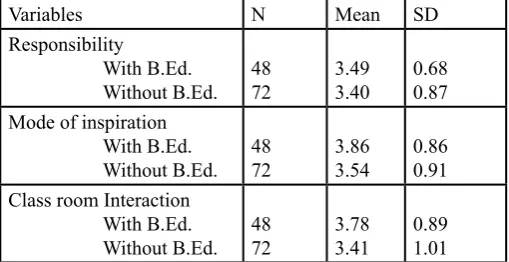
Table 2 indicates
that-• the mean (3.49) response of teachers with B.Ed. is greater than the mean (3.40) responses of teachers without B.Ed. with respect to Teacher’s responsibility inside classroom. • the mean (3.86) response of teachers with B.Ed. is greater
than the mean (3.54)responses of teachers without B.Ed.
with respect to Mode of inspiration
• the mean (3.78) responses of teachers with B.Ed. is greater than the mean (3.41) responses of teachers without B.Ed. with respect to Class room interaction.
Table 2 : Mean and standard deviation of responses on teachers role in Mathematics class
Variables N Mean SD
Responsibility
With B.Ed.
Without B.Ed. 4872 3.493.40 0.68 0.87 Mode of inspiration
With B.Ed.
Without B.Ed. 4872 3.863.54 0.86 0.91 Class room Interaction
With B.Ed.
Without B.Ed. 4872 3.783.41 0.89 1.01
Objective 2: The difference between boys’ and girls’ learning styles and strategies towards learning mathematics of secondary schools:
Factors taken under consideration are:
Extent of utilities of outline given by the teacher: Majority (51.43%) of the responses obtained from Girls indicate that the outline given by teacher in respect of on the concept /content is somewhat helpful to them and 50.71% of Boys reflects as very helpful.
Preference of students in presentation of numerical data by the teachers: Majority (52.50%) of the responses obtained from Girls and 50.71% of Boys indicate that they prefer presentation of numerical data by the teachers.
Activities preferred by students in a group project: Majority (66.43%) of the responses obtained from Girls and 60.71% of Boys indicate that they prefer to work with the group members to generate ideas within the group
Manner of working of mathematical problems by students:
Majority (87.86%) of the responses obtained from Boys and 84.64% of Girls prefer to try to understand the problem first before solving the problem.
Activity involved solving mathematical problems: A section (47.86%) of the responses obtained from Boys and 43.57% of Girls indicate that they prefer to work in their own ways to solve problems, one step at a time.
Mode of retention by students: Majority (78.21%) of the responses obtained from Boys and 75.36% of Girls indicated that they remember well when they do something by self involvement.
Mathematics teachers preferred by students: Majority (57.86%) of the responses obtained from Boys and 44.64% of Girls indicate that they prefer explanation of Mathematics lesson in detail and get solution of all the problems by teachers.
Objective 3: The difference between students’ learning styles and strategies of private and government secondary schools in mathematics:
Following factors are taken under consideration for the purpose:
Preference of students on Mathematics lesson: Majority (63.64%) of the responses obtained from students of Private schools and 45.67%, students of Government school prefers both abstract and concrete presentations on Mathematics lesson.
of utilities of outline given by teacher in the class room, majority (57.69%) of students from Government school students indicated is very helpful to them and 55.40% of students from Private school indicated as somewhat helpful to them.
Preference of students in presentation of numerical data by the teachers: Majority (58.81%) of the responses obtained from students of Private schools indicated that they prefer teachers to indicate numerical data in the form of tables, chart or graph whereas 41.83%, students of Government school prefers chart or graph only.
Activities preferred by students in a group project: Majority (68.75%) of the responses obtained from students of Private schools and 54.81% of students from Government school indicated that they prefer to work with the group members to generate ideas within the group to complete a project given to them.
Manner of working of mathematical problems by students:
Majority (88.92%) of the responses obtained from students of Private schools and 81.73% of students from Government school indicated that they prefer to try to understand the problem first before solving the problem.
Activity involved solving mathematical problems: It reflects, 46.88% of the responses obtained from students of Private schools and 43.75 % of students from Government school indicated that they prefer to work in their way to solve problems step by step while solving mathematical problem.
Mode of remembering: It reflects majority (77.56%) of the responses obtained from students of Private schools and 75.48 % of students from Government school indicated that they remember well when they do something practically.
Mathematics teachers preferred by students: Majority (55.29%) of the responses obtained from students of Private schools and 49.86 % of students from Government school indicated that they prefer Mathematics teacher who explain Mathematics lesson in detail and solve all the problems.
Hypothesis-1: Significant difference between Trained and
Untrained teachers.
Factors considered to test the significance are reflected in the
Table 3.
Table 3: Significant difference between Trained and Untrained teachers.
Sl.
No. Area Between Trained & Untrained Teachers Private
Govern-ment ‘t’ value
1 School resources 5.4088** 0.6759 2 View on curriculum 14.0749* 0.1125 3 View on syllabus 2.7056** 1.9160 4 Views in teaching Mathematics 0.6264 1.5159 5 Variety of teaching methods 2.6469* 2.4115* 6 Use of teaching method best fit
to a content 7.1254** 3.6049**
7 Use of teaching aids 3.4378** 0.2691
8 Classroom teaching 2.9897** 0.9889
9 Clearing students doubt 0.444 2.8469**
10 Freedom of expression 0.5265 2.8115**
11 Evaluation 6.3182** 1.9514
12 Opinion towards teaching
profession 2.1311* 6.7260**
* at 0.05 level; ** at 0.01 level
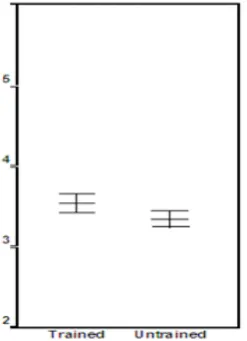
On summarizing ANOVA test is conducted on Trained and Untrained teacher and the (Table 4) revels that there exists no significant difference of the opinion among the teacher role in the classroom. Box Plot reflects mean position of Trained teacher is higher than the Untrained teacher (Graph 1).
Table 4: One way Analysis of Variance (ANOVA) on Trained and Untrained teacher on the basis of role in the classroom
Source df Sum of
Square Mean Square F p Between group 1 1.147 1.146
68.0658 0.1970 Within group 118 1.987 0.017
Total 119 3.134
p=0.1970 > 0.05
Graph 1: Box Plot representing mean position of Trained and Untrained teacher
Hypothesis-2: Significant difference between boys’ and girls’
learning styles and strategies:
Items are grouped in different areas as shown in Table 5. The underlying idea behind the grouping of different areas is to pinpoint the students learning style and strategies in the classroom situation.
Table 5: Significant difference between Boys and Girls student.
Sl.
No. Area Between Boys & Girls Students’ ‘t’ value
1 Mathematics, as a subject of
inspi-ration. 2.2467
*
2 Interest towards the subject. 2.7891* 3 Memorizing mathematical terms. 2.1594* 4 Computation of mathematical tasks. 1.906 5 Understanding importance of the
subject in day to day life. 0.8693 6 Opinion towards the subject
* at 0.05 level
For this purpose, t-test is conducted to test significance of Boys’ and Girls’ learning styles and strategies in Mathematics with respect to Private and Government secondary schools under different areas.
Table 6: Deference between students’ learning styles and strategies of Private and Government secondary schools on the basis of gender (Mean and SD)
Variables N Mean SD
Private Boys 176 3.39 0.42
Girls 176 3.37 0.41
Government Boys 104 3.29 0.41
Girls 104 3.18 0.38
Hypothesis-3: there is no significant difference between students’ learning styles and strategies of private and government secondary schools in mathematics:
For this purpose, t-test is conducted to test significance of students learning styles and strategies in Mathematics with respect to Private and Government secondary schools the factors considered under the areas reflected in Table 7.
Table 7: Significant difference between Students of Private and Government schools.
S l .
No. Area PrivateStudent Govern-ment ‘t’ value
1 Mathematics, as a subject of
inspiration. 0.5343
2 Interest towards the subject. 2.3299* 3 Memorizing mathematical
terms. 0.4797
4 Computation of
mathemati-cal tasks. 1.0500
5 Understanding importance of the subject in day to day life.
6.7758**
6 Opinion towards the subject
Mathematics. 7.4249**
* at 0.05 level; ** at 0.01 level
The result of the two way t-test (Table 8) revealed that the t value of students with respect to Private and Government secondary schools is 3.6309, which is more than tabulated value. Thus the result is significant at 0.01 levels. This meant that there exists significant difference between Private and Government school students towards learning styles and strategies in Mathematics.
Table 8: t-test analysis on summary of Boys’ and Girls’ learning styles and strategies in Mathematics
Category N M SD SEM t Significance
Student Private 352 3.30 0.3744 0.01995 3.6309** significant
Government 208 3.18 0.3837 0.02660
** at 0.01 level
IX. Findings of The Study
Teachers with B.Ed. in both Private and Government secondary schools take care of students’ learning style and strategies where ever possible.
Near about 80% of Government and Private secondary school teachers with B.Ed. applies the techniques of throwing question, voluntary response and encourage students to participate in class room discussion.
Teachers with B.Ed. are aware of the importance of different teaching learning aids in the classroom compare to teachers without B.Ed.
A few number of teachers from Government and near about half of teachers from Private without B.Ed. expressed their ignorance of the use of teaching aids.
This is quite shocking to note that more than 80% of Government and Private teachers without B.Ed. expressed that they have no idea about students learning styles and strategies.
The tactics used in teaching a lesson by majority (69.70%) of Government and 80% of Private teachers with B.Ed. is based on facts and real life situations whereas a section of Government and Private school teachers without B.Ed. deals with theoretical aspects only.
More than 60% of the teachers from Government and Private with B.Ed. and teachers without B.Ed. from Private schools allow students to solve problem using teachers practiced
procedures whereas 60% of Government teachers without B.Ed. allow student to solve problem using students preferred learning styles and strategies.
With respect to Teacher’s responsibility inside classroom, teachers with B.Ed. is found to be more responsible than the teachers without B.Ed. (in both Private and Government schools.)
With respect to Mode of inspiration, teachers with B.Ed. inspires the students more compared to the teachers without B.Ed. ( in both Private and Government schools.)
With respect to Class room interaction, the mean responses of teachers with B.Ed. is greater than the mean responses of teachers without B.Ed.( in both Private and Government schools.)
More than 55% responses obtained from Boys and Girls indicated that they prefer both abstract presentations (concepts, theories) and concrete presentations (facts, data) from their teacher.
More than 51% of the responses obtained from Girls indicate that the outline given by teacher in respect of on the content is somewhat helpful to them and 50.71% of Boys reflects as very helpful.
Majority (52.50%) of the responses obtained from Girls and 50.71% of Boys indicate that they prefer presentation of numerical data by the teachers.
60.71% of Boys indicate that they prefer to work with the group members to generate ideas within the group
Majority (87.86%) of the responses obtained from Boys and 84.64% of Girls prefer to try to understand the problem first before solving the problem
A section (47.86%) of the responses obtained from Boys and 43.57% of Girls indicate that they prefer to work in their own ways to solve problems, one step at a time
Majority (78.21%) of the responses obtained from Boys and 75.36% of Girls indicated that they remember well when they do something by self involvement.
Majority (57.86%) of the responses obtained from Boys and 44.64% of Girls indicate that they prefer explanation of Mathematics lesson in detail and get solution of all the problems by teachers.
In the view of utilities of outline given by teacher in the class room, more than 57% of students from Government school indicate that it is very helpful to them and 55.40% of students from Private school indicate as somewhat helpful to them.
More than 58% of the responses obtained from students of Private schools reflects that they prefer teachers to indicate numerical data in the form of tables, chart or graph whereas more than 41% students of Government school prefer chart or graph only.
More than 54% of the responses obtained from student of Private schools and Government schools indicate that they prefer to work with the group members to generate ideas within the group to complete a project given to them.
More than 81% of the responses obtained from students of Private schools and Government schools indicate that they prefer to try to understand the problem first before solving the problem.
46.88% of the responses obtained from students of Private schools and 43.75 % of students from Government school indicated that they prefer to work in their way to solve problems step by step while solving mathematical problem.
More than 75% of the responses obtained from students of Private school and Government school indicates that they remember well when they do something practically.
Majority (55.29%) of the responses obtained from students of Private schools and 49.86 % of students from Government school indicated that they prefer Mathematics teacher who explain Mathematics lesson in detail and solve all the problems.
In respect to school resources, there exists a significant difference of opinion of teachers with B.Ed. and teachers without B.Ed. in the Private schools whereas there exists no significant difference of opinion between teachers with B.Ed. and teachers without B.Ed. Government school teachers. With respect to curriculum there exists a significant difference of opinion of teachers with B.Ed. and teachers without B.Ed. in the Private schools whereas there exists no significant difference of opinion between teachers with B.Ed. and teachers without B.Ed. Government teachers.
With respect to teaching Mathematics, there exists no significant difference of opinion of teachers with B.Ed. and teachers without B.Ed. in both the Private and Government schools.
There exists significant difference of opinion of teachers with respect to teaching methods, between teachers with B.Ed.
and teachers without B.Ed. in the Private schools as well as Government schools.
With respect to use of teaching method best fit to content, there exists a significant difference of opinion of teachers with B.Ed. and teachers without B.Ed. in both the Private and Government schools.
With respect to use of teaching aids, there exists a significant difference of opinion of teachers with B.Ed. and teachers without B.Ed. in the Private schools whereas there exists no significant difference of opinion between teachers with B.Ed. and teachers without B.Ed. in Government schools.
There exists a significant difference of opinion of teachers with B.Ed. and teachers without B.Ed. in the Private schools with respect to classroom interaction but there exists no significant difference of opinion between teachers with B.Ed. and teachers without B.Ed. in Government schools.
With respect to clarifying of students’ doubt, there exists no significant difference of opinion of teachers with B.Ed. and teachers without B.Ed. in the Private and in contrast there exists a significant difference of opinion of teachers with B.Ed. and teachers without B.Ed. in the Government schools.
There exists no significant difference of opinion of teachers with B.Ed. and teachers without B.Ed. with respect to freedom of queries in the Private and in contrast there exists a significant difference of opinion of teachers with B.Ed. and teachers without B.Ed. in the Government schools.
There exists a significant difference of opinion of teachers with B.Ed. and teachers without B.Ed. in the Private schools with respect to evaluation and in contrast there exists no significant difference of opinion of teachers with B.Ed. and teachers without B.Ed. in the Government schools.
With respect to opinion towards teaching profession there exists a significant difference of opinion of teachers with B.Ed. and teachers without B.Ed. in both the Private and Government schools.
On the whole, there exists a significant difference between Private and Government teachers with B.Ed. with respect to their role in the Mathematics class.
On the other hand, there exists no significant difference between Private and Government secondary school teachers without B.Ed. for the same.
There exists a significant difference between Boys and Girls student towards Mathematics as a subject of inspiration.
There exists a significant difference between Boys and Girls student towards interest in the subject Mathematics.
There exists a significant difference between Boys and Girls student towards memorizing mathematical terms.
There exists no significant difference between Boys and Girls student towards computation of mathematical tasks.
There exists no significant difference between Boys and Girls student towards understanding importance of the subject in day to day life.
There exists no significant difference between Boys and Girls student towards opinion on the subject Mathematics.
There exists a significant difference between Boys and Girls student towards learning styles and strategies in Mathematics.
students.
Further it is found that Private schools boy student has stronger learning styles and strategies than Boys and girl students of Government secondary school, more over there is a nominal difference in learning styles and strategies on the subject Mathematics comparing to boy and girl students of Private secondary schools.
Boys’ attitude towards the subject Mathematics is better than that of Girls’ in both Private and Government schools.
There exists no significant difference between Private and Government students toward Mathematics, as a subject of inspiration.
There exists a significant difference between Private and Government students toward interest in the subject Mathematics.
There exists no significant difference between students of Private and Government school towards memorizing mathematical terms.
There exists no significant difference between Private and Government school students towards computation of mathematical tasks.
There exists a significant difference between Private and Government students towards understanding importance of the subject in day to day life.
There exists a significant difference between Private and Government students towards opinion on the subject Mathematics.
X. Conclusions
Pupils in the Private schools performed better than the Government schools due to good management, continuous evaluation and continuous feedback where as percentage of professionally qualified teachers in Private schools are less. Preferred learning styles and strategies of students need to be employed in learning Mathematics; to accommodate students’ own preferred learning styles and strategies in the learning of Mathematics by the students from their teachers, the assistance required is through the conduciveness of the design of Mathematics curriculum. In Private schools, teachers appointment should be strictly on professional criteria so that teachers are aware of students preferred learning styles and strategies while learning Mathematics and provision needs to be made for longer retention of teachers in the school. The teachers should be encouraged, supported and empowered to conduct action research so as to improve their pedagogic practices. Teachers need to be encouraged for bringing in innovations in their teaching learning approaches keeping in view the needs of learners with varying learning styles, intelligences and socio economic and cultural backgrounds. The schools should provide essential ICT equipments to teacher to use them. The student assessment needs to be participatory, comprehensive and continuous. Capacity building of teachers needs to be undertaken for the in-service teachers.
XI. Acknowledgement
I express gratitude to the department of Humanities and Social Science and Mathematics, Assam Down Town University, Guwahati, Assam for sincere guidance and support in this work.
Reference
[1] Ames, C. Classrooms: Goals, structure, and student motivation. Journal of Educational Psychology, 84(3), 1992.
[2] Bandura, A. Self-efficacy mechanism in human agency.
American Psychologist, 1982.
[3] Barr, A. Accounting research. The Accounting Review (January). 1960.
[4] Batcher, R. Psychology Applied to Teaching. New York:
Houghton Mifflin Company, 1971.
[5] Beck, C.R. Matching Teaching Strategies to Learning Style Preferences. The Teacher Educator, 2001.
[6] Biggs, J.B. and Moore J.P. The process of Learning. Publisher: Prentice Hall, 1993.
[7] Canfield, A. Canfield Learning Styles Inventory Manual.
Western Psychological Services, Los Angeles, 1992. [8] Cangelosi, J S. Teaching Mathematics in Secondary and
Middle School: An Interactive Approach (2nd Edition) NJ: Prentice Hall,Inc, 1996.
[9] Chan, D.W. Winter. Learning Styles of Gifted and Non-gifted Secondary Students in HongKong. Gifted Children Quarterly, 2001.
[10] Chance, P. The rewards of learning. Phi Delta Kappan, 1992.
[11] Devi, Tribeni. A Study of Educational Policy in India since Independence with Special Reference to School Education. Assam University, 2013.
[12] Dooley, D. Social Research Methods. (3rd edition). New Delhi, Prentice Hall of India, 2004.
[13] Dunn, R. Strategies for Educating Diverse Learners. Bloomington, IN: Phi Delta Kappan, 1995.
[14] Dyer, Timothy J. Personalization: If Schools do not implement this one. There Will Be No Reform. NASSP Bulletin, 1996.
[15] Farooq, S. and Shah, S. Z. U. Students’ Attitude Towards
Mathematics. Pakistan Economic and Social Review. Volume 46, No. 1 (2008).
[16] Gadgil. A study of the causes of large failure in mathematics at the S.S.C Examination (std X)”. Pune, Indian Institute of Education, 1979.
[17] Government of India (GOI)–Ministry of Human Resource Development (MHRD). National Education Policy 1986 as revised in 1992 and National Education Policy 1968. New Delhi: New Delhi: GOI-MHRD, 1998.
[18] Hazarika, Banani Bora. Factors Effecting Interest In Mathematics Among Upper Primary School Students, a Study on The Basis of The Students of Guwahati, Ph.D. Diss., Gauhati University, 2013.
[19] Kay, N.C. Practical Teaching. London: Fetcher and Saint Ltd., 1971.
[20] Kisakali. Justin and Kuznetsov. Dmitry. Modeling Factors Influencing Mathematics Learning and Performance in Tanzanian Secondary Schools. Asian Journal Of Mathematics And Applications Volume 2015, Article Id Ama0244, ISSN: 2307-7743, 2015.
[21] Klein David, The State Of State Math Standards. 1627 K Street, Northwest Suite 600 Washington, D.C., 2005. www. edexcellence.net. (Accessed on 12th Nov 2014).
[22] Kohn, A. Punished by Rewards: the Trouble with Gold Stars.
Incentive Plans, A’s, Praise, and Other Bribes. Boston: Houghton Mifflin, 1993.
Techniques. New-Delhi: New Age International Publishers, 2006.
[24] Lockard , J. and Abrams, P.D. Computers for twenty-first
century educators. (6th Ed.). Boston, MA: Allyn and Bacon,
2004.
[25] Malik S., and J. Fouzia. Learning Styles and Teaching Strategies: Creating a Balance. Language in India. Volume 11, ISSN: 1930-2940, 2011.
[26] Mayer, R.E. Cognition and Instruction: Their Historic Meeting within Educational Psychology. Journal of Educational Psychology, 84, 1992.
[27] Md. Farooq, S. and Shahzadi N. Effect of Teachers’ Professional Education on Students’ Achievement in
Mathematics. Bulletin of Education & Research. Vol. 28, No. 1, 2006.
[28] National Council of Teachers of Mathematics. NCTM Standards. http://www. nctm.org /standards/#annuals. (Accessed on 12th Oct. 2014).
[29] National Curriculum Framework, www.ncert.nic.in/ rightside/links/pdf/ framework/english/nf2005.pdf., 2005. (Accessed on 12th Sept. 2014).
[30] National Curriculum Framework (NCF): National Council of Educational Research and Training, Sri Aurobindo Marg New Delhi – 110 016, 2005.
[31] National Curriculum Framework for Teacher Education (NCFTE), National Council for Teacher Education, Wing II, Hans Bhawan, 1, Bahadur Shah Zafar Marg, New Delhi-110002, 2009.
[32] National Policy On Education, MHRD, 1986. mhrd.gov.in/
sites/ upload_files/mhrd/files/upload_document/npe.pdf.(
Accessed on 22nd Nov 2014).
[33] Oxford, R. Language learning strategies: What every teacher should know.” New York: Newbury House/ Harper and Row, 1990.
[34] Patel. Ashok, Investigation Study to Decrease Failure Ratio of Mathematics Subject in S.S.C. Examination. Vasna-Ahmedabad-07 , Gujarat – India, 2005.
[35] Polya, G. How to Solve It: A New Aspect of Mathematical Method. (2nd ed)., Princeton University Press, ISBN 0-691-08097-6, 1957.
[36] Price, G. E., Dunn, R. and Sanders, W. Reading achievement and learning style characteristics. The Clearing House, 5, 223-226, 1980.
[37] SCERT, Nagaland, Kohima, A study of the Evaluation System in Government & Private Primary Schools, Kohima District, 2009.
[38] Schneider, Daniel K., Introduction to Educational Technology. Fern University, Hagen, Kultur, 2013. [39] Searson, R & Dunn, R. The Learning-Style Teaching Model.
Journal of Science and Children, 38(5), pp. 22-26, 2001. [40] Sidhu, K. S. The Teaching of Mathematics. New Delhi:
Sterling Publishers Pvt. Ltd., 1995; 2006.
[41] Stellwagen, Joel B. A Challenge to the Learning Style
Advocates. (pp.265-268). http://eflpresentations.pbworks.
com/f/, (Accessed on 12th May 2014).
[42] Yamane, Taro. Statistics: An Introductory Analysis. (2nd Edition). New York: Harper and Row, 1967.
[43] Zhang, Li-Fang. Do Styles of Thinking Matter among Hong-Kong Secondary School students? Personality and Individual Differences. 31(3), pp. 289-301, 2001.
Author’s Profile
Taught in Schools, Higher Secondary Schools, Degree College from 1996 till 2005. Asst. Prof., at a Government Teacher Education Institute (B.Ed & M.
Ed) since 2005. Educational Qualification: