The Journal of Social Sciences Research
ISSN(e): 2411-9458, ISSN(p): 2413-6670
Vol. 4, Issue. 11, pp: 271-275, 2018
URL: https://arpgweb.com/journal/journal/7 DOI: https://doi.org/10.32861/jssr.411.271.275
Academic Research Publishing Group
Original Research Open Access
Systematic Thinking Underlying Cross-Cultural Differences in Deception
Acceptability
Claudia Castro
*Cognitive Science Laboratory Department of Psychology Universidad Autonoma de Nuevo Leon (UANL), Mexico
Guadalupe Elizabeth Morales
Cognitive Science Laboratory Instituto de Investigaciones sobre la Universidad y la educación (IISUE) Universidad Nacional Autónoma de México (UNAM), Mexico
Ernesto Octavio Lopez
Cognitive Science Laboratory Department of Psychology Universidad Autonoma de Nuevo Leon (UANL), Mexico
Laura Olivares
Department of Social Psychology and Anthropology University of Salamanca, Spain
Jaume Masip
Department of Social Psychology and Anthropology University of Salamanca, Spain
Abstract
This study aims to explore cultural differences between Spanish and Mexican individuals in how specific cognitive-based thinking explains judgment formation regarding deception acceptability. Here, participants from both populations were required to judge acceptability of actors´ lying and truth-telling tendencies across several social scenarios. These deception scenarios were built by considering experimental manipulation of the type of relationship with the deceiver, gender, motive, and deception consequences. Analysis results indicate that judgment formation of acceptability in both populations followed a cognitive summative rule to integrate factor information valuation. However, when considering valuation of telling lies to an unknown individual, acceptability was significantly different for the two populations. Spanish individuals viewed lying to an unknown individual significantly more acceptable than did Mexican participants.
Keywords: Lying; Information integration theory (IIT); Cognitive judgment formation; Deception acceptability.
CC BY: Creative Commons Attribution License 4.0
1. Introduction
Normally, telling the truth is considered a desirable social behavior, whereas telling lies is not (Carson, 2010). However, in some social contexts (Bakir et al., 2017; Graziolli, 2004) deceiving is acceptable, promoted, and even rewarded. What is clear about deception acceptability judgment is its dependency on a multifactor set of social interaction variables constrained by culture. For instance, what is considered acceptable in some societies does not generalize to others (Seiter et al., 2002).
Academic efforts exploring human deception across cultures have led to a variety of models aimed at explaining how cultural differences permeate our accuracy of deception detection or our ability to deceive (Taylor et al., 2015). For instance, regarding deception detection, it has been suggested that, for an individual to correctly identify a liar, she/he must possess culture-specific code defining norms and expectations about a person´s reliability (The Global Deception Research Team, 2006). Violation of any of these norms (Bond et al., 1992; Castillo and Mallard, 2012; Levine et al., 2000), empower a judge for deception detection. This kind of rationality appears as one possibility to explain why it is harder to judge if someone from another culture is lying. It has been frequently reported that our within-cultural capacity for deception detection averages at about 56% (Bond and DePaulo, 2006;2006b; Castro et al., 2012). This capacity might decrease by up to 10% when we judge people from other cultures (Bond and Atoum, 2000; Park and Ahn, 2007).
theory of planned behavior (TPB), which is a version of the TRA model, to establish that study participants promoted positive normative rationality towards unethical behaviors among Taiwanese but not so among Americans. Here, it is proposed that these cognitive approaches for studying deception are limited. On one hand, Jaccard and Becker (1985) showed that markedly superior predictive power is obtained from attitude decision models if they are compared to TPB (TRA) in real life situations. On the other hand, alternative approaches like the information integration theory (IIT) provide the same predictive power as attitudinal models. They also yield and more precise specification of cognitive parameters participating in judgment formation (Anderson, 2007) than TPB. Thus, we present next an IIT study to show cognitive specification advantages of this approach when the topic of cross-cultural differences related to telling lies is under scrutiny.
1.1. Functional Measurement (IIT) and Algebraic Ruled Thinking About Deception
A TPB/TRA model is an expectancy-value model characterizing systematic thinking (Ajzen and Fishbein, 2005). Here, an attitude is formed by summing the multiplicative combination of (a) the strength of a salient belief that a behavior will produce a given outcome and (b) the subjective evaluation of this outcome, such that:
Attitude = Σ bi ei,
where birepresents the strength of the belief and eiis the value of the attitude object on attribute i evaluation.
Beliefs and evaluations are typically scored on 7-point scales. In this model, it is assumed that multiplying the expectancy and value components associated with each outcome and summing up these products determines an attitude. This model implies deliberative processing, since it involves analysis of available information, as well as positive and negative attributes of the attitude object, along with consideration of weighted costs and benefits of engaging in a course of action.
However, the main objective of this approach is to provide behavior prediction, rather than to specify cognitive processing of beliefs and cognitive valuation of events. As suggested by Anderson (2007), ―These two directions,
namely, prediction of behavioral outcomes and understanding of cognitive processes, impose generally different constraints on strategy and tactics of investigation. Hence they usually interfere with each other‖ (p. 128).
Lack of cognitive specification of beliefs and valuation of events may limit prediction power. This is the case for TPB/TRA models where scale reliability and validity due to multicollinearity has been reported, thus raising doubts about measured concepts (Harris et al., 1982).
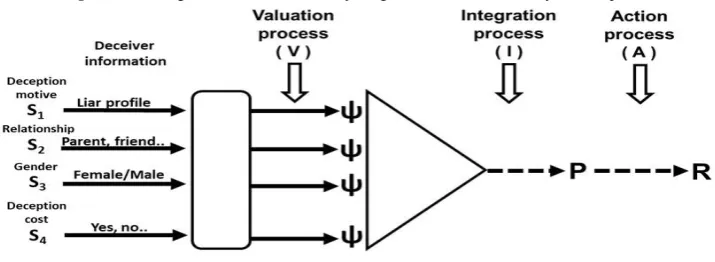
This limitation can be overcome by a careful consideration of IIT experimental designs. In general, this approach postulates that relevant stimuli (Si) are extracted from an environment (in this case a possible deceiver in a
social context). This information is psychologically represented through a valuation process (V) with cognitive coefficients (ψi). In our case, a judge is assumed to systematically combine these subjective values (I) by means of a
cognitive algebra rule (additive, multiplicative, or average) to form a unified implicit response (
judgment) that willproduce an explicit response (R) through an action operator (A). This goal-oriented and feed-forward cognitive processing within the context of the current study is best described by the IIT functional diagram given in Figure 1.
Figure-1. An Integration Information Theory Diagram for the Current Study on Deception
The main IIT assumption is that, whilst valuation (V) of information depends on each individual’s perception of events, the systematic integration (I) relates to a generalizable cognitive processing algebraic rule across a sample of individuals. This cognitive algebraic behavior can be specified by IIT functional measurement methodology (FMIIT) as described in the method section (Castro et al., 2012). This is relevant because cognitive specification of systematic thinking deepens our knowledge about people’s beliefs. For instance, there is robust evidence suggesting that people tend to follow an average integration rule in attitude formation and change rather than a summation of products, as proposed in the Fishbein and Ajzen´s expectancy-value model (Anderson, 1971). In contrast to TPB, the IIT model allows for the study of much broader concepts regarding either attitudes toward targets or behavior
(Mairese et al., 2012).
model, relates to System 1, where judgements of deception (from the judge’s point of view) may be driven by systematic automatic and implicit processing of information about a possible deceiver (Hartwig and Granhag, 2015). Thus, in this study, we explored the possibility of specifying cross-cultural differences due to assorted styles of cognitive information integration regarding deceiving behavior. As our aim is to understand additional factors influencing judgment (other than evident differences regarding individualistic and collective social behaviors), we consider populations from two different countries with similar cultural roots (Mexico and Spain) to explore prosocial or antisocial behavior (acceptability) toward deception.
1.2. Method
A cognitive algebra study under the IIT assumptions was implemented to explore cross-cultural differences between Spanish and Mexican bachelor students regarding judgment formation of deception acceptability. Here, a four-factor experimental design was considered to build the set of deception scenarios: deceiver’s gender (female vs. male), target of a deceiver (a romantic partner vs. family vs. unknown), deceiver’s antecedents (with antecedents vs. no antecedents), and deception consequences (consequences vs. no consequences).
1.3. Participants
The study sample comprised of 96 Spanish psychology bachelor students (53 females and 43 males). Their age ranged from 18 to 23 years old. Another sample of 99 Mexican psychology bachelor students (58 females and 41 males) was recruited for comparison purposes. Their age ranged from 19 to 23 years old. No credits or economic remuneration were provided for participation.
1.4. Instruments
In line with the aforementioned experimental design, 24 vignettes (experimental conditions) were built, each describing a possible deceiving scenario. At the end of each scenario, participants were asked to judge the acceptability of a vignette actor deceiving another person. To this purpose, a judge had to use a 11-point anchored scale ranging from ―Unacceptable‖ to ―Completely acceptable‖ (Figure 2).
Figure-2. Example of a vignette from the research study
1.5. Procedure
Appointment by groups was carried on. First, written consent to participate in the study was obtained. Then, verbal and written instructions about the study were presented. A practice scenario followed instructions, and after this training participants proceeded into the study. The deceiving scenarios were presented at random to each participant. The time required to finish the study was around 30 minutes.
2. Results
A mixed ANOVA was conducted on a 2 (Country: Mexico vs. Spain) x 2 (Liar gender: female vs. male) x 3 (Relationship: romantic partner vs. family vs unknown) x 2 (Behavioral antecedent: has lied before vs. has not lied before) x 2 (Consequence: consequences vs. no consequences). Significance criterion was set to p < .001.
The ANOVA results revealed no main effect for the country factor F(1, 177) = 1.217, p = .27, η2 =.006 or gender F(1, 177) = 0.07, p = .78, η2
=.004. However, participants from both countries produced similar data patterns (systematic thinking), as indicated by parallel lines in the interaction graph shown in Figure 3 (a summative cognitive information integration rule). However, an important cross-cultural difference regarding judgement formation (valuation of factors) of acceptability emerged. Spanish individuals deemed it much more acceptable to lie to an unknown person (more than lying to parents or a romantic partner), whereas Mexican participants did not. Both participant groups found the deception more acceptable if a deceiver had antecedents and both felt that a romantic partner telling lies was the least acceptable.
Laura lied to her boyfriend when she told him she would not be able to see him later, since she would leave the office very late. The truth was that she already had a romantic date with another person, even though her boyfriend has never given her motives to cheat. Her boyfriend never knew about this. She decided to continue normally with her boyfriend as if nothing happened.
How acceptable/justified was Laura´s deception?
Table-1. Main Effects Obtained by ANOVA
Figure- 3. Interaction graph (relationship with a liar vs. group type) showing parallel deception acceptability patterns (summative information integration rule of factors) for the two study groups (Mexico vs. Spain)
3. Discussion
As it has been pointed out previously, people in diverse cultures have varying expectations about their interpersonal roles and normative behaviors regarding deception (Seiter et al., 2002). In this study, Spanish individuals saw deception of an unknown individual as much more acceptable than Mexican participants did. This finding reveals participation of an affective (attitudinal) component underlying judgment formation of acceptability, since a relationship with a familiar person or a romantic partner is sentimental, but that with a stranger it is not. On the other hand, Mexican participants’ judgment formation seems more normative oriented, due to the belief that, in general, it is not good to lie to anyone. This does not affect the collective-oriented tendency to treat a stranger as a friend. In Mexico, strangers are welcomed as friends, which in turn defines a Latino sense of collective identity that differentiates cultures between north America (normative) and the rest of Latin American continent (collective-attitudinal). For instance, Zurcher (1968)compared Mexicans and Americans using role conflict scenarios, reporting that Americans were much less likely to lie than Mexicans to protect a friend in a car accident situation.
In Mexico, there is a popular saying ―Mexico is a blend of cultures. The Spanish is one of them.‖ According to the results reported here, this phrase is not completely true, and the IIT approach allowed us to elucidate why this is so. For instance, we have < similar cognitive rule to judge deception but specific differences on valuating the deceiver.
There is one more advantage on using the IIT approach over current theoretical alternatives, such as functional cognitive specification. Note that our results can be more formally specified as follows:
Yacceptability = GenderA + RelationshipB + AntecedentsC + ConsequencesD.
where the judgment of acceptability index is a sum of factors and constants estimated by linearly fitting the obtained data.
Mexico
No Yes
1 2 3 4 5 6 7 8 9 10
Inde
x of dec
ep
tion ac
ce
ptab
ilit
y
Spain
No Yes
Relationship
Romantic partner Parents Unknown
Deceiving antecedents Deceiving antecedents
Source df MS df MS F p 2
<< Mexico-Spain>>
df MS df MS F p 2
different social contexts (consistency judgment). Second, cultural background does not affect this judgment cognitive rule, but it relates to psychological valuation of integration factor information regarding deception
More research is required, however, to determine how additional factor integration (valuation constants) fits judgment regarding deception through each culture.
References
Ajzen, I. and Fishbein, M. (1980). Understanding attitudes and predicting social behavior. Prentice-Hall: Englewood Cliffs, NJ,.
Ajzen, I. and Fishbein, M. (2005). The influence of attitudes on behavior, In D, Albarracín, B.,T, Johnson, & M., P, Zanna (Eds.),The handbook of attitudes. Erlbaum: Mahwah, NJ. 173-221.
Anderson (1971). Integration theory and attitude change. Psychological Review, 78(3): 171-206.
Anderson (2007). Unified social cognition, Scientific psychology series. Psychology Press: New York, NY.
Aune, R. K. and Waters, L. L. (1994). Cultural differences in deception: Motivations to deceive in Samoans and North Americans. International Journal of Intercultural Relations, 18(2): 159-72.
Bakir, V., Herring, E., Miller, D. and Robinson, P. (2017). Lying and deception in politics. In J. Meibauer (Ed.).
Oxford University Presz: The Oxford Handbook of Lying.
Bond and Atoum, A. O. (2000). International deception. Personality and Social Psychology Bulletin, 26(3): 385-95. Bond and DePaulo, B. M. (2006). Accuracy of deception judgments. Personality and Social Psychology Review,
10(3): 214-34.
Bond and DePaulo, B. M. (2006b). Individual differences in judging deception, Accuracy and bias. Psychological Bulletin, 134(4): 477-92.
Bond, Atoum, O. A., Pitre, U., Lashley, B., Skaggs, L. M. and Kirk, C. T. (1992). Fishy-looking liars: Deception judgment from expectancy violation. Journal of Personality and Social Psychology, 63(6): 969-77.
Carson, T. L. (2010). Lying and deception, Theory and practice. Oxford Scholarship Online: Oxford, UK.
Castillo, P. A. and Mallard, D. (2012). Preventing cross-cultural bias in deception judgements, The role of expectancies about nonverbal behavior. Journal of Cross-Cultural Psychology, 43(6): 967-78.
Castro, C. C., Lopez, R. E. O. and Morales, G. E. (2012). Cognitive algebra to deception detectio, Information integration theory contributions to study human deception detection´s cognitive nature. International Journal of Psychology Research, 7(5/6): 5.
Chaiken, S. and Trope, Y. (1999). Dual-process theories in social psychology. Guilford Press: New York, NY. Cherry, J. (2006). The impact of normative influence and locus of control on ethical judgments and intentions, A
cross-cultural comparison. Journal of Business Ethics, 68(2): 113-32.
Choi, H. J., Park, H. S. and Oh, J. Y. (2011). Cultural differences in how individuals explain their lying and truth-telling tendencies. International Journal of Intercultural Relations, 35(6): 749–66.
Graziolli, S. (2004). Where did they go wrong? An analysis of the failure of knowledgeable internet consumers to detect deception over the internet. Group Decision and Negotiation, 13(2): 149-72.
Harris, R., Skyler, J. S., Linn, M. W., Pollack, L. and Tewksbury, D. (1982). Relationship between the health belief model and compliance as a basis for intervention in diabetes mellitus. Pediatric and Adolescent Endocrinology, 10(5): 123-32.
Hartwig, M. and Granhag, P. A. (2015). Exploring the nature and origin of beliefs about deception, Implicit and explicit knowledge among lay people and presumed experts. In P. A. Granhag, A. Vrij, & B. Verschuere (Eds.), Detecting Deception, Current challenges and cognitive approaches. 1st ed edn: John Wiley & Sons, Ltd: West Sussex, UK.
Jaccard, J. and Becker, M. A. (1985). Attitudes and behavior, An information integration perspective. Journal of Experimental Social Psychology, 21(5): 440-65.
Levine, T. R., Anders, L. N., Banas, J., Baum, K. L., Endo, K., Hu, A. D. S. and Wong, N. C. H. (2000). Norms, expectations, and deception, A norm violation model of veracity judgements. Communication Monographs,
67(2): 123-37.
Mairese, O., Macharis, C., Lebeau, K. and Turcksin, L. (2012). Understanding the attitude-action gap, functional integration of environmental aspects in car purchase intentions. Psicológica, 33(3): 547-74.
Park, H. S. and Ahn, J. Y. (2007). Cultural differences in judgement of truthful and deceptive messages. Western Journal of Communication, 71(4): 294-315.
Seiter, J. S., Bruscke, J. and Bai, C. (2002). The acceptability of deception as a function of perceivers' culture, deceiver's intention, and deceiver‐deceived relationship. Western Journal of Communication, 66(2): 158-80. Taylor, J. P., Larner, S., Conchie, S. M. and Zee, S. (2015). Cross-Cultural Deception Detection. In P. Anders Granhag, Al. Vrij & B. Verschuere (Eds.), Detecting Deception, Current Challenges and Cognitive Approaches. John Wiley & Sons, Ltd.: West Sussex, UK.
The Global Deception Research Team (2006). A world of lies. Journal of Cross-Cultural Psychology, 37(1): 60-74. Zurcher, L. A. (1968). Particularism and organizational position, A cross-cultural analysis. Journal of Applied