The Thirty-Third AAAI Conference on Artificial Intelligence (AAAI-19)
Explainable Recommendation through Attentive Multi-View Learning
Jingyue Gao,
1,2Xiting Wang,
2*Yasha Wang,
1Xing Xie
21Peking University,{gaojingyue1997, wangyasha}@pku.edu.cn 2Microsoft Research Asia,{xitwan, xingx}@microsoft.com
Abstract
Recommender systems have been playing an increasingly im-portant role in our daily life due to the explosive growth of in-formation. Accuracy and explainability are two core aspects when we evaluate a recommendation model and have become one of the fundamental trade-offs in machine learning. In this paper, we propose to alleviate the trade-off between accuracy and explainability by developing an explainable deep model that combines the advantages of deep learning-based models and existing explainable methods. The basic idea is to build an initial network based on an explainable deep hierarchy (e.g., Microsoft Concept Graph) and improve the model accu-racy by optimizing key variables in the hierarchy (e.g., node importance and relevance). To ensure accurate rating predic-tion, we propose an attentive multi-view learning framework. The framework enables us to handle sparse and noisy data by co-regularizing among different feature levels and combining predictions attentively. To mine readable explanations from the hierarchy, we formulate personalized explanation genera-tion as a constrained tree node selecgenera-tion problem and propose a dynamic programming algorithm to solve it. Experimen-tal results show that our model outperforms state-of-the-art methods in terms of both accuracy and explainability.
Introduction
Personalized recommendation has become one of the most effective techniques to help users sift through massive amounts of web content and overcome information over-load. Recently, the recommendation community has reached a consensus that accuracy can only be used to partially evaluate a system. Explainabilityof the model, which is the ability to provide explanations for why an item is rec-ommended, is considered equally important (Wang et al. 2018a). Appropriate explanations may persuade users to try the item, increase users’ trust, and help users make better decisions (Zhang et al. 2014a).
Determining whether to optimize towards accuracy or ex-plainability poses a fundamental dilemma for practitioners. Currently, their choices are limited to two types of models:
• Deep but unexplainable. Deep learning-based recom-mendation models (Wang et al. 2017; Zheng, Noroozi,
*Xiting Wang is the corresponding author
Copyright © 2019, Association for the Advancement of Artificial Intelligence (www.aaai.org). All rights reserved.
Dessert
Steak Seafood
Vegetable
Bread Fruit
Meat Food
Oyster
Shrimp Gelato Cake
Food
High Fiber Food
Croissant
Green
Pear Arugula
Tomato
Figure 1: Multi-level user interest extracted using our method. The hierarchies correspond to a 26-year-old female Yelp user (left) and a 30-year-old male Yelp user (right). The features users care most about are highlighted in orange.
and Yu 2017) achieve state-of-the-art accuracy due to their capacity to model complex high-level features. How-ever, the high-dimensional high-level features they learn are beyond the comprehension of ordinary users.
To design an explainable deep model as such, we are faced with two major technical challenges. The first challenge is to accurately model multi-level explicit features from noisy and sparse data. It is very difficult to model the relation-ships between high-level and low-level features since they have overlapping semantic meanings. For example, learning whetherseafoodis important to the user is challenging be-cause the user may only mentionshrimpormeatin the re-view. The second challenge is to generate explanations that are easy for common users to understand from the multi-level structure.
To address these challenges, we develop a Deep Explicit Attentive Multi-View Learning Model (DEAML). The basic idea is to build an initial network based on an explainable deep structure (e.g., knowledge graph) and improve accu-racy by optimizing key variables in the explainable structure (e.g., node importance and relevance). To improve model accuracy, we propose an attentive multi-view learning frameworkfor rating prediction. In this framework, differ-ent levels of features are considered as differdiffer-ent views. Adja-cent views are connected by using the attention mechanism. Results from different views are co-regularized and atten-tively combined to make the final prediction. This frame-work helps improve accuracy since it is robust to noise and enables us to fully leverage the hierarchical information in the explainable structure. Second, weformulate personal-ized explanation generation as a constrained tree node selection problem. To solve this problem, we propose a dy-namic programming algorithm, which finds the optimal fea-tures for explanation in a bottom-up manner.
We conduct two experiments and a user study to evalu-ate our method. Numerical experiments show that DEAML outperforms state-of-art deep learning-based recommenda-tion models in terms of accuracy. An evaluarecommenda-tion with 20 hu-man subjects has shown that the explanations generated by us are considered significantly more useful than state-of-the-art aspect-based explainable recommendation method.
Related Work
Many methods have been proposed to improve recom-mendation accuracy, including content-based (Kompan and Bielikov´a 2010), collaborative filtering-based (Das et al. 2007) and hybrid methods (De Francisci Morales, Gionis, and Lucchese 2012). As an integration and extension of pre-vious methods, deep learning-based models are proposed to further improve accuracy. For example, CDL (Wang, Wang, and Yeung 2015) jointly performs deep represen-tation leaning and collaborative filtering by employing a hierarchical Bayesian model. He et al. propose a Neural Collaborative Filtering framework to learn nonlinear in-teractions between users and items (He et al. 2017). In DeepCoNN and NARRE (Zheng, Noroozi, and Yu 2017; Chen et al. 2018), convolutional neural networks are lever-aged to extract features from textual reviews. Although these methods achieve significant improvement in accuracy, the high-level features extracted are beyond the understanding of common users. Except for unstructured textual data, re-searchers have also designed models that leverage structural
information. Famous examples are taxonomy-based meth-ods that incorporate taxonomies of items into latent factor models (Kanagal et al. 2012; Zhang et al. 2014b). These methods can effectively mitigate data sparsity. However, their accuracy and explainability are limited due to the lack of a mechanism to model multi-level item features.
Recently, researchers have discovered that providing ex-planations may improve persuasiveness, effectiveness, ef-ficiency and user trust (Zhang et al. 2014a). Thus, many methods have been developed to improve the explainabil-ity of recommendation models (Ren et al. 2017; Peake and Wang 2018; Wang et al. 2018b). Pioneer works (McAuley and Leskovec 2013; Zhang et al. 2014a) focus on im-proving the explainability of collaborative filtering models. These works usually rely on shallow explainable compo-nents such as matrix factorization (Zhang et al. 2014a) and generative models (Diao et al. 2014; Wu and Ester 2015) for explanation generation. More recently, researchers dis-covered the attention mechanism’s capability in improving the explainability of deep learning-based methods. By us-ing the attention mechanism, the models can automatically learn the importance of explicit features and at the same time refine user and/or item embeddings (Chen et al. 2017; 2018). Researchers have also built explainable models based on interpretable structures such as graphs (He et al. 2015) and trees (Wang et al. 2018a).
The aforementioned explainable recommendation meth-ods have achieved considerable success in improving ex-plainability. However, to the best of our knowledge, none of the existing explainable recommendation methods can model multi-level explicit (explainable) features. As a re-sult, the accuracy and/or explainability of these methods are limited. Compared with these methods, our DEAML is an explainable deep model that achieves state-of-the-art accu-racy and meanwhile is highly explainable. Moreover, our model can automatically learn multi-level user profile and infer which level of features best captures a user’s interest.
Problem Definition
We aim to build an explainable deep recommendation model by incorporating an explicit (explainable) feature hierarchy.
Input:The input of our model includes a user setU, an item setV, and an explicit feature hierarchyΥ.
Definition 1. An explicit feature hierarchy Υ is a tree where each node Fl is an explicit feature or aspect (e.g., meat) of the items (e.g., restaurants). Each edge is a tuple
(Fl1, Fl2), which represents that the childFl1 (e.g.,beef) is a sub-concept of the parentFl2 (e.g.,meat). We denote the
set of nodes inΥasF, whereF={F1, ..., FL}andL
rep-resents the total number of nodes inΥ.
To build Υ, we leverage the Microsoft Concept Graph1(Wu et al. 2012; Wang et al. 2015), which is a widely
used knowledge graph with over 5 million concepts and 85 million “IsA” relations (e.g.,cat IsAanimal). We first map n-grams in the reviews to concepts (or instances) in the con-cept graph. Only the frequently used concon-cepts that are highly
1
1 i
u
H i
u
2 i
u
Hierarchical Propagation of User-Feature Interest
1 j
v
H j
v
2 j
v
EFM++ at View 1
EFM++ at View H
EFM++ at View 2
User Embedding
ui
Item Embedding
vj
1
~i
x
H
~i
x
2
~i
x
1
~j
y
H
~j
y
2
~j
y
Pork Beef Wine Pear Plum Meat Drink Fruit
Food Price
Co-Regularization Co-Regularization
Attention Layer Rating Prediction
Hierarchical Propagation of Item-Feature Quality Attentive Multi-View Learning
Attention Layer
Pork Beef Wine Pear Plum Meat Drink Fruit
Food Price
Attention Layer
ROOT ROOT
A
B
C
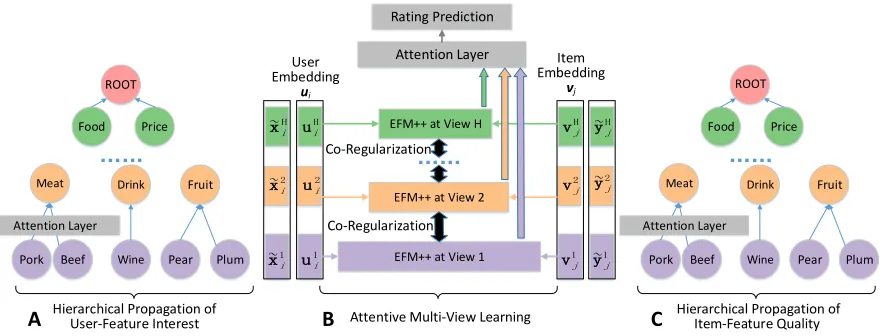
Figure 2: Architecture of our proposed DEAML model for rating prediction.
correlated with the ratings are kept and regarded as the ex-plicit features. We then recursively search the exex-plicit fea-tures in the concept graph and utilize the “IsA” relationships to buildΥ. On average, the depth ofΥis 5.
Next, we define the hierarchical level of each feature.
Definition 2. Thehierarchical levelhlofFlis recursively defined based on its children:hl= maxFc∈children(FL)hc+
1. IfFlis a leaf, its hierarchical level is set to 1. LetHdenote the largest hierarchical level of internal nodes inΥ.
Besides Υ, two other types of input are the user set U and the item setV. Each user in U is represented as a tu-ple (i,xi), wherei is the user id andxi ∈ RL is the
ob-served user-feature interest vector. Here thel-th element in
ximeasures how much usericares about featureFl. Sim-ilarly, each item inV is represented as(j,yj)and the ob-served item-feature quality vectoryj ∈ RL measures how
welljperforms on these features. We adopt the method pro-posed by (Zhang et al. 2014a) to calculatexi andyj. The basic idea is to computexiandyj based on the mentioned times and the sentiments of the features in the reviews.
Output:Given a useriand an itemj, the output of our model includes the predicted ratingr˜ij and a personalized feature-level explanationE, whereE ={Fl1, ..., FlT}is a subset ofF. Similar to (Zhang et al. 2014a), the final expla-nations presented to users are in the template as follows.
You might be interested in [features inE], on which this item performs well.
Approach Overview
Given an explicit feature hierarchyΥ, we build a Deep Ex-plicit Attentive Multi-View Learning Model (DEAML) that is able to 1) accurately predict ratings and 2) produce useful explanations. Our method consists of two steps.
Step 1: Prediction with Attentive Multi-View Learn-ing.In this step, we build the DEAML model by minimiz-ing the ratminimiz-ing prediction error. The architecture of the model is shown in Figure 2. For each useri, we first build a user-feature interest hierarchy (Figure 2A) by using Υandxi.
While xi measures user interest to some extent, it is in-accurate due to data sparsity, noises in the data, and also overlapping semantics of the features. To improve accuracy, we propose ahierarchical propagationmethod that prop-agates user interest along the hierarchy based on user at-tention. Similarly, for each itemj, we build an item-feature quality hierarchy (Figure 2C) by propagatingyjalong edges ofΥ. To effectively predict ratings by using the two hierar-chies, we propose anattentive multi-view learning frame-work. As shown in Figure 2B, features at different hierarchi-cal levels are regarded as different views. Predictions from multiple views are co-regularized to enforce the agreement among them. Considering a user’s interest is not equally dis-tributed over different hierarchical levels, we calculate the final prediction by attentively integrating results from multi-ple views. Hierarchical propagation and attentive multi-view learning are jointly optimized, which allows us to simultane-ously infer user profiles and predict ratings in an end-to-end manner.
Step 2: Personalized explanation generation. In this step, we generate the explanations by using the DEAML model. To this end, we first define a utility function for candidate features, which jointly considers user-feature in-terest, item-feature quality and attention scores of different views. Then we formulate explanation generation as a con-strained tree node selection problem and propose a dynamic programming algorithm to solve it efficiently.
Prediction with Attentive Multi-View Learning
In this section, we introduce how to predict the rating givenxi and yj. We first describe the hierarchical propagation method used to build an accurate user-feature interest hi-erarchy. Then we propose the attentive multi-view learning framework that leverages complementary information in the feature hierarchy to improve rating prediction accuracy.
Hierarchical Propagation
e1 ec el
Attention Layer
ui
1
~i
x x~ic xil
User Embedding
Feature Embedding
il
x~
Children Parent
Figure 3: Hierarchical propagation of user interest.
feature Fl inΥ, we can assume that user i’s interest inFl is equal toxil, which is thelth element inxi. Sincexil is calculated by counting the number of timesFl appears in the reviews written by useri, this method captures user in-terest to some extent. However, due to data sparsity, noises in the data, and overlapping semantics of features inΥ, the constructed user-feature interest hierarchy can be inaccurate. For instance, a user interested in meatmay comment fre-quently onbeefandporkbut rarely mentions the wordmeat. To solve this issue, we infer users’ true interest x˜i by propagating xi along Υ. For each parent Fl, we calculate
˜
xilby considering personalized user attention (Figure 3):
˜
xil=αllxil+P
Fc∈children(Fl)αlcxic,˜
αlc = exp(α
∗
lc)
P
Fc0 ∈children(Fl)∪{Fl}exp(α∗lc0)
, (1)
α∗lc=h>1ReLU(Wlel+Wcec+Wuui+b1) +b2,
whereαlc is the attention score of featureFc.el,ec ∈Rd1
are pre-trained embeddings of Fl and Fc. We follow the method proposed in (Choi et al. 2017) to train feature em-beddings that capture both semantic and hierarchical infor-mation. As there areH levels of features exceptFL inΥ, the user embedding at levelhis uh
i ∈ Rk and the global user embeddingui ∈RkH is the concatenation ofuhi at all levels (shown in Figure 2). The hidden layer size of the at-tention network isd2.Wl∈Rd2×d1,W
c ∈Rd2×d1,W
u ∈
Rd2×kH,h
1 ∈ Rd2,b
1 ∈ Rd2, b
2 ∈ Randui ∈ RkH are
model parameters to be learned.
Propagation ofyj is similar to that ofxi. After that we obtain a more accurate item-feature quality vectory˜j.
Attentive Multi-View Learning
After we obtain accurate estimates of user-feature interest and item-feature quality, we predicate how much userilikes itemj based onx˜i andy˜j. To accurately predict the rat-ing, we design an attentive multi-view learning framework. In this section, we first introduce how to predict the ratings based on the information in a single view. Then, we describe the co-regularization loss that enforces agreement among different views. Finally, we illustrate how to combine dif-ferent views in a unified model and learn parameters from different views jointly.
Loss in each view. In our framework, each view consists of features at the same hierarchical level. We first consider rating prediction in a single view. Suppose there are Lh features at levelh. By only considering users’ interest on
these features, we obtain a local user-feature interest vector
˜ xh
i ∈RLh, which is a slice ofx˜i. Similarly, we can obtain
˜ yh
j ∈RLh, which is a slice ofy˜j.
At level h, we employ an extended version of EFM (Zhang et al. 2014a) to predict the rating based on
˜ xh
i andy˜hj. Compared with collaborative filtering, EFM en-riches the user and item representations by adding an addi-tional set of latent factors learned from the explicit features. Specifically, the user embedding for viewhconsists of two parts:uh
i =phi⊕chi ∈Rk. Herephi ∈Rk1are latent factors learned from explicit features (explicit factors),ch
i ∈ Rk2 are implicit factors, and ⊕ is the concatenation operator. Similarly, the item embedding at levelhisvh
j =qhj ⊕dhj, whereqh
j ∈Rk1 denote the explicit factors anddhj ∈ Rk2 are the implicit factors. The explicit factorsph
i andqhj are used to fit x˜h
i with Zhphi and fit y˜jh with Zhqjh, where
Zh∈RLh×k1 is the projection matrix of features at levelh.
Traditional EFM directly predicts the rating of userion item j as uh
i >
vh
j. We further extend it by incorporating global average rating biasµ, user biasoiand item biasoj:
˜
rijh =u h i
>
vjh+oi+oj+µ. (2) LetΩdenote the set of training instances andrijdenote the ground-truth rating of userion itemj, the loss in viewhis:
Lh=λaPi,j∈Ω(˜r
h ij−rij)
2 +
λxP
ikx˜ h i −Z
hph ik
2+λyP
jky˜ h j −Z
hqh jk
2, (3)
whereλa,λx andλy are weights of corresponding items.
Co-regularization loss. We then consider how the mod-els in multiple views can complement each other. Based on the consensus principle which aims to maximize the agree-ment on multiple views (Xu, Tao, and Xu 2013), a common paradigm of multi-viewing learning is co-regularization. Ac-tually, information distributed in different views describes the inherent characteristics of user-feature interest and item-feature quality from various aspects. We can regularize the learning of multiple views by enforcing agreement among their predictions. This way, complementary information can be leveraged to benefit the learning of each single view. By enforcing the agreement between two adjacent views, the co-regularization loss is:
Lv=
X
i,j∈Ω
H−1 X
h=1
(˜rijh −r˜ h+1
ij )
2. (4)
the attention mechanism to combine multiple views. LetIh denote theH-dimensional one-hot vector for viewh. The attention network for view combination is:
w∗
h=h>2ReLU(W1ui+W2vj+W3Ih+b3) +b4, wh=
exp(w∗h)
PH
h0=1exp(w
∗
h0)
. (5)
where ui,vj ∈ RkH are the global user embedding and
item embedding used in hierarchical propagation. W1 ∈
Rd3×kH,W2 ∈ Rd3×kH,W3 ∈ Rd3×H,h2 ∈ Rd3,b3 ∈
Rd3, b
4 ∈ R are model parameters and d3 is the hidden
layer size of this attention network. The final prediction is a weighted sum of predictions in each view, wherewhis the weight of viewh:
˜
rij=
H
X
h=1
whr˜hij. (6)
Let kΘk2 denote the L2 norm of all parameters in our
model. We optimize the following objective function:
L= X
i,j∈Ω
(˜rij−rij)2+ H
X
h=1
Lh+λvLv+λrkΘk2, (7)
whereλv, λrare weights of corresponding items. We use the Adam optimizer (Kingma and Ba 2014) because it can auto-matically adjust the learning rate during the training phase.
Personalized Explanation Generation
The goal of personalized explanation generation is to select T features from Υ that are most useful in helping user i decide whether s/he will try itemj. Selecting features dis-tributed in multiple hierarchical levels is challenging be-cause 1) users’ interest is not evenly distributed over differ-ent hierarchical levels and 2) we need to avoid selecting fea-tures with overlapping semantics. In this section, we first in-troduce our utility function, which estimates the usefulness of each feature. Then, we formulate the feature selection as a constrained tree node selection problem and propose a dy-namic programming method to solve it efficiently.Utility function.Given useriand itemj, three factors are considered when judging whether a featureFlis useful:
• Whether useriis interested inFl. • How well itemjperforms onFl.
• The weight of the view thatFlbelongs to. In viewh, the explicit factorsph
i andqjhare used to fit the user-interest vectorx˜h
i withZhphi and fit y˜hj withZhqhj. LetFl be the ˆl-th feature at level h. We define the utility score ofFlin the recommendation instance(i, j)as:
Ψ(Fl) = Zhphiˆl Zhqjh
ˆ
lwh, (8) wherewhis the user-item-specific attention weight for view h, which is calculated by using Equation (5). The utility score for the root feature is set to0since it does not have a concrete meaning. This utility function jointly incorporates three factors mentioned above.
Constrained tree node selection.Next, we selectTfeatures to be included in the explanation. The goal is to maximize
the total utility score of the selected features. We further re-quire that features (e.g.beef) cannot be selected simultane-ously with their ancestors inΥ(e.g.meat) since they are se-mantically overlapping. Mathematically, we formulate per-sonalized explanation generation as a constrained tree node selection problem:
argmax
φ1,...,φL
PL
l=1(φlΨ(Fl)),
s.t. PL
l=1φl=T, φl∈ {0,1}, (9)
φl1φl2Anc(l1, l2) = 0,∀hl1< hl2,
whereφl = 1(φl = 0) means featureFl is (not) selected andAnc(l1, l2)returns1ifFl2 is an ancestor ofFl1.
We solve the above problem by using dynamic program-ming. LetG(l, t)denote the maximum utility we can obtain by selectingtnodes in the subtree rooted atFl. Let us use IDls to represent the id of thes-th child feature ofFl, em-ployJ(l, s, t)to denote the maximum utility we can obtain by selectingtnodes from the firstschildren ofFl, and use Sto denote the total number of children ofFl. We have the following transition equations:
G(l, t) =
max (Ψ(Fl), J(l, S, t)) t= 1
J(l, S, t) t >1 (10)
J(l, s, t) = max
06t06t(J(l, s−1, t
0) +G(IDls, t−t0)).
Here, we need to carefully consider whethert= 1because if we select more than one node (i.e.,t >1) from the sub-tree rooted at Fl,Flitself can not be selected. Otherwise, the constraint will be violated. Supposing that the root ofΥ
isFL, we can obtain the final solution with the maximum utility G(L,T) by using Equation (10) iteratively.
Time complexity.If the maximum number of children of a feature isM, the time complexity of our dynamic program-ming algorithm is O(LM T2). It is more efficient than the brute force algorithm whose time complexity is O(LT).
Experiments
We conduct two experiments and a user study to evaluate the effectiveness of our method. First, we demonstrate that our method performs better than the state-of-the-art methods in terms of accuracy. Then, we conduct parameter sensitivity analysis to validate the robustness of our model. Finally, we evaluate the explainability of DEAML with 20 human sub-jects in a user study.
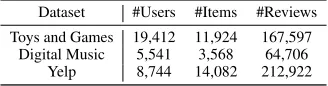
Table 1: Statistics of three public datasets. Dataset #Users #Items #Reviews
Toys and Games 19,412 11,924 167,597 Digital Music 5,541 3,568 64,706
Yelp 8,744 14,082 212,922
Experimental Settings
Datasets.We use three datasets from different domains for evaluation. Table 1 summarizes the statistics of the datasets. • Toys and Gamesis the part of the Amazon dataset2 that
2
Table 2: RMSE comparison with baselines on three datasets. Best results are highlighted in bold.
.
G1 G2 G3 Ours
NMF PMF SVD++ CKE HFT EFM DeepCoNN NARRE DEAML-V DEAML
Toys and Games 1.1489 1.1832 0.9071 0.9923 0.9958 0.9534 0.9199 0.9084 0.9062 0.9040 Digital Music 1.1520 1.2619 0.9211 0.9849 1.0910 0.9696 0.9212 0.9209 0.9190 0.9118
Yelp 1.2678 1.2413 1.1561 1.2279 1.2738 1.2019 1.1503 1.1348 1.1343 1.1333
focuses on Toys and Games. We choose the 5-core version where all users and items have at least 5 reviews. • Digital Musicis also from the Amazon 5-core dataset. It
focuses on the domain of digital music.
• Yelpconsists of restaurant reviews from Yelp Challenge 20183. Since the raw data is very large and sparse, we
follow (Zhang et al. 2014a) to preprocess the data. Specif-ically, we select restaurants located in the Phoenix city and ensure that all users and items have at least 10 ratings.
Baselines.We select eight competitive methods for compar-ison. These methods can be divided into three groups ac-cording to the type of data they use.
• The first group (G1) only relies on the observed rating matrix for rating prediction. This group consists of three methods:NMF(Lee and Seung 2001),PMF(Mnih and Salakhutdinov 2008) andSVD++(Koren 2008).
• The second group (G2) contains a knowledge-based method,CKE (Zhang et al. 2016). Here, we regard the feature hierarchyΥas the structural knowledge in CKE. • The third group (G3) consists of four methods that
leverage the textual reviews for rating prediction:
HFT(McAuley and Leskovec 2013),EFM(Zhang et al. 2014a),DeepCoNN(Zheng, Noroozi, and Yu 2017) and
NARRE (Chen et al. 2018). Among them, DeepCoNN
and NARRE are deep learning-based. EFM is the state-of-the-art method for mining feature-level explanations from a single layer of features (no hierarchical structure).
Evaluation metric.We adopt the widely-used Root Mean Square Error (RMSE) to evaluate the accuracy of all algo-rithms on rating prediction. A lower RMSE indicates a better performance. This is calculated as:
RM SE=
s 1
N
X
i,j
(˜rij−rij)2,
(11)
whereN is the total number of testing instances.
Details.We randomly split the dataset into training (70%), validation (15%) and test (15%) sets. We tune the hyper-parameters of each algorithm on the validation set and eval-uate their performance on the test set. The number of latent factorskfor algorithms is searched in [8,16,32,64,128]. Af-ter parameAf-ter tuning, we setk= 8for NMF, PMF and HFT, andk = 16for SVD++. We set k = 32 for EFM, CKE, DeepCoNN, NARRE and DEAML. We reuse most hyper-parameters of DeepCoNN and NARRE reported by their au-thors. For simplicity, the number of explicit and implicit fac-tors are set equally in EFM and DEAML. When constructing
Υin DEAML, we select the top-2000 frequently mentioned concepts in reviews, sort them by their correlations with the
3
https://www.yelp.com/dataset/challenge
ratings and keep only top-500 of them. We setd1,d2,d3,λv,
andλato 20, 10, 10, 10.0, and 3.0, respectively.
Study on Model Accuracy
Overall performance. The accuracy of our approach and the baselines on three datasets are shown in Table 2. After analyzing the results, we made the following conclusions.
First, methods that incorporate review information (G3) generally perform better than others. Compared with those only relying on a rating matrix (G1) and the method that incorporates the feature hierarchy (G2), methods in G3 re-spectively achieve 8.9% and 3.0% improvement in accuracy on average. We ascribe this to the fact that reviews provide more information about users’ interest and items’ quality.
Second, deep recommendation models (DeepCoNN, NARRE and ours) perform significantly better than those with shallow models (10.7% improvement in accuracy on average). This is because deep models can model high-level features more effectively and better capture non-linear inter-actions. This again demonstrates the necessity of developing a deep version of the explainable models.
Third, our DEAML model achieves the best performance on all three datasets. Our approach performs significantly better than EFM, achieving 5.7%, 5.2% and 6.0% improve-ments on three datasets. This demonstrates the effective-ness of our attentive multi-view learning framework. While EFM predicts ratings from a single view, our design of at-tentive multi-view learning allows different views to com-plement and benefit each other. Compared with CKE that simply learns item embeddings from knowledge bases, our approach fully leverages the feature hierarchy and improves accuracy by 8.0%. The infusion of explicit feature hierarchy provides our approach with additional knowledge that Deep-CoNN and NARRE cannot leverage. Given a set of explicit features, DEAML can differentiate low-level features from high-level ones and learn the associations between the fea-tures, while DeepCoNN and NARRE treat all features as if they are at the same level. On average, our method is 1.0% more accurate than DeepCoNN and NARRE.
Effectiveness of the attention mechanism. In DEAML,
8 16 32 64 128 Number of latent factors
0.91 0.92 0.93 0.94 0.95
RMSE
DEAML SVD++ DeepCoNN NARRE
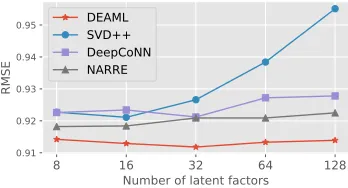
Figure 4: RMSE on Digital Music with different numbers of latent factors (compared with three competitive baselines).
0 10 20 30 40 50
v
0.911 0.913 0.915
RMSE
0 1 2 3 4 5
a
0.911 0.915 0.919
RMSE
Figure 5: RMSE on Digital Music with different weightsλv of co-regularization (left) and weightsλa of errors in each view (right).
Parameter Sensitivity Analysis
In this section, we study the sensitivity of several important parameters in our approach. We only report results on Digi-tal Music here due to the space limitation. Results on other datasets are similar.
Effect of number of latent factors.We first compare our approach with three competitive baselines (SVD++, Deep-CoNN and NARRE) at different numbers of latent factors. The results are shown in Figure 4. We can see that DEAML consistently achieves the best performance with varying numbers of latent factors. This demonstrates the robustness of our approach. We further observe that increasing the num-ber of latent factors does not necessarily improve accuracy, because too many latent factors may lead to over fitting.
Effectiveness of co-regularization. We then study how RMSE changes with λv, which is the weight of the co-regularization loss term. The left part of Figure 5 shows that our approach achieves the best performance when λv is 10.0. Smaller or larger λv will hurt performance. This demonstrates the importance of involving agreement (co-regularization) among different views.
Effectiveness of enforcing accurate prediction in each view.The right part of Figure 5 shows how RMSE changes with increasingλa, which is the weight of rating prediction errors in each single view. The lowest RMSE is achieved when λa = 3.0. Whenλa is 0, the performance degrades since we fail to train a good predictor in each single view.
Study on Explainability
In this section, we evaluate the usefulness of our explana-tions in helping real-world users make better decisions.With the help of a data annotation company, we recruit 20 partic-ipants who have written at least 15 Yelp reviews. The par-ticipants are independent and do not know each other. All reviews on the restaurants they mentioned are crawled and merged with other reviews in the Yelp dataset. Two baselines are used for comparison. The first baseline is PAV, which is the famous “People Also Viewed” explanation. The sec-ond baseline is EFM, which is the state-of-the-art method for generating feature-level explanations. We apply our method and baselines on the merged dataset and randomly sample 100 restaurants for testing. We ensure that none of the partic-ipants go to these restaurants. For each restaurant, we gener-ate three explanations for each participant using PAV, EFM, and DEAML. The template of EFM is same as DEAML and PAV has it own format:“People also viewed this item”.T is set to 3 for both EFM and DEAML. The participants are re-quired to give annotations from 1 to 5 on each explanation according to its usefulness in helping them decide whether they will go to the restaurants. We randomly shuffle the order of explanations so that they do not know which explanation comes from which method4.
Table 3: Average score on explanation usefulness.<30 and
≥30 refer to two age groups.
.
Male Female <30 ≥30 Overall
PAV 1.35 1.51 1.65 1.11 1.41
EFM 3.18 3.13 3.03 3.32 3.16
DEAML 3.69 3.52 3.58 3.68 3.63
Table 3 shows the average score on the usefulness of explanations generated by the three methods. We observe that PAV performs the worst since it only suggests that one restaurant is popular and is not personalized. Our DEAML outperforms EFM in explanation usefulness (14.9% im-provement). This suggests that DEAML can accurately iden-tify a user’s interest and a restaurant’s quality on multi-level features while EFM suffers from the sparse and noisy data. Additionally, EFM often selects features that are semanti-cally overlapped (e.g.,foodandcheese) since it ignores the hierarchical structure of features while DEAML considers such constraints to make the generated explanation more in-formative. We also study the annotations given by partici-pants of different profiles such as gender and age (see Table 3). DEAML consistently performs the best for both male and female participants. It is the same for participants in the two age groups. This suggests that DEAML is robust to various user profiles and is personalized enough to generate useful explanations that help each user make better decisions.
Conclusions
In this paper, we propose a Deep Explicit Attentive Multi-View Learning Model (DEAML) for explainable
rec-4
ommendation, which combines the advantages of deep learning-based methods and existing explainable methods. The proposed attentive multi-view learning frameworks en-ables the model to accurately predict ratings and infer multi-level user profiles. To support personalized explanation gen-eration from multi-level features, we formulate the problem as constrained tree node selection and solve it efficiently by using dynamic programming. Experimental results show that our model performs better than state-of-the-art methods in both accuracy and explainability.
Acknowledgments
This work is supported by the National Natural Science Foundation of China (Grant No. 61772045).
References
Chen, J.; Zhang, H.; He, X.; Nie, L.; Liu, W.; and Chua, T.-S. 2017. Attentive collaborative filtering: Multimedia recommendation with item-and component-level attention. InSIGIR, 335–344. ACM.
Chen, C.; Zhang, M.; Liu, Y.; and Ma, S. 2018. Neural attentional rating regression with review-level explanations. InWWW, 1583–1592. International World Wide Web Con-ferences Steering Committee.
Choi, E.; Bahadori, M. T.; Song, L.; Stewart, W. F.; and Sun, J. 2017. Gram: graph-based attention model for healthcare representation learning. InSIGKDD, 787–795. ACM. Das, A. S.; Datar, M.; Garg, A.; and Rajaram, S. 2007. Google news personalization: scalable online collaborative filtering. InWWW, 271–280. ACM.
De Francisci Morales, G.; Gionis, A.; and Lucchese, C. 2012. From chatter to headlines: harnessing the real-time web for personalized news recommendation. In WSDM, 153–162. ACM.
Diao, Q.; Qiu, M.; Wu, C.-Y.; Smola, A. J.; Jiang, J.; and Wang, C. 2014. Jointly modeling aspects, ratings and senti-ments for movie recommendation. InSIGKDD, 193–202. He, X.; Chen, T.; Kan, M.-Y.; and Chen, X. 2015. Trirank: Review-aware explainable recommendation by modeling as-pects. InCIKM, 1661–1670. ACM.
He, X.; Liao, L.; Zhang, H.; Nie, L.; Hu, X.; and Chua, T.-S. 2017. Neural collaborative filtering. In WWW, 173– 182. International World Wide Web Conferences Steering Committee.
Kanagal, B.; Ahmed, A.; Pandey, S.; Josifovski, V.; Yuan, J.; and Garcia-Pueyo, L. 2012. Supercharging recommender systems using taxonomies for learning user purchase behav-ior.Proceedings of the VLDB Endowment5(10):956–967. Kingma, D. P., and Ba, J. 2014. Adam: A method for stochastic optimization.arXiv preprint arXiv:1412.6980. Kompan, M., and Bielikov´a, M. 2010. Content-based news recommendation. InInternational conference on electronic commerce and web technologies, 61–72. Springer.
Koren, Y. 2008. Factorization meets the neighborhood: a multifaceted collaborative filtering model. InSIGKDD, 426–434. ACM.
Lee, D. D., and Seung, H. S. 2001. Algorithms for non-negative matrix factorization. InNIPS, 556–562.
McAuley, J., and Leskovec, J. 2013. Hidden factors and hidden topics: understanding rating dimensions with review text. InRecSys, 165–172. ACM.
Mnih, A., and Salakhutdinov, R. R. 2008. Probabilistic ma-trix factorization. InNIPS, 1257–1264.
Peake, G., and Wang, J. 2018. Explanation mining: Post hoc interpretability of latent factor models for recommendation systems. InSIGKDD, 2060–2069. ACM.
Ren, Z.; Liang, S.; Li, P.; Wang, S.; and de Rijke, M. 2017. Social collaborative viewpoint regression with explainable recommendations. InWSDM, 485–494. ACM.
Wang, Z.; Wang, H.; Wen, J.-R.; and Xiao, Y. 2015. An in-ference approach to basic level of categorization. InCIKM, 653–662. ACM.
Wang, X.; Yu, L.; Ren, K.; Tao, G.; Zhang, W.; Yu, Y.; and Wang, J. 2017. Dynamic attention deep model for article recommendation by learning human editors’ demonstration. InSIGKDD, 2051–2059. ACM.
Wang, X.; He, X.; Feng, F.; Nie, L.; and Chua, T.-S. 2018a. Tem: Tree-enhanced embedding model for explainable rec-ommendation. InWWW, 1543–1552. International World Wide Web Conferences Steering Committee.
Wang, X.; Chen, Y.; Yang, J.; Wu, L.; Wu, Z.; and Xie, X. 2018b. A reinforcement learning framework for explainable recommendation. InICDM. IEEE.
Wang, H.; Wang, N.; and Yeung, D.-Y. 2015. Collaborative deep learning for recommender systems. InSIGKDD, 1235– 1244. ACM.
Wu, Y., and Ester, M. 2015. Flame: A probabilistic model combining aspect based opinion mining and collaborative filtering. InWSDM, 199–208.
Wu, W.; Li, H.; Wang, H.; and Zhu, K. Q. 2012. Probase: A probabilistic taxonomy for text understanding. InSIGMOD, 481–492. ACM.
Xu, C.; Tao, D.; and Xu, C. 2013. A survey on multi-view learning.arXiv preprint arXiv:1304.5634.
Zhang, Y.; Lai, G.; Zhang, M.; Zhang, Y.; Liu, Y.; and Ma, S. 2014a. Explicit factor models for explainable recommen-dation based on phrase-level sentiment analysis. InSIGIR, 83–92. ACM.
Zhang, Y.; Ahmed, A.; Josifovski, V.; and Smola, A. 2014b. Taxonomy discovery for personalized recommendation. In WSDM, 243–252. ACM.
Zhang, F.; Yuan, N. J.; Lian, D.; Xie, X.; and Ma, W.-Y. 2016. Collaborative knowledge base embedding for recom-mender systems. InSIGKDD, 353–362. ACM.