Sustainability assessment
Applying sustainability assessment models
Jenny Pope, Angus Morrison-Saunders and David Annandale
Three sustainability assessment models are ap-plied to a major Australian resource proposal — the Gorgon gas development. ‘Environmental impact assessment (EIA)-driven integrated as-sessment’ resulted in significant environmental resources being ‘traded’ for socio-economic benefits. ‘Objectives-led integrated assessment’ seeks to maximise social, economic and envi-ronmental objectives set by decision-makers. The Gorgon assessment focused on meeting the pro-ponent’s strategic objectives, thus missing an opportunity to maximise benefits for the wider community. ‘Assessment for sustainability’ uses sustainability criteria determined by society. The Western Australian Government has recently begun to derive such criteria and the Gorgon proposal would have failed to meet some of them. The actual Gorgon assessment was conducted within a sustainability framework, but the EIA-based approach used did not result in sustainable outcomes. An ‘assessment for sustainability’ ap-proach offers the most promising avenue for future applications.
Keywords: sustainability assessment models, impact assessment, Australia
Jenny Pope is in the Institute for Sustainability and Technology Policy, Angus Morrison-Saunders (corresponding author) and David Annandale are in the School of Environmental Science all at Murdoch University, South Street, Murdoch, WA 6150, Aus-tralia; Tel: +618 9360 6125; Fax: +618 9360 6787; E-mail: [email protected].
HERE IS INCREASING interest in how sus-tainability assessment might be undertaken in practice, and a number of models for possible processes have been mooted (for instance, Devuyst, 1999; George, 1999; 2001; Sadler, 1999; Gibson, 2001; 2004; Jenkins et al, 2003). We do not intend to review this work here, nor explore the origins and permutations of the sustainability concept. The pur-pose of this paper is to apply existing conceptual models for sustainability assessment to a case study in order to understand how impact assessment for sustainability might be conducted in practice.
Recently we reviewed the literature concerning sustainability assessment and identified three con-ceptual models for how it might be undertaken (Pope et al, 2004). Two of the models were derived from environmental impact assessment (EIA) and strategic environmental assessment (SEA) ap-proaches respectively, whilst the third, ‘assessment for sustainability’, provides a novel, as yet untested, approach. Each can be differentiated in terms of the principal initiating or guiding stakeholders in the impact assessment process, the treatment of im-pacts, and the relationship to a sustainable state or target.
To further illustrate the distinction between these three approaches to sustainability assessment, each conceptual model is discussed in the context of the assessment of the Gorgon gas development in West-ern Australia. We first outline the development pro-posal, and then describe the possible application of each sustainability assessment model to the Gorgon casestudy.Indoingso,wedonotattempttodevelop or discuss in detail the process steps that may be ap-propriate within each conceptual model; indeed we recognise that many process steps and tools will be common to more than one model and that therefore
they are not mutually exclusive in a process sense. Instead, we indicate how the basic premise of each model might have guided the Gorgon assessment, to illustrate the distinguishing features of each model.
Gorgon gas development
The Greater Gorgon gas fields, located off the North West coast of Australia, constitute the single largest natural gas resource discovered to date in Australia and its territorial waters (Allen Consulting Group, 2003). During 2002 and 2003, the Government of Western Australia undertook an integrated, strategic-level assessment of the proposed Aus$6 billion dol-lar development of the fields, by ChevronTexaco and its joint venture partners. The assessment con-sidered social, economic and environmental issues, and the strategic implications of the proposal for Western Australia. The assessment process, which has been reviewed by Pope (2003), was put forward as a triple bottom-line (TBL) integrated assessment. Salient points are described in subsequent sections of this paper.
In seeking to develop the gas fields, the Gorgon Joint Venture identified Barrow Island as the only commercially viable location for the initial stage of the development involving construction of a gas-processing facility. Barrow Island has been a Class A Nature Reserve since 1910, although it has sup-ported a small operating oilfield since 1967. The is-land has unique and internationally significant conservation values, including being home to a number of wildlife species that are endemic to the island, and others that are now extinct on the Austra-lian mainland (ChevronTexaco Australia, 2003). Furthermore, the election platform of the incumbent Labor Government of Western Australia stated that it would “prohibit mineral and petroleum explora-tion and mining in Naexplora-tional Parks and nature reserves” (Australian Labor Party WA Branch, 2001).
Unwilling in this context to invest resources to carry out the front-end engineering design necessary to submit a formal proposal for EIA under the West-ern Australian Environmental Protection Act 1986, the proponent approached the Western Australian Government in 2001 seeking approval in principle for access to Barrow Island. Such approval would allow the proponent to continue its marketing efforts with more certainty and justify the commencement of front-end engineering design for the development. It was agreed that if in-principle approval were granted, a more detailed project proposal would be subject to EIA at the state and federal levels.
The Western Australian Cabinet responded to this request by determining that access to Barrow Island would not be rejected as a matter of policy, but that the proposed development plan would be subject to a strategic level assessment to determine (Pope, 2003):
• Why Barrow Island? In other words, was the Government satisfied with the veracity of the pro-ponent’s analysis of alternative locations, which demonstrated that Barrow Island represented the only commercially viable option for the initial stagesofthedevelopmentoftheGorgongasfield?
• If it was determined that granting access to Barrow Island was indeed the only way that the Gorgon gas field could be developed in the foreseeable future, the additional questions to be answered were:
- What are the potential impacts of the proposed development on the conservation values of Bar-row Island, and what is the likelihood of these impacts occurring?
- What are the potential strategic, economic and social benefits of the proposed development to the people of Western Australia?
- Is the Government convinced that the environ-mental risks are sufficiently low, and the stra-tegic, economic and social benefits sufficiently high, to justify allowing the proponent access to Barrow Island? and
- Can the proponent demonstrate net conser-vation benefits (NCBs) associated with the development plan?
Since the proponent was not in a position at that time to commit to a particular process or develop-ment plan, the assessdevelop-ment was conducted on an illustrative reference case for the initial development of the resource based on a gas processing facility ini-tially producing liquefied natural gas for the inter-national market, but with the potential to supply gas into the Western Australian domestic market, or to a gas-to-liquids (GTL) plant, in the future. In the absence of a detailed project proposal, the process was considered to be a strategic assessment of a pro-posed development plan rather than a project-level impact assessment.
Gorgon assessment process
The Gorgon assessment was undertaken at a time when sustainability was high on the State Govern-ment’s agenda. The Western Australian State Sus-tainability Strategy was in preparation, and included commitments to introduce sustainability assessment processes (Government of Western Australia, 2002; 2003a). Furthermore, a review of project approval processes in Western Australia had highlighted the need for an integrated assessment process for pro-jects of State significance, including consideration of the sustainability issues associated with the proposal (Independent Review Committee, 2002).
Australian Government in relation to the Gorgon gas development. Consequently a unique process was developed for the Gorgon case.
The Gorgon assessment process was managed through a whole-of-government approach with a high degree of interaction between relevant agencies at both Chief Executive Officer (CEO), and officer level. Guidelines were prepared defining the scope of the social, economic, environmental and strategic review that the proponent was required to undertake.
Theproponentsubsequentlyprovidedthemajority of the dataon which the assessment would be con-ducted in a TBL reviewdocument (ChevronTexaco Australia, 2003) that was made publicly available. Followingpublicreview,theproponentwasrequired torespondtoissuesraisedinthepublicsubmissions. Three individual assessment documents were then prepared for consideration by Cabinet:
• an environmental review undertaken by the Western Australian Environmental Protection Authority (EPA, 2003);
• advice on biodiversity conservation values by the Conservation Commission of Western Australia (2003), which is the vesting authority for Barrow Island; and
• advice on social, economic and strategic consid-erations by consultants to the Department of Industry and Resources (DoIR) (Allen Consulting Group, 2003).
Each of these reports, along with a separate sum-mary/overview document (Government of Western Australia, 2003b) was made available for public comment. After the public submissions were received, advice for Cabinet was prepared by the CEOs of the relevant government agencies to facili-tate Cabinet’s decision.
On the basis of the advice received as a result of the assessment process, Cabinet decided on 8 Sep-tember 2003 to grant the Gorgon Joint Venture ac-cess to Barrow Island for the purposes of gas processing. The proponent’s EIA documentation un-der Part IV of the Environmental Protection Act
1986, detailing the environmental impacts and miti-gation strategies for the project, is currently under public review.
In the following sections, we summarise three models for sustainability assessment that we out-lined in Pope et al (2004), and apply them to the Gorgon case study.
EIA-driven integrated assessment
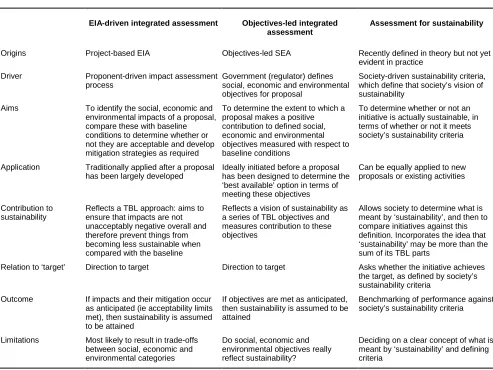
EIA-driven integrated assessment is an approach to sustainability assessment that has its origins in the 30-odd years of international experience with tradi-tional, project-based EIA. Like EIA, this approach is proponent-driven and reactive, being initiated in re-sponse to a proponent’s planning and announcement of a new proposal (see Table 1). In addition to envi-ronmental impacts, it aims to identify the social and economic impacts of a proposal and propose appro-priate mitigation measures for potential negative impacts. During decision-making, the overall likely impacts are compared with baseline conditions to determine whether or not the proposal is ‘accept-able’. In bringing together the TBL impacts, there is potential for trade-offs among social, economic and environmental factors (Pope et al, 2004).
In terms of contribution to sustainability, EIA-driven integrated assessment seeks to ensure that impacts are not unacceptably negative overall. The guiding acceptability criterion for a proposal is that it does not lead to a less sustainable outcome than the current status without the proposal. Previously we defined this approach as having a “direction to target”, where the exact position of a sustainable state for that particular proposal is unknown (Pope et al, 2004). In terms of outcomes, it is assumed that, if impacts occur as predicted and mitigation measures are implemented as planned, then acceptability limits will be met, and sustainability (or at least, an acceptably sustainable position) will have been at-tained for that proposal.
Gorgon as an EIA-driven integrated assessment
The Gorgon case study provides a clear, real-life ex-ample of an EIA-driven integrated assessment ap-proach. The assessment process was borrowed deliberately from the established project-based EIA process in Western Australia (described previously in Morrison-Saunders and Bailey (2000)). It focused on identifying and evaluating the social, economic and environmental impacts of the proposal and at-tempting to determine whether or not these impacts were acceptable. It was also conducted reactively, after many key decisions relating to the development had already been made. The EIA-driven approach highlighted some of the issues and inherent difficul-ties associated with this form of assessment, espe-cially in relation to integration and trade-offs.
The assessment was divided into two main parts: the environmental assessment conducted by the EPA (plus the separate report by the Conservation Com-mission of Western Australia), and the strategic
Three individual assessment
documents were prepared for
consideration by Cabinet: an
environmental review; advice on
biodiversity conservation values; and
advice on social, economic and
economic and social assessment conducted by con-sultants on behalf of the DoIR. This approach was at least partly a function of the institutional arrange-ments in Western Australia, in that the EPA is restricted to providing advice on environmental matters and is not permitted to consider social or economic issues (Bache et al, 1996).
It is important to realise that in this case, the term ‘strategic’ was used by DoIR to mean strategic to the future of Western Australia; consequently the strat-egic review was effectively a component of the economic assessment. In addition, the social issues associated with the Gorgon proposal were consid-ered to be peripheral to the assessment. This was partly because of the location of the development on an uninhabited island with no permanent local community, and also partly because of the lack of experience in social impact assessment within West-ern Australian govWest-ernment agencies. Therefore, al-though it was presented as a TBL approach, the assessment only effectively evaluated environmental and economic impacts.
Thetwoassessmentsessentiallyreflectedthetwo distinct‘camps’thatformed,bothinthecommunity and amongst the government agencies. The ‘green camp’ was fundamentally opposed to an industrial development ona ClassANatureReserve;boththe
EPA (2003) and the Conservation Commission of Western Australia (2003) recommended that the Government should not approve the location, con-struction andoperation ofa gasprocessingplant on Barrow Island. On the other hand, the ‘pro-development camp’ felt that the strategic and eco-nomic benefitsto WesternAustraliaofthe develop-ment outweighed the riskto the environment andit wasemphasisedbyDoIRthatutilisingBarrowIsland wasthe“onlycommercialoptionfor monetisingthe substantialnational assetrepresented bythe Gorgon resource” (Allen Consulting Group, 2003, page 5).
As a result of the divide between the green and the pro-development government agencies, it was deemed impossible to provide consensus advice to Cabinet in the final stages of the process. Neither was any attempt made to apply weightings to the critical issues to provide some means of integrating the competing considerations. Instead, the advice submitted presented the two opposing arguments, for and against the development, leaving it to Cabinet, as representatives of the elected Government, to make the final decision. Consequently, the final weighing up of factors and the reasons behind the ul-timate decision were not transparent.
At times, the process was observed by one of the authors to be characterised by a high degree of
Table 1. Comparison of sustainability assessment approaches
EIA-driven integrated assessment Objectives-led integrated
assessment
Assessment for sustainability
Origins Project-based EIA Objectives-led SEA Recently defined in theory but not yet evident in practice
Driver Proponent-driven impact assessment process
Government (regulator) defines social, economic and environmental objectives for proposal
Society-driven sustainability criteria, which define that society’s vision of sustainability
Aims To identify the social, economic and environmental impacts of a proposal, compare these with baseline conditions to determine whether or not they are acceptable and develop mitigation strategies as required
To determine the extent to which a proposal makes a positive contribution to defined social, economic and environmental objectives measured with respect to baseline conditions
To determine whether or not an initiative is actually sustainable, in terms of whether or not it meets society’s sustainability criteria
Application Traditionally applied after a proposal has been largely developed
Ideally initiated before a proposal has been designed to determine the ‘best available’ option in terms of meeting these objectives
Can be equally applied to new proposals or existing activities
Contribution to sustainability
Reflects a TBL approach: aims to ensure that impacts are not unacceptably negative overall and therefore prevent things from becoming less sustainable when compared with the baseline
Reflects a vision of sustainability as a series of TBL objectives and measures contribution to these objectives
Allows society to determine what is meant by ‘sustainability’, and then to compare initiatives against this definition. Incorporates the idea that ‘sustainability’ may be more than the sum of its TBL parts
Relation to ‘target’ Direction to target Direction to target Asks whether the initiative achieves the target, as defined by society’s sustainability criteria
Outcome If impacts and their mitigation occur as anticipated (ie acceptability limits met), then sustainability is assumed to be attained
If objectives are met as anticipated, then sustainability is assumed to be attained
Benchmarking of performance against society’s sustainability criteria
Limitations Most likely to result in trade-offs between social, economic and environmental categories
Do social, economic and environmental objectives really reflect sustainability?
Deciding on a clear concept of what is meant by ‘sustainability’ and defining criteria
conflict between the opposing camps. Since the process was managed by DoIR, certain green groups felt disenfranchised and marginalised throughout the process, and in turn were accused by some pro-development groups of being emotional and irrational. This conflict and tension arose from the fundamentally different views held by the opposing camps on issues such as development, conservation, and sustainability, and the EIA-driven integrated as-sessment process provided no means of reconciling these differences.
The focus was on gathering scientific and other technical data on which to base the assessments, in an attempt to make the assessment process ‘ra-tional’. However, experience showed that no amount of data was sufficient to change the fundamental po-sitions of the two camps, and in fact the extensive amount of data generated appeared to simply provide further ammunition in the conflicts. It was suggested by some participants in a post-process re-view, in which one of the authors participated, that this focus on the quality and quantity of technical data was a result of the process’s origins in EIA methodology, and was inappropriate for a strategic-level assessment.
This situation highlighted the practical difficulties of integrating environmental considerations with socio-economic ones. It was subsequently suggested by some participants in the process and other stake-holders during the post-process review that some of the conflict and the integration issues could perhaps have been overcome by incorporating a multi-criteria analysis into the assessment process with ap-propriate weightings applied to the critical issues. Others suggested that a fundamentally different institutional structure was required, specifically a multi-disciplinary agency or body with overall re-sponsibility for sustainability.
The issue of trade-offs was paramount. It was perceived that the so-called integrated assessment acknowledged an inverse relationship between the level of environmental risk considered acceptable and the level of socio-economic benefits that the project could potentially provide for Western Aus-tralia. This implied that the environment could and would be traded off if the project and its economic benefits were sufficiently large.
Objectives-led integrated assessment
Objectives-led integrated assessment is based on ob-jectives-led SEA which itself draws on policy analy-sis processes, extended to include the three pillars of the TBL (Pope et al, 2004). It reflects a desire to achieve defined social, economic and environmental objectives, by assessing the extent to which the im-plementation of a proposal contributes to these objectives when compared with baseline conditions. It can be applied to strategic-level and project-level proposals alike.
Like objectives-ledSEA,bestpractice objectives-ledintegratedassessmentaimstobeproactive in or-dertomaximisecontributionstowardstheobjectives. Assuch,theassessmentshouldideallybeanintegral part of the process of choosing between alternative options and developing a proposal that best meets TBLobjectives(Hacking,2004),ratherthanaprocess forevaluatingandrefiningthepreferredoptionafter thedevelopmentoftheproposal,althoughamore re-active application is also theoretically possible.
A proactive approach to objectives-led integrated assessment requires agreement on a broad set of TBL objectives prior to the development of the pro-posal. For an assessment conducted by Government decision-makers this means defining Government objectives relevant to the proposal at the outset (see Table 1). This effectively provides boundaries within which the proponent is able to develop the proposal to meet its own strategic outcomes, making the overall process Government-driven, as well as proponent-driven. However, it is acknowledged that this proactive approach is more likely to be effective when applied to the development of projects, poli-cies, plans and programmes within Government than when applied to private projects.
Impact assessment and decision-making are ori-ented towards maximising achievement of TBL objectives. However, opportunities for trade-offs between TBL factors still exist in this model of sustainability assessment.
In terms of contribution to sustainability, if the TBL objectives accepted during decision-making are met in practice, then it is assumed that sustainability, as defined by the TBL objectives, will have been at-tained. Given the prevalent view that sustainability is about positive change rather than simply minimis-ing negative effects (Gibson, 2001), objectives-led integrated assessment clearly has more potential to contribute to sustainability than EIA-driven inte-grated assessment.
However, the fundamental question with respect to objectives-led integrated assessment as a form of sustainability assessment is whether the chosen TBL objectives really reflect ‘sustainability’; a point made by George (2001) and discussed further by Hacking (2004). If the concept of sustainability as a desirable state that society is working to achieve is
Given the prevalent view that
sustainability is about positive change
rather than simply minimising
negative effects, objectives-led
integrated assessment has more
not emphasised, assumptions may be implicitly made that any arbitrary environmental, social and economic objectives collectively represent sustain-ability, irrespective of how they are defined or how much improvement they actually represent.
Gorgon as an objectives-led integrated assessment
At the time of the Gorgon assessment, the Western Australian Government’s definition of sustainability was (Government of Western Australia, 2002):
“meeting the needs of current and future gen-erations through simultaneous environmental, social and economic improvement.”
In other words, the Government considered sustain-ability as achieving a ‘win–win–win’ outcome with respect to the three pillars of the TBL. The final ver-sion of the Western Australian State Sustainability Strategy (Government of Western Australia, 2003) has adopted a modified definition, but in the same spirit. This definition is consistent with the objec-tives-led integrated assessment notion of sustainabil-ity as a series of TBL objectives to be achieved.
In the early days of the Gorgon assessment, it was argued by some that the process was indeed intended to ensure a win–win–win outcome with respect to the TBL, by virtue of the inclusion of the require-ment for net conservation benefits (NCBs). A NCBs strategy was accordingly provided in the propo-nent’s document (ChevronTexaco Australia, 2003, chapter 9), which aimed to offset the 300 hectares of Barrow Island that would be developed for the pro-posed gas processing facilities.
The implication was that the environmental risks associated with the development proposal could be outweighed by a sufficiently large environmental offset to be provided by the proponent, perhaps in the form of funding for the restoration of a degraded ecosystem, and that, therefore, the development would deliver environmental improvements as well as social and economic gains. However, NCBs be-came a highly contested issue throughout the as-sessment process, with the EPA (2003) finally concluding that no net conservation benefit could be achieved in the event of any loss of conservation values on Barrow Island. NCBs came to be viewed by most as a compensation package, rather than any attempt to achieve environmental improvements.
Furthermore, while manyState policy issues and objectivesreflectingthe TBL,includingthe require-ment for NCBs, were understood by the proponent andgivensomeconsiderationintheassessment pro-cess,theprimaryaimoftheGorgonassessment was not toevaluate the proposalinterms ofhowwell it mettheseobjectives,buttodeterminewhetherornot the identified TBL impacts were acceptable to the State. Furthermore, it was a reactive process con-ducted after the development proposal had largely beenfinalisedbytheproponent.Therefore, it clearly
could not be considered an example of objectives-led integrated assessment and, as already discussed, reflected an EIA-driven approach.
The Gorgon experience could be viewed as a missed opportunity for Western Australia to maxi-mise benefits to the State with respect to policy ob-jectives. Instead, the proposal was developed to meet the proponent’s own strategic and commercial objectives, leaving the Government to conduct the assessment ‘on the back foot’.
Had a proactive, objectives-led integrated assess-ment methodology been applied, the State’s objec-tives with respect to the Gorgon development would have been developed and clearly expressed at the outset. These would have included both broad stra-tegic objectives and TBL objectives. For example, it is likely that these objectives would have reflected Government’s goals with respect to:
• industrial development;
• security of energy supply;
• greenhouse gas management;
• protection of the conservation estate; and
• employment and training
As it was,some of these objectiveswere reactively appliedbyincorporatingthemintotheenabling legis-lation: the Barrow Island Act 2003 (WA) and the
appendedGorgonGasProcessingandInfrastructure ProjectAgreementthatwaspreparedoncetheproject wasapproved.HadsuchTBLobjectivesbeen proac-tivelyestablished,theproponentwouldhavebeen re-quiredtodevelopitsproposaltomeetboththeState’s objectives and its own strategic and commercial
objectivesandGovernmentwouldthenhaveassessed the final proposal against its own objectives.
The distinction between the EIA-driven and a proactive objectives-led approaches is perhaps best illustrated by the ‘alternative sites’ debate. While the proponent was required to prove its assertion that Barrow Island was the only commercially viable lo-cation for the development, the process focused on a justification of an established position. A proactive, objectives-led process would have instead consid-ered which of the alternative locations could best meet defined TBL objectives. Although the propo-nent may have still chosen to take the ‘Barrow or nothing’ line, it is likely that this would more explic-itly have shown the proposal to be contrary to several State objectives.
methodologies. Others highlighted the lack of Gov-ernment policy with respect to NCBs. The implica-tion was that, without these policies and clear associated objectives, it was difficult to assess whether the development proposal was a good thing for Western Australia.
What the outcome of this hypothetical process would havebeen dependsonhowthe State’s objec-tives were defined and whether the proponent was abletodevelopacommerciallyviableproposalwithin the boundary formed bythese objectives. However, thefactthatabestpracticeobjectives-ledapproachis proactiveandintegraltotheprocessofdevelopingthe proposalmeansthatoptionsareleftopenlongerand thefocusisonfindingthebestoptionratherthan de-fendingthe proponent-preferredoption.This in turn suggeststhatitmayhavebeenpossibletoreacha dif-ferentandmorewidely acceptableoutcomethrough an objectives-ledprocess, particularly in relation to the location of the Gorgon development.
However, even if all the State’s objectives had been met, the question would have remained as to whether or not the achievement of the TBL objec-tives could be considered to represent ‘sustainabil-ity’. While the list of broad Government objectives discussed previously in this section is not a detailed or complete representation of the Government’s ‘wish-list’ with respect to the Gorgon development, it does suggest that these objectives are unlikely to define adequately a societal condition of sustainabil-ity. For one thing, they are largely specific to the de-velopment, and for another they clearly do not cover adequately the holistic concept of sustainability (such as inter- and intra-generational equity or inte-gration of the precautionary principle). Furthermore, the assessment was scoped such that fundamental sustainability questions around the extraction and use of fossil fuels were not addressed.
Assessment for sustainability
Assessment for sustainability represents an entirely different approach to impact assessment. Rather than being ‘direction to target’ based on the question: are we heading in the right direction?, assessment for sustainability attempts to determine whether or not a particular proposal or existing activity is or is not sustainable. Thus it poses the question: are we there? George (1999; 2001) and Sadler (1999) have dis-cussed the notion of sustainability assessment along these lines. We have used the term assessment for sustainability to distinguish it from other related forms of assessment that do not share this specific aim (Pope et al, 2004).
This assessment is based on the concept of sus-tainability as a societal state to be attained, and does not call for comparisons with baseline conditions as in the cases of the first two models discussed. It necessarily requires a clear vision of what this state should look like and we suggest that the process of
creating this vision and translating it into context-specific sustainability criteria to be applied during the assessment process should be a societal respon-sibility (see Table 1). Sustainability criteria should effectively separate sustainable outcomes from un-sustainable ones, and the basis of the impact assess-ment and subsequent decision-making is therefore to determine whether or not the sustainability criteria have been, or will be, met.
Since sustainability is a complex concept and consensus on an operational definition remains elu-sive, society-driven sustainability criteria could be expected to be defined differently by different socie-ties and to evolve over time in accordance with changing knowledge or societal values. However, for the purposes of an individual assessment, the criteria would be ‘fixed’. They would represent a ‘line-in-the-sand’ and thus trade-offs among social, economic and environmental factors that trans-gressed the criteria would not be permitted.
Building on Sippe’s (1990) ideas for acceptability of environmental impacts in EIA, proposed trans-gression of sustainability criteria would be a ‘non-negotiable’ issue. In terms of outcomes, follow-up studies would simply benchmark performance against the sustainability criteria. Thus, newly de-veloped proposals or long-standing activities and practices alike could be evaluated as to whether or not they are sustainable.
The key challenge with assessment for sustain-ability is to define appropriate sustainsustain-ability criteria in the first place. Two alternative approaches have been identified from the literature: sustainability criteria based on TBL factors and those derived from sustainability principles (Pope et al, 2004). The lat-ter is the preferred approach of several commenta-tors (Sadler, 1999; George, 2001; Gibson, 2001), since it avoids many of the challenges of integration and tendencies towards reductionism associated with the TBL conceptualisation of sustainability. The use of sustainability principles as defined in the Rio Declaration has been advocated by some (George, 2001; The Natural Step, 2001; Sadler, 1999; IAIA, 2002), while others suggest different suites of sus-tainability principles as an appropriate basis for de-veloping sustainability criteria (Gibson, 2001; 2004).
The design and phrasing of sustainability criteria will dictate how they can be used in practice, espe-cially with respect to determining whether sustain-ability has been attained or not. Sustainsustain-ability criteria could be either procedural or outcome fo-cused; these correspond to the ‘process’ and ‘target’ indicators discussed by Kirkpatrick and Lee (2002). They note that sustainable development is often as-sessed in terms of certain characteristics, such as key procedures, processes and practices, that are needed to progress towards the long-term goal of sustainable development (that is, process indicators). For exam-ple, with respect to sustainability criteria, some of those established by George (2001) are clearly pro-cedural in nature, such as: have suitable provisions been made for the participation of disadvantaged minorities in the planning process?
The assumption here is that providing for this par-ticipation will result in sustainable outcomes, much like the case for minimising impacts in EIA-driven integrated assessment or maximising TBL objectives in objectives-led integrated assessment. Checking that a process has been followed is different from determining whether sustainable outcomes have been achieved. Morrison-Saunders et al (2004) noted a similar problem with respect to the use of compliance audits in EIA compared to follow-up based on environmental management outcomes.
In contrast, target indicators serve to indicate the final impact on sustainability and thus are outcome focused (Kirkpatrick and Lee, 2002). An example from the criteria developed by George (2001) is: is it satisfactorily demonstrated that total capital will be conserved? Rather than being ‘direction to target’, these lend themselves to direct benchmarking of per-formance (Pope et al, 2004). We would advocate the use of outcome-oriented criteria wherever possible, but recognise that they may be difficult to derive for some elements of sustainability and that it may be useful also to include procedural-oriented criteria in an assessment for sustainability process.
Gorgon as assessment for sustainability
The point was made previously that, while the West-ern Australian GovWest-ernment did not explicitly state its objectives prior to the Gorgon assessment, some objectives were understood throughout the process and even became explicit through the drafting of the enabling legislation. Many of these objectives were related to the TBL. However, it was also suggested previously that objectives of this type do not ade-quately represent a societal condition of sustainabil-ity and therefore that, even if the assessment had been rigorously conducted against these objectives, it could not have been considered an assessment for sustainability as we have defined it.
In Western Australia, an assessment for sustain-ability would have required the proponent to demon-strate how its proposal would meet the Western Australian sustainability criteria. Table 2 presents
the sustainability principles that have been devel-oped for Western Australia and the criteria for sus-tainability assessment that have been derived from the principles (Government of Western Australia, 2003a). Some of these are outcome focused while others are process focused. Clearly the criteria are somewhat generic and insufficiently defined to form the basis of an assessment for sustainability process that we envisage. However, assuming that robust cri-teria were established, the next stage in the process of defining criteria for the purposes of assessment would be to operationalise the criteria in Table 2 specifically for the assessment at hand.
Had such an approach been adopted, the purpose of the Gorgon assessment process would have been to determine whether or not the development pro-posal was consistent with the vision of a sustainable Western Australia as defined by the State’s sustain-ability principles and criteria, as opposed to assess-ing whether or not certain TBL policy objectives were met (objectives-led integrated assessment) or whether the potential TBL impacts were acceptable (EIA-driven integrated assessment). It is likely that the proposal would have failed to meet some of the sustainability criteria, particularly those relating to biodiversity and ecological integrity in the context of the precautionary principle. While this assessment outcome would not have precluded Cabinet from de-ciding in favour of the proponent, the proposal would have been clearly and publicly demonstrated to be unsustainable.
Interestingly, the proponent in this case did at-tempt its own version of an assessment for sustain-ability process by establishing sustainsustain-ability principles and associated criteria for the Gorgon development and demonstrating how these cri- teria could be achieved (ChevronTexaco Australia, 2003, chapter 14). Many of these criteria are process-based or otherwise stated in sufficiently vague terms that they cannot unambiguously be used to determine sustainability outcomes. For example, one of the criteria for the principle of “Social Equity and Community Well-being En-hancement” is (ChevronTexaco Australia, 2003, page 264):
“Community well-being will be sustained by effective identification and management of po-tential impacts on people’s way of life, their culture or their communities.”
Additionally, a number of the public submissions re-ceived pointed out that the proponent’s sustainability principles and criteria were markedly different from the State’s. Particularly contentious was the propo-nent’s principle of “Economic Benefit Delivery”, which included a criterion of corporate “profitabil-ity” (ChevronTexaco Australia, 2003, page 262):
Venture and for other industrial gas projects in Australia that depend on gas as a feedstock.”
This is in contrast to the State’s principle of “long-term economic health” of all people (see Table 2). This example clearly demonstrates how interpreta-tions of sustainability can vary significantly, and how sustainability principles and criteria developed by an organisation for the purposes of an internal assessment may be vastly different from those de-veloped as a tool for governmental decision-making. It highlights the importance of a society-driven approach to assessment for sustainability.
In practice, the process of assessing the Gorgon proposal for sustainability would also have incorpo-rated some similar process steps as the other models we have discussed. For example, the criteria would ideally have been defined at the commencement of the development of the proposal, akin to best prac-tice objectives-led integrated assessment. Further-more, the determination of whether sustainability criteria relating to the principle of “Biodiversity and Ecological Integrity” had been met would have re-quired the application of traditional EIA tools. We therefore recognise that the three conceptual models are not mutually exclusive with respect to process steps; however, they are distinctly different in terms of intent.
Conclusion
From the three conceptual models of sustainability assessment examined in this paper and their applica-tion to the Gorgon gas project, broad conclusions can be drawn relating to the potential contribution of existing impact assessment processes in providing a basis for sustainability assessment.
Our analysis suggests that traditional EIA (even extended to EIA-driven integrated assessment) is of limited value by virtue of its reactive nature and its focus on minimising negative impacts. It also lends itself to trade-offs between social, economic and en-vironmental parameters. The Gorgon gas project was a clear example of EIA-driven integrated assessment that experienced such problems.
Some forms of SEA (extended to objectives-led integrated assessment) are more appropriate, since they aim to ensure that certain aspirational goals are achieved. They are often more proactive than an EIA -driven approach with the focus on finding the best option rather than defending the proponent-preferred option. Had this approach been used for the Gorgon development, it is possible that different outcomes would have been achieved, especially with regard to the consideration of alternatives and the location of the gas processing facility, and that the State’s ob-jectives could have been achieved better.
Table 2. Western Australian sustainability principles and criteria
Principles Criteria
Long-term economic health Sustainability recognises the needs of current and future generations for long-term economic health, innovation, diversity and productivity of the earth
Provides both short and long-term economic gain
Equity and human rights Sustainability recognises that: an environment needs to be created in which all people can express their full potential and lead productive lives; and that significant gaps in sufficiency, safety and opportunity endanger the earth
Increases access, equity and human rights in the provision of material security and effective choices
Biodiversity and ecological integrity Sustainability recognises that all life has intrinsic value and is interconnected and that biodiversity and ecological integrity are part of the irreplaceable life support systems on which the earth depends
Improves biodiversity and ecological integrity and builds life support systems
Settlement efficiency and quality of life Sustainability recognises that settlements need to reduce their ecological footprint (ie less material and energy demands and reduction in waste) while they simultaneously improve their quality of life (health, housing, employment, community …)
Reduces ecological footprint while improving quality of life
Community, regions, ‘sense of place’ and heritage Sustainability recognises the significance and diversity of community and regions for the management of the earth,
and the critical importance of ‘sense of place’ and heritage (buildings, townscapes, landscapes and culture) in any plans for the future
Builds up community and regions, ‘sense of place’ and heritage protection
Net benefit from development Sustainability means that all development, particularly
that involving extraction of non-renewable resources, should strive to provide net environmental, social and economic benefit for future generations
Provides conservation benefits and net social–economic benefit
Common good from planning Sustainability recognises that planning for the common good requires equitable distribution of public resources (such as air, water and open space) so that ecosystem functions are maintained and a shared resource is available to all
Increases ‘common good’ resources
Precaution Sustainability requires caution, avoiding poorly understood risks of serious or irreversible damage to environmental, economic or social capital, designing for surprise and managing for adaptation
Ensures there are acceptable levels of risk with adaptation processes for the worst case scenarios
Hope, vision, symbolic and iterative change Sustainability recognises that applying these principles as part of a broad strategic vision for the earth can generate hope in the future, and thus it will involve symbolic change that is part of many successive steps over generations
Brings change and a sense of hope for the future as it is linked to a broader strategic vision
Both forms of integrated assessment process in practice tend to limit themselves to measuring whether or not a proposal represents a positive or negative contribution to sustainability when com-paredwith baselineconditions. In otherwords, they considerdirectiontotarget,wherethetargetisa sus-tainablesociety.Whilethiscanbeuseful,itmaynot besufficient todrivethe kind ofchangerequiredin thepursuitofthisgoal. Weare oftheviewthat pro-cessesareneededthatactuallyassesswhetheran ini-tiative is, or is not, sustainable as defined by society. Assessment for sustainability represents a funda-mentally new way of thinking about impact assess-ment and has the most potential to make significant shifts towards sustainability. It requires a clear defi-nition of sustainability and corresponding criteria against which the assessment can be conducted, a definition that reflects societal views and with em-phasis given to outcome-oriented rather than pro-cess-oriented criteria. Several commentators have recommended principles-based criteria for sustain-ability that avoid some of the inherent problems of the alternative TBL approach. The Western Austra-lian sustainability principles and criteria were pre-sented as a possible starting point for this form of assessment. It is our conviction that an assessment for sustainability of the Gorgon proposal using these criteria would have demonstrated that the proposal was fundamentally unsustainable.
References
The Allen Consulting Group Pty Ltd (2003), Proposed Access to Barrow Island for Gas Development: advice on social, eco-nomic and strategic considerations, a report to the WA Department of Industry and Resources (The Allen Consulting Group Pty Ltd, Perth, Western Australia).
Australian Labour Party WA Branch (2001), “Environment policy”, available at <www.wa.alp.org.au/dl/camp2001/enviro.pdf>, last accessed 18 May 2004.
Bache, S, J Bailey and N Evans (1996), “Interpreting the Envi-ronmental Protection Act 1986 (WA): social impacts and the environment refined”, Environmental and Planning Law Journal, 13, pages 487–493.
ChevronTexaco Australia Pty Ltd (2003), Environmental, Social and Economic Review of the Gorgon gas Development on Barrow Island (ChevronTexaco Australia Pty Ltd, Perth, West-ern Australia) available at <http://www.gorgon.com.au/ readour_submenu.htm>, last accessed 18 May 2004.
Conservation Commission of Western Australia (2003), Biodiver-sity Conservation Values on Barrow Island Nature Reserve and the Gorgon Gas Development: Advice to Government from the Conservation Commission of Western Australia (Conservation Commission of Western Australia, Crawley, Western Australia).
Devuyst, D (1999), “Sustainability assessment: the application of a methodological framework”, Journal of Environmental As-sessment Policy and Management, 14: pages 459–487. EPA, Environmental Protection Authority (2003), Environmental
Advice on the Principle of Locating a Gas Processing Complex on Barrow Island Nature Reserve: Section 16 Report and Recommendations of the Environmental Protection Authority (EPA, Perth, Western Australia).
George, C (1999), “Testing for sustainable development through assessment”, Environmental Impact Assessment Review, 19, pages 175–200.
George, C (2001), “Sustainability appraisal for sustainable devel-opment: integrating everything from jobs to climate change”, Impact Assessment and Project Appraisal, 19, pages 95–106. Gibson, R (2001), Specification of Sustainability-based
Environ-mental Assessment Decision Criteria and Implications for Determining ‘Significance’ in Environmental Assessment, available at <http://www.sustreport.org/downloads/ SustainabilityEA.doc., last accessed 12 August 2003.
Gibson, R (2004), “Sustainability assessment: basic components of a practical approach”, paper presented at IAIA’04 Impact Assessment for Industrial Development Whose Business Is It?, 24th annual meeting of the International Association for Impact Assessment, 24–30 April 2004, Vancouver, Canada. Government of Western Australia (2002), Focus on the Future:
the Western Australian State Sustainability Strategy Consulta-tion Draft (Department of the Premier and Cabinet, Perth, Western Australia).
Government of Western Australia (2003a), Hope for the Future: the Western Australian State Sustainability Strategy (Depart-ment of the Premier and Cabinet, Perth, Western Australia). Government of Western Australia (2003b), Consideration of
Ac-cess to Barrow Island for Gas Development: Advice of Government’s Environmental, Social, Economic and Strategic Deliberations; Overview (Government of Western Australia, Perth, Western Australia).
Hacking, T (2004), “Clarifying the scope and meaning of integra-tion, integrated assessment and sustainability assessment”, paper presented at IAIA’04 Impact Assessment for Industrial Development Whose Business Is It?, 24th annual meeting of the International Association for Impact Assessment, 24–30 April 2004, Vancouver, Canada.
IAIA, International Association for Impact Assessment (2002), Strategic Environmental Assessment Performance Criteria (IAIA, Fargo, North Dakota) available at <http://www. iaia.org/Non_Members/Pubs_Ref_Material/pubs_ref_material_ index.htm>, last accessed 24 November 2005.
Independent Review Committee (2002), Review of the Project Development Approvals System: Final Report (Government of Western Australia, Perth, Western Australia).
Jenkins, B, D Annandale and A Morrison-Saunders (2003), “The evolution of a sustainability assessment strategy for Western Australia”, Environmental and Planning Law Journal, 20(1), pages 56–65.
Kirkpatrick, C, and N Lee (2002), Further Development of the Methodology for a Sustainability Impact Assessment of Pro-posed WTO Negotiations: Final Report to the European Com-mission (Institute for Development Policy and Management, University of Manchester) available at <http://idpm.man.ac.uk/ sia-trade/Phase3/final.pdf>, last accessed 3 May 2004. Morrison-Saunders, A, and J Bailey (2000), “Transparency in EIA
decision-making: recent developments in Western Australia”,
Impact Assessment and Project Appraisal, 18(4), pages
260–270.
Morrison-Saunders, A, B Jenkins and J Bailey (2004), “EIA follow-up and adaptive management”, in A Morrison-Saunders and J Arts (editors), Assessing Impact: Handbook of EIA and SEA
Follow-up (Earthscan James and James, London) pages
156–177.
The Natural Step (2001), Sustainability Made Easy: Guide for Logical Living (The Natural Step Environmental Institute Aus-tralia Ltd, Melbourne, AusAus-tralia).
Pope, J (2003), “Strategic integrated assessment of the proposed Gorgon gas development in Western Australia”, paper pre-sented at IAIA’03 Impact Assessment and Capacity Building, 23rd annual meeting of the International Association for Impact Assessment, 14–20 June, Marrakech, Morocco.
Pope, J, D Annandale and A Morrison-Saunders (2004), “Concep-tualising sustainability assessment”, Environmental Impact Assessment Review, 24(6), pages 595–616.
Sadler, B (1999), “A framework for environmental sustainability assessment and assurance”, in J Petts (editor), Handbook of Environmental Impact Assessment, vol 1(Blackwell Science, Oxford) pages 12–32.