227
Copyright © 2011-15. Vandana Publications. All Rights Reserved.
Volume-5, Issue-2, April-2015 International Journal of Engineering and Management Research Page Number: 227-234
Effect of Weaving Construction Parameters of PES/ Metallic Woven Blend
Fabrics on their UV Protection Characteristics
Ghada Ahmad Mohamad1,Afaf Farag Shahba2
1,2
Department of Spinning, Weaving and Knitting Engineering, Faculty of Applied Arts, Helwan University, Giza, EGYPT
ABSTRACT
Long-term exposure to UV light can result in acceleration of skin ageing, photo-dermatosis, erythemal, sunburn, increased risk of skin cancer, eye and DNA damage. Clothing can provide convenient personal protection. However not all fabrics offer sufficient UV protection. Ultraviolet Protection Factor (UPF) of fabrics depends on fabric materials, and fabric construction. Choosing suitable fabric type and construction are deemed to present the simplest and cheapest solution to achieve good personal UV protection without additional finishing processes. The present study aims at developing UV protective fabric based on polyester and metallic yarns. The effect of number of weft yarns thereof and fabric constructions on the ultimate UPF of the produced fabrics were investigated. For this regard, two kinds of yarn materials were chosen to construct fabrics, namely, polyester PES and metallic yarns. 100 % PES yarns were used for warping, whereas weft yarn were verified with three different blending ratios namely, 100 %, PES, 50/50 PES/metallic and 100 % metallic. For each blending ratio three kind of construction and picks number were exploit. The fabrics were monitored for UPF, scanning electron microscopy and EDX. The results show that, highest UPF (93.3) was obtained with fabric made from: 100 % PES warp yarn and metallic/polyester (50/50) weft yarn, constructed using satin weaving construction with picks number of 28 pick/cm.
Keywords: Fabric construction, Metallic yarns, Polyester, UV Protective, UPF, Weaving,
I.
INTRODUCTION
Solar radiation consists of visible light, ultraviolet radiation and infrared radiation [1]. Long-term exposure to UV light can result in acceleration of skin ageing, photodermatosis (acne), phototoxic reactions to drugs, erythemal (skin reddening), sunburn, increased risk of
melanoma (skin cancer), eye damage (opacification of the cornea) and DNA damage. Numerous publications have published describing the use of textiles to protect the wearer from these harmful sun effects [2 - 5].
Solar radiation striking the earth’s surface is composed of light waves with wavelengths ranging from the infrared to the UV. Table 1 gives the wavelengths, relative intensities and average photon energies of this radiation. Although the intensity of UV radiation is much less than visible or infrared radiation, the energy per photon is significantly higher. The very high energy of the UV-C photons is mostly absorbed by ozone in the higher regions of the atmosphere decreasing their relative intensity on the earth surface to almost zero. Nevertheless, the energies of UV-A and UV-B photons that reach the earth surface exceed the carbon–carbon single bond energy of 335 kJ mol–1
228
Copyright © 2011-15. Vandana Publications. All Rights Reserved.
the amount of radiation absorbed by ozone layer aresummarized by the Table 1 [2].
One of the factors adversely affecting the human organism is ultraviolet radiation (UV radiation). Two types of UV radiation can be distinguished: natural; which is a component of solar radiation and artificial; generated by electric devices - mainly different kinds of lamps. Of natural radiation, only UVA and about 10% of the UVB rays reach the Earth’s surface. UVC rays are totally absorbed by the atmospheric ozone. Artificial sources of UV radiation are used in many different applications and have wavelength ranges from 100 to 400 nm. In some cases, workers are exposed to some radiation, normally by reflection or scattering from adjacent surfaces. Typical industry processes where high intensity UV radiation is used are curing processes based on photo initiators, such as curing adhesives, overprints functionalizing textiles, sterilization and disinfection, welding, etc. [7, 8].
To quantify the protective effect of textiles, the solar protection factor (SPF) is determined. The SPF is the ratio of the potential erythemal effect to the actual erythemal effect transmitted through the fabric by the radiation and can be calculated from spectroscopic measurements [5]. The larger the SPF, the more protection of the fabric against UV radiation. In Europe and Australia, the SPF is referred to as the ultraviolet protection factor (UPF). The SPF is also used with so-called ‘sun blocking’ skin creams, giving a relative measure of how much longer a person can be exposed to sunlight before skin damage occurs [6]. Typically, a fabric with an SPF of greater than 40 is considered to provide excellent protection against UV radiation (according to AS/NZS 4399: Sun protective clothing – Evaluation and classification, Standards Australia, Sydney) [5, 6].
When ultraviolet radiation hits the textile materials, different types of interactions occur depending upon the substrate types and its construction [9]. In other
words, the UV protection provided by apparel is a function of the construction of fabric; thickness, porosity, extension of the fabric, chemical characteristics; physico-chemical nature of fibre, dyeing and finishing treatment given to the fabric (presence of ultraviolet absorbers) moisture content of the fabrics [10].
It has been also found that, porosity, weight, and thickness are the most important parameters under the fabric construction category. Fabric porosity sometimes referred to as fabric openness is a measure of tightness of weave [11].
For textiles, UPF is strongly dependent on the chemical structure of the fibres. The nature of the fibres influences the UPFs as they vary in UV transparency. Natural fibres like cotton, silk, and wool have a lower UPF than synthetic fibres such as PES. Cotton fabric in a grey state provides a higher UPF because the natural pigments, pectin, and waxes act as UV absorbers. Raw natural fibres like linen and hemp possess a UPF of 20 and 10 to 15 respectively, and are not perfect UV protectors even with lignin content [12, 13]. Dyed cotton fabrics show higher UPF and un-dyed, bleached cotton yields very poor UPF values [14, 15].
The relative humidity (RH) and/or moisture content affect the UPF of the fabric in two ways, namely the swelling of fibres due to moisture absorption, which reduces the interstices, and consequently the UV transmittance. On the other hand, the presence of water reduces scattering effects, as the refractive index of water is closer to that of the textile polymer, and hence there is a lower UPF [16, 17].
In general, knit fabrics have a lower cover factor than woven textiles because of their open structure. In a knit fabric, loops are pulled through previously formed loops and double layers occur to a lesser extent. Among woven textiles, plain weaves have a higher cover factor than other weaves [2]. However, to the author’s knowledge, little work in the literature described the effect of other weaving construction on the UPF of the polyester fabrics. Moreover, no work described the effect of incorporation of metallic yarns in the fabric weaving construction on its ultimate UPF characteristics. This actually stimulates the aim of the present work, which aims at achieving superior UPF textiles through incorporation of metallic yarns in the woven fabrics designed with different constructions.
II.
EXPERIMENTAL WORK
2.1 Materials
Polyester (PES) yarns with 150/1 denier was used in warp and weft direction. Multi filament metallic yarns with denier (150/1) were supplied from Blue Sky Tex, 500N Rainbow Blvd. Ste. 300A Las Vegas, NV, USA. It is PES yarn coated with thin layer from aluminum.
229
Copyright © 2011-15. Vandana Publications. All Rights Reserved.
The samples were produced usingJacquard-weaving machine from Estopli Electronic, Italy. The machine has the following specifications:
Number of Hooks in Jacquard machine = 3072 Hooks Number of actual Hooks design = 2560 Hooks Machine speed 290 Picks/min
Fabric width without selvage = 142 cm Number of warp set = 72 ends/cm Reed count = 9 dent/cm
Reeding (number of yarn/dent) = 8 yarn/ dent
2.3 Fabrics specifications
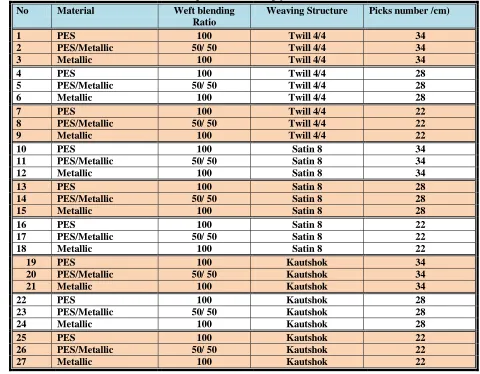
Table II shows the specification of the produced fabrics and its weaving construction. 100 % PES yarns were used in warp direction whereas different ratios of PES and metallic yarns in the weft direction were used. According to the capacity of machine used, and weaving construction chosen; the maximum picks number in cm could achieved is 34 pick/cm. Two other lower picks number was chosen, namely 28 and 22 picks/cm. For PES/ metallic blend fabrics 50/50 were weaved through insertion one by one yarn to provide equal blending ratio.
Table II: Fabric specifications (warp yarns is 100 % PES) No Material Weft blending
Ratio
Weaving Structure Picks number /cm)
1 PES 100 Twill 44 / 34
2 PES/Metallic 50 / 50 Twill 44 / 34
3 Metallic 100 Twill 44/ 34
4 PES 100 Twill 44/ 28
5 PES/Metallic 50 / 50 Twill 44/ 28
6 Metallic 100 Twill 44/ 28
7 PES 100 Twill 44/ 22
8 PES/Metallic 50 / 50 Twill 44/ 22
9 Metallic 100 Twill 44/ 22
10 PES 100 Satin 8 34
11 PES/Metallic 50 / 50 Satin 8 34
12 Metallic 100 Satin 8 34
13 PES 100 Satin 8 28
14 PES/Metallic 50 / 50 Satin 8 28
15 Metallic 100 Satin 8 28
16 PES 100 Satin 8 22
17 PES/Metallic 50 / 50 Satin 8 22
18 Metallic 100 Satin 8 22
19 PES 100 Kautshok 34
20 PES/Metallic 50 / 50 Kautshok 34
21 Metallic 100 Kautshok 34
22 PES 100 Kautshok 28
23 PES/Metallic 50 / 50 Kautshok 28
24 Metallic 100 Kautshok 28
25 PES 100 Kautshok 22
26 PES/Metallic 50 / 50 Kautshok 22
27 Metallic 100 Kautshok 22
2.4 Testing and analysis
Laboratory tests on the produced samples were carried out at the standard conditions for textiles with an air temperature (20 ±2P
°
P
C) and relative humidity of air (65 ± 5 %) according to the American Society of Testing Materials (ASTM). The fabrics were tested without any treatments.
2.4.1 Scanning electron microscopy and EDX
230
Copyright © 2011-15. Vandana Publications. All Rights Reserved.
2.4.2 Measurement of UPF
Ultraviolet protection factor (UPF) was measured using UV Shimadzu 3101 PC-Spectrophotometer. UPF was determined by measuring the Ultraviolet radiation transmittance value of each fabric across the wavelength range 280 - 400 nm. The UPF of the treated samples were obtained used ‘Ultra Violet Transmittance Fabric Analyzer-Lab sphere- USA. The UPF values are calculated automatically, in accordance with Australia / Newzeland standard AS/NZS4399:1996. The UPF is determined by measuring the direct and diffuse transmission of the fabric across the wavelength range 290-400 nm which include UVB (290 - 315 nm) and UVA (315-380 nm).
UPF ratings indicate how much the textile material reduces UV radiation that causes skin reddening. For example, UPF 50 indicates that the UV rays in the wavelength range of 290 - 380 nm is reduced by 50 times.
III.
THEORETICAL SECTION
When radiation strikes fabric surface, it can be reflected, absorbed, transmitted through the fabric (Figure 2). The relative amounts of radiation reflected, absorbed or transmitted depend on many factors, including the fibre type, the fibre surface smoothness, the fabric cover factor (the fraction of the surface area of the fabric covered by yarns) and the presence or absence of finishing treatment.
If the fibres absorb all of the incident radiation, then the only source of transmitted rays is from the spacing between the yarns. By definition, the theoretical maximum SPF is the reciprocal of 1 minus the cover factor (equation 1) [2]
Based on the above mentioned criteria, UPF of fabrics will depend on fabric materials, and fabric construction (porosity, weight, thickness, etc). Fabric type and construction are deemed to present the simplest and cheapest solution to achieve good UV protection without additional finishing processes. The aim of the present work is to develop UV protective fabric based on polyester
and metallic yarns. The effect of number of weft yarns thereof and fabric constructions on the ultimate UPF of the produced fabrics were investigated. For this regard, two kinds of yarn materials were chosen to form a fabric with three different blending ratios namely, polyester and metallic yarns. 100 % PES yarns were used in warp direction whereas different ratios from PES and metallic yarns in the weft direction. The blending ratios in weft direction were, PES, 100 %, PES/metallic 50/50 and metallic 100 %. For each blending ratio three kind of weaving construction and picks number were exploit. The produced fabrics were monitored for UPF.
IV.
RESULTS AND DISCUSSION
4.1 Effect of number of picks number and weaving construction on UPF of the produced fabrics
Figure 3 shown the relation between picks number and weaving construction of 100 % PES on UPF of the produced fabrics. It is seen from Figure 3 that: i) At the same weaving construction, increasing the picks number from 22 to 28 pick/cm leads to increase in the UPF of the fabrics, further increased in the picks number to 34 pick/cm decreased the UPF.
ii) At the same picks number, the highest UPF was observed at satin weaving construction then Kautshok whereas twill-weaving construction verifies the least UPF value.
231
Copyright © 2011-15. Vandana Publications. All Rights Reserved.
Satin 8 is a basic weaving structure, in which the yarn crossover or interlacing points are spaced as evenly and widely as possible and in which the yarn crossover points lying between the visible crossover points are more or less covered by yarns lying on the surface (floats) [17]. Satin waving construction has the highest float characteristics compared with other two weaving construction used in this study, namely Kautshok and twill. This higher float characteristic in satin construction enhances the reflection of incident UV radiation and therefore increases the UPF. Similarly, Kautshok has higher float characteristics compared with Twill construction and therefore verifies higher UPF compared with twill construction at the same picks number and yarn type [18, 19].
The way that threads interlace in satin weaving also provides the maximum cover factor of weft threads, which also occurs due to deformations (twisted) of these threads. This will lead to an increase in the thickness of the fabric. The higher UPF observed at 28 picks/cm could be attributed to preserving the metallic yarns morphology in its flatting form that reflects the UV rays. At Higher picks number (34 picks/cm) the metallic yarn become more condensed and at the same time the orientation of metallic yarns change inducing disordered in the structure and leading to lower UPF [18, 19].
Figure 4 shows the dependence of UPF of fabrics formed from 100 % metallic yarns in the weft direction and 100 % PES in warp direction on weaving construction and picks number. Whereas Figure 5 shows similar relation of those fabrics constructed from PES/metallic yarns (50/50) in the weft direction. Results obtained in Figures 4, 5 are similar to those obtained in Figure 3 and could be explained on similar basis.
4.2 Effect of different yarn ratios in the weft direction on UPF of the produced fabrics
Figure 6 shows the effect weaving construction and different blending ratio of weft yarn on UPF of the produced fabrics at the same picks number (28 pick/cm) and weaving construction (satin). It is seen from Figure 6 that; by replacement 50 % of metallic yarns with polyester yarn in the weft direction, the UPF of the resultant fabrics increased from 67.4 to 93.3. Further increase of metallic yarn ratio in weft direction up-to 100 % slightly decreased UPF of the fabrics, but with certainty that, the UPF values are still higher than that observed with 100 % PES at the same picks number and weaving construction.
232
Copyright © 2011-15. Vandana Publications. All Rights Reserved.
Figure 7 shows the picks number and differentblending yarns ratio on UPF of fabrics at the same weaving construction (Satin 8). It is seen from Figure 7 that, the highest UPF was observed for fabrics constructed from PES warp yarns (100%) and PES/metallic blend yarns (50/50) in the weft direction using 28 picks/cm. These results are in accordance to the above-mentioned results and can be similarly explained.
4.3 Scanning electron microscope (SEM) and
energy-dispersive X-ray spectroscopy (EDX)
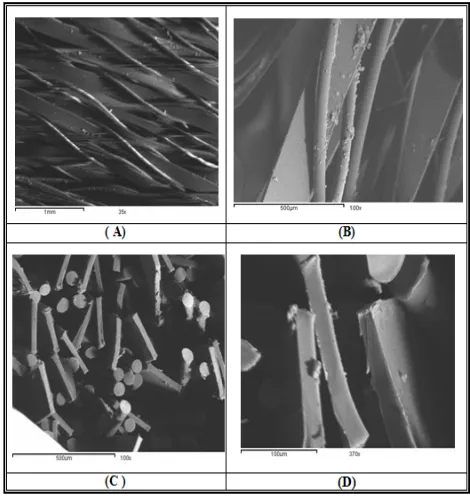
Figure 8 (A, B) show scanning electron microscope (SEM) of longitudinal section of metallic yarn at different magnification power, whereas, Figure 8 (C, D) show SEM of cross section of the metallic yarn. Figure 8A shows smooth oblate cupid yarn with no observed twisted or wrinkled. Higher SEM magnification of the metallic yarn (Figure 8 B) shows the smooth core typical regular melt spun polyester yarn split up from the coated thin aluminum layer. Figure 8 C, D shows the SEM of cross section of metallic yarns. Figure 8 C, D shows
cylindrical core regular melt spun PES yarns surrounding with aluminum film.
233
Copyright © 2011-15. Vandana Publications. All Rights Reserved.
V.
CONCLUSION
It could be conclude from the above results that: at the same weaving construction, increasing the picks number from 22 to 28 pick/cm leads to increase in the UPF of the fabrics. Further increased in the picks number to 34 pick/cm decreased the UPF of the produced fabrics. At the same picks number, the highest UPF was observed when the fabrics was design using Satin weaving construction then Kautshok whereas twill-weaving construction verifies the least UPF value. By replacement of 50 % metallic yarns with polyester yarn in weft direction, the UPF of the resultant fabrics increased from 67.4 to 93.3 at the same picks number (28 pick/cm) and Satin weaving construction. Further increase of weft metallic yarn to 100 % in the produced fabrics, slightly decreased UPF of the fabrics, but with certainty that, the UPF values are still higher than that observed with those fabric formed from 100 % PES yarns and at the same picks number and weaving construction.
REFERENCES
[1] Reichrath J. “Sunlight, Vitamin D and Skin Cancer” Springer, New York, NY, 283-295 (2008).
[2] W. D. Schindler and P. J. Hauser “Chemical finishing of textiles” CRC Press Boca Raton Boston New York Washington, DC - Published by Woodhead Publishing
Limited in association with The Textile Institute (2000) page 157.
[3] Reinert G, Fuso F, Hilfiker R and Schmidt E, ‘UV-protecting properties of textile fabrics and their improvement’, Textile Chemist and Colorist, 29 (12) 36– 43 (1997).
[4] Hilfiker R, Kaufmann W, Reinert G and Schmidt E, ‘Improving sun protection factors of fabrics by applying
UV-absorbers’, Textile Research Journal, 66 (2) 61–70
(1996).
[5] Reinert G, Hilfiker R, Schmidt E and Fuso F, ‘Sonnenschutzeigenschaften Textile Flächen und deren
Verbesserung’, Textilveredlung, , 31 (11/12) 227–234
(1996).
[6] Wun T. F.,"Investigation of Ultraviolet Protective Lightweight Knitwear Fabric With Direct Dyes and Optical Brightening Agents". A Thesis Submitted for the Degree of Bachelor of Arts in Fashion & Textiles, Institute of Textiles & Clothing, The Hong Kong Polytechnic University (2012).
[7] Kerr J. B.,"Understanding the factors that affect surface ultraviolet radiation", Optical Engineering, 44 (4), (April 2005).
[8] Stempień Z, Dominiak J, Sulerzycka-Bil M,"
Protection Properties of Woven Fabrics Against High-Intensity UV Radiation Emitted by Artificial Sources",
Fibres & Textiles in Eastern Europe, 21 (98) 96-102
(2013).
[9] Perenich, T. A., “Textiles as preventive measures for skin cancer”, Colorage, 45, 71-73, Annual (1998).
[10] Biswa R.," UV Radiation Protective Clothing", The Open Textile Journal, 3, 14-21 (2010).
[11] Capjack, L., Kerr, N., Davis, S., Fedosejevs, R., Hatch, K.L. and Markee, N.L. Protection of humans from ultraviolet radiation through the use of textiles: A Review. Family and Consumer Sciences Research Journal, 23 (2), 198 – 218 (1994).
[12] Scott, R.A.,"Textiles for protection", Woodhead Publishing Limited, ISBN 13:978-1-85573-921-5, Cambridge, England, (2005)
[13] Gogoi, S., Baruah, B., Sarkar, C.R., “Effect of Ultraviolet Light on Silk Fabric”, Colourage, (2) 23 – 29 (1999)
[14] D. Saravanan., "UV Protection Textile Materials", AUTEX Research Journal, 7 (1) March 2007
[15] Rupp, J., Bohringer A., Yonenaga, A., and J. Hilden, “Textiles for protection against harmful ultraviolet radiation”, International Textile Bull., 6 (11) 8- 20 (2001). [16] Radetić M. Functionalization of textile materials with
TiOR2R nanoparticles. Journal of Photochemistry and
Photobiology C: Photochemistry Reviews, 16 (10) 62-76 (2013).
[17] Hans-Karl Rouette, Encyclopedia of Textile Finishing, Springer 2000