(IJTRD), ISSN: 2394-9333, www.ijtrd.com
International Conference on Innovative Practices in Management, Engineering & Social Sciences, Singapore, 20-23 June 2019 Page 41
Integrate Business Concept Planner
Attila Petheő, Janos Vecsenyi
Corvinus University of Budapest, Hungary, Small Business Development Center
Abstract:
Purpose: You have a business idea either because not only you recognized a market need, but you found the solution as well, or you worked hard and developed a great something, which may lead to be a great product for many people. You have at least two questions to be answered:
1. Is it really a great business opportunity?
2. How can you make it a viable and feasible business?
Most cases you are an expert either the product side or the business side of the new venture and sooner or later you recognize that you need more complex approach to pursue the recognized business opportunity and develop it as a successful business venture. So, you need some help to integrate various perspectives into a coherent perspective and a systematic methodology.
Design/methodology/approach: In the last 9 years more than 2200 students got the assignment to build business model using one of the tools. We were evaluating the quality and the content of the student home works, and tested our new concept. June 2019 we release a new online tool in English, and we will collecting feedback from users.
Findings: In this methodology, instead of using the Business Model Canvas, another model, the Business Concept with six major building blocks was used. The model was further developed as a standalone tool called Business Concept Map published in a „How to cook type guidebook‟ (Vecsenyi, Petheő 2017).
Research/practical implications: Vecsenyi (2011) developed a website (www.startmybusiness123.com) to support students and other future entrepreneurs to develop their business concept, analyze risks and make an educated decision on stopping, postponing or starting the implementation of their business idea.
Originality/value: In this paper we would like to define, compare and differentiate the three tools. We would like to share our experience of using the tools by early adapters.
Keywords: Business Model Canvas, Lean Canvas, Business Model Concept, Entrepreneurship Education,
JEL Codes: L26, M13, L21
I. INTRODUCTION
During the last decades business model emerged as a popular term in management and entrepreneurship. Those who wanted to have a better understanding of the operation of any organization developed concepts and tools. As early as the 1960s to the 1980s during the hype of systems movement Soft System Methodology emerged. At that time a great tool, CATWOE, was developed by Checkland and colleagues (Checkland 1981).
Although the CATWOE tool was first introduced in 1981, there are signs that it is still in use at least by business analysts in design thinking (Elmansy 2014). CATWOE is a simple checklist of thinking used by people „to identify what the business is trying to achieve, what the problem areas are and how the solution is going to affect the business and people involved in it” (Pandey 2011). It is worth listing the elements of the tool and recognizing the similarities of elements in later tools.
1. Clients/Customers 2. Actors
3. Transformation process 4. Weltanschauung or World-view 5. Owners or ownership
6. Environment
II. PROBLEM IDENTIFICATION AND BASIC PRINCIPLE
With the internet bubble attention turned to understanding the successes and failures of e-businesses. Experts in the field wanted to explain how these ventures make business. In a narrower sense, business models research focused primarily on the revenue stream, the way the business generates any kind of income. Business models were defined from the classical product or service direct sale through subscription, razor and blades, crowdsourcing, brokerage, to freemium (Barakonyi, 2008, Ovans 2015)
Other experts broaden the picture and consider business model as description of how an existing or a future organization creates, delivers and captures value in an uncertain environment. The breakthrough happened in this field when Osterwalder (2004), Osterwalder and Pigneur (2010) combined the two approaches: revenue generation and value creation.
(IJTRD), ISSN: 2394-9333, www.ijtrd.com
International Conference on Innovative Practices in Management, Engineering & Social Sciences, Singapore, 20-23 June 2019 Page 42
business strategies either of existing firms and in the entrepreneurship arena creation new companies.
When startup and venture capital financing hype emerged the role of business plan received a kind of new perspective. Traditional venture capitalists, who wanted to minimize their risks, insisted to use extensive business plans with ample market research and financial data organized neatly in spreadsheets as a great tool of communication among stakeholders. At the same time potential investors wanted the new venture creators to be prepared based on educated decisions other than hunch. Consequently, new venture creators prepared a business plan to create a document for themselves, their key staff members and potential investors as a convincing, credible and comforting document (Bygrave 1994, Vecsenyi and Petheő 2017). At the same time, quick decision makers argued the usefulness of such an extensive business plan and wanted to have better tools.
Some practitioners even went further to challenge their right to existence. Personally, we do not share this opinion. We believe that business plan is a useful tool, but it has some limitation which might be corrected by other forms. One of the facts which makes business plan old fashioned, that business plans take too long to write, are seldom updated, and almost never read by others. By the time the 100 pages long business plan attached to a 5-year spreadsheet with numbers that all show a tendency to grow in a neat diagram or chart is ready, the window of opportunity is nearly closed. Decision makers are not wasting their time to read long business plans. So, they need other solutions. One type of answers to this challenge is to use business models as a one-page business plan.
We agree that documenting entrepreneurs‟ hypothesis is the key to understand success. We agree with Maurya (Maruya 2012) “Document your key business model assumptions (and learning) in a portable format that you can share and discuss with people other than yourself.”
We would like to present the Business Model Canvas, the Lean Canvas and Business Concept Map and highlight the pros and cons of using them to make the choice easier for future nascent entrepreneurs. We would like to investigate why these tools were introduced, what the purpose of the tool is and where and how the tool can be applied. In our view „one size fits all‟ is not the right way to follow selecting the right business model tool, so everyone should select the one fits to its project the best.
III. CONCEPT 1 BUSINESS MODEL CANVAS BY OSTERWALDER AND PIGNEUR 2010
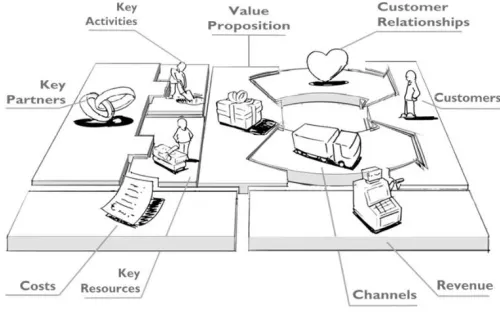
After Business Model Canvas became very popular the two authors prepared a book to explain more thoroughly the tool. Their book simply answers the question: How to generatethe business model for a business?
In our opinion the tool is a good option when somebody would like to describe an existing business. It helps to identify the major elements and does not require deep digging research. Later, somehow nascent entrepreneurs started to use the tool to describe a new venture. As most of the people know only this tool, the result is just a little above the satisfying level. Several questions in business model canvas cannot be answered without industry experience or considering a role model company.
However, this fact does not inhibit many nascent entrepreneurs
to prepare their business model with the help of business model Canvas. We did the same in our courses.
Figure 1. Business Model Canvas
Source: Osterwalder and Pigneur (2010)
Why do so many people use the Business Model Canvas? We listed the major benefits of using the Business Model Canvas based on our practical experience with student assigmnets.
easy to use with clear terms
helps understanding the business model of an existing or a new venture
helps revealing assumptions, helps to generate new business model
easy access to the tool and explanations (home pages)
access to examples
popular, well-known almost everywhere
We identified the following weaknesses of the model:
static model, hard to take trends into consideration
growth potential, market size not part of the canvas
less attention on competition
entrepreneurial team is completely missing, which is a crucial element of startups, although in the resources section it can be mentioned
no attention on special considerations of new ventures, e.g. investments needs, uniqueness of the value proposition, distinctive competence to create competitive advantages, outsourced competencies in creating values.
do not support defining needs for change, no list of actions
In addition to BMC Osterwalder and his colleagues further developed this tool, and added Value Proposition Canvas (Osterwalder and others 2014) which focuses in more detail the fit between value propositions and targeted customers.
IV. CONCEPT 2 LEAN CANVAS BY MAURYA (2013)
(IJTRD), ISSN: 2394-9333, www.ijtrd.com
International Conference on Innovative Practices in Management, Engineering & Social Sciences, Singapore, 20-23 June 2019 Page 43
Model Canvas and Maruya optimized this tool for lean startups.
The Lean Canvas tool helps users to define key elements of the new business and key issues to handle.
Lean Canvas was designed for entrepreneurs, not consultants, customers, advisors, or investors. It started that, the entrepreneur can greatly benefit by engaging all stakeholders while validating their Canvas. It is more specific than the Business Model Canvas. Usually custom models and tools fits better to user needs.
From the original Business Model Canvas four elements out of nine were eliminated and four elements were added. The Lean Canvas finally covers the following nine elements listed here and shown in Figure 2:
Figure 2. From Business Model Canvas to Lean Canvas
Source: Mauryahttps://blog.leanstack.com/why-lean-canvas-vs-business-model-canvas-af62c0f250f0
The elements Maruya took out were either overlapping with other blocks or were not crucial factor of success. Customer relationship is already part of the channel. Key partners are hard to gain in the starting phase.
Maurya also changed the suggested route of filling Lean Canvas. Defining problems becomes the second step. Market segment and early adopters got special attention at first. Cost structure is not the last any more. Unfair advantage and key metrics got special focus as they are important to become sustainable and gain market share in the long run. As the original model is under creative common license, so everyone is invited to further develop.
In our opinion after testing it with students, Mauyra‟s version is very good with a focus shifted toward problems. He does not mention product, rather building solution and business model gets special attention.
Lean Canvas has many valuable features which add value to the model. We suggest using it as focus on the critical elements starting a new venture. It is still very simple to use. It builds on the Canvas and keeps the clear form. It steps even further as integrates the new business formation terms like cost of customer acquisition (COCA), life time value of customer (LTV), early adopters. This model forces the user to make assumption explicit for validation, which makes it enhances its value.
On the other hand, according to our classroom experience, there
is no place for competition in the model (opposite to the Porter model). Growth potential (scalability) is not handled at all. HR is not included, as also mentioned earlier in BMC. Initial funding is not mentioned anywhere in the model. The tool is weak in finance and concentrate more on technology, business model and project management.
V. CONCEPT 3 BUSINESS CONCEPT MAP BY VECSENYI (2011)
Teaching at Corvinus University of Budapest and Budapest University of Technology and Economics, Professor Vecsenyi wanted to improve the entrepreneurship education. In 2011 he developed an online platform where students could develop a short business plan using structured questions, financial planning tools, risk assessment methods, mitigation suggestions of entrepreneurs and other experts. Receiving feedback both from students, nascent entrepreneurs and other scholars, Vecsenyi developed Business Concept Map (BCM). When he formed his model, his purpose was very ambitious:
helping smart new venture creation, define the business to start
combine the business opportunity and value creation
reveal assumptions for validation before developing products/ services
provide a tool for investment pitching, give answers to questions of potential investors, partners
create an easy to read one-page summary of major aspects of a new business
After several versions and fine tuning of the map, it arrived at a stage where more than 1200 concept formulated with its use. In our view, Business Concept Map helps to structure the business idea, and create an easy to read summary. We realized a side-effect that in the process several circles of preparing, validating and modifying the Business Concept Map answers to potential investors‟, product, market and business developers‟ questions were given. In the business concept map six major aspects of a new venture are identified. The first three define the core elements of a business opportunity, explain why the entrepreneur would like to pursue:
The market need and target customers
The value proposition and uniqueness (competitive advantages) the way the new business would like to satisfy that need
The revenue stream and channels clarify what is the potential to generate money
The other three elements cover the business creation condition, explaining how the entrepreneur would like to exploit the opportunity:
The entrepreneur (owner) and the starting internal and external team
The core and special competencies and resources
Cost structure, initial investment and financing
(IJTRD), ISSN: 2394-9333, www.ijtrd.com
International Conference on Innovative Practices in Management, Engineering & Social Sciences, Singapore, 20-23 June 2019 Page 44
Figure 3. The Business Concept Map Source: Vecsenyi, Petheő 2017
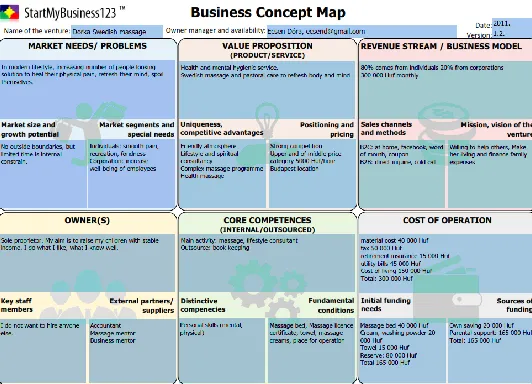
This tool was found useful for those who would like to start small, traditional businesses, but start-uppers also considered it as vital tool. Here we present an example of how a sole proprietorship demonstrates the basic use of this tool.
Figure 4. Business Concept Map example Source: Vecsenyi, Petheő 2017
During validation process the tools help to clarify why the business makes sense:
Is there a real market need, are there real customers who are ready to buy?
Is it the right product/service to satisfy that need and is it attractive enough for customers to buy it?
Does it generate enough revenue through the channels designed and does this business fit your mission?
This model also has some week points such as:
It requires extensive market research on the field and deep analysis for validation (stundents find Business Modell Canvas easier to use, more user friendly model)
It is a tool demanding more time and energy to fill out the template compared with the other two canvases
It needs to have business mindset and vocabulary
Compared with the two other models, BCM covers additional aspects: growth potential and market size projections; competitive analysis and market positioning; mission statement or reason for existence; owner entrepreneur(s), key personals,
external partners, suppliers; legal conditions of existence; initial investments, funding and financing.
These aspects in addition to the basic elements of the BCM, cover several questions which nascent entrepreneurs / students have never thought of earlier.
VI. RESULTS AND DISCUSSION
We are about to release a free online version of business concept planner. This planner has a very developed engine. It gives a sample case and a lot of option to choose the right answer for you own business. After every question, it provides a sample answer, and an explanation from your business coach. This way user can improve their business concept going through entire questions. They should not do it at ones. Users can stop any time asking others (experts, customers etc.) or doing further research.
Our new online toolkit which will help user to develop his/her idea to the next level and find out why, how and what kind of business does he/she want to create. This will be the
conceptualization phase of new business creation entrepreneurial process.
Answering the online questions in this toolkit, use will be able to define his/her startup business concept, to set the direction of the new venture development, to reveal assumptions and to make decisions about next steps in his/her new venture creation process.
First, this tool helps user to fine tune the business opportunity he/she wants to pursue and second, define how the new business will be able to make it happen.
User has found a real business opportunity when value proposition product or service is
• FIT to a real market need
• SEXY to win your customers against competitors in the competitive environment
• MONEY-MAKER to generate growing revenue to at least sustain the business
Anyone can successfully pursue this business opportunity when its value creation venture has
• COMMITED & COMPETENT founders, team members and partners
• CAPABLE & COMPLIENT with available human, technical, financial competencies which make your activities legally and ethically acceptable
• COST EFFECTIVE & FUNDABLE operation to survive the valley of death
This tool will help user to convince her/himself and supporters if she/she honestly answers the online questions. When users are uncertain they should consult mentors and team members.
How to use this tool?
1. Visit the website of the tool (published soon)
2. Answer the questions in the box with grey shadows where you can find an example text which will disappear when you replace it with your text.
(IJTRD), ISSN: 2394-9333, www.ijtrd.com
International Conference on Innovative Practices in Management, Engineering & Social Sciences, Singapore, 20-23 June 2019 Page 45
about the nature of the potential answer.
4. If you still are uncertain how to find the right answer you can follow a link to the Online Training Center where you can find more know how on the topic.
We believe that with these kind of tools we can reach many startups and young talented people. As we are very limited in free time, we cannot give advice too many people. This technology may escort early stage entrepreneurs to a certain point, where they discover what kind of help might they need. This can be part of the learning process and may show the way, how to become a professional player on a competitive market.
CONCLUSION
Recent years showed that these tools were not only published but widely used by
students at their business or entrepreneurship courses
practitioners, managers, consultants, analysts for improving existing firms
entrepreneurs for clarifying business opportunity and business creation conditions
In new business creation these tools have not substituted business-plan but provided basic answers for investors‟ questions in a limited time. With the help of these tools the quality and clarity improved a lot. The tools helped nascent entrepreneurs/ students to have a better understanding of their business, to visualize their concept and use them as an easy to use communication tool with such stakeholders as decision maker managers, investors, or lecturers. The reasons behind authorsintrodiuced the Business Concept Map to help new venture creators/ students:
to define the imagined new business with a practical structure that covers most relevant business aspects
to understand the business in creation, in addition to having an idea
to reveal assumptions for validation and generation of pivot decisions and follow up actions
The major advantage of using Business Concept Map are as follows:
almost full picture of the business in creation
the clear definition of the business opportunity
answers to most of the questions potential investors may have
The use of Business Concept Map is limited since
defining of a business concept requires the understanding of business terms and having at least a limited business mindset
developing, validating and modifying a Business Concept Map take time and energy prior to execution
Creation of the Business Concept Map is part of a 12-step process of starting a new venture from the idea to entering the market, as introduced in our recently published book (Vecsenyi and Petheő 2017). With this book and our courses at Corvinus University and Budapest University of Technology and Economic Sciences BCM became a reality in helping students and nascent entrepreneurs to identify business opportunities and to create conditions to pursue them. These tools are useful and
highly recommended to have better business in our world. Developing new tools is a never-ending story. Just to give an example see Disciplined Entrepreneurship Canvas, Aulet (2017).
Acknowledgement
We want thank the support of GE healthcare program, to support the development of the tool.
References
[1] Aulet, Bill (2017): Disciplined Entrepreneurship Workbook. Willey
[2] Barakonyi, Károly (2008). Business models.
Vezetéstudomány Vol 39. May 2008
[3] Blank, Steve (2006): The Four Step to Ephiphany.
https://web.stanford.edu/group/e145/cgi-bin/winter/drupal/upload/handouts/Four_Steps.pdf
[4] Bygrave, William (1994): The Portable MBA in Entrepreneurship. Wiley
[5] Checkland, Peter (1981): Systems Thinking, Systems Practice, John Wiley & Sons Ltd.
[6] Coes, Bastian (2014): Critically assessing the strengths and limitations of the business model Canvas. Master thesis business administration. http://essay.utwente.nl/64749/1/Coes_MA_MB.pdf [7] Emansy, Rafik: CATWOE: Building problem-solving
checklist http://www.designorate.com/catwoe-problem-solving/
[8] Ovans, Andrea (2015) What is a Business Model. Harvard business review. 2015 January
[9] Osterwalder, Alexander (2004): The business model ontology. A proposition in a design science approach.
THESE Présentée à l‟Ecole des Hautes Etudes Commerciales de l‟Université de Lausanne. Source: Business_Model_Ontology_a_propositio.pdf
[10] Osterwalder, Alexander, Yves Pigneur (2010): Business Model Generation. Willey
[11] Osterwalder, Alexander, Yves Pigneur, Gregory Bernarda (2014). Value proposition design. Strategyzer [12] Maurya, Ash (2012): Why lean canvas vs business model
canvas? https://blog.leanstack.com/why-lean-canvas-vs-business-model-canvas-af62c0f250f0
[13] Maruya, Ash (2016): Scaling lean. Portfolio/Penguin [14] Pandey, Abha (2011): What is CATWOE analysis?
http://bpmgeek.com/blog/what-catwoe-analysis
[15] Ries, Eric (2011) Lean startup. Crown Business Publishing
[16] Štefan Slávik, Bednár Richard (2014): Analysis of Business Models. Journal of Competitiveness. Vol. 6, Issue 4, pp. 19-40, December 2014
[17] Vecsenyi, János (2011) www.startmybusiness123.com / www.vallalkozasindito.hu