188
Copyright © 2011-15. Vandana Publications. All Rights Reserved.
Volume-5, Issue-3, June-2015
International Journal of Engineering and Management Research
Page Number: 188-195
A Comparatively study for Project Management Software Selection Using
Analytic Hierarchy Process Method
Nand Kishore Sharma1, Sanket Gupta2, Vandana Sharma3 1,2
Assistant Professor, Department of Computer Science & Engineering ,Acropolis Technical Campus, Indore, INDIA 3
Assistant Professor, Department of Management, Malwa Institute of Science & Technology, Indore, INDIA
ABSTRACT
Today, project management software is indispensable for organizations to better manage their projects, reduce their costs, shorten schedules and be more responsive to customer demands. Software selection process is a serious issue for future growth and competitiveness of the company; moreover project management software selection also has a insightful effect on the operation or control of the projects to be successful. A very large class of problems in management and administration are known as multi-attribute decision problems. Such problems involve decisions that must take into account large numbers of variables and objectives that cannot always be directly quantified. These problems are rendered even more cumbersome to handle by the fact that the variables and objectives are often in conflict The aim of this research is to focus on selection of project management software using Analytic Hierarchy Process (AHP) method. The selection criteria is specified by the comparatively study of 3 project management software packages, namely HP-PPM, MS-Project and Primavera. These criteria are evaluated by 5 project managers from different companies for these 3 project management tools. Results have specified that HP-PPM is the most appropriate tool among other two project tools in the scope of the interviewed companies.
Keywords---- Project management, Software Selection, Analytic hierarchy process
I.
INTRODUCTION
Project management is the process and activity of planning, organizing, motivating, and controlling resources, procedures and protocols to achieve specific goals in scientific or daily problems. Project management provides a framework to help accomplish goals for all organizations. One critical issue for project management is selection of proper project management software which has the capacity
to help plan, organize, and manage resource pools and develop resource estimates.
Following project steps are easier with the use of appropriate tools. Project management tools provide a large number of features that are customizable and can be tailored to meet the specific need of the organizations. However, the problem is that every company, even every project has different requirements. The more suitable tool that managers select, the more the projects will be executed successfully and their company may become more profitable.Decision making in the field of software selection has become more complex due to a large number of software products in the market, ongoing improvements, information technology, and multiple and sometimes conflicting objectives (Zahedi et al., 2011).
Project management software is a term covering many types of software, including scheduling, cost control, budget management, resource allocation, collaboration, communication, quality management and documentation (Unesco Bangkok, 2008).
The choice of project management tool selection has a profound effect on the operation or control of the projects and their success. The reason for this matter lies in the complex and crucial nature of selecting project management tool for project managers. The aim of this research is to select appropriate project management tool with the AHP methodology to meet expectations’ of high level managers and to increase profitability of the company.
II.
LITERATURE SURVEY
In this survey we collected the complete details of these three project management tools with there prons and cons.
189
Copyright © 2011-15. Vandana Publications. All Rights Reserved.
1. HP-PPM 1.1. Introduction
When there are many projects run by an organization, it is vital for the organization to manage their project portfolio. This helps the organization to categorize the projects and align the projects with their organizational goals. Project Portfolio Management (PPM) is the term used for centralized management and administration of the processes, technologies and methods that are used by the project managers within an organization. It is most relevant for companies that undertake multiple projects at one time which require a dignified framework for effective tracking, allocation and management of these projects. However, for this PPM to be effective, companies should incorporate real-time governance within their business practices and activities.
The Five Question Model
The five question model of project portfolio management illustrates
The five question model of project portfolio management illustrates that the project manager is required to answer five essential questions before the inception as well as during the project execution.
The answers to these questions will determine the success of the implementation of the project.
1.2. Objectives of Project Portfolio Management
Same as with financial portfolio management, the project portfolio management also has its own set of objectives. These objectives are designed to bring about expected results through coherent team players.
When it comes to the objectives, the following factors need to be outlined. The need to create a descriptive document, which contains vital information such as name of project, estimated timeframe, cost and business objectives. The project needs to be evaluated on a regular basis to ensure that the project is meeting its target and stays in its course. Selection of the team players, who will work towards achieving the project's objectives.
1.3. Benefits of Project Portfolio Management
Project portfolio management ensures that projects have a set of objectives, which when followed brings about the expected results. Furthermore, PPM can be used to bring out changes to the organization which will create a flexible structure within the organization in terms of project
execution. In this manner, the change will not be a threat for the organization.
The following benefits can be gained through efficient project portfolio management:
• Greater adaptability towards change.
• Constant review and close monitoring brings about a
higher return.
• Management's perspectives with regards to project
portfolio management is seen as an 'initiative towards higher return'. Therefore, this will not be considered to be a detrimental factor to work.
• Identification of dependencies is easier to identify.
This will eliminate some inefficiency from occurring.
• Advantage over other competitors (competitive
advantage).
• Helps to concentrate on the strategies, which will
help to achieve the targets rather than focusing on the project itself.
• The responsibilities of IT is focused on part of the
business rather than scattering across several.
• The mix of both IT and business projects are seen as
contributors to achieving the organizational objectives.
14. Overcome Business Challenges
With the valuable expertise, we will be able to benefit with an efficient and effective project and portfolio management by aligning IT portfolio with business goals and objectives.
However, this will also bring some added benefits for business, which includes:
• Efficient portfolio management with the use of an
effective real-time governance
• No prioritization of projects; every project given
equal importance and allocated with sufficient resources for its successful completion
• Improved ability to capture structured demands from
the business; input, analysis and approval
• Enhanced real-time visibility of the budgets,
resources, costs, programs, forecasts and projects; enabling the attainment of relevant matrices
• Achieve optimum alignment of business
1.6. Components
1. Project Management: Helps you reduce project
complexity and accelerate project delivery by integrating project management and process controls.
2. Portfolio Management: Align your IT portfolio to better support your business strategy. Use what-if scenario planning to automatically or manually creates an optimal mix of projects, proposals and assets. Gather accurate, up-to-date information for difficult portfolio decisions.
190
Copyright © 2011-15. Vandana Publications. All Rights Reserved.
costs and variances that delivers detailed comparisons of yourproject health.
4. Time Management: Helps you streamline time collection and improve the accuracy of tracking the work your IT organization performs. The software bridges the gap between work management and time management across a range of items, including projects, tasks, requests and deployments. It enables you to focus on value-added activities by helping you manage both the work-demanded and time-expended sides of the equation in your IT portfolio.
5. Program Management: Provides visibility across programs, projects and operational-type activities, enabling your team to collaboratively manage programs from concept to completion. It automates processes for managing scope, risk, quality, issues and schedules. This software provides a single repository for all project status reports, including detailed cost and schedule metrics as well as expected benefits. This information is presented to all project participants and stakeholders through a role-based dashboard. 6. Resource Management: Enables you to effectively manage resource capacity and allocation. This software provides a clear picture of your resource supply, including resource roles, skills and skill levels, across your entire organization. It also balances your resource supply with incoming demand, giving you full visibility and control over your project demands. Support for top-down and bottom-up resource planning allows you to forecast resource demand by roles for high-level portfolio planning. Through resource requests, this high-level planning profile transitions to detailed task and request assignments. And because HP PPM Resource Management provides visibility for both operational tasks and mission-critical, strategic projects, you can allocate resources to the highest-priority activities to ensure IT stays in alignment with business priorities.
7. Demand Management: Enables you to capture all the requests made on your IT organization. It allows you to aggregate, prioritize and fulfill demands for both strategic projects and day-to-day activities. As a result, business users and IT can collaborate efficiently, which helps you cut costs, accelerate problem resolution and manage your service levels. HP PPM Center Demand Management software leverages a powerful workflow process engine that helps automate business processes and enforce best practice process methodologies.
1.7. Cons:
1. No Customization Options
Calling HP PPM rigid might be a stretch, but its lack of customization options should be noted. It's more than just visual tweaks too. For example, you can't make custom fields to save off data that might be specific to your company's process.
2. No Task Management
In a perfect world, all employees would know exactly what to work on at any given time. Obviously, this isn't the case, and is why HP PPM's lack of task management features is a con. Can you make do without these
capabilities? Yes, but your team will thank you if you choose a solution with built-in task management.
2. MS Project 2.1 Introduction
Quality is an important factor when it comes to any product or service. With the high market competition, quality has become the market differentiator for almost all products and services.
Therefore, all manufacturers and service providers out there constantly look for enhancing their product or the service quality. In order to maintain or enhance the quality of the offerings, manufacturers use two techniques, quality control and quality assurance. These two practices make sure that the end product or the service meets the quality requirements and standards defined for the product or the service.
There are many methods followed by organizations to achieve and maintain required level of quality. Some organizations believe in the concepts of Total Quality Management (TQM) and some others believe in internal and external standards.
The standards usually define the processes and procedures for organizational activities and assist to maintain the quality in every aspect of organizational functioning. When it comes to standards for quality, there are many. ISO (International Standards Organization) is one of the prominent bodies for defining quality standards for different industries. Therefore, many organizations try to adhere to the quality requirements of ISO. In addition to that, there are many other standards that are specific to various industries.
Since standards have become a symbol for products and service quality, the customers are now keen on buying their product or the service from a certified manufacturer or a service provider. Therefore, complying with standards such as ISO has become a necessity
2.2 Types of Project Management Software
1) Desktop
There are two types of project management software available for project managers. The first category of such software is the desktop software. Microsoft Project is a good example for this type. You can manage your entire project using MS Project, but you need to share the electronic documents with others, when collaboration is required.
2) Web Based
As a solution for the above issue, the web-based project management software was introduced. With this type, the users can access the web application and read, write or change the project management-related activities. This was a good solution for distributed projects across departments and geographies. This way, all the stakeholders of the project have access to project details at any given time. Specially, this model is the best for virtual teams that operate on the Internet.
191
Copyright © 2011-15. Vandana Publications. All Rights Reserved.
projects may utilize all the features offered by projectmanagement software.
Therefore, you should have a good understanding of your project requirements before attempting to select one for you. Following are the most important aspects of project management software:
1) Collaboration
The project management software should facilitate the team collaboration. This means that the relevant stakeholders of the project should be able to access and update the project documents whenever they want to.
2) Scheduling
Scheduling is one of the main features that should be provided by project management software. Usually, modern project management software provides the ability to draw Gantt charts when it comes to activity scheduling.In addition to this, activity dependencies can also be added to the schedules, so such software will show you the project critical path and later changes to the critical path automatically.
When requirements are changed and new requirements are added to the project later, project management team can compare the new schedule with the baseline schedule automatically to understand the project scope and cost deviations.
3) Issue Tracking
During the project life cycle, there can be many issues related to project that needs constant tracking and monitoring. Therefore, the project management software should have features to track and monitor the issues reported by various stakeholders of the project.
4) Document Management
A project has many documents in use. Most of these documents should be accessible to the stakeholders of the project. Therefore, the project management software should have a document management facility with correct access control system.
5) Resource Management
Resource management of the project is one of the key expectations from project management software. This includes both human resources and other types.The project management software should show the utilization of each resource throughout the entire project life cycle.
3. Primavera 3.1. Introduction:
Les Seskin, Dick Faris and Joel Koppelman) under which a range of software packages that collectively form a comprehensive enterprise (EPPM) 1983 by Primavera Systems Inc. and was acquired by
Primavera software includes project management, collaboration and control capabilities and integrates with other enterprise software such a systems.
III.
METHODOLOGY
3.1 Analytic Hierarchy Process (AHP)
The Analytic Hierarchy Process (AHP) is a structured technique for organizing and analyzing complex decisions that is developed by Saaty (1980). It is a method for ranking decision alternatives and selecting the best one when the decision maker has multiple criteria. It is based on the well-defined mathematical structure of consistent matrices and their associated right eigenvector's ability to generate true or approximate weights (Merkin, 1979).
Typical applications where AHP has been used are in:
• Prioritizing factors and requirements that impact
software development and productivity,
• Choosing among several strategies for improving
safety features in motor vehicles,
• Estimating cost and scheduling options for material
requirements planning (MRP),
• Selecting desired software components from several
software vendors,
• Evaluating the quality of research or investment
proposals.
AHP also uses actual measures like price, counts, or subjective opinions as inputs into a numerical matrix. The outputs include ratio scales and consistency indices derived by computing eigenvalues and eigenvectors.
There are seven steps for applying AHP (Saaty, 1980):
1. Define the problem and determine its goals.
2. Structure the hierarchy from the top through the
intermediate levels and to the lowest level which usually contains the list of alternatives.
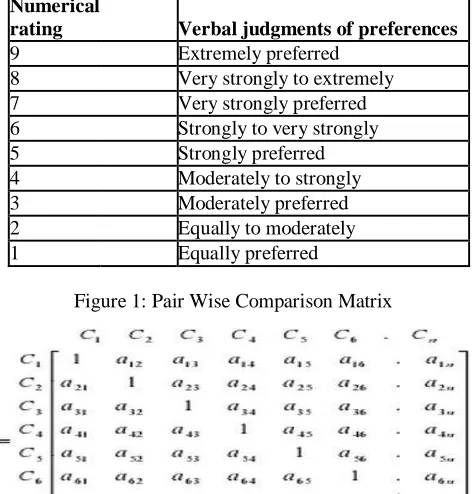
3. Construct a set of pair-wise comparison matrices
(size n x n) for each of the lower levels with one matrix for each element in the level immediately above by using the relative scale management (Figure 1).
4. There are n*(n-1) judgments required to develop the
set of matrices in step 3. Reciprocals are automatically assigned in each pair-wise comparison.
5. Hierarchical synthesis is used to weight the
eigenvectors by the weights of the criteria and the sum is taken over all weighted eigenvector entries corresponding to those in the next lower level of hierarchy.
6. Having made all the pair-wise comparisons, the
consistency is determined by the eigenvalue.
7. Steps 3-6 are performed for all levels in the
hierarchy.
192
Copyright © 2011-15. Vandana Publications. All Rights Reserved.
pair wise comparison matrix, the value 9 indicates that onefactor is extremely more important than the other, and the value 1/9 indicates that one factor is extremely less important than the other, and the value 1 indicates equal importance (Sarkis and Talluri, 2004). Table 1 displays the pair-wise comparison scale used for this study.
Table 1: Pair-Wise Comparison Scale for AHP Preferences
Numerical
rating Verbal judgments of preferences
9 Extremely preferred
8 Very strongly to extremely
7 Very strongly preferred
6 Strongly to very strongly
5 Strongly preferred
4 Moderately to strongly
3 Moderately preferred
2 Equally to moderately
1 Equally preferred
Figure 1: Pair Wise Comparison Matrix
In Figure 1:
n = criteria number to be evaluated Ci = ith criteria,
Aij = importance of ith criteria according to jth criteria The next stage is to calculate λmax so as to lead to the Consistency Index and the Consistency Ratio.
Consider [Ax = λmax * x] where x is the Eigenvector.
Then Consistency Ratio (CR) is calculated to measure how consistent the judgments have been relative to large samples of purely random judgments. If CR is greater than 0.1 the judgments are untrustworthy because they are too close for comfort to randomness and the exercise is valueless or must be repeated.
3.2 Implementation of AHP
In this part, application of each step of AHP will be explained in detail.
3.2.1 Problem Statement
Decision making in the field of software selection has become more complex due to a large number of software products in the market, ongoing improvements, information technology, and multiple and sometimes conflicting
objectives (Zahedi et al., 2011). For instance, project managers coming from different backgrounds are prone to choose different tools according to their prior experiences without considering companies real requirements. This may result in wrong decision as well as loss of money, time and effort.
The choice of project management tool selection has a profound effect on the operation or control of the projects to be more successful. The reason for this matter lies in the complex and crucial nature of selecting project management tool for project managers. The aim of this project is to select appropriate project management software with AHP methodology to meet expectations’ of high level managers and to increase profitability of the company.
3.2.2 Constructing the Structure of AHP Structure of AHP method
AHP method as a flexible model for decision making, clarifying the issues which have
several possible solutions. AHP is performed by expert method and then by performed
mathematical one, which divides the main problem into smaller and more detailed elements.
Decision by AHP method can be divided into three different levels [2]:
1. hierarchy, 2. priorities, 3. consistency.
Explanation of the AHP hierarchy
193
Copyright © 2011-15. Vandana Publications. All Rights Reserved.
Defining criteria is one of the most critical steps ofconstructing AHP model since the decision of users shapes around these pre-determined criteria. In order to define the most appropriate criteria, first the literature is searched comprehensively and then experts that use project management tools from different sectors are interviewed. Criteria affecting selection of project management software are specified by literature and interviews performed with experts (Table 2
Some other criteria are also found such as application development cost, acquire and test hardware, suitability with programming, language, browser compatibility from the literature. However, these criteria are excluded sincethe system is not being developedand the aim is to buy one. If the application will be developed in house, these criteria will also be crucial.
In order to implement AHP methodology and to perform the calculation accurately, real values of all criteria for each tool are needed. Therefore, appointments are arranged with executives from 3 mainly used project management software companies; HP (HP-PPM, 2014), Microsoft (MS-Project, 2014) and Oracle (Primavera, 2014). The executives are requested to specifyscores for each criterion of the 3 tools. Table 3 shows the values for each criterion. In order to state the strength of each tool according to different criteria, executives have given scores to project management tools for each main and sub criterion between 1 and 10.
3.2.3 Constructing Pair wise Comparison Matrices
After the criteria are determined and the values of each tool for each criterion are assigned, AHP template is formed using Microsoft Excel. In this template, there are 5 comparison matrices consisting of one for main criteria and one for sub criteria of each main criterion. Main criteria matrix consists of cost, user friendliness, tool maturity, and vendor/consultant support variables. First sub criteria matrix consists of the sub criteria of cost which are hardware infrastructure, implementation, maintenance, and software license costs.
Second sub criteria matrix consists of multidimensional reporting and user responsiveness which are the sub criteria of user friendliness. Third main criteria matrix contains platform variety, maintainability, functionality, documentation quality, customization, upgrade ability that form tool maturity. The elements of final sub criteria matrix are demo and pilot test opportunity, online help, training and tutorial, technical support, vendor reputation, and, experience and knowledge which are the sub criteria of vendor and consultant support.
3.2.4 Judgments of the Experts
In order to analyze which tool is appropriate for the businesses according to the priorities of the companies, AHP methodology is implemented through interviews. Experts, using project management software, from different sectors are interviewed:
194
Copyright © 2011-15. Vandana Publications. All Rights Reserved.
MS-Project: 1 company from aircraft maintenance and 1company from information/communication services sector Primavera: 1 company from construction sector
The experts state which criterion is more important than other when using project management tool by giving weights differing from 1/9 to 9. They repeat pairwise comparison for main criteria and each sub criteria matrices. 3.2.5 Calculating Eigen Vectors
In order to find the ranking of matrices, namely the Eigen vector, the column entries are normalized by dividing each entry by the sum of the column. Then the overall row averages are taken. Eigen vector, in other words priority vector, represents the ranking of criteria.
3.2.6 Consistency Check
In order to check the consistency of the judgments, system checks the Consistency Ratio. AHP assumes that the users are rational decision makers which mean if A is preferred to B and B is preferred to C, then A is preferred to C. For this purpose, Consistency Ratio is checked and if it is greater than 0.1, then the judgments are unreliable and must be repeated (Saaty, 1980).
The formula of Consistency Index (CI) as follows:
Where n is the order of matrix and also can be extracted from following equation:
After calculating Consistency Index, final step is calculating Consistency Ratio which has to be less than 0.1. Table 4 shows the average consistency indices derived from Saaty’s book (1980).
Table 4: Average Consistency Indices
In Table 4, the first row shows the order of matrix that is used in pair wise comparison and second row shows the average consistency indices derived from a sample of randomly selected reciprocal matrices of AHP method. The formula of Consistency Ratio is as follows:
Then consistency ratio is checked to be less than 0.1.
If the consistency ratio doesn’t ensure required value then experts repeated the pair wise comparison.
3.2.7 Iteration of the Previous Steps
All previous steps are repeated for all criteria matrices and satisfactory consistency ratios are tried to be obtained. After that, priority matrices that show the ranking of criteria are formed. The last step is taking matrix
multiplication of the Eigen vectors and the values of alternatives which are given by experts based on pre-determined criteria. The results give the ranking of alternatives and the best alternative takes the highest score.
IV.
RESULTS
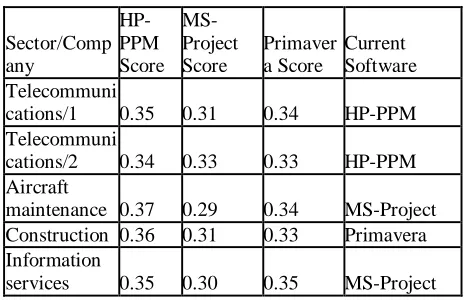
After interviews with 5 experts from different sectors namely telecommunication, aircraft maintenance, construction, and information services, calculations were completed using AHP template prepared with Excel and the results are presented in Table 5. As it can be seen from Table 5, scores are not very far away from each other. Based on the pair wise criteria comparisons of two experts from communication sectors who are currently using HP-PPM as project management tool, HP-PPM was determined as the most appropriate tool for their demands. An expert, who is currently using MS-Project, from aircraft maintenance sector applied pairwise criteria comparison based on the needs of the projects that he executed and it is determined that HP-PPM is the most appropriate tool for his needs. Moreover, another expert who is also using MS-Project currently applied AHP and both HP-PPM and Primavera were found to be the most suitable tools having equal scores. Finally, after calculations that were made based on the pair wise criteria comparison of expert who is currently using Primavera from construction sector, HP-PPM was determined as the most appropriate tool for the needs of the expert.
Table 5: AHP Scores
Sector/Comp any
HP-PPM Score
MS-Project Score
Primaver a Score
Current Software Telecommuni
cations/1 0.35 0.31 0.34 HP-PPM
Telecommuni
cations/2 0.34 0.33 0.33 HP-PPM
Aircraft
maintenance 0.37 0.29 0.34 MS-Project
Construction 0.36 0.31 0.33 Primavera
Information
services 0.35 0.30 0.35 MS-Project
Sub-criteria based results can be summarized as follows:
According to the sub criteria weights among tools, for all companies the weight of the cost criteria is the highest in HP-PPM tool. For the criteria of user friendliness, it has the highest weight in MS-Project according to the preferences of all companies.
195
Copyright © 2011-15. Vandana Publications. All Rights Reserved.
For the company from aircraft maintenance sector,MS-Project is the best tool, Primavera is the second best tool and HP-PPM is the third best tool for vendor/consultant criteria. For the companies from telecommunication and construction sectors, MS-Project and Primavera are the best tools with equal weights for vendor/consultant criteria. For the company from information services, HP-PPM is the best tool for vendor/consultant criteria.
V.
CONCLUSION
The selection of project management tool is a very critical decision that affects the efficiency and effectiveness of operations and also affects the control of the projects. The aim of this study is to focus on selection of project management software using AHP method.
The main steps completed in this study are as follows: Literature about project management is searched comprehensively and the most crucial criteria are extracted. Interviews with experts are conducted and criteria are determined for AHP by also taking into account the criteria from literature. Moreover, three mostly used project management software packages are elected as alternatives for AHP. After that, weights for these three alternatives are determined according to pre-determined criteria by interviewing experts. The model is developed in Excel. AHP is applied with five experts from different sectors and they made pairwise criteria comparisons based on their priorities. Finally, calculations are made and results are formed.
Results show that HP-PPM is the most appropriate tool for various businesses interviewed. Depending on AHP results, it can be asserted that interviewed companies from the telecommunication sector already have the best project management tool to manage and control their projects. As for the interviewed companies from aircraft maintenance, construction and information/communication services sector, the tools they are using are not appropriate for them. Therefore, it can be concluded that they may benefit from changing their project management tool. Nonetheless, this project should be broadened by including other sectors and interviewing more companies from each sector to generalize the conclusions.
REFERENCES
[1] Eilat, H., Golany, B. & Shtub, A. (2008). R&D project evaluation: An integrated DEA and balanced scorecard approach. Omega: the international journal of management science, 36, 895-912.
[2] Farzaneh, M., Vaani, I. & Sohrabi, B. (2013). A survey of influential factors in the implementation of enterprise resource planning system. International Journal of Enterprise Information Systems, 9(1), 76-96.
[3] HP-PPM (2014). HP Project and Portfolio Management. [Online] Available:
http://www8.hp.com/us/en/software- solutions/project-portfolio-management-it-portfolio-management/?jumpid=reg_r1002_usen_c-001_title_r0001 (October 20, 2014)
[4] Jadhav, A.S. &Sonar, R.M. (2009). Evaluating and selecting software packages: A review. Information and Software Technology, 51(3), 555-563.
[5] Kamal M. Al-Subhi Al-Harbi. (2001). Application of the AHP in project management. International Journal of Project Management, 19, 19-27.
Merkin, B.G. (1979). Group Choice. New York: John Wiley & Sons.
[6] MS-Project. (2014). Deliver winning projects. [Online] Available:http://products.office.com/en-us/project/project-and-portfolio-management-software (October 20, 2014) [7] Primavera. (2008). Oracle-Primavera. [Online] Available: http://www.oracle.com/us/products/applications/primavera/05 7415.pdf (October 20, 2014)
[8] Saaty, T.L. (1980). The analytic hierarchy process. New York: McGraw-Hill.
[9] Sarkis, J., & Talluri, S. (2004). Evaluating and selecting e-commerce software and systems for a supply chain. European Journal of Operational Research, 159, 318-329. [10] Silva, J., Fernandes, J., Gonçalves, J. & Cunha, M. (2013). Criteria for ERP selection using AHP approach, 8th Iberian Conference on Information Systems and Technologies (CISTI), 1-6.
[11] UnescoBangkok. (2008). Using project management software in education. [Online] Available:
http://www.unescobkk.org/education/ict/online-
resources/databases/ict-in-education- database/item/article/using-project-management-software-in-education (October 20, 2014)
[12] Zahedi,M.R., Yousefi,S. & Cheshberah,M. (2011). A fuzzy quality function deployment approach to enterprise resource planning software selection. Asian Journal of Scientific Research, 4(2), 114-128.
[13] BUSSARD, A., MARČEK, E., MARKUŠ, M.,
BUNČÁK, M. Spoločensky zodpovedné
podnikanie - Prehľad základných princípov a príkladov.