On the optimality of the Hedge algorithm in the stochastic
regime
Jaouad Mourtada [email protected]
Centre de Math´ematiques Appliqu´ees ´
Ecole Polytechnique Palaiseau, France
St´ephane Ga¨ıffas [email protected]
Laboratoire de Probabilit´es, Statistique et Mod´elisation Universit´e Paris Diderot
Paris, France
Editor:Laurent Orseau
Abstract
In this paper, we study the behavior of the Hedge algorithm in the online stochastic setting. We prove that anytime Hedge with decreasing learning rate, which is one of the simplest algorithm for the problem of prediction with expert advice, is remarkably both worst-case optimal and adaptive to the easier stochastic and adversarial with a gap problems. This shows that, in spite of its small, non-adaptive learning rate, Hedge possesses the same optimal regret guarantee in the stochastic case as recently introduced adaptive algorithms. Moreover, our analysis exhibits qualitative differences with other versions of the Hedge algorithm, such as the fixed-horizon variant (with constant learning rate) and the one based on the so-called “doubling trick”, both of which fail to adapt to the easier stochastic setting. Finally, we determine the intrinsic limitations of anytime Hedge in the stochastic case, and discuss the improvements provided by more adaptive algorithms.
Keywords. Online learning; prediction with expert advice; Hedge; adaptive algorithms.
1. Introduction
The standard setting of prediction with expert advice (Littlestone and Warmuth, 1994; Freund and Schapire, 1997; Vovk, 1998; Cesa-Bianchi and Lugosi, 2006) aims to provide sound strategies for sequential prediction that combine the forecasts from different sources. More precisely, in the so-calledHedge problem (Freund and Schapire, 1997), at each round the learner has to output a probability distribution on a finite set of experts {1, . . . , M}; the losses of the experts are then revealed, and the learner incurs the expected loss from its chosen probability distribution. The goal is then to control the regret, defined as the difference between the cumulative loss of the learner and that of the best expert (with smallest loss). This online prediction problem is typically considered in the individual sequences framework, where the losses may be arbitrary and in fact set by an adversary that seeks to maximize the regret. This leads to regret bounds that hold under virtually no assumption (Cesa-Bianchi and Lugosi, 2006).
c
In this setting, arguably the simplest and most standard strategy is the Hedge algo-rithm(Freund and Schapire, 1997), also called theexponentially weighted averaged forecaster (Cesa-Bianchi and Lugosi, 2006). This algorithm depends on a time-varying parameter ηt
called thelearning rate, which quantifies by how much the algorithm departs from its ini-tial probability distribution to put more weight on the currently leading experts. Given a known finite time horizon T, the standard tuning of the learning rate is fixed and given by ηt=η ∝
p
log(M)/T, which guarantees an optimal worst-case regret of orderO(√TlogM). Alternatively, whenT is unknown, one can set ηt∝
p
log(M)/tat round t, which leads to an anytime O(√TlogM) regret bound valid for allT >1.
While worst-case regret bounds are robust and always valid, they turn out to be overly pessimistic in some situations. A recent line of research (Cesa-Bianchi et al., 2007; de Rooij et al., 2014; Gaillard et al., 2014; Koolen et al., 2014; Sani et al., 2014; Koolen and van Erven, 2015; Luo and Schapire, 2015) designs algorithms that combineO(√TlogM) worst-case regret guarantees with an improved regret on easier instances of the problem. An interesting example of such an easier instance is the stochastic problem, where it is assumed that the losses are stochastic and that at each round the expected loss of a “best” expert is smaller than those of the other experts by some gap ∆. Such algorithms rely either on a more careful, data-dependent tuning of the learning rate ηt (Cesa-Bianchi et al., 2007;
de Rooij et al., 2014; Koolen et al., 2014; Gaillard et al., 2014), or on more sophisticated strategies (Koolen and van Erven, 2015; Luo and Schapire, 2015). As shown by Gaillard et al. (2014) (see also Koolen et al. 2016), one particular type of adaptive regret bounds (so-called second-order bounds) implies at the same time a O(√TlogM) worst-case bound and a betterconstant O(log(M)/∆) bound in the stochastic problem with gap ∆. Arguably starting with the early work on second-order bounds (Cesa-Bianchi et al., 2007), the design of online learning algorithms that combine robust worst-case guarantees with improved performance on easier instances has been an active research goal in recent years (de Rooij et al., 2014; Gaillard et al., 2014; Koolen et al., 2014; Sani et al., 2014). However, to the best of our knowledge, existing work on the Hedge problem has focused on developing new adaptive algorithms rather than on analyzing the behavior of “conservative” algorithms in favorable scenarios. Owing to the fact that the standard Hedge algorithm is designed for — and analyzed in — the adversarial setting (Littlestone and Warmuth, 1994; Freund and Schapire, 1997; Cesa-Bianchi and Lugosi, 2006), and that its parameters are not tuned adaptively to obtain better bounds in easier instances, it may be considered as overly conservative and not adapted to stochastic environments.
Our contribution. This paper fills a gap in the existing literature by providing an anal-ysis of the standard Hedge algorithm in the stochastic setting. We show that the anytime Hedge algorithm with default learning rateηt∝
p
log(M)/tactuallyadapts to the stochas-tic setting, in which it achieves an optimal constant O(log(M)/∆) regret bound without any dedicated tuning for the easier instance, which might be surprising at first sight. This contrasts with previous works, which require the construction of new adaptive (and more involved) algorithms. Remarkably, this property is not shared by the variant of Hedge for a known fixed-horizon T with constant learning rate η ∝ p
Given the aforementioned adaptivity of Decreasing Hedge, one may wonder whether there is in fact any benefit in using more sophisticated algorithms in the stochastic regime. We answer this question affirmatively, by considering a more refined measure of complexity of a stochastic instance than the gap ∆. Specifically, we show that Decreasing Hedge does not admit improved regret under Bernstein conditions, which are standard low-noise con-ditions from statistical learning (Mammen and Tsybakov, 1999; Tsybakov, 2004; Bartlett and Mendelson, 2006). By contrast, it was shown by Koolen et al. (2016) that algorithms which satisfy some adaptive adversarial regret bound achieve improved regret under Bern-stein conditions. Finally, we characterize the behavior of Decreasing Hedge in the stochastic regime, by showing that its eventual regret on any stochastic instance is governed by the gap ∆.
Related work. In the bandit setting, where the feedback only consists of the loss of the selected action, there has also been some interest in “best-of-both-worlds” algorithms that combine optimal O(√M T) worst-case regret in the adversarial regime with improved O(MlogT) regret (up to logarithmic factors) in the stochastic case (Bubeck and Slivkins, 2012; Seldin and Slivkins, 2014; Auer and Chiang, 2016). In particular, Seldin and Slivkins (2014); Seldin and Lugosi (2017) showed that by augmenting the standard EXP3 algorithm for the adversarial regime (an analogue of Hedge with Θ(1/√t) learning rate) with a special-purpose gap detection mechanism, one can achieve poly-logarithmic regret in the stochastic case. This result is strengthened in some recent follow-up work (Zimmert and Seldin, 2019; Zimmert et al., 2019), that appeared since the completion of the first version of the present paper, which obtains optimal regret in the stochastic and adversarial regimes through a variant of the Follow-The-Regularized-Leader (FTRL) algorithm with Θ(1/√t) learning rate and a proper regularizer choice. This result can be seen as an analogue in the bandit case of our upper bound for Decreasing Hedge. Note that, in the bandit setting, the hardness of an instance is essentially characterized by the gap ∆ (Bubeck and Cesa-Bianchi, 2012); in particular, the Bernstein condition, which depends on the correlations between the losses of the experts, cannot be exploited under bandit feedback, where one only observes one arm at each round. Hence, it appears that the negative part of our results (on the limitations of Hedge) does not have an analogue in the bandit case.
Outline. We define the setting of prediction with expert advice and the Hedge algorithm in Section 2, and we recall herein its standard worst-case regret bound. In Section 3, we consider the behavior of the Hedge algorithm on easier instances, namely the stochastic setting with a gap ∆ on the best expert. Under an i.i.d assumption on the sequence of losses, we provide in Theorem 2 an upper bound on the regret of order (logM)/∆ for Decreasing Hedge. In Proposition 4, we prove that the rate (logM)/∆ cannot be improved in this setting. In Theorem 5 and Corollary 6, we extend the regret guarantees to the adversarial with a gap setting, where a leading expert linearly outperforms the others. These results stand for any Hedge algorithm which is worst-case optimal and with any learning rate which is larger than the one of Decreasing Hedge, namelyO(plogM/t). In Proposition 7, we prove the sub-optimality of the fixed-horizon Hedge algorithm, and of another version of Hedge based on the so-called “doubling trick”. In Section 4, we discuss the advantages of adaptive Hedge algorithms, and explain what the limitations of Decreasing Hedge are compared to such versions. We include numerical illustrations of our theoretical findings in Section 5, conclude in Section 6 and provide the proofs in Section 7.
2. The expert problem and the Hedge algorithm
In the Hedge setting, also called decision-theoretic online learning (Freund and Schapire, 1997), the learner and its adversary (the Environment) sequentially compete on the following game: at each roundt>1,
1. the Learner chooses a probability vectorvt= (vi,t)16i6M on theM experts 1, . . . , M;
2. the Environment picks a bounded loss vector `t= (`i,t)16i6M ∈[0,1]M, where `i,t is
the loss of expert iat roundt, while the Learner suffers loss`bt=vt>`t.
The goal of the Learner is to control its regret
RT = T
X
t=1 b
`t− min
16i6M T
X
t=1
`i,t (1)
for every T > 1, irrespective of the sequence of loss vectors `1,`2, . . . chosen by the En-vironment. One of the most standard algorithms for this setting is the Hedge algorithm. The Hedge algorithm, also called the exponentially weighted averaged forecaster, uses the vector of probabilities vt= (vi,t)16i6M given by
vi,t=
e−ηtLi,t−1
PM
j=1e−ηtLj,t−1
(2)
at eacht>1, whereLi,T =PtT=1`i,tdenotes the cumulative loss of expertifor everyT >1.
Let us also denoteLbT := PT
t=1`btand Ri,T =LbT −Li,T the regret with respect to expert i. We consider in this paper the following variants of Hedge, wherec0 >0 is a constant.
Decreasing Hedge (Auer et al., 2002). This is Hedge with the sequence of learning rates ηt=c0
p
Constant Hedge (Littlestone and Warmuth, 1994). Given a finite time horizon T > 1, this is Hedge with constant learning rate ηt=c0
p
log(M)/T.
Hedge with doubling trick(Cesa-Bianchi et al., 1997; Cesa-Bianchi and Lugosi, 2006). This variant of Hedge uses a constant learning rate on geometrically increasing intervals, restarting the algorithm at the beginning of each interval. Namely, it uses
vi,t =
exp(−ηtPts−=1Tk`i,s)
PM
j=1exp(−ηt
Pt−1
s=Tk`j,s)
, (3)
withTl= 2l forl>0,k∈Nsuch thatTk6t < Tk+1 and ηt=c0 p
log(M)/Tk.
Let us recall the following standard regret bound for the Hedge algorithm from Chernov and Zhdanov (2010).
Proposition 1 Let η1, η2, . . . be a decreasing sequence of learning rates. The Hedge algo-rithm (2) satisfies the following regret bound:
RT 6
1 ηT
logM+1 8
T
X
t=1
ηt. (4)
In particular, the choice ηt = 2
p
log(M)/t yields a regret bound of √TlogM for every T >1.
Note that the regret bound stated in Equation (4) holds for every sequence of losses
`1,`2, . . ., which makes it valid under no assumption (aside from the boundedness of the losses). The worst-case regret bound in O(√TlogM) is achieved by Decreasing Hedge, Hedge with doubling trick and Constant Hedge (whenever T is known in advance). The O(√TlogM) rate cannot be improved either by Hedge or any other algorithm: it is known to be the minimax optimal regret (Cesa-Bianchi and Lugosi, 2006). Contrary to Constant Hedge, Decreasing Hedge is anytime, in the sense that it achieves the O(√TlogM) regret bound simultaneously for each T >1. We note that this worst-case regret analysis fails to exhibit any difference between these three algorithms.
In many cases, this √T regret bound is pessimistic, and more “aggressive” strategies (such as the follow-the-leader algorithm, which plays at each round the uniform distribution on the experts with smallest loss, Cesa-Bianchi and Lugosi, 2006) may achieve constant regret in easier instances, even though they lack regret guarantees in the adversarial regime. We show in Section 3 below that Decreasing Hedge is actually better than both Constant Hedge and Hedge with doubling trick in some easier instance of the problem (including in the stochastic setting). This entails that Decreasing Hedge is actually able to adapt, without any modification, to the easiness of the problem considered.
3. Regret of Hedge variants on easy instances
3.1. Optimal regret for Decreasing Hedge in the stochastic regime
We examine the behavior of Decreasing Hedge in the stochastic regime, where the losses are the realization of some (unknown) stochastic process. More precisely, we consider the standard i.i.d. case, where the loss vectors `1,`2, . . . are i.i.d. (independence holds over rounds, but not necessarily across experts). In this setting, the regret can be much smaller than the worst-case √TlogM regret, since the best expert (with smallest expected loss) will dominate the rest after some time. Following Gaillard et al. (2014); Luo and Schapire (2015), the easiness parameter we consider in this case, which governs the time needed for the best expert to have the smallest cumulative loss and hence the incurred regret, is the sub-optimality gap ∆ = mini6=i∗E[`i,t−`i∗,t], where i∗= argminiE[`i,t].
We show below that, despite the fact that Decreasing Hedge is designed for the worst-case setting described in Section 2, it is able to adapt to the easier problem considered here, Indeed, Theorem 2 shows that Decreasing Hedge achieves a constant, and in fact optimal (by Proposition 4 below) regret bound in this setting, in spite of its “conservative” learning rate.
With the exception of the high-probability bound of Corollary 6, the upper and lower bounds in the stochastic case are stated for thepseudo-regret RT =E[Ri∗,T] (similar bounds
hold for the the expected regretE[RT], sinceRT 6E[RT] and by Remark 14 in Section 7.1).
Theorem 2 LetM >3. Assume that the loss vectors`1,`2, . . . are i.i.d. random variables, where `t= (`i,t)16i6M. Also, assume that there existsi∗∈ {1, . . . , M} and∆>0 such that
E[`i,t−`i∗,t]>∆ (5)
for everyi6=i∗. Then, the Decreasing Hedge algorithm with learning rateηt= 2
p
(logM)/t achieves the following pseudo-regret bound: for every T >1,
RT 6
4 logM+ 25
∆ . (6)
The proof of Theorem 2 is given in Section 7.1. Theorem 2 proves that, in the stochas-tic setting with a gap ∆, the Decreasing Hedge algorithm achieves a regretO(log(M)/∆), without any prior knowledge of ∆. This matches the guarantees of adaptive Hedge algo-rithms which are explicitly designed to adapt to easier instances (Gaillard et al., 2014; Luo and Schapire, 2015). This result may seem surprising at first: indeed, adaptive exponen-tial weights algorithms that combine optimal regret in the adversarial setting and constant regret in easier scenarios, such as Hedge with a second-order tuning (Cesa-Bianchi et al., 2007) or AdaHedge (de Rooij et al., 2014), typically use a data-dependent learning rate ηt that adapts to the properties of the losses. While the learning rate ηt chosen by these
algorithms may be as low as the worst-case tuningηt∝
p
log(M)/t, in the stochastic case those algorithms will use larger, lower-bounded learning rates to ensure constant regret. As Theorem 2 above shows, it turns out that the data-independent, “safe” learning rates ηt∝
p
Idea of the proof. The idea of the proof of Theorem 2 is to divide time in two phases: a short initial phase [[1, t1]], where t1 = O(log∆M2 ), and a second phase [[t1, T]]. The initial
phase is dominated by noise, and regret during this period is bounded through the worst-case regret bound of Proposition 1, which gives a regret of O(√t1logM) = O(log∆M). In the second phase, the best expert dominates the rest, and the weights concentrate on this best expert fast enough that the total regret incurred is small. The control of the regret in the second phase relies on the critical fact that, if ηt is at least as large as
p
(logM)/t, then the following two things occur simultaneously att1 log∆M2 , namely at the beginning
of the late phase:
1. with high probability, the best expert i∗ dominates all the others linearly: for every i6=i∗ andt>t1,Li,t−Li∗,t > ∆t
2 ;
2. the total weight of all suboptimal experts is controlled: P
i6=i∗vi,t1 6
1
2. If ηt > p
(logM)/tand the first condition holds, this amounts to Mexp(−∆2√tlogM)6 12, namely t1& log∆M2 .
In other words, the learning rate ηt
p
(logM)/t ensures that the total weight of subop-timal experts starts vanishing at about the same time as when the best expert starts to dominate the others with a large probability (and remarkably, this property holds for every value of the sub-optimality gap ∆). Finally, the upper bound on the regret in the second phase rests on the two conditions above, together with the bound P
t>1e
−c√t =O(1
c2) for
c >0.
Remark 3 The fact thatP
t>1e−c
√
t=O(1/c2)is also used in the analysis of the EXP3++ bandit algorithm (Seldin and Slivkins, 2014, Lemma 10). In the expert setting considered here, summing the contribution of all experts (which suffices in the bandit setting to obtain the correct order of regret) would yield a significantly suboptimal O(M/∆) regret bound, with a linear dependence on the number of experts M. In our case, the decomposition of the regret in two phases, which is explained above, removes the linear dependence onM and allows to obtain the optimal rate (logM)/∆.
We complement Theorem 2 by showing that the O((logM)/∆) regret under the gap condition cannot be improved, in the sense that its dependence on bothM and ∆ is optimal.
Proposition 4 Let ∆∈(0,14), M >4 and T >(logM)/(16∆2). Then, for any algorithm for the Hedge setting, there exists an i.i.d. distribution over the sequence of losses (`t)t>1 such that:
• there existsi∗ ∈ {1, . . . , M} such that, for any i6=i∗, E[`i,t−`i∗,t]>∆;
• the pseudo-regret of the algorithm satisfies:
RT >
logM
256∆ . (7)
The proof of Proposition 4 is given in Section 7.2. Proposition 4 generalizes the well-known minimax lower bound of Θ(√TlogM), which is recovered by taking ∆
p
3.2. Small regret for Decreasing Hedge in the adversarial with a gap problem
In this section, we extend the regret guarantee of Decreasing Hedge in the stochastic setting (Theorem 2), by showing that it holds for more general algorithms and under more general assumptions. Specifically, we consider an “adversarial with a gap” regime, similar to the one introduced by Seldin and Slivkins (2014) in the bandit case, where the leading expert linearly outperforms the others after some time. As Theorem 5 shows, essentially the same regret guarantee can be obtained in this case, up to an additional log(∆−1)/∆ term. Theorem 5 also applies to any Hedge algorithm whose (possibly data-dependent) learning rateηt is at
least as large as that of Decreasing Hedge, and which satisfies a O(√TlogM) worst-case regret bound; this includes algorithms with anytime first and second-order tuning of the learning rate (Auer et al., 2002; Cesa-Bianchi et al., 2007; de Rooij et al., 2014). In what follows, we will assume M >3 for convenience, similar results holds for M = 2.
Theorem 5 Let M >3. Assume that there exists τ0 >1, ∆∈(0,1)and i∗ ∈ {1, . . . , M} such that,for every t>τ0 and i6=i∗, one has
Li,t−Li∗,t>∆t. (8)
Consider any Hedge algorithm with (possibly data-dependent) learning rate ηt such that
• ηt>c0 p
(logM)/t for some constant c0 >0;
• it admits the following worst-case regret bound: RT 6 c1
√
TlogM for every T >1, for some c1 >0.
Then, for every T >1, the regret of this algorithm is upper bounded as
RT 6c1
p
τ0logM+ c2logM +c3log ∆
−1+c 4
∆ (9)
where c2 =c1+
√
8
c0 , c3 = √
8
c0 and c4 =
16
c2 0
.
The idea of the proof of Theorem 5 is the same as that of Theorem 2, the only difference being the slightly longer initial phase to account for the adversarial nature of the losses. As a consequence of the general bound of Theorem 5, we can recover the guarantee of Theorem 2 (up to an additional log(∆−1)/∆ term), both in expectation and with high probability, under more general stochastic assumptions than i.i.d. over time. The proofs of Theorem 5 and Corollary 6 are provided in Section 7.3.
Corollary 6 Assume that the losses (`i,t)16i6M,t>1 are random variables. Also, denoting
Ft=σ (`i,s)16i6M,16s6t
, assume that there exists i∗ and ∆>0 such that
E[`i,t−`i∗,t| Ft−1]>∆ (10)
for every i6=i∗ and every t >1. Then, for any Hedge algorithm satisfying the conditions of Theorem 5, and everyT >1:
RT 6(5c1+ 2c2)logM
∆ + 2c3
log ∆−1
∆ +
2c4
with c1, c2, c3, c4 as in Theorem 5. In addition, for every ε∈(0,1), we have
RT 6
c1
√
8 + 2c2
logM
∆ +c1
p
8 logMlogε−1
∆ + 2c3
log ∆−1
∆ +
2c4
∆ (12)
with probability at least 1−ε.
3.3. Constant Hedge and Hedge with the doubling trick do not adapt to the stochastic case
Now, we show that the adaptivity of Decreasing Hedge to gaps in the losses, established in Sections 3.1 and 3.2, is not shared by the two closely related Constant Hedge and Hedge with the doubling trick, despite the fact that they both achieve the minimax optimal worst-caseO(√TlogM) regret. Proposition 7 below shows that both algorithms fail to achieve a constant regret, and in fact to improve over their worst-case Θ(√TlogM) regret guarantee, even in the extreme case of experts with constant losses 0 (for the leader), and 1 for the rest (i.e., ∆ = 1).
Proposition 7 Let T > 1, M > 2, and consider the experts i = 1, . . . , M with losses `1,t = 0, `i,t = 1 (16t6T,26i6M). Then, the pseudo-regret of Constant Hedge with
learning rate ηt =c0 p
log(M)/T (where c0 >0 is a numerical constant) is lower bounded as follows:
RT >min
√
TlogM 3c0
,T 3
. (13)
In addition, Hedge with doubling trick (3) also suffers a pseudo-regret satisfying
RT >min
√
TlogM 6c0
, T 12
. (14)
The proof of Proposition 7 is given in Section 7.4. Although Hedge with a doubling trick is typically considered as overly conservative and only suitable for worst-case scenarios Cesa-Bianchi and Lugosi, 2006 (especially due to its periodic restarts, after which it discards past observations), to the best of our knowledge Proposition 7 (together with Theorem 2) is the first to formally demonstrate the advantage of Decreasing Hedge over the doubling trick version. This implies that Decreasing Hedge should not be seen as merely a substitute for Constant Hedge to achieve anytime regret bounds. Indeed, even when the horizon T is fixed, Decreasing Hedge outperforms Constant Hedge in the stochastic setting.
4. Limitations of Decreasing Hedge in the stochastic case
Definition 8 (Bernstein condition) Assume that the losses`1,`2, . . . are the realization of a stochastic process. Denote Ft=σ(`1, . . . ,`t) the σ-algebra generated by`1, . . . ,`t. For
β ∈ [0,1] and B > 0, the losses are said to satisfy the (β, B)-Bernstein condition if there exists i∗ such that, for every t>1 and i6=i∗,
E[(`i,t−`i∗,t)2| Ft−1]6BE[`i,t−`i∗,t| Ft−1]β. (15)
The Bernstein condition (Bartlett and Mendelson, 2006), a generalization of the Tsy-bakov margin condition (TsyTsy-bakov, 2004; Mammen and TsyTsy-bakov, 1999), is a geometric property on the losses which enables to obtain fast rates (e.g., faster than O(1/√n) for parametric classes) in statistical learning; we refer to van Erven et al. (2015) for a discus-sion of fast rates conditions. The Bernstein condition (15) quantifies the “easiness” of a stochastic instance, and generalizes the gap condition considered in the previous section (see Example 1 below). Roughly speaking, it states that good experts (with near-optimal expected loss) are highly correlated with the best expert. In the examples below, we assume that the loss vectors`1,`2, . . . are i.i.d.
Example 1 (Gap implies Bernstein) If ∆i = E[`i,t −`i∗,t] > ∆ for i 6= i∗, then the
(1,∆1)-Bernstein condition holds (Koolen et al., 2016, Lemma 4). Furthermore, letting α =E[`i∗,t] denote the expected loss of the best expert, the (1,1 +2α
∆)-Bernstein condition holds. Indeed, for any i6= i∗, denoting µi := E[`i,t] = α+ ∆i, we have (since (u−v)2 6
max(u2, v2)6u2+v2 6u+v for u, v∈[0,1]):
E(`i,t−`i∗,t)26E[`i,t+`i∗,t] = µi+α
µi−αE
[`i,t−`i∗,t] =
1 +2α
∆i
E[`i,t−`i∗,t],
which establishes the claim since∆i >∆. This provides an improvement whenα is small.
Example 2 (Bernstein without a gap) Let P be a distribution on X × {0,1}, whereX
is some measurable space. Assume that(X1, Y1),(X2, Y2). . . are i.i.d. samples fromP, and that the experts i∈ {1, . . . , M} correspond to classifiers fi :X → {0,1}: `i,t =1(fi(Xt)6=
Yt), and that expert i∗ is the Bayes classifier: fi∗(X) = 1(η(X) > 1/2), where η(X) =
P(Y = 1|X). Tsybakov’s low noise condition (Tsybakov, 2004), namely P(|2η(X)−1|6
t)6Ctκ for some C >0, κ>0 and every t >0, implies the (κκ+1, B)-Bernstein condition for some B (see, e.g., Boucheron et al., 2005). In addition, under the Massart condition (Massart and N´ed´elec, 2006) that|η(X)−1/2|>c >0, the(1,1/(2c))-Bernstein condition holds. Note that these conditions may hold even with an arbitrarily small sub-optimality gap ∆, since the fi, i6=i∗, may be arbitrary.
Theorem 9 below shows that Decreasing Hedge fails to achieve improved rates under Bernstein conditions.
Theorem 9 For every T >1, there exists a (1,1)-Bernstein stochastic instance on which the pseudo-regret of the Decreasing Hedge algorithm with ηt=c0
p
(logM)/tsatisfiesRT >
1 3min(
1
c0 √
The proof of Theorem 9 is given in Section 7.6. By contrast, it was shown by Koolen et al. (2016) (and implicitly used by Gaillard et al., 2014) that some adaptive algorithms with data-dependent regret bounds enjoy improved regret under the Bernstein condition. For the sake of completeness, we state this fact in Proposition 10 below, which corresponds to Koolen et al. (2016, Theorem 2), but where the dependence onB is made explicit. We also only provide a bound in expectation, which considerably simplifies the proof. The proof of Proposition 10, which uses the same ideas as Gaillard et al. (2014, Theorem 11), is provided in Section 7.5.
Proposition 10 Consider an algorithm for the Hedge problem which satisfies the following regret bound: for every i∈ {1, . . . , M},
Ri,T 6C1 v u u
t(logM)
T
X
t=1
(`bt−`i,t)2+C2logM (16)
where C1, C2 >0 are constants. Assume that the losses satisfy the (β, B)-Bernstein condi-tion. Then, the pseudo-regret of the algorithm satisfies:
RT 6C3(BlogM)
1 2−βT
1−β
2−β +C
4logM (17)
where C3 = max(1,4C12) and C4 = 2C2.
The data-dependent regret bound (16), a “second-order” bound, is satisfied by adaptive algorithms such as Adapt-ML-Prod (Gaillard et al., 2014) and Squint (Koolen and van Erven, 2015). A slightly different variant of second-order regret bounds, which depends on some cumulative variance of the losses across experts, has been considered by Cesa-Bianchi et al. (2007); de Rooij et al. (2014), and is achieved by Hedge algorithms with a data-dependent tuning of the learning rate. Second-order bounds refine so-calledfirst-order bounds (Cesa-Bianchi et al., 1997; Auer et al., 2002; Cesa-Bianchi and Lugosi, 2006), which are adversarial regret bounds that scale as O(p
L∗T logM+ logM), where L∗T denotes the cumulative loss of the best expert. While first-order bounds may still scale as the worst-caseO(√TlogM) rate in a typical stochastic instance (where the best expert has a positive expected loss), second-order algorithms are known to achieve constantO((logM)/∆) regret in the stochastic case with gap ∆ (Gaillard et al., 2014; Koolen and van Erven, 2015).
Remark 11 The advantage of larger learning rates on some stochastic instances may be understood intuitively as follows. Consider an instance with B small but small gap∆. The learning rate of Decreasing Hedge is large enough so that it can rule out bad experts (with large enough gap ∆i) at the optimal rate (i.e., at time (logM)/∆2i). However, once these
bad experts are ruled out, near-optimal experts (with small gap∆i) are ruled out late (after
(logM)/∆2i rounds). On the other hand, the Bernstein assumption entails that those experts are highly correlated with the best expert, the amount of noise on the relative losses of these near-optimal experts is small, so that a larger learning rate could be safely used and would enable to dismiss near-optimal experts sooner.
Setting the Bernstein condition aside, we conclude by investigating the intrinsic limi-tations of Decreasing Hedge in the stochastic setting. Indeed, it is natural to ask whether Decreasing Hedge can exploit some other regularity of a stochastic instance, apart from the gap ∆. Theorem 12 shows that this is in fact not the case.
Theorem 12 For every i.i.d. (over time) stochastic instance with a unique best expert
i∗= argmin 16i6M E
[`i,t],
the pseudo-regret of Decreasing Hedge (with c0>1)satisfies
RT >
1 450c4
0(logM)2∆ for T > 4∆12,where ∆ := infi=6 i∗E[`i,t−`i∗,t].
Theorem 12 shows (together with the upper bound of Theorem 2) that the eventual regret of Decreasing Hedge onany stochastic instance is determined by the sub-optimality gap ∆, and scales (up to a log3M factor, depending on the number of near-optimal experts) as Θ(∆1). This characterizes the behavior of Decreasing Hedge on any stochastic instance. 5. Experiments
In this section, we illustrate our theoretical results by numerical experiments that compare the behavior of various Hedge algorithms in the stochastic regime.
Algorithms. We consider the following algorithms: hedgeis Decreasing Hedge with the default learning ratesηt= 2
p
log(M)/t,hedge constantis Constant Hedge with constant learning rate ηt =
p
8 log(M)/T,hedge doubling is Hedge with doubling trick with c0 =
√
8, adahedge is the AdaHedge algorithm from de Rooij et al. (2014), which is a variant of the Hedge algorithm with a data-dependent tuning of the learning rate ηt (based on
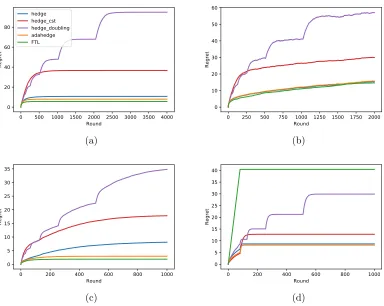
Results. We report in Figure 1 the cumulative regrets of the considered algorithms in four examples. The results for the stochastic instances (a), (b) and (c) described below are averaged over 50 trials.
(a) Stochastic instance with a gap. This is the standard instance considered in this paper. The losses are drawn independently from Bernoulli distributions (one of parameter 0.3, 2 of parameter 0.4 and 7 of parameter 0.5, so that M = 10 and ∆ = 0.1). The results of Figure 1a confirm our theoretical results: Decreasing Hedge achieves a small, constant regret which is close to that of AdaHedge and FTL, while Constant Hedge and Hedge with doubling trick suffer a larger regret of order√T (note that, although the expected regret of Constant Hedge converges in this case, the value of this limit depends on its learning rate and hence onT).
(b)“Hard” stochastic instance. This example has a zero gap ∆ = 0 between the two leading experts and M = 10, which makes it “hard” from the standpoint of Theorem 2 (which no longer applies in this limit case). The losses are drawn from independent Bernoulli distributions, of parameters 0.5 for the 2 leading experts, and 0.7 for the 8 remaining ones. Although all algorithms suffer an unavoidable Θ(√T) regret due to pure noise, Decreasing Hedge, AdaHedge and FTL achieve better regret than the two conservative Hedge variants (Figure 1b). This is due to the fact that for the former algorithms, the weights of suboptimal experts decrease quickly and only induce a constant regret.
(c)Small loss for the best expert. In this experiment, we illustrate one advantage of adaptive Hedge algorithms such as AdaHedge over Decreasing Hedge, namely the fact that they admit improved regret bounds when the leading expert has small loss. We considered in this experiment M = 10, ∆ = 0.04 and the leading expert is Beta(0.04,0.96), then 4
Beta(0.08,0.92), then 5 Beta(0.5,0.5).
(d) Adversarial with a gap instance. This simple instance is not random, and satisfies the assumptions of Theorem 5. It is defined by M = 3, ∆ = 0.04, `3,t = 34 for t > 1,
(`1,t, `2,t) = (12,0) ift = 1, (0,1) if t>80 or if tis even, and (1,0) otherwise. FTL suffers
linear regret in the first phase, while Constant Hedge and Hedge with doubling trick suffer Θ(√T) during the second phase.
6. Conclusion
In this article, we carried the regret analysis of the standard exponential weights (Hedge) algorithm in the stochastic expert setting, closing a gap in the existing literature. Our analysis reveals that, despite being tuned for the worst-case adversarial setting and lacking any adaptive tuning of the learning rate, Decreasing Hedge achieves optimal regret in the stochastic setting. This property also enables one to distinguish it qualitatively from other variants including the one with fixed (horizon-dependent) learning rate or the one with doubling trick, which both fail to adapt to gaps in the losses. To the best of our knowledge, this is the first result that shows the superiority of the decreasing learning rate over the doubling trick. In addition, it suggests that, even for a fixed time horizonT, the decreasing learning rate tuning should be favored over the constant one.
0 500 1000 1500 2000 2500 3000 3500 4000 Round
0 20 40 60 80
Regret
hedge hedge_cst hedge_doubling adahedge FTL
(a)
0 250 500 750 1000 1250 1500 1750 2000 Round
0 10 20 30 40 50 60
Regret
(b)
0 200 400 600 800 1000 Round
0 5 10 15 20 25 30 35
Regret
(c)
0 200 400 600 800 1000 Round
0 5 10 15 20 25 30 35 40
Regret
(d)
including algorithms achieving second-order regret bounds, can actually outperform De-creasing Hedge on some stochastic instances that exhibit a more refined form of “easiness”.
A link with stochastic optimization. Our results have a similar flavor to a well-known result (Moulines and Bach, 2011) about stochastic optimization: stochastic gradient descent (SGD) with learning rateηt∝1/
√
t(which is tuned for the convex case but not for the non-strongly convex case) and Polyak-Ruppert averaging achieves a fast O(1/(µt)) excess risk rate for µ-strongly convex problems, without the knowledge of µ. However, this link stops here since the two results are of a significantly different nature: theO(1/(µt)) rate is satisfied only by SGD with Polyak-Ruppert averaging, and it does not come from a regret bound; even in theµ-strongly convex case, it can be seen that SGD with step-sizeηt∝1/
√
tsuffers a Θ(√t) regret. In fact, the opposite phenomenon occurs: in stochastic optimization, SGD uses a larger Θ(1/√t) step-size than the Θ(1/(µt)) step size which exploits the knowledge of strong convexity, but the effect of this larger step-size is balanced by the averaging. By contrast, in the expert setting, Hedge uses asmaller Θ(p(logM)/t) learning rate than the constant, large enough learning rate which exploits the knowledge of the stochastic nature of the problem.
Acknowledgments. The authors wish to warmly thank all four Anonymous Reviewers for their helpful feedback and insights on this work. In particular, the proof of Proposition 4 was proposed by an Anonymous Referee, which allowed to shorten our initial proof.
7. Proofs
We now provide the proofs of the results from the previous Sections, by order of appearance in the text.
7.1. Proof of Theorem 2
Let t0 = l
8 logM
∆2
m
, so that√t0 6
q
1 +8 log∆2M 61 + √
8 logM
∆ (since
√
a+b6√a+√bfor a, b>0). The worst-case regret bound of Hedge (Proposition 1) shows that for 16T 6t0:
Ri∗,T 6
p
TlogM 6pt0logM 6 p
logM+2
√
2 logM
∆ 6
4 logM
∆ (18)
(since logM >1 asM >3, ∆61 and 2√263), which establishes (6) forT 6t0. In order to prove (6) for T >t0+ 1, we start by decomposing the regret with respect toi∗ as
Ri∗,T =LbT −Li∗,T =Lbt0 −Li∗,t0 +
T
X
t=t0+1
(`bt−`i∗,t). (19)
Since Lbt0 −Li∗,t0 6 Rt0 is controlled by (18), it remains to upper bound the second term in (19). First, for every t>t0+ 1,
b
`t−`i∗,t=
X
i6=i∗
Since `t is independent ofvt (which is σ(`1, . . . ,`t−1)-measurable), taking the expectation in (20) yields, denoting ∆i =E[`i,t−`i∗,t],
E[b`t−`i∗,t] = X
i6=i∗
∆iE[vi,t]. (21)
First, for everyi6=i∗, applying Hoeffding’s inequality to the i.i.d. centered variablesZi,t :=
−`i,t+`i∗,t+ ∆i, which belong to [−1 + ∆i,1 + ∆i], yields
P
Li,t−1−Li∗,t−1 < ∆i(t−1)
2
=P
t−1 X
s=1 Zi,s>
∆i(t−1)
2 !
6e−t−21(∆i/2) 2
=e−(t−1)∆2i/8. (22)
On the other hand, if Li,t−1−Li∗,t−1 >∆i(t−1)/2, then
vi,t=
e−ηt(Li,t−1−Li∗,t−1)
1 +P
j6=i∗e−ηt(Lj,t−1−Li∗,t−1) 6e−2
√
(logM)/t×∆i(t−1)/2
6e−∆i
√
(t−1)(logM)/2 (23)
sincet62(t−1). It follows from (23) and (22) that, for t>t0+ 1>2,
E[vi,t]6P
Li,t−1−Li∗,t−1> ∆i(t
−1) 2
+e−∆i
√
(t−1)(logM)/2
6e−(t−1)∆2i/8+e−∆i
√
(t−1)(logM)/2. (24)
Now, a simple analysis of functions shows that the functions f1(u) = ue−u and f2(u) = ue−u2/2 are decreasing on [1,+∞). Since ∆i >∆, this entails that
∆ie−(t−1)∆
2
i/8 = √ 2 t−1f2
√
t−1∆i
2
6 √ 2
t−1f2
√
t−1∆ 2
= ∆e−(t−1)∆2/8 (25)
provided that
√
t−1∆
2 >1, i.e. t>1 + 4
∆2, which is the case since t>t0+ 1>1 +8 log∆2M.
Likewise,
∆ie−∆i
√
(t−1)(logM)/2 6∆e−∆
√
(t−1)(logM)/2 (26) if ∆p(t−1)(logM)/2>1,i.e.t>1 +(logM2)∆2, which is ensured byt>t0+ 1. It follows from (21), (24), (25) and (26) that for every t>t0+ 1:
E[`bt−`i∗,t]6M∆e−(t−1)∆
2/8
+M∆e−∆
√
(t−1)(logM)/2 = M e−t0∆2/8 ∆e−(t−t0−1)∆2/8+ M e−∆
√
(t−1)(logM)/8
∆e−∆
√
(t−1)(logM)/8
6∆e−(t−t0−1)∆2/8+ ∆e−∆
√
where inequality (27) comes from the bound M e−t0∆2/8 61 (since t
0 > 8 log∆2M) and from
the fact that M e−∆
√
(t−1)(logM)/8
6 1 amounts to t > 1 + 8 log∆2M, that is, to t > t0+ 1.
Summing inequality (27) yields, for everyT >t0+ 1,
E[
T
X
t=t0+1
(`t−`i∗,t)]6 T
X
t=t0+1
n
∆e−(t−t0−1)∆2/8+ ∆e−∆ √
(t−1)/8o
6∆X
t>0
e−t∆2/8+ ∆X
t>1 e−(∆/
√
8)√t
6∆
1 + 8
∆2
+ ∆× 2
(∆/√8)2 (28)
6 25
∆ (29)
where inequality (28) comes from Lemma 13 below. Finally, combining inequalities (18) and (28) yields the pseudo-regret boundRT 6 4 logM∆+25.
Lemma 13 For every α >0,
X
t>1
e−αt6 1
α (30)
X
t>1 e−α
√
t6 2
α2 . (31)
Proof Since the functions t7→e−αt and t7→e−α
√
t are decreasing onR+, we have
X
t>1
e−αt6
Z ∞
0
e−αtdt= 1 α
X
t>1 e−α
√
t 6
Z +∞ 0
e−α
√
tdt = u=α√t
2 α2
Z +∞ 0
ue−udu= 2 α2.
Remark 14 While the upper bound of Theorem 2 is stated for the pseudo-regret RT, a similar upper bound holds for the expected regret E[RT]. Indeed, under the assumptions of
Theorem 2, for every T > 4 log∆2M, we have E[RT]6RT +
1.1 ∆.
Proof Note that E[RT]− RT = E[Li∗,T −min16i6TLi,T]. For every a > 0, Hoeffding’s
16t6T) entails
P
Li∗,T − min
16i6TLi,T >a
6X
i6=i∗
P(Li∗,T −Li,T + ∆iT >∆iT+a)
6X
i6=i∗
e−(∆iT+a)2/(2T) (32)
6M e−T∆2/2e−a2/(2T)
6e−T∆2/4e−a2/(2T), (33)
where inequality (33) comes from the fact that M e−T∆2/4 61 since T > 4 log∆2M. Since the
random variableLi∗,T −min16i6T Li,T is nonnegative, this implies that
E
Li∗,T − min
16i6TLi,T
=
Z ∞
0
P
Li∗,T − min
16i6TLi,T >a
da
6e−T∆2/4 Z ∞
0
e−a2/(2T)da =
r π 2 ·
√
T e−T∆2/4 =
√
π ∆
∆pT /2·e−(∆
√
T /2)2/2
6
p π/e
∆ (34)
where inequality (34) comes from the fact that the function u7→ue−u2/2 attains its maxi-mum onR+ atu= 1. This concludes the proof, since p
π/e61.1.
7.2. Proof of Proposition 4
Fix M, ∆ and T as in Proposition 4. For i∗ ∈ {1, . . . , M}, denote Pi∗ the following
distribution on [0,1]M×T: if (`i,t)16i6M,16t6T ∼Pi∗, then the variables `i,t are independent
Bernoulli variables, of parameter 12 −∆ if i = i∗ and 12 otherwise; also, denote by Ei∗
the expectation with respect to Pi∗. Let A= (At)16t6T be any Hedging algorithm, where
At : [0,1]M×(t−1) → PM maps past losses (`1, . . . ,`t−1) to an element of the probability
simplex PM ⊂ RM on {1, . . . , M}. For any i∗ ∈ {1, . . . , M}, let RT(i∗,A) denote the pseudo-regret of algorithm A under the distribution Pi∗. Since `t is independent of vt
underPi∗, we have
RT(i∗,A) =
T
X
t=1 X
i6=i∗
Ei∗vi,t(`i,t−`i∗,t)= ∆ T
X
t=1 X
i6=i∗
Ei∗[vi,t] = ∆ T
X
t=1
Ei∗[1−vi∗,t] (35)
b(logM)/(16∆2)c. The maximum pseudo-regret ofAon the instancesPi∗ is lower-bounded
as follows:
sup 16i∗6M
RT(i∗,A)>
1 M
X
16i∗6M
RT(i∗,A) =
1 M
X
16i∗6M
∆
T
X
t=1
Ei∗[1−vi∗,t]. (36)
We now “randomize” the algorithm A, by replacing it with a randomized algorithm which picks expert i at time t with probability vi,t. Formally, let Pe = U([0,1])⊗T be the distribution ofT independent uniform random variables on [0,1], and denotePei∗ =Pi∗⊗Pe for i∗ ∈ {1, . . . , M}. Furthermore, for every v ∈ PM, let Iv : [0,1] → {1, . . . , M} be a
measurable map such thatP(Iv(U) =i) =vi for everyi∈ {1, . . . , M}, whereU ∼ U([0,1]).
For every sequence of losses`1, . . . ,`T and random variablesU1, . . . , UT and every 16t6T,
let It=Ivt(Ut), where vt=At(`1, . . . ,`t).
Denote by Eei∗ the expectation with respect to Pei∗. By definition of Iv, we have
Ei∗[vi∗,t] = Eei∗[1(It = i∗)] so that, denoting Ni = PT
i=11(It = i) the number of times expertiis picked,
T
X
t=1
Ei∗[1−vi∗,t] =Eei∗[T −Ni∗]>Pi∗(Ni∗6T /2)· T
2 .
Hence, lettingAi ⊆[0,1]M×T×[0,1]T be the event{Ni> T /2}, Equation (36) implies that
sup 16i∗6M
RT(i∗,A)>
∆T
2 ×
1 M
X
16i∗6M
1−ePi∗(Ai∗)
. (37)
It now remains to upper bound M1 P
i∗ePi∗(Ai∗). To do this, first note that the events Ai∗, 1 6i∗ 6 M, are pairwise disjoint. Hence, Fano’s inequality (see Gerchinovitz et al.,
2017, p.2) implies that, for every distributionQe on [0,1]M×T ×[0,1]T,
1 M
X
16i∗6M
e
Pi∗(Ai∗)6 1
logM
1 M
X
16i∗6M
KL(Pei∗,Qe) + log 2
(38)
where KL(P,Q) denotes the Kullback-Leibler divergence between P and Q. Here, we take
e
Q=Q⊗Pe, whereQis the product of Bernoulli distributionsB(1/2)⊗T. This choice leads to
KL(Pei∗,Qe) = KL(Pi∗,Q) =T·KL(B(1/2−∆),B(1/2))64T∆26 logM
4 ,
where the first bound is obtained by comparing KL and χ2 divergences (Tsybakov, 2009, Lemma 2.7). Hence, inequality (38) becomes (recalling that M >4)
1 M
X
16i∗6M
e
Pi∗(Ai∗)6 (logM)/4
logM +
log 2
logM 6
3 4;
plugging this into (37) yields, noting that T =b(logM)/(16∆2)c >(logM)/(32∆2) since (logM)/(16∆2)>1 (asM >4 and ∆6 14),
sup 16i∗6M
RT(i∗,A)> ∆T
2 ×
1 4 >
logM 256∆ .
7.3. Proof of Theorem 5 and Corollary 6
Let t0 be the smallest integer t > 1 such that M e−c0∆
√
tlog(M)/8 6 ∆, namely t 0 = l
8
c2 0∆2
log2(M/∆) logM
m
. Note that√t0 6
r 1 +c28
0∆2
log2(M/∆) logM 61 +
√
8
c0∆
log(√M/∆)
logM . Lett1 :=t0∨τ0.
For every T 6t1, the regret bound in the assumption of Theorem 5 implies
RT 6c1 p
TlogM
6c1 p
τ0logM+c1 p
t0logM
6c1 p
τ0logM+c1 p
logM+
√
8 log(M/∆) c0∆
(39)
which implies (9) with c2 =c1+
√
8
c0 and c3 = √
8
c0 (since 1 6 √
logM 6 log∆M). From now on, assume thatT >t1+ 1. SinceT >τ0, we haveRT =LbT −Li∗,T, so that
RT =Lbt1 −Li∗,t1 +
T
X
t=t1+1
b
`t−`i∗,t. (40)
In addition, we have fort>t1+ 1
b
`t−`i∗,t=
X
i6=i∗
vi,t(`i,t−`i∗,t)
6X
i6=i∗
vi,t
=X
i6=i∗
e−ηt(Li,t−1−Li∗,t−1)
1 +P
j6=i∗e−ηt(Lj,t−1−Li∗,t−1)
6X
i6=i∗
e−c0 √
(logM)/t×∆(t−1) (41)
6M e−c0∆ √
(t−1)(logM)/2
6 M e−c0∆ √
t0(logM)/8e−c0∆ √
(t−1)/8 (42)
6∆e−c0∆ √
(t−1)/8 (43)
where (41) comes from the fact that ηt > c0
p
(logM)/t and Li,t−1 −Li∗,t−1 > ∆(t−1)
fact that M e−c0∆ √
t0(logM)/8 6∆. Summing inequality (43), we obtain
T
X
t=t1+1
(b`t−`i∗,t)6 T
X
t=t1+1
∆e−c0∆ √
(t−1)/8
6∆X
t>1 e−c0∆
√
t/8
6∆× 2
(c0∆/
√
8)2 (44)
= 16
c20∆ (45) where (44) follows from Lemma 13. Combining (40), (39) and (45) proves Theorem 5 with c2 =c1+
√
8
c0 ,c3= √
8
c0 andc4=
16
c2 0.
Proof[Proof of Corollary 6] Defineτ = sup{t>0,∃i6=i∗, Li,t−Li∗,t 6 ∆t
2 }. By Lemma 15 below, for everyε >0 we have, with probability at least 1−ε,τ 68(logM+ logε−1)/∆2. By Theorem 5, this implies that, with probability at least 1−ε,
RT 6c1
p
τlogM +c2logM +c3log ∆
−1+c4 ∆/2
6c1
√
8 + 2c2
logM
∆ +c1
p
8 logMlogε−1
∆ + 2c3
log ∆−1
∆ +
2c4 ∆
where c2, c3, c4 are the constants of Theorem 5. The bound (11) on the pseudo-regret is obtained similarly from Theorem 5, by using the fact that RT 6E[RT] and
E[
p
τlogM]6pE[τ] logM 6
p logM
r
1 +8(logM+ 1)
∆2 6
p
logM1 +
√
8 logM+ 1 ∆
which is smaller than (2 +√8)(logM)/∆65(logM)/∆ sinceM >3 and ∆61.
Lemma 15 Let (`i,t)16i6M,t>1 be as in Theorem 2. Denote τ = sup{t>0,∃i6=i∗, Li,t−
Li∗,t6 ∆t
2 }. We have
E[τ]61 +8(logM+ 1)
∆2 , (46)
and for every ε∈(0,1),
P
τ > 8(logM+ logε
−1) ∆2
6ε . (47)
Proof[Proof of Lemma 15] For everyi6=i∗ andt>1, let ∆i,t:=E[`i,t−`i∗,t| Ft−1]. Using
the Hoeffding-Azuma’s maximal inequality to the (Ft)t>1-martingale difference sequence Zi,t = −(Li,t −Li∗,t) + ∆i,t (such that ∆i,t−1 6 Zi,t 6 ∆i,t+ 1), together with the fact
that ∆i,t >∆, implies that
P
∃t>t0, Li,t−Li∗,t6 ∆t
2
6P sup
t>t0
1 t t X s=1 Zi,s ! > ∆ 2 !
By a union bound, equation (48) implies that
P(τ >t0)6M e−t0∆
2/8
. (49)
Solving for the probability level in (49) yields the high probability bound (47) on τ. The bound onτ in expectation (46) ensues by integrating the high-probability bound overε.
We recall Hoeffding-Azuma’s maximal inequality for bounded martingale difference se-quences (Hoeffding, 1963; Azuma, 1967). While it follows from a standard argument, we provide a short proof for completeness, since the inequality given in Proposition 16 below differs slightly from the one given in Hoeffding (1963).
Proposition 16 (Hoeffding-Azuma’s maximal inequality) Let (Zt)t>1 be a sequence of random variables adapted to a filtration(Ft)t>1. Assume thatZtis a martingale difference
sequence: E[Zt| Ft−1] = 0for anyt>1, and thatAt−16Zt6At+ 1 almost surely, where
At is Ft−1-measurable. Then, denotingSn:=Pnt=1Zt, we have for every n>1 anda>0:
P
sup
m>n
Sm
m >a
6e−na2/2. (50)
Proof Fix λ > 0. By Hoeffding’s inequality, E[eλZt| Ft−1] 6eλ
2/2
, so that the sequence Mλ
t := exp λSt −λ2t/2
is a positive supermartingale. Hence, Doob’s supermartingale inequality implies that forε∈(0,1]:
P
sup
t>1
Mtλ > 1
ε
6 E[M
λ
0]
1/ε =ε . (51)
Rearranging (51) and letting λ = p2 log(1/ε)/n yields: with probability 1−ε, for every t>n,
St t 6 log (1/ε) λt + λ 2 = r log(1/ε) 2 √ n t + 1 √ t 6 r 2 log(1/ε)
n . (52)
Settingε=e−na2/2 in (52) gives the desired bound.
7.4. Proof of Proposition 7
Note that, since the loss vectors`tare in fact deterministic,RT =RT. Denoting (vi,t)16i6M
the weights selected by the Constant Hedge algorithm at timet, and lettingc=c0√logM, we have
RT = T X t=1 M X i=2
vi,t(`i,t−`1,t)
= T X t=1 M X i=2
exp −√c
T(Li,t−1−L1,t−1)
1 +P
26i06Mexp −√c
T(Li0,t−1−L1,t−1)
=
T
X
t=1
(M−1) exp − √c
T(t−1)
1 + (M−1) exp −√c
T(t−1)
Now, lett0 >0 be the largest integer such that (M−1) exp(−√cTt)>1/2, namely
t0 = j
√
T
c log(2(M−1)) k
.
It follows from Equation (53) that
RT >
T∧(t0+1)
X
t=1
(M−1) exp −√c
T(t−1)
1 + (M −1) exp −√c
T(t−1)
> 1
3min(T, t0+ 1) (54)
where the second inequality comes from the fact that 1+xx > 13 forx > 12, which we apply to x = (M−1) exp(−√c
T(t−1)) >
1
2 for t 6T ∧(t0+ 1) 6t0 + 1. In order to establish inequality (13), it remains to note that
t0+ 1>
√
T
c log 2(M −1)
>
√
TlogM c0 ,
since 2(M−1)>M and c=√c0logM.
Now, consider the Hedge algorithm with doubling trick. Assume that T > 2, and let k > 1 such that Tk 6 T < Tk+1. Since RT =
PT t=1
P
26i6Mvi,t(`i,t −`1,t) and each of
the terms in the sum is nonnegative, RT is lower bounded by the cumulative regret on
the period [[Tk−1, Tk−1]]. During this period of length Tk−1, the algorithm reduces to the
Hedge algorithm with constant learning ratec0plog(M)/Tk−1, so that the above bound (13) applies; further bounding Tk−1 > T4 establishes (14).
7.5. Proof of Proposition 10
By convexity ofx7→x2 and concavity ofx7→xβ, we have:
E[(b`t−`i∗,t)2]6E
M
X
i=1
vi,t(`i,t−`i∗,t)2
(55)
=E
M
X
i=1
vi,tE(`i,t−`i∗,t)2| Ft−1
6BE
M
X
i=1
vi,tE[`i,t−`i∗,t| Ft−1]β
(56)
6BE
M
X
i=1
vi,tE[`i,t−`i∗,t| Ft−1]
β
(57)
where inequalities (55) and (57) come from Jensen’s inequality, and (56) from the Bernstein condition (15). Taking the expectation of the regret bound (16), we obtain
E[Ri∗,T]6E
" C1
v u u
t(logM)
T
X
t=1
(`bt−`i∗,t)2+C2logM #
6C1 v u u
t(logM)
T
X
t=1
E(`bt−`i∗,t)2
+C2logM (59)
6C1
v u u
t(logM)B
T
X
t=1
Eb`t−`i∗,tβ+C2logM
=C1 p
BTlogM
1 T
T
X
t=1
E`bt−`i∗,t β
1/2
+C2logM
6C1 p
BTlogM
E[Ri∗,T]
T
β/2
+C2logM (60)
where inequalities (59) and (60) come from Jensen’s inequality. Lettingr=E[Ri∗,T]/T and
u= (logM)/T, inequality (60) writesr6C1
√
Burβ/2+C2u. This implies that (depending on which of these two terms is larger) eitherr 62C2u, orr 62C1√Burβ/2, and the latter condition amounts to r6(2C1)2/(2−β)(Bu)1/(2−β). This entails that
r6(2C1)2−2β(Bu)
1
2−β + 2C2u ,
which amounts to
E[Ri∗,T]6C3(BlogM)
1 2−βT
1−β
2−β +C
4logM (61)
whereC3 = (2C1)2/(2−β)6max(1,4C12) and C4= 2C2.
7.6. Proof of Theorem 9
Consider the constant losses `1,t = 0, `i,t = ∆ where ∆ = 1∧c−01 p
(logM)/T. These losses satisfy the (1,1)-Bernstein condition since, for every i > 1, E[(`i,t −`1,t)2] = ∆2 6
ηt=c0 p
(logM)/t writes
RT = T
X
t=1 X
i6=1
E[vi,t(`i,t−`1,t)]
= ∆
T
X
t=1
(M −1)e−ηt∆(t−1) 1 + (M−1)e−ηt∆(t−1)
> ∆
3
T
X
t=1
1(M −1)e−ηt∆(t−1) > 1
2 > ∆ 3 T X t=1
1M e−c0∆ √
(t−1) logM >1 (62)
> ∆
3 ×min
logM
c20∆2 , T = 1 3min 1 c0 p
TlogM , T, (63)
where (62) relies on the inequalities 2(M−1)>M and (t−1)/√t6√t−1 forM >2, t>
1, while (63) is obtained by noting that (logM)/(c20∆2) > T since ∆ 6 c−01p(logM)/T and substituting for ∆.
7.7. Proof of Theorem 12
Assume that the loss vectors`1,`2, . . . are i.i.d., and denotei∗= argmin16i6ME[`i,t] (which
is assumed to be unique), ∆ = mini6=i∗∆i >0 where ∆i=E[`i,t−`i∗,t] andj∈ {1, . . . , M}
such that ∆j = ∆. The Decreasing Hedge algorithm with learning rate ηt=c0 p
(logM)/t satisfies
RT = T
X
t=1 X
i6=i∗
E[vi,t]∆i
>∆ T X t=1 E " P
i6=i∗e−ηt(Li,t−1−Li∗,t−1)
1 +P
i6=i∗e−ηt(Li,t−1−Li∗,t−1)
# >∆ T X t=1 E "
e−ηt(Lj,t−1−Li∗,t−1)
1 +e−ηt(Lj,t−1−Li∗,t−1)
# (64) > ∆ 3 T X t=1 E 1
e−ηt(Lj,t−1−Li∗,t−1)> 1
2 = ∆ 3 T X t=1
where (64) relies on the fact that the function x 7→ x
1+x is increasing on R
+. Denoting a= (log 2)/(c0
√
logM), we have for every 16t61 +4∆a22:
P(ηt(Lj,t−1−Li∗,t−1)>log 2) =P
Lj,t−1−Li∗,t−1−∆(t−1)> a
√
t−∆(t−1)
6P
Lj,t−1−Li∗,t−1−∆(t−1)> a
√
t−1 2
(66)
6e−a2/8 (67)
where inequality (66) stems from the fact that ∆(t−1) 6 a
√
t−1
2 (since t 6 1 +
a2
4∆2),
while (67) is a consequence of Hoeffding’s bound applied to the i.i.d. [−1−∆,1−∆]-valued random variables`j,s−`i∗,s−∆, 16s6t−1. Assuming thatc0 >1, we havea6
√
log 261, so that by concavity of the functionx7→1−e−x/8, 1−e−a2/8 >(1−e−1/8)a2. Combining this with inequalities (65) and (67) and using the fact thatj1 +4∆a22
k
> 4∆a22, we obtain for
T > 4∆12 >
a2
4∆2:
E[RT]>
∆
3 min
a2 4∆2, T
(1−e−1/8)a2 = (1−e
−1/8)a4
12∆ >
1 450c4
0(logM)2∆
, (68)
where the last inequality comes from the fact that (log 2)4(1−e−1/8)/12> 4501 . References
Peter Auer and Chao-Kai Chiang. An algorithm with nearly optimal pseudo-regret for both stochastic and adversarial bandits. In Proceedings of the 29th Annual Conference on Learning Theory (COLT), pages 116–120, 2016.
Peter Auer, Nicol`o Cesa-Bianchi, and Claudio Gentile. Adaptive and self-confident on-line learning algorithms. Journal of Computer and System Sciences, 64(1):48–75, 2002.
Kazuoki Azuma. Weighted sums of certain dependent random variables. Tohoku Mathe-matical Journal, Second Series, 19(3):357–367, 1967.
Peter L. Bartlett and Shahar Mendelson. Empirical minimization. Probability Theory and Related Fields, 135(3):311–334, 2006.
St´ephane Boucheron, Olivier Bousquet, and G´abor Lugosi. Theory of classification: A survey of some recent advances. ESAIM: probability and statistics, 9:323–375, 2005.
S´ebastien Bubeck and Nicol`o Cesa-Bianchi. Regret analysis of stochastic and nonstochastic multi-armed bandit problems. Foundations and TrendsR in Machine Learning, 5(1): 1–122, 2012.
Nicol`o Cesa-Bianchi and G´abor Lugosi. Prediction, Learning, and Games. Cambridge University Press, Cambridge, New York, USA, 2006.
Nicol`o Cesa-Bianchi, Yoav Freund, David Haussler, David P. Helmbold, Robert E. Schapire, and Manfred K. Warmuth. How to use expert advice.Journal of the ACM, 44(3):427–485, 1997.
Nicol`o Cesa-Bianchi, Yishay Mansour, and Gilles Stoltz. Improved second-order bounds for prediction with expert advice. Machine Learning, 66:321–352, 2007.
Alexey Chernov and Fedor Zhdanov. Prediction with expert advice under discounted loss. In International Conference on Algorithmic Learning Theory (ALT), pages 255–269, 2010.
Steven de Rooij, Tim van Erven, Peter Gr¨unwald, and Wouter M. Koolen. Follow the leader if you can, hedge if you must.Journal of Machine Learning Research, 15:1281–1316, 2014.
Yoav Freund and Robert E. Schapire. A decision-theoretic generalization of on-line learning and an application to boosting.Journal of Computer and System Sciences, 55(1):119–139, 1997.
Pierre Gaillard, Gilles Stoltz, and Tim van Erven. A second-order bound with excess losses. In Proceedings of the 27th Annual Conference on Learning Theory (COLT), pages 176– 196, 2014.
Sebastien Gerchinovitz, Pierre M´enard, and Gilles Stoltz. Fano’s inequality for random variables. arXiv preprint arXiv:1702.05985, 2017.
Elad Hazan. Introduction to online convex optimization. Foundations and Trends in Opti-mization, 2(3-4):157–325, 2016.
Wassily Hoeffding. Probability inequalities for sums of bounded random variables. Journal of the American Statistical Association, 58(301):13–30, 1963.
Ruitong Huang, Tor Lattimore, Andr´as Gy¨orgy, and Csaba Szepesv´ari. Following the leader and fast rates in online linear prediction: Curved constraint sets and other regularities. Journal of Machine Learning Research, 18(145):1–31, 2017.
Wouter M. Koolen. Bounded excess risk for adahedge. http://blog.wouterkoolen.info/ ConstantRegret4AdaHedge/post.html, 2018. [Online; accessed 3-04-2019].
Wouter M. Koolen and Tim van Erven. Second-order quantile methods for experts and combinatorial games. In Proceedings of the 28th Annual Conference on Learning Theory (COLT), pages 1155–75, 2015.
Wouter M. Koolen, Tim van Erven, and Peter D. Gr¨unwald. Learning the learning rate for prediction with expert advice. In Advances in Neural Information Processing Systems 27, pages 2294–2302, 2014.
Nick Littlestone and Manfred K Warmuth. The weighted majority algorithm. Information and computation, 108(2):212–261, 1994.
Haipeng Luo and Robert E. Schapire. Achieving all with no parameters: AdaNormalHedge. In Proceedings of the 28th Annual Conference on Learning Theory (COLT), pages 1286– 1304, 2015.
Enno Mammen and Alexandre B. Tsybakov. Smooth discrimination analysis. The Annals of Statistics, 27(6):1808–1829, 1999.
Pascal Massart and ´Elodie N´ed´elec. Risk bounds for statistical learning. The Annals of Statistics, 34(5):2326–2366, 2006.
Eric Moulines and Francis Bach. Non-asymptotic analysis of stochastic approximation algorithms for machine learning. In Advances in Neural Information Processing Systems 24, pages 451–459, 2011.
Amir Sani, Gergely Neu, and Alessandro Lazaric. Exploiting easy data in online optimiza-tion. In Advances in Neural Information Processing Systems 27, pages 810–818, 2014.
Yevgeny Seldin and G´abor Lugosi. An improved parametrization and analysis of the EXP3++ algorithm for stochastic and adversarial bandits. In Proceedings of the 2017 Conference on Learning Theory (COLT), pages 1743–1759, 2017.
Yevgeny Seldin and Aleksandrs Slivkins. One practical algorithm for both stochastic and adversarial bandits. In Proceedings of the 31st International Conference on Machine Learning (ICML), pages 1287–1295, 2014.
Alexandre B. Tsybakov. Optimal aggregation of classifiers in statistical learning. Annals of Statistics, 32(1):135–166, 2004.
Alexandre B. Tsybakov. Introduction to nonparametric estimation. Springer, 2009.
Tim van Erven, Peter D. Gr¨unwald, Nishant A. Mehta, Mark D. Reid, and Robert C. Williamson. Fast rates in statistical and online learning. Journal of Machine Learning Research, 16(1):1793–1861, 2015.
Vladimir Vovk. A game of prediction with expert advice. Journal of Computer and System Sciences, 56(2):153–173, 1998.
Julian Zimmert and Yevgeny Seldin. An optimal algorithm for stochastic and adversarial bandits. InInternational Conference on Artificial Intelligence and Statistics (AISTATS), 2019.