IJP (2018), Vol. 5, Issue 5 (Research Article)
Received on 03 January 2018; received in revised form, 03 February 2018; accepted, 13 February 2018; published 01 May 2018
IDENTIFICATION OF BIOACTIVE COMPOUNDS OF ALCHEMILLA CAUCASICA USING GAS CHROMATOGRAPHY-MASS SPECTROMETRY
Esen Sezen Karaoglan * 1 and Bilal Yilmaz 2
Department of Pharmaceutical Botany 1, Department of Analytical Chemistry 2, Faculty of Pharmacy, Ataturk University, 25240, Erzurum, Turkey.
ABSTRACT: Alchemilla species (Rosaceae) are locally known as "aslanpençesi" in Turkey. Alchemilla plants (lady's mantle) are used in traditional medicine for different indications. In this study, the methanol extract of Alchemilla caucasica was analyzedusing gas chromatography-Mass Spectrometry, while the mass spectra of the compounds found in the extract were matched with the National Institute of Standards and Technology Library. The study revealed the presence of fourteen phyto-components. The most abundant compounds in the methanol extract were 13-docosenamide (Z)-, 5- octadecenoic acid 2,3-dihydroxy-propyl ester and hexadecanoic acid 2-hydroxy-1-(hydroxyl-methyl) ethyl ester which had concentrations of 59.77%, 15.34%, and 7.59% respectively. Results indicated that polarity of the solvents used in extraction influenced the relative abundance and type of compounds extracted. Various compounds identified are known to have varying bioactivities such as being anticancer and antioxidant. Therefore, the presence of these compounds in Alchemilla caucasica could be useful in the preparation of functional foods and neutraceuticals in preventing and treating debilitating and chronic human diseases.
INTRODUCTION: Plants play a major role in primary health care as therapeutic remedies in developing countries 1. They serve as a source of medicine and an important component in health care system 2. This stems from the fact that aside from providing vitamins and minerals, plants contain phytochemicals which are secondary metabolites. These phytochemicals have various bioactivities such as being antioxidants, anti-nutritional or cytotoxic.
QUICK RESPONSE CODE
DOI:
10.13040/IJPSR.0975-8232.IJP.5(5).287-93
The article can be accessed online on
www.ijpjournal.com
DOI link: http://dx.doi.org/10.13040/IJPSR.0975-8232.IJP.5(5).287-93
Antioxidants are substances used by the body to protect itself from damage caused by free radicals, whose accumulation has been linked to several diseases such as heart diseases 3, liver diseases and cancers 4.
The anti-nutritional activity of a bioactive compound is based on its ability to inhibit the absorption and utilization of nutrients. Currently, there is upsurge interest in the knowledge of bioactive compounds present in plants and hence their beneficial potentials as nutraceuticals and functional foods; hence, having positive health-promoting effects. Herbal medicine, as a major part of traditional medicine, has been used in medical practice since antiquity and is a common element of Ayurvedic, homeopathic, and naturopathic medicine.
Keywords:
Alchemilla caucasica, Rosaceae, Bioactive compounds, Gas
chromatography-mass spectrometry Correspondence to Author: Dr. Esen Sezen Karaoglan
Assistant Professor,
Department of Pharmaceutical Botany, Faculty of Pharmacy, Ataturk University, 25240, Erzurum, Turkey.
World health organization notes that 74% of the plant-derived medicines are used in modern medicine, in a way that their modern application directly correlates with their traditional use as herbal medicines by native cultures 5, 6.
Alchemilla species belonging to Rosaceae family are locally known as "aslanpençesi" in Turkey. These species include fatty acids, esters, aldehydes, terpenes, hydrocarbons, mainly phenolic compounds, including flavonoids and tannins 7 - 10. Alchemilla plants (lady's mantle) are used in traditional medicine for different indications which are minimizing the symptoms of sore throat, promoting wound healing, stopping bleeding, gynecological diseases, alleviating nausea and vomiting 11. Different studies showed that the phenolic compounds (tannins, flavonoids, etc.) present in the plant are responsible for the pharmacological activity of Lady’s mantle 12-14
.
Alchemilla caucasica is a member of this genus. This plant has short, erect flowering stems, wide and reniform leaves 15Fig. 1.
FIG. 1: ALCHEMILLA CAUCASICA PLANT
Knowledge of the chemical constituents of
Alchemilla caucasica is desirable not only for the discovery of therapeutic agents but also because such information may be of great value in disclosing new sources of economic phyto-compounds for the synthesis of complex chemical substances and for discovering the actual significance of folkloric remedies. Hence, a thorough validation of the herbal drugs has emerged as a new branch of science emphasizing and prioritizing the standardization of the natural drugs and products because several of the phytochemical have the complementary and
over-lapping mechanism of action. Mass spectrometry coupled with chromatographic separations such as gas chromatography (GC-MS) is normally used for direct analysis of components existing in traditional medicines and medicinal plants. In previous studies, it was reported that the seeds contained mainly palmitic, stearic, oleic and linoleic fatty acids 16. In this study, the fourteen chemical content of the aerial part of the plant was tried to be determined by GS-MS method.
MATERIALS AND METHODS:
Chemicals and Reagents: Glycolaldehyde dimethyl acetal, furfural, phthalic acid dibutyl ester, n-hexadecanoic acid, linoleic acid, linolenic acid, octodecanoic acid, hexadecanoic acid 2-hydroxy- 1- (hydroxymethyl) ethyl ester, dicyclohexyl phthalate, octadecanoic acid, 2,3-dihydroxypropyl ester, 13- docosenamide (Z)-, octadecanamide, 24, 25 dihydroxycholecalciferol and β-sitosterol were purchased from Sigma-Aldrich (St. Louis, MO, USA).
GC-MS System: Chromatographic analysis were carried out on an Agilent 7820A gas chromatography system equipped with 5977 series mass selective detector, 7673 series autosampler and chemstation (Agilent Technologies, Palo Alto, CA). HP-5 MS column with 0.25 μm film thickness (30 m × 0.25 mm I.D., USA) was used for separation. The temperatures of the inlet, transfer line, and detector were 250, 250 and 300 °C, respectively.
GC-MS Conditions: Different temperature programs were investigated for GC-MS method. The end of this investigation, the temperature program of the GC/MS was as follows: initial temperature was 50 °C, held for 1 min, increased to 100 °C at a rate of 20 °C/min held for 1 min, increased to 180 °C at a rate of 10 °C/min held for 1 min, increased to 220 °C at a rate of 5 °C/min held for 5 min, and finally to 300 °C at a rate of 10°C/min and held for 5.5 min.
parts of the plant were extracted three times with methanol in the mantle heater at 40 °C (3 × 1 L). After filtration, 1 μl of this solution was employed for GC-MS analysis.
Identification of Components: Identification was based on the molecular structure, molecular mass, and calculated fragments. Interpretation on mass spectrum GC-MS was conducted using the database on National Institute Standard and Technology having more than 62,000 patterns. The name, molecular weight, and structure of the components of the test materials were ascertained. The relative percentage amount of each component was calculated by comparing its average peak area to the total areas. The spectrum of the unknown component was compared with the spectrum of the component stored in the National Institute of Standards and Technology Library Version (2005), Software, Turbomass 5.2.
RESULTS AND DISCUSSIONS:
Method Development and Optimization: The method development for the assay of phyto-components was based on their chemical properties. In this study, the capillary column coated with 5% phenyl, 95% dimethylpolysiloxane is a good choice for separation of these analytes since they elute as symmetrical peaks at a wide range of concentrations. Different temperature programs were investigated for the GC oven. The end of this investigation, the best temperature
program was selected for good separation. The temperature programs of the GC oven were as follows: initial temperature 50 ºC, held for 1 min, increased to 100 ºC at a rate of 20 ºC/min held for 1 min, increased to 180 ºC at a rate of 10 ºC/min held for 1 min, increased to 220 ºC at a rate of 5 ºC/min held for 5 min, and finally to 300 ºC at a rate of 10 ºC/min and held for 5.5 min. The splitless injection mode was chosen. The injector volume was 1 µl in splitless mode, and the carrier gas was helium at a flow rate of 1 ml/min.
GC-MS Analysis: The more precise information in qualitative analysis can be obtained by GC-MS. For quantitative determination, gas chromatography with flame ionization detector (FID) and GC-MS are preferred. GC-GC-MS is one of the best techniques to identify the constituents of volatile matter, long chain, branched chain hydrocarbons, alcohols, acids, esthers etc.
The GC-MS analysis of Alchemilla caucasica
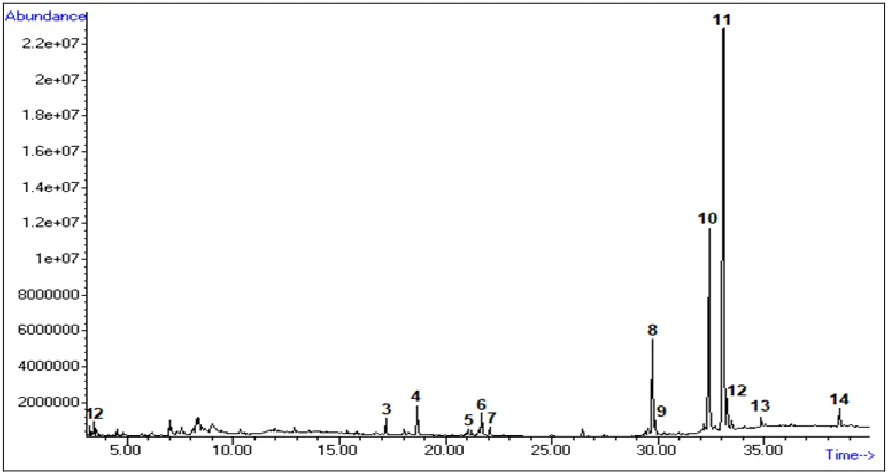
extracts revealed the presence of fourteen compounds (phytochemical constituents) that could contribute to the medicinal quality of the plant. The identification of the phytochemical compounds was confirmed based on the peak area, retention time and molecular formula. The major phytochemical constituent’s present in methanolic extract of
Alchemilla caucasica is presented as compound chromatogram is in Fig. 2.
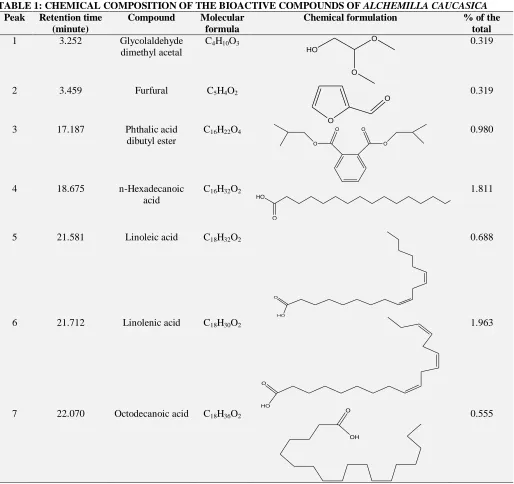
GC-MS analysis revealed the presence of fourteen compounds in methanol extracts of Alchemilla caucasica. Peak number, retention time, compound name, molecular weight, and molecular formula are stated in Table 1. It shows compounds identified in methanol extract of Alchemilla caucasica which represented the hydrophobic and hydrophilic bioactive fraction. Three compounds were identified as the major bioactive compounds. They are 13-docosenamide (Z)- and it had a relative abundance of 59.77% and eluted as represented at peak 11, octadecenoic acid 2, 3-dihydroxy-propyl ester ester had a relative abundance of 15.34% and eluted as represented at peak 10 and hexadecanoic acid 2-hydroxy-1-(hydroxymethyl)ethyl ester had a
relative abundance of 7.59% and eluted as represented at peak 8. Major fatty acids have biological activities such as being anti-inflammatory, anti-androgenic, cancer preventing, dermatigenic, hypocholesterolemic, anaemiagenic, insectifuge as well as being a 5-alpha-reductase inhibitor 17. n- hexadecanoic acid has been reported to show selective toxicity to human leukemic cells as well as antitumor activity and is suggested to be a lead compound in anti-cancer drugs 18. Other fatty acids and fatty acid esters identified were linoleic acid (0.69%), linolenic acid (1.96%), octadecanoic acid (0.56%) and n-hexadecanoic acid (1.81%).
TABLE 1: CHEMICAL COMPOSITION OF THE BIOACTIVE COMPOUNDS OF ALCHEMILLA CAUCASICA
Peak Retention time (minute)
Compound Molecular formula
Chemical formulation % of the total
1 3.252 Glycolaldehyde
dimethyl acetal
C4H10O3
HO
O
O
0.319
2 3.459 Furfural C5H4O2
O
O 0.319
3 17.187 Phthalic acid
dibutyl ester
C16H22O4
O O
O O 0.980
4 18.675 n-Hexadecanoic
acid
C16H32O2 HO
O
1.811
5 21.581 Linoleic acid C18H32O2
O
HO
0.688
6 21.712 Linolenic acid C18H30O2
O
HO
1.963
7 22.070 Octodecanoic acid C18H36O2
O
OH
8 29.728 Hexadecanoic acid
2-hydroxy-1-(hydroxymethyl) ethyl ester
C19H38O4 OH
HO O
O
7.594
9 29.838 Dicyclohexyl
phthalate
C20H26O4
O
O O
O
2.031
10 32.396 Octadecanoic acid 2,3-dihydroxypropyl
ester
C21H42O4
O OH
O HO
15.335
11 33.097
13-Docosenamide, (Z)-
C22H43NO
NH2
O 59.771
12 13.246 Octadecanamide C18H37NO
NH2
O
1.728
13 34.867 24, 25
dihydroxycholeca lciferol
C27H44O3
HO
O
OH OH
0.711
14 38.534 β- sitosterol C29H50O
HO
1.561
Phthalic acid and phthalate derivatives are major industrial materials used to manufacture plastic products like toys and bottles, also being widely used as plasticizers, adhesives, films, polymers, etc. However, some studies revealed that these compounds could affect the male reproductive systems producing testicular atrophy 19 and alter the normal development of fetuses in pregnant rats
20
. In view of these adverse effects on living beings, the US Environmental Protection Agency (EPA) classified the phthalic acid and some industrial
phthalates as priority pollutants 21 and so, for example, the maximum admissible content in water for a common phthalic acid derivative such as the phthalic acid dibutyl ester was established in 6 g/dm.
Among all phytochemicals, β-sitosterol is the main phytosterol found in many plants. It has been reported to show anti-inflammatory, antineoplastic, antipyretic, and immunomodulating activity 23.
The chemical composition of the total methyl esthers of fatty acids from the extracts of
Alchemilla caucasica showed to have a very similar profile. Fatty acid methyl esthers are an alternative diesel fuel (namely, biodiesel) derived from vegetable oils or animal fats 24. The main components of vegetable oils and animal fats are triglycerides or also known as esthers of fatty acids attached to a glycerol. The most widely used industrial method for the commercial production of fatty acid methyl esthers from vegetable oils/fats is a base catalyzed trans-esterification process using sodium hydroxide or potassium hydroxide as the homogeneous catalyst and methanol as the lower alcohol 25.
CONCLUSION: The source of many plants can often be identified from the peak pattern of the chromatograms obtained directly from GC-MS analysis. Similarly, unique qualitative and quantitative patterns from a GC analysis will often help identify the source of many alcoholic beverages. The technique of fingerprint could identify false herbal products. The construction of chromatographic fingerprints aims at evaluating the quality of herbal medicines. The fundamental reason of quality control of herbal medicines is based on the concept of phytoequivalence of herbs, and then to use this conception to identify the real herbal medicine and the false one, and further to do quality control. The importance of the study is due to the biological activity of some of these compounds. The present study, which reveals the presence of components in Alchemilla caucasica
suggest that the contribution of these compounds on the pharmacological activity should be evaluated.
ACKNOWLEDGEMENT: Nil
CONFLICT OF INTEREST: Nil
REFERENCES:
1. Jonathan G, Ohimain E and Kigigha L: Antagonistic
effects of extracts of some Nigerian higher fungi against selected microorganisms. American-European Journal of Agriculture Environment and Science 2007; 2: 364-68.
2. Kathirvel A and Sujatha V: Phytochemical studies,
antioxidant activities and identification of active compounds using GC-MS of Dryopertis cochleota leaves. Arabian Journal of Chemistry 2016; 9: 1435-42.
3. Aviram M: Review of human studies on oxidative damage
and antioxidative damage and antioxidant protection related to cardiovascular disease. Free Radical Research 2000; 33: 585-97.
4. Owen RW, Giacosa WE, Hull R, Haubner BS and Bartsh H: The antioxidant/anticancer potential of phenolic compounds isolated from olive oil. European Journal of Cancer 2000; 36: 1235-47.
5. Kumar V and Parmar NS: Herbs: A potential source for the development of new phytomedicines. The Pharma Review 2003; 1: 59-63.
6. Mukherjee PK: Quality control of herbal drugs. An
approach to the evaluation of botanicals. Business Horizons Pharmaceutical Publishers 2002.
7. Babayan MS, Chelombit'ko VA: Study of polysaccharides
of herb Alchemilla tredecimloba from Rosaceae family. Izvestiya Vysshikh Uchebnykh Zavedenii, Severo-Kavkazskii Region, Estestvennye Nauki 2009; 4: 68-69. 8. Falchero L, Coppa M, Fossi A, Lombardi G, Ramella D
and Tava A: Essential oil composition of lady's mantle
(Alchemilla xanthochlora Rothm.) growing wild in Alpine
pastures. Natural Product Research 2009; 23: 1367-72. 9. Kaya B, Menemen Y and Saltan FZ: Flavonoids in the
endemic species of Alchemilla L., (section Alchemilla L. subsection Calycanthum Rothm. ser. elatae Rothm.) from North-East Black sea region in Turkey. Pakistan Journal of Botany 2012; 44: 595-97.
10. Kaya B, Menemen Y and Saltan FZ: Flavonoid
compounds identified in Alchemilla L. species collected in the north-eastern Black Sea region of Turkey. African Journal of Traditional, Complementary and Alternative Medicines 2012; 9: 418-25.
11. Makau JN, Watanabe K and Kobayashi N: Anti-influenza
activity of Alchemilla mollis extract: Possible virucidal activity against influenza virus particles. Drug Discoveries and Therapeutics 2013; 7: 189-95.
12. Jonadet M, Meunier MT, Villie F, Bastide JP and
Lamaison JL: Flavonoids extracted from Ribes nigrum L.
and Alchemilla vulgaris L.: 1. In-vitro inhibitory activities
on elastase, trypsin and chymotrypsin. 2. Angioprotective activities compared in-vivo. Journal of Pharmacology 1986; 17: 21-27.
13. Filipek J: Effect of Alchemilla xantochlora Water Extract on Lipid Peroxidation and Superoxide Anion Scavenging Activity. Pharmazie 1992; 47: 717-18.
14. Schimmer O and Lindenbaum M: Tannins with
anti-mutagenic properties in the herb of Alchemilla species and
Potentilla anserina. Planta medica 1995; 61: 141-45.
15. PH Davis: Flora of Turkey and the East Aegean Islands. Edinburgh University Press 1972; 4: 88.
16. Matthaus B and Özcan MM: Fatty acid, tocopherol and squalene contents of Rosaceae seed oils. Botanical Studies 2014; 55(48): 1-6.
17. Duke JA: Phytochemical and ethnobotanical databases; Available:https://phytochem.usda.gov/phytochem/search/li st, 1998.
18. Harada H, Yamashita U, Kurihara H, Fukushi E, Kawabata
J and Kamei Y: Antitumor activity of palmitic and found as the selective cytotoxic substance in marine red algae. Anticancer Research 2002; 22: 2587-90.
concentrations, Toxicology and Applied Pharmacology 1980; 53: 35-41.
20. Makoto E, Emiko M, Akira H and Kunio K:
Developmental toxicity evaluation of phthalic acid, one of the metabolites of phthalic acid esters, in rats. Toxicology Letters 1997; 93: 109-15.
21. The United States Environmental Protection Agency
(7407), Pollution Prevention and Toxics, EPA 749-F-95-016a, 1994.
22. Harborne JB: Twenty-five years of chemical ecology. Natural Product Reports 2001; 18: 361-79.
23. Fraile L, Crisci E, Córdoba L, Navarro MA, Osada J and Montoya M: Immunomodulatory properties of beta-sitosterol in pig immune responses. International Immunopharmacology 2012; 13: 316-21.
24. Vasudevan PT and Briggs M: Biodiesel production current
state of the art and challenges. The Journal of Industrial Microbiology and Biotechnology 2008; 35: 421-30.
25. Semwal S, Arora AK, Badoni RP and Tuli DK: Biodiesel
production using heterogeneous catalysts. Bioresource Technology 2011; 102: 2151-61.
This Journal licensed under a Creative Commons Attribution-Non-commercial-Share Alike 3.0 Unported License.
This article can be downloaded to ANDROID OS based mobile. Scan QR Code using Code/Bar Scanner from your mobile. (Scanners are available on Google Playstore)
How to cite this article: