RESEARCH ARTICLE
Acceptance and commitment therapy
universal prevention program for adolescents: a
feasibility study
Rowan Burckhardt
1,2*, Vijaya Manicavasagar
1,2, Philip J. Batterham
3, Dusan Hadzi‑Pavlovic
1and Fiona Shand
1,2Abstract
Background: There is a need to prevent anxiety and depression in young people and mindfulness contains impor‑ tant emotion regulation strategies. Acceptance and commitment therapy (ACT), a mindfulness‑based therapy, has yet to be evaluated as a prevention program, but has demonstrated an ability to reduce symptoms of anxiety and depression in adult and adolescent populations. This study examines the feasibility of using an ACT‑based prevention program in a sample of year 10 (aged 14–16 years) high school students from Sydney, Australia.
Methods: Participants were allocated to either their usual classes or to the ACT‑based intervention. Participants were followed for a period of 5 months post‑intervention and completed the Flourishing Scale, Depression Anxiety Stress Scale, and a program evaluation questionnaire. Analyses were completed using intention‑to‑treat mixed models for repeated measures.
Results: The results indicated that the intervention was acceptable to students and feasible to administer in a school setting. There were no statistically significant differences between the conditions, likely due to the small sample size (N= 48). However, between‑group effect sizes demonstrated small to large differences for baseline to post‑interven‑ tion mean scores and medium to large differences for baseline to follow‑up mean scores, all favouring the ACT‑based condition.
Conclusion: The results suggest that an ACT‑based school program has potential as a universal prevention program and merits further investigation in a larger trial.
Trial registration Australian New Zealand Clinical Trials Registry. Trial ID: ACTRN12616001383459. Registered 06/10/2016. Retrospectively registered.
Keywords: Acceptance and commitment therapy, Adolescent, Early‑intervention, Mindfulness, School, Prevention
© The Author(s) 2017. This article is distributed under the terms of the Creative Commons Attribution 4.0 International License (http://creativecommons.org/licenses/by/4.0/), which permits unrestricted use, distribution, and reproduction in any medium, provided you give appropriate credit to the original author(s) and the source, provide a link to the Creative Commons license, and indicate if changes were made. The Creative Commons Public Domain Dedication waiver (http://creativecommons.org/ publicdomain/zero/1.0/) applies to the data made available in this article, unless otherwise stated.
Background
Youth are disproportionately represented in epidemio-logical studies of anxiety and depressive disorders [1]. Furthermore, evidence suggests that 50% of these disor-ders begin before the age of 14 and 75% by age 24 years [2]. Anxiety and depressive disorders significantly impact on individuals, their families, workplaces, communities, and countries [3–5], making prevention an important goal. Compared to treatment in the early stages of the
disorder, termed ‘early intervention’, prevention averts the short- and long-term consequences of such disor-ders and has been shown to be more cost-effective [6, 7]. Prevention programs that are delivered to all individu-als irrespective of their level of symptomatology, termed ‘universal prevention’, reduce the logistical difficulties involved in large-scale screening, avert missing suscepti-ble students, and ensure that the benefits of such a pro-gram are available to all. Existing prevention propro-grams have largely drawn these skills from cognitive behavioural therapy (CBT), which focuses primarily on teaching indi-viduals to change their appraisal of a situation in order to modify the emotional experience [8–11].
Open Access
*Correspondence: [email protected]
2 The Black Dog Institute, Hospital Rd, Randwick, NSW 2031, Australia
Mindfulness, a particular manner of engaging with one’s environment, is a concept that has grown in popu-larity over recent years. It has been defined as compris-ing two components—paycompris-ing attention to the present moment and doing so with a non-judgmental attitude [12]. These two components correspond closely with two well-established emotion regulation strategies: attention deployment and acceptance [13, 14]. Attention deploy-ment is the ability to choose which aspect of a situation to focus on while acceptance involves allowing an emo-tion to occur without attempting to avoid the experience. With emotion regulation implicated in the development of mental disorders, particularly to anxiety disorders and depression [14–17], it is unsurprising that numerous clinical trials have demonstrated that mindfulness can assist with a wide range of mental health symptoms in adult populations [18–28].
There are reasons to believe that mindfulness may be beneficial to adolescents in navigating their environ-ment. Developmental brain changes mean that ado-lescents are more impacted by emotions than adults or children: they have increased limbic reactivity (indicative of a greater sensitivity to threat), a stronger startle reflex (suggesting a more intense automatic emotional reactiv-ity), and are more interfered by emotional stimuli when completing tasks [29–32]. In spite of adolescents experi-encing stronger emotional reactions, the frontal lobe of the brain, which controls the executive functions such as judgment, impulse control, planning, and emotion regu-lation, remains underdeveloped [33]. Mindfulness and its ability to regulate emotions, may help counteract this imbalance. Research has demonstrated that mindfulness can reduce mental health symptoms in both clinical and non-clinical adolescent populations [34].
There are a number of existing programs that have been designed to train individuals to become more mind-ful such as mindmind-fulness-based stress reduction (MBSR), mindfulness-based cognitive therapy (MBCT), and acceptance and commitment therapy (ACT). MBSR has a focus on teaching meditation practices, which serve to train the brain to become more mindful (similar to using weight training to increase physical strength). MBCT combines meditational practices with components of cognitive-behavioural therapy for depression. Unlike MBCT and MBSR, ACT does not use meditation but rather is didactic in style and draws heavily on imagery, metaphors, personal stories, and short experiential exercises. It also focuses on the application of mindful-ness to emotions and related internal constructs such as thoughts, memories, and body sensations. In addition to mindfulness, ACT draws on the concept of ‘values’ as an over-arching framework to guide the intervention
techniques, improve life-satisfaction, and increase moti-vation. ACT defines values as the type of person an individual wishes to be in the future. Behavioural prin-ciples are also incorporated into ACT to assist a per-son in working towards their values. Engaging in such behaviours that are important and goal-directed even while experiencing intense emotions, may be regarded as a form of emotion regulation [35]. Acceptance prin-ciples are encouraged when thoughts and feelings draw the individual away from maintaining value consistent behaviours. ACT does not distinguish between psy-chopathology and everyday struggles and so, is equally applicable to those with or without significant psychopa-thology. While ACT was developed for adults, it has been successfully applied to adolescent clinical populations [36–38]. When used with adolescents, ACT principals remain the same but exercises, examples, and metaphors employed will be more age appropriate [39].
Acceptance and commitment therapy is an appealing mindfulness program to use with adolescents compared to other meditation-based programs because adolescents may struggle to engage with meditation, particularly in a school setting. It is also appealing for use with adoles-cents as it places particular emphasis on using mindful-ness to regulate emotions, which is important for this age group. Finally, the additional components of ACT such as values may be particularly useful for adolescents as they are in an important transitional period where they are creating a self-identity. ACT has been shown to be effective in clinical samples of adolescents to address symptoms of depression and anxiety [37, 38] but remains untested as a prevention program (i.e. in a non-clinical sample of adolescents). The results from clinical samples suggest that ACT is effective as an emotion regulation strategy and so is worth evaluating as a prevention pro-gram. There are nonetheless differences in using ACT as a therapy compared to as a prevention program. Many ACT-based therapies will incorporate other elements to target the disorder (e.g. behavioural activation for depres-sion or exposure for anxiety) whereas in prevention this may be less relevant. Instead it may be more important to emphasise how experiential avoidance can lead to many types of problems and techniques that can be used to reduce experiential avoidance. Furthermore, the exam-ples used to illustrate how ACT can be applied to real-life situations in clinical therapies may need to be modified to make ACT more relevant to a non-clinical population.
anxiety and depression over any given period, it has been estimated that over 30,000 participants are needed to adequately power a prevention program evaluation study [40]. Measuring symptom reduction rather than cases can reduce this figure but still almost 1000 would be required to demonstrate a statistically significant differ-ence between conditions [41]. However to justify invest-ment in a trial of this size, preliminary evidence, obtained in a feasibility study, is required. The aims of this study were to: (a) examine the feasibility and acceptability of using an ACT-based prevention program that targets anxiety and depressive symptoms in a non-clinical sam-ple of adolescents; and (b) to compare the impact of the ACT-based program on wellbeing and symptoms of depression and anxiety. It was expected that there would be a trend for the ACT participants to demonstrate improvements on a range of measures compared to par-ticipants in the control condition. Given the underpow-ered nature of feasibility studies, this trial sought to use effect sizes as an indication of feasibility and to provide evidence to determine whether a large-scale prevention study of this intervention would be appropriate.
Methods
Participants
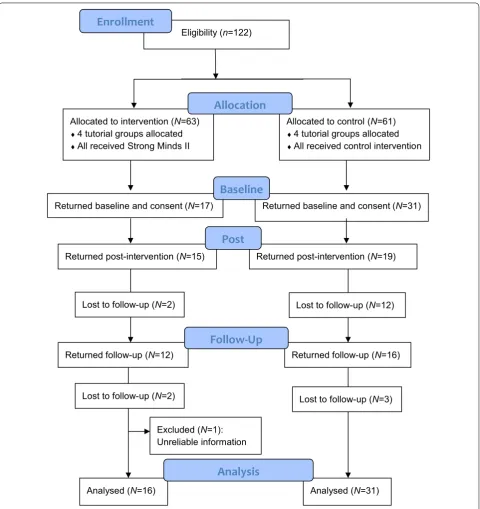
Participants were drawn from a private high school located in Sydney, Australia. Students attending this school are socio-economically advantaged compared with other students in the state of New South Wales and Australia, with 76% in the top quartile on a meas-ure of socio-educational advantage [42]. The school per-forms well academically and is ranked in the top 15% of schools in New South Wales [43]. All students in year 10 (N = 122) were invited to participate in the study and, if they agreed, were required to provide signed parental and self-consent. Regardless of participation in the evaluation study, all year 10 students attended the ACT workshops as it was required curriculum. Year 10 in the Australian school system is the 3rd year completed before graduating from high school. Ethi-cal approval was obtained from the University of New South Wales Human Research Ethics Committee (refer-ence HC13132). Of the 122 students in year 10 who were invited to take part in the study, 76 were males (62%). Forty-nine participants provided self- and parental-consent. The primary reason the remaining students did not take part was due to not returning signed parental consent forms. Of the 49 participants who provided self- and parental-consent, one student’s data had to be dis-carded because of unreliable information. A flow chart presents participants progression through the study (Fig. 1). The final sample comprised 48 participants aged
between 14 and 16 years (M = 15.64), of whom 28 were male (58%).
Interventions
ACT condition
An ACT-based prevention program was developed by two of the authors (RB and VM) that utilises the ACT components of: values, committed action, contact with present moment, acceptance of emotions, and thought defusion. These components are included in other ACT trials and are consistent with the manner in which ACT is described by the original authors of ACT [44]. While ACT traditionally includes a section on the component of self-as-context, the technique of detaching from the experience, this was dropped from the current inter-vention as the facilitator (RB) has found that it is a dif-ficult and confusing concept to transmit to adolescents. Many programs make changes to the original therapy in order to better suit the population targeted [e.g. 36, 45] and other ACT interventions have also chosen not to include this component [46]. The lead author delivered each session of the ACT program face-to-face to half of year 10 (approximately 60 students, 30% of whom were enrolled in the study) in an amphitheatre at the school. The aim of each session was to educate the students on a particular concept (e.g. values) and encourage them to apply the concepts to their everyday life. To achieve this aim in each session, verbal explanations, personal stories, metaphors, PowerPoint slides, videos, and experiential exercises were used. An example of an experiential exer-cise was the mindful eating of a sultana to help teach the concept of contact with present moment. The lecture-style presentations were supported by four teacher-led exercises between the presentations, during class time and in smaller groups (approximately 15 students). Teacher exercises, outlined in Table 1, were based on the ACT components of thought defusion, contact with present moment, and values. All workshops and teacher-led classes were 25 min in duration. In total, students received 4.6 h of the intervention.
The control condition
Procedure
Recruitment and procedure
The program was delivered to half year 10 students in Term 1 and half in Term 3. The school made attend-ing the workshops obligatory but participation in the study was voluntary. Prior to the first session, partici-pants filled out baseline questionnaires and students who were absent on the day were approached up to
1 week later. Workshops began 1 week after the base-line questionnaires were completed and were delivered once per week for 7 weeks. At the end of the last ACT workshop, participants completed a program evaluation survey. The post-intervention questionnaire was admin-istered 1 week after the final workshop. Attempts were made to contact absent students for a period of up to 2 weeks. The follow-up questionnaire was administered
Returned post-intervention (N=19) Eligibility (n=122)
Returned post-intervention (N=15) Allocated to intervention (N=63)
♦4 tutorial groups allocated
♦All received Strong Minds II
Allocated to control (N=61)
♦4 tutorial groups allocated
♦All received control intervention
Allocation
Post
Returned baseline and consent (N=17)Enrollment
Excluded (N=1): Unreliable information
Returned baseline and consent (N=31)
Lost to follow-up (N=2) Lost to follow-up (N=12)
Returned follow-up (N=12) Returned follow-up (N=16)
Follow-Up
Lost to follow-up (N=2) Lost to follow-up (N=3)
Analysed (N=16) Analysed (N=31)
Baseline
Analysis
5 months after the baseline questionnaire was com-pleted. After the final follow-up questionnaires were collected, the ACT program was delivered to the con-trol condition.
Design and randomisation
The current study was a quasi-randomised controlled study. Randomisation was conducted by a staff member of the school who was independent of the study using cluster randomisation based on their tutorial groups of which there were eight in the year group. Tutorial groups had a name and these were listed alphabetically and the first assigned to the ACT condition and the last four to the control condition. Randomisation was completed before enrolment in the study because attendance to the workshops was a required curricular activity for students. It was for this reason that there were disproportionate numbers in each condition and the randomisation was considered ‘quasi’.
The ACT program facilitator
The ACT workshop facilitator (RB) had 6 years of univer-sity training in psychology, including 2 years in a clinical master’s program. He had also received specialist training and supervision in ACT and had previously delivered the same material to a similar sized group of students in the same school. At the time of workshop delivery, he had approximately 2 years’ experience using ACT in both an individual and group context.
Measures
A questionnaire for anxiety and depression symptoms and a wellbeing scale were selected as outcome meas-ures. While it was acknowledged that there are inherent difficulties in using a measure of anxiety and depression created for clinical populations in a non-clinical sample,
it was esteemed that it was the best choice of the alterna-tives available. The symptom measure selected has been used and validated in a non-clinical adolescent popula-tion [47–49]. In addition, a program evaluation question-naire was created specifically for this study. Finally, while a fidelity scale created for another study [50] was used, technical problems meant the data was not obtained.
The Depression Anxiety and Stress Scale—Short Form (DASS‑21)
The DASS-21 is a widely used measure of negative affect [51]. It comprises 21 items scored on a 4-point Lik-ert scale. For adults, items load onto three subscales— depressive symptoms, anxiety symptoms, and stress symptoms. Both the anxiety and stress subscale are measures of anxiety, the former are symptoms found in phobias while the latter is consistent with generalized anxiety disorder. For adolescents some authors found the same loading structure as for adults whereas others found a single loading—negative affect [47–49]. Given these discrepancies, both the three subscales and a sin-gle total score were used in the current study. For adoles-cents, the Cronbach’s α has been found to be .87 for the depression subscale, .79 for the anxiety subscale, and .83 for the stress subscale [48]. In the current study, the Cronbach’s α was .90 for the depression subscale, .81 for anxiety, .88 for stress, and .95 for DASS-Total.
Flourishing Scale (FS)
The FS is a 7-item measure of wellbeing with responses given on a 7-point Likert scale [52]. Items assess sev-eral domains of wellbeing including social relationships, competency in activities, optimism, purpose and mean-ing, and self-esteem. The FS has a single factor structure with item loadings between .72 and .81 [53]. The scale also correlates negatively with the Centre for Epidemio-logic Studies—Depression Scale (−.60). Amongst the 18–20 year-old cohort in this study, the mean score was 42.71 (SD = 7.96) with a Cronbach’s α of .87.
Program evaluation
A series of 10 questions with a 6-point Likert scale was created for this study: “Because of the workshops… (a) I’m clearer about what’s important to me in life (values); (b) I am more comfortable sitting with negative emo-tions; (c) My negative thoughts impact me less; d) I am exercising more; (e) I feel happier; (f) I feel more confi-dent; (g) Anxiety is less of a problem for me; (h) I am get-ting along better with friends or family; (i) I have found that the workshops/tutorials have helped me; (j) I have been applying what I learnt in the workshops/tutorials to my everyday life.” The measure was delivered at the post-intervention time-point only.
Table 1 Overview of the ACT program Exercise ACT component Exercise
1 Values Debate between students on whether it is better to follow values‑based living or feeling good
2 Values Completing a booklet that guides students through a series of questions to help them identify their values 3 Thought defusion Acting in a short play where
characters’ thoughts are spoken out loud 4 Contact with present
Statistical analysis
Statistical analysis was completed using SPSS 22.0. For the DASS-21 subscales, at least six of the seven items were required to compute a mean and seven of the eight items for the FS, as per author guidelines. For baseline and dropout comparisons, t-tests were used for continu-ous variables and Chi square tests of independence with Yates Continuity Correction for categorical variables. In the universal effects analysis comparing outcome scores between the ACT and control conditions an intention-to-treat analysis was used. Mixed models with repeated measures (MMRM) is considered to be particularly appropriate for school-based studies or when the dropout rate is above 5% as it includes all available data from both completers and dropouts [54]. A single analysis exam-ined the outcome scores across the three time-points. To select the covariance structure, the best fitting model using Akaike’s information criterion was retained. The parameters of the model were estimated using restricted maximum likelihood as the evidence suggests it is prefer-able over maximum likelihood when the sample is small [55]. The dppc2, formula [56] was used to estimate Cohen’s
d effect sizes, except for the Chi square tests that Phi (φ) effect size, both of which were interpreted using Cohen’s standards [57]. A positive effect size on the DASS-21 and FS scales represent improvement in symptoms and well-being, respectively.
Results
Mean scores and standard deviations for the ACT and control condition are presented in Table 2.
Baseline comparisons
The comparison of baseline scores of the ACT and con-trol conditions found no significant differences for DASS-depression (p = .55), DASS-anxiety (p = .88),
DASS-stress (p = .48), DASS-total (p = .96), or FS
(p = .37). No significant difference in sex distribution was found between the conditions (p = .72).
Comparison of dropouts
Comparisons of the differences between participants that completed their post-intervention and follow-up ques-tionnaires (‘completers’) from those who did not (‘drop-outs’) suggested there were no significant differences between post-intervention completers and dropouts on DASS-depression (p = .69, Cohen’s d = .14), DASS-anxiety (p = .88, Cohen’s d = .05), DASS-stress (p = .72, Cohen’s d = .11), DASS-total (p = .81, Cohen’s d = .08), and FS (p = .93, Cohen’s d = .02). Likewise, no differences were found between follow-up dropouts and completers scores for DASS-depression (p = .36, Cohen’s d = .27), DASS-anxiety (p = .18, Cohen’s d = .41), DASS-stress (p = .29, Cohen’s d = .33), DASS-total (p = .24, Cohen’s d = .36), and FS (p = .28, Cohen’s d = .32). No significant differences were detected on the variable sex between the completers and dropouts at post-intervention (p = .67, φ = .11) or follow-up (p = .92, φ = .06). Likewise, no dif-ferences in attrition were observed between the ACT and control conditions at post-intervention (p = .10, φ = .27) or follow-up (p = .20, φ = .18).
Universal effects of the program
The MMRM findings from the Time × Condition anal-yses are presented in Table 3. There were no significant differences between the ACT and control conditions for the DASS-21 or FS. However, given this was a pilot study in a non-clinical sample, we were chiefly interested in whether effect sizes suggested that a larger trial of the intervention would be worthwhile. Effect sizes were cal-culated for both baseline-post and baseline-follow-up dif-ferences. Table 4 presents Cohen’s d effect sizes observed for the difference between the ACT and control condi-tions. Results indicate medium or large between-group
Table 2 Means (SDs) for mental health measures at each time point, N = 48
Measure Condition Baseline Post Follow-up
DASS‑depression ACT 7.34 (7.85), n= 17 7.38 (6.81), n= 15 6.00 (5.59), n= 12 Control 9.27 (10.95), n= 31 12.33 (12.25), n= 19 11.25 (10.75), n= 16 DASS‑anxiety ACT 9.06 (7.22), n= 17 8.00 (6.55), n= 15 5.33 (4.03), n= 12
Control 9.42 (8.47), n= 31 10.63 (9.59), n= 19 10.19 (10.08), n= 16 DASS‑stress ACT 13.29 (7.87), n= 17 11.07 (6.32), n= 15 9.00 (5.62), 12
Control 11.48 (8.75), n= 31 14.70 (11.17), n= 19 13.63 (9.75), n= 16 DASS‑total ACT 29.78 (20.99), n= 17 26.44 (16.75), n= 15 20.33 (12.26), n= 12
Control 30.17 (25.57), n= 31 37.67 (29.72), n= 19 35.06 (28.48), n= 16 FS ACT 46.47 (7.19), n= 17 46.64 (9.47), n= 14 45.64 (7.12), n= 11
effect sizes for all outcomes for baseline to follow-up differences.
Program evaluation
Twenty-four participants, from both conditions, com-pleted the ACT program evaluation. Program evaluation data are summarized in Table 5. To assess the percentage of affirmative/negative responses, the ‘Strongly Disagree’, ‘Moderately Disagree’, and ‘Slightly Disagree’ responses were combined into a single outcome ‘Disagree’ and the same done for the three agree options which were com-bined into ‘Agree’. Overall, there was agreement with the questions posed, except in response to whether they were exercising more.
Discussion
The current study investigated the feasibility of using an ACT-based prevention program for adolescents in a school setting. As expected because of the small sample size, the analyses indicated that there were no statisti-cally significant differences between the ACT and con-trol conditions on the outcome measures of depression, stress, anxiety, total negative affect, and wellbeing. The effect sizes, which were expected to be of greater util-ity in this study, ranged from small to large according to Cohen’s standards [57], all in the direction of greater improvements in the ACT compared to control condi-tion. The high rate of endorsement of the various items in the workshop evaluation questionnaire also suggests that many participants perceived benefits from the work-shops. To our knowledge, this is the first time that an ACT-based program has been evaluated as a prevention
program in a non-clinical population of adolescents. It is conceivable that with a larger sample size, a universal pre-vention evaluation study of an ACT-based program may find mean differences that are statistically significant.
Interestingly, the present study found that stress scores demonstrated greater improvements over time than anxi-ety scores on the DASS-21. While both are broad meas-ures of anxiety, the stress scale of the DASS-21 relates to cognitive symptoms (i.e. worry) while the anxiety subscale tends to relate to physiological symptoms (e.g. increased heart beat). Given that worry may be regarded as a form of avoidance [58], it is unsurprising that this aspect would be more amendable to change for par-ticipants in the ACT intervention compared to physi-cal symptoms that are not associated with avoidance behaviours.
Compared to the findings from CBT prevention pro-grams, our results are encouraging. A meta-analysis of prevention programs for depression [10] found that the average effect size from baseline to post-intervention was Pearson’s r = .15 (Cohen’s d = .30), which is equivalent to our results. Effect sizes at follow-up were Pearson’s r = .11 (Cohen’s d = .20), which is lower than the effect size found in the present study. Early intervention programs targeting depression and other mental health-related problems have reported a reduction in efficacy from Table 3 Linear mixed modelling time × condition results,
type III fixed effects, N = 48
Measure DF F P
DASS‑depression 1.61 .24 .79 DASS‑anxiety 1.60 1.72 .19 DASS‑stress 1.61 2.05 .14 DASS‑total 1.60 1.39 .26 FS (Wellbeing) 1.45 .57 .57
Table 4 Cohen’s d effect sizes and standard interpretations, N = 48
Measure Baseline-post Cohen’s standard Baseline-follow-up Cohen’s standard
DASS‑depression .31 Small .34 Medium
DASS‑anxiety .28 Small .55 Medium
DASS‑stress .63 Large .75 Large
DASS‑total .44 Medium .59 Medium
FS .20 Small .31 Medium
Table 5 Means and percentage of participants agreeing on the program evaluation questions, N = 24
Question n Mean SD % Agreeing
More confident 24 4.1 1.4 75 Less impact of negative thoughts 23 4.0 1.2 70 Happier 24 4.0 1.7 67 Workshops helpful 24 3.8 1.4 63 More comfortable with negative
post-intervention to follow-up [10, 59]. These programs were predominately CBT-based and thus focused on teaching skills, the retention of which is likely to diminish over time. The present intervention, on the other hand, observed an increase in efficacy from post-intervention to follow-up. It is possible that ACT may create a more fun-damental shift in how a person relates to their thoughts and feelings rather than teaching a new set of skills [60].
The program evaluation questions showed strong satis-faction with the ACT program. The item which most stu-dents agreed with related to increased confidence from the workshops. This is likely to reflect that many young people struggle with low confidence. Despite two-thirds of participants reporting that the workshops were help-ful, three-quarters said they felt more confident because of them, which may be reflective of a tendency amongst adolescents to downplay positive changes.
The present study used a large group setting to deliver the workshops, with approximately 60 students attend-ing the workshop at the same time. The findattend-ings suggest that future early intervention programs may not need to be delivered to small groups. Large groups enable pro-grams to be more readily delivered by external psycholo-gists (due to reduced costs) rather than teachers which is an important advantage given that research suggests that compared to teacher-led programs, psychologist facili-tated programs have better outcomes [59, 61]. In addi-tion, it was observed that in the present study, students asked clarifying questions on the workshop material that schoolteachers without psychology training/experi-ence would have difficulty in answering. The responses to these questions appeared important to ensure stu-dents understood the material taught. For these reasons, we recommend that trained psychologists rather than schoolteachers deliver the program.
This study did have a number of methodological issues that limit the conclusions that can be drawn, including the small sample size and the quasi-randomisation pro-cess. Although the randomisation method led to unequal numbers of participants in each condition, importantly, baseline differences between conditions were not sta-tistically different. Another limitation was the inability to differentiate the benefits obtained from the practical teacher-led exercises compared to the psychologist-led workshops. Future research to examine their differential benefits would be of interest. The study was also lim-ited in that the sample used was a private school with students from high socio-economic status families. It would be of interest to evaluate the program across the socio-economic spectrum. The present study experi-enced a substantial dropout of participants in the con-trol condition between baseline and post-intervention. The workshops ended close to school holidays and so the
limited time available before students left meant that the students in the control condition, absent on the day the questionnaires were administered, could not be located. This learning can be utilised in future school-based pro-gram evaluation research to avoid this same issue.
There are a number of components that would be of benefit to include in a larger trial of an ACT-based prevention program. Examining an increased range of outcomes, such as academic indicators and social rela-tionships (e.g. family, friendships, teacher–student) in addition to the mental health outcomes, would be of interest. The study design could also have been improved by including a measure of emotion regulation, and it is recommended that future studies in this area do so. In addition, it would be of benefit that such a trial test the model that mindfulness reduces and prevents depres-sive and anxiety symptoms through improved emotion regulation. Including mediator variables and testing this model through analysis would provide greater insight into the link between mindfulness and symptom reduc-tion/prevention. Future trials could also be strengthened by examining potential confounds and moderators of outcome, such as previous experience with mindfulness, current engagement with mental health professionals, student tutorial group, school exams during the study period, and past engagement with mental health preven-tion workshops. Finally, although it would be resource intensive, a future trial that can compare the effectiveness of several key emotion regulation strategies (e.g. prob-lem-solving, cognitive re-appraisals, and acceptance) as well as a combined program of all these together, would be of great benefit to the field of prevention.
Conclusions
The results from the current feasibility study found that an ACT-based prevention program delivered in a school setting led to moderate to large effect size differences between the conditions at the 5 month follow-up and that the program was feasible and acceptable to partici-pants. This study suggests that an ACT-based program should be examined further in a larger and more repre-sentative sample. A number of lessons can be drawn from this study to inform such a trial.
Abbreviations
ACT: acceptance and commitment therapy; CBT: cognitive behavioural ther‑ apy; DASS‑21: The Depression Anxiety and Stress Scale—Short Form; MBCT: mindfulness‑based cognitive therapy; MBSR: mindfulness‑based stress reduc‑ tion; MMRM: mixed models with repeated measures; FS: Flourishing Scale.
Authors’ contributions
Author details
1 School of Psychiatry at the University of NSW, Randwick, Australia. 2 The Black
Dog Institute, Hospital Rd, Randwick, NSW 2031, Australia. 3 Centre for Men‑
tal Health Research, Research School of Population Health, The Australian National University, Canberra, Australia.
Acknowledgements
We would like to thank the students who participated in the study and the school for their strong support. We would like to also thank the parents of students who gave their consent to their children’s participation in this study. Finally, we would like to express our appreciation to the University of NSW School of Psychiatry and the Black Dog Institute for their support during the study.
Competing interests
The authors declare that they have no competing interests.
Availability of data and materials
Due to privacy and confidentiality reasons, the dataset from this study is not publically available but a de‑identified copy is available upon reasonable request from the first author, Mr. Rowan Burckhardt.
Ethics approval and consent to participate
Ethics approval was obtained from the University of New South Wales Human Research Ethics Committee (Reference HC13132). All participants consented to take part in the study.
Funding
This study was supported by a University of NSW Australian Postgraduate Award that was awarded to the first author, Mr. Rowan Burckhardt.
Publisher’s Note
Springer Nature remains neutral with regard to jurisdictional claims in pub‑ lished maps and institutional affiliations.
Received: 6 October 2016 Accepted: 16 May 2017
References
1. Australian Bureau of Statistics. National survey of mental health and wellbeing: summary of results. Canberra: Bureau of Statistics; 2008 (Cat 2326.0).
2. Kessler RC, Berglund P, Demler O, Jin R, Merikangas KR, Walters EE. Lifetime prevalence and age‑of‑onset distributions of DSM‑IV disorders in the National Comorbidity Survey Replication. Arch Gen Psychiatry. 2005;62:593–602.
3. Glied S, Pine DS. Consequences and correlates of adolescent depression. Arch Pediatr Adolesc Med. 2002;156:1009–14.
4. Lawrence D, Johnson S, Hafekost J, Boterhoven de Haan K, Sawyer M, Ainley J, Zubrick SR. The mental health of children and adolescents: report on the second Australian Child and Adolescent Survey of Mental Health and Wellbeing; 2015. https://www.health.gov.au/internet/main/ publishing.nsf/Content/9DA8CA21306FE6EDCA257E2700016945/$File/ child2.pdf. Accessed 1 Sept 2016.
5. Schofield DJ, Shrestha RN, Percival R, Passey ME, Callander EJ, Kelly SJ. The personal and national costs of mental health conditions: impacts on income, taxes, government support payments due to lost labour force participation. BMC Psychiatry. 2011;11:72.
6. O’Connell ME, Boat T, Warner KE. Preventing mental, emotional, and behavioral disorders among young people: progress and possibilities. Washington, D.C: The National Academies Press; 2009.
7. Vos T, Carter R, Barendregt J, Mihalopoulos C, Veerman L, Magnus A, et al. Assessing cost‑effectiveness in prevention: ACE‑Prevention. Final report; 2010. https://public‑health.uq.edu.au/filething/get/1836/ACE‑Preven‑ tion_final_report.pdf. Accessed 1 Sept 2016.
8. Merry SN, Hetrick SE, Cox GR, Brudevold‑Iversen T, Bir JJ, McDow‑ ell H. Psychological and educational interventions for preventing
depression in children and adolescents. Cochrane Database Syst Rev. 2011;(12):CD003380. doi:10.1002/14651858.CD003380.pub3. 9. Neil AL, Christensen H. Australian school‑based prevention and early
intervention programs for anxiety and depression: a systematic review. Syst Rev. 2007;186:305–8.
10. Stice E, Shaw H, Bohon C, Marti CN, Rohde P. A meta‑analytic review of depression prevention programs for children and adolescents: factors that predict magnitude of intervention effects. J Consult Clin Psychol. 2009;77:486–503.
11. Stockings EA, Degenhardt L, Dobbins T, Lee YY, Erskine HE, Whiteford HA, Patton G. Preventing depression and anxiety in young people: a review of the joint efficacy of universal, selective and indicated prevention. Psychol Med. 2016;46:11–26.
12. Kabat‑Zinn J. Full catastrophe living: Using the wisdom of your mind to face stress, pain and illness. New York: Dell; 1990.
13. Gross JJ. The emerging field of emotion regulation: an integrative review. Rev Gen Psychol. 1998;2:271–99.
14. Aldao A, Nolen‑Hoeksema S, Schweizer S. Emotion‑regulation strate‑ gies across psychopathology: a meta‑analytic review. Clin Psychol Rev. 2010;30:217–37.
15. Mennin DS, Fresco DM. Emotion regulation as a framework for under‑ standing and treating anxiety pathology. In: Krink AM, Sloan DM, editors. Emotion regulation in psychopathology. New York: Guildford Press; 2009. 16. Schäfer JO, Naumann E, Holmes EA, Tuschen‑Caffier B, Samson AC. Emo‑ tion regulation strategies in depressive and anxiety symptoms in youth: a meta‑analytic review. J Youth Adolesc. 2017;46:261–76.
17. Sheppes G, Suri G, Gross JJ. Emotion regulation and psychopathology. Annu Rev Clin Psychol. 2015;11:379–405.
18. Luken M, Sammons A. Systematic review of mindfulness practice for reducing job burnout. Am J Occup Ther. 2016;70:1–10.
19. Burton A, Burgess C, Dean S, Koutsopoulou GZ, Hugh‑Jones S. How effective are mindfulness‑based interventions for reducing stress among healthcare professionals? A systematic review and meta‑analysis. Stress Health. 2017;33:3–13.
20. Strauss C, Cavanagh K, Oliver A, Pettman D. Mindfulness‑based interven‑ tions for people diagnosed with a current episode of an anxiety or depressive disorder: a meta‑analysis of randomised controlled trials. PLoS ONE. 2014;9:e96110.
21. Vollestad J, Nielsen MB, Nielsen GH. Mindfulness‑ and acceptance‑based interventions for anxiety disorders: a systematic review and meta‑analy‑ sis. Br J Clin Psychol. 2012;51:239–60.
22. Hofmann SG, Sawyer AT, Witt AA, Oh D. The effect of mindfulness‑based therapy on anxiety and depression: a meta‑analytic review. J Consult Clin Psychol. 2010;78:169–83.
23. Khoury B, Lecomte T, Fortin G, Masse M, Therien P, Bouchard V, Chapleau M‑A, Paquin K, Hofmann SG. Mindfulness‑based therapy: a comprehen‑ sive meta‑analysis. Clin Psychol Rev. 2013;33:763–71.
24. Fjorback LO, Arendt M, Ombøl E, Fink P, Walach H. Mindfulness‑based stress reduction and mindfulness‑based cognitive therapy: a sys‑ tematic review of randomized controlled trials. Acta Psychiatr Scand. 2011;124:102–19.
25. Klainin‑Yobas P, Cho MA, Creedy D. Efficacy of mindfulness‑based inter‑ ventions on depressive symptoms among people with mental disorders: a meta‑analysis. Int J Nurs Stud. 2012;49:109–21.
26. Zgierska A, Rabago D, Chawla N, Kushner K, Koehler R, Marlatt A. Mindful‑ ness meditation for substance use disorders: a systematic review. Subst Abus. 2009;30:266–94.
27. Bohlmeijer E, Prenger R, Taal E, Cuijpers P. The effects of mindfulness‑ based stress reduction therapy on mental health of adults with a chronic medical disease: a meta‑analysis. J Psychosom Res. 2010;68:539–44. 28. Chiesa A, Serretti A. Mindfulness‑based stress reduction for stress man‑
agement in healthy people: a review and meta‑analysis. J Altern Comple‑ ment. 2009;15:593–600.
29. Silk JS, Siegel GJ, Whalen DJ, Ostapenko LJ, Ladoucer CD, Dahl RE. Puber‑ tal changes in emotion processing: pupillary, behavioral, and subjective evidence during emotional work identification. Dev Psychopathol. 2009;21:7–26.
• We accept pre-submission inquiries
• Our selector tool helps you to find the most relevant journal
• We provide round the clock customer support
• Convenient online submission
• Thorough peer review
• Inclusion in PubMed and all major indexing services
• Maximum visibility for your research
Submit your manuscript at www.biomedcentral.com/submit
Submit your next manuscript to BioMed Central
and we will help you at every step:
31. Quevedo K, Benning SD, Gunnar MR, Dahl RE. The onset of puberty: effects on the psychophysiology of defensive and appetitive motivation. Dev Psychopathol. 2009;21:27–45.
32. Hare TA, Tottenham N, Galvan A, Voss HU, Glover GH, Casey BJ. Biological substrates of emotional reactivity and regulation in adolescence during an emotional go‑nogo task. Bio Psychiatry. 2008;63:927–34.
33. Johnson SB, Blum RW, Giedd JN. Adolescent maturity and the brain: the promise and pitfalls of neuroscience research in adolescent health policy. J Adolesc Health. 2010;45:216–21.
34. Kallapiran K, Koo S, Kirubakaran R, Hancock K. Effectiveness of mindful‑ ness in improving mental health symptoms of children and adolescents: a meta‑analysis. Child Adolesc Ment Health. 2015;20:182–94.
35. Roemer L, Williston SK, Rollins LG. Mindfulness and emotion regulation. 2015;3:52–7.
36. Metzler CW, Biglan A, Noell J, Ary DV, Ochs L. A randomized controlled trial of a behavioral intervention to reduce high‑risk sexual behaviour among adolescents in STD clinics. Behav Ther. 2000;31:27–54.
37. Hayes L, Boyd CP, Sewell J. Acceptance and commitment therapy for the treatment of adolescent depression: a pilot study in a psychiatric outpa‑ tient setting. Mindfulness. 2011;2:86–94.
38. Livheim F, Hayes L, Ghaderi A, Magnusdottir T, Högfeldt A, Rowse J, Turner S, Hayes SC, Tengström. The effectiveness of acceptance and commit‑ ment therapy for adolescent mental health: Swedish and Australian pilot outcomes. J Child Fam Stud. 2015;24:1016–30.
39. Ciarrochi J, Hayes L, Bailey A. Get out of your mind and into your life for teens: a guide to living an extraordinary life. Oakland: Harbinger Publica‑ tions; 2012.
40. Muños RF, Cuijpers P, Smit F, Barrera AZ, Leykin Y. Preventing of major depression. Annu Rev Clin Psychol. 2010;6:181–212.
41. Calear AL, Christensen H, Mackinnon A, Griffiths KM, O’Kearney R. The YouthMood Project: a cluster randomized controlled trial of an online cognitive behavioral program with adolescents. J Consult Clin Psychol. 2009;77:1021–32.
42. My schools. https://www.myschools.edu.au. Accessed 30 Aug 2016. 43. The Matrix Education. 2013 high school rankings. https://www.matrix.
edu.au/2013‑high‑school‑rankings/. Accessed 1 Sept 2016.
44. Hayes SC, Strosahl K, Wilson KG. Acceptance and commitment therapy: the process and practice of mindful change. 2nd ed. New York: Guilford Press; 2012.
45. Nelson‑Gray RO, Keane SP, Hurst RM, Mitchell JT, Warburton JB, Chok JT, Cobb AR. A modified DBT skills training program for oppositional defiant adolescents: promising preliminary findings. Behav Res Ther. 2006;44:1811–20.
46. Levin ME, Haeger JA, Pierce BG, Twohig MP. Web‑based acceptance and commitment therapy for mental health problems in college students: a randomized controlled trial. Behav Modif. 2016;41(1):141–62.
47. Patrick J, Dyck M, Bramston P. Depression anxiety stress scale: is it valid for children and adolescents? J Clin Psychol. 2010;66:996–1007.
48. Szabó M. The short version of the depression anxiety stress scales (DASS‑21): factor structure in a young adolescent sample. J Adolesc. 2010;33:1–8.
49. Tully PJ, Zajac IT, Venning AJ. The structure of anxiety and depression in a normative sample of younger and older Australian adolescents. J Abnorm Child Psychol. 2009;37:717–26.
50. Burckhardt RB, Manicavasagar V, Batterham PJ, Hadzi‑Pavlovic D. A ran‑ domized controlled trial of strong minds: a school‑based mental health program combining acceptance and commitment therapy and positive psychology. J Sch Psychol. 2016;57:41–52.
51. Lovibond SH, Lovibond PF. Manual for the depression anxiety stress scales. 2nd ed. Sydney: Psychology Foundation; 1995.
52. Diener E, Wirtz D, Tov W, Kim‑Prieto C, Choi DW, Oishi S, Biswas‑Diener R. New well‑being measure: short scales to assess flourishing and positive and negative feelings. Soc Indic Res. 2010;97:143–56.
53. Hone L, Jarden A, Schofield G. Psychometric properties of the Flourishing Scale in a New Zealand sample. Soc Indic Res. 2014;119:1031–45. 54. Verbeke G, Molenberghs G. Linear mixed models for longitudinal data.
New York: Springer; 2000.
55. Kenward MG, Roger JH. Small sample inference for fixed effects from restricted maximum likelihood. Biometrics. 1997;53:983–97. 56. Morris SB. Estimating effect sizes from pretest‑posttest‑control group
designs. Organ Res Meth. 2008;11:364–86.
57. Cohen J. Statistical power analysis for the behavioral sciences. 2nd ed. Hillsdale: Lawrence Earlbaum Associates; 1988.
58. Behar E, DiMarco ID, Hekler EB, Mohlman J, Staples AM. Current theoreti‑ cal models of generalized anxiety disorder (GAD): conceptual review and treatment implications. J Anxiety Disord. 2009;23:1011–23.
59. Stice E, Shaw H. Eating disorder prevention programs: a meta‑analytic review. Psychol Bull. 2004;130:206–27.
60. Forman EM, Chapman JE, Herbert JD, Goetter EM, Yuen EK, Moitra E. Using session‑by‑session measurement to compare mechanisms of action for acceptance and commitment therapy and cognitive therapy. Behav Ther. 2012;43:341–54.