Abstract
Background: codeine represents a commonly used drug to suppress cough. central antitussive effect of codeine has been confirmed in a number of animal studies. However, available data related to antitussive activity of codeine in rabbits are very limited.
Objective: We investigated the effects of codeine on cough, single expiratory responses (expiration-like re-flex) induced by mechanical tracheo-bronchial stimula-tion, and on the sneeze reflex in the anesthetized rab-bit.
Material and methods: twenty pentobarbitone anes-thetized spontaneously breathing rabbits were used for the study. Increasing doses of codeine (codeinum di-hydrogenphosphate, Interpharm) were injected intra-venously (iv); 0, 0.15, 0.76, and 3.78 mg/kg of codeine dissolved in saline, 0.25 ml/kg) or intracerebroventric-ularly (icv); 0, 0.015, 0.076, and 0.378 mg/kg of codeine dissolved in artificial cerebrospinal fluid, 0.033 ml/kg.
Results: Both iv and icv injections of codeine led to a dose-dependent reduction of coughing provoked by tracheo-bronchial stimulation; however, the doses dif-fered substantially. the effective cumulative dose for a 50% reduction in the number of coughs was 3.9 and 0.11 mg/kg after iv and icv administration of codeine, respectively; representing about 35-fold higher efficacy of the icv route. the numbers of expiration-like re-sponses and sneeze reflex rere-sponses remained un-changed.
Conclusions: the study confirmed the central antitus-sive effect of codeine, but showed a low sensitivity of sneeze and expiration reflex to codeine. We validated the experimental model of an anesthetized rabbit for studies on central antitussive action.
Key words:antitussive, tracheo-bronchial cough, sneeze, expiration, airway defense
I
ntRodUctIonantitussive drugs, such as codeine and dextromethor-phan, are among the most commonly prescribed medi-cines in the world. codeine acts antitussively within the brain stem, where the basic neuronal circuitry re-sponsible for coughing is located [1-3]. central action of codeine is accepted, since the drug is more effec-tive when administered centrally, either via the verte-bral artery or intracerebroventricularly (icv) into the
4thbrain ventricle, compared with an intravenous (iv)
route [4].
codeine is considered to be primarily the µ-opioid receptor agonist [5, 6]. However, for central antitus-sives, including codeine, also other than µ-opioid re-ceptor mechanisms have been proposed [5, 7-9].
codeine reduces the number of coughs provoked by tracheo-bronchial stimulation; decreasing the expi-ratory (E) component of cough efforts, with a much lower effect on the inspiratory (I) one, cough timing, and parameters of respiration [10, 11]. However, a complete analysis of the effect of codeine on cough motor pattern has never been performed in the rabbit [12].
Previous studies have shown the effective antitus-sive dose of codeine in experimentally produced cough in anesthetized rabbits was 100 mg/kg for oral and 1-10 mg/kg for iv administration [13, 14]. Howev-er, none of the studies have attempted to analyze and determine Ed50(effective dose for 50% reduction of
coughing) providing the base for comparison of anti-tussive efficacy upon different routes of codeine ad-ministration and for the determination of its central or peripheral action [4, 11].
In the present study we investigated the hypothesis that in the rabbit the codeine would centrally suppress tracheo-bronchial cough at a lower dose than that re-quired for iv administration.
M
atERIaL andM
EtHodS gEnERaLPRocEdURES andStIMULatIon all procedures were performed in accordance with the laws, rules, and regulations of Slovakian government and Ec; the Ethics committee of Jessenius Faculty of Medicine in Martin approved the protocols.Experiments were performed in 20 rabbits (new Zeland white, line P91; 3.65 ±0.15 kg) of either sex, pre-medicated with the diazepam (apaurin, KRKa, croatia; 5 mg/kg, im) and anesthetized with sodium pentobarbital (Biowet, Pulawy, Poland; 35 mg/kg, ip). Supplementary anesthetic doses were administered (1-3 mg/kg, iv) as needed. atropine (Biotika; 0.15 mg/kg, iv) was given at the beginning of the experi-ment to reduce secretions. the trachea, femoral artery and vein were canulated. the animals were allowed to breathe spontaneously a gas mixture of 30-60% oxy-gen, balanced by nitrogen. arterial blood pressure (BP), end-tidal co2concentration (Etco2),
respirato-Eur J Med Res (2010) 15(Suppl. II): 184-188 © I. Holzapfel Publishers 2010
c
EntRaL
a
ntItUSSIVE
E
FFEct oF
c
odEInE In tHE
a
nEStHEtIZEd
R
aBBIt
M. Simera, I. Poliacek, J. Jakus
ry rate (RR), and body temperature were monitored continuously. Body temperature was maintained at 39.0 ±0.5°c. Periodically, the samples of arterial blood were removed for blood gases and pH analysis.
Bipolar fine wire hook electrodes were placed in the crural diaphragm (dIa) and bilaterally in the transver-sal abdominal, or the external oblique abdominal mus-cles (aBd) for electromyogram (EMg) recordings. a soft balloon was inserted into the esophagus for a measurement of the intrathoracic pressure changes (esophageal pressure – EP). Foramen magnum with the occipital bone was carefully exposed, a thin poly-ethylene catheter was inserted throughout and fixed in dura mater for central injections of codeine. the tip of the catheter was positioned about 2 mm rostral to the obex (the most caudal point of the area postrema) in the 4thbrain ventricle. the position and patency of
the catheter were tested post-mortem.
tracheo-bronchial cough was induced by a mechan-ical stimulation of the trachea and the carina areas with a nylon loop attached to a soft catheter. this tool was inserted into the trachea and moved fore and back toward carina 4 times during one stimulation trial. Sneeze was induced by mechanical stimulation (4 touches) of the nasal septum with a soft nylon fiber (∆0.3 mm). cough or sneeze were defined by a large augmenting burst of diaphragm (dIa) EMg activity immediately followed (and partially overlapped) by a burst of E abdominal (aBd) EMg activity corre-sponding to the related I-E wave of EP. Stimulation of tracheo-bronchial airways also resulted in single expi-ratory responses (ER-like response) independent of, and separated from, the previous inspiration. these expiratory responses were analyzed separately from coughing.
codeinum dihydrogenphosphate (Interpharm, Brati -s lava, Slovakia) wa-s di-s-solved in -saline for iv (via femoral vein; 0.25 ml of solution/kg) and in the artifi-cial cerebrospinal fluid (acSF) for icv injection (viathe catheter fixed in the foramen magnum; 0.033 ml of so-lution/kg). Increasing doses of codeine were injected iv (pure saline followed by 0.2, 0.8, and 4.0 mg/kg), representing cumulative doses of 0, 0.15, 0.76, and 3.78 mg/kg or icv (pure acSF followed by 0.02, 0.08, and 0.4 mg/kg), representing cumulative doses of 0, 0.015, 0.076, and 0.378 mg/kg of codeine). Stimulation of tracheo-bronchial airways and the nasal mucosa were performed at 1 min intervals; two stimulation tri-als before the first (saline or acSF) and after each in-jection. during the icv injection protocol, additional
stimulations were performed more than 30 min after the last injection (‘recovery’). the experiment was ter-minated by an iv overdose of pentobarbitone, followed by a saturated solution of Kcl.
d
ataP
RocESSIng and tHEIRa
naLySISall EMgs were amplified, filtered (300-3000 Hz; Iso daM8, WPI), digitalized (12-bit multi-function plug-in ISa card, dataq Instruments, oH, USa, samplplug-ing frequency of 20.000 Hz), and recorded (Windaq, dataq Instruments - akron, oH, USa) along with the waveforms of BP and EP.
the number of cough efforts and single expiratory responses induced during the mechanical probing of the lower airways (mean number of coughs and single expiratory efforts - En per 4 penetrations and touches of carina) and the number of sneeze efforts in re-sponse to stimulation of the nasal septum (mean num-ber of sneezes - Sn per 4 touches of nasal mucosa) were analyzed in each sequence of trials. We also per-formed a complex spatiotemporal analysis of studied responses (cough, sneeze, single expiratory responses) including the duration of dIa, aBd activity, aug-menting and decreaug-menting part of these activities, overlapping of them, the duration of quiescent period between coughs or sneezes (the intervals from the end of aBd activity to the beginning of the next dIa ac-tivity such as next cough/sneeze or eupneic inspira-tion). differences in amplitudes of dIa and aBd moving averages and of I and E components of the esophageal pressure recording between those obtained in response to saline or acSF and codeine injections were measured.
the results are expressed as means ±SE. For statis-tical analysis t-test, Mann-Whitney U test, and repeat-ed measures anoVa with the Student-newman-Keuls post-hoc test were applied as appropriate. the differences of variables were considered significant at P<0.05.
R
ESULtSMechanical tracheal-bronchial stimulation produced coughing and single expiratory responses (Fig. 1), while nasal stimuli resulted in vigorous sneezing in our animals (Fig. 2). Spatiotemporal analysis of the cough reflex during sequential stimulation (up to 6 tion sequences, each with 2 tracheo-bronchial stimula-tion trials) showed no significant differences. no sig-EURoPEan JoURnaL oF MEdIcaL RESEaRcH
november 4, 2010 185
nificant differences were also detected in the parame-ters of induced responses before and after injection (saline for iv and acSF for icv protocols).
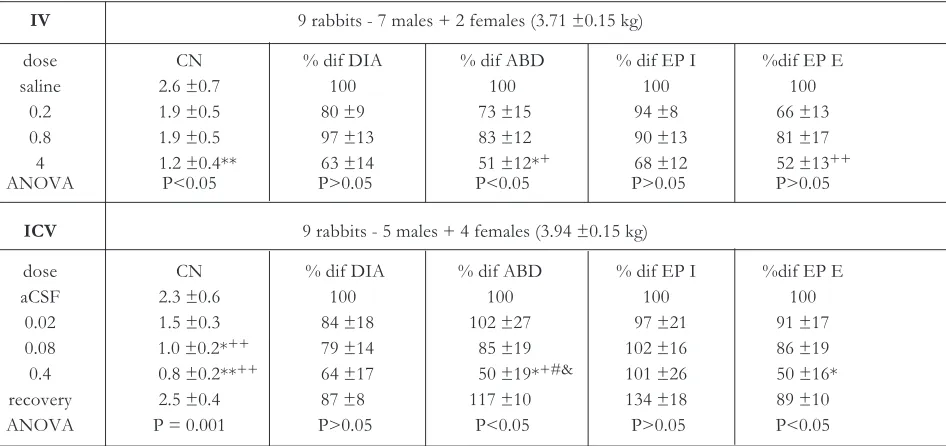
Increasing doses of codeine, injected either iv or icv, reduced the number of coughs, the cough expira-tory effort expressed in the esophageal pressure recording, and aBd EMg moving average amplitudes (table 1). the number of coughs and the difference in cough aBd EMg amplitude following the highest dose of codeine, in both icv and iv protocols, were significantly lower than those at the 5th sequence of
repetitive control cough stimulations (table 1). a re-duced number of coughs was associated with a ten-dency for a prolongation of the period of relative mo-tor quiescence during the cough expiramo-tory period (in case of repetitive coughing representing the inter-cough interval within the inter-cough trial) and of the total cough cycle duration. We found no differences in the expression of En or Sn, their intensities, or timing of single expiratory responses and sneezes during both icv and iv codeine protocols.
Furthermore, we found a linear relationship be-tween cough number reduction and the logarithm of
the cumulative codeine dose (r = 0.95 and r = 0.98 for iv and icv protocols, respectively), with the slopes sig-nificantly different from zero (P<0.05). the effective doses of codeine for 50% reduction in the cough number (Ed50), extrapolated from the regression
analysis, were 3.9 and 0.11 mg/kg for iv and icv ad-ministration. the ivEd50/icvEd50 ratio was ~35. We
found no appreciable differences in RR and BP during our protocols, with the exception of a slightly reduced mean BP (from 10.5 ±1.0 to 9.5 ±1,0; P<0.01) follow-ing the highest iv codeine dose.
d
IScUSSIonthe major finding of this study was that codeine sup-pressed the cough reflex in the anesthetized rabbit, and that intracerebroventricular route of its adminis-tration was much more efficient to this end. thus, the results confirmed the central antitussive effect of codeine in response to mechanically-induced tracheo-bronchial cough. In contrast, sensitivity of the sneeze and expiration-like reflexes to codeine was low. In ad-dition, we validated the experimental model of an
Fig. 2. Increasing doses of codeine injected icv (0.4 mg/kg) did not af-fect sneezing. BP - blood pressure; EP esophageal pressure; dIa -integrated EMg of the diaphragm; aBd - integrated EMg of abdomi-nal muscles; Stim - nasal stimula-tion.
Table 1.Parameters of coughing after iv and icv application of increasing doses of codeinum dihydrogenphosphate (mg/kg).
IV 9 rabbits - 7 males + 2 females (3.71 ±0.15 kg)
dose cn % dif dIa % dif aBd % dif EP I %dif EP E
saline 2.6 ±0.7 100 100 100 100
0.2 1.9 ±0.5 80 ±9 73 ±15 94 ±8 66 ±13
0.8 1.9 ±0.5 97 ±13 83 ±12 90 ±13 81 ±17
4 1.2 ±0.4** 63 ±14 51 ±12*+ 68 ±12 52 ±13++
anoVa P<0.05 P>0.05 P<0.05 P>0.05 P>0.05
ICV 9 rabbits - 5 males + 4 females (3.94 ±0.15 kg)
dose cn % dif dIa % dif aBd % dif EP I %dif EP E
acSF 2.3 ±0.6 100 100 100 100
0.02 1.5 ±0.3 84 ±18 102 ±27 97 ±21 91 ±17
0.08 1.0 ±0.2*++ 79 ±14 85 ±19 102 ±16 86 ±19
0.4 0.8 ±0.2**++ 64 ±17 50 ±19*+#& 101 ±26 50 ±16*
recovery 2.5 ±0.4 87 ±8 117 ±10 134 ±18 89 ±10
anoVa P = 0.001 P>0.05 P<0.05 P>0.05 P<0.05
cn – cough number, dIa – diaphragmatic EMg activity, aBd – abdominal EMg ativity, EP – esophageal pressure, I & E – inspiratory & expiratory components of esophageal pressure trace.
* P<0.05, **P<0.01 compared with control (saline or acSF);
+P<0.05, ++P<0.01 compared with control stimulations (5thseries of stimulation trials without injection);
#P<0.05 - codeine 0.4 mg/kg compared with recovery;
anesthetized rabbit for studies on central antitussives. In this study we performed sequential tracheo-bronchial stimulation for up to 13 times and demon-strated a stable cough response during these control, non-injection trials. the stability of coughing allowed us to compare coughing in codeine-treated and -un-treated animals. the number of coughs and E efforts during coughing was reduced in codeine-treated rab-bits (at the highest dose of codeine) compared with the 5thseries (5thpair) of stimulations in the untreated
rabbits, and also when compared with coughing after the vehicle injection alone in codeine-treated animals. We further showed that the dose of codeine necessary for a 50% reduction in the number of coughs (Ed50)
was many-fold smaller in case of icv than iv codeine administration. that points to a central site of antitus-sive action of codeine in the anesthetized rabbit as it has also been reported by others [11, 15]. our results showing suppression of cough by codeine and the analysis of temporary cough characteristics that is similar to previous data in cats [12] support the notion that central antitussive drugs act by the inhibition of specific components of the cough neuronal control and do not generally suppress all aspects of its motor task [10, 11].
codeine is a µ-opioid receptor agonist. these re-ceptors are abundantly expressed in the brainstem ar-eas involved in cough production, such as the ambigu-us, solitary tract, medial parabrachial, and raphe nuclei, and possibly the periaqueductal gray matter [5]. How-ever, the antitussive effects of different µ-opioid re-ceptor agonists greatly vary, as also does the efficacy of codeine in cough suppression in individual animal species [16]. the antitussive effects of codeine are only little blocked by naloxone, a non-specific opioid receptor antagonist, mainly in cats [5].
thus, the exact structures and neuronal populations that are affected by central antitussives to reduce cough are largely unknown. application of different antitussive agents (daMgo and baclofen) within the caudal aspect of the solitary tract nucleus in the rabbit induces decreases in the number of coughs, peak ab-dominal activity, and in the duration of the cough res-piratory cycle; the latter being augmented due to cough-related prolongation of both I and E compo-nents of the cycle. In the present study we found no significant changes in the total cough cycle duration or I and E cough phase durations during our codeine protocols. those findings are in line with the lack of changes in temporal characteristics of cough being re-ported after codeine microinjections into the caudal part of the ventral respiratory group in cats [12]. this study also confirmed the lack of a suppressive effect of codeine on sneeze and ‘expiration-like’ single reflex expiratory responses after codeine, which accords with other studies [15, 17] and indicates different central control mechanisms for cough and the other two re-flex responses.
a limitation of this and other studies is a mechani-cal probing in the tracheo-bronchial region to induce cough. Pathological cough seems to be more related to chemical stimuli, involving peripheral and central plas-ticity and up-regulation of cough at multiple levels of the cough neural pathway [10, 11, 18]. cough is a
complex phenomenon affected by a number of sys-temic and regulatory malfunctions, and non-specific environmental factors [18-20].
In this study we did not detect changes in respirato-ry rate or blood pressure after the application of in-creasing doses of codeine. that indicates a limited res-piratory effect of central antitussives at a dose which is capable of suppressing the cough reflex, which has also been found in other reports [11]. However, we detected a weak, but statistically significant, decrease in BP after iv application of the highest dose of codeine. other authors have previously shown that codeine causes a combination of pulmonary vasocon-striction and systemic vasodilation in the anesthetized dog [21], and opioids, in higher doses, generally reduce peripheral and aortic systolic, mean, and end-systolic pressures [22]. In clinical use of codeine as an antitus-sive agent these possible untoward effects should thus be taken into consideration.
Acknowledgements: We gratefully acknowledge the technical assistance of assoc. Prof. Helena Barani, Mgr. nadezda Vis-novcova, Eva Frolova, Ing. Peter Machac, Roman Kubizna, Mgr. Ivana Lamosova as well as inspiring revision of the manuscript by Prof. Mieczyslaw Pokorski. this study was co-financed form VEga 1/0038/09 and Ec sources - Euro-pean Regional development Fund (cEcR).
Conflicts of interests: the authors declare no conflicts of in-terest in relation to this article.
R
EFEREncES1. Shannon R, Baekey dM, Morris KF, nuding Sc, Segers LS, Lindsey Bg. Production of reflex cough by brainstem respiratory networks. Pulm Pharmacol ther 2004; 17(6): 369-76.
2. Bolser dc, Poliacek I, Jakus J, Fuller dd, davenport PW. neurogenesis of cough, other airway defensive be-haviors and breathing: a holarchical system? Respir Physi-ol neurobiPhysi-ol 2006; 152: 255-65.
3. Jakus J, Poliacek I, Halasova E, Murin P, Knocikova J, tomori Z, Bolser dc. Brainstem circuitry of tracheal-bronchial cough: c-fos study in anesthetized cats. Respir Physiol neurobiol 2008; 160(3): 289-300.
4. Bolser dc, degennaro Fc, o’Reilly S, Hey Ja, chapman RW. Pharmacological studies of alergic cough in the guinea pig. Eur J Pharmacol 1995; 277(2-3): 159-64. 5. takahama K, Shirasaki t. central and peripheral
mecha-nisms of narcotic antitussives: codeine-sensitive and -re-sistant coughs. cough 2007; 3: 8.
6. Kotzer cJ, Hay dW, dondio g, giardina g, Petrillo P, Underwood dc. the antitussive activity of delta-opioid receptor stimulation in guinea pigs. J Pharmacol Exp ther 2000; 292(2): 803-9.
7. yamakura t, Sakimura K, Shimoji K. direct inhibition of the n-methyl-d-aspartate receptor channel by high con-centrations of opioids. anesthesiology 1999; 91(4): 1053 63.
8. nosalova g. actions of drugs affecting the cough reflex. Bratisl Lek Listy 1998; 99(10): 531-5 (article in Slovak). 9. Kamei J. Role of opioidergic and serotonergic
mecha-nisms in cough and antitussives. Pulm Pharmacol 1996; 9(5-6): 349-56.
10. Bolser dc, davenport PW. Functional organization of the central cough generation mechanism. Pulm Pharma-col ther 2002; 15(3): 221-5.
11. Bolser dc, Hey Ja, chapman RW. Influence of central antitussive drugs on the cough motor pattern. J appl Physiol 1999; 86: 1017-24.
EURoPEan JoURnaL oF MEdIcaL RESEaRcH
12. Poliacek I, Wang c, corrie LW, Rose MJ, Bolser dc. Mi-croinjection of codeine into the region of the caudal ven-tral respiratory column suppresses cough in anesthetized cats. J appl Physiol 2010; 108(4): 858-65.
13. graham JdP. Evaluation of isoaminile citrate as an anti-tussive. J clin Pharmacol 1962; 2: 43-9.
14. Furakawa F, okabe M. the antitussive action of dex-tromethorphan hydrobromide. Igaku Kenkya 1958; 28: 1643-7.
15. Korpas J, tomori Z. cough and other Respiratory Re-flexes. Karger, new york 1979.
16. Eddy nB, Friebel H, Hahn KJ, Halbach H. codeine and its alternates for pain and cough relief. the antitussive ac-tion of codeine-mechanisms, methodology and evalua-tion. Bull World Health organ 1969; 40(3): 425-54. 17. Poliacek I, Rose MJ, corrie LW, Wang c, Jakus J, Barani
H, Stransky a, Polacek H, Halasova E, Bolser dc. Short reflex expirations (expiration reflexes) induced by me-chanical stimulation of the trachea in anesthetized cats. cough 2008; 4: 1.
18. Plevkova J, antosiewicz J, Varechova S, Poliacek I, Jakus J, tatar M, Pokorski M. convergence of nasal and tra-cheal neural pathways in modulating the cough response in guinea pigs. J Physiol Pharmacol 2009; 60(2): 89-93. 19. Jakusova V. Ultraviolet Radiation and Mobile
communi-cation. In: Physical Properties, Biological Effects and Health Protection. SaMoSato, Bratislava, 2009; ISBn: 978-80-89464-00-5 (in Slovak).
20. Brozmanova M, Javorkova n, Hajtmanova E, Zamecnik L, Javorka M, Hanacek J, tatar M. Influence of chest gamma-irradiation on cough response in awake guinea pigs. J Physiol Pharmacol 2007; 58 Suppl 5: 67-74. 21. Bianchi a, aviado dM. antitussive drugs. I.
cardiopul-monary effects of codeine. arch Int Pharmacodyn ther 1975; 216(2): 208-15.
22. afshari R, Maxwell SR, Bateman dn. Hemodynamic ef-fects of methadone and dihydrocodeine in overdose. clin toxicol (Phila) 2007; 45(7): 763-72.
Address for correspondence:
Michal Simera
Institute of Medical Biophysics Jessenius Faculty of Medicine comenius University Mala Hora 4
037 54, Martin Slovakia